Flagging Super-Eddington Candidates among Jetted, {γ}-Ray-Emitting AGN
Pith reviewed 2026-06-27 12:11 UTC · model grok-4.3
The pith
The Eigenvector-1 sequence can flag super-Eddington accretion among some jetted gamma-ray AGN.
A machine-rendered reading of the paper's core claim, the machinery that carries it, and where it could break.
Core claim
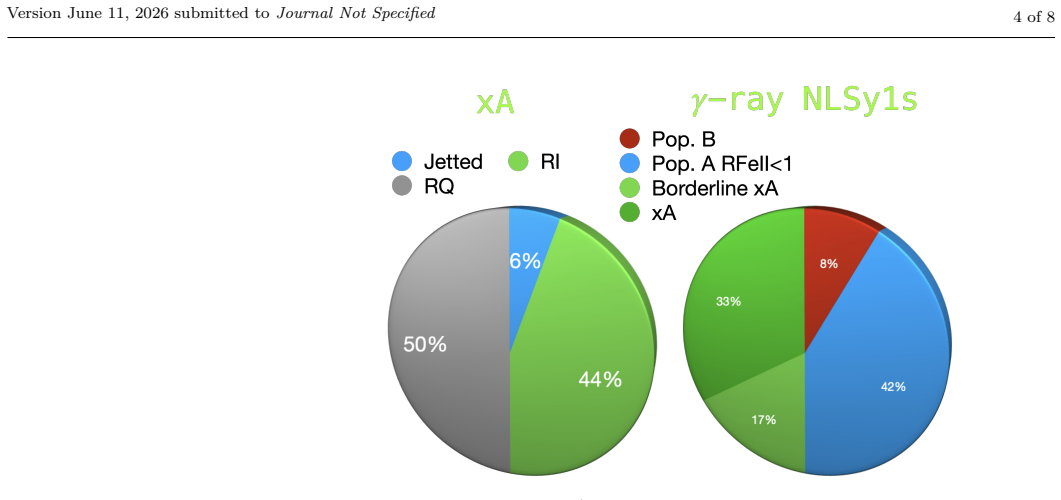
The E1/MS optical plane, defined by Hβ FWHM and the Fe II strength ratio R_FeII, places sources along a sequence driven primarily by Eddington ratio. Application of this sequence shows that some jetted γ-ray AGN qualify as super-Eddington candidates because their spectra fall in the extreme Population A region, and their radio properties include high-brightness-temperature cores or lobes consistent with jet activity. A subset of low-redshift γ-ray narrow-line Seyfert 1 galaxies also exhibit xA or borderline-xA spectra.
What carries the argument
The quasar Eigenvector-1/Main Sequence (E1/MS), an empirical sequence in the optical plane of Hβ full width at half maximum versus Fe II strength ratio R_FeII that classifies sources as extreme Population A (xA) when they occupy the high-Eddington-ratio end.
If this is right
- Some candidate super-Eddington accretors display radio signatures such as high-brightness-temperature non-thermal cores or extended radio lobes consistent with jet activity.
- A subset of low-redshift γ-ray narrow-line Seyfert 1 galaxies exhibit optical spectra consistent with xA or borderline-xA classification.
- The E1/MS framework places γ-ray-detected AGN within the broader context of quasar spectroscopic diversity.
- Highly accreting quasars can serve as tools to explore extreme accretion states and as probes of quasars near the reionization epoch.
Where Pith is reading between the lines
- If the E1/MS classification holds for jetted sources, multi-wavelength monitoring of xA-classified gamma-ray AGN could test whether jet power scales with accretion rate in the super-Eddington regime.
- Application of the same spectral diagnostics at higher redshift could identify additional super-Eddington candidates provided orientation and selection effects are modeled.
- Confirmation that xA sources maintain high Eddington ratios would strengthen their use as standardized probes in cosmological studies.
Load-bearing premise
The E1/MS sequence is driven primarily by Eddington ratio, so placement in the xA region reliably indicates super-Eddington accretion even in jetted sources.
What would settle it
An object whose E1/MS parameters place it firmly in the xA region but whose independent measurement of bolometric luminosity and black-hole mass yields an Eddington ratio substantially below unity.
Figures
read the original abstract
The quasar Eigenvector-1/Main Sequence (E1/MS) provides a physically motivated empirical framework to organize the spectroscopic diversity of type~1 active galactic nuclei (AGN). In its optical plane, the full width at half maximum of H$\beta$ and the Fe\,II strength ratio $R_{\mathrm{FeII}}$ define a sequence that is primarily driven by Eddington ratio, with important secondary roles played by black-hole mass, orientation, spectral energy distribution, and chemical enrichment. The E1/MS framework is therefore well suited to identify highly accreting and possibly super-Eddington (SE) sources, usually associated with the extreme Population~A (xA) spectral types. We discuss why E1/MS is a useful tool to search for SE accretors among jetted AGN and, conversely, to place $\gamma$-ray-detected AGN in the broader context of quasar phenomenology. We summarize two complementary results: (1) some candidate SE accretors show radio properties such as high brightness temperature non-thermal cores or radio lobes} consistent with jet activity; and (2) a subset of low-redshift $\gamma$-ray narrow-line Seyfert~1 galaxies exhibit optical spectra consistent with xA or borderline-xA classification. We also expand the discussion of recent developments in E1/MS studies, including metallicity trends, the spectral energy distribution of xA quasars, and the role of highly accreting quasars as discovery tools for extreme accretion states, as probes of quasars at the reionization epoch, and as possible cosmological probes.
Editorial analysis
A structured set of objections, weighed in public.
Referee Report
Summary. The manuscript proposes using the quasar Eigenvector-1/Main Sequence (E1/MS) framework—defined in the optical plane by FWHM(Hβ) and the Fe II strength ratio R_FeII—to flag super-Eddington (SE) accretors among jetted, γ-ray-emitting AGN. It summarizes two observational consistencies: (1) some candidate SE sources exhibit radio properties (high brightness-temperature non-thermal cores or lobes) consistent with jet activity, and (2) a subset of low-redshift γ-ray narrow-line Seyfert 1 galaxies show optical spectra consistent with xA or borderline-xA classification. The paper also reviews recent E1/MS developments on metallicity trends, xA SEDs, and the utility of highly accreting quasars as probes of extreme accretion, reionization-era sources, and cosmology.
Significance. If the central claim holds, the work would supply a practical empirical tool for identifying SE candidates within the jetted AGN population and for situating γ-ray sources in the broader E1/MS context. Credit is due for explicitly linking the E1/MS sequence (with its documented secondary dependencies on mass, orientation, SED, and enrichment) to jet-related observables and for highlighting xA sources as discovery tools. The discussion of metallicity and cosmological applications adds value if the flagging method proves robust against contaminants.
major comments (1)
- [Abstract (discussion of result 2); E1/MS framework section] The claim that E1/MS reliably flags SE accretors among γ-ray jetted AGN rests on the assumption that measured R_FeII and FWHM(Hβ) are not significantly altered by beamed non-thermal jet continuum in the optical. The abstract notes secondary roles for orientation and SED but does not address this specific contamination channel for the γ-ray NLS1 subset used in result (2). If R_FeII is inflated by jet emission, the xA/borderline-xA assignments become unreliable; this issue is load-bearing for the second consistency and requires either quantitative correction, sample restriction, or explicit justification that the effect is negligible.
minor comments (2)
- [Abstract] The abstract summarizes consistencies but supplies no sample sizes, selection criteria, error bars, or statistical tests; the full text should include these to allow evaluation of selection effects.
- [Introduction / E1/MS framework] Notation for R_FeII and xA is introduced without a brief reminder of the conventional definitions or the precise boundaries used for 'borderline-xA'.
Simulated Author's Rebuttal
We thank the referee for their careful reading and constructive comments on our manuscript. We address the single major comment below and have revised the manuscript to incorporate additional discussion of the noted limitation.
read point-by-point responses
-
Referee: The claim that E1/MS reliably flags SE accretors among γ-ray jetted AGN rests on the assumption that measured R_FeII and FWHM(Hβ) are not significantly altered by beamed non-thermal jet continuum in the optical. The abstract notes secondary roles for orientation and SED but does not address this specific contamination channel for the γ-ray NLS1 subset used in result (2). If R_FeII is inflated by jet emission, the xA/borderline-xA assignments become unreliable; this issue is load-bearing for the second consistency and requires either quantitative correction, sample restriction, or explicit justification that the effect is negligible.
Authors: We agree that this is a substantive and load-bearing concern that was not explicitly addressed in the submitted version. The E1/MS framework incorporates orientation and SED as secondary parameters in general, but the specific risk of beamed non-thermal optical continuum inflating R_FeII for the low-redshift γ-ray NLS1 sample requires direct discussion. In the revised manuscript we have added a paragraph in the E1/MS framework section that (i) acknowledges the possibility of jet contamination, (ii) notes that the selected NLS1s exhibit prominent Fe II blends and narrow Hβ profiles inconsistent with a featureless, jet-dominated continuum, and (iii) cites supporting multi-wavelength studies indicating accretion-disk dominance in the optical for these sources. We have not applied a quantitative correction (no simultaneous polarization or variability data are available for the sample) and now explicitly flag this as a limitation rather than claiming the effect is negligible. The core observational consistencies are retained but are now presented with this caveat. revision: yes
Circularity Check
No significant circularity in E1/MS framework application
full rationale
The paper applies the established E1/MS empirical sequence to flag SE candidates among jetted AGN and summarizes observational results on radio properties and spectral classifications. No derivation chain, fitted parameters renamed as predictions, or load-bearing self-citation reductions are present. The central claims rest on direct spectral and radio data comparisons without equations or steps that reduce to inputs by construction. The framework is treated as an external empirical tool whose driving parameters (Eddington ratio primacy) are stated without internal re-derivation.
Axiom & Free-Parameter Ledger
axioms (1)
- domain assumption E1/MS sequence is primarily driven by Eddington ratio
Reference graph
Works this paper leans on
-
[1]
Introduction The diversity of type 1 AGN is not random. Over the past three decades, it has become increasingly clear that a large fraction of the observed phenomenology can be organized along a low-dimensional parameter space, originally revealed by principal component analysis and now commonly referred to as Eigenvector 1 (E1) or the quasar Main Sequenc...
work page internal anchor Pith review Pith/arXiv arXiv doi:10.3390/1010000arxiv:2606.11374v1 2026
-
[5]
Can super-Eddington accretion and relativistic jets coexist? The empirical answer appears to be yes
Discussion 5.1. Can super-Eddington accretion and relativistic jets coexist? The empirical answer appears to be yes. The overlap between the two selections is not large, but it is now difficult to argue that the two regimes are mutually exclusive. From the E1/MS perspective, the significance of the overlap is twofold. First, it shows that the xA classific...
-
[6]
Conclusions The E1/Main Sequence remains the most practical empirical roadmap for identifying the most highly accreting type 1 AGN. In the optical plane, xA quasars occupy the high- RFeII end of the sequence and provide the most direct route to flagging SE candidates. https://doi.org/10.3390/1010000 Version June 11, 2026 submitted toJournal Not Specified ...
-
[7]
The emission-line properties of low-redshift quasi-stellar objects
Boroson, T.A.; Green, R.F. The emission-line properties of low-redshift quasi-stellar objects. ApJS1992,80, 109–135
-
[8]
Phenomenology of Broad Emission Lines in Active Galactic Nuclei.ARA&A2000,38, 521–571
Sulentic, J.W.; Marziani, P.; Dultzin-Hacyan, D. Phenomenology of Broad Emission Lines in Active Galactic Nuclei.ARA&A2000,38, 521–571. https://doi.org/10.1146/annurev.astro. 38.1.521
-
[9]
Eigenvector 1: An Optimal Correlation Space for Active Galactic Nuclei
Sulentic, J.W.; Zwitter, T.; Marziani, P.; Dultzin-Hacyan, D. Eigenvector 1: An Optimal Cor- relation Space for Active Galactic Nuclei.ApJL2000,536, L5–L9, [arXiv:astro-ph/0005177]. https://doi.org/10.1086/312717
work page internal anchor Pith review Pith/arXiv arXiv doi:10.1086/312717
-
[10]
Highly accreting quasars: sample definition and possible cosmo- logical implications.MNRAS2014,442, 1211–1229
Marziani, P.; Sulentic, J.W. Highly accreting quasars: sample definition and possible cosmo- logical implications.MNRAS2014,442, 1211–1229
-
[11]
Unveiling the quasar main sequence: illuminating the complexity of active galactic nuclei and their evolution.Frontiers in Astronomy and Space Sciences2024,11, 1479874
Panda, S. Unveiling the quasar main sequence: illuminating the complexity of active galactic nuclei and their evolution.Frontiers in Astronomy and Space Sciences2024,11, 1479874
-
[12]
The Demise of the Classical Broad-Line Region in the Luminous AGN Population.ApJL2000,536, L5–L9
Sulentic, J.W.; Marziani, P.; Zwitter, T.; Dultzin-Hacyan, D.; Calvani, M. The Demise of the Classical Broad-Line Region in the Luminous AGN Population.ApJL2000,536, L5–L9
-
[13]
Marziani, P.; Dultzin, D.; Sulentic, J.W.; Del Olmo, A.; Negrete, C.A.; Martínez-Aldama, M.L.; D’Onofrio, M.; Bon, E.; Bon, N.; Stirpe, G.M. A main sequence for quasars.Frontiers in Astronomy and Space Sciences2018,5, 6, [arXiv:astro-ph.GA/1802.05575]. https://doi. org/10.3389/fspas.2018.00006. https://doi.org/10.3390/1010000 Version June 11, 2026 submitt...
work page internal anchor Pith review Pith/arXiv arXiv doi:10.3389/fspas.2018.00006 2018
-
[14]
The Fundamental Plane of the Broad-line Region in Active Galactic Nuclei
Du, P.; Wang, J.M.; Hu, C.; Ho, L.C.; Li, Y.R.; Bai, J.M. The Fundamental Plane of the Broad-line Region in Active Galactic Nuclei.ApJL2016,818, L14, [1601.01391]. https://doi.org/10.3847/2041-8205/818/1/L14
work page internal anchor Pith review Pith/arXiv arXiv doi:10.3847/2041-8205/818/1/l14 2041
-
[15]
Panda, S.; Marziani, P. High Eddington quasars as discovery tools: current state and challenges.Frontiers in Astronomy and Space Sciences2023,10, 1130103, [arXiv:astro- ph.GA/2210.15041]. https://doi.org/10.3389/fspas.2023.1130103
-
[16]
Super-Eddington Accretion in Quasars.Universe2025, 11, 69, [arXiv:astro-ph.GA/2502.14713]
Marziani, P.; Garnica Luna, K.; Floris, A.; del Olmo, A.; Deconto-Machado, A.; Buendia-Rios, T.M.; Negrete, C.A.; Dultzin, D. Super-Eddington Accretion in Quasars.Universe2025, 11, 69, [arXiv:astro-ph.GA/2502.14713]. https://doi.org/10.3390/universe11020069
-
[17]
Ohsuga, K.; Mori, M.; Nakamoto, T.; Mineshige, S. Supercritical Accretion Flows around Black Holes: Two-dimensional, Radiation Pressure-dominated Disks with Photon Trapping. ApJ2005,628, 368–381, [arXiv:astro-ph/astro-ph/0504168]. https://doi.org/10.1086/430728
work page internal anchor Pith review Pith/arXiv arXiv doi:10.1086/430728
-
[18]
Clumpy Outflow from Supercritical Accretion Flows
Takeuchi, S.; Ohsuga, K.; Mineshige, S. Clumpy Outflows from Supercritical Accretion Flow.Publications of the Astronomical Society of Japan2013,65, 88, [1305.1023]. https: //doi.org/10.1093/pasj/65.4.88
work page internal anchor Pith review Pith/arXiv arXiv doi:10.1093/pasj/65.4.88
-
[19]
Ogawa, T.; Mineshige, S.; Kawashima, T.; Ohsuga, K.; Hashizume, K. Radiation hydrody- namic simulations of a super-Eddington accretor as a model for ultra-luminous sources.PASJ 2017,69, 33. https://doi.org/10.1093/pasj/psx006
-
[20]
Kitaki, T.; Mineshige, S.; Ohsuga, K.; Kawashima, T. Systematic Two-dimensional Radiation- hydrodynamic Simulations of Super-Eddington Accretion Flow and Outflow: Comparison with the Slim Disk Model.Publications of the Astronomical Society of Japan2018,70, 108, [1809.01151]. https://doi.org/10.1093/pasj/psy110
work page internal anchor Pith review Pith/arXiv arXiv doi:10.1093/pasj/psy110
-
[21]
Jiang, Y.F.; Stone, J.M.; Davis, S.W. Super-Eddington Accretion Disks around Supermassive Black Holes.The Astrophysical Journal2019,880, 67, [1709.02845]. https://doi.org/10.384 7/1538-4357/ab29ff
-
[22]
Searching for the Physical Drivers of the Eigenvector 1 Correlation Space
Marziani, P.; Sulentic, J.W.; Zwitter, T.; Dultzin-Hacyan, D.; Calvani, M. Searching for the Physical Drivers of the Eigenvector 1 Correlation Space.ApJ2001,558, 553–560, [arXiv:astro-ph/0105343]. https://doi.org/10.1086/322286
work page internal anchor Pith review Pith/arXiv arXiv doi:10.1086/322286
-
[23]
Highly accreting quasars: The SDSS low-redshift catalog.A&A2018,620, A118, [1809.08310]
Negrete, C.A.; Dultzin, D.; Marziani, P.; Esparza, D.; Sulentic, J.W.; del Olmo, A.; Martínez- Aldama, M.L.; García López, A.; D’Onofrio, M.; Bon, N.; et al. Highly accreting quasars: The SDSS low-redshift catalog.A&A2018,620, A118, [1809.08310]. https://doi.org/10.105 1/0004-6361/201833285
-
[24]
Gemini Near Infrared Spectrograph Distant Quasar Survey: The First Year
Matthews, B.; Shemmer, O.; Brotherton, M.S.; Andruchow, I.; Boroson, T.A.; Brandt, W.N.; Cellone, S.; Ferrero, G.; Gallagher, S.C.; Green, R.F.; et al. Gemini Near Infrared Spectrograph Distant Quasar Survey: The First Year. In Proceedings of the American Astronomical Society Meeting Abstracts #233, 2019, Vol. 233,American Astronomical Society Meeting Abs...
2019
-
[25]
The case for super-Eddington accretion in JWST broad-line AGN during the first billion years
Lambrides, E.; Larson, R.L.; Garofali, K.; Ptak, A.; Chiaberge, M.; Long, A.S.; Hutchison, T.A.; Norman, C.; McKinney, J.; Akins, H.B.; et al. The case for super-Eddington accretion in JWST broad-line active galactic nuclei during the first billion years.Nature Astronomy 2026, [arXiv:astro-ph.HE/2409.13047]. https://doi.org/10.1038/s41550-026-02813-w
work page internal anchor Pith review Pith/arXiv arXiv doi:10.1038/s41550-026-02813-w 2026
-
[26]
Chemical abundances along the quasar main sequence.A&A2024, 689, A321
Floris, A.; Marziani, P.; Panda, S.; Sniegowska, M.; D’Onofrio, M.; Deconto-Machado, A.; Del Olmo, A.; Czerny, B. Chemical abundances along the quasar main sequence.A&A2024, 689, A321
-
[27]
Accretion Disk Winds from Active Galactic Nuclei.ApJ1995,451, 498–+
Murray, N.; Chiang, J.; Grossman, S.A.; Voit, G.M. Accretion Disk Winds from Active Galactic Nuclei.ApJ1995,451, 498–+. https://doi.org/10.1086/176238
-
[28]
Disk Winds and Disk Emission Lines.ApJ1997,474, 91
Murray, N.; Chiang, J. Disk Winds and Disk Emission Lines.ApJ1997,474, 91. https: //doi.org/10.1086/303443
-
[29]
Proga, D. Theory of Winds in AGNs. In Proceedings of the The Central Engine of Active Galactic Nuclei; Ho, L.C.; Wang, J.W., Eds., 2007, Vol. 373,Astronomical Society of the Pacific Conference Series, p. 267, [astro-ph/0701100]
Pith/arXiv arXiv 2007
-
[30]
Fraix-Burnet, D.; Marziani, P.; D’Onofrio, M.; Dultzin, D. The Phylogeny of Quasars and the Ontogeny of Their Central Black Holes.Frontiers in Astronomy and Space Sciences2017, 4, 1. https://doi.org/10.3389/fspas.2017.00001. https://doi.org/10.3390/1010000 Version June 11, 2026 submitted toJournal Not Specified 8 of 8
-
[31]
Panda, S.; Marziani, P.; Czerny, B. The Quasar Main Sequence Explained by the Combi- nation of Eddington Ratio, Metallicity, and Orientation.ApJ2019,882, 79, [arXiv:astro- ph.HE/1905.01729]. https://doi.org/10.3847/1538-4357/ab3292
-
[32]
Naddaf, M.H.; Martínez-Aldama, M.L.; Marziani, P.; Czerny, B.; Hutsemékers, D. Quasar main sequence unfolded by 2.5D FRADO: Natural expression of Eddington ratio, black hole mass, and inclination.A&A2025,702, L13, [arXiv:astro-ph.GA/2510.01092]. https: //doi.org/10.1051/0004-6361/202556852
-
[33]
Black holes in binary systems
Shakura, N.I.; Sunyaev, R.A. Black holes in binary systems. Observational appearance.A&A 1973,24, 337–355
1973
-
[34]
1988, ApJ, 332, 646, doi: 10.1086/166683
Abramowicz, M.A.; Czerny, B.; Lasota, J.P.; Szuszkiewicz, E. Slim accretion disks.ApJ 1988,332, 646–658. https://doi.org/10.1086/166683
-
[35]
Super-Eddington black hole accretion: Polish doughnuts and slim disks
Abramowicz, M.A. Super-Eddington black hole accretion: Polish doughnuts and slim disks. In Proceedings of the Growing Black Holes: Accretion in a Cosmological Context; Merloni, A.; Nayakshin, S.; Sunyaev, R.A., Eds., 2005, pp. 257–273, [arXiv:astro-ph/astro-ph/0411185]. https://doi.org/10.1007/11403913_49
work page internal anchor Pith review Pith/arXiv arXiv doi:10.1007/11403913_49 2005
-
[36]
Radiation-driven accretion disk winds in a physical context
Giustini, M.; Proga, D. A global view of the inner accretion and ejection flow around super massive black holes. Radiation-driven accretion disk winds in a physical context.A&A2019, 630, A94, [arXiv:astro-ph.GA/1904.07341]. https://doi.org/10.1051/0004-6361/201833810
-
[37]
Du, P.; Hu, C.; Lu, K.X.; Wang, F.; Qiu, J.; Li, Y.R.; Bai, J.M.; Kaspi, S.; Netzer, H.; Wang, J.M.; et al. Supermassive Black Holes with High Accretion Rates in Active Galactic Nuclei. I. First Results from a New Reverberation Mapping Campaign.ApJ2014,782, 45, [arXiv:astro-ph.CO/1310.4107]. https://doi.org/10.1088/0004-637X/782/1/45
work page internal anchor Pith review Pith/arXiv arXiv doi:10.1088/0004-637x/782/1/45
-
[38]
Du, P.; Hu, C.; Lu, K.X.; Huang, Y.K.; Cheng, C.; Qiu, J.; Li, Y.R.; Zhang, Y.W.; Fan, X.L.; Bai, J.M.; et al. Supermassive Black Holes with High Accretion Rates in Active Galactic Nuclei. IV. HβTime Lags and Implications for Super-Eddington Accretion.ApJ2015, 806, 22, [arXiv:astro-ph.GA/1504.01844]. https://doi.org/10.1088/0004-637X/806/1/22
work page internal anchor Pith review Pith/arXiv arXiv doi:10.1088/0004-637x/806/1/22
-
[39]
The spectral energy distribution of extreme population A quasars.MNRAS2025,540, 3289–3310
Garnica, K.; Dultzin, D.; Marziani, P.; Panda, S. The spectral energy distribution of extreme population A quasars.MNRAS2025,540, 3289–3310
-
[40]
Foschini, L. The growing family of gamma-ray narrow-line Seyfert 1 galaxies.arXiv e-prints 2026, [arXiv:astro-ph.HE/2601.18635]. https://doi.org/10.48550/arXiv.2601.18635
-
[41]
Zamfir, S.; Sulentic, J.W.; Marziani, P. New insights on the QSO radio-loud/radio-quiet dichotomy: SDSS spectra in the context of the 4D eigenvector1 parameter space.MNRAS 2008,387, 856–870, [0804.0788]. https://doi.org/10.1111/j.1365-2966.2008.13290.x
work page internal anchor Pith review Pith/arXiv arXiv doi:10.1111/j.1365-2966.2008.13290.x 2008
-
[42]
Gendron-Marsolais, M.; Marziani, P.; Berton, M.; Järvelä, E.; del Olmo, A.; Sargent, M.; D’Onofrio, M.; Crepaldi, L.; Damas-Segovia, A.; Punsly, B.; et al. Investigating the origin of radio emission in candidate super-Eddington accreting black holes.A&A2026,707, A388, [arXiv:astro-ph.GA/2602.00321]. https://doi.org/10.1051/0004-6361/202557025
-
[43]
Revised optical classification of a sample of gamma-ray-emitting active galactic nuclei with GTC and VLT.A&A2026,705, A122
Dalla Barba, B.; Foschini, L.; Berton, M.; Järvelä, E.; Marziani, P.; Ciroi, S.; Dalla Bontà, E.; Crepaldi, L.; Vietri, A.; Antón, S.; et al. Revised optical classification of a sample of gamma-ray-emitting active galactic nuclei with GTC and VLT.A&A2026,705, A122
-
[44]
Accretion Disk Model of Short-Timescale Intermittent Activity in Young Radio Sources
Czerny, B.; Siemiginowska, A.; Janiuk, A.; Nikiel-Wroczyński, B.; Stawarz, Ł. Accretion Disk Model of Short-Timescale Intermittent Activity in Young Radio Sources.ApJ2009, 698, 840–851, [arXiv:astro-ph.CO/0903.3940]. https://doi.org/10.1088/0004-637X/698/1/840
work page internal anchor Pith review Pith/arXiv arXiv doi:10.1088/0004-637x/698/1/840
-
[45]
The jetted NLS1 1H 0323+342: the Rosetta stone for accretion/ejection in AGN.arXiv e-prints2025, p
Foschini, L. The jetted NLS1 1H 0323+342: the Rosetta stone for accretion/ejection in AGN.arXiv e-prints2025, p. arXiv:2512.01053, [arXiv:astro-ph.HE/2512.01053]. https: //doi.org/10.48550/arXiv.2512.01053. https://doi.org/10.3390/1010000
discussion (0)
Sign in with ORCID, Apple, or X to comment. Anyone can read and Pith papers without signing in.