SDSS-V LVM: Revealing the Physical and Chemical Structure of the Helix Nebula
Pith reviewed 2026-06-27 12:08 UTC · model grok-4.3
The pith
Spatially complete spectroscopy shows the Helix Nebula has near-solar oxygen abundance with variations driven by ionization effects.
A machine-rendered reading of the paper's core claim, the machinery that carries it, and where it could break.
Core claim
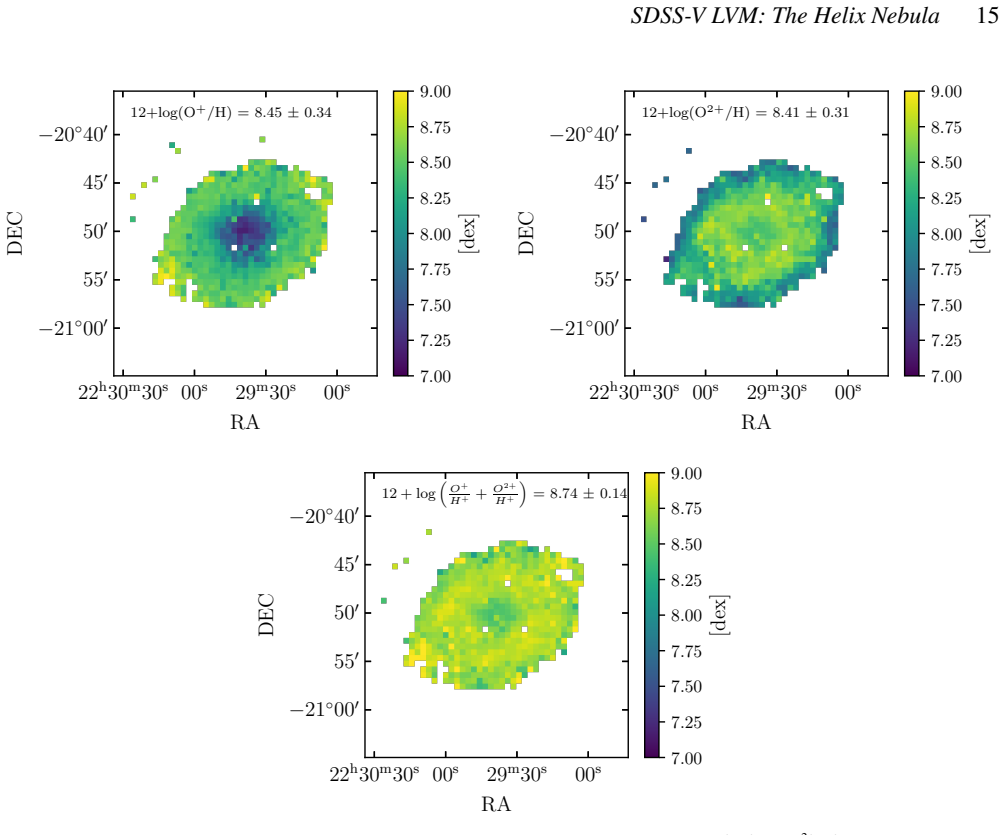
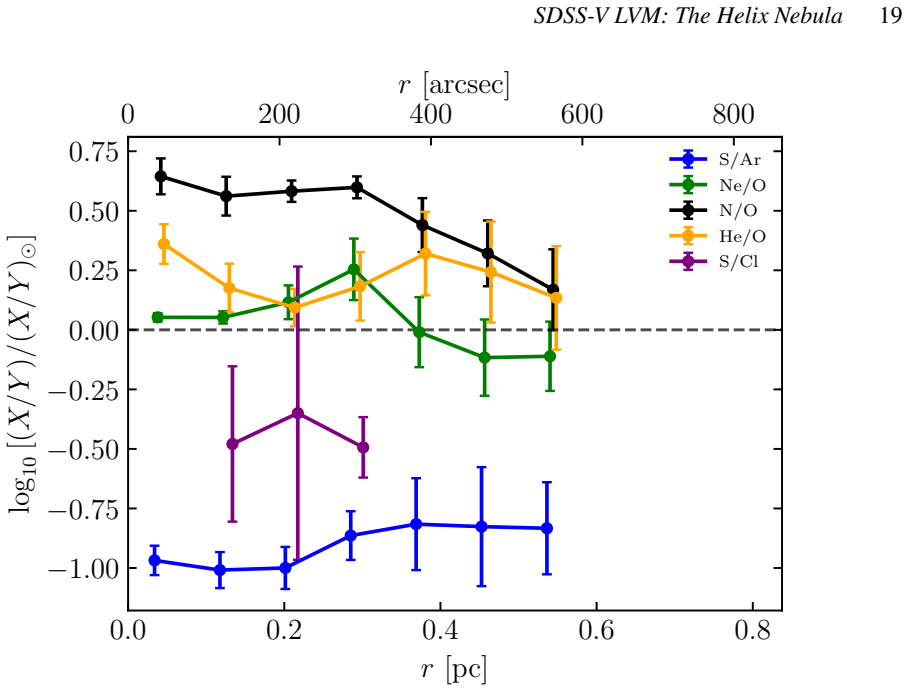
The Helix Nebula exhibits a near-solar oxygen abundance of 12 + log(O/H) ≃ 8.7 based on complete spatial coverage. Central abundance patterns indicate significant contribution from unobserved O^{3+}, implying that apparent variations result from ionization effects instead of chemical inhomogeneities. A sulfur deficit of approximately 1 dex is also found, consistent with the planetary nebula sulfur anomaly. The helium and nitrogen abundances place the Helix near the classical boundary of Type I planetary nebulae.
What carries the argument
Spatially contiguous integral-field spectroscopy that measures 41 optical emission lines across the full nebula to separate ionization zones and apply ionization correction factors.
If this is right
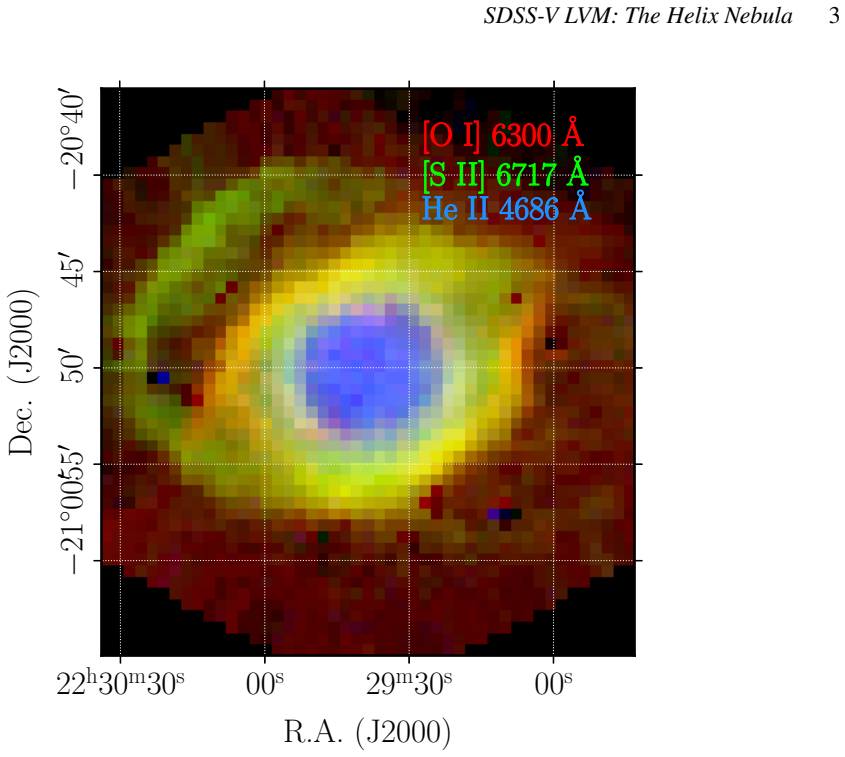
- The nebula shows a strongly stratified ionization structure with He II concentrated in the central cavity and low-ionization gas in the bright shell.
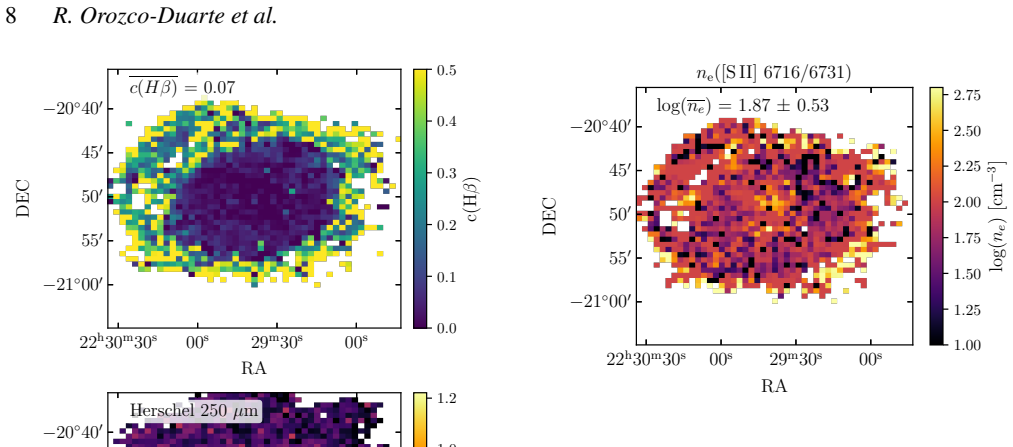
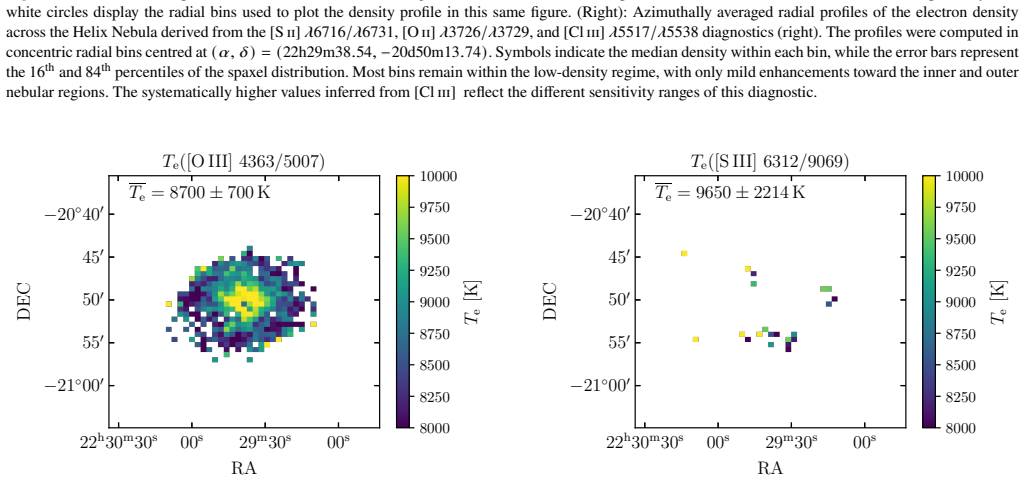
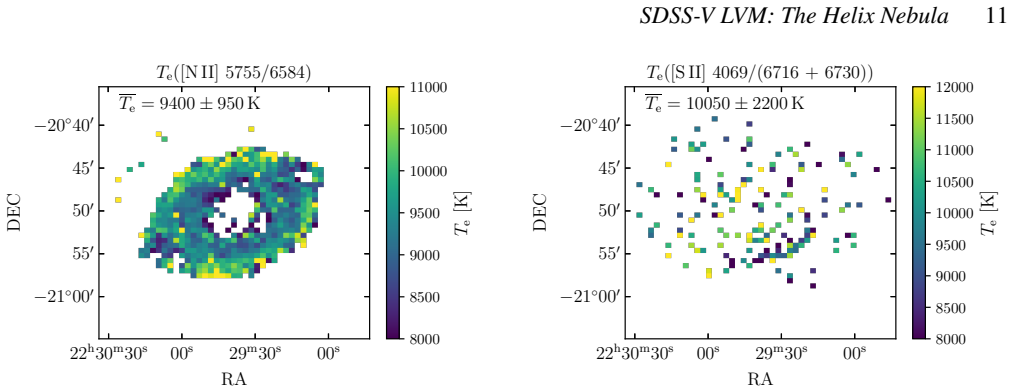
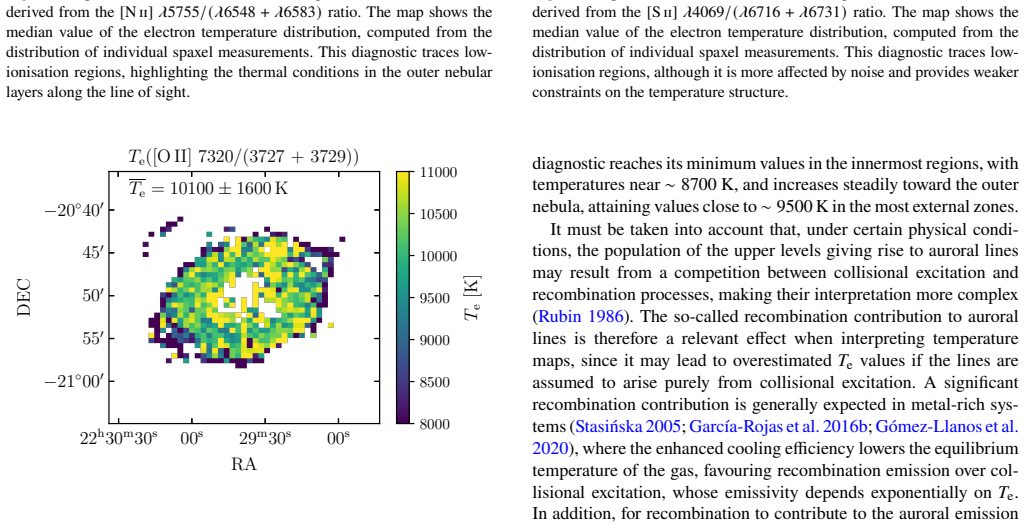
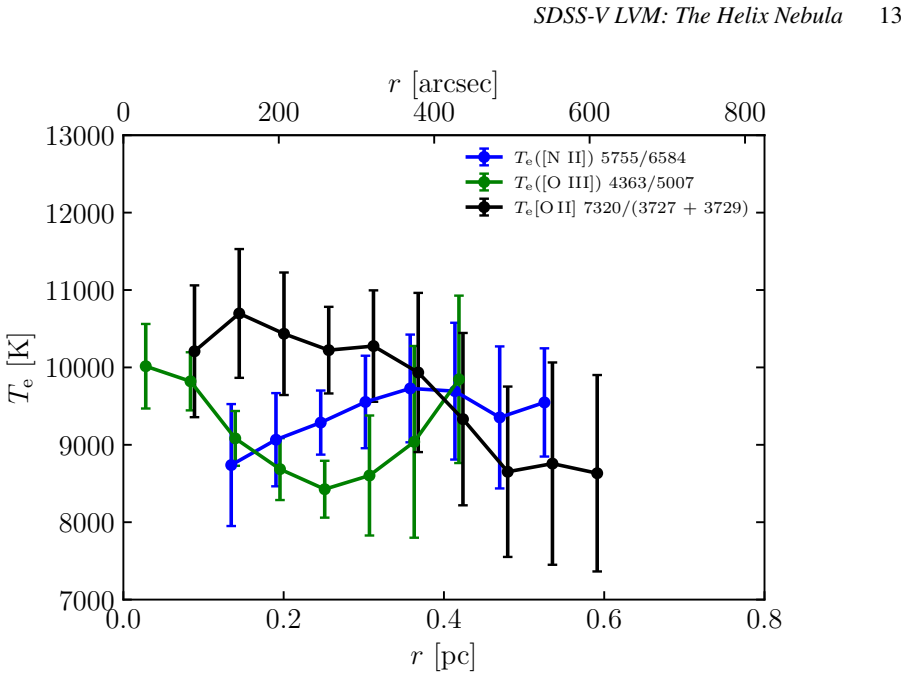
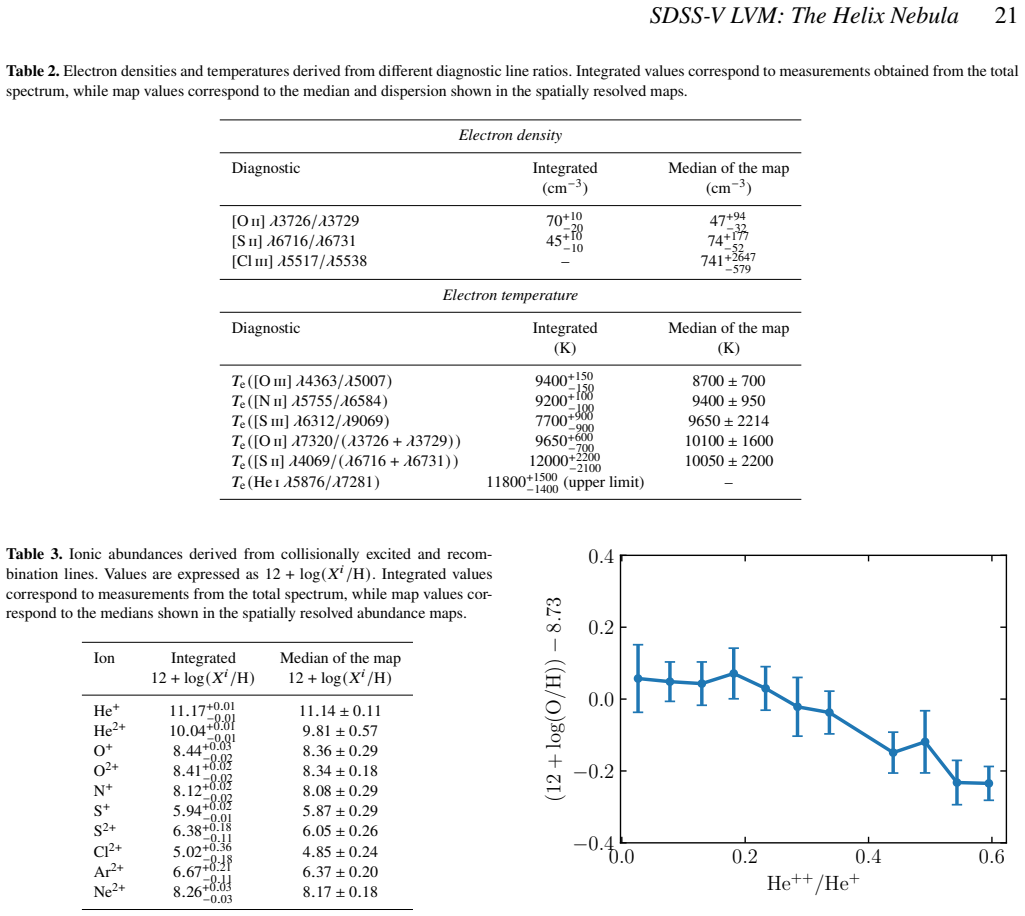
- Typical electron densities are around 100 cm^{-3} with temperature variations of several thousand Kelvin between zones.
- Apparent abundance variations across the object are not evidence of true chemical inhomogeneities.
- The sulfur deficit of ~1 dex aligns with the planetary-nebula sulfur anomaly seen in other objects.
Where Pith is reading between the lines
- Similar ionization-correction uncertainties may affect abundance maps of other extended planetary nebulae when only partial spatial coverage is available.
- Full mapping of additional nebulae could test whether many reported chemical gradients are actually ionization artifacts.
- The same data cubes allow direct comparison of neutral, transition, and ionized zones to refine models of how progenitor enrichment appears in the final nebula.
Load-bearing premise
Standard ionization correction factors for unobserved ions such as O^{3+} can be applied uniformly across the nebula without introducing spatially varying systematic errors.
What would settle it
Direct measurement of lines from O^{3+} in the central cavity that either matches or contradicts the amount needed to flatten the apparent oxygen abundance map.
Figures
read the original abstract
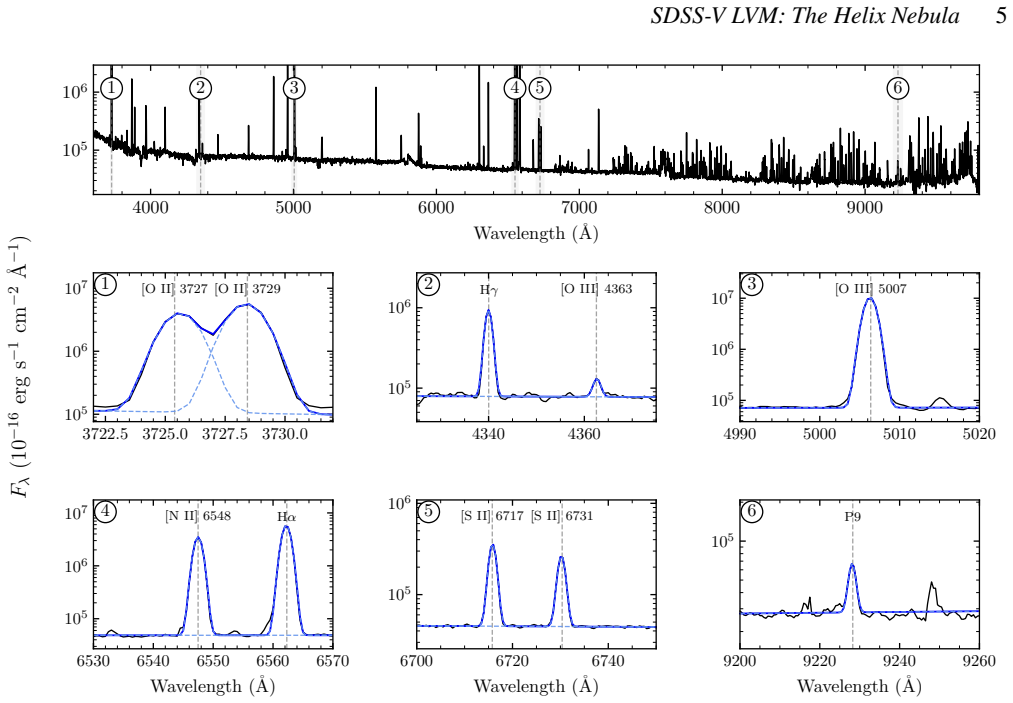
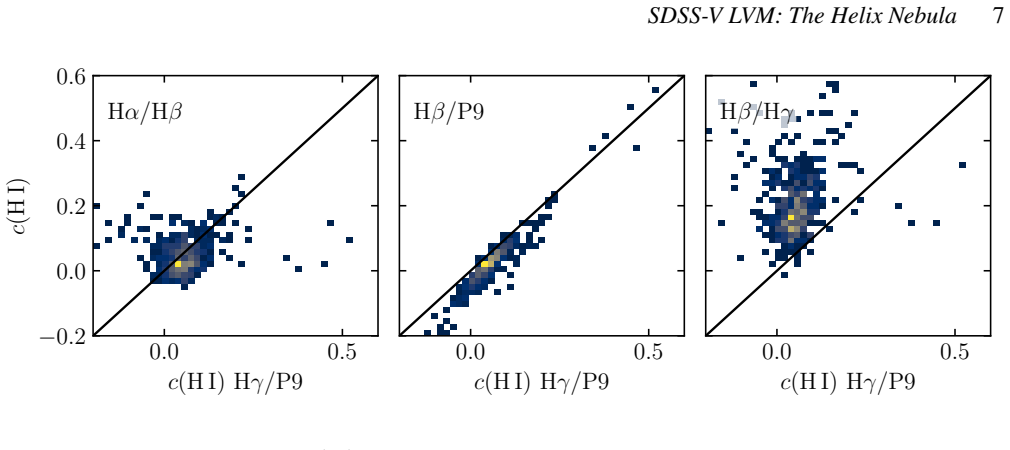
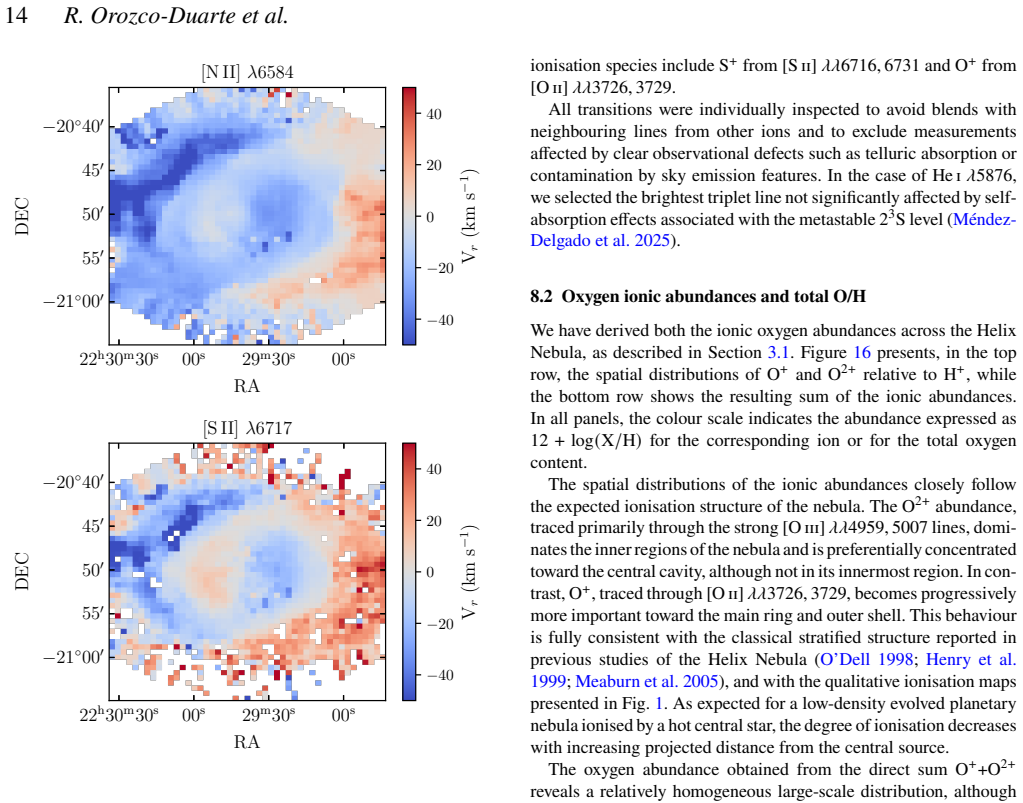
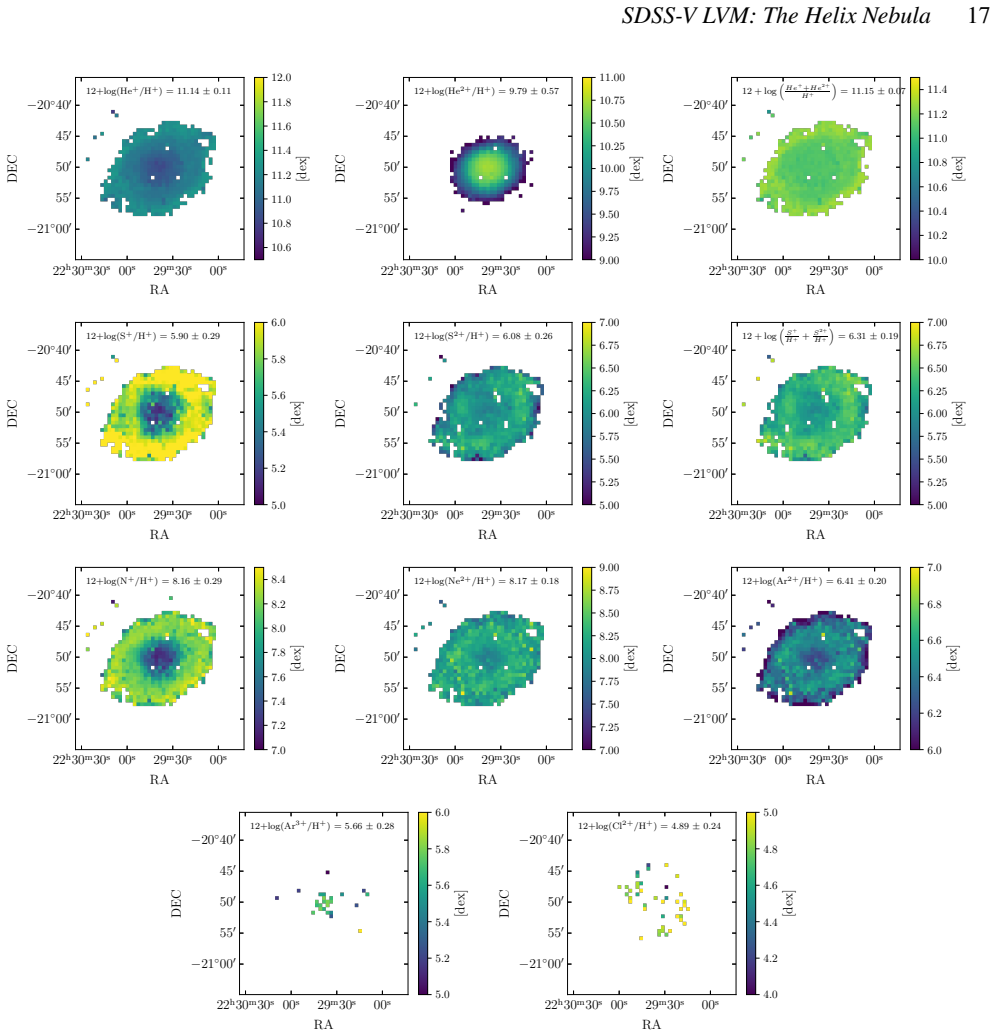
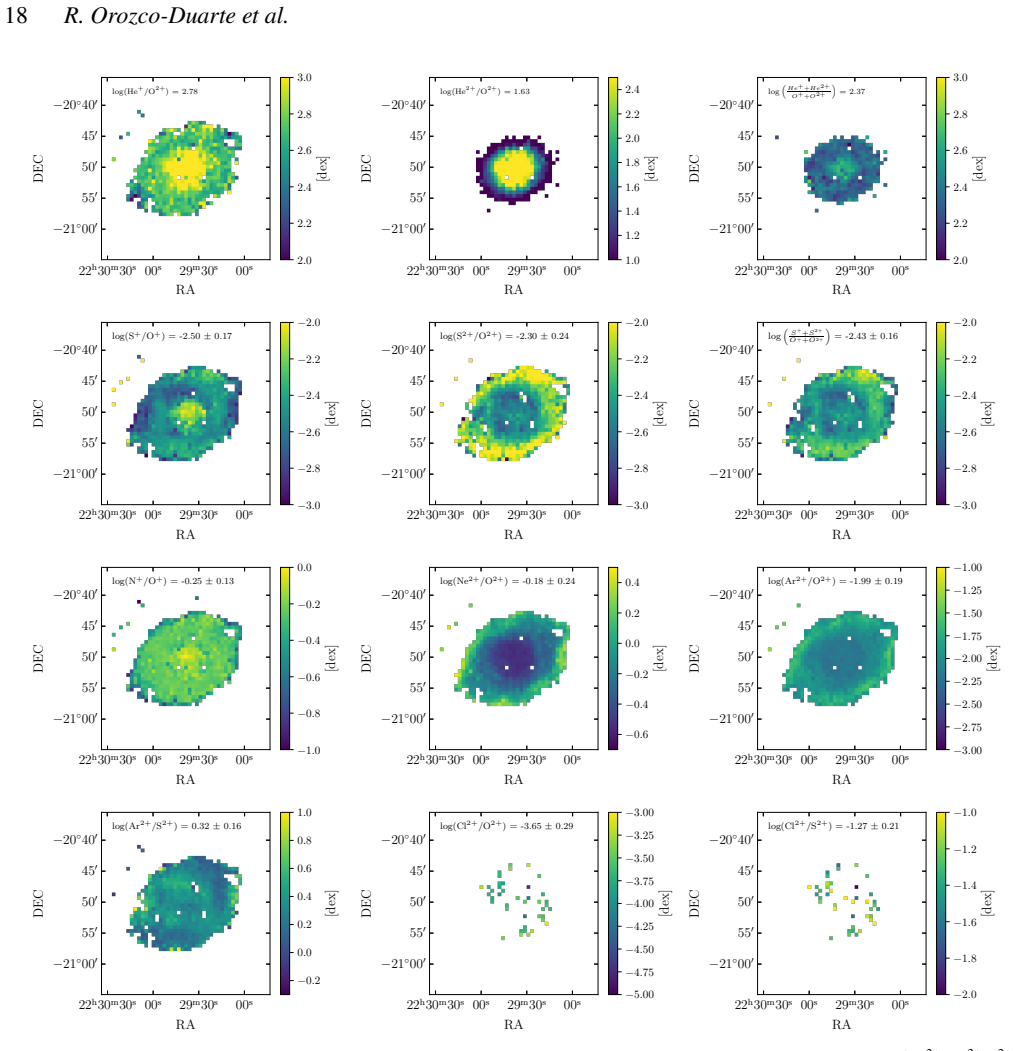
We present the first spatially contiguous study of the physical and chemical structure of the Helix Nebula (NGC~7293, PNG 036.1-57.1) based on integral-field spectroscopy from the SDSS-V Local Volume Mapper (LVM). The wide-field observations provide nearly complete spectroscopic coverage of the nebula, enabling a spaxel-by-spaxel analysis of extinction, electron density and temperature, ionisation structure, and chemical abundances. We reconstruct calibrated datacubes from the LVM row-stacked spectra and measure 41 optical emission lines, including hydrogen, helium, and collisionally excited metal lines. The resulting maps reveal a strongly stratified nebula, with highly ionised gas traced by \heii~concentrated toward the central cavity, low-ionisation material dominating the bright shell, and neutral or transition-zone gas enhanced in the outer regions. The Helix is a low-density object, with typical electron densities of $\sim10^{2}\mathrm{cm^{-3}}$, and exhibits a non-uniform temperature structure, with variations of several thousand Kelvin across different ionisation zones. We derive a near-solar oxygen abundance, $12+\log(\mathrm{O/H})\simeq8.7$, consistent with spatially complete sampling. The central abundance pattern indicates a significant contribution from unobserved O$^{3+}$, suggesting that apparent abundance variations are primarily driven by ionisation effects rather than true chemical inhomogeneities. We also find evidence for a sulfur deficit of $\sim$1 dex, consistent with the planetary-nebula sulfur anomaly. The helium and nitrogen abundances place the Helix near the classical boundary of Type~I planetary nebulae, suggesting moderate chemical enrichment by its progenitor star.
Editorial analysis
A structured set of objections, weighed in public.
Referee Report
Summary. The manuscript presents the first spatially contiguous integral-field spectroscopic study of the Helix Nebula (NGC 7293) using SDSS-V LVM data. It measures 41 optical emission lines across nearly complete coverage to derive maps of extinction, electron density (~10^2 cm^{-3}), temperature (with variations of several thousand K), ionization structure, and chemical abundances. Key results include a near-solar oxygen abundance of 12+log(O/H) ≃ 8.7, the conclusion that central abundance patterns and apparent variations are driven by ionization effects from unobserved O^{3+} rather than chemical inhomogeneities, a sulfur deficit of ~1 dex consistent with the planetary-nebula sulfur anomaly, and helium/nitrogen abundances placing the object near the Type I boundary.
Significance. If the abundance results hold after addressing methodological details, the work would be significant as the first nearly complete spectroscopic mapping of this well-studied planetary nebula, confirming the sulfur anomaly as likely intrinsic and illustrating how ionization stratification affects apparent abundance gradients. The wide-field LVM coverage provides a clear advance over prior partial observations, with the stratified structure maps offering useful constraints for nebular models.
major comments (2)
- [Chemical abundance analysis and interpretation] The claim that apparent abundance variations are primarily ionization-driven (due to significant O^{3+} contribution in the center) rather than true chemical inhomogeneities depends on applying standard ICFs uniformly. This is invoked in the interpretation of the central abundance pattern and the 12+log(O/H) ≃ 8.7 value. However, the results describe a strongly stratified nebula (He II concentrated in the central cavity, low-ionization material in the bright shell, neutral gas in outer regions), where ionization parameter and hardness vary spatially; uniform ICFs calibrated on average conditions can therefore introduce position-dependent biases that either create or erase gradients.
- [Observations, data reduction, and line measurements] The quantitative abundance claims, including the near-solar oxygen value and the ~1 dex sulfur deficit, rest on direct measurements of 41 lines and standard nebular diagnostics, but the text provides no details on the data-reduction pipeline, line-fitting methods, or error budgets. This absence undermines verification of the maps and the conclusion that variations are ionization effects, as these elements are load-bearing for the central claims.
minor comments (1)
- [Abstract] The abstract states 'we measure 41 optical emission lines' but does not specify which lines or the fitting approach; adding this would improve clarity for readers assessing the diagnostics used.
Simulated Author's Rebuttal
We thank the referee for their detailed and constructive review of our manuscript on the SDSS-V LVM observations of the Helix Nebula. The comments identify key areas requiring clarification and expansion, particularly regarding methodological transparency and the robustness of abundance interpretations in a stratified object. We address each major comment below and outline the revisions we will make.
read point-by-point responses
-
Referee: [Chemical abundance analysis and interpretation] The claim that apparent abundance variations are primarily ionization-driven (due to significant O^{3+} contribution in the center) rather than true chemical inhomogeneities depends on applying standard ICFs uniformly. This is invoked in the interpretation of the central abundance pattern and the 12+log(O/H) ≃ 8.7 value. However, the results describe a strongly stratified nebula (He II concentrated in the central cavity, low-ionization material in the bright shell, neutral gas in outer regions), where ionization parameter and hardness vary spatially; uniform ICFs calibrated on average conditions can therefore introduce position-dependent biases that either create or erase gradients.
Authors: We agree that the use of uniform ICFs in a spatially stratified nebula merits explicit discussion, as ionization conditions vary across the object. Our analysis applies standard ICF prescriptions from the literature (e.g., those calibrated for planetary nebulae) to enable direct comparison with prior studies of the Helix and other objects. The spaxel-by-spaxel maps of ionization structure, combined with the observed concentration of He II in the central cavity and low-ionization species in the shell, support our interpretation that the central abundance pattern reflects the contribution of unobserved O^{3+} rather than intrinsic chemical variations. Nevertheless, we acknowledge that position-dependent biases cannot be entirely ruled out without additional tests. We will revise the manuscript to include a dedicated subsection discussing the applicability and limitations of the adopted ICFs in stratified environments, along with sensitivity checks using alternative prescriptions where feasible. revision: partial
-
Referee: [Observations, data reduction, and line measurements] The quantitative abundance claims, including the near-solar oxygen value and the ~1 dex sulfur deficit, rest on direct measurements of 41 lines and standard nebular diagnostics, but the text provides no details on the data-reduction pipeline, line-fitting methods, or error budgets. This absence undermines verification of the maps and the conclusion that variations are ionization effects, as these elements are load-bearing for the central claims.
Authors: We accept that the current manuscript does not provide sufficient detail on the data-reduction pipeline, emission-line fitting procedures, or associated error budgets, which are necessary for full verification of the results. The LVM observations are processed through the SDSS-V pipeline to produce row-stacked spectra, from which we reconstruct calibrated datacubes before measuring the 41 lines; however, this workflow and the specific fitting and uncertainty methods were not described. We will add a new section (or expanded subsection) detailing the data reduction steps, the line measurement methodology (including fitting routines and deblending where applicable), and the derivation of uncertainties for the derived quantities such as densities, temperatures, and abundances. revision: yes
Circularity Check
No circularity: abundances derived from direct line measurements and standard external ICFs
full rationale
The paper's central results (near-solar O/H, ionization-driven variations, sulfur deficit) rest on spaxel-by-spaxel measurements of 41 emission lines from the LVM datacube, followed by application of established nebular diagnostics and standard ionization correction factors drawn from the literature. No equations or steps reduce the reported abundances to quantities fitted from the same dataset, and no load-bearing premise is justified solely by self-citation. The derivation chain is therefore self-contained against external benchmarks.
Axiom & Free-Parameter Ledger
axioms (1)
- domain assumption Standard ionization correction factors (ICFs) accurately recover total elemental abundances from observed ions
Reference graph
Works this paper leans on
-
[1]
The Chemical Composition of the Sun. , keywords =. doi:10.1146/annurev.astro.46.060407.145222 , archivePrefix =. 0909.0948 , primaryClass =
-
[2]
The LBT Y_ p Project II: MODS Spectra, Physical Conditions, and Oxygen Abundances in Local Metal-Poor Nebulae. arXiv e-prints , keywords =. doi:10.48550/arXiv.2601.22236 , archivePrefix =. 2601.22236 , primaryClass =
-
[3]
MUSE spectroscopy of planetary nebulae with high abundance discrepancies. , keywords =. doi:10.1093/mnras/stab3523 , archivePrefix =. 2112.00480 , primaryClass =
-
[4]
, keywords =
Planetary nebulae with a high degree of ionization : NGC 2242 and NGC 4361. , keywords =
-
[5]
Collisional excitation effects on He I line intensities
Chemical composition of Type I planetary nebulae. Collisional excitation effects on He I line intensities. , keywords =
-
[6]
The Curious Conundrum Regarding Sulfur Abundances In Planetary Nebulae
The Curious Conundrum Regarding Sulfur Abundances in Planetary Nebulae. , keywords =. doi:10.1088/0004-637X/749/1/61 , archivePrefix =. 1202.1563 , primaryClass =
work page internal anchor Pith review Pith/arXiv arXiv doi:10.1088/0004-637x/749/1/61
-
[7]
On the abundance discrepancy problem in HII regions
On the Abundance Discrepancy Problem in H II Regions. , keywords =. doi:10.1086/521871 , archivePrefix =. 0707.3518 , primaryClass =
work page internal anchor Pith review Pith/arXiv arXiv doi:10.1086/521871
-
[8]
Planetary Nebulae , year = 1978, editor =
Chemical abundances in planetary nebulae. Planetary Nebulae , year = 1978, editor =
1978
-
[9]
Oxygen enrichment in carbon-rich planetary nebulae
Oxygen enrichment in carbon-rich planetary nebulae. , keywords =. doi:10.1093/mnras/stv388 , archivePrefix =. 1502.06043 , primaryClass =
work page internal anchor Pith review Pith/arXiv arXiv doi:10.1093/mnras/stv388
-
[10]
Ionization Correction Factors for Planetary Nebulae: I- Using optical spectra
Ionization correction factors for planetary nebulae - I. Using optical spectra. , keywords =. doi:10.1093/mnras/stu341 , archivePrefix =. 1402.4852 , primaryClass =
work page internal anchor Pith review Pith/arXiv arXiv doi:10.1093/mnras/stu341
-
[11]
The DESIRED temperature─metallicity relations in star-forming regions: probing the Galactic radial and azimuthal metallicity distributions. , keywords =. doi:10.1093/mnras/stag149 , archivePrefix =. 2601.13337 , primaryClass =
-
[12]
A reappraisal of the chemical composition of the Orion nebula based on Very Large Telescope echelle spectrophotometry. , keywords =. doi:10.1111/j.1365-2966.2004.08313.x , archivePrefix =. astro-ph/0408249 , primaryClass =
-
[13]
A virtual observatory for photoionized nebulae: the Mexican Million Models database (3MdB)
A virtual observatory for photoionized nebulae: the Mexican Million Models database (3MdB). , keywords =. doi:10.48550/arXiv.1412.5349 , archivePrefix =. 1412.5349 , primaryClass =
work page internal anchor Pith review Pith/arXiv arXiv doi:10.48550/arxiv.1412.5349
-
[14]
Large scale structure, the cosmic microwave background, and primordial non-gaussianity
NGC 6153: a super-metal-rich planetary nebula?. , keywords =. doi:10.1046/j.1365-8711.2000.03167.x , adsurl =
-
[15]
Bi-abundance photoionization models of planetary nebulae: determining the amount of oxygen in the metal-rich component. , keywords =. doi:10.1093/mnras/staa2157 , archivePrefix =. 2007.14414 , primaryClass =
-
[16]
Faint emission lines in the Galactic HII regions M16, M20 and NGC 3603 ^ *. , keywords =. doi:10.1111/j.1365-2966.2006.10105.x , archivePrefix =. astro-ph/0601595 , primaryClass =
-
[17]
Morphology and Composition of the Helix Nebula
Morphology and Composition of the Helix Nebula. , keywords =. doi:10.1086/307215 , archivePrefix =. astro-ph/9901060 , primaryClass =
work page internal anchor Pith review Pith/arXiv arXiv doi:10.1086/307215
-
[18]
SDSS-V LVM: Resolving physical conditions in the Trifid Nebula. , keywords =. doi:10.1051/0004-6361/202558091 , archivePrefix =. 2512.02802 , primaryClass =
-
[19]
SDSS-V LVM: A Spatially Resolved Study of the Physical Conditions and the Chemical Abundance Discrepancy in the Lagoon Nebula (M 8). , keywords =. doi:10.3847/1538-4357/ae563a , archivePrefix =. 2603.22382 , primaryClass =
work page internal anchor Pith review Pith/arXiv arXiv doi:10.3847/1538-4357/ae563a
-
[20]
, keywords =
The chemical evolution of planetary nebulae. , keywords =
-
[21]
Ground-based and Airborne Instrumentation for Astronomy III , year = 2010, editor =
The MUSE second-generation VLT instrument. Ground-based and Airborne Instrumentation for Astronomy III , year = 2010, editor =. doi:10.1117/12.856027 , archivePrefix =. 2211.16795 , primaryClass =
-
[22]
Estimating Distances from Parallaxes. V. Geometric and Photogeometric Distances to 1.47 Billion Stars in Gaia Early Data Release 3. , keywords =. doi:10.3847/1538-3881/abd806 , archivePrefix =. 2012.05220 , primaryClass =
work page internal anchor Pith review Pith/arXiv arXiv doi:10.3847/1538-3881/abd806 2012
-
[23]
Solar oxygen abundance. , keywords =. doi:10.1093/mnras/stab2160 , archivePrefix =. 2109.01143 , primaryClass =
-
[24]
The SDSS-V Local Volume Mapper (LVM): Scientific Motivation and Project Overview. , keywords =. doi:10.3847/1538-3881/ad6de9 , archivePrefix =. 2405.01637 , primaryClass =
-
[25]
Probing the chemo-dynamical evolution of disc galaxies
The PHANGS-MUSE survey. Probing the chemo-dynamical evolution of disc galaxies. , keywords =. doi:10.1051/0004-6361/202141727 , archivePrefix =. 2110.03708 , primaryClass =
-
[26]
Herschel spectral mapping of the Helix nebula (NGC 7293). Extended CO photodissociation and OH ^ + emission. , keywords =. doi:10.1051/0004-6361/201322941 , archivePrefix =. 1404.2177 , primaryClass =
work page internal anchor Pith review Pith/arXiv arXiv doi:10.1051/0004-6361/201322941
-
[27]
Correcting for the Effects of Interstellar Extinction
Correcting for the Effects of Interstellar Extinction. , keywords =. doi:10.1086/316293 , archivePrefix =. astro-ph/9809387 , primaryClass =
work page internal anchor Pith review Pith/arXiv arXiv doi:10.1086/316293
-
[28]
Imaging the elusive H-poor gas in the high ADF planetary nebula NGC 6778
Imaging the Elusive H-poor Gas in the High adf Planetary Nebula NGC 6778. , keywords =. doi:10.3847/2041-8205/824/2/L27 , archivePrefix =. 1606.02830 , primaryClass =
work page internal anchor Pith review Pith/arXiv arXiv doi:10.3847/2041-8205/824/2/l27 2041
-
[29]
Tomography of the Unique Ongoing Jet in the Planetary Nebula NGC 2392. , keywords =. doi:10.3847/1538-4357/abe2aa , archivePrefix =. 2102.01093 , primaryClass =
-
[30]
MUSE spectroscopy of the high abundance discrepancy planetary nebula NGC 6153. , keywords =. doi:10.1051/0004-6361/202450822 , archivePrefix =. 2407.06385 , primaryClass =
-
[31]
Trigonometric Parallaxes of Central Stars of Planetary Nebulae
Trigonometric Parallaxes of Central Stars of Planetary Nebulae. , keywords =. doi:10.1086/510348 , archivePrefix =. astro-ph/0611543 , primaryClass =
work page internal anchor Pith review Pith/arXiv arXiv doi:10.1086/510348
-
[32]
Abundance anomalies in the Helix nebula. , keywords =. doi:10.1086/130342 , adsurl =
-
[33]
The SDSS-V Local Volume Mapper Telescope System. , keywords =. doi:10.3847/1538-3881/ad7948 , adsurl =
-
[34]
Integral field spectroscopy of the planetary nebula NGC 3242 and the puzzling nature of its low-ionization structures. , keywords =. doi:10.1051/0004-6361/202453635 , archivePrefix =. 2503.16662 , primaryClass =
-
[35]
Planetary Nebulae: Sources of Enlightenment. , keywords =. doi:10.1088/1538-3873/ac32b1 , archivePrefix =. 2110.13993 , primaryClass =
-
[36]
Planetary Nebulae Research: Past, Present, and Future. Galaxies , keywords =. doi:10.3390/galaxies12040039 , archivePrefix =. 2408.06448 , primaryClass =
-
[37]
The PHANGS-JWST Treasury Survey: Star Formation, Feedback, and Dust Physics at High Angular Resolution in Nearby GalaxieS. , keywords =. doi:10.3847/2041-8213/acaaae , archivePrefix =. 2212.02667 , primaryClass =
-
[38]
PyNeb: a new tool for analyzing emission lines. I. Code description and validation of results. , keywords =. doi:10.1051/0004-6361/201323152 , archivePrefix =. 1410.6662 , primaryClass =
work page internal anchor Pith review Pith/arXiv arXiv doi:10.1051/0004-6361/201323152
-
[39]
Abundance Gradient for 13 Planetary Nebulae in the Galaxy. , keywords =. doi:10.1007/BF00637306 , adsurl =
-
[40]
The nature of the cometary knots in the Helix planetary nebula (NGC7293). , keywords =. doi:10.1046/j.1365-8711.1998.01152.x10.1111/j.1365-8711.1998.01152.x , adsurl =
work page doi:10.1046/j.1365-8711.1998.01152.x10.1111/j.1365-8711.1998.01152.x 1998
-
[41]
The creation of the Helix planetary nebula (NGC 7293) by multiple events. , keywords =. doi:10.1111/j.1365-2966.2005.09083.x , archivePrefix =. astro-ph/0504295 , primaryClass =
-
[42]
The bow-shock and high-speed jet in the faint, 40 arcmin diameter, outer halo of the evolved Helix planetary nebula (NGC 7293). , keywords =. doi:10.1093/mnras/stt1580 , archivePrefix =. 1308.5460 , primaryClass =
work page internal anchor Pith review Pith/arXiv arXiv doi:10.1093/mnras/stt1580
-
[43]
The Multitude of Molecular Hydrogen Knots in the Helix Nebula
The Multitude of Molecular Hydrogen Knots in the Helix Nebula. , keywords =. doi:10.1086/444539 , archivePrefix =. astro-ph/0509887 , primaryClass =
work page internal anchor Pith review Pith/arXiv arXiv doi:10.1086/444539
-
[44]
On the radial abundance gradients of nitrogen and oxygen in the inner Galactic disc. , keywords =. doi:10.1093/mnras/staa3903 , archivePrefix =. 2012.06643 , primaryClass =
-
[45]
Gradients of chemical abundances in the Milky Way from H II regions: distances derived from Gaia EDR3 parallaxes and temperature inhomogeneities. , keywords =. doi:10.1093/mnras/stab3782 , archivePrefix =. 2112.12600 , primaryClass =
-
[46]
BOND: Bayesian Oxygen and Nitrogen abundance Determinations in giant H II regions using strong and semistrong lines. , keywords =. doi:10.1093/mnras/stw971 , archivePrefix =. 1605.01057 , primaryClass =
work page internal anchor Pith review Pith/arXiv arXiv doi:10.1093/mnras/stw971
-
[47]
The Dawes Review 2: Nucleosynthesis and stellar yields of low and intermediate-mass single stars
The Dawes Review 2: Nucleosynthesis and Stellar Yields of Low- and Intermediate-Mass Single Stars. , keywords =. doi:10.1017/pasa.2014.21 , archivePrefix =. 1405.0062 , primaryClass =
work page internal anchor Pith review Pith/arXiv arXiv doi:10.1017/pasa.2014.21 2014
-
[48]
Revisiting the radial abundance gradients of nitrogen and oxygen of the Milky Way
Revisiting the radial abundance gradients of nitrogen and oxygen of the Milky Way. , keywords =. doi:10.1093/mnras/sty1168 , archivePrefix =. 1805.00714 , primaryClass =
work page internal anchor Pith review Pith/arXiv arXiv doi:10.1093/mnras/sty1168
-
[49]
The chemical make-up of the Sun: A 2020 vision. , keywords =. doi:10.1051/0004-6361/202140445 , archivePrefix =. 2105.01661 , primaryClass =
work page internal anchor Pith review Pith/arXiv arXiv doi:10.1051/0004-6361/202140445 2020
-
[50]
Boletin de los Observatorios Tonantzintla y Tacubaya , keywords =
Chemical Abundances in Galactic HII Regions. Boletin de los Observatorios Tonantzintla y Tacubaya , keywords =
-
[51]
Sulfur, Chlorine, and Argon Abundances in Planetary Nebulae. IV. Synthesis and the Sulfur Anomaly. , keywords =. doi:10.1086/382242 , archivePrefix =. astro-ph/0401156 , primaryClass =
work page internal anchor Pith review Pith/arXiv arXiv doi:10.1086/382242
-
[52]
Is the Sulphur Anomaly in Planetary Nebulae Caused by the s-Process?
Is the sulphur anomaly in planetary nebulae caused by the s-process?. , keywords =. doi:10.1093/mnras/stt386 , archivePrefix =. 1302.6758 , primaryClass =
work page internal anchor Pith review Pith/arXiv arXiv doi:10.1093/mnras/stt386
-
[53]
Whither or Wither the Sulfur Anomaly in Planetary Nebulae?. , keywords =. doi:10.3847/2041-8213/ad1ed9 , archivePrefix =. 2401.09020 , primaryClass =
-
[54]
Galactic chemical evolution: Carbon through Zinc
Galactic Chemical Evolution: Carbon through Zinc. , keywords =. doi:10.1086/508914 , archivePrefix =. astro-ph/0608688 , primaryClass =
work page internal anchor Pith review Pith/arXiv arXiv doi:10.1086/508914
-
[55]
, year = 2013, month = aug, volume =
Nucleosynthesis in Stars and the Chemical Enrichment of Galaxies. , year = 2013, month = aug, volume =. doi:10.1146/annurev-astro-082812-140956 , adsurl =
-
[56]
Alpha-element abundance patterns in star-forming regions of the Local Universe. , keywords =. doi:10.1051/0004-6361/202453379 , archivePrefix =. 2501.13586 , primaryClass =
-
[57]
The Effect of Shock Waves on the Spectra of H II Regions and Planetary Nebulae. , keywords =. doi:10.1086/132886 , adsurl =
-
[58]
Theory of interstellar shocks. , keywords =. doi:10.1146/annurev.aa.31.090193.002105 , adsurl =
-
[59]
Noncollisional Excitation of Low-lying States in Gaseous Nebulae. , keywords =. doi:10.1086/164606 , adsurl =
-
[60]
Biases in abundance derivations for metal-rich nebulae
Biases in abundance derivations for metal-rich nebulae. , keywords =. doi:10.1051/0004-6361:20042216 , archivePrefix =. astro-ph/0501574 , primaryClass =
work page internal anchor Pith review Pith/arXiv arXiv doi:10.1051/0004-6361:20042216
-
[61]
Three-dimensional chemically homogeneous and bi-abundance photoionization models of the `super-metal-rich' planetary nebula NGC 6153. , keywords =. doi:10.1111/j.1365-2966.2010.17732.x , archivePrefix =. 1009.6148 , primaryClass =
-
[62]
, keywords =
Total and effective radiative recombination coefficients. , keywords =
-
[63]
New effective recombination coefficients for nebular N II lines
New effective recombination coefficients for nebular N ii lines. , keywords =. doi:10.1051/0004-6361/201116511 , archivePrefix =. 1103.5558 , primaryClass =
work page internal anchor Pith review Pith/arXiv arXiv doi:10.1051/0004-6361/201116511
-
[64]
New empirical metallicity relations for the local and high-redshift universe
The DESIRED strong-line calibrations: I. New empirical metallicity relations for the local and high-redshift universe. arXiv e-prints , keywords =
-
[65]
doi:10.1051/0004-6361/201116511e , publisher =
New effective recombination coefficients for nebular N II lines (Corrigendum). doi:10.1051/0004-6361/201116511e , publisher =
-
[66]
A characteristic oxygen abundance gradient in galaxy disks unveiled with CALIFA
A characteristic oxygen abundance gradient in galaxy disks unveiled with CALIFA. , keywords =. doi:10.1051/0004-6361/201322343 , archivePrefix =. 1311.7052 , primaryClass =
work page internal anchor Pith review Pith/arXiv arXiv doi:10.1051/0004-6361/201322343
-
[67]
The PHANGS-MUSE nebular catalogue. , keywords =. doi:10.1093/mnras/stad114 , archivePrefix =. 2301.03811 , primaryClass =
-
[68]
The chemical gradient of oxygen in the Galaxy from planetary nebulae. , keywords =. doi:10.1111/j.1365-2966.2006.10559.x , adsurl =
-
[69]
The O3N2 and N2 abundance indicators revisited: improved calibrations based on CALIFA and T _ e -based literature data. , keywords =. doi:10.1051/0004-6361/201321956 , archivePrefix =. 1307.5316 , primaryClass =
work page internal anchor Pith review Pith/arXiv arXiv doi:10.1051/0004-6361/201321956
-
[70]
The impact of strong recombination on temperature determination in planetary nebulae. , keywords =. doi:10.1093/mnrasl/slaa131 , archivePrefix =. 2007.05488 , primaryClass =
-
[71]
Astrophysics of gaseous nebulae and active galactic nuclei
-
[72]
Generalized T _ e ([O III])─T _ e (He I) Discrepancies in Ionized Nebulae: Possible Evidence of Case B Deviations and Temperature Inhomogeneities. , keywords =. doi:10.3847/1538-4357/adc67a , archivePrefix =. 2410.17381 , primaryClass =
-
[73]
Temperature inhomogeneities cause the abundance discrepancy in H II regions. , keywords =. doi:10.1038/s41586-023-05956-2 , archivePrefix =. 2305.11578 , primaryClass =
-
[74]
Density biases and temperature relations for DESIRED H II regions. , keywords =. doi:10.1093/mnras/stad1569 , archivePrefix =. 2305.13136 , primaryClass =
-
[75]
Atomic Data Assessment with PyNeb. Atoms , keywords =. doi:10.3390/atoms8040066 , archivePrefix =. 2009.10586 , primaryClass =
-
[76]
Characterizing the physical properties of the rings around IC 418 with MUSE
Rings and arcs around evolved stars: IV. Characterizing the physical properties of the rings around IC 418 with MUSE. , keywords =. doi:10.1051/0004-6361/202555063 , adsurl =
-
[77]
The MUSE view of the planetary nebula NGC 3132. , keywords =. doi:10.1051/0004-6361/201936845 , archivePrefix =. 1912.02847 , primaryClass =
-
[78]
Unraveling the Helix Nebula: Its Structure and Knots
Unraveling the Helix Nebula: Its Structure and Knots. , keywords =. doi:10.1086/424621 , archivePrefix =. astro-ph/0407556 , primaryClass =
work page internal anchor Pith review Pith/arXiv arXiv doi:10.1086/424621
-
[79]
Imaging and Spectroscopy of the Helix Nebula: The Ring Is Actually a Disk. , keywords =. doi:10.1086/300506 , adsurl =
-
[80]
A Multi-Instrument Study of the Helix Nebula Knots with the Hubble Space Telescope
A Multi-Instrument Study of the Helix Nebula Knots with the Hubble Space Telescope. , keywords =. doi:10.1086/430803 , archivePrefix =. astro-ph/0504210 , primaryClass =
work page internal anchor Pith review Pith/arXiv arXiv doi:10.1086/430803
discussion (0)
Sign in with ORCID, Apple, or X to comment. Anyone can read and Pith papers without signing in.