A Cryogenic Uniaxial Strain Cell for Quantum Devices
Pith reviewed 2026-06-27 12:45 UTC · model grok-4.3
The pith
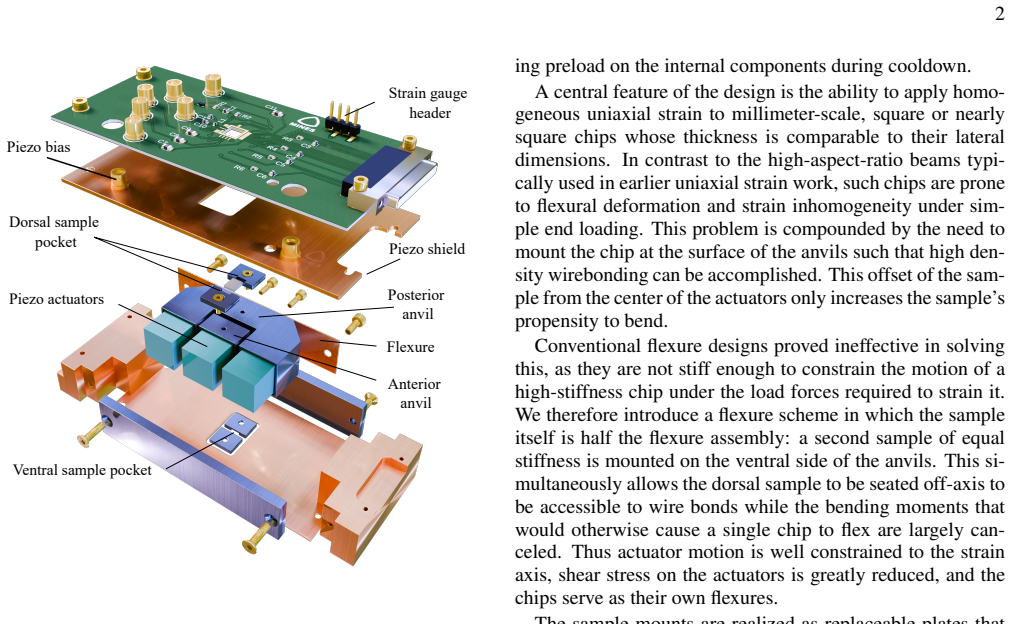
A dual-chip piezoelectric cell applies uniform uniaxial strain to thick square chips typical of quantum devices.
A machine-rendered reading of the paper's core claim, the machinery that carries it, and where it could break.
Core claim
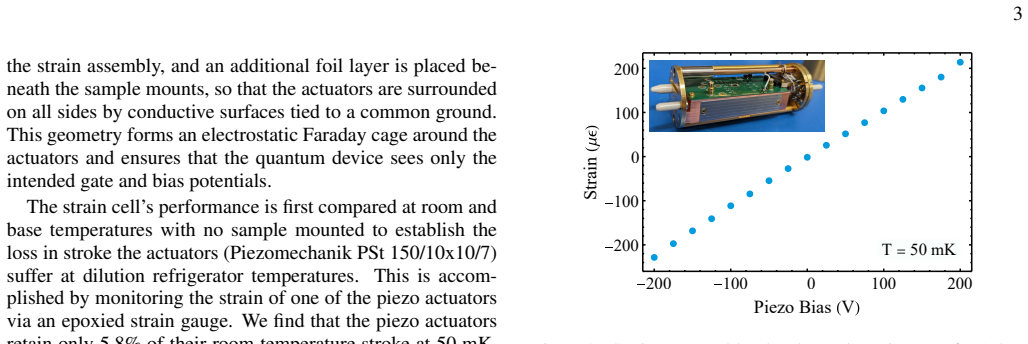
The central claim is that a highly symmetric dual-chip loading configuration in a piezoelectric uniaxial strain cell, together with stiff actuators and a grounded Faraday cage around the actuators, produces homogeneous uniaxial strain on thick square-profile substrates, accommodates standard RF and DC wiring through a high-density interposer, and avoids electrical interference with the device layer, as confirmed by finite-element simulations and surface strain measurements of 215 μϵ at 200 V bias on a 200 μm silicon die.
What carries the argument
The highly symmetric dual-chip loading configuration that suppresses flexural deformation and shear stress.
If this is right
- The cell enables strain tuning of quantum systems on standard thick semiconductor chips without introducing flexural or shear artifacts.
- The integrated interposer allows dense wire bonding while preserving electrical isolation from the piezo actuators.
- The Faraday cage around the actuators prevents unwanted Stark shifts in the device layer during high-voltage operation.
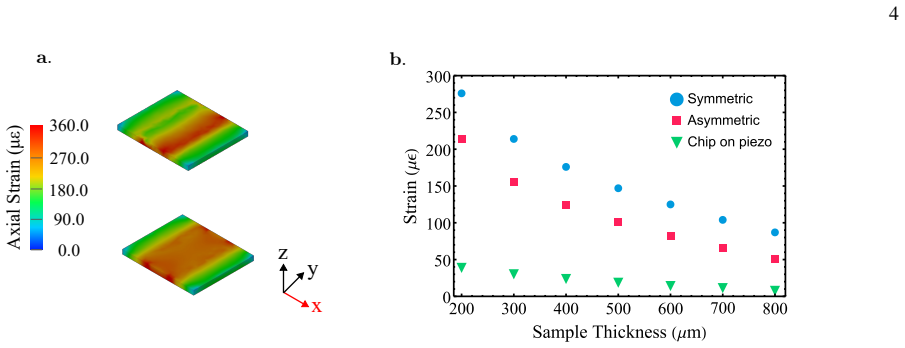
- Combining stiff actuators with the dual-chip symmetry produces improved strain homogeneity according to the simulations.
- The design supports cryogenic operation on the chip geometries already used in semiconductor quantum devices.
Where Pith is reading between the lines
- The same symmetry principle could be adapted to apply controlled strain while measuring coherence or transport in other quantum platforms.
- Mounting real devices in the cell would allow direct tests of how homogeneous strain shifts energy levels or interaction strengths without sample-preparation changes.
- The approach reduces reliance on specially prepared thin crystals and may simplify strain studies on multi-layer or encapsulated quantum structures.
Load-bearing premise
Surface strain measurements on a bare silicon die accurately reflect the strain magnitude and uniformity experienced by a functional quantum device layer once mounted, without significant mounting or interposer artifacts.
What would settle it
A measurement of strain distribution or qubit response on an actual mounted quantum device that deviates substantially from the reported 215 μϵ value or shows clear non-uniformity.
Figures
read the original abstract
Mechanical strain is a powerful resource for tuning quantum systems, but existing piezoelectric strain cells are generally optimized for fragile, high-aspect-ratio single crystals rather than the thick, square-profile chips typical of semiconductor quantum devices. Furthermore, adapting these cells for qubits requires accommodating dense RF and DC wiring while maintaining strict electrical isolation from high-voltage piezo actuators. Here, we present a piezoelectric uniaxial strain cell designed to homogeneously strain thick, square-profile substrates. We introduce a highly symmetric dual-chip loading configuration that effectively suppresses flexural deformation and shear stress. The cell integrates a high-density RF/DC interposer to support standard wire bonding and encloses the actuators in a grounded Faraday cage to prevent unwanted Stark shifts in the device layer. Finite element simulations confirm that combining stiff actuators with this symmetric mounting drastically improves strain homogeneity. Finally, we validate the apparatus experimentally by applying uniaxial strain to a 200 $\mu$m thick silicon die. Surface strain measurements demonstrate an applied strain of 215 $\mu\epsilon$ for 200 V applied piezo bias.
Editorial analysis
A structured set of objections, weighed in public.
Referee Report
Summary. The manuscript describes a cryogenic piezoelectric uniaxial strain cell optimized for thick, square-profile semiconductor chips typical of quantum devices. It introduces a symmetric dual-chip loading configuration to suppress flexural deformation and shear stress, integrates a high-density RF/DC interposer for wire bonding, and encloses actuators in a grounded Faraday cage. Finite-element simulations are used to confirm improved strain homogeneity with stiff actuators, and the apparatus is experimentally validated by applying strain to a 200 μm thick bare silicon die, achieving 215 μϵ at 200 V piezo bias.
Significance. If the homogeneity and magnitude claims hold for functional quantum devices, the cell would provide a practical tool for strain-tuning qubits and related systems on standard chip formats while accommodating dense wiring and maintaining electrical isolation. The symmetric mounting approach and integration features address real engineering constraints in cryogenic quantum experiments. The combination of simulation support and basic experimental data is a positive aspect of the presentation.
major comments (2)
- [Abstract] Abstract (experimental validation paragraph): Surface strain measurements are reported only for a bare 200 μm silicon die. The central claim that the dual-chip symmetric mounting delivers homogeneous uniaxial strain to a functional quantum device layer is load-bearing, yet the measurements omit the high-density interposer, wire bonds, and device heterostructure. Because the interposer is mechanically compliant, the transferred strain field could differ in magnitude and uniformity; this is not closed by simulation alone and requires experimental verification on the complete assembly.
- [Abstract] Abstract and results section: The reported 215 μϵ value at 200 V lacks accompanying error bars, full methods details, or baseline comparisons (e.g., against single-chip mounting). This weakens the quantitative support for both the strain magnitude and the homogeneity improvement asserted from the dual-chip configuration.
minor comments (1)
- [Abstract] Ensure consistent notation for strain units (μϵ) and clarify whether the quoted value is an average or local maximum.
Simulated Author's Rebuttal
We thank the referee for the constructive review and positive assessment of the work's significance. We address the two major comments point by point below, indicating planned revisions where appropriate.
read point-by-point responses
-
Referee: [Abstract] Abstract (experimental validation paragraph): Surface strain measurements are reported only for a bare 200 μm silicon die. The central claim that the dual-chip symmetric mounting delivers homogeneous uniaxial strain to a functional quantum device layer is load-bearing, yet the measurements omit the high-density interposer, wire bonds, and device heterostructure. Because the interposer is mechanically compliant, the transferred strain field could differ in magnitude and uniformity; this is not closed by simulation alone and requires experimental verification on the complete assembly.
Authors: We acknowledge that the presented experimental validation used a bare silicon die to characterize the strain cell in isolation. The manuscript's simulations already incorporate the interposer geometry and material properties, showing that strain homogeneity remains high with the chosen stiff actuators. We will revise the abstract and results sections to explicitly state the scope of the experimental data, expand the simulation discussion to include strain maps for the full assembly (including interposer and representative wire bonds), and add a limitations paragraph noting that direct measurements on a complete quantum device stack were not performed. This addresses the concern without overstating the current experimental scope. revision: partial
-
Referee: [Abstract] Abstract and results section: The reported 215 μϵ value at 200 V lacks accompanying error bars, full methods details, or baseline comparisons (e.g., against single-chip mounting). This weakens the quantitative support for both the strain magnitude and the homogeneity improvement asserted from the dual-chip configuration.
Authors: We agree that error bars, clearer methods referencing, and quantitative comparisons would strengthen the presentation. In the revised manuscript we will add error bars derived from the strain measurement repeatability, ensure the methods section is cross-referenced in the abstract/results, and include additional finite-element results directly comparing strain homogeneity and magnitude between the dual-chip symmetric configuration and a single-chip mounting under identical actuator conditions. These changes will be made in both the abstract and main text. revision: yes
Circularity Check
No circularity: apparatus paper with direct experimental validation and no fitted predictions or self-referential derivations
full rationale
The paper describes the design, FEM simulation, and experimental testing of a strain cell. No mathematical derivation chain exists. Surface strain measurements on a bare Si die are reported directly from experiment (215 μϵ at 200 V), with FEM used only for design guidance on homogeneity. No parameters are fitted to data and then relabeled as predictions, no self-citations form load-bearing uniqueness claims, and no ansatz or renaming of known results occurs. The central claims rest on physical construction and measurement rather than any reduction to prior fitted values or self-referential logic.
Axiom & Free-Parameter Ledger
Reference graph
Works this paper leans on
-
[1]
Review of Scientific Instruments , author =
Piezoelectric-based apparatus for strain tuning , volume =. Review of Scientific Instruments , author =. 2014 , keywords =. doi:10.1063/1.4881611 , abstract =
-
[2]
Journal of Applied Physics , author =
Piezoelectric-based uniaxial strain cell with high strain throughput and homogeneity , volume =. Journal of Applied Physics , author =. 2019 , pages =. doi:10.1063/1.5063729 , abstract =
-
[3]
Review of Scientific Instruments , author =
Piezoelectric-based uniaxial pressure cell with integrated force and displacement sensors , volume =. Review of Scientific Instruments , author =. 2019 , keywords =. doi:10.1063/1.5075485 , abstract =
-
[4]
Probing single electrons across 300-mm spin qubit wafers , volume =. Nature , author =. 2024 , keywords =. doi:10.1038/s41586-024-07275-6 , abstract =
-
[5]
12-spin-qubit arrays fabricated on a 300 mm semiconductor manufacturing line
12-. Nano Letters , author =. 2025 , keywords =. doi:10.1021/acs.nanolett.4c05205 , abstract =
-
[6]
Applied Physics Letters , author =
Pursuing high-fidelity control of spin qubits in natural. Applied Physics Letters , author =. 2024 , keywords =. doi:10.1063/5.0230605 , abstract =
-
[7]
Acceptor-based qubit in silicon with tunable strain , volume =. Physical Review B , author =. 2023 , pages =. doi:10.1103/PhysRevB.107.155301 , abstract =
-
[8]
Applied Physics Letters , author =
Engineering local strain for single-atom nuclear acoustic resonance in silicon , volume =. Applied Physics Letters , author =. 2021 , pages =. doi:10.1063/5.0069305 , abstract =
-
[9]
Formation of strain-induced quantum dots in gated semiconductor nanostructures , volume =. AIP Advances , author =. 2015 , pages =. doi:10.1063/1.4928320 , abstract =
-
[10]
Composite Structures , author =
Dynamic and static modelling of piezoelectric composite structures using a thermal analogy with. Composite Structures , author =. 2004 , keywords =. doi:10.1016/j.compstruct.2003.12.008 , abstract =
-
[11]
The International Journal of Advanced Manufacturing Technology , author =
Dynamic analysis of structures with piezoelectric actuators based on thermal analogy method , volume =. The International Journal of Advanced Manufacturing Technology , author =. 2006 , keywords =. doi:10.1007/s00170-004-2290-5 , abstract =
-
[12]
Chu, Jiun-Haw and Kuo, Hsueh-Hui and Analytis, James G. and Fisher, Ian R. , month = aug, year =. Divergent. Science , publisher =. doi:10.1126/science.1221713 , abstract =
-
[13]
Kim, H.-H. and Lefrançois, E. and Kummer, K. and Fumagalli, R. and Brookes, N. B. and Betto, D. and Nakata, S. and Tortora, M. and Porras, J. and Loew, T. and Barber, M. E. and Braicovich, L. and Mackenzie, A. P. and Hicks, C. W. and Keimer, B. and Minola, M. and Le Tacon, M. , month = jan, year =. Charge. Physical Review Letters , publisher =. doi:10.110...
-
[14]
and Worasaran, Thanapat and Rosenberg, Elliott W
Ikeda, Matthias S. and Worasaran, Thanapat and Rosenberg, Elliott W. and Palmstrom, Johanna C. and Kivelson, Steven A. and Fisher, Ian R. , month = sep, year =. Elastocaloric signature of nematic fluctuations , volume =. Proceedings of the National Academy of Sciences , publisher =. doi:10.1073/pnas.2105911118 , abstract =
-
[15]
Uniaxial-strain control of nematic superconductivity in
Kostylev, Ivan and Yonezawa, Shingo and Wang, Zhiwei and Ando, Yoichi and Maeno, Yoshiteru , month = aug, year =. Uniaxial-strain control of nematic superconductivity in. Nature Communications , publisher =. doi:10.1038/s41467-020-17913-y , abstract =
-
[16]
and Klauss, Hans-Henning and Sigrist, Manfred and Khasanov, Rustem , month = jun, year =
Grinenko, Vadim and Das, Debarchan and Gupta, Ritu and Zinkl, Bastian and Kikugawa, Naoki and Maeno, Yoshiteru and Hicks, Clifford W. and Klauss, Hans-Henning and Sigrist, Manfred and Khasanov, Rustem , month = jun, year =. Unsplit superconducting and time reversal symmetry breaking transitions in. Nature Communications , publisher =. doi:10.1038/s41467-0...
-
[17]
Ghosh, Sayak and Ikeda, Matthias S. and Chakraborty, Anzumaan R. and Worasaran, Thanapat and Theuss, Florian and Peralta, Luciano B. and Lozano, P. M. and Kim, Jong-Woo and Thompson, P. J. and Ryan, Philip J. and Ye, Linda and Kapitulnik, Aharon and Kivelson, Steven A. and Ramshaw, B. J. and Fernandes, Rafael M. and Fisher, Ian R. , month = sep, year =. E...
-
[18]
Pfau, H. and Chen, S. D. and Hashimoto, M. and Gauthier, N. and Rotundu, C. R. and Palmstrom, J. C. and Fisher, I. R. and Mo, S.-K. and Shen, Z.-X. and Lu, D. , month = apr, year =. Anisotropic quasiparticle coherence in nematic. Physical Review B , publisher =. doi:10.1103/PhysRevB.103.165136 , abstract =
-
[19]
physica status solidi (b) , author =
Two-dimensional electrons occupying multiple valleys in. physica status solidi (b) , author =. 2006 , keywords =. doi:10.1002/pssb.200642212 , abstract =
-
[20]
Applied Physics Letters , author =
Low-temperature,. Applied Physics Letters , author =. 2003 , pages =. doi:10.1063/1.1635963 , abstract =
-
[21]
Journal of Applied Physics , author =
Continuously tunable uniaxial strain control of van der. Journal of Applied Physics , author =. 2024 , pages =. doi:10.1063/5.0211557 , abstract =
-
[22]
Strain-tunable microwave-resonance technique for quantum materials , volume =
Hosoi, Suguru and Matsuura, Kohei and Shimozawa, Masaaki and Izawa, Koichi and Kasahara, Shigeru and Shibauchi, Takasada , month = aug, year =. Strain-tunable microwave-resonance technique for quantum materials , volume =. Physical Review Applied , publisher =. doi:10.1103/x9gz-dhmr , abstract =
-
[23]
Uniaxial stress effect on the electronic structure of quantum materials , volume =
Jo, Na Hyun and Gati, Elena and Pfau, Heike , month = may, year =. Uniaxial stress effect on the electronic structure of quantum materials , volume =. Frontiers in Electronic Materials , publisher =. doi:10.3389/femat.2024.1392760 , abstract =
-
[24]
Journal of Microelectromechanical Systems , author =
What is the. Journal of Microelectromechanical Systems , author =. 2010 , keywords =. doi:10.1109/JMEMS.2009.2039697 , abstract =
-
[25]
and Oakes, Eric J
Ojeda, Cassandra E. and Oakes, Eric J. and Hill, Jennifer R. and Aldi, Dominic and Forsberg, Gustaf A. , month = may, year =. Temperature
-
[26]
Infrared Physics & Technology , author =
Mechanical and thermal properties of. Infrared Physics & Technology , author =. 2022 , keywords =. doi:10.1016/j.infrared.2022.104373 , abstract =
-
[27]
Kim, H.-H. and Souliou, S. M. and Barber, M. E. and Lefrançois, E. and Minola, M. and Tortora, M. and Heid, R. and Nandi, N. and Borzi, R. A. and Garbarino, G. and Bosak, A. and Porras, J. and Loew, T. and König, M. and Moll, P. J. W. and Mackenzie, A. P. and Keimer, B. and Hicks, C. W. and Le Tacon, M. , month = nov, year =. Uniaxial pressure control of ...
-
[28]
Occhialini, Connor A. and Sanchez, Joshua J. and Song, Qian and Fabbris, Gilberto and Choi, Yongseong and Kim, Jong-Woo and Ryan, Philip J. and Comin, Riccardo , month = aug, year =. Spontaneous orbital polarization in the nematic phase of. Nature Materials , publisher =. doi:10.1038/s41563-023-01585-2 , abstract =
-
[29]
Dashwood, C. D. and Walker, A. H. and Kwasigroch, M. P. and Veiga, L. S. I. and Faure, Q. and Vale, J. G. and Porter, D. G. and Manuel, P. and Khalyavin, D. D. and Orlandi, F. and Colin, C. V. and Fabelo, O. and Krüger, F. and Perry, R. S. and Johnson, R. D. and Green, A. G. and McMorrow, D. F. , month = oct, year =. Strain control of a bandwidth-driven s...
-
[30]
Heisenberg spins on an anisotropic triangular lattice:
Sun, Dan and Sokolov, Dmitry A and Waite, Richard and Khim, Seunghyun and Manuel, Pascal and Orlandi, Fabio and Khalyavin, Dmitry D and Mackenzie, Andrew P and Hicks, Clifford W , month = dec, year =. Heisenberg spins on an anisotropic triangular lattice:. New Journal of Physics , publisher =. doi:10.1088/1367-2630/ac4280 , abstract =
-
[31]
Applied Physics Letters , author =
Piezoplasmonics:. Applied Physics Letters , author =. 2020 , pages =. doi:10.1063/5.0012496 , abstract =
-
[32]
Applied Physics Letters , author =
Anisotropic low-temperature piezoresistance in (311). Applied Physics Letters , author =. 2007 , pages =. doi:10.1063/1.2753735 , abstract =
-
[33]
Paik, D. S. and Park, S. E. and Shrout, T. R. and Hachenberger, W. , title =. Journal of Materials Science , year =
-
[34]
Mulvihill, Maureen L. and Shawgo, Ryan J. and Bagwell, Roger B. and Ealey, Mark A. , year =. Cryogenic Cofired Multilayer Actuator Development for a Deformable Mirror in the Next Generation Space Telescope , volume =. Journal of Electroceramics , publisher =. doi:10.1023/a:1020551812502 , number =
-
[35]
Temperature-
Liu, Zunping , editor =. Temperature-. Proceedings of the 11th Mechanical Engineering Design of Synchrotron Radiation Equipment and Instrumentation , publisher =. 2021 , keywords =
2021
discussion (0)
Sign in with ORCID, Apple, or X to comment. Anyone can read and Pith papers without signing in.