Diffusive Relaxation of Participation Entropy in U(1)-symmetric Dynamics
Pith reviewed 2026-06-27 09:55 UTC · model grok-4.3
The pith
U(1) conservation slows participation entropy relaxation to t to the minus one half via diffusive density correlations.
A machine-rendered reading of the paper's core claim, the machinery that carries it, and where it could break.
Core claim
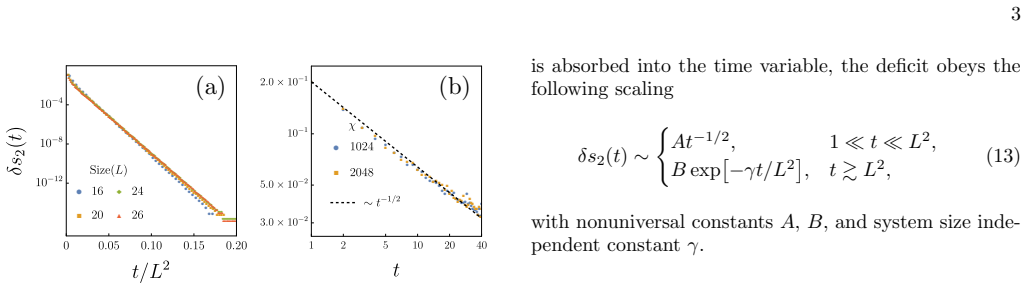
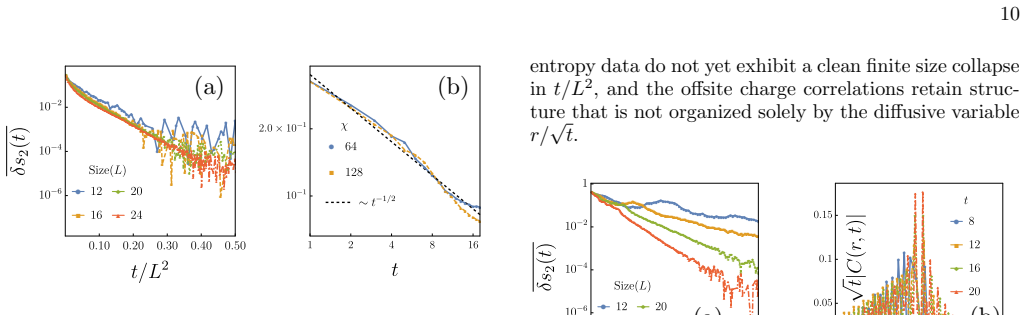
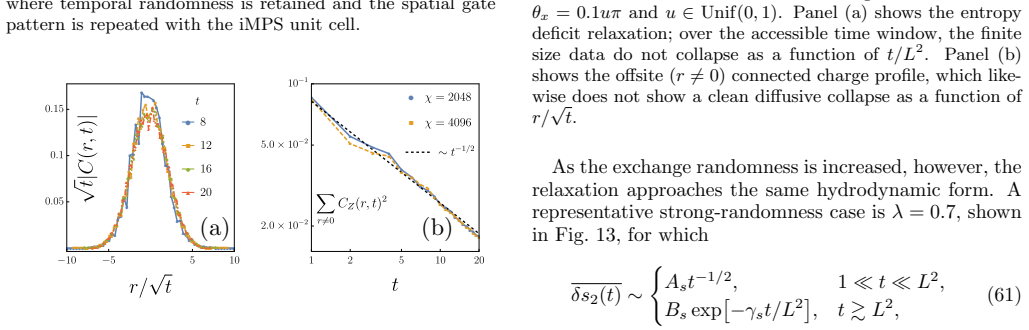
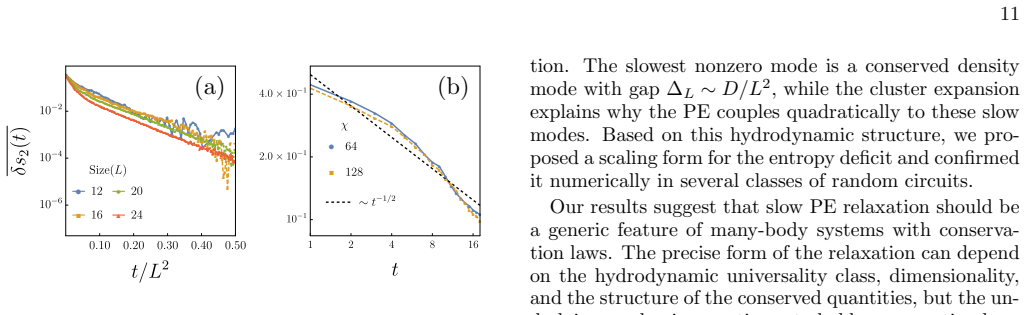
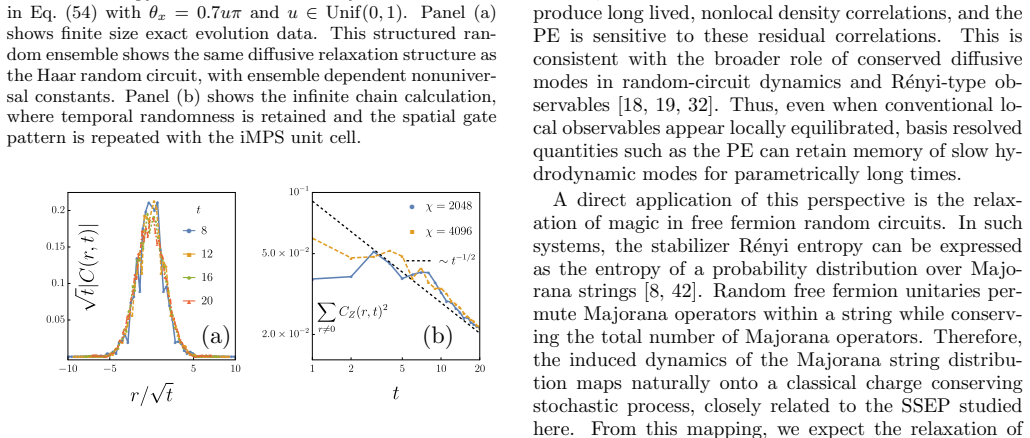
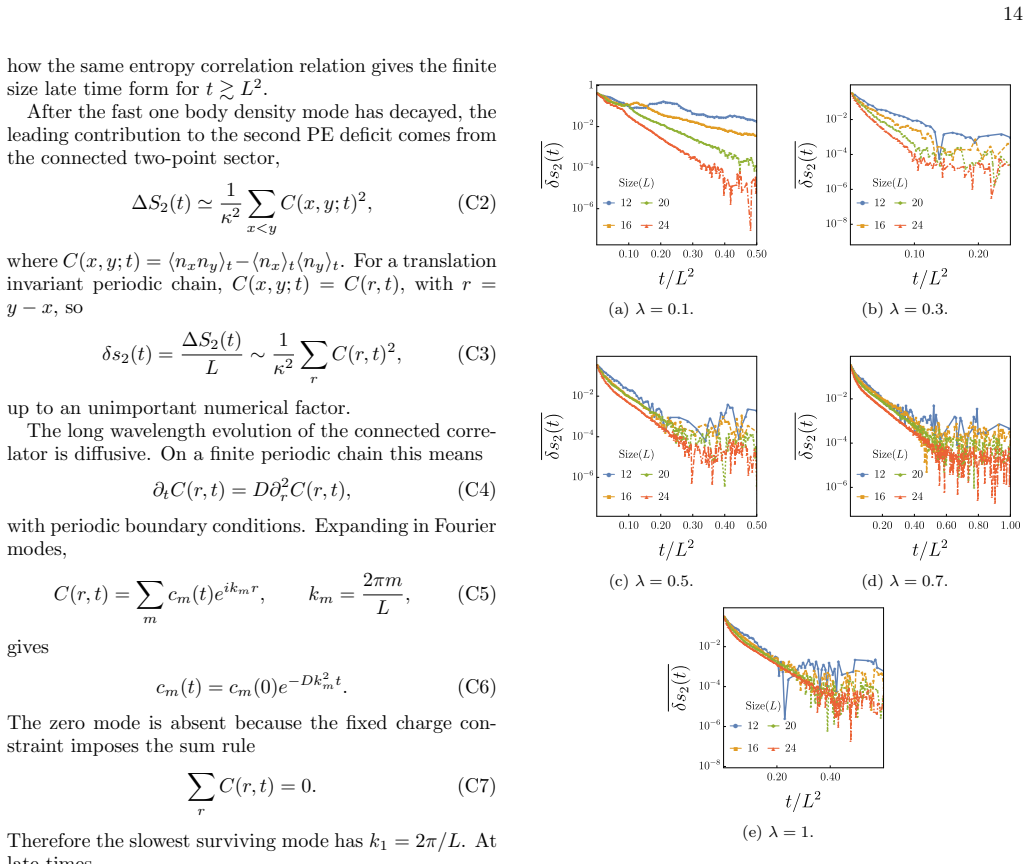
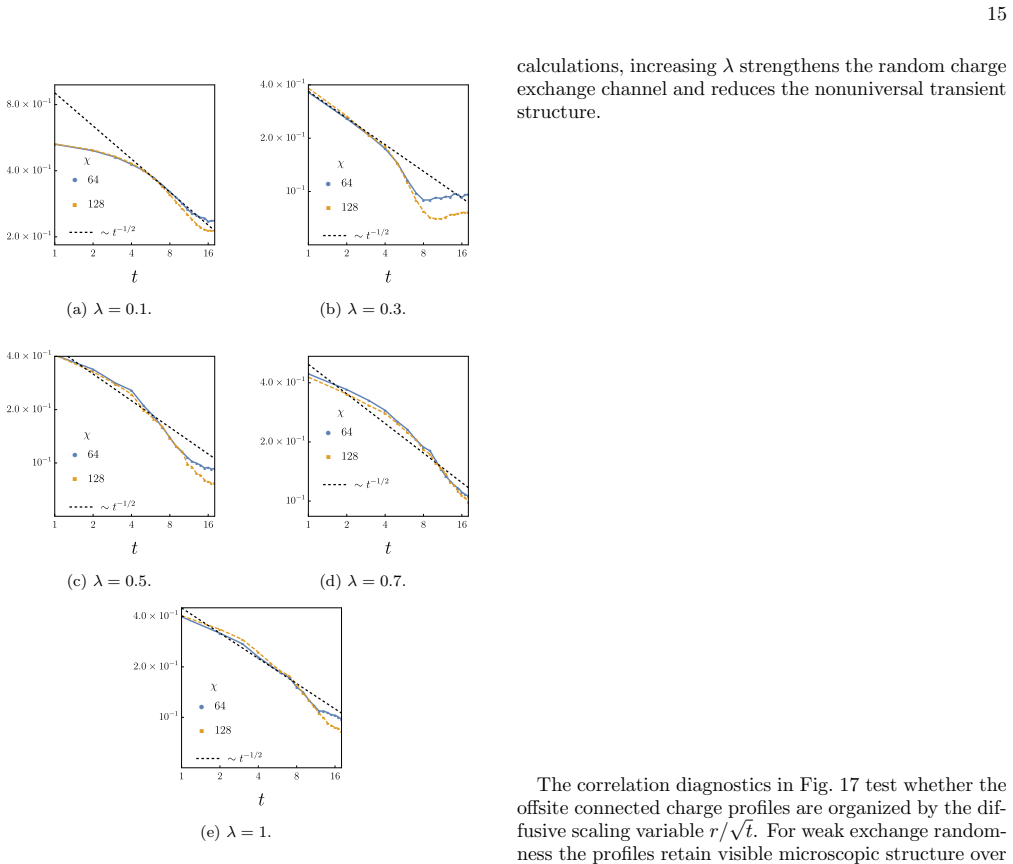
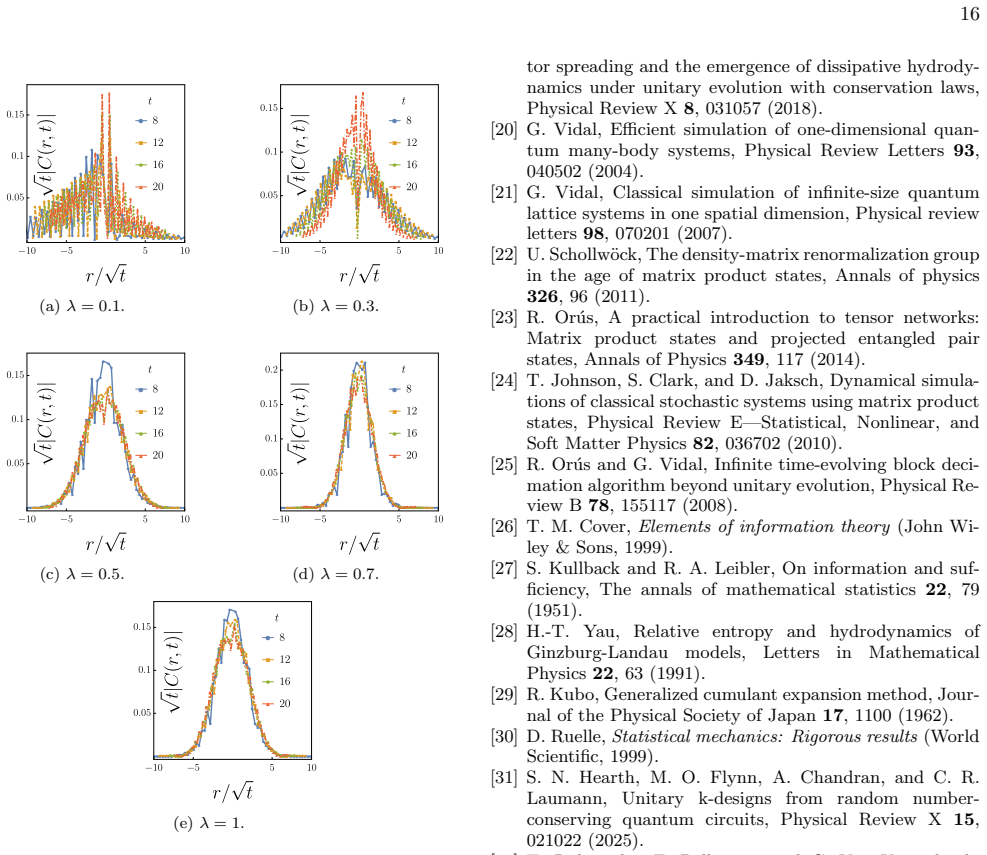
After local density inhomogeneities decay, the leading participation entropy deficit is dominated by squared connected density correlations. The long time relaxation is therefore controlled by diffusive correlation spreading, giving ΔS(t)∼t^{-1/2} in the hydrodynamic regime and crossing over to ∼exp[-O(t/L^2)] when t≥L^2.
What carries the argument
Cluster expansion around equilibrium that isolates the participation entropy deficit as the square of connected density correlations.
If this is right
- Participation entropy becomes a direct probe of hydrodynamic memory in conserved quantum systems.
- Slow relaxation of this entropy follows generically from the presence of conservation laws.
- The functional form crosses from power-law to exponential decay at diffusion time across the system size.
- The same correlation-squared relation holds across different U(1)-conserving circuit models.
Where Pith is reading between the lines
- Similar hydrodynamic slowing should appear in other spread measures such as entanglement or operator entanglement when conservation laws are present.
- In higher dimensions the decay exponent would change with the diffusive scaling of density correlations.
- Adding weak breaking of the U(1) symmetry should restore faster relaxation once the induced length scale is reached.
Load-bearing premise
The cluster expansion around equilibrium stays valid with higher-order terms negligible once local density inhomogeneities have decayed.
What would settle it
A measurement in a U(1)-conserving circuit showing that the participation entropy deficit fails to track the square of connected density correlations or deviates from t to the minus one half decay in the hydrodynamic regime would falsify the claimed relation.
Figures
read the original abstract
Participation entropy (PE) quantifies the spread of a many-body wavefunction across configuration space. While PE relaxes rapidly in generic chaotic systems, we show that $\mathrm{U}(1)$ conservation laws slow it down by imprinting with the slow hydrodynamic modes. Using a cluster expansion around equilibrium, we show that, after local density inhomogeneities decay, the leading PE deficit is dominated by squared connected density correlations. The long time relaxation is therefore controlled by diffusive correlation spreading, giving $\Delta S(t)\sim t^{-1/2}$ in the hydrodynamic regime and crossing over to $\sim \exp[-O(t/L^2)]$ when $t\geq L^2$. We confirm this entropy correlation relation using exact computation and infinite system tensor network simulations in various quantum $\mathrm{U}(1)$ conserving circuits. Our results establish PE as a sensitive probe of hydrodynamic memory and suggest that slow relaxation is a generic consequence of conservation laws.
Editorial analysis
A structured set of objections, weighed in public.
Referee Report
Summary. The manuscript claims that U(1) conservation laws slow the relaxation of participation entropy (PE) by coupling it to hydrodynamic modes. After local density inhomogeneities decay, a cluster expansion around equilibrium shows that the leading PE deficit ΔS is dominated by the square of connected two-point density correlations. This implies diffusive relaxation ΔS(t)∼t^{-1/2} in the hydrodynamic regime, crossing over to ∼exp[-O(t/L²)] for t≥L². The relation is confirmed via exact diagonalization and infinite-system tensor-network simulations on U(1)-conserving quantum circuits.
Significance. If the central entropy-correlation relation holds, the work establishes PE as a sensitive probe of hydrodynamic memory and shows that slow relaxation is a generic consequence of conservation laws. Credit is due for deriving the relation via an independent cluster expansion (rather than fitting) and for providing numerical confirmation across multiple circuit families and system sizes.
major comments (2)
- [cluster expansion around equilibrium] The central claim rests on truncating the cluster expansion to the two-point level after local density relaxation. Because the connected two-point density correlator itself decays only as t^{-d/2} in the diffusive regime, it is not obvious that three-point and higher connected cumulants remain parametrically smaller; an explicit scaling bound or order-of-magnitude estimate justifying the neglect of these terms is required (see the derivation of the PE deficit in terms of density correlations).
- [numerical confirmation] The hydrodynamic scaling ΔS(t)∼t^{-1/2} and the subsequent finite-size crossover are load-bearing predictions. The numerical evidence must demonstrate that the observed power law is not contaminated by residual local-density relaxation or by higher-order cumulants; quantitative comparison of the prefactor extracted from the two-point function versus the measured ΔS(t) would strengthen the result.
minor comments (2)
- Notation for the participation entropy deficit ΔS and the connected density correlator should be introduced with a single consistent definition early in the text to avoid ambiguity when the cluster expansion is applied.
- Figure captions for the tensor-network data should explicitly state the bond dimension, truncation error, and how the infinite-system limit is taken.
Simulated Author's Rebuttal
We thank the referee for the careful reading and constructive comments. We address each major comment below.
read point-by-point responses
-
Referee: [cluster expansion around equilibrium] The central claim rests on truncating the cluster expansion to the two-point level after local density relaxation. Because the connected two-point density correlator itself decays only as t^{-d/2} in the diffusive regime, it is not obvious that three-point and higher connected cumulants remain parametrically smaller; an explicit scaling bound or order-of-magnitude estimate justifying the neglect of these terms is required (see the derivation of the PE deficit in terms of density correlations).
Authors: We thank the referee for highlighting this important point regarding the validity of the truncation. In the cluster expansion of the participation entropy deficit, after local density relaxation the two-point term is leading because higher-order connected cumulants enter as products involving three or more correlation functions. Each additional factor decays as t^{-d/2} (with spatial support growing as t^{d/2}), so that the three-point contribution scales as t^{-3d/2} or faster while the two-point squared term yields the observed t^{-d/2} after spatial summation. We will add an explicit order-of-magnitude estimate and scaling bound in a revised section on the cluster expansion to make this rigorous. revision: yes
-
Referee: [numerical confirmation] The hydrodynamic scaling ΔS(t)∼t^{-1/2} and the subsequent finite-size crossover are load-bearing predictions. The numerical evidence must demonstrate that the observed power law is not contaminated by residual local-density relaxation or by higher-order cumulants; quantitative comparison of the prefactor extracted from the two-point function versus the measured ΔS(t) would strengthen the result.
Authors: We agree that a quantitative prefactor comparison would strengthen the evidence. The existing numerics (exact diagonalization and tensor-network simulations) already confirm the scaling and crossover across multiple circuit families, with local density relaxation occurring at much earlier times than the hydrodynamic regime. In the revised manuscript we will add a direct comparison of the prefactor obtained from the independently computed two-point density correlator against the prefactor fitted to ΔS(t), together with explicit checks that residual density inhomogeneities and higher-cumulant contributions remain negligible in the fitting window. revision: yes
Circularity Check
No circularity: central relation derived via independent cluster expansion around equilibrium
full rationale
The paper derives the leading PE deficit relation to squared connected density correlations explicitly from a cluster expansion around equilibrium after local density relaxation. This is a theoretical expansion step, not a fit, redefinition, or self-citation chain. The result is then checked against independent exact diagonalization and tensor-network simulations on U(1)-conserving circuits. No load-bearing self-citations, ansatze smuggled via prior work, or fitted inputs renamed as predictions appear in the provided text. The truncation of the cluster expansion is a modeling assumption whose validity can be tested externally, but it does not reduce the claimed relation to its own inputs by construction.
Axiom & Free-Parameter Ledger
axioms (1)
- domain assumption Cluster expansion around equilibrium accurately isolates the leading PE deficit as the square of connected density correlations after local density decay
Forward citations
Cited by 2 Pith papers
-
Unitary Designs from Doped Matchgate Circuits
Doped matchgate circuits achieve approximate parity-preserving 2-designs in polylogarithmic depth using a sparse number of non-Gaussian gates, with the design formation mapped exactly to a birth-death Markov chain.
-
Diffusive Dynamics of Nonstabilizerness
In U(1)-symmetric 1D random circuits the stabilizer Rényi entropy gap closes diffusively as 1/t, with the same scaling seen in an energy-conserving Ising chain.
Reference graph
Works this paper leans on
-
[1]
Eisert, M
J. Eisert, M. Friesdorf, and C. Gogolin, Quantum many- body systems out of equilibrium, Nature Physics11, 124 (2015)
2015
-
[2]
D’Alessio, Y
L. D’Alessio, Y. Kafri, A. Polkovnikov, and M. Rigol, From quantum chaos and eigenstate thermalization to statistical mechanics and thermodynamics, Advances in Physics65, 239 (2016)
2016
-
[3]
Rigol, V
M. Rigol, V. Dunjko, and M. Olshanii, Thermalization and its mechanism for generic isolated quantum systems, Nature452, 854 (2008)
2008
-
[4]
Eisert, M
J. Eisert, M. Cramer, and M. B. Plenio, Colloquium: Area laws for the entanglement entropy, Reviews of Mod- ern Physics82, 277 (2010)
2010
-
[5]
Calabrese and J
P. Calabrese and J. Cardy, Evolution of entanglement entropy in one-dimensional systems, Journal of Statisti- cal Mechanics: Theory and Experiment2005, P04010 (2005)
2005
-
[6]
Kim and D
H. Kim and D. A. Huse, Ballistic spreading of entangle- ment in a diffusive nonintegrable system, Physical Re- view Letters111, 127205 (2013)
2013
-
[7]
Nahum, J
A. Nahum, J. Ruhman, S. Vijay, and J. Haah, Quantum entanglement growth under random unitary dynamics, Physical Review X7, 031016 (2017)
2017
-
[8]
Leone, S
L. Leone, S. F. Oliviero, and A. Hamma, Stabilizer Renyi entropy, Physical Review Letters128, 050402 (2022)
2022
-
[9]
Turkeshi and P
X. Turkeshi and P. Sierant, Hilbert space delocalization under random unitary circuits, Entropy26, 471 (2024)
2024
-
[10]
A. M. Dalzell, N. Hunter-Jones, and F. G. Brand˜ ao, Ran- dom quantum circuits anticoncentrate in log depth, PRX Quantum3, 010333 (2022)
2022
-
[11]
Turkeshi, E
X. Turkeshi, E. Tirrito, and P. Sierant, Magic spread- ing in random quantum circuits, Nature Communications 16, 2575 (2025)
2025
-
[12]
M. P. Fisher, V. Khemani, A. Nahum, and S. Vijay, Random quantum circuits, Annual Review of Condensed Matter Physics14, 335 (2023)
2023
-
[13]
E. Heinrich, H. Liu, T. Zhou, and X. Chen, Criti- cal behaviors of magic and participation entropy at 16 ● ● ● ● ● ● ● ● ● ● ● ● ● ● ● ● ● ● ● ● ● ● ● ● ● ● ● ● ● ● ● ● ● ● ●●● ● ●●● ● ●●● ● ●●● ● ●●●●●●■ ■ ■ ■ ■ ■ ■ ■ ■ ■ ■ ■ ■ ■ ■ ■ ■ ■ ■ ■ ■ ■ ■ ■ ■ ■ ■ ■ ■ ■ ■ ■ ■ ■ ■ ■ ■ ■ ■ ■■ ■ ■■■ ■ ■■■ ■ ■■■ ■ ■■■ ■ ■■■ ■ ■■ ◆ ◆ ◆ ◆ ◆ ◆ ◆ ◆ ◆ ◆ ◆ ◆ ◆ ◆ ◆ ◆ ◆ ◆ ◆ ...
-
[14]
E. Tirrito, P. S. Tarabunga, D. S. Bhakuni, M. Dal- monte, P. Sierant, and X. Turkeshi, Universal spread- ing of nonstabilizerness and quantum transport, arXiv preprint arXiv:2506.12133 (2025)
-
[15]
Coherence dynamics in quantum many-body systems with conservation laws
S. Aditya, E. Tirrito, P. Sierant, and X. Turkeshi, Coher- ence dynamics in quantum many-body systems with con- servation laws, arXiv preprint arXiv:2604.23192 (2026)
work page internal anchor Pith review Pith/arXiv arXiv 2026
-
[16]
Kipnis and C
C. Kipnis and C. Landim,Scaling Limits of Interacting Particle Systems(Springer, Berlin, 1999)
1999
-
[17]
Spohn,Large Scale Dynamics of Interacting Particles (Springer, Berlin, 1991)
H. Spohn,Large Scale Dynamics of Interacting Particles (Springer, Berlin, 1991)
1991
-
[18]
Rakovszky, F
T. Rakovszky, F. Pollmann, and C. Von Keyserlingk, Dif- fusive hydrodynamics of out-of-time-ordered correlators with charge conservation, Physical Review X8, 031058 (2018)
2018
-
[19]
Khemani, A
V. Khemani, A. Vishwanath, and D. A. Huse, Opera- tor spreading and the emergence of dissipative hydrody- namics under unitary evolution with conservation laws, Physical Review X8, 031057 (2018)
2018
-
[20]
Vidal, Efficient simulation of one-dimensional quan- tum many-body systems, Physical Review Letters93, 040502 (2004)
G. Vidal, Efficient simulation of one-dimensional quan- tum many-body systems, Physical Review Letters93, 040502 (2004)
2004
-
[21]
Vidal, Classical simulation of infinite-size quantum lattice systems in one spatial dimension, Physical review letters98, 070201 (2007)
G. Vidal, Classical simulation of infinite-size quantum lattice systems in one spatial dimension, Physical review letters98, 070201 (2007)
2007
-
[22]
Schollw¨ ock, The density-matrix renormalization group in the age of matrix product states, Annals of physics 326, 96 (2011)
U. Schollw¨ ock, The density-matrix renormalization group in the age of matrix product states, Annals of physics 326, 96 (2011)
2011
-
[23]
Or´ us, A practical introduction to tensor networks: Matrix product states and projected entangled pair states, Annals of Physics349, 117 (2014)
R. Or´ us, A practical introduction to tensor networks: Matrix product states and projected entangled pair states, Annals of Physics349, 117 (2014)
2014
-
[24]
Johnson, S
T. Johnson, S. Clark, and D. Jaksch, Dynamical simula- tions of classical stochastic systems using matrix product states, Physical Review E—Statistical, Nonlinear, and Soft Matter Physics82, 036702 (2010)
2010
-
[25]
Or´ us and G
R. Or´ us and G. Vidal, Infinite time-evolving block deci- mation algorithm beyond unitary evolution, Physical Re- view B78, 155117 (2008)
2008
-
[26]
T. M. Cover,Elements of information theory(John Wi- ley & Sons, 1999)
1999
-
[27]
Kullback and R
S. Kullback and R. A. Leibler, On information and suf- ficiency, The annals of mathematical statistics22, 79 (1951)
1951
-
[28]
Yau, Relative entropy and hydrodynamics of Ginzburg-Landau models, Letters in Mathematical Physics22, 63 (1991)
H.-T. Yau, Relative entropy and hydrodynamics of Ginzburg-Landau models, Letters in Mathematical Physics22, 63 (1991)
1991
-
[29]
Kubo, Generalized cumulant expansion method, Jour- nal of the Physical Society of Japan17, 1100 (1962)
R. Kubo, Generalized cumulant expansion method, Jour- nal of the Physical Society of Japan17, 1100 (1962)
1962
-
[30]
Ruelle,Statistical mechanics: Rigorous results(World Scientific, 1999)
D. Ruelle,Statistical mechanics: Rigorous results(World Scientific, 1999)
1999
-
[31]
S. N. Hearth, M. O. Flynn, A. Chandran, and C. R. Laumann, Unitary k-designs from random number- conserving quantum circuits, Physical Review X15, 021022 (2025)
2025
-
[32]
Rakovszky, F
T. Rakovszky, F. Pollmann, and C. Von Keyserlingk, Sub-ballistic growth of Renyi entropies due to diffusion, Physical Review Letters122, 250602 (2019)
2019
-
[33]
C. E. Porter and R. G. Thomas, Fluctuations of nuclear reaction widths, Physical Review104, 483 (1956)
1956
-
[34]
E. H. Lieb, T. D. Schultz, and D. C. Mattis, Two soluble models of an antiferromagnetic chain, Annals of Physics 16, 407 (1961)
1961
-
[35]
Foxen, C
B. Foxen, C. Neill, A. Dunsworth, P. Roushan, B. Chiaro, A. Megrant, J. Kelly, Z. Chen, K. Satzinger, R. Barends, et al., Demonstrating a continuous set of two-qubit gates for near-term quantum algorithms, Physical Review Let- ters125, 120504 (2020)
2020
-
[36]
ˇZnidariˇ c, InhomogeneousSU(2) symmetries in homo- geneous integrableU(1) circuits and transport, Nature Communications16, 4336 (2025)
M. ˇZnidariˇ c, InhomogeneousSU(2) symmetries in homo- geneous integrableU(1) circuits and transport, Nature Communications16, 4336 (2025)
2025
-
[37]
Summer, A
A. Summer, A. Nico-Katz, S. Dooley, and J. Goold, Anomalous transport inU(1)-symmetric quantum cir- cuits, npj Quantum Information12, 32 (2026)
2026
-
[38]
Dzyaloshinsky, A thermodynamic theory of weak ferro- magnetism of antiferromagnetics, Journal of physics and chemistry of solids4, 241 (1958)
I. Dzyaloshinsky, A thermodynamic theory of weak ferro- magnetism of antiferromagnetics, Journal of physics and chemistry of solids4, 241 (1958)
1958
-
[39]
Moriya, Anisotropic superexchange interaction and weak ferromagnetism, Physical Review120, 91 (1960)
T. Moriya, Anisotropic superexchange interaction and weak ferromagnetism, Physical Review120, 91 (1960)
1960
-
[40]
Jonay, J
C. Jonay, J. F. Rodriguez-Nieva, and V. Khemani, Slow thermalization and subdiffusion in u (1) conserving flo- 17 quet random circuits, Physical Review B109, 024311 (2024)
2024
-
[41]
Marvian, Theory of quantum circuits with Abelian symmetries, Physical Review Research6, 043292 (2024)
I. Marvian, Theory of quantum circuits with Abelian symmetries, Physical Review Research6, 043292 (2024)
2024
-
[42]
C. Wang, Z.-C. Yang, T. Zhou, and X. Chen, Magic tran- sition in monitored free fermion dynamics, arXiv preprint arXiv:2507.10688 (2025)
-
[43]
In that numerical work, the asymptotic diffusive relax- ation regime was not resolved because of limitations of the available numerical methods
-
[44]
Non-stabilizerness and U(1) symmetry in chaotic many-body quantum systems
D. Iannotti, A. Russotto, B. Jasser, J. Odavi´ c, and A. Hamma, Non-stabilizerness and u (1) symmetry in chaotic many-body quantum systems, arXiv preprint arXiv:2603.28870 (2026)
work page internal anchor Pith review Pith/arXiv arXiv 2026
-
[45]
Rattacaso, L
D. Rattacaso, L. Leone, S. F. Oliviero, and A. Hamma, Stabilizer entropy dynamics after a quantum quench, Physical Review A108, 042407 (2023)
2023
-
[46]
Odavi´ c, M
J. Odavi´ c, M. Viscardi, and A. Hamma, Stabilizer en- tropy in nonintegrable quantum evolutions, Physical Re- view B112, 104301 (2025)
2025
-
[47]
F. Mezzadri, How to generate random matrices from the classical compact groups, arXiv preprint math- ph/0609050 (2006)
-
[48]
Zyczkowski and H.-J
K. Zyczkowski and H.-J. Sommers, Induced measures in the space of mixed quantum states, Journal of Physics A: Mathematical and General34, 7111 (2001)
2001
-
[49]
O’Donnell,Analysis of boolean functions(Cambridge University Press, 2014)
R. O’Donnell,Analysis of boolean functions(Cambridge University Press, 2014)
2014
discussion (0)
Sign in with ORCID, Apple, or X to comment. Anyone can read and Pith papers without signing in.