REVIEW 5 major objections 7 minor 5 references
LLMs excel at planning analysis but fail at institutional facts and practical judgment, so agencies should use them only under differential delegation.
Reviewed by Pith at T0; open to challenge. T0 means a machine referee read the full paper against a public rubric. the ladder, T0–T4 →
T0 review · grok-4.5
2026-07-14 18:04 UTC pith:KCQVNMJL
load-bearing objection Useful first theory-grounded planning LLM bench with a real multi-model pattern, but the abstract misstates the curve and the structural-limit claim outruns the construct validation. the 5 major comments →
Can AI Reason Like an Urban Planner? Benchmarking Large Language Models Against Professional Judgment
The pith
A machine-rendered reading of the paper's core claim, the machinery that carries it, and where it could break.
Core claim
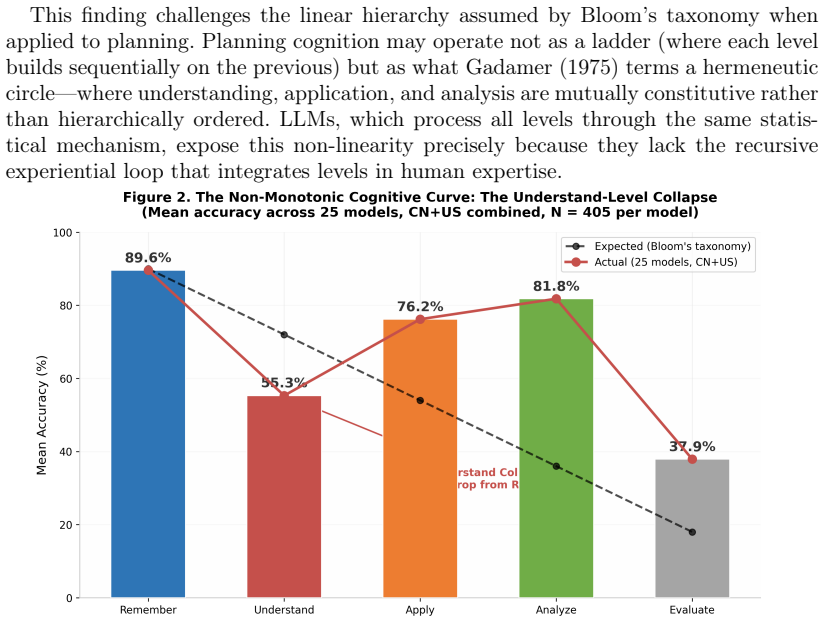
Across 25 LLMs and 405 UPBench scenarios, planning competence is non-monotonic by cognitive level (Remember ~89.6%, Understand ~55.3%, Apply ~76.2%, Analyze ~81.8%, Evaluate ~37.9%). Models handle broad analytical synthesis better than precise conceptual understanding or integrative judgment, because planning’s “lower-order” knowledge is institutionally and temporally embedded. The authors formalize the resulting limits as four epistemic diagnostics—regulatory hallucination, conceptual conflation, wickedness paralysis, and phronetic deficit—and conclude that AI should be delegated only where these modes do not dominate.
What carries the argument
UPBench: a bilingual 4×5 matrix of four knowledge pillars (Principles of Urban Planning, Cross-Disciplinary Integration, Planning Governance, Planning Practice) by five Bloom-adapted cognitive levels, scored by a dual-track protocol of LLM-as-judge plus expert panel.
Load-bearing premise
That the dual-track scoring of adapted licensure and curriculum items, after calibration to moderate expert agreement, genuinely measures professional planning judgment rather than exam-style pattern matching.
What would settle it
If frontier models or domain-fine-tuned systems reverse the non-monotonic curve—matching or exceeding human experts on Understand and Evaluate items that require jurisdiction-specific regulatory application and normative commitment—while expert panels still rate the reasoning as professionally adequate, the claim of structural (not merely developmental) limits collapses.
If this is right
- Agencies can productively use LLMs for literature review, scenario generation, and preliminary cross-disciplinary analysis under ordinary professional review.
- Any AI-assisted regulatory interpretation or procedural advice requires structured human verification against current local law.
- Planning education should shift emphasis from transmitting facts AI already approximates toward institutional literacy, normative courage, and critical evaluation of AI outputs.
- Training-data origin strongly shapes cross-national performance, so “global” planning models will systematically under-serve underrepresented institutional systems.
Where Pith is reading between the lines
- The same institutional-density argument likely applies to other phronetic professions (architecture, public administration, social work) whose “basic” knowledge is jurisdictionally encoded.
- If the Understand collapse is architectural rather than data-limited, continued scaling alone will not close the gap; retrieval-augmented or institution-specific systems may still leave the normative and phronetic failures intact.
- Longitudinal re-runs of UPBench on successive model generations would cleanly test whether the four diagnostics are temporary or structural ceilings.
Editorial analysis
A structured set of objections, weighed in public.
Referee Report
Summary. The paper introduces UPBench, a 4×5 domain-specific benchmark (four planning knowledge pillars × five Bloom-adapted cognitive levels) for evaluating whether LLMs can reason like professional urban planners. Using 405 bilingual (US/China) scenarios, a dual-track protocol (LLM-as-judge for lower levels; five-expert panel for Analyze/Evaluate), and evaluation of 25 models, the authors report a non-monotonic performance curve across cognitive levels, pillar asymmetries, cross-national origin effects, and four epistemic failure modes (regulatory hallucination, conceptual conflation, wickedness paralysis, phronetic deficit). They argue for differential delegation of planning tasks to AI rather than wholesale substitution, with implications for practice and education.
Significance. The work fills a clear gap: planning lacks a theory-grounded, profession-specific AI evaluation framework comparable to Med-PaLM or LegalBench. Strengths include scale (25 models, 405 scenarios), explicit grounding in phronesis and plan-quality evaluation traditions, dual-track scoring with reported calibration (Table 1), qualitative appendices with verbatim failure examples, and a practical differential-delegation framing. Code is released. If the non-monotonic curve and diagnostics hold under stronger construct validation, the paper would be a durable reference for AI governance in planning agencies and for reorienting planning education toward institutional literacy and normative judgment.
major comments (5)
- Abstract vs. §4.2 inconsistency on the central empirical claim. The abstract states models “perform better on higher-order analytical tasks than on factual recall and integrative judgment.” §4.2 and Figure 2 report the opposite ordering for factual recall: Remember 89.6% (highest), Understand 55.3% (collapse), Apply 76.2%, Analyze 81.8%, Evaluate 37.9%. The body’s U-shape (high Remember, low Understand, recovery at Analyze, low Evaluate) is the load-bearing result; the abstract misstates it. Align abstract, takeaway, and discussion with the reported means before any claim about “inverted” or “non-monotonic” gradients is used for differential delegation.
- Construct validity of cognitive-level operationalization, especially Evaluate (§3.1). Remember/Understand/Apply map reasonably to item formats, but Evaluate is defined as “precise retrieval of domain-specific terminology” (e.g., supplying “Multiple nuclei model”). That is closer to Remember/Understand than to Bloom’s Evaluate (criterion-based judgment) or to phronesis. If Evaluate items are terminology fill-ins, the 37.9% floor and the “phronetic deficit” diagnosis partly reflect item design, not structural incapacity for professional judgment. Re-map or re-label levels, or replace Evaluate items with genuine multi-criteria judgment tasks, and re-estimate the curve.
- No human-planner baseline on the same 405 items. Claims that the non-monotonic curve and four diagnostics mark structural AI limits on planning phronesis (§4.2–4.4, §5.1) require an anchor: how do licensed planners or advanced students score under the same dual-track rubrics? Without that, low Understand/Evaluate scores may reflect hard or poorly calibrated items rather than AI-specific failure. Report at least a small human baseline (or pilot) on a stratified subset and discuss relative gaps.
- Figure 4 and data integrity. Figure 4 shows original pillar means underestimated by up to −17.4% (Planning Practice) relative to “verified” data, compressing the pillar range from a claimed 48.2%–72.4% to 65.6%–69.3%. The manuscript does not explain how the original numbers were produced, what was corrected, or whether Table 2 / cognitive-level means were similarly revised. Clarify the verification pipeline and ensure all reported aggregates (including CN/US splits and the non-monotonic curve) come from a single audited scoring run.
- Dual-track validity for “professional judgment” (§3.3, Table 1). Final automated–expert Spearman ρ = 0.67 after nine prompt iterations is only moderate; the expert panel is n = 5; Track 1 uses LLM-as-judge for Remember/Understand/Apply. The paper treats this as acceptable by analogy to plan-quality intercoder ranges, but the central claim is about professional judgment, not plan completeness. Report inter-expert agreement (not only judge–expert), sensitivity of the U-curve to Track 1 vs Track 2, and whether conclusions change if only expert-scored Analyze/Evaluate cells are used for the phronesis claims.
minor comments (7)
- §3.1: Bloom operationalization for Evaluate is internally inconsistent with the later claim that Evaluate “most directly tests phronesis.” Fix the prose so level definitions match the theoretical claims.
- Table 2 is split across pages and repeats the header awkwardly; consider a single compact table or supplementary full matrix with CN/US averages.
- GitHub is named PlanBench while the paper uses UPBench; align naming to avoid confusion with related PlanGPT work.
- Several typos and spacing artifacts (e.g., “an non-monotonic,” “remain remain,” “domain-specificfine-tuned,” missing spaces after periods in §1–2). Full copy-edit pass needed.
- §2.3 claims UPBench addresses “all five deficits” but only three are listed immediately above; fix the count.
- Figure 1 caption says 405 items each for CN and EN; confirm whether total is 405 or 810 and make N consistent throughout.
- Cross-national equivalence mapping (§3.2) is described at a high level; a short appendix table of example Chinese→US instrument mappings would strengthen reproducibility.
Circularity Check
Empirical benchmark study with no derivation-by-construction; only mild non-load-bearing self-citation of authors' prior PlanGPT work.
full rationale
UPBench is an empirical evaluation framework (4×5 matrix of knowledge pillars × Bloom-adapted cognitive levels; 405 scenarios; 25 LLMs; dual-track LLM-as-judge + 5-expert panel). The non-monotonic cognitive curve (Remember ~89.6%, Understand ~55.3%, Apply ~76.2%, Analyze ~81.8%, Evaluate ~37.9%) and the four epistemic diagnostics are observational summaries of model scores and qualitative error patterns, not quantities defined from or fitted to the same inputs they claim to predict. Scenario construction draws on external AICP materials, Chinese Registered Urban Planner exams, and curricula, with cross-national equivalence mapping; scores are produced by evaluating external models, not by re-labeling fitted parameters. Self-citations to PlanGPT / PlanGPT-VL (Zhu et al.) and the PlanBench GitHub appear as related prior work and code availability; they do not supply a uniqueness theorem, ansatz, or load-bearing premise that forces the central performance claims. Abstract–body wording tension on the curve and original-vs-verified pillar corrections (Figure 4) are consistency/construct-validity issues, not circular reductions. No self-definitional loop, fitted-input-as-prediction, or renaming of a known result as a first-principles derivation is present. Score 1 reflects only the minor, non-load-bearing author-overlap citations.
Axiom & Free-Parameter Ledger
free parameters (3)
- Judge–expert calibration target / final prompt version
- Minimum 15 scenarios per matrix cell and pillar oversampling
- Model set composition (25 LLMs, mostly open-weight)
axioms (5)
- domain assumption Professional planning expertise is usefully decomposed into four pillars (Principles, Cross-Disciplinary Integration, Governance, Practice) aligned with AICP/RTPI/PIA/Chinese exam structures.
- domain assumption Five levels of revised Bloom’s taxonomy (Remember–Evaluate), excluding Create, validly order planning cognitive demands for LLM assessment.
- ad hoc to paper Cross-contextual functional equivalence mapping preserves cognitive demand when Chinese institutional instruments are replaced by US counterparts.
- domain assumption LLM-as-judge scoring of CoT and answers is an adequate proxy for structured planning correctness at lower levels.
- domain assumption Phronesis (context-dependent, value-laden practical wisdom) is a real, partly non-computational core of planning expertise.
invented entities (3)
-
UPBench (4×5 Urban Planning Bench)
no independent evidence
-
Four epistemic diagnostics (regulatory hallucination, conceptual conflation, wickedness paralysis, phronetic deficit)
no independent evidence
-
Differential delegation zones (competence / qualified utility / persistent incapacity)
no independent evidence
read the original abstract
Problem, Research Strategy, and Findings: The rise of large language models (LLMs) raises a key question for urban planning: which forms of professional planning knowledge can AI replicate, and which still require human judgment? Although AI tools are increasingly used in planning practice, there is still no systematic framework for testing whether they can reason with the contextual sensitivity, value awareness, and institutional literacy central to planning expertise. This paper introduces Urban Planning Bench (UPBench), a domain-specific evaluation framework that assesses LLM reasoning through a 4x5 matrix of four knowledge pillars and five cognitive levels adapted from Bloom's revised taxonomy. Evaluating 25 LLMs with automated scoring and expert review, we find a non-monotonic cognitive curve: models perform better on higher-order analytical tasks than on factual recall and integrative judgment. This suggests that planning knowledge often treated as lower-order is deeply shaped by institutional, jurisdictional, and temporal context, making it hard for LLMs to generalize. We summarize these limits as four epistemic diagnostics: regulatory hallucination, conceptual conflation, wickedness paralysis, and phronetic deficit. Takeaway for Practice: The findings support differential delegation in planning. LLMs can assist with cross-disciplinary synthesis, literature review, scenario generation, and preliminary policy analysis. However, they remain unreliable for jurisdiction-specific regulation, normative conflict resolution, and context-sensitive procedure. Agencies should require verification for AI-assisted regulatory analysis, while planning education should emphasize institutional literacy, normative judgment, and contextual sensitivity.
Figures



Reference graph
Works this paper leans on
-
[1]
understands
Research Design 3.1. Assessment Architecture UPBench employs Evidence-Centered Design (ECD), a psychometric framework that structures assessment around three interconnected models: a student model specifying the knowledge constructs to be measured, an evidence model defining what observable behaviors constitute evidence of those constructs, and a task mod...
2003
-
[2]
bigger is bet- ter
Findings Table 2.: The score of UPBench's evaluation of the model (China vs. US) Model names Remember Understand Apply Analyze Evaluate Average score Score in the China Context DeepSeek F amily DeepSeek-R1-Distill-Llama-8B 93.8 64.2 75.3 78.8 28.4 68.1 DeepSeek-R1-Distill-Qwen-7B 96.3 69.1 77.8 73.4 23.5 68.0 LLaMa F amily Meta-Llama-3-8B-Instruct 95.1 58...
2023
-
[3]
understanding
Discussion 5.1. What LLMs Reveal About Planning Knowledge Itself The inverted cognitive gradient is not merely a finding about AI performance; it is a finding about the structure of planning knowledge itself. By revealing where AI reasoning systematically breaks down, UPBench functions as what we have termed an epistemic mirror—reflecting back the archite...
2024
-
[4]
simple” institutional knowledge than with its “complex
Conclusion Can AI reason like an urban planner? Our findings suggest an answer more nuanced than either techno-optimism or professional defensiveness would allow. LLMs can ap- proximate certain dimensions of planning reasoning—particularly cross-disciplinary synthesis and broad analytical integration—at levels that suggest productive aug- mentation potent...
2024
-
[5]
Medieval European urban development was based on functional zoning and spatial or- der
References Aher, G. V., et al. (2023). Using large language models to simulate multiple humans and replicate human subject studies.Proceedings of the 40th International Conference on Machine Learning (ICML).https://doi.org/10.48550/arXiv.2208.10264 American Institute of Certified Planners. (2023).AICP certification examination: Content outline and prepara...
discussion (0)
Sign in with ORCID, Apple, or X to comment. Anyone can read and Pith papers without signing in.