REVIEW 2 major objections 1 minor 71 references
Large Fluctuations in Open Quantum Systems
T0 review · 2 major / 1 minor · reviewed 2026-06-27 · grok-4.3
Pith's one-line read In driven dissipative quantum systems the large-deviation function for rare fluctuations develops lines and surfaces of discontinuous derivatives.
desk verdict The paper shows non-analytic large-deviation functions in driven open systems from competing instantons, but the semiclassical claim needs checking against quantum corrections. read the letter →
The pith
A machine-rendered reading of the paper's core claim, the machinery that carries it, and where it could break.
The reading
What carries the argument
Competition among multiple distinct semiclassical instanton trajectories of the Keldysh-Lindblad action that realize the same rare fluctuation.
What would settle it
A calculation or measurement of the large-deviation function for the parametrically driven Kerr oscillator that remains everywhere differentiable would show that the claimed non-analyticities do not appear.
Extended reading notes
Core claim
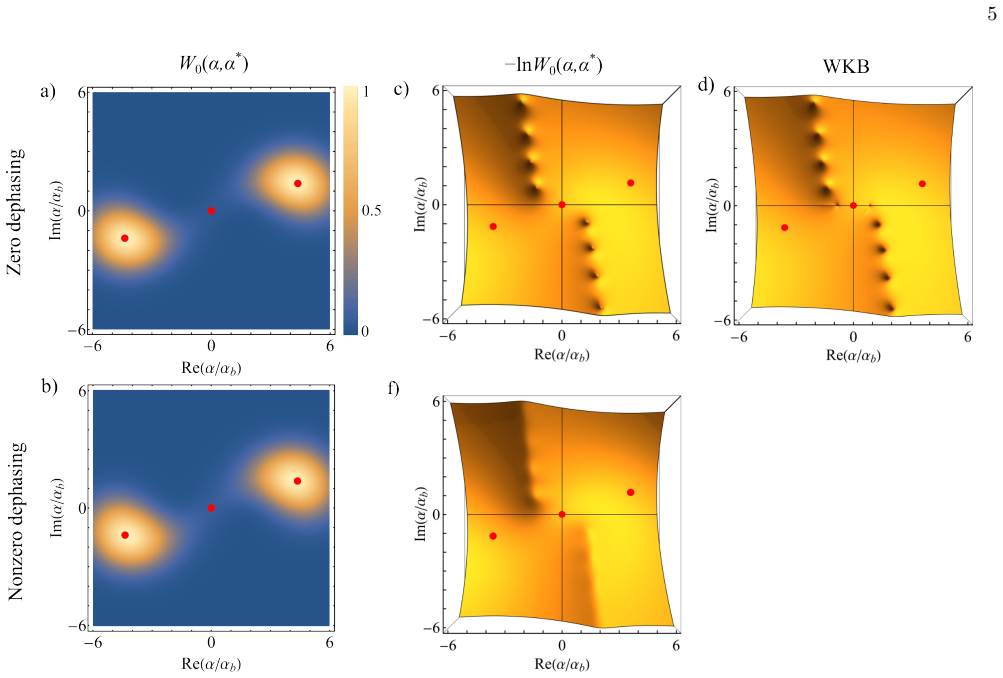
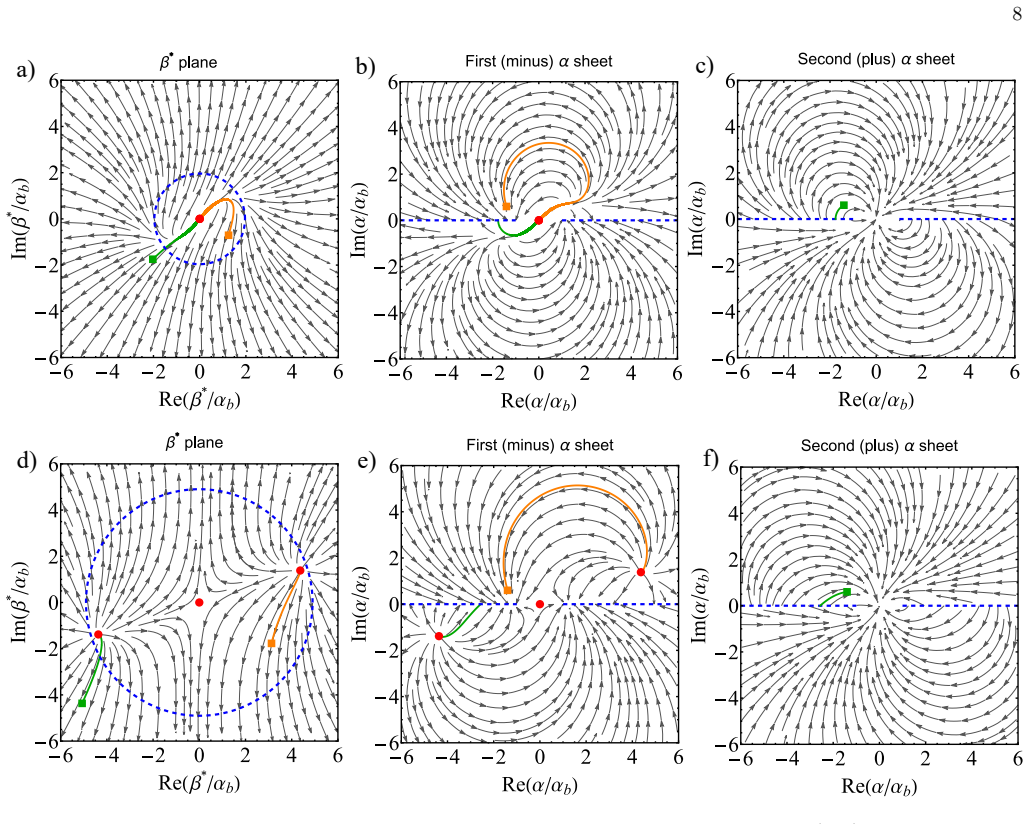
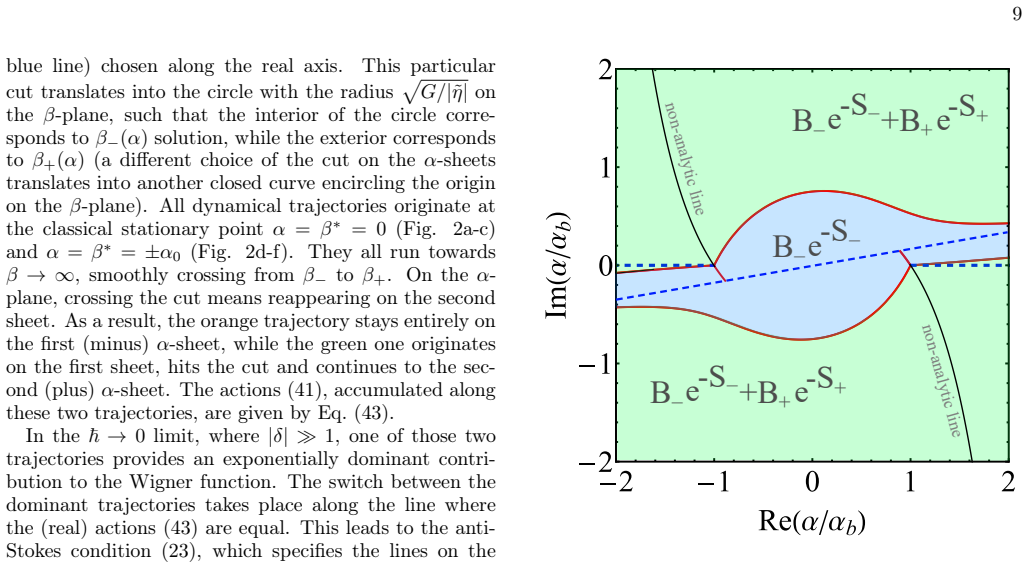
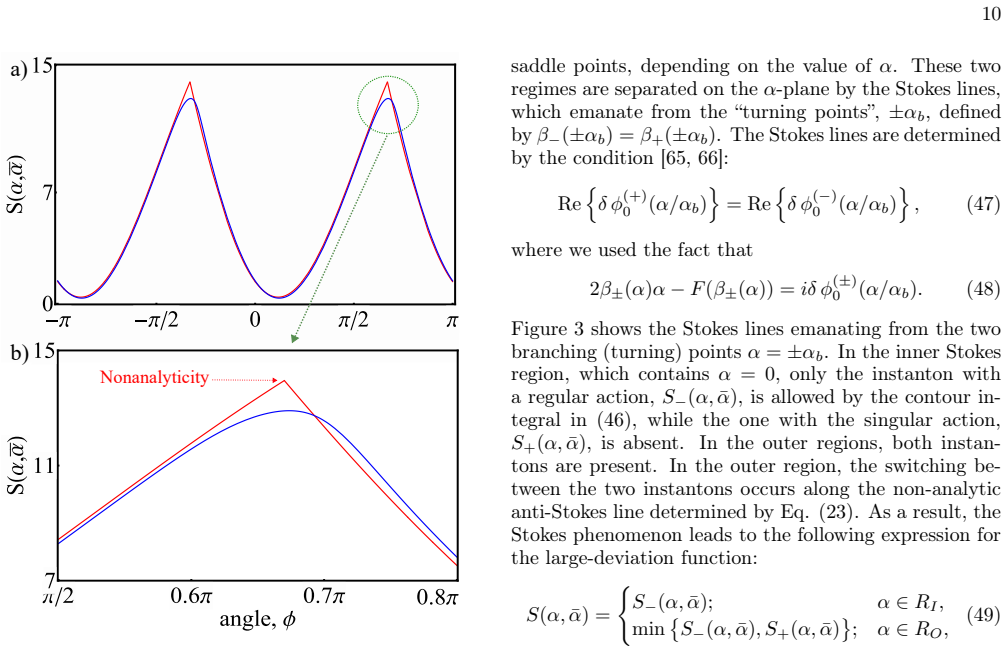
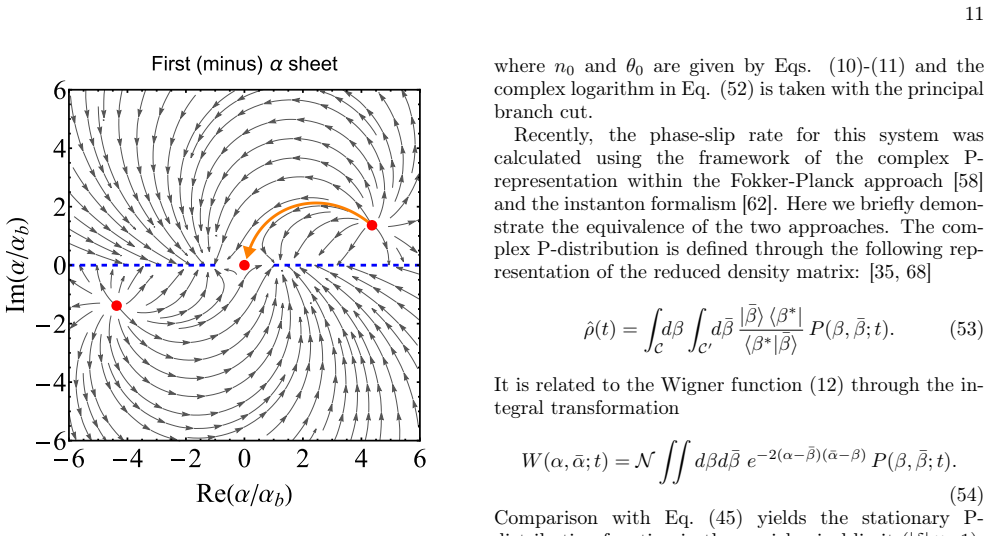
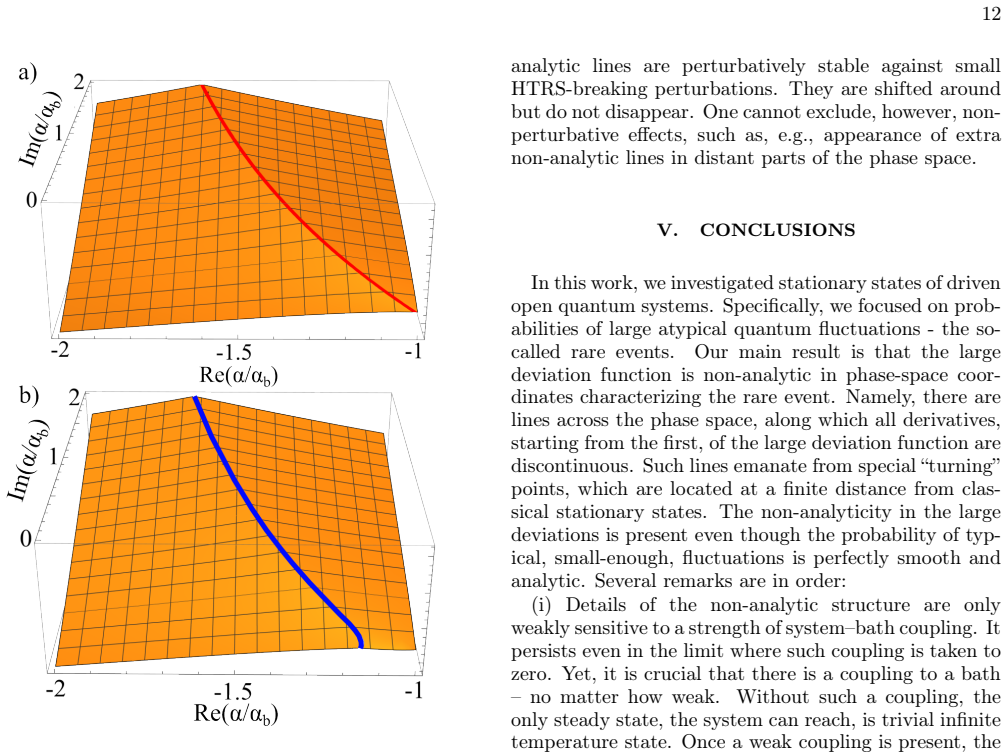
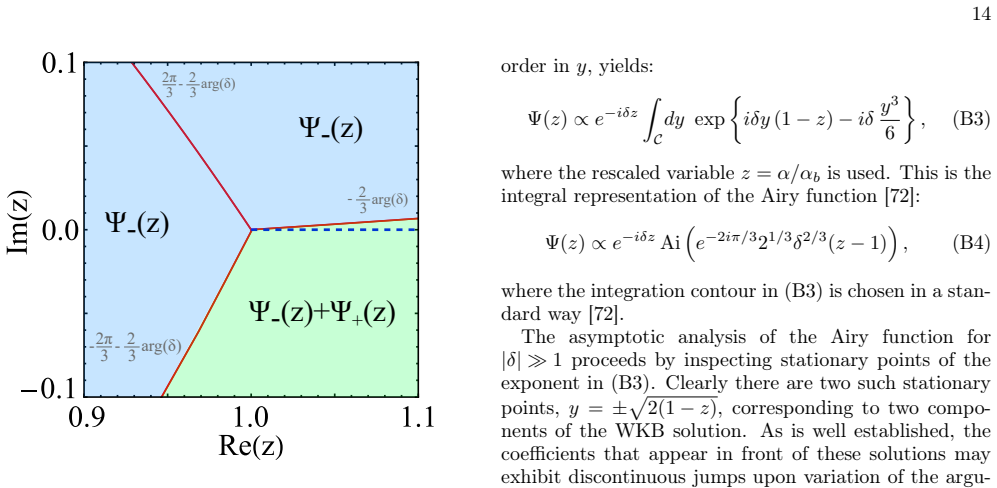
We show that this property is generically lost in driven dissipative systems: their large-deviation function develops lines and surfaces across which its derivatives are discontinuous. Rare fluctuations in the amplitude and phase of the induced oscillations are governed by semiclassical instanton trajectories of the corresponding Keldysh-Lindblad action. We demonstrate that a given fluctuation can be realized through multiple distinct instanton trajectories. The competition between these trajectories leads to abrupt switching of the dominant instanton and, consequently, to non-analytic features in the large-deviation function.
Load-bearing premise
Rare fluctuations are governed by semiclassical instanton trajectories of the Keldysh-Lindblad action, and a given fluctuation can be realized through multiple distinct such trajectories whose competition produces the non-analyticity.
Editorial extensions
If this is right
- The probabilities of atypical measurement outcomes in driven open systems can change abruptly across certain surfaces in phase space.
- In the Kerr-oscillator example the statistics of amplitude and phase fluctuations exhibit these derivative discontinuities.
- The dominant instanton trajectory switches at the locations of the non-analytic lines or surfaces.
- The non-analyticity is presented as a generic feature of driven dissipative steady states rather than a special case.
Reading between the lines
- Similar competition between trajectories could produce non-analytic large-deviation functions in other open quantum models that admit multiple instanton solutions.
- Numerical sampling of rare events in driven dissipative systems may need to account for the abrupt switches rather than assuming smooth interpolation.
- The locations of the non-analytic surfaces might serve as signatures that distinguish driven-dissipative dynamics from equilibrium ones in experiments.
Editorial analysis
A structured set of objections, weighed in public.
Referee Report
Summary. The paper claims that in driven dissipative quantum systems the large-deviation function for atypical steady-state measurement outcomes develops lines and surfaces across which its derivatives are discontinuous, in contrast to the analytic phase-space distributions (e.g., Wigner function) found in equilibrium. This non-analyticity is attributed to competition among multiple distinct semiclassical instanton trajectories of the Keldysh-Lindblad action; the claim is illustrated with a parametrically driven Kerr oscillator coupled linearly or nonlinearly to a bath, where abrupt switching between dominant instantons produces the kinks or cusps.
Significance. If substantiated, the result would establish a qualitative distinction between equilibrium and driven open quantum systems in the structure of large-deviation functions, with potential consequences for the statistics of rare events in quantum optics and related platforms. The mechanistic identification of instanton competition as the origin of the non-analyticity supplies a concrete, falsifiable picture within the standard Keldysh-Lindblad formalism.
major comments (2)
- [Kerr-oscillator example (semiclassical treatment)] The central claim that non-analyticities survive generically rests on the semiclassical saddle-point approximation; the Kerr-oscillator example supplies no explicit bound on the magnitude of subleading fluctuation determinants or interference terms that could round the discontinuities across the switching surface.
- [Abstract and illustrative example] Generality is asserted from a single model without a parameter-free argument showing that the same multiple-trajectory competition mechanism persists in other driven-dissipative systems; the abstract states the property is 'generically lost' but the supporting analysis is model-specific.
minor comments (1)
- Notation for the large-deviation function I(observable) and the precise definition of the observable (amplitude/phase) should be introduced earlier for clarity.
Simulated Author's Rebuttal
We thank the referee for the careful reading and constructive comments on our manuscript. We address the two major comments point by point below, clarifying the scope of the semiclassical analysis and the generality of the proposed mechanism.
read point-by-point responses
-
Referee: [Kerr-oscillator example (semiclassical treatment)] The central claim that non-analyticities survive generically rests on the semiclassical saddle-point approximation; the Kerr-oscillator example supplies no explicit bound on the magnitude of subleading fluctuation determinants or interference terms that could round the discontinuities across the switching surface.
Authors: The large-deviation function is defined as the leading exponential rate I = -lim (1/N) log P, obtained from the saddle-point evaluation of the Keldysh-Lindblad path integral. This rate is exactly the minimum action among competing instantons; at a switching surface the rate function is the lower envelope of two smooth branches and is therefore non-analytic whenever the gradients differ. Sub-exponential corrections arising from fluctuation determinants or interference enter only the prefactor and cannot remove the non-analyticity of the leading rate function itself. In open dissipative systems the environment further suppresses coherent interference between macroscopically distinct trajectories. We will add a short clarifying paragraph on this point in the revised manuscript. revision: partial
-
Referee: [Abstract and illustrative example] Generality is asserted from a single model without a parameter-free argument showing that the same multiple-trajectory competition mechanism persists in other driven-dissipative systems; the abstract states the property is 'generically lost' but the supporting analysis is model-specific.
Authors: The mechanism follows from the general structure of the Keldysh-Lindblad action for driven systems: the drive term renders the effective potential non-Hermitian, permitting multiple distinct instanton solutions that can cross in action. In equilibrium the corresponding action reduces to a form whose minimizing trajectory is unique for each observable, restoring analyticity. This distinction is independent of the specific Kerr parameters and holds for any driven dissipative system whose steady-state manifold supports multiple attractors. The Kerr oscillator serves only as an explicit illustration; we will revise the abstract and introduction to separate the general structural argument from the concrete example. revision: yes
Circularity Check
No circularity: derivation applies standard Keldysh-Lindblad instanton analysis to derive non-analyticity
full rationale
The paper's central result follows from minimizing the Keldysh-Lindblad action over semiclassical trajectories for the driven Kerr oscillator model; multiple distinct instantons compete to produce switching and kinks in the large-deviation function as a direct consequence of the variational problem. No step reduces by definition to the target non-analyticity, no parameters are fitted to the observable being predicted, and no load-bearing self-citation or imported uniqueness theorem is required. The derivation remains self-contained within the established formalism.
Assumptions & free parameters
assumptions (1)
- domain assumption Semiclassical instanton trajectories of the Keldysh-Lindblad action govern rare fluctuations in driven open quantum systems.
Cite this review
Pith. "Pith review of Large Fluctuations in Open Quantum Systems." pith.science (2026). https://pith.science/paper/XHPN23BT
@misc{pith2026260611822,
  author       = {Pith},
  title        = {Pith review of: Large Fluctuations in Open Quantum Systems},
  year         = {2026},
  howpublished = {\url{https://pith.science/paper/XHPN23BT}},
  note         = {Machine review of arXiv:2606.11822}
}
read the original abstract
We study statistics of atypical measurement outcomes in the steady states of driven open quantum systems. In equilibrium, the probability distribution over the phase space, as encoded in, e.g., the Wigner function, is analytic in the phase-space coordinates. We show that this property is generically lost in driven dissipative systems: their {\it large-deviation function} develops lines and surfaces across which its derivatives are discontinuous. As an illustrative example, we consider a parametrically driven Kerr oscillator coupled linearly and/or nonlinearly to a dissipative bath. Rare fluctuations in the amplitude and phase of the induced oscillations are governed by semiclassical instanton trajectories of the corresponding Keldysh-Lindblad action. We demonstrate that a given fluctuation can be realized through multiple distinct instanton trajectories. The competition between these trajectories leads to abrupt switching of the dominant instanton and, consequently, to non-analytic features in the large-deviation function.
Figures
Figures from the paper (4 more)
Reference graph
Works this paper leans on
-
[1]
Leghtas, G
Z. Leghtas, G. Kirchmair, B. Vlastakis, R. J. Schoelkopf, M. H. Devoret, and M. Mirrahimi, Phys. Rev. Lett.111, 120501 (2013)
2013
-
[2]
Mirrahimi, Z
M. Mirrahimi, Z. Leghtas, V. V. Albert, S. Touzard, R. J. Schoelkopf, L. Jiang, and M. H. Devoret, New J. Phys. 16, 045014 (2014)
2014
-
[3]
Grimm, N
A. Grimm, N. E. Frattini, S. Puri, S. O. Mundhada, S. Touzard, M. Mirrahimi, S. M. Girvin, S. Shankar, and M. H. Devoret, Nature584, 205 (2020)
2020
-
[4]
S. Puri, S. Boutin, and A. Blais, npj Quantum Inf.3, 18 (2017)
2017
-
[5]
Goto, Scientific Reports6, 21686 (2016), publisher: Nature Publishing Group
H. Goto, Scientific Reports6, 21686 (2016), publisher: Nature Publishing Group
2016
-
[6]
Zhang and M
Y. Zhang and M. I. Dykman, Physical Review A95, 053841 (2017), publisher: American Physical Society
2017
-
[7]
Ch´ avez-Carlos, M
J. Ch´ avez-Carlos, M. A. Prado Reynoso, R. G. Corti˜ nas, I. Garc´ ıa-Mata, V. S. Batista, F. P´ erez-Bernal, D. A. Wisniacki, and L. F. Santos, Quantum Science and Tech- nology10, 015039 (2024), publisher: IOP Publishing
2024
-
[8]
Venkatraman, R
J. Venkatraman, R. G. Corti˜ nas, N. E. Frattini, X. Xiao, and M. H. Devoret, Proceedings of the National Academy of Sciences121, e2311241121 (2024), publisher: Proceed- ings of the National Academy of Sciences
2024
Show all 71 references
-
[9]
R´ eglade, A
U. R´ eglade, A. Bocquet, R. Gautier, J. Cohen, A. Marquet, E. Albertinale, N. Pankratova, M. Hall´ en, F. Rautschke, L.-A. Sellem, P. Rouchon, A. Sarlette, M. Mirrahimi, P. Campagne-Ibarcq, R. Lescanne, S. Je- zouin, and Z. Leghtas, Nature629, 778 (2024), pub- lisher: Nature ...
2024
-
[10]
Marquet, S
A. Marquet, S. Dupouy, U. R´ eglade, A. Essig, J. Co- hen, E. Albertinale, A. Bienfait, T. Peronnin, S. Jezouin, R.Lescanne, andB.Huard,PhysicalReviewApplied22, 034053 (2024), publisher: American Physical Society
2024
-
[11]
Rugar and P
D. Rugar and P. Gr¨ utter, Physical Review Letters67, 699 (1991), publisher: American Physical Society
1991
-
[12]
R. B. Karabalin, R. Lifshitz, M. C. Cross, M. H. Ma- theny, S. C. Masmanidis, and M. L. Roukes, Physical Review Letters106, 094102 (2011), publisher: American Physical Society
2011
-
[13]
Eichler, T
A. Eichler, T. L. Heugel, A. Leuch, C. L. Degen, R. Chi- tra, and O. Zilberberg, Applied Physics Letters112, 233105 (2018)
2018
-
[14]
Eichler and O
A. Eichler and O. Zilberberg,Classical and Quantum Parametric Phenomena(Oxford University Press, Ox- ford, 2023)
2023
-
[15]
J. Guo, Q. He, and M. Fadel, Physical Review A109, 052604 (2024), publisher: American Physical Society
2024
-
[16]
Lescanne, M
R. Lescanne, M. Villiers, T. Peronnin, A. Sarlette, M. Delbecq, B. Huard, T. Kontos, M. Mirrahimi, and Z. Leghtas, Nat. Phys.16, 509–513 (2020)
2020
-
[17]
Touchette, Physics Reports478, 1 (2009)
H. Touchette, Physics Reports478, 1 (2009)
2009
-
[18]
Assaf and B
M. Assaf and B. Meerson, Journal of Physics A: Mathe- matical and Theoretical50, 263001 (2017)
2017
-
[19]
Graham and A
R. Graham and A. Schenzle, Zeitschrift f¨ ur Physik B Condensed Matter52, 61 (1983)
1983
-
[20]
M. I. Dykman, M. M. Millonas, and V. N. Smelyanskiy, Physics Letters A195, 53 (1994)
1994
-
[21]
M. I. Freidlin and A. D. Wentzell, inRandom perturba- tions of dynamical systems(Springer, 1998) pp. 15–43
1998
-
[22]
Graham and T
R. Graham and T. T´ el, Phys. Rev. A31, 1109 (1985)
1985
-
[23]
Graham and T
R. Graham and T. T´ el, Physical review letters52, 9 (1984)
1984
-
[24]
Graham and T
R. Graham and T. T´ el, Journal of statistical physics35, 729 (1984)
1984
-
[25]
Dembo and O
A. Dembo and O. Zeitouni,Large deviations techniques and applications, Vol. 38 (Springer Science & Business Media, 2009)
2009
-
[26]
P. C. Martin, E. D. Siggia, and H. A. Rose, Physical Review A8, 423 (1973)
1973
-
[27]
Wigner, Physical review40, 749 (1932)
E. Wigner, Physical review40, 749 (1932)
1932
-
[28]
M. V. Berry, Philosophical Transactions of the Royal So- ciety of London. Series A, Mathematical and Physical Sciences287, 237 (1977)
1977
-
[29]
Dykman, M
M. Dykman, M. Marthaler, and V. Peano, Physical Review A—Atomic, Molecular, and Optical Physics83, 052115 (2011)
2011
-
[30]
M. I. Dykman and V. N. Smelyanskii, Sov. Phys. JETP 67, 61 (1988)
1988
-
[31]
Roberts, A
D. Roberts, A. Lingenfelter, and A. Clerk, PRX Quan- tum2, 020336 (2021)
2021
-
[32]
Roberts and A
D. Roberts and A. A. Clerk, Phys. Rev. X10, 021022 (2020)
2020
-
[34]
Kamenev,Field theory of non-equilibrium systems (Cambridge University Press, 2023)
A. Kamenev,Field theory of non-equilibrium systems (Cambridge University Press, 2023)
2023
-
[35]
Bartolo, F
N. Bartolo, F. Minganti, W. Casteels, and C. Ciuti, Physical Review A94, 033841 (2016)
2016
-
[36]
C. H. Meaney, H. Nha, T. Duty, and G. J. Milburn, EPJ quantum technology1, 7 (2014)
2014
-
[37]
V. Y. Mylnikov, S. O. Potashin, G. S. Sokolovskii, and N. S. Averkiev, Nanomaterials12, 2543 (2022)
2022
-
[38]
Downing and A
C. Downing and A. Vidiella-Barranco, Scientific reports 13, 11004 (2023)
2023
-
[39]
V. Y. Mylnikov, S. Potashin, G. Sokolovskii, and N. Averkiev, Physical Review Research7, 013061 (2025)
2025
-
[40]
Walls and G
D. Walls and G. Milburn,Quantum Optics(Springer Cham, 2025)
2025
-
[41]
M. O. Scully and M. S. Zubairy,Quantum optics(Cam- bridge university press, 1997)
1997
-
[42]
K. E. Cahill and R. J. Glauber, Phys. Rev.177, 1882 (1969)
1969
-
[43]
Husimi, Proceedings of the Physico-Mathematical So- ciety of Japan
K. Husimi, Proceedings of the Physico-Mathematical So- ciety of Japan. 3rd Series22, 264 (1940)
1940
-
[44]
R. J. Glauber, Physical Review131, 2766 (1963)
1963
-
[45]
P. D. Drummond and C. W. Gardiner, Journal of Physics A: Mathematical and General13, 2353 (1980)
1980
-
[46]
Kinsler and P
P. Kinsler and P. D. Drummond, Physical Review A43, 6194 (1991)
1991
-
[47]
Marthaler and M
M. Marthaler and M. Dykman, Physical Review A—Atomic, Molecular, and Optical Physics76, 010102 (2007)
2007
-
[48]
Dykman, C
M. Dykman, C. Maloney, V. Smelyanskiy, and M. Sil- verstein, Physical Review E57, 5202 (1998). 17
1998
-
[49]
Dykman, Physical Review E—Statistical, Nonlinear, and Soft Matter Physics75, 011101 (2007)
M. Dykman, Physical Review E—Statistical, Nonlinear, and Soft Matter Physics75, 011101 (2007)
2007
-
[50]
Dykman, Fluctuating Nonlinear Oscillators , 165 (2012)
M. Dykman, Fluctuating Nonlinear Oscillators , 165 (2012)
2012
-
[51]
Q. Su, R. G. Corti˜ nas, J. Venkatraman, and S. Puri, Phys. Rev. A112, 042202 (2025)
2025
-
[52]
N. E. Frattini, R. G. Corti˜ nas, J. Venkatraman, X. Xiao, Q. Su, C. U. Lei, B. J. Chapman, V. R. Joshi, S. Girvin, R. J. Schoelkopf,et al., Physical Review X14, 031040 (2024)
2024
-
[53]
D. K. J. Boneß, W. Belzig, and M. I. Dykman, Phys. Rev. Res.7, 023188 (2025)
2025
-
[54]
Putterman, K
H. Putterman, K. Noh, R. N. Patel, G. A. Peairs, G. S. MacCabe, M. Lee, S. Aghaeimeibodi, C. T. Hann, I. Jar- rige, G. Marcaud, Y. He, H. Moradinejad, J. C. Owens, T. Scaffidi, P. Arrangoiz-Arriola, J. Iverson, H. Levine, F. G. S. L. Brand˜ ao, M. H. Matheny, and O. Painter, P...
2025
-
[55]
K. S. Dubovitskii, D. M. Basko, J. S. Meyer, and M. Houzet, Phys. Rev. B110, 024505 (2024)
2024
-
[56]
K.S.Dubovitskii,PhysicalReviewA111,012617(2025)
2025
-
[57]
Chamberland, K
C. Chamberland, K. Noh, P. Arrangoiz-Arriola, E. T. Campbell, C. T. Hann, J. Iverson, H. Putterman, T. C. Bohdanowicz, S. T. Flammia, A. Keller, G. Refael, J. Preskill, L. Jiang, A. H. Safavi-Naeini, O. Painter, and F. G. Brand˜ ao, PRX Quantum3, 010329 (2022)
2022
-
[58]
F.-X. Sun, Q. He, Q. Gong, R. Y. Teh, M. D. Reid, and P. D. Drummond, New Journal of Physics21, 093035 (2019)
2019
-
[59]
C.-W. Lee, P. Brookes, K.-S. Park, M. H. Szyma´ nska, and E. Ginossar, Phys. Rev. A112, 012216 (2025)
2025
-
[60]
Thompson and A
F. Thompson and A. Kamenev, Physical Review Re- search4, 023020 (2022)
2022
-
[61]
S´ epulcre, Phys
T. S´ epulcre, Phys. Rev. Res.8, L012058 (2026)
2026
-
[62]
Carde, R
L. Carde, R. Gautier, N. Didier, A. Petrescu, J. Cohen, and A. McDonald, Phys. Rev. Lett.136, 100402 (2026)
2026
-
[63]
Thompson, D
F. Thompson, D. K. J. Boneß, M. Dykman, and A. Kamenev, Phys. Rev. A113, 043712 (2026)
2026
-
[64]
L. M. Sieberer, M. Buchhold, and S. Diehl, Reports on Progress in Physics79, 096001 (2016)
2016
- [65]
-
[66]
C. M. Bender and S. A. Orszag,Advanced Mathematical Methods for Scientists and Engineers: Asymptotic Meth- ods and Perturbation Theory, Vol. 1 (Springer, 1999)
1999
-
[67]
Xiang, W
Y.-X. Xiang, W. Li, Z. Bai, and Y.-Q. Ma, National Science Review , nwag146 (2026)
2026
-
[68]
Drummond and D
P. Drummond and D. Walls, Journal of Physics A: Math- ematical and General13, 725 (1980)
1980
-
[69]
Marthaler and M
M. Marthaler and M. I. Dykman, Phys. Rev. A73, 042108 (2006)
2006
-
[70]
Vicentini, F
F. Vicentini, F. Minganti, R. Rota, G. Orso, and C. Ciuti, Physical Review A97, 013853 (2018)
2018
-
[71]
L. M. Sieberer, M. Buchhold, J. Marino, and S. Diehl, Reviews of Modern Physics97, 025004 (2025)
2025
-
[72]
Olver,Asymptotics and special functions(Academic Press, New York, 1997)
F. Olver,Asymptotics and special functions(Academic Press, New York, 1997)
1997
Reviewed June 27, 2026 · model on record in the stance chip above.
Discussion (0). Continue with ORCID to comment.