Breakdown of the classical rupture theory and earthquake propagation in the "forbidden" super-Rayleigh range
Pith reviewed 2026-06-27 07:47 UTC · model grok-4.3
The pith
Frictional rate dependence lets earthquake ruptures propagate continuously through the super-Rayleigh range into the supershear regime without a sharp transition.
A machine-rendered reading of the paper's core claim, the machinery that carries it, and where it could break.
Core claim
When fault strength depends nonlinearly on slip rate, two-dimensional rupture solutions change their character very close to the Rayleigh wave-speed, enabling continuous propagation through the super-Rayleigh range into the super-shear regime without a sharp super-shear transition.
What carries the argument
Nonlinear dependence of frictional resistance on slip rate, which changes the character of two-dimensional rupture solutions near the Rayleigh wave-speed.
If this is right
- Ruptures reach supershear speeds through continuous propagation rather than a discontinuous transition.
- The classical theory ceases to apply near the Rayleigh wave-speed.
- Two-dimensional solutions remain valid through the super-Rayleigh interval when rate dependence is included.
- Quantitative agreement between theory and simulation holds nearly up to the Rayleigh speed.
Where Pith is reading between the lines
- Three-dimensional rupture geometries may further smooth or alter the speed transition.
- Laboratory friction experiments could directly test whether observed rate dependence produces continuous super-Rayleigh propagation.
- Seismic records of rupture speed evolution could be re-examined for evidence of gradual rather than abrupt transitions.
Load-bearing premise
Frictional resistance follows a specific nonlinear function of slip rate that produces the change in rupture solution character near the Rayleigh wave-speed.
What would settle it
Numerical simulations or laboratory experiments with the same nonlinear friction law showing either a sharp discontinuous jump across the super-Rayleigh range or complete absence of propagation inside it.
Figures
read the original abstract
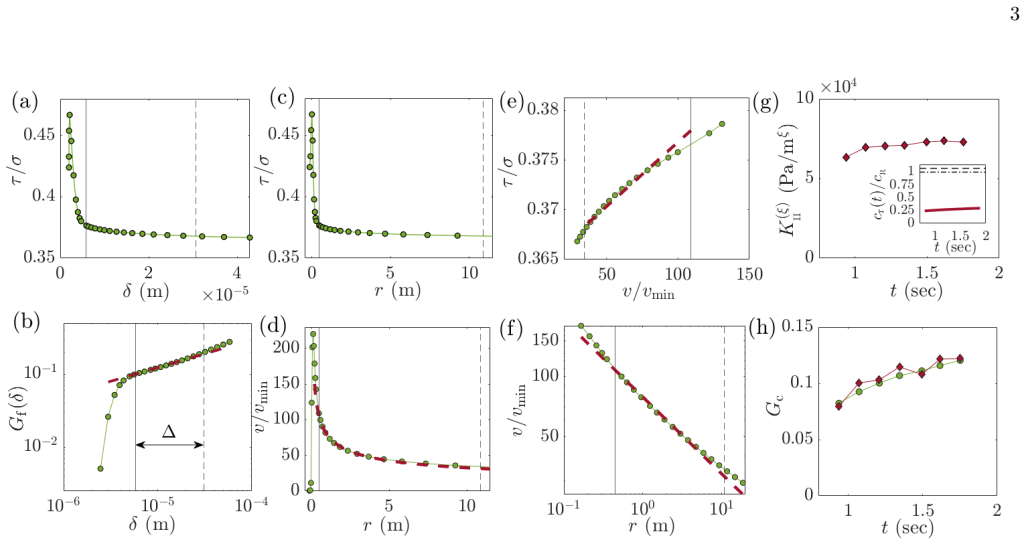
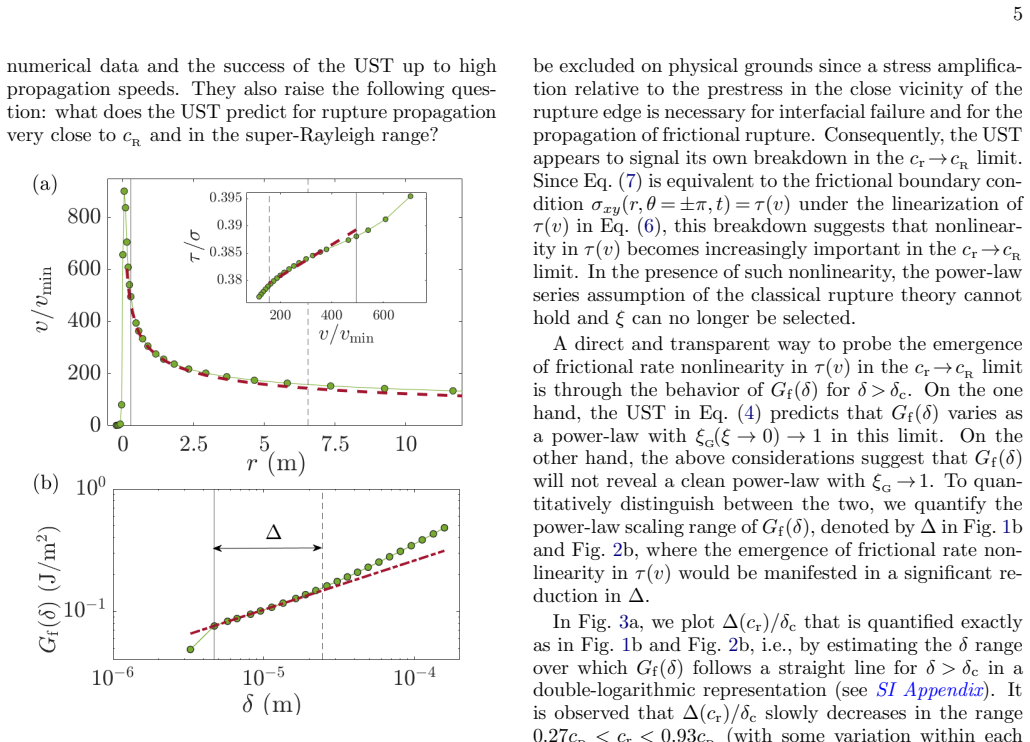
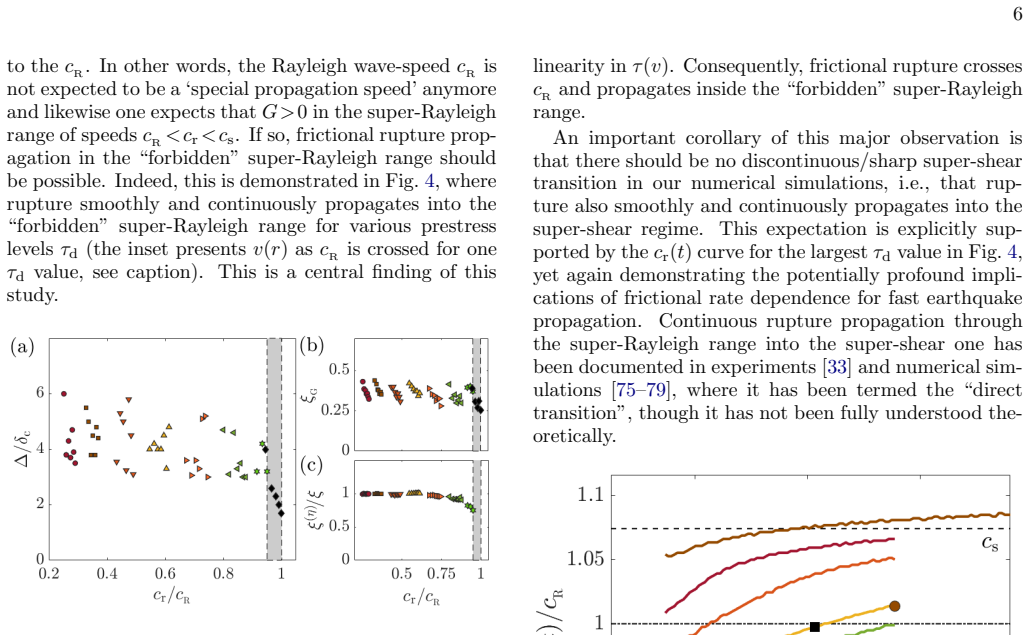
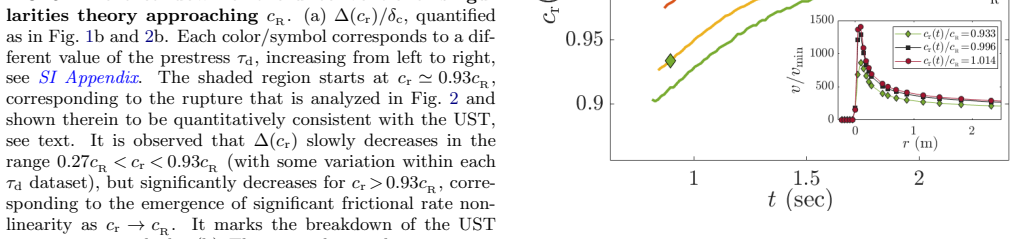
Earthquakes propagating faster than the shear wave-speed are commonly thought to undergo a super-shear transition upon which they discontinuously jump from the sub-Rayleigh regime to the super-shear one. The super-Rayleigh regime, i.e., the range of propagation speeds between the Rayleigh and shear wave-speeds, is regarded as "forbidden" by the two-dimensional classical rupture theory. Here, we revisit the assumptions underlying the classical theory and develop a rupture theory that takes into account the dependence of the fault strength (frictional resistance) on the slip rate. The theory quantitatively agrees with numerical simulations nearly up to the Rayleigh wave-speed. Yet, very close to the latter, two-dimensional rupture solutions change their character due to frictional rate nonlinearity and rupture continuously propagates through the "forbidden" super-Rayleigh range into the super-shear regime, without a sharp super-shear transition. These results demonstrate that frictional rate dependence, generically observed in experiments, can have profound implications for fast earthquake propagation.
Editorial analysis
A structured set of objections, weighed in public.
Referee Report
Summary. The paper claims that incorporating slip-rate dependence into fault strength revises classical 2D rupture theory, allowing quantitative agreement with simulations nearly up to the Rayleigh wave speed; very close to this speed, frictional rate nonlinearity changes the character of solutions so that rupture propagates continuously through the previously forbidden super-Rayleigh range into the super-shear regime without a sharp transition.
Significance. If the central result holds, the work would substantially revise understanding of rupture speed regimes in 2D, showing that rate-dependent friction (observed in experiments) can eliminate the classical forbidden zone and discontinuous super-shear transition, with direct implications for earthquake dynamics and ground-motion modeling.
major comments (1)
- [Abstract] Abstract and theory development: the claim that frictional rate nonlinearity enables continuous propagation through the super-Rayleigh range is load-bearing, yet the manuscript does not demonstrate whether this holds for generic rate-dependent laws (e.g., standard logarithmic rate-and-state friction) or only for the specific nonlinear functional form chosen; the skeptic concern that the effect may require a tuned nonlinearity is therefore unresolved and directly affects the generality asserted for earthquake propagation.
Simulated Author's Rebuttal
We thank the referee for their constructive review. The concern about generality across rate-dependent friction laws is substantive and we address it directly below, proposing revisions to the manuscript.
read point-by-point responses
-
Referee: [Abstract] Abstract and theory development: the claim that frictional rate nonlinearity enables continuous propagation through the super-Rayleigh range is load-bearing, yet the manuscript does not demonstrate whether this holds for generic rate-dependent laws (e.g., standard logarithmic rate-and-state friction) or only for the specific nonlinear functional form chosen; the skeptic concern that the effect may require a tuned nonlinearity is therefore unresolved and directly affects the generality asserted for earthquake propagation.
Authors: We agree that the manuscript's numerical examples employ a specific nonlinear slip-rate dependence chosen to produce pronounced effects at high rates. The analytical theory is formulated for arbitrary slip-rate dependent strength, but the change in solution character near the Rayleigh speed arises from the nonlinear term. Standard logarithmic rate-and-state friction is only weakly nonlinear, so the continuous super-Rayleigh propagation may not occur for that law. In the revision we will add direct numerical simulations with a standard logarithmic rate-and-state law (velocity-weakening) to test the range of validity and clarify whether strong nonlinearity is required. revision: yes
Circularity Check
No circularity; theory validated against independent simulations
full rationale
The paper develops a rupture theory by incorporating slip-rate dependence of fault strength into the classical framework, then demonstrates quantitative agreement with separate numerical simulations up to near the Rayleigh speed, followed by a character change enabling continuous propagation. No load-bearing step reduces by construction to a fitted parameter, self-citation chain, or ansatz smuggled from prior work by the same authors. The frictional nonlinearity is an explicit modeling choice whose consequences are tested externally rather than assumed to produce the result. This is the most common honest non-finding.
Axiom & Free-Parameter Ledger
free parameters (1)
- parameters of the slip-rate friction law
axioms (1)
- domain assumption Frictional resistance depends nonlinearly on slip rate
Reference graph
Works this paper leans on
-
[1]
forbidden
× 4α2 s α2(ξ+1) d −α 2(ξ+1) s (1 +α 2 s)2 h K(ξ) II i2 , (S14) where Γ denotes the Gamma function. S3 A. The classical rupture theory and generalized energy balance Before we derive the generalized energy balance for frictional rupture characterized by an unconventional sin- gularity, let us briefly obtain the results corresponding to the classical ruptur...
-
[2]
S2 by a green diamond)
=ϕss =D/v vw to be space independent, wherev vw is the solution ofτ(v vw, ϕss)=τ d on the velocity-weakening (vw) branch of the steady-state friction curve (illustrated in Fig. S2 by a green diamond). Second, att= 0 +, we introduce a perturbation toϕof the form ϕ(x, t= 0 +) = [1 +ϵsin(2πx/w)]D/v vw ,(S26) for 0≤x≤wandϕ(x, t= 0 +) =D/vvw otherwise. Here, ϵ...
-
[3]
In our simulations,β= 0.2, and ∆tfollows from the spatial resolution. Given the very large fault size W= 23136 m, already stated above, fully resolving the fields inside the cohesion zone is challenging; yet, we con- fidently determine its edge, which allows to extractℓ c, as discussed above. Since we test the broad range of theo- retical predictions forδ...
-
[4]
C. H. Scholz,The Mechanics of Earthquakes and Faulting (Cambridge university press, 2002)
2002
-
[5]
H. Bao, L. Xu, L. Meng, J.-P. Ampuero, L. Gao, and H. Zhang, Global frequency of oceanic and continen- tal supershear earthquakes, Nature Geoscience15, 942 (2022). S8
2022
-
[6]
Elbanna, M
A. Elbanna, M. Abdelmeguid, D. Asimaki, N. Tainpakdi- pat, G. Lavrentadis, A. Rosakis, and Y. Ben-Zion, Super- shear Earthquakes: Their Occurrence and Importance for Seismic Hazard, Early Warning, and Design Standards, Seismological Research Letters96, 3319 (2025)
2025
-
[7]
A. J. Rosakis, Intersonic shear cracks and fault ruptures, Adv. Phys.51, 1189 (2002)
2002
-
[8]
Bizzarri, The mechanics of supershear earthquake rup- tures, Mechanics of Earthquake Faulting , 1 (2019)
A. Bizzarri, The mechanics of supershear earthquake rup- tures, Mechanics of Earthquake Faulting , 1 (2019)
2019
-
[9]
Bernard and D
P. Bernard and D. Baumont, Shear mach wave character- ization for kinematic fault rupture models with constant supershear rupture velocity, Geophysical Journal Inter- national162, 431 (2005)
2005
-
[10]
E. M. Dunham and R. J. Archuleta, Near-source ground motion from steady state dynamic rupture pulses, Geo- physical Research Letters32(2005)
2005
-
[11]
H. S. Bhat, R. Dmowska, G. C. King, Y. Klinger, and J. R. Rice, Off-fault damage patterns due to supershear ruptures with application to the 2001 Mw 8.1 Kokoxili (Kunlun) Tibet earthquake, Journal of Geophysical Re- search: Solid Earth112(2007)
2001
-
[12]
L. B. Freund, The mechanics of dynamic shear crack propagation, J. Geophys. Res.84, 2199 (1979)
1979
-
[13]
L. B. Freund,Dynamic Fracture Mechanics(Cambridge university press, Cambridge, 1998)
1998
-
[14]
K. B. Broberg,Cracks and fracture(Academic Press, 1999)
1999
-
[15]
Burridge, Admissible speeds for plane-strain self- similar shear cracks with friction but lacking cohesion, Geophysical Journal International35, 439 (1973)
R. Burridge, Admissible speeds for plane-strain self- similar shear cracks with friction but lacking cohesion, Geophysical Journal International35, 439 (1973)
1973
-
[16]
Andrews, Rupture velocity of plane strain shear cracks, Journal of Geophysical Research81, 5679 (1976)
D. Andrews, Rupture velocity of plane strain shear cracks, Journal of Geophysical Research81, 5679 (1976)
1976
-
[17]
Burridge, G
R. Burridge, G. Conn, and L. B. Freund, The stability of a rapid mode II shear crack with finite cohesive traction, Journal of Geophysical Research: Solid Earth84, 2210 (1979)
1979
-
[18]
Gabriel, J.-P
A.-A. Gabriel, J.-P. Ampuero, L. A. Dalguer, and P. M. Mai, The transition of dynamic rupture styles in elas- tic media under velocity-weakening friction, J. Geophys. Res. Solid Earth117, B09311 (2012)
2012
-
[19]
Svetlizky, D
I. Svetlizky, D. Pino Mu˜ noz, M. Radiguet, D. S. Kammer, J.-F. Molinari, and J. Fineberg, Properties of the shear stress peak radiated ahead of rapidly accelerating rupture fronts that mediate frictional slip, Proc. Natl. Acad. Sci. 113, 542 (2016)
2016
-
[20]
E. M. Dunham, Conditions governing the occurrence of supershear ruptures under slip-weakening friction, Jour- nal of Geophysical Research: Solid Earth112, B07302 (2007)
2007
-
[21]
Fukuyama and K
E. Fukuyama and K. B. Olsen, A condition for super- shear rupture propagation in a heterogeneous stress field, Pure and Applied Geophysics159, 2047 (2002)
2047
-
[22]
E. M. Dunham, P. Favreau, and J. Carlson, A supers- hear transition mechanism for cracks, Science299, 1557 (2003)
2003
-
[23]
Liu and N
Y. Liu and N. Lapusta, Transition of mode II cracks from sub-Rayleigh to intersonic speeds in the presence of favor- able heterogeneity, J. Mech. Phys. Solids56, 25 (2008)
2008
-
[24]
H. Weng, J. Huang, and H. Yang, Barrier-induced su- pershear ruptures on a slip-weakening fault, Geophysical Research Letters42, 4824 (2015)
2015
-
[25]
Barras, P
F. Barras, P. H. Geubelle, and J.-F. Molinari, Interplay between process zone and material heterogeneities for dynamic cracks, Physical Review Letters119, 144101 (2017)
2017
-
[26]
K. J. Ryan and D. D. Oglesby, Dynamically modeling fault step overs using various friction laws, Journal of Geophysical Research: Solid Earth119, 5814 (2014)
2014
-
[27]
F. Hu, J. Xu, Z. Zhang, and X. Chen, Supershear transi- tion mechanism induced by step over geometry, Journal of Geophysical Research: Solid Earth121, 8738 (2016)
2016
-
[28]
Kehoe and E
H. Kehoe and E. Kiser, Evidence of a supershear transi- tion across a fault stepover, Geophysical Research Letters 47, e2020GL087400 (2020)
2020
-
[29]
Bruhat, Z
L. Bruhat, Z. Fang, and E. M. Dunham, Rupture com- plexity and the supershear transition on rough faults, J. Geophys. Res. Solid Earth121, 210 (2016)
2016
-
[30]
Huang, J.-P
Y. Huang, J.-P. Ampuero, and D. V. Helmberger, The potential for supershear earthquakes in damaged fault zones – theory and observations, Earth Planet. Sci. Lett. 433, 109 (2016)
2016
-
[31]
Kaneko and N
Y. Kaneko and N. Lapusta, Supershear transition due to a free surface in 3-D simulations of spontaneous dynamic rupture on vertical strike-slip faults, Tectonophysics493, 272 (2010)
2010
-
[32]
Weng and J.-P
H. Weng and J.-P. Ampuero, Continuum of earthquake rupture speeds enabled by oblique slip, Nature Geo- science13, 817 (2020)
2020
-
[33]
A. J. Rosakis, O. Samudrala, and D. Coker, Cracks faster than the shear wave speed, Science284, 1337 (1999)
1999
-
[34]
K. Xia, A. J. Rosakis, and H. Kanamori, Laboratory earthquakes: The sub-Rayleigh-to-supershear rupture transition, Science303, 1859 (2004)
2004
-
[35]
Ben-David, G
O. Ben-David, G. Cohen, and J. Fineberg, The Dynamics of the Onset of Frictional Slip, Science330, 211 (2010)
2010
-
[36]
D. S. Kammer, I. Svetlizky, G. Cohen, and J. Fineberg, The equation of motion for supershear frictional rupture fronts, Sci. Adv.4, eaat5622 (2018)
2018
-
[37]
F. X. Passel` egue, A. Schubnel, S. Nielsen, H. S. Bhat, and R. Madariaga, From sub-Rayleigh to supershear ruptures during stick-slip experiments on crustal rocks, Science 340, 1208 (2013)
2013
-
[38]
S. Xu, E. Fukuyama, F. Yamashita, K. Mizoguchi, S. Takizawa, and H. Kawakata, Strain rate effect on fault slip and rupture evolution: Insight from meter-scale rock friction experiments, Tectonophysics733, 209 (2018)
2018
-
[39]
J. H. Dieterich, Modeling of rock friction: 1. Experimen- tal results and constitutive equations, J. Geophys. Res. Solid Earth84, 2161 (1979)
1979
-
[40]
A. L. Ruina, Slip instability and state variable friction laws, J. Geophys. Res.88, 10359 (1983)
1983
-
[41]
Shimamoto, Transition Between Frictional Slip and Ductile Flow for Halite Shear Zones at Room Tempera- ture, Science231, 711 (1986)
T. Shimamoto, Transition Between Frictional Slip and Ductile Flow for Halite Shear Zones at Room Tempera- ture, Science231, 711 (1986)
1986
-
[42]
T. E. Tullis and J. D. Weeks, Constitutive behavior and stability of frictional sliding of granite, Pure and Applied Geophysics124, 383 (1986)
1986
-
[43]
Blanpied, D
M. Blanpied, D. Lockner, and J. Byerlee, Fault stability inferred from granite sliding experiments at hydrother- mal conditions, Geophysical Research Letters18, 609 (1991)
1991
-
[44]
B. N. J. Persson,Sliding Friction: Physical Principles and Applications(Springer Sciense & Buisness Media, 1998)
1998
-
[45]
Marone, Laboratoty-derived friction laws and their application to seismic faulting, Annu
C. Marone, Laboratoty-derived friction laws and their application to seismic faulting, Annu. Rev. Earth Planet. Sci.26, 643 (1998)
1998
-
[46]
Baumberger and P
T. Baumberger and P. Berthoud, Physical analysis of the S9 state- and rate-dependent friction law. II. Dynamic fric- tion, Phys. Rev. B60, 3928 (1999)
1999
-
[47]
Nakatani, Conceptual and physical clarification of rate and state friction: Frictional sliding as a thermally activated rheology, J
M. Nakatani, Conceptual and physical clarification of rate and state friction: Frictional sliding as a thermally activated rheology, J. Geophys. Res. Solid Earth106, 13347 (2001)
2001
-
[48]
Baumberger and C
T. Baumberger and C. Caroli, Solid friction from stick- slip down to pinning and aging, Adv. Phys.55, 279 (2006)
2006
-
[49]
Reches and D
Z. Reches and D. A. Lockner, Fault weakening and earth- quake instability by powder lubrication, Nature467, 452 (2010)
2010
-
[50]
Bar-Sinai, R
Y. Bar-Sinai, R. Spatschek, E. A. Brener, and E. Bouch- binder, On the velocity-strengthening behavior of dry friction, J. Geophys. Res. Solid Earth119, 1738 (2014)
2014
-
[51]
H. Gou, W. Hu, Q. Xu, J. Chen, M. McSaveney, E. C. Breard, R. Huang, Y. Wang, X. Jia, and L. Zhou, Vari- ation in granular frictional resistance across nine orders of magnitude in shear velocity, Journal of Geophysical Research: Solid Earth129, e2023JB028241 (2024)
2024
-
[52]
R. C. Viesca and D. I. Garagash, Ubiquitous weakening of faults due to thermal pressurization, Nat. Geosci.8, 875 (2015)
2015
-
[53]
Brantut and R
N. Brantut and R. C. Viesca, The fracture energy of rup- tures driven by flash heating, Geophysical Research Let- ters44, 6718 (2017)
2017
-
[54]
Bar-Sinai, M
Y. Bar-Sinai, M. Aldam, R. Spatschek, E. A. Brener, and E. Bouchbinder, Spatiotemporal dynamics of frictional systems: The interplay of interfacial friction and bulk elasticity, Lubricants7, 91 (2019)
2019
-
[55]
Landau and E
L. Landau and E. Lifshitz,Theory of Elasticity, Third Edition: Volume 7 (Course of Theoretical Physics) (Butterworth-Heinemann, 1986)
1986
-
[56]
4.3 in [10], Eq
See Sect. 4.3 in [10], Eq. (4.3.2) therein in particular
-
[57]
(4.3.2) of [10], displacement potentials are used such that the order of singularity therein isp 0 =ξ+ 2, with 1< p 0 <2
In Eq. (4.3.2) of [10], displacement potentials are used such that the order of singularity therein isp 0 =ξ+ 2, with 1< p 0 <2
-
[58]
A. C. Palmer and J. R. Rice, The growth of slip surfaces in the progressive failure of over-consolidated clay, Proc. R. Soc. A Math. Phys. Eng. Sci.332, 527 (1973)
1973
-
[59]
Berman, G
N. Berman, G. Cohen, and J. Fineberg, Dynamics and properties of the cohesive zone in rapid fracture and fric- tion, Physical Review Letters125, 125503 (2020)
2020
-
[60]
Kanamori and T
H. Kanamori and T. H. Heaton, Microscopic and macro- scopic physics of earthquakes, Geocomplexity and the Physics of Earthquakes120, 147 (2000)
2000
-
[61]
R. E. Abercrombie and J. R. Rice, Can observations of earthquake scaling constrain slip weakening?, Geophys. J. Int.162, 406 (2005)
2005
-
[62]
Tinti, P
E. Tinti, P. Spudich, and M. Cocco, Earthquake frac- ture energy inferred from kinematic rupture models on extended faults, J. Geophys. Res.110, B12303 (2005)
2005
-
[63]
S. B. Nielsen, E. Spagnuolo, S. A. F. Smith, M. Violay, G. Di Toro, and A. Bistacchi, Scaling in natural and labo- ratory earthquakes, Geophys. Res. Lett.43, 1504 (2016)
2016
-
[64]
E. A. Brener and E. Bouchbinder, Unconventional sin- gularities and energy balance in frictional rupture, Nat. Commun.12, 1 (2021)
2021
-
[65]
E. A. Brener and E. Bouchbinder, Theory of unconven- tional singularities of frictional shear cracks, J. Mech. Phys. Solids153, 104466 (2021)
2021
-
[66]
Cocco, S
M. Cocco, S. Aretusini, C. Cornelio, S. B. Nielsen, E. Spagnuolo, E. Tinti, and G. Di Toro, Fracture energy and breakdown work during earthquakes, Annual Review of Earth and Planetary Sciences51, 217 (2023)
2023
-
[67]
Ida, Slow-moving deformation pulses along tectonic faults, Physics of the Earth and Planetary Interiors9, 328 (1974)
Y. Ida, Slow-moving deformation pulses along tectonic faults, Physics of the Earth and Planetary Interiors9, 328 (1974)
1974
-
[68]
E. A. Brener and V. I. Marchenko, Frictional shear cracks, J. Exp. Theor. Phys. Lett.76, 211 (2002)
2002
-
[69]
E. A. Brener, S. V. Malinin, and V. I. Marchenko, Frac- ture and friction: Stick-slip motion, Eur. Phys. J. E17, 101 (2005)
2005
-
[70]
Desroches, E
J. Desroches, E. Detournay, B. Lenoach, P. Papanasta- siou, J. R. A. Pearson, M. Thiercelin, and A. Cheng, The crack tip region in hydraulic fracturing, Proceedings of the Royal Society of London. Series A: Mathematical and Physical Sciences447, 39 (1994)
1994
-
[71]
Garagash and E
D. Garagash and E. Detournay, The tip region of a fluid- driven fracture in an elastic medium, J. Appl. Mech.67, 183 (2000)
2000
-
[72]
Detournay, Mechanics of hydraulic fractures, Annual review of fluid mechanics48, 311 (2016)
E. Detournay, Mechanics of hydraulic fractures, Annual review of fluid mechanics48, 311 (2016)
2016
-
[73]
Barras, M
F. Barras, M. Aldam, T. Roch, E. A. Brener, E. Bouch- binder, and J.-F. Molinari, The emergence of crack-like behavior of frictional rupture: Edge singularity and en- ergy balance, Earth and Planetary Science Letters531, 115978 (2020)
2020
-
[74]
Paglialunga, F
F. Paglialunga, F. X. Passel` egue, N. Brantut, F. Barras, M. Lebihain, and M. Violay, On the scale dependence in the dynamics of frictional rupture: Constant fracture energy versus size-dependent breakdown work, Earth and Planetary Science Letters584, 117442 (2022)
2022
-
[75]
Paglialunga, F
F. Paglialunga, F. Passel` egue, M. Lebihain, and M. Vio- lay, Frictional weakening leads to unconventional singu- larities during dynamic rupture propagation, Earth and Planetary Science Letters626, 118550 (2024)
2024
-
[76]
Fryer, M
B. Fryer, M. Lebihain, C. No¨ el, F. Paglialunga, and F. Passel` egue, The effect of stress barriers on unconventional-singularity-driven frictional rupture, Journal of the Mechanics and Physics of Solids193, 105876 (2024)
2024
-
[77]
T. Roch, F. Barras, P. H. Geubelle, and J.-F. Molinari, cRacklet: a spectral boundary integral method library for interfacial rupture simulation, Journal of Open Source Software7, 3724 (2022)
2022
-
[78]
Festa and J.-P
G. Festa and J.-P. Vilotte, Influence of the rupture initia- tion on the intersonic transition: Crack-like versus pulse- like modes, Geophysical Research Letters33, L15320 (2006)
2006
-
[79]
X. Lu, N. Lapusta, and A. J. Rosakis, Analysis of su- pershear transition regimes in rupture experiments: the effect of nucleation conditions and friction parameters, Geophysical Journal International177, 717 (2009)
2009
-
[80]
C. Liu, A. Bizzarri, and S. Das, Progression of sponta- neous in-plane shear faults from sub-rayleigh to compres- sional wave rupture speeds, Journal of Geophysical Re- search: Solid Earth119, 8331 (2014)
2014
discussion (0)
Sign in with ORCID, Apple, or X to comment. Anyone can read and Pith papers without signing in.