Image Quality Assessment of Identity Cards Using Measures from Open Face Image Quality
Pith reviewed 2026-06-27 10:17 UTC · model grok-4.3
The pith
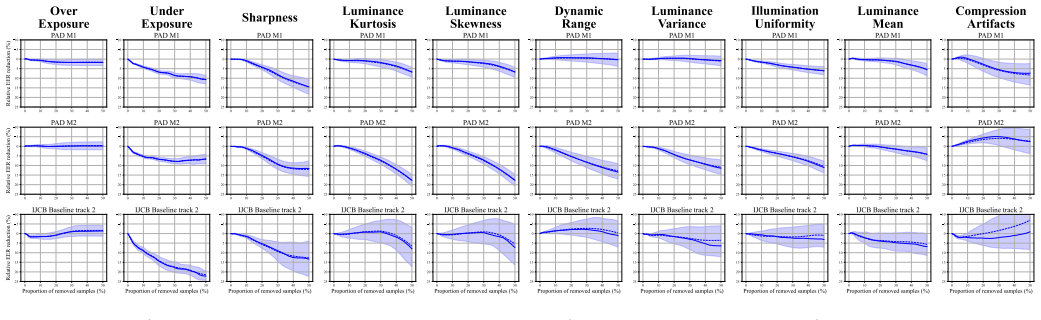
Some Open Face Image Quality measures, after preprocessing, correlate with improved presentation attack detection on ID cards.
A machine-rendered reading of the paper's core claim, the machinery that carries it, and where it could break.
Core claim
The authors show that quality assessment based on some Open Face Image Quality measures can significantly improve presentation attack detection performance when the measures are computed on ID card images that have first undergone corner detection, perspective normalization, and comprehensive foreground masking.
What carries the argument
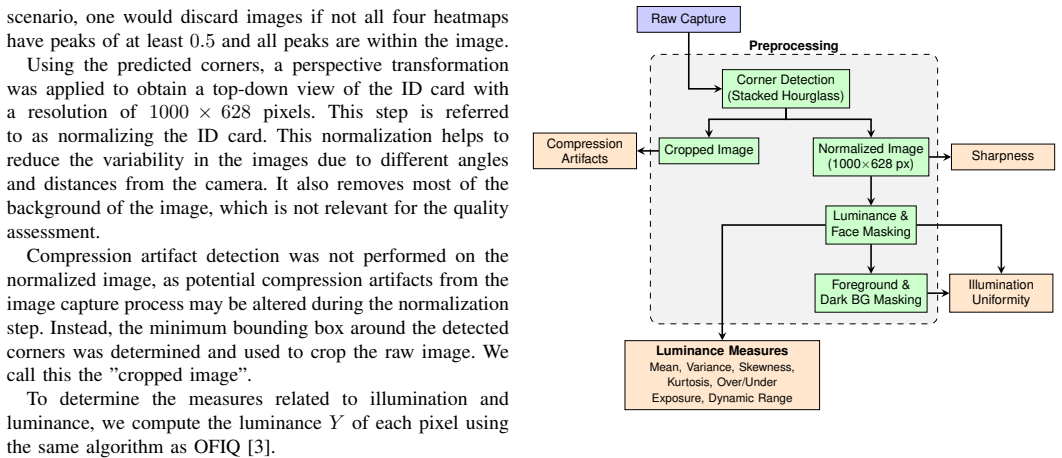
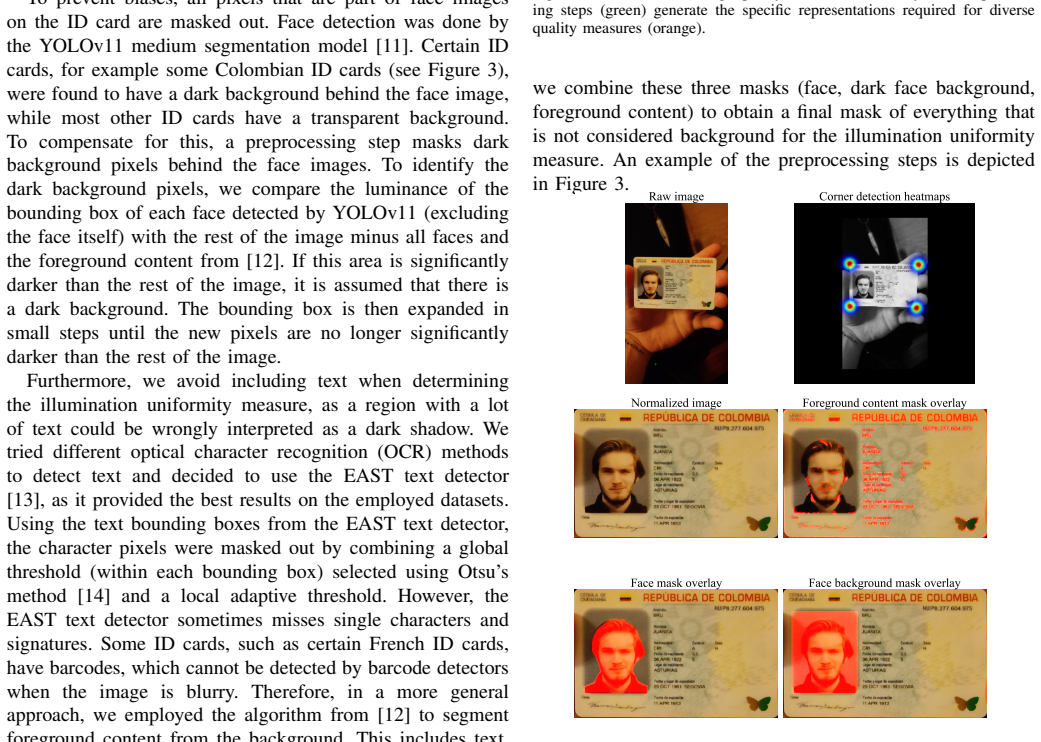
The preprocessing pipeline (corner detection, perspective normalization, and foreground masking) that adapts Open Face Image Quality measures from faces to ID cards.
If this is right
- Selected OFIQ measures can be added as an input feature to existing PAD algorithms to raise their detection rates on both pristine and mock ID cards.
- The same preprocessing and scoring pipeline works across multiple distinct ID card datasets without retraining the quality measures.
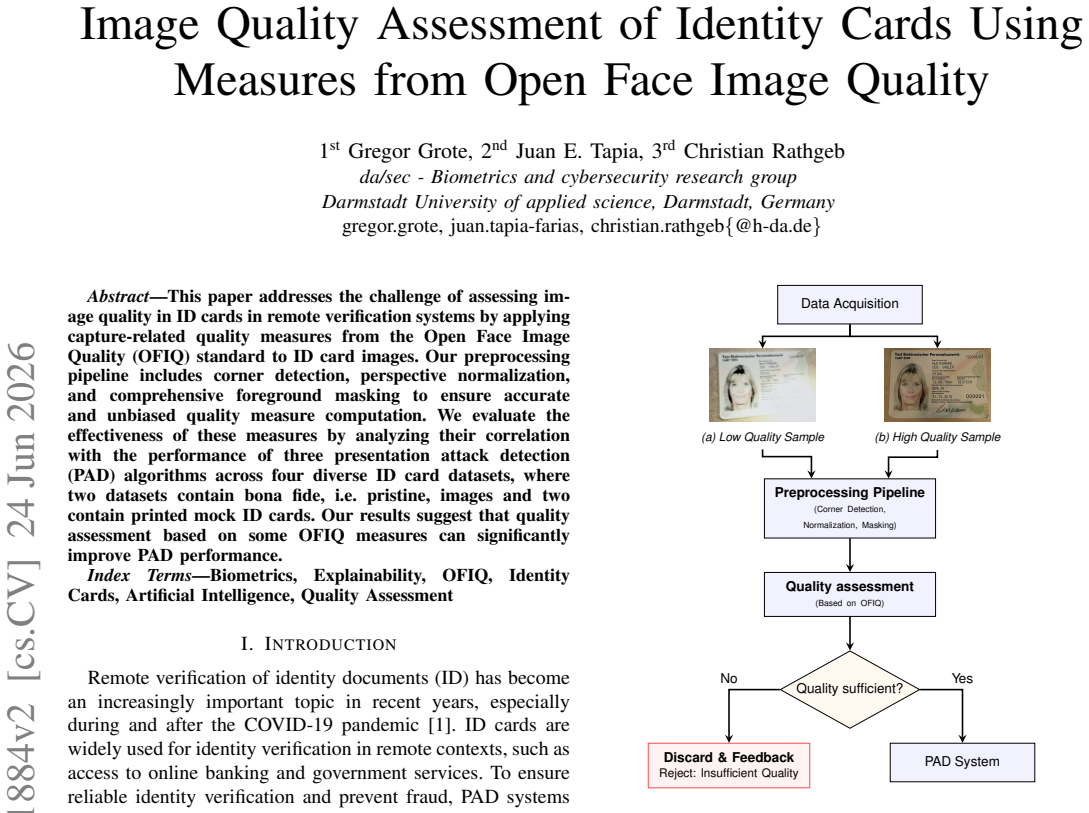
- Quality filtering based on these measures can be inserted upstream of PAD to discard low-quality captures before attack detection is attempted.
Where Pith is reading between the lines
- The same adaptation steps could be tested on other non-face identity documents such as passports or driver's licenses to check whether the correlation with attack detection generalizes.
- Real-time computation of these quality scores during capture could trigger an automatic request for a better image before the verification process continues.
Load-bearing premise
The preprocessing pipeline ensures accurate and unbiased quality measure computation on ID card images.
What would settle it
A new set of ID card images where adding the selected OFIQ quality scores produces no measurable gain in PAD accuracy on any of the three tested detectors would falsify the claim.
Figures
read the original abstract
This paper addresses the challenge of assessing image quality in ID cards in remote verification systems by applying capture-related quality measures from the Open Face Image Quality (OFIQ) standard to ID card images. Our preprocessing pipeline includes corner detection, perspective normalization, and comprehensive foreground masking to ensure accurate and unbiased quality measure computation. We evaluate the effectiveness of these measures by analyzing their correlation with the performance of three presentation attack detection (PAD) algorithms across four diverse ID card datasets, where two datasets contain bona fide, i.e. pristine, images and two contain printed mock ID cards. Our results suggest that quality assessment based on some OFIQ measures can significantly improve PAD performance.
Editorial analysis
A structured set of objections, weighed in public.
Referee Report
Summary. The manuscript applies capture-related quality measures from the Open Face Image Quality (OFIQ) standard to identity card images. A preprocessing pipeline (corner detection, perspective normalization, comprehensive foreground masking) is used to enable unbiased computation. Effectiveness is assessed via correlation analysis between these measures and the performance of three existing PAD algorithms across four ID card datasets (two bona fide, two with printed mocks). The authors conclude that some OFIQ measures can significantly improve PAD performance.
Significance. If the central claim holds, the work could aid remote ID verification by providing a standardized way to identify images where PAD is unreliable. The reuse of an existing standard (OFIQ) and evaluation on multiple external datasets and PAD algorithms are strengths. However, the absence of any reported numerical correlations, dataset sizes, or statistical tests in the abstract makes the practical impact difficult to gauge from the provided text.
major comments (1)
- [Abstract] Abstract: The claim that 'quality assessment based on some OFIQ measures can significantly improve PAD performance' is not supported by the described evaluation. The text states that effectiveness is evaluated by 'analyzing their correlation with the performance of three presentation attack detection (PAD) algorithms,' but no experiment is described that integrates an OFIQ quality measure into a PAD pipeline (e.g., via low-quality sample rejection, score weighting, or conditional decision) and reports the resulting change in EER, AUC, BPCER, or APCER.
minor comments (1)
- [Abstract] Abstract: No numerical results, correlation coefficients, p-values, dataset sizes, or error bars are supplied, which prevents verification of the 'significantly improve' assertion even at the level of the reported correlations.
Simulated Author's Rebuttal
We thank the referee for the constructive feedback. We address the major comment on the abstract below and will revise accordingly to ensure the claims align precisely with the reported evaluation.
read point-by-point responses
-
Referee: [Abstract] Abstract: The claim that 'quality assessment based on some OFIQ measures can significantly improve PAD performance' is not supported by the described evaluation. The text states that effectiveness is evaluated by 'analyzing their correlation with the performance of three presentation attack detection (PAD) algorithms,' but no experiment is described that integrates an OFIQ quality measure into a PAD pipeline (e.g., via low-quality sample rejection, score weighting, or conditional decision) and reports the resulting change in EER, AUC, BPCER, or APCER.
Authors: We acknowledge the distinction: our evaluation consists of correlation analysis between the OFIQ measures (computed after preprocessing) and the performance metrics of three PAD algorithms on the four datasets, rather than an explicit integration experiment that applies quality-based filtering, weighting, or conditional decisions and quantifies the resulting change in EER/APCER/etc. The observed correlations support the suggestion that certain measures are associated with improved PAD reliability and could therefore be used to enhance performance in a deployed system, but the abstract wording does overstate the direct demonstration of improvement. We will revise the abstract (and relevant sections) to state that the measures exhibit significant correlations with PAD performance, indicating their potential utility for improving PAD in remote verification. If space permits in the revision, we will also add a brief integration experiment (e.g., rejecting low-quality samples) to strengthen the claim. revision: yes
Circularity Check
No significant circularity; empirical analysis uses external components
full rationale
The paper performs an empirical evaluation: it applies existing OFIQ measures to preprocessed ID card images and computes correlations against the standalone error rates of three external PAD algorithms on four external datasets. No equations, fitted parameters, or self-referential definitions are described that would reduce the reported correlations or the suggestion of PAD improvement to quantities defined by the authors' own choices. The preprocessing steps are standard geometric operations with no mathematical derivation that loops back to the quality measures themselves. The central claim rests on observable statistical associations rather than any self-definitional or self-citation chain.
Axiom & Free-Parameter Ledger
Reference graph
Works this paper leans on
-
[1]
Biometrics in the era of COVID-19: Challenges and opportunities,
M. Gomez-Barrero, P. Drozdowski, C. Rathgebet al., “Biometrics in the era of COVID-19: Challenges and opportunities,”Trans. on Technology and Society (TTS), June 2022. [2]Information Technology – Biometric Sample Quality – Part 5: Face Image Data, ISO/IEC Std. ISO/IEC 29 794-5:2025, Apr. 2025, published April 2025
2022
-
[2]
State of the Art of Quality Assessment of Facial Images,
J. Merkle, C. Rathgeb, B. Tams, D.-P. Lou, A. D ¨orsch, and P. Droz- dowski, “State of the Art of Quality Assessment of Facial Images,” arXiv e-prints, p. arXiv:2211.08030, Nov. 2022
arXiv 2022
-
[3]
Identity card presentation attack detection: A systematic review,
E. M. Ruiz, J. E. Tapia, R. T. Soto, and C. Busch, “Identity card presentation attack detection: A systematic review,” 2025. [Online]. Available: https://arxiv.org/abs/2511.06056
arXiv 2025
-
[4]
Face image quality assessment: A literature survey,
T. Schlett, C. Rathgeb, O. Henniger, J. Galbally, J. Fierrez, and C. Busch, “Face image quality assessment: A literature survey,”ACM Comput. Surv., vol. 54, no. 10s, Sep. 2022. [Online]. Available: https://doi.org/10.1145/3507901
-
[5]
Image quality assessment on identity documents,
C. Y ´a˜nez and E. J. Tapia, “Image quality assessment on identity documents,” in2021 International Conference of the Biometrics Special Interest Group (BIOSIG), 2021, pp. 1–5
2021
-
[6]
Identity documents im- age quality assessment,
D. Schulz, J. Maureira, J. Tapia, and C. Busch, “Identity documents im- age quality assessment,” in30th European Signal Processing Conference (EUSIPCO), 2022, pp. 1017–1021
2022
-
[7]
Towards refining id cards presentation attack detection systems using face quality index,
S. Gonz ´alez and J. Tapia, “Towards refining id cards presentation attack detection systems using face quality index,” in30th European Signal Processing Conference (EUSIPCO), 2022, pp. 1027–1031
2022
-
[8]
M. Al-Ghadi, J. V oerman, M. Coustaty, O. Lessard, and N. Sidere, “ IDTrust: Deep Identity Document Quality Detection with Bandpass Filtering ,” inIEEE/CVF Winter Conf. on Appl. of Computer Vision Workshops (WACVW). Los Alamitos, CA, USA: IEEE Computer Society, Mar. 2025, pp. 668–675. [Online]. Available: https://doi.ieeecomputersociety.org/10.1109/W ACVW...
work page doi:10.1109/w 2025
-
[9]
Stacked hourglass networks for human pose estimation,
A. Newell, K. Yang, and J. Deng, “Stacked hourglass networks for human pose estimation,” inComputer Vision – ECCV 2016, B. Leibe, J. Matas, N. Sebe, and M. Welling, Eds. Cham: Springer Intl. Publishing, 2016, pp. 483–499
2016
-
[10]
Yolov11: An overview of the key architectural enhancements,
R. Khanam and M. Hussain, “Yolov11: An overview of the key architectural enhancements,” 2024. [Online]. Available: https: //arxiv.org/abs/2410.17725
Pith/arXiv arXiv 2024
-
[11]
Screen content image segmentation using sparse decomposition and total variation minimization,
S. Minaee and Y . Wang, “Screen content image segmentation using sparse decomposition and total variation minimization,” inIEEE Intl. Conf. on Image Processing (ICIP), 2016, pp. 3882–3886
2016
-
[12]
EAST: An Efficient and Accurate Scene Text Detector ,
X. Zhou, C. Yao, H. Wen, Y . Wang, S. Zhou, W. He, and J. Liang, “ EAST: An Efficient and Accurate Scene Text Detector ,” inIEEE Conf. on Computer Vision and Pattern Recognition (CVPR). Los Alamitos, CA, USA: IEEE Computer Society, Jul. 2017, pp. 2642–2651. [Online]. Available: https://doi.ieeecomputersociety.org/10.1109/CVPR.2017.283
-
[13]
A threshold selection method from gray-level histograms,
N. Otsu, “A threshold selection method from gray-level histograms,” IEEE Trans. on Systems, Man, and Cybernetics, vol. 9, no. 1, pp. 62– 66, 1979
1979
-
[14]
Second competition on presentation attack detection on ID Card,
J. E. Tapia, M. Nieto, and J. M. e. a. Espin, “Second competition on presentation attack detection on ID Card,” inIEEE International Joint Conference on Biometrics (IJCB), 2025, pp. 1–10
2025
-
[15]
Document liveness challenge dataset (dlc-2021),
D. V . Polevoy, I. V . Sigareva, and e. a. Ershova, “Document liveness challenge dataset (dlc-2021),”Journal of Imaging, vol. 8, no. 7, 2022. [Online]. Available: https://www.mdpi.com/2313-433X/8/7/181
2021
-
[16]
ISO/IEC 30107-3, information technology — biometric presentation attack detection — part 3: Testing and reporting,
ISO/IEC JTC 1/SC 37 Biometrics, “ISO/IEC 30107-3, information technology — biometric presentation attack detection — part 3: Testing and reporting,”International Organization for Standardization, Geneva, CH, Standard, 2021
2021
-
[17]
Considerations on the evaluation of biometric quality assessment algorithms,
T. Schlett, C. Rathgeb, J. Tapia, and C. Busch, “Considerations on the evaluation of biometric quality assessment algorithms,”IEEE Trans. on Biometrics, Behavior , and Identity Science, vol. 6, no. 1, pp. 54–67, 2024
2024
-
[18]
Performance of biometric quality measures,
P. Grother and E. Tabassi, “Performance of biometric quality measures,” IEEE Trans. Pattern Anal. Mach. Intell., vol. 29, no. 4, p. 531–543, Apr
-
[19]
Available: https://doi.org/10.1109/TPAMI.2007.1019
[Online]. Available: https://doi.org/10.1109/TPAMI.2007.1019
discussion (0)
Sign in with ORCID, Apple, or X to comment. Anyone can read and Pith papers without signing in.