Pith. sign in

REVIEW 2 major objections 299 references

Building three-dimensional giant stellar models for common envelope simulations

T0 review · 2 major / 0 minor · reviewed 2026-06-27 · grok-4.3

Pith's one-line read Depositing stellar luminosity in an inner shell while cooling low-density outer cells produces stable pulsating 3D giant star models without any relaxation step.

desk verdict The paper gives a usable initialization recipe for 3D red supergiant models by mapping from 1D, adding inner luminosity deposition, cooling the outer low-density cells, and skipping relaxation. read the letter →

arxiv 2606.11927 v1 pith:LWBXKZZZ submitted 2026-06-10 astro-ph.SR

classification astro-ph.SR
keywords 3Dstellarmodelscommonenvelopeevolutionredsupergiantstarspulsationshydrodynamicsimulationsnumericalstructure
verification ladder T0 review T1 audit T2 compute T3 formal

The pith

A machine-rendered reading of the paper's core claim, the machinery that carries it, and where it could break.

The reading

The paper maps a one-dimensional red supergiant model onto a three-dimensional grid and tests ways to sustain its structure for common-envelope simulations. It deposits energy in an inner shell at the star's actual luminosity rate to stand in for nuclear burning and cools grid cells below photospheric density to stand in for surface emission. When both steps are used, the model develops sustained radial pulsations with a roughly one-year period plus non-radial modes and vigorous convection; without the outer cooling the oscillations decay. The authors conclude this combination prepares usable initial conditions more simply than traditional relaxation procedures.

What carries the argument

Inner-shell energy deposition at the stellar luminosity rate combined with cooling of low-density outer cells, which together replace nuclear burning and photospheric emission while letting the 3D model evolve its own pulsations.

What would settle it

A 3D simulation run lasting several dynamical times in which both inner-shell heating and outer cooling are applied, then checking whether the pulsation amplitude remains roughly constant or continues to grow instead of decaying.

Watch

Extended reading notes

Core claim

Transporting a 1D stellar model to a 3D grid, depositing energy at the stellar luminosity in an inner shell above the inert core, and cooling cells with densities below the photospheric value allows the model to execute its natural pulsations without relaxation. With both energy deposition and cooling active the oscillations do not decay and their amplitude slowly grows; the dominant period is about one year, comparable to the dynamical time, and the model also develops non-spherical structure, radius variations, and vigorous convection.

Load-bearing premise

That replacing nuclear burning with inner-shell energy input at the observed luminosity and replacing surface emission with cooling of low-density cells will reproduce the essential dynamical behavior of a real giant star on a 3D grid.

Editorial extensions

If this is right

  • The resulting model shows a dominant pulsation period of about one year that matches the stellar dynamical timescale.
  • Non-spherical density structure and slow changes in average radius appear, indicating superposed non-radial modes.
  • Vigorous convection develops naturally inside the model.
  • The same preparation can be used directly for grazing-envelope evolution simulations.

Reading between the lines

Editorial extensions of the paper, not claims the author makes directly.

  • This preparation might allow simulations to begin from a more realistic pulsating state rather than an artificially static one.
  • The sustained pulsations could influence the efficiency of envelope ejection during common-envelope interactions.
  • The approach might be tested on other giant-star masses or metallicities to check whether the same inner-shell plus outer-cooling recipe remains sufficient.
Share X Bluesky LinkedIn Reddit HN

Signed reviews

No signed human review yet.

Request a human review

A listed scientist reviews the paper for a fee and the review publishes here regardless of verdict. See the reviewers or get listed.

Editorial analysis

A structured set of objections, weighed in public.

Desk editor's note, referee report, simulated authors' rebuttal, and a circularity audit.

Referee Report

2 major / 0 minor

Summary. The manuscript presents a procedure for constructing 3D red supergiant models from 1D stellar models for common-envelope evolution simulations. The approach maps the 1D structure to a 3D grid, deposits energy at the stellar luminosity rate in an inner shell above the inert core to mimic nuclear burning, and cools low-density cells to mimic photospheric emission, without any relaxation step. The authors report that oscillations decay in the absence of cooling, remain stable or grow slowly when both energy deposition and cooling are active, exhibit a dominant ~1 yr period consistent with the dynamical timescale (suggesting a fundamental radial mode), display non-radial modes via non-spherical structure and radius variations, and produce vigorous convection. They conclude that this combination is the optimal preparation method and that relaxation is unnecessary.

Significance. If validated, the method supplies a parameter-free initialization route that directly imports quantities from the input 1D model and permits natural pulsations and convection to emerge, potentially reducing computational overhead for CEE and grazing-envelope simulations. The absence of invented entities or fitted parameters in the core procedure is a clear strength.

major comments (2)
  1. [Abstract] Abstract and results description: the statements that oscillations 'slowly decay', 'do not decay', or 'slowly increase' with time are presented without any quantitative metrics (e.g., e-folding times, amplitude growth rates, or time-series statistics of radius or kinetic energy), error estimates, or resolution studies. These quantitative diagnostics are load-bearing for the central claim that the combined inner-shell deposition plus low-density cooling produces sustained natural pulsations without relaxation.
  2. [Abstract] Abstract and method description: no grid-resolution tests, convergence checks, or direct comparisons to 1D linear pulsation calculations or other 3D codes are reported to confirm that the ~1 yr period, non-radial mode content, and convection are physical rather than numerical artifacts. Such tests are required to substantiate the assertion that the procedure accurately represents essential stellar physics.

Simulated Author's Rebuttal

2 responses · 0 unresolved

We thank the referee for their constructive comments on our manuscript. We address each major comment below and indicate the revisions we will make.

read point-by-point responses
  1. Referee: [Abstract] Abstract and results description: the statements that oscillations 'slowly decay', 'do not decay', or 'slowly increase' with time are presented without any quantitative metrics (e.g., e-folding times, amplitude growth rates, or time-series statistics of radius or kinetic energy), error estimates, or resolution studies. These quantitative diagnostics are load-bearing for the central claim that the combined inner-shell deposition plus low-density cooling produces sustained natural pulsations without relaxation.

    Authors: We agree that quantitative support would improve the abstract and results. In the revised manuscript we will add time-series statistics of the average stellar radius and total kinetic energy, together with estimates of e-folding times or growth rates extracted from the existing simulation data. These metrics will be described in the results section and briefly summarized in the abstract. revision: yes

  2. Referee: [Abstract] Abstract and method description: no grid-resolution tests, convergence checks, or direct comparisons to 1D linear pulsation calculations or other 3D codes are reported to confirm that the ~1 yr period, non-radial mode content, and convection are physical rather than numerical artifacts. Such tests are required to substantiate the assertion that the procedure accurately represents essential stellar physics.

    Authors: The manuscript demonstrates the initialization procedure and reports the emergent behavior from the simulations performed. We did not carry out resolution studies or comparisons to other codes. In revision we will add a limitations paragraph in the discussion noting the absence of these tests and reiterating that the dominant period is consistent with the dynamical timescale of the input 1D model. We maintain that the method's parameter-free character remains a useful contribution for CEE simulations, while acknowledging that further validation lies beyond the present scope. revision: partial

Circularity Check

0 steps flagged · score 0.0 of 10

No significant circularity; procedure is self-contained numerical construction

full rationale

The paper presents a direct numerical method: map a 1D stellar model to a 3D grid, deposit energy in an inner shell at the input stellar luminosity rate, and cool low-density cells to mimic photospheric emission. Outcomes such as oscillation decay/growth, ~1 yr period matching dynamical time, non-radial modes, and convection are reported as simulation results, not used to define or fit the inputs. No equations reduce by construction to outputs, no fitted parameters are renamed as predictions, and no self-citations or uniqueness theorems are invoked as load-bearing. The central claim (this preparation method works without relaxation) rests on the described procedure's internal consistency with known stellar timescales, which is externally falsifiable via the reported behavior.

Assumptions & free parameters 0 free parameters · 3 assumptions · 0 invented entities

The central claim depends on the validity of three domain assumptions about physical mimicking and the suitability of the input 1D model; no free parameters are explicitly fitted in the abstract, and no new entities are postulated.

assumptions (3)
  • domain assumption A 1D stellar evolution model provides an accurate initial structure for a red supergiant that can be directly transported to a 3D grid.
    The method begins by transporting a 1D model to the 3D numerical grid.
  • domain assumption Depositing energy at the stellar luminosity rate into an inner shell above the inert core accurately mimics core nuclear power production.
    Used to mimic core nuclear power by depositing energy to an inner shell.
  • domain assumption Cooling grid cells with densities below the photospheric density accurately mimics stellar photospheric emission.
    Used to mimic stellar emission by cooling grid cells with densities below the photospheric density.

how reviews work

0 comments
Cite this review

Pith. "Pith review of Building three-dimensional giant stellar models for common envelope simulations." pith.science (2026). https://pith.science/paper/LWBXKZZZ

@misc{pith2026260611927,
  author       = {Pith},
  title        = {Pith review of: Building three-dimensional giant stellar models for common envelope simulations},
  year         = {2026},
  howpublished = {\url{https://pith.science/paper/LWBXKZZZ}},
  note         = {Machine review of arXiv:2606.11927}
}
read the original abstract

We build a three-dimensional (3D) red supergiant (RSG) stellar model for common envelope evolution (CEE) simulations by transporting a 1D stellar model to a 3D numerical grid, mimicking core nuclear power by depositing energy to an inner shell, and mimicking stellar emission by cooling grid cells with densities below the photospheric density. We do not relax the model; rather, we let it perform its natural pulsation. We find that when we mimic photospheric emission by cooling low-density grid cells, the oscillations slowly decay on a time scale much longer than in the absence of photospheric cooling. When we mimic both nuclear energy production, by depositing the stellar luminosity in an inner shell above the inert core of the stellar model, and the photospheric cooling, the oscillations do not decay and their amplitude slowly increases with time. The main pulsational period is about 1 year, comparable to the stellar dynamical time, suggesting a fundamental radial pulsation mode. The non-spherical structure of the stellar model and rapid low-amplitude temporal variations in the average stellar radius testify to the presence of non-radial oscillation modes on top of the fundamental radial mode. We also obtain vigorous convection, as RSG stars have. We conclude that the best way of preparing a giant star to simulate CEE and grazing-envelope evolution is to deposit energy with the stellar luminosity in an inner shell, and to cool the outer low-density numerical shell. There is no need to relax the model.

Figures

Figures reproduced from arXiv: 2606.11927 by the authors.

Figure 1
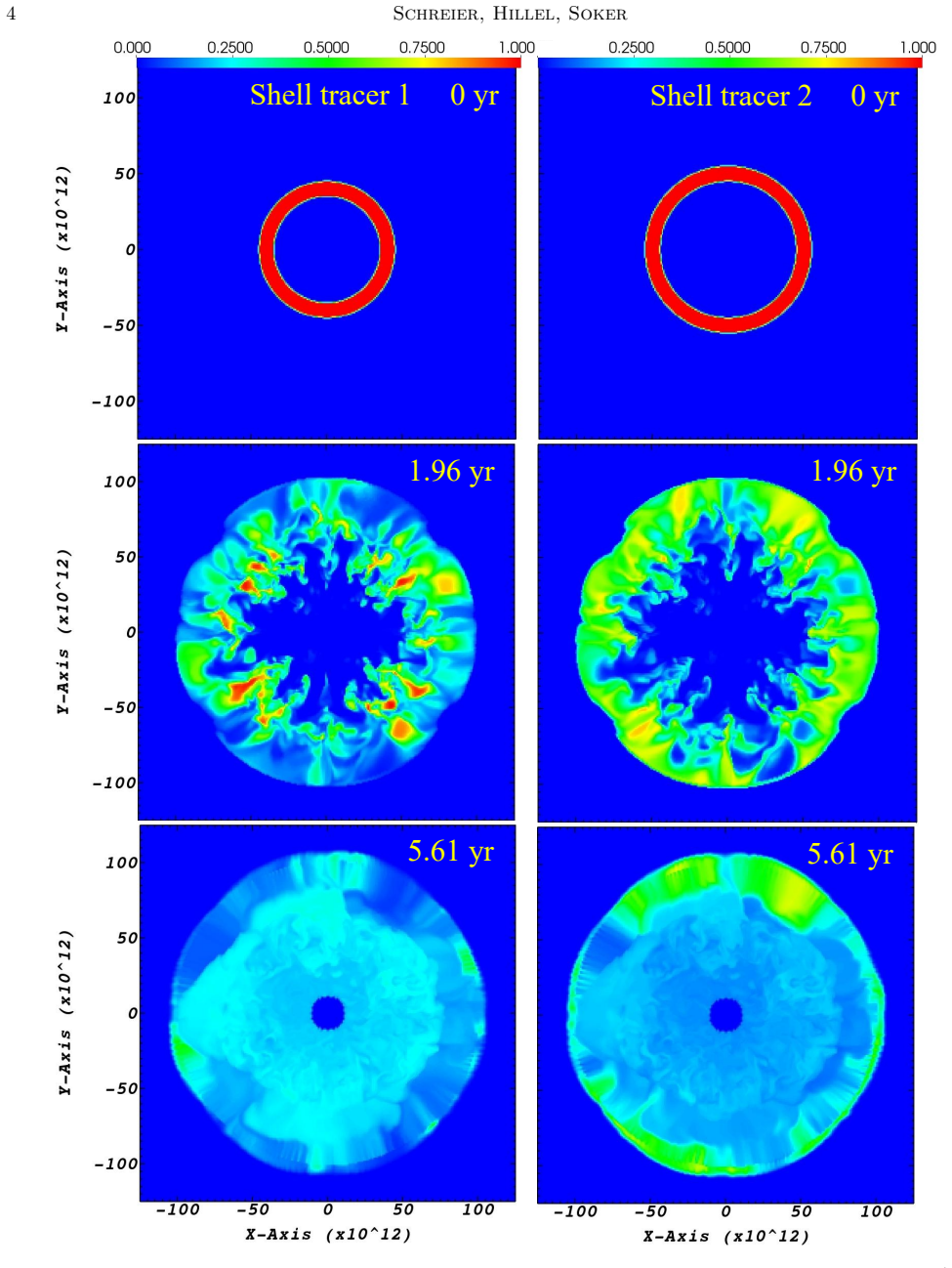
Figure 1. Maps of the two tracers in the energy-deposition simulation starting in the inner shell 503R⊙ < r < 647R⊙ (Shell 1; left column), and in the outer shell 647R⊙ < r < 790R⊙ (Shell 2; right column) in the plane z = 0, at three times as indicated. We recall that we set a numerical spherical boundary at Rw = 100×1012 cm (Section 2); this is why the tracer does not expand beyond that radius [PITH_FULL_IMAGE:figures/full_… view at source ↗
Figure 2
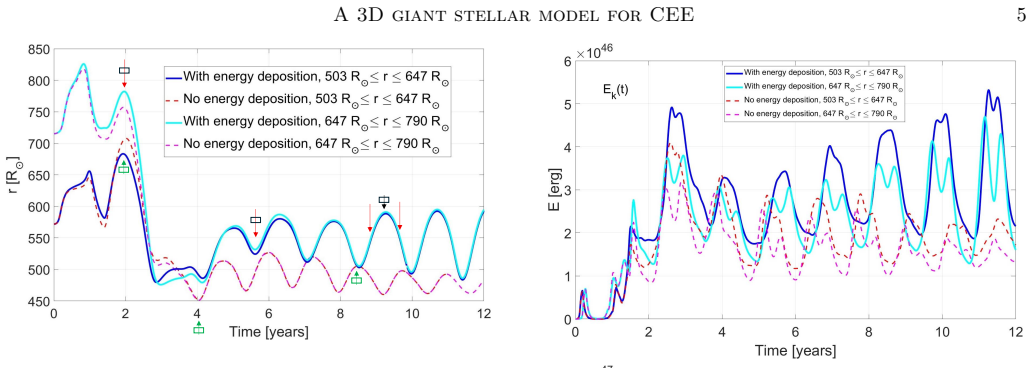
Figure 2. The average radii of the tracers of two initial spherical shells: 35 × 1012 cm = 503R⊙ < r < 45 × 1012 cm = 647R⊙ and 45 × 1012 cm = 647R⊙ < r < 55 × 1012 cm = 790R⊙. Dashed lines are for the no-energy simulation, while solid lines are for the simulation with energy deposition. By t ≃ 3 yr, convection mixes the two shells almost completely, and the material that started in separate shells becomes indistinguishable. … view at source ↗
Figure 3
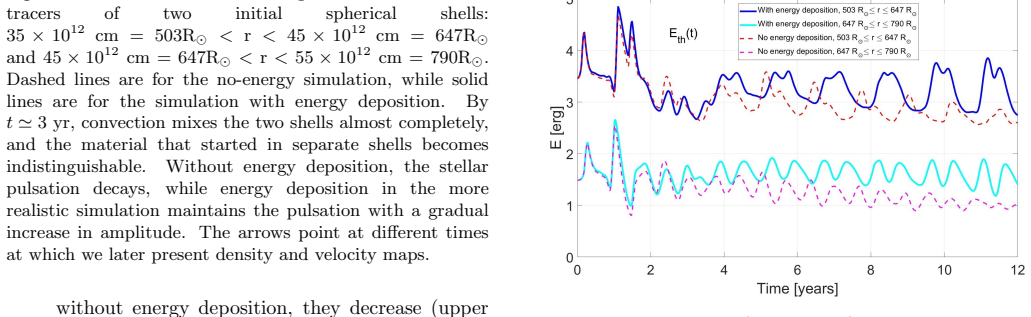
Figure 3. The kinetic (upper panel) and thermal energy (lower panel) of the two simulations inside two fixed shells: 35 × 1012 cm = 503R⊙ < r < 45 × 1012 cm = 647R⊙ and 45 × 1012 cm = 647R⊙ < r < 55 × 1012 cm = 790R⊙. The kinetic energy line of each simulation of the inner shell is above that of the outer shell because of the larger mass in the inner shell; the thermal energy line of the inner shell is much higher than that o… view at source ↗
Figures from the paper (2 more)
Figure 4
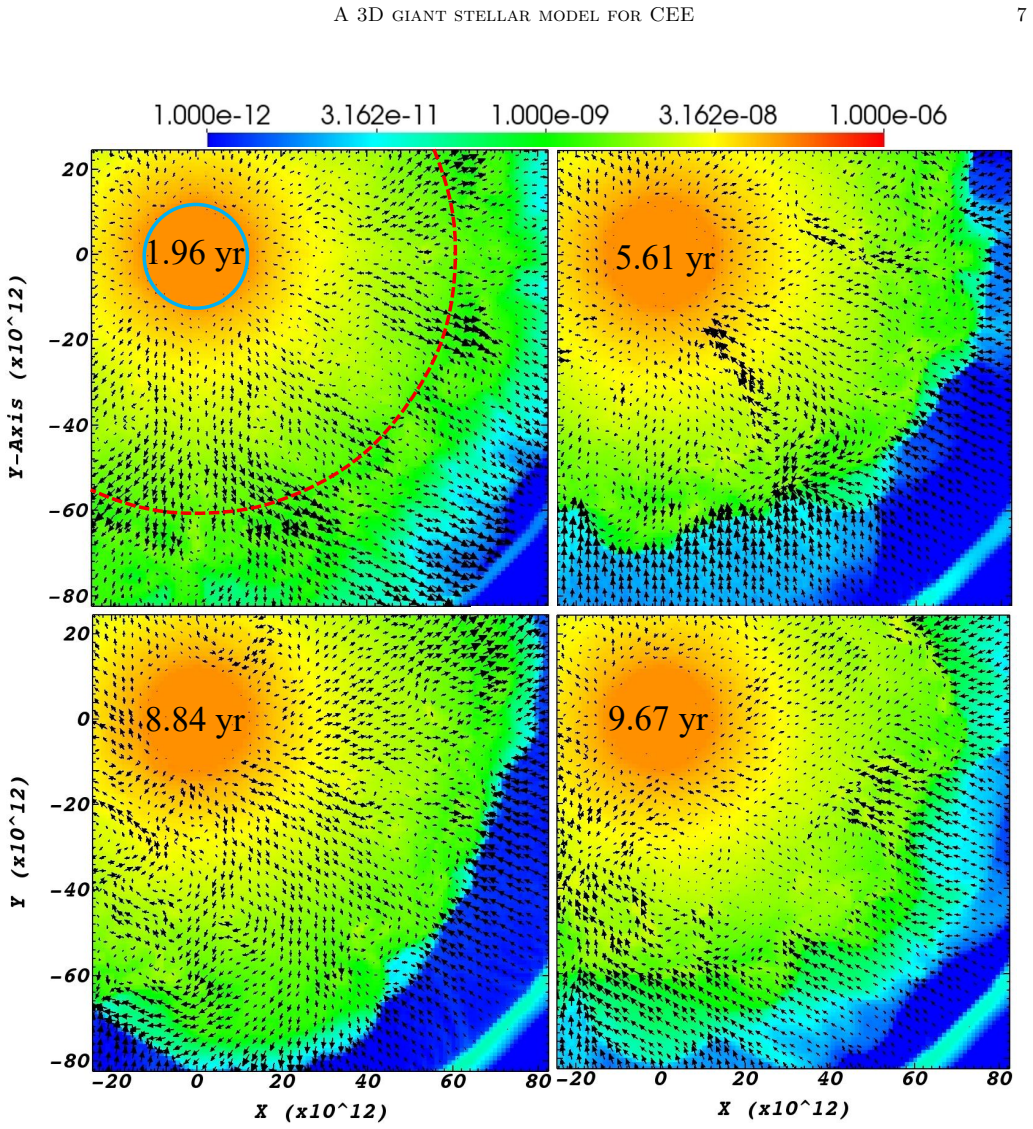
Figure 4. Figure 4: Velocity and density maps in the plane z = 0 for the energy-deposition simulation at four times as indicated. The four times of these panels are marked with red down-pointing arrows in [PITH_FULL_IMAGE:figures/full_fig_p007_4.png]
Figure 5
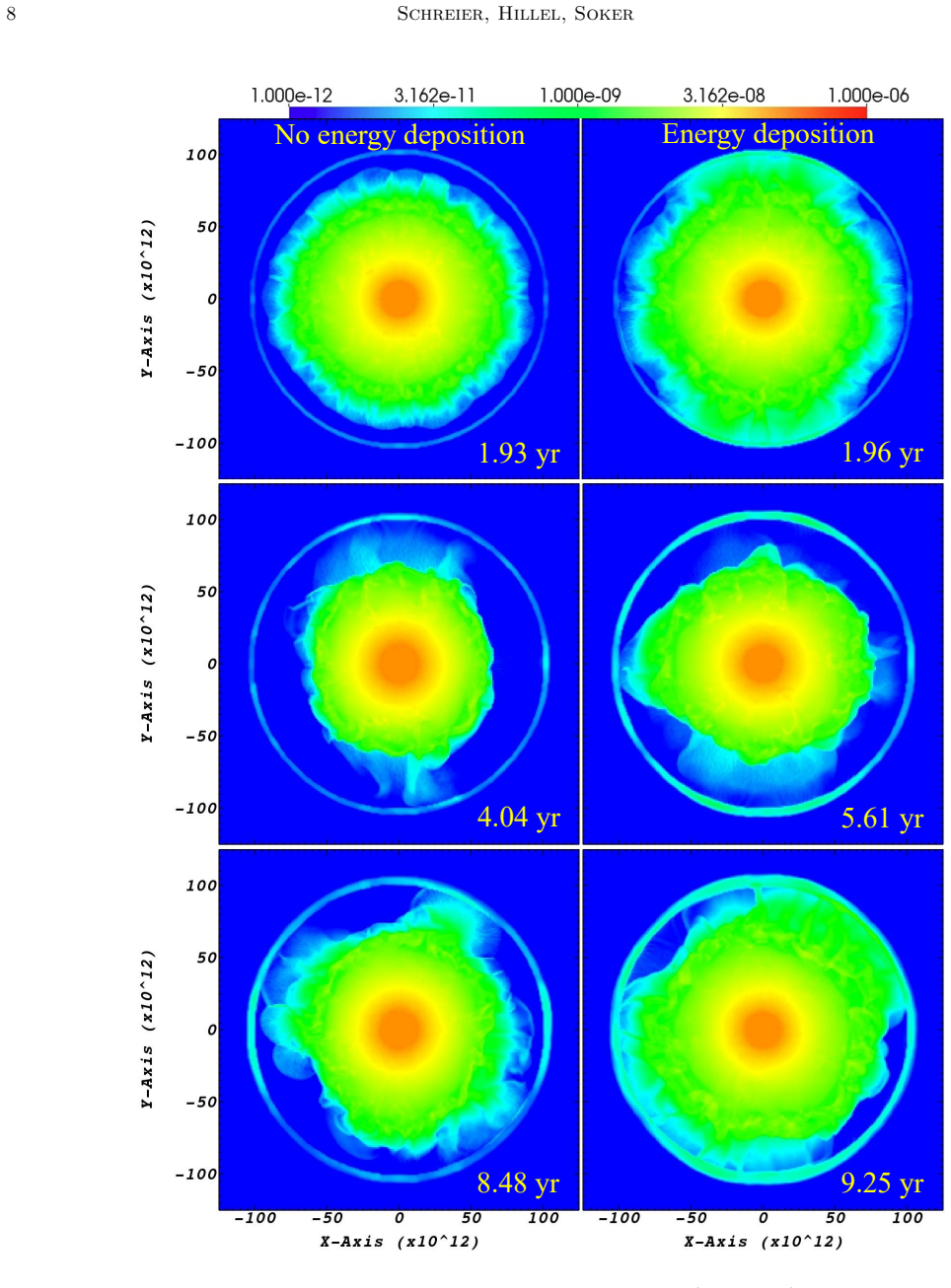
Figure 5. Figure 5: Density maps in the plane z = 0 for the No-energy-deposition simulation (left column) and the energy deposition simulation (right column), each at three times; note that times differ between the two simulations. We mark the times of these six panels in [PITH_FULL_IMAG…

Discussion (0). Continue with ORCID to comment.

Reference graph

Works this paper leans on

299 extracted references · 279 canonical work pages

  1. [1]

    SN 2006jc: A Wolf-Rayet Star Exploding in a Dense He-Rich Circumstellar Medium

    SN 2006jc: A Wolf-Rayet Star Exploding in a Dense He-rich Circumstellar Medium. , keywords =. doi:10.1086/513145 , archivePrefix =. astro-ph/0612711 , primaryClass =

  2. [2]

    2022, MNRAS, 511, 176, doi: 10.1093/mnras/stab3776

    Numerical simulations of the random angular momentum in convection: Implications for supergiant collapse to form black holes. , keywords =. doi:10.1093/mnras/stab3776 , archivePrefix =. 2107.09068 , primaryClass =

  3. [3]

    2023, , 525, 1229, 10.1093/mnras/stad2328

    Numerical simulations of the random angular momentum in convection - II. Delayed explosions of red supergiants following 'failed' supernovae. , keywords =. doi:10.1093/mnras/stad2328 , archivePrefix =. 2301.05237 , primaryClass =

  4. [4]

    , keywords =

    Spitzer Observations of Dust Destruction in the Puppis A Supernova Remnant. , keywords =. doi:10.1088/0004-637X/725/1/585 , adsurl =

  5. [5]

    , keywords =

    Comparative Morphological Analysis of Puppis A at Radio, Infrared, Optical, and X-Ray Wavelengths. , keywords =. doi:10.1086/168378 , adsurl =

  6. [6]

    Planetary Nebula Image Catalogue: HST data

  7. [7]

    2023, Research Notes of the American Astronomical Society, 7, 266, 10.3847/2515-5172/ad1392

    The Jets and the Neutron Star Kick Velocity of the Supernova Remnant CTB 1. Research Notes of the American Astronomical Society , keywords =. doi:10.3847/2515-5172/ad1392 , archivePrefix =. 2312.02026 , primaryClass =

  8. [8]

    Relativistic MHD simulations of core-collapse GRB jets: 3D instabilities and magnetic dissipation

    Relativistic MHD simulations of core-collapse GRB jets: 3D instabilities and magnetic dissipation. , keywords =. doi:10.1093/mnras/stv2591 , archivePrefix =. 1508.02721 , primaryClass =

Show all 299 references
  1. [9]

    , keywords =

    Core-collapse supernova explosion theory. , keywords =. doi:10.1038/s41586-020-03059-w , archivePrefix =. 2009.14157 , primaryClass =

  2. [10]

    , keywords =

    The most complete and detailed X-ray view of the SNR Puppis A. , keywords =. doi:10.1051/0004-6361/201321401 , archivePrefix =. 1305.1275 , primaryClass =

  3. [11]

    American Astronomical Society Meeting Abstracts \#215 , year = 2010, series =

    Three-Dimensional Kinematics of the Supernova Remnant Puppis A. American Astronomical Society Meeting Abstracts \#215 , year = 2010, series =

  4. [12]

    , keywords =

    Explaining the Most Energetic Supernovae with an Inefficient Jet-feedback Mechanism. , keywords =. doi:10.3847/0004-637X/826/2/178 , archivePrefix =. 1511.01471 , primaryClass =

  5. [13]

    , keywords =

    Triggering jet-driven explosions of core-collapse supernovae by accretion from convective regions. , keywords =. doi:10.1093/mnras/stu257 , archivePrefix =. 1401.1597 , primaryClass =

  6. [14]

    , keywords =

    Angular Momentum Fluctuations in the Convective Helium Shell of Massive Stars. , keywords =. doi:10.3847/0004-637X/827/1/40 , archivePrefix =. 1505.05756 , primaryClass =

  7. [15]

    , keywords =

    The Peculiar Ejecta Rings in the O-Rich Supernova Remnant Puppis A: Evidence of a Binary Interaction?. , keywords =. doi:10.3847/1538-4357/ad0156 , archivePrefix =. 2310.00661 , primaryClass =

  8. [16]

    arXiv e-prints , keywords =

    Evidence for proton acceleration and escape from the Puppis A SNR using Fermi-LAT observations. arXiv e-prints , keywords =. doi:10.48550/arXiv.2308.14848 , archivePrefix =. 2308.14848 , primaryClass =

  9. [17]

    , keywords =

    Black Hole to Photosphere: 3D GRMHD Simulations of Collapsars Reveal Wobbling and Hybrid Composition Jets. , keywords =. doi:10.3847/2041-8213/ac7530 , archivePrefix =. 2204.12501 , primaryClass =

  10. [18]

    , keywords =

    The chemical signature of jet-driven hypernovae. , keywords =. doi:10.1093/mnras/staa3819 , archivePrefix =. 2010.06766 , primaryClass =

  11. [19]

    , keywords =

    Constraining the fraction of core-collapse supernovae harbouring choked jets with high-energy neutrinos. , keywords =. doi:10.1093/mnras/stz3245 , archivePrefix =. 1906.07399 , primaryClass =

  12. [20]

    , keywords =

    Hubble Space Telescope Observations and Geometric Models of Compact Multipolar Planetary Nebulae. , keywords =. doi:10.1088/0004-637X/787/1/25 , adsurl =

  13. [21]

    , keywords =

    Fermi-LAT and WMAP Observations of the Puppis A Supernova Remnant. , keywords =. doi:10.1088/0004-637X/759/2/89 , adsurl =

  14. [22]

    , keywords =

    Chandra X-Ray Observation of a Mature Cloud-Shock Interaction in the Bright Eastern Knot Region of Puppis A. , keywords =. doi:10.1086/497298 , archivePrefix =. astro-ph/0508243 , primaryClass =

  15. [23]

    , keywords =

    X-Ray-emitting Ejecta in Puppis A Observed with Suzaku. , keywords =. doi:10.1086/528925 , archivePrefix =. 0712.3208 , primaryClass =

  16. [24]

    , keywords =

    Discovery of Fast-Moving X-Ray-Emitting Ejecta Knots in the Oxygen-Rich Supernova Remnant Puppis A. , keywords =. doi:10.1086/586891 , archivePrefix =. 0805.1369 , primaryClass =

  17. [25]

    , keywords =

    Discovery of X-ray-emitting O-Ne-Mg-rich Ejecta in the Galactic Supernova Remnant Puppis A. , keywords =. doi:10.1088/0004-637X/714/2/1725 , archivePrefix =. 1004.4132 , primaryClass =

  18. [26]

    , keywords =

    Dynamics of X-Ray-emitting Ejecta in the Oxygen-rich Supernova Remnant Puppis A Revealed by the XMM-Newton Reflection Grating Spectrometer. , keywords =. doi:10.1088/0004-637X/768/2/182 , archivePrefix =. 1303.6607 , primaryClass =

  19. [27]

    , keywords =

    Jet-induced Explosions of Core Collapse Supernovae. , keywords =. doi:10.1086/312305 , archivePrefix =. astro-ph/9904419 , primaryClass =

  20. [28]

    , keywords =

    Wide-field X-ray observations of the supernova remnant Puppis A with the SRG/ART-XC telescope. , keywords =. doi:10.1093/mnras/stab3647 , archivePrefix =. 2107.05586 , primaryClass =

  21. [29]

    , keywords =

    Three-dimensional Adaptive Mesh Refinement Simulations of Long-duration Gamma-Ray Burst Jets inside Massive Progenitor Stars. , keywords =. doi:10.1088/0004-637X/767/1/19 , archivePrefix =. 1212.0539 , primaryClass =

  22. [30]

    From the weakest to most powerful explosions

    Core-collapse supernova diversities . From the weakest to most powerful explosions. , keywords =

  23. [31]

    The IAC morphological catalog of northern Galactic planetary nebulae

  24. [32]

    , keywords =

    The Intermediate r-process in Core-collapse Supernovae Driven by the Magneto-rotational Instability. , keywords =. doi:10.3847/2041-8213/aa5dee , archivePrefix =. 1611.02280 , primaryClass =

  25. [33]

    arXiv e-prints , keywords =

    Nucleosynthesis in jet-driven and jet-associated supernovae. arXiv e-prints , keywords =. doi:10.48550/arXiv.2303.12458 , archivePrefix =. 2303.12458 , primaryClass =

  26. [34]

    arXiv e-prints , keywords =

    Modeling the Evolution from Massive Stars to Supernovae and Supernova Remnants. arXiv e-prints , keywords =. doi:10.48550/arXiv.2311.05612 , archivePrefix =. 2311.05612 , primaryClass =

  27. [35]

    , keywords =

    Exploding core collapse supernovae with jittering jets. , keywords =. doi:10.1111/j.1365-2966.2011.18671.x , archivePrefix =. 1103.1554 , primaryClass =

  28. [36]

    , keywords =

    A planar jittering-jets pattern in core collapse supernova explosions. , keywords =. doi:10.1093/mnras/stu1129 , archivePrefix =. 1403.5152 , primaryClass =

  29. [37]

    , keywords =

    Black hole accretion discs and luminous transients in failed supernovae from non-rotating supergiants. , keywords =. doi:10.1093/mnrasl/slz031 , archivePrefix =. 1811.12427 , primaryClass =

  30. [38]

    , keywords =

    A high-resolution H I study towards the supernova remnant Puppis A and its environments. , keywords =. doi:10.1093/mnras/stw2219 , archivePrefix =. 1609.01779 , primaryClass =

  31. [39]

    , keywords =

    New perspectives on the supernova remnant Puppis A based on a radio polarization study. , keywords =. doi:10.1093/mnras/sty751 , archivePrefix =. 1803.07104 , primaryClass =

  32. [40]

    , keywords =

    The Starfish Twins: Two Young Planetary Nebulae with Extreme Multipolar Morphology. , keywords =. doi:10.1086/312748 , adsurl =

  33. [41]

    , keywords =

    Supplying angular momentum to the jittering jets explosion mechanism using inner convection layers. , keywords =. doi:10.1093/mnrasl/slab105 , archivePrefix =. 2107.08779 , primaryClass =

  34. [42]

    , keywords =

    Remnant masses of core collapse supernovae in the jittering jets explosion mechanism. , keywords =. doi:10.1093/mnras/stac1075 , archivePrefix =. 2112.10697 , primaryClass =

  35. [43]

    , keywords =

    The implications of large binding energies of massive stripped core collapse supernova progenitors on the explosion mechanism. , keywords =. doi:10.1093/mnras/stad889 , archivePrefix =. 2301.05144 , primaryClass =

  36. [44]

    In preparation , keywords =

    The point-symmetrical morphology of supernova remnant G321.3-3.9: Exploding jets jitter around an axis. In preparation , keywords =. doi:, archivePrefix =. , primaryClass =

  37. [45]

    , keywords =

    Applying the jet feedback mechanism to core-collapse supernova explosions. , keywords =. doi:10.1111/j.1365-2966.2009.15862.x , archivePrefix =. 0909.5276 , primaryClass =

  38. [46]

    Research in Astronomy and Astrophysics , keywords =

    Amplifying magnetic fields of a newly born neutron star by stochastic angular momentum accretion in core collapse supernovae. Research in Astronomy and Astrophysics , keywords =. doi:10.1088/1674-4527/20/2/24 , archivePrefix =. 1903.08349 , primaryClass =

  39. [47]

    Research in Astronomy and Astrophysics , keywords =

    Imprints of the Jittering Jets Explosion Mechanism in the Morphology of the Supernova Remnant SNR 0540-69.3. Research in Astronomy and Astrophysics , keywords =. doi:10.1088/1674-4527/ac49e6 , archivePrefix =. 2109.10230 , primaryClass =

  40. [48]

    Research in Astronomy and Astrophysics , keywords =

    The Neutron Star to Black Hole Mass Gap in the Frame of the Jittering Jets Explosion Mechanism (JJEM). Research in Astronomy and Astrophysics , keywords =. doi:10.1088/1674-4527/ace9b3 , archivePrefix =. 2304.05705 , primaryClass =

  41. [49]

    Research in Astronomy and Astrophysics , keywords =

    Classifying Core Collapse Supernova Remnants by Their Morphology as Shaped by the Last Exploding Jets. Research in Astronomy and Astrophysics , keywords =. doi:10.1088/1674-4527/acf446 , archivePrefix =. 2307.15666 , primaryClass =

  42. [50]

    , keywords =

    Hints of point-symmetric structures in SN 1987A: The jittering jets explosion mechanism. , keywords =. doi:10.1016/j.newast.2023.102154 , archivePrefix =. 2309.07863 , primaryClass =

  43. [51]

    arXiv e-prints , keywords =

    Jet - counter-jet asymmetry in the jittering jets explosion mechanism of supernovae. arXiv e-prints , keywords =. doi:10.48550/arXiv.2311.03286 , archivePrefix =. 2311.03286 , primaryClass =

  44. [52]

    , keywords =

    Three-dimensional numerical simulations of structured gamma-ray burst jets. , keywords =. doi:10.1093/mnras/stac3401 , archivePrefix =. 2207.07925 , primaryClass =

  45. [53]

    , keywords =

    The collapse and three-dimensional explosion of three-dimensional massive-star supernova progenitor models. , keywords =. doi:10.1093/mnras/stab3702 , archivePrefix =. 2109.10920 , primaryClass =

  46. [54]

    , keywords =

    The Jittering Jets Explosion Mechanism in Electron Capture Supernovae. , keywords =. doi:10.3847/1538-4357/ad487f , archivePrefix =. 2401.06652 , primaryClass =

  47. [55]

    Research in Astronomy and Astrophysics , keywords =

    The Energy Sources of Superluminous Supernovae. Research in Astronomy and Astrophysics , keywords =. doi:10.1088/1674-4527/19/5/63 , archivePrefix =. 1902.07943 , primaryClass =

  48. [56]

    , keywords =

    Production and Distribution of ^ 44 Ti and ^ 56 Ni in a Three-dimensional Supernova Model Resembling Cassiopeia A. , keywords =. doi:10.3847/1538-4357/aa72de , archivePrefix =. 1610.05643 , primaryClass =

  49. [57]

    , keywords =

    Three-dimensional simulations of core-collapse supernovae: from shock revival to shock breakout. , keywords =. doi:10.1051/0004-6361/201425025 , archivePrefix =. 1409.5431 , primaryClass =

  50. [58]

    , keywords =

    Neutron Star Kicks by the Gravitational Tug-boat Mechanism in Asymmetric Supernova Explosions: Progenitor and Explosion Dependence. , keywords =. doi:10.3847/1538-4357/aa618e , archivePrefix =. 1611.07562 , primaryClass =

  51. [59]

    , keywords =

    Gravitational waves from 3D core-collapse supernova models: The impact of moderate progenitor rotation. , keywords =. doi:10.1093/mnras/stz990 , archivePrefix =. 1810.07638 , primaryClass =

  52. [60]

    , keywords =

    Neutrino emission characteristics of black hole formation in three-dimensional simulations of stellar collapse. , keywords =. doi:10.1103/PhysRevD.101.123013 , archivePrefix =. 1910.12971 , primaryClass =

  53. [61]

    , keywords =

    Core-collapse supernova neutrino emission and detection informed by state-of-the-art three-dimensional numerical models. , keywords =. doi:10.1093/mnras/staa2691 , archivePrefix =. 2007.05000 , primaryClass =

  54. [62]

    , keywords =

    Characteristic time variability of gravitational-wave and neutrino signals from three-dimensional simulations of non-rotating and rapidly rotating stellar core collapse. , keywords =. doi:10.1093/mnras/stab228 , archivePrefix =. 2010.03882 , primaryClass =

  55. [63]

    The Parkes-MIT-NRAO Surveys. IV. Maps fpr the Southern Survey Covering -88degrees < delta < -37degrees. , keywords =. doi:10.1086/116707 , adsurl =

  56. [64]

    arXiv e-prints , keywords =

    Deep Optical Emission-Line Images of Nine Known and Three New Galactic Supernova Remnants. arXiv e-prints , keywords =. doi:10.48550/arXiv.2403.00317 , archivePrefix =. 2403.00317 , primaryClass =

  57. [65]

    , keywords =

    The Distribution of Radioactive ^ 44 Ti in Cassiopeia A. , keywords =. doi:10.3847/1538-4357/834/1/19 , archivePrefix =. 1612.02774 , primaryClass =

  58. [66]

    arXiv e-prints , keywords =

    Identifying a point-symmetric morphology in supernova remnant Cassiopeia A: explosion by jittering jets. arXiv e-prints , keywords =. doi:10.48550/arXiv.2403.07625 , archivePrefix =. 2403.07625 , primaryClass =

  59. [67]

    , keywords =

    A JWST Survey of the Supernova Remnant Cassiopeia A. , keywords =. doi:10.3847/2041-8213/ad324b , archivePrefix =. 2401.02477 , primaryClass =

  60. [68]

    , keywords =

    The Three-dimensional Structure of Cassiopeia A. , keywords =. doi:10.1088/0004-637X/725/2/2038 , archivePrefix =. 1011.3858 , primaryClass =

  61. [69]

    Galaxies , keywords =

    Planetary Nebula Morphologies Indicate a Jet-Driven Explosion of SN 1987A and Other Core-Collapse Supernovae. Galaxies , keywords =. doi:10.3390/galaxies12030029 , archivePrefix =. 2404.14843 , primaryClass =

  62. [70]

    The Open Journal of Astrophysics , keywords =

    Comparing jet-shaped point symmetry in cluster cooling flows and supernovae. The Open Journal of Astrophysics , keywords =. doi:10.33232/001c.120279 , archivePrefix =. 2403.08544 , primaryClass =

  63. [71]

    The Open Journal of Astrophysics , keywords =

    Jet - counter-jet asymmetry in the jittering jets explosion mechanism of supernovae. The Open Journal of Astrophysics , keywords =. doi:10.21105/astro.2311.03286 , archivePrefix =. 2311.03286 , primaryClass =

  64. [72]

    Hubble Space Telescope Observations of Oxygen-rich Supernova Remnants in the Magellanic Clouds. III. WFPC2 Imaging of the Young, Crab-like Supernova Remnant SNR 0540-69.3. , keywords =. doi:10.1086/503313 , adsurl =

  65. [73]

    , keywords =

    A detailed look at the thermal and nonthermal X-ray emission from the Vela supernova remnant with SRG/eROSITA. , keywords =. doi:10.1051/0004-6361/202346691 , archivePrefix =. 2306.10975 , primaryClass =

  66. [74]

    , keywords =

    Three-dimensional neutrino-driven supernovae: Neutron star kicks, spins, and asymmetric ejection of nucleosynthesis products. , keywords =. doi:10.1051/0004-6361/201220636 , archivePrefix =. 1210.8148 , primaryClass =

  67. [75]

    , keywords =

    A Detailed Kinematic Map of Cassiopeia A's Optical Main Shell and Outer High-velocity Ejecta. , keywords =. doi:10.1088/0004-637X/772/2/134 , archivePrefix =. 1306.2310 , primaryClass =

  68. [76]

    , keywords =

    The mass and energy budget of Cassiopeia A. , keywords =. doi:10.1051/0004-6361:20021554 , archivePrefix =. astro-ph/0207273 , primaryClass =

  69. [77]

    , keywords =

    Fallback onto kicked neutron stars and its effect on spin-kick alignment. , keywords =. doi:10.1093/mnras/stad2881 , archivePrefix =. 2308.08312 , primaryClass =

  70. [78]

    , keywords =

    Supernova Fallback as Origin of Neutron Star Spins and Spin-kick Alignment. , keywords =. doi:10.3847/1538-4357/ac403c , archivePrefix =. 2104.07493 , primaryClass =

  71. [79]

    , keywords =

    Clumps and Rings of Ejecta in SNR 0540-69.3 as Seen in 3D. , keywords =. doi:10.3847/1538-4357/ac2a41 , archivePrefix =. 2109.03683 , primaryClass =

  72. [80]

    , keywords =

    Core collapse supernova remnants with ears. , keywords =. doi:10.1093/mnras/stx534 , archivePrefix =. 1610.09647 , primaryClass =

  73. [81]

    , keywords =

    The sculpting of rectangular and jet-like morphologies in supernova remnants by anisotropic equatorially confined progenitor stellar winds. , keywords =. doi:10.1093/mnras/stad039 , archivePrefix =. 2301.03660 , primaryClass =

  74. [82]

    , keywords =

    Postexplosion Positive Jet-feedback Activity in Inner Ejecta of Core Collapse Supernovae. , keywords =. doi:10.3847/1538-4357/ac6102 , archivePrefix =. 2202.07685 , primaryClass =

  75. [83]

    , keywords =

    Simulating the inflation of bubbles by late jets in core collapse supernova ejecta. , keywords =. doi:10.1093/mnras/staa3897 , archivePrefix =. 2006.01717 , primaryClass =

  76. [84]

    , keywords =

    Simulating Jets from a Neutron Star Companion Hours after a Core-collapse Supernova. , keywords =. doi:10.3847/1538-4357/abad35 , archivePrefix =. 2007.07819 , primaryClass =

  77. [85]

    , keywords =

    A Theory for Neutron Star and Black Hole Kicks and Induced Spins. , keywords =. doi:10.3847/1538-4357/ad2353 , adsurl =

  78. [86]

    arXiv e-prints , keywords =

    Nucleosynthesis in the Innermost Ejecta of Magnetorotational Supernova Explosions in 3-dimensions. arXiv e-prints , keywords =. doi:10.48550/arXiv.2403.02072 , archivePrefix =. 2403.02072 , primaryClass =

  79. [87]

    , keywords =

    Diagnostics of 3D explosion asymmetries of stripped-envelope supernovae by nebular line profiles. , keywords =. doi:10.1093/mnras/stae1603 , archivePrefix =. 2404.01763 , primaryClass =

  80. [88]

    , keywords =

    Supernova Explosions of the Lowest-mass Massive Star Progenitors. , keywords =. doi:10.3847/1538-4357/ad5009 , archivePrefix =. 2405.06024 , primaryClass =

  81. [89]

    , keywords =

    Three-dimensional GRMHD simulations of rapidly rotating stellar core collapse. , keywords =. doi:10.1093/mnras/stae1361 , archivePrefix =. 2309.05161 , primaryClass =

  82. [90]

    arXiv e-prints , keywords =

    Interplay Between Neutrino Kicks and Hydrodynamic Kicks of Neutron Stars and Black Holes. arXiv e-prints , keywords =. doi:10.48550/arXiv.2401.13817 , archivePrefix =. 2401.13817 , primaryClass =

  83. [91]

    arXiv e-prints , keywords =

    Supernova Simulations. arXiv e-prints , keywords =. doi:10.48550/arXiv.2403.18952 , archivePrefix =. 2403.18952 , primaryClass =

  84. [92]

    Research in Astronomy and Astrophysics , keywords =

    Boosting Jittering Jets by Neutrino Heating in Core Collapse Supernovae. Research in Astronomy and Astrophysics , keywords =. doi:10.1088/1674-4527/ac7cbc , archivePrefix =. 2202.05556 , primaryClass =

  85. [93]

    Hydrodynamic evolution and protoneutron star properties

    Three-dimensional Magneto-hydrodynamic Simulations of Core-collapse Supernovae: I. Hydrodynamic evolution and protoneutron star properties. arXiv e-prints , keywords =. doi:10.48550/arXiv.2405.08367 , archivePrefix =. 2405.08367 , primaryClass =

  86. [94]

    The Open Journal of Astrophysics , keywords =

    Supernovae in 2023 (review): possible breakthroughs by late observations. The Open Journal of Astrophysics , keywords =. doi:10.33232/001c.117147 , archivePrefix =. 2311.17732 , primaryClass =

  87. [95]

    Evolution of ejecta structure and asymmetries in SNR Cassiopeia A

    The fully developed remnant of a neutrino-driven supernova. Evolution of ejecta structure and asymmetries in SNR Cassiopeia A. , keywords =. doi:10.1051/0004-6361/202039335 , archivePrefix =. 2009.01789 , primaryClass =

  88. [96]

    arXiv e-prints , keywords =

    The minimum neutron star mass in neutrino-driven supernova explosions. arXiv e-prints , keywords =. doi:10.48550/arXiv.2407.08407 , archivePrefix =. 2407.08407 , primaryClass =

  89. [97]

    , keywords =

    A Chandra X-Ray Survey of Ejecta in the Cassiopeia A Supernova Remnant. , keywords =. doi:10.1088/0004-637X/746/2/130 , archivePrefix =. 1111.7316 , primaryClass =

  90. [98]

    , keywords =

    Spatial and Spectral Interpretation of a Bright Filament in the Cygnus Loop. , keywords =. doi:10.1086/165945 , adsurl =

  91. [99]

    , keywords =

    The Cygnus Loop: Shock Precursors and Electron-Ion Equilibration. , keywords =. doi:10.3847/1538-4357/ace692 , adsurl =

  92. [100]

    , keywords =

    Gray two-moment neutrino transport: Comprehensive tests and improvements for supernova simulations. , keywords =. doi:10.1051/0004-6361/202449776 , archivePrefix =. 2402.18303 , primaryClass =

  93. [101]

    arXiv e-prints , keywords =

    The vela supernova remnant: The unique morphological features of jittering jets. arXiv e-prints , keywords =. doi:10.48550/arXiv.2409.02626 , archivePrefix =. 2409.02626 , primaryClass =

  94. [102]

    , keywords =

    On the plerionic rectangular supernova remnants of static progenitors. , keywords =. doi:10.1093/mnras/stad3495 , archivePrefix =. 2311.06817 , primaryClass =

  95. [103]

    , keywords =

    Supernova remnants of red supergiants: From barrels to loops. , keywords =. doi:10.1051/0004-6361/202449706 , adsurl =

  96. [104]

    , keywords =

    Rectangular core-collapse supernova remnants: application to Puppis A. , keywords =. doi:10.1093/mnras/stac1832 , archivePrefix =. 2206.14495 , primaryClass =

  97. [105]

    , keywords =

    The Proper Motion of the Central Compact Object RX J0822-4300 in the Supernova Remnant Puppis A, Revisited. , keywords =. doi:10.3847/1538-4357/aba121 , archivePrefix =. 2005.09457 , primaryClass =

  98. [106]

    , keywords =

    On the origin of mixed morphology supernova remnants: linking their properties to the evolution of a red supergiant progenitor star. , keywords =. doi:10.1093/mnras/stae947 , archivePrefix =. 2403.19743 , primaryClass =

  99. [107]

    Research in Astronomy and Astrophysics , keywords =

    Numerically investigating the peculiar periphery of a supernova remnant in the medium with a density gradient: the case of RCW 103. Research in Astronomy and Astrophysics , keywords =. doi:10.1088/1674-4527/21/2/33 , archivePrefix =. 2008.02574 , primaryClass =

  100. [108]

    Research in Astronomy and Astrophysics , keywords =

    Investigating the morphology of the supernova remnant G349.7+00.2 in the medium with a density gradient. Research in Astronomy and Astrophysics , keywords =. doi:10.1088/1674-4527/20/9/154 , archivePrefix =. 2004.06992 , primaryClass =

  101. [109]

    Research in Astronomy and Astrophysics , year = 2019, month = sep, volume =

    How does a strong surrounding magnetic field influence the evolution of a supernova remnant?. Research in Astronomy and Astrophysics , year = 2019, month = sep, volume =. doi:10.1088/1674-4527/19/9/124 , adsurl =

  102. [110]

    Panchromatic HST/WFC3 Imaging Studies of Young, Rapidly Evolving Planetary Nebulae. II. NGC 7027. , keywords =. doi:10.3847/1538-4357/aca401 , archivePrefix =. 2210.01859 , primaryClass =

  103. [111]

    , keywords =

    A Catalog of Outer Ejecta Knots in the Cassiopeia A Supernova Remnant. , keywords =. doi:10.1086/591528 , adsurl =

  104. [112]

    , keywords =

    An HST Survey of the Highest-velocity Ejecta in Cassiopeia A. , keywords =. doi:10.3847/0004-637X/818/1/17 , archivePrefix =. 1512.05049 , primaryClass =

  105. [113]

    , keywords =

    The imprints of the last jets in core collapse supernovae. , keywords =. doi:10.1093/mnras/stx2125 , archivePrefix =. 1706.00003 , primaryClass =

  106. [114]

    , keywords =

    The early interaction of the planetary nebula NGC 40 with the interstellar medium. , keywords =. doi:10.1051/0004-6361:20020848 , archivePrefix =. astro-ph/0201252 , primaryClass =

  107. [115]

    , keywords =

    'Ears' formation in supernova remnants: overhearing an interaction history with bipolar circumstellar structures. , keywords =. doi:10.1093/mnras/staa3573 , archivePrefix =. 2011.06020 , primaryClass =

  108. [116]

    Research in Astronomy and Astrophysics , keywords =

    An explanation for the peculiar periphery of supernova remnant G309.2-0.6. Research in Astronomy and Astrophysics , keywords =. doi:10.1088/1674-4527/18/9/117 , archivePrefix =. 1805.00228 , primaryClass =

  109. [117]

    , keywords =

    G309.2-00.6 and jets in supernova remnants. , keywords =. doi:10.1046/j.1365-8711.1998.01814.x , archivePrefix =. astro-ph/9805163 , primaryClass =

  110. [118]

    Research in Astronomy and Astrophysics , keywords =

    The distance measurements of supernova remnants in the fourth Galactic quadrant. Research in Astronomy and Astrophysics , keywords =. doi:10.1088/1674-4527/19/7/92 , archivePrefix =. 1901.02882 , primaryClass =

  111. [119]

    , keywords =

    The 1.28 GHz MeerKAT Galactic Center Mosaic. , keywords =. doi:10.3847/1538-4357/ac449a , archivePrefix =. 2201.10541 , primaryClass =

  112. [120]

    , keywords =

    Effect of stellar rotation on the development of post-shock instabilities during core-collapse supernovae. , keywords =. doi:10.1051/0004-6361/202245799 , archivePrefix =. 2301.01962 , primaryClass =

  113. [121]

    Research in Astronomy and Astrophysics , keywords =

    Supernova 1987A's Keyhole: A Long-lived Jet-pair in the Final Explosion Phase of Core-collapse Supernovae. Research in Astronomy and Astrophysics , keywords =. doi:10.1088/1674-4527/ad4fc2 , archivePrefix =. 2404.07455 , primaryClass =

  114. [122]

    , keywords =

    Radio spectral characteristics of the supernova remnant Puppis A and nearby sources. , keywords =. doi:10.1093/mnras/stv1147 , archivePrefix =. 1506.03801 , primaryClass =

  115. [123]

    , keywords =

    New VLA observations of the SNR <ASTROBJ>Puppis A</ASTROBJ>: the radio properties and the correlation with the X-ray emission. , keywords =. doi:10.1051/0004-6361:20065061 , archivePrefix =. astro-ph/0607200 , primaryClass =

  116. [124]

    , keywords =

    Radio emission from supernova remnants. , keywords =. doi:10.1007/s00159-015-0083-5 , archivePrefix =. 1508.07294 , primaryClass =

  117. [125]

    , keywords =

    What planetary nebulae can tell us about jets in core collapse supernovae. , keywords =. doi:10.1093/mnras/stx431 , archivePrefix =. 1611.07327 , primaryClass =

  118. [126]

    , keywords =

    Explaining the morphology of supernova remnant (SNR) 1987A with the jittering jets explosion mechanism. , keywords =. doi:10.1093/mnras/sty1053 , archivePrefix =. 1803.03946 , primaryClass =

  119. [127]

    , keywords =

    Hydrodynamical Neutron Star Kicks in Three Dimensions. , keywords =. doi:10.1088/2041-8205/725/1/L106 , archivePrefix =. 1010.0167 , primaryClass =

  120. [128]

    , keywords =

    Theoretical support for the hydrodynamic mechanism of pulsar kicks. , keywords =. doi:10.1103/PhysRevD.82.103016 , archivePrefix =. 1010.0674 , primaryClass =

  121. [129]

    Multidimensional supernova simulations with approximative neutrino transport. I. Neutron star kicks and the anisotropy of neutrino-driven explosions in two spatial dimensions. , keywords =. doi:10.1051/0004-6361:20064855 , archivePrefix =. astro-ph/0601302 , primaryClass =

  122. [130]

    , keywords =

    Pulsar Recoil by Large-Scale Anisotropies in Supernova Explosions. , keywords =. doi:10.1103/PhysRevLett.92.011103 , archivePrefix =. astro-ph/0307352 , primaryClass =

  123. [131]

    , keywords =

    Is the birth of PSR J0538+2817 accompanied by a gamma-ray burst?. , keywords =. doi:10.1093/mnras/stab3342 , archivePrefix =. 2109.11485 , primaryClass =

  124. [132]

    Nature Astronomy , keywords =

    Evidence for three-dimensional spin-velocity alignment in a pulsar. Nature Astronomy , keywords =. doi:10.1038/s41550-021-01360-w , archivePrefix =. 2103.01839 , primaryClass =

  125. [133]

    , keywords =

    Neutron Star Natal Kick and Jets in Core Collapse Supernovae. , keywords =. doi:10.3847/1538-4357/aaad07 , archivePrefix =. 1710.00819 , primaryClass =

  126. [134]

    Analysis of complete PSR

    The observed velocity distribution of young pulsars - II. Analysis of complete PSR. , keywords =. doi:10.1093/mnras/staa958 , archivePrefix =. 2002.01367 , primaryClass =

  127. [135]

    , keywords =

    Supernova simulations from a 3D progenitor model - Impact of perturbations and evolution of explosion properties. , keywords =. doi:10.1093/mnras/stx1962 , archivePrefix =. 1705.00620 , primaryClass =

  128. [136]

    , keywords =

    Physical Correlations and Predictions Emerging from Modern Core-collapse Supernova Theory. , keywords =. doi:10.3847/2041-8213/ad319e , archivePrefix =. 2401.06840 , primaryClass =

  129. [137]

    arXiv e-prints , keywords =

    MHD lensing in inhomogeneous ISM for qualitative understanding of the morphology of supernova remnants. arXiv e-prints , keywords =. doi:10.48550/arXiv.2408.00260 , archivePrefix =. 2408.00260 , primaryClass =

  130. [138]

    , keywords =

    Comparing Neutron Star Kicks to Supernova Remnant Asymmetries. , keywords =. doi:10.3847/1538-4357/aa7a5c , archivePrefix =. 1705.08454 , primaryClass =

  131. [139]

    , keywords =

    Anomalous X-Ray Pulsars and Soft Gamma-Ray Repeaters in Supernova Remnants. , keywords =. doi:10.1086/322358 , archivePrefix =. astro-ph/0104228 , primaryClass =

  132. [140]

    Supernova Remnants in the Magellanic Clouds. IX. Multiwavelength Analysis of the Physical Structure of N49. , keywords =. doi:10.1086/522302 , archivePrefix =. 0708.1515 , primaryClass =

  133. [141]

    ALMA Observations of Supernova Remnant N49 in the LMC. I. Discovery of CO Clumps Associated with X-Ray and Radio Continuum Shells. , keywords =. doi:10.3847/1538-4357/aacfff , archivePrefix =. 1806.10390 , primaryClass =

  134. [142]

    , keywords =

    Spatially resolved X-ray study of supernova remnants that host magnetars: Implication of their fossil field origin. , keywords =. doi:10.1051/0004-6361/201936002 , archivePrefix =. 1909.01922 , primaryClass =

  135. [143]

    , keywords =

    NuSTAR Detection of Quiescent Hard X-Ray Emission from SGR 0526-66 in the Large Magellanic Cloud. , keywords =. doi:10.3847/1538-4357/ab83f8 , archivePrefix =. 2003.11730 , primaryClass =

  136. [144]

    arXiv e-prints , keywords =

    New radio continuum study of the Large Magellanic Cloud Supernova Remnant N49. arXiv e-prints , keywords =

  137. [145]

    , keywords =

    Effect of Rotation on the Stability of a Stalled Cylindrical Shock and Its Consequences for Core-Collapse Supernovae. , keywords =. doi:10.1086/587732 , archivePrefix =. 0710.3041 , primaryClass =

  138. [146]

    , keywords =

    A global view of shocked plasma in the supernova remnant Puppis A provided by SRG/eROSITA. , keywords =. doi:10.1051/0004-6361/202142517 , archivePrefix =. 2110.12220 , primaryClass =

  139. [147]

    arXiv e-prints , keywords =

    Identifying jittering-jet-shaped ejecta in the Cygnus Loop supernova remnant. arXiv e-prints , keywords =

  140. [148]

    IAU Colloq

    Kinematics of Oxygen-Rich Filaments in Puppis A. IAU Colloq. 101: Supernova Remnants and the Interstellar Medium , year = 1988, editor =

  141. [149]

    arXiv e-prints , keywords =

    It's written in the massive stars: The role of stellar physics in the formation of black holes. arXiv e-prints , keywords =. doi:10.48550/arXiv.2409.02058 , archivePrefix =. 2409.02058 , primaryClass =

  142. [150]

    , keywords =

    Molecular and Atomic Clouds Associated with the Gamma-Ray Supernova Remnant Puppis A. , keywords =. doi:10.3847/1538-4357/ac90c6 , archivePrefix =. 2206.00211 , primaryClass =

  143. [151]

    , keywords =

    Evidence for past interaction with an asymmetric circumstellar shell in the young SNR Cassiopeia A. , keywords =. doi:10.1051/0004-6361/202243258 , archivePrefix =. 2202.01643 , primaryClass =

  144. [152]

    , keywords =

    The hydrodynamic origin of neutron star kicks. , keywords =. doi:10.1111/j.1365-2966.2012.21002.x , archivePrefix =. 1112.3342 , primaryClass =

  145. [153]

    , keywords =

    Pulsar spin-velocity alignment: further results and discussion. , keywords =. doi:10.1111/j.1365-2966.2012.21083.x , archivePrefix =. 1205.2305 , primaryClass =

  146. [154]

    arXiv , Author =:1307.6212 , Journal =

    doi:10.1051/0004-6361/201322068 , Eid =. arXiv , Author =:1307.6212 , Journal =

  147. [155]

    , keywords =

    The Astropy Project: Building an Open-science Project and Status of the v2.0 Core Package. , keywords =. doi:10.3847/1538-3881/aabc4f , archivePrefix =. 1801.02634 , primaryClass =

  148. [156]

    , keywords =

    The Astropy Project: Sustaining and Growing a Community-oriented Open-source Project and the Latest Major Release (v5.0) of the Core Package. , keywords =. doi:10.3847/1538-4357/ac7c74 , archivePrefix =. 2206.14220 , primaryClass =

  149. [157]

    Hunter, J. D. , Title =. Computing in Science & Engineering , Volume =

  150. [158]

    Harris and K

    Charles R. Harris and K. Jarrod Millman and St. Array programming with. 2020 , month = sep, journal =. doi:10.1038/s41586-020-2649-2 , publisher =

  151. [159]

    2024 , journal =

    On the explosion engine of supernovae driven by a hadron-quark phase transition , author=. 2024 , journal =. 2409.16189 , archivePrefix=

  152. [160]

    arXiv e-prints , keywords =

    Magnetorotational neutron star kicks. arXiv e-prints , keywords =

  153. [161]

    The Open Journal of Astrophysics , keywords =

    The compact circumstellar material of SN 2024ggi: another supernova with a pre-explosion effervescent zone and jet-driven explosion. The Open Journal of Astrophysics , keywords =. doi:10.33232/001c.122844 , archivePrefix =. 2406.17751 , primaryClass =

  154. [162]

    , keywords =

    Core collapse supernova gravitational wave emission for progenitors of 9.6, 15, and 25M. , keywords =. doi:10.1103/PhysRevD.107.043008 , archivePrefix =. 2208.10643 , primaryClass =

  155. [163]

    Research in Astronomy and Astrophysics , keywords =

    Predicting Gravitational Waves from Jittering-jets-driven Core Collapse Supernovae. Research in Astronomy and Astrophysics , keywords =. doi:10.1088/1674-4527/ad013e , archivePrefix =. 2308.04329 , primaryClass =

  156. [164]

    , keywords =

    Core-collapse Supernovae from 9 to 120 Solar Masses Based on Neutrino-powered Explosions. , keywords =. doi:10.3847/0004-637X/821/1/38 , archivePrefix =. 1510.04643 , primaryClass =

  157. [165]

    , keywords =

    Remnant masses from 1 D + core-collapse supernovae simulations: Bimodal neutron star mass distribution and black holes in the low-mass gap. , keywords =. doi:10.1103/PhysRevD.110.023007 , archivePrefix =. 2404.05927 , primaryClass =

  158. [166]

    Universe , keywords =

    The Physics of Core-Collapse Supernovae: Explosion Mechanism and Explosive Nucleosynthesis. Universe , keywords =. doi:10.3390/universe10030148 , archivePrefix =. 2403.12942 , primaryClass =

  159. [167]

    arXiv e-prints , keywords =

    The Puppis A supernova remnant: an early jet-driven neutron star kick followed by jittering jets. arXiv e-prints , keywords =. doi:10.48550/arXiv.2409.11453 , archivePrefix =. 2409.11453 , primaryClass =

  160. [168]

    arXiv e-prints , keywords =

    Learning from core-collapse supernova remnants on the explosion mechanism. arXiv e-prints , keywords =. doi:10.48550/arXiv.2409.13657 , archivePrefix =. 2409.13657 , primaryClass =

  161. [169]

    , keywords =

    Self-consistent 3D Supernova Models From -7 Minutes to +7 s: A 1-bethe Explosion of a 19 M _ Progenitor. , keywords =. doi:10.3847/1538-4357/abf82e , archivePrefix =. 2010.10506 , primaryClass =

  162. [170]

    , keywords =

    Masses, Radii, and the Equation of State of Neutron Stars. , keywords =. doi:10.1146/annurev-astro-081915-023322 , archivePrefix =. 1603.02698 , primaryClass =

  163. [171]

    , keywords =

    A New Constraint on the Nuclear Equation of State from Statistical Distributions of Compact Remnants of Supernovae. , keywords =. doi:10.3847/2041-8213/ac7054 , archivePrefix =. 2111.01815 , primaryClass =

  164. [172]

    8th International Conference of Numerical Modeling of Space Plasma Flows (ASTRONUM 2013) , year = 2014, editor =

    Two- and Three-Dimensional Multi-Physics Simulations of Core Collapse Supernovae: A Brief Status Report and Summary of Results from the ``Oak Ridge'' Group. 8th International Conference of Numerical Modeling of Space Plasma Flows (ASTRONUM 2013) , year = 2014, editor =. doi:10...

  165. [173]

    , keywords =

    New expansion rate measurements of the Crab nebula in radio and optical. , keywords =. doi:10.1093/mnras/stv2112 , archivePrefix =. 1509.04687 , primaryClass =

  166. [174]

    , keywords =

    Evolution of the Crab Nebula in a Low Energy Supernova. , keywords =. doi:10.1088/0004-637X/806/2/153 , archivePrefix =. 1505.03211 , primaryClass =

  167. [175]

    , keywords =

    A call for a paradigm shift from neutrino-driven to jet-driven core-collapse supernova mechanisms. , keywords =. doi:10.1093/mnras/stv131 , archivePrefix =. 1402.4362 , primaryClass =

  168. [176]

    Type II supernovae from the Carnegie Supernova Project-I. III. Understanding SN II diversity through correlations between physical and observed properties. , keywords =. doi:10.1051/0004-6361/202142555 , archivePrefix =. 2202.11220 , primaryClass =

  169. [177]

    , keywords =

    Nothing to see here: failed supernovae are faint or rare. , keywords =. doi:10.1093/mnras/stac1308 , archivePrefix =. 2201.12187 , primaryClass =

  170. [178]

    , keywords =

    A Bias-corrected Luminosity Function for Red Supergiant Supernova Progenitor Stars. , keywords =. doi:10.3847/2041-8213/ad3064 , archivePrefix =. 2311.00744 , primaryClass =

  171. [179]

    , keywords =

    The search for failed supernovae with the Large Binocular Telescope: confirmation of a disappearing star. , keywords =. doi:10.1093/mnras/stx816 , archivePrefix =. 1609.01283 , primaryClass =

  172. [180]

    , keywords =

    A Rapidly Fading Star as a Type II Obscuring Intermediate Luminosity Optical Transient (ILOT) in a Triple-star System. , keywords =. doi:10.3847/1538-4357/ac7a9d , archivePrefix =. 2202.08629 , primaryClass =

  173. [181]

    Research in Astronomy and Astrophysics , keywords =

    The circumstellar matter of type II intermediate luminosity optical transients (ILOTs). Research in Astronomy and Astrophysics , keywords =. doi:10.1088/1674-4527/21/5/112 , archivePrefix =. 2010.14490 , primaryClass =

  174. [182]

    , keywords =

    Type II intermediate-luminosity optical transients (ILOTs). , keywords =. doi:10.1093/mnras/stx240 , archivePrefix =. 1611.05855 , primaryClass =

  175. [183]

    , keywords =

    JWST Reveals a Luminous Infrared Source at the Position of the Failed Supernova Candidate N6946-BH1. , keywords =. doi:10.3847/1538-4357/ad21fa , archivePrefix =. 2309.16121 , primaryClass =

  176. [184]

    , keywords =

    The Search for Failed Supernovae with the Large Binocular Telescope: The Mid-infrared Counterpart to N6946-BH1. , keywords =. doi:10.3847/1538-4357/ad18d7 , archivePrefix =. 2310.01514 , primaryClass =

  177. [185]

    , keywords =

    Transients obscured by dusty discs. , keywords =. doi:10.1093/mnras/stae589 , archivePrefix =. 2305.11936 , primaryClass =

  178. [186]

    , keywords =

    Supernova simulations confront SN 1987A neutrinos. , keywords =. doi:10.1103/PhysRevD.108.083040 , archivePrefix =. 2308.01403 , primaryClass =

  179. [187]

    , keywords =

    The Three-dimensional Evolution to Core Collapse of a Massive Star. , keywords =. doi:10.1088/2041-8205/808/1/L21 , archivePrefix =. 1503.02199 , primaryClass =

  180. [188]

    , keywords =

    A successful 3D core-collapse supernova explosion model. , keywords =. doi:10.1093/mnras/sty2585 , archivePrefix =. 1809.05106 , primaryClass =

  181. [189]

    , keywords =

    The Last Minutes of Oxygen Shell Burning in a Massive Star. , keywords =. doi:10.3847/1538-4357/833/1/124 , archivePrefix =. 1605.01393 , primaryClass =

  182. [190]

    , keywords =

    3D simulations of strongly magnetized non-rotating supernovae: explosion dynamics and remnant properties. , keywords =. doi:10.1093/mnras/stac3247 , archivePrefix =. 2204.11009 , primaryClass =

  183. [191]

    , keywords =

    On the Development of Multidimensional Progenitor Models for Core-collapse Supernovae. , keywords =. doi:10.3847/1538-4357/abada7 , archivePrefix =. 2008.04266 , primaryClass =

  184. [192]

    arXiv e-prints , keywords =

    The red supergiant progenitor luminosity problem. arXiv e-prints , keywords =

  185. [193]

    arXiv e-prints , keywords =

    The effect of mass loss in models of red supergiants in the Small Magellanic Cloud. arXiv e-prints , keywords =. doi:10.48550/arXiv.2410.07335 , archivePrefix =. 2410.07335 , primaryClass =

  186. [194]

    arXiv e-prints , keywords =

    The disappearance of a massive star marking the birth of a black hole in M31. arXiv e-prints , keywords =

  187. [195]

    , keywords =

    Wave-driven mass loss in the last year of stellar evolution: setting the stage for the most luminous core-collapse supernovae. , keywords =. doi:10.1111/j.1745-3933.2012.01264.x , archivePrefix =. 1202.5036 , primaryClass =

  188. [196]

    Setting the Stage for Circumstellar Interaction in Core-Collapse Supernovae. II. Wave-driven Mass Loss in Supernova Progenitors. , keywords =. doi:10.1088/0004-637X/780/1/96 , archivePrefix =. 1308.5978 , primaryClass =

  189. [197]

    Shock Dynamics in Stellar Outbursts. I. Shock Formation. , keywords =. doi:10.3847/1538-4357/aa6d5c , archivePrefix =. 1612.08997 , primaryClass =

  190. [198]

    , keywords =

    A Diversity of Wave-driven Presupernova Outbursts. , keywords =. doi:10.3847/1538-4357/abc87c , archivePrefix =. 2011.05453 , primaryClass =

  191. [199]

    , keywords =

    Wave-driven Outbursts and Variability of Low-mass Supernova Progenitors. , keywords =. doi:10.3847/1538-4357/ac660c , archivePrefix =. 2205.03319 , primaryClass =

  192. [200]

    , keywords =

    Circumstellar Interaction in the Ultraviolet Spectra of SN 2023ixf 14 66 Days After Explosion. , keywords =. doi:10.3847/2041-8213/ad7855 , archivePrefix =. 2408.03993 , primaryClass =

  193. [201]

    The Open Journal of Astrophysics , keywords =

    Boil-off of red supergiants: mass loss and type II-P supernovae. The Open Journal of Astrophysics , keywords =. doi:10.33232/001c.120130 , archivePrefix =. 2405.21049 , primaryClass =

  194. [202]

    , keywords =

    Explosion of red-supergiant stars: Influence of the atmospheric structure on shock breakout and early-time supernova radiation. , keywords =. doi:10.1051/0004-6361/201730942 , archivePrefix =. 1704.01697 , primaryClass =

  195. [203]

    , keywords =

    Pre-supernova outbursts by core magnetic activity. , keywords =. doi:10.1093/mnras/stad3745 , archivePrefix =. 2310.02411 , primaryClass =

  196. [204]

    , keywords =

    Immediate dense circumstellar environment of supernova progenitors caused by wind acceleration: its effect on supernova light curves. , keywords =. doi:10.1093/mnrasl/slx056 , archivePrefix =. 1703.03084 , primaryClass =

  197. [205]

    , keywords =

    Probing the Shock Breakout Signal of SN 2024ggi from the Transformation of Early Flash Spectroscopy. , keywords =. doi:10.3847/2041-8213/ad5da4 , archivePrefix =. 2406.07806 , primaryClass =

  198. [206]

    , keywords =

    The Red Supergiant Progenitor of Type II Supernova 2024ggi. , keywords =. doi:10.3847/2041-8213/ad54b3 , archivePrefix =. 2405.07699 , primaryClass =

  199. [207]

    , keywords =

    SN 2023ixf in Messier 101: Photo-ionization of Dense, Close-in Circumstellar Material in a Nearby Type II Supernova. , keywords =. doi:10.3847/2041-8213/acf2ec , archivePrefix =. 2306.04721 , primaryClass =

  200. [208]

    arXiv e-prints , keywords =

    A binary scenario for the pre-explosion outburst of the supernova 2010mc. arXiv e-prints , keywords =. doi:10.48550/arXiv.1302.5037 , archivePrefix =. 1302.5037 , primaryClass =

  201. [209]

    arXiv e-prints , keywords =

    Quantifying the Impact of the Si/O Interface in CCSN Explosions Using the Force Explosion Condition. arXiv e-prints , keywords =. doi:10.48550/arXiv.2410.17232 , archivePrefix =. 2410.17232 , primaryClass =

  202. [210]

    arXiv e-prints , keywords =

    Synthetic Light Curves and Spectra for the Photospheric Phase of a 3D Stripped-Envelope Supernova Explosion Model. arXiv e-prints , keywords =. doi:10.48550/arXiv.2410.20829 , archivePrefix =. 2410.20829 , primaryClass =

  203. [211]

    arXiv e-prints , keywords =

    A 3D Simulation of a Type II-P Supernova: from Core Bounce to Beyond Shock Breakout. arXiv e-prints , keywords =

  204. [212]

    arXiv e-prints , keywords =

    Identifying a point-symmetrical morphology in the core-collapse supernova remnant W44. arXiv e-prints , keywords =. doi:10.48550/arXiv.2411.04654 , archivePrefix =. 2411.04654 , primaryClass =

  205. [213]

    arXiv e-prints , keywords =

    Et tu, Brute?: The Crab Nebula also exploded by jittering jets. arXiv e-prints , keywords =

  206. [214]

    Type IIn Supernovae. I. Uniform Light Curve Characterization and a Bimodality in the Radiated Energy Distribution. arXiv e-prints , keywords =

  207. [215]

    arXiv e-prints , keywords =

    Black Hole Supernovae, their Equation of State Dependence and Ejecta Composition. arXiv e-prints , keywords =

  208. [216]

    arXiv e-prints , keywords =

    Long-time 3D supernova simulations of non-rotating progenitors with magnetic fields. arXiv e-prints , keywords =

  209. [217]

    arXiv e-prints , keywords =

    The Red Supergiant Problem: As Seen from the Local Group's Red Supergiant Populations. arXiv e-prints , keywords =

  210. [218]

    , keywords =

    Properties of convective oxygen and silicon burning shells in supernova progenitors. , keywords =. doi:10.1093/mnras/stx2470 , archivePrefix =. 1709.00236 , primaryClass =

  211. [219]

    Red supergiants

    Pre-supernova outbursts via wave heating in massive stars - I. Red supergiants. , keywords =. doi:10.1093/mnras/stx1314 , archivePrefix =. 1704.08696 , primaryClass =

  212. [220]

    , keywords =

    Pre-explosion dynamo in the cores of massive stars. , keywords =. doi:10.1093/mnras/stw2546 , archivePrefix =. 1606.06544 , primaryClass =

  213. [221]

    , keywords =

    Pre-supernova outbursts of massive stars in the presence of a neutron star companion. , keywords =. doi:10.1093/mnras/sty2892 , archivePrefix =. 1805.08396 , primaryClass =

  214. [222]

    , keywords =

    Wave-driven stellar expansion and binary interaction in pre-supernova outbursts. , keywords =. doi:10.1093/mnras/stu1952 , archivePrefix =. 1408.1564 , primaryClass =

  215. [223]

    , keywords =

    Early Time Spectropolarimetry of the Aspherical Type II Supernova SN 2023ixf. , keywords =. doi:10.3847/2041-8213/acf1a3 , archivePrefix =. 2307.01268 , primaryClass =

  216. [224]

    , keywords =

    Unravelling the Asphericities in the Explosion and Multifaceted Circumstellar Matter of SN 2023ixf. , keywords =. doi:10.3847/1538-4357/ad7955 , archivePrefix =. 2405.20989 , primaryClass =

  217. [225]

    arXiv e-prints , keywords =

    A shock crashing into confined dense circumstellar matter brightens the nascent SN 2023ixf. arXiv e-prints , keywords =. doi:10.48550/arXiv.2411.06351 , archivePrefix =. 2411.06351 , primaryClass =

  218. [226]

    , keywords =

    NEOWISE-R Caught the Luminous SN 2023ixf in Messier 101. , keywords =. doi:10.3847/1538-4357/ad8cd8 , archivePrefix =. 2406.18005 , primaryClass =

  219. [227]

    arXiv e-prints , keywords =

    Signatures of the Shock Interaction as an Additional Power Source in the Nebular Spectra of SN 2023ixf. arXiv e-prints , keywords =. doi:10.48550/arXiv.2412.03509 , archivePrefix =. 2412.03509 , primaryClass =

  220. [228]

    , keywords =

    High-resolution Spectroscopy of SN 2023ixf's First Week: Engulfing the Asymmetric Circumstellar Material. , keywords =. doi:10.3847/1538-4357/acf366 , archivePrefix =. 2306.07964 , primaryClass =

  221. [229]

    , keywords =

    SN 2023ixf in Messier 101: A Variable Red Supergiant as the Progenitor Candidate to a Type II Supernova. , keywords =. doi:10.3847/2041-8213/ace4ca , archivePrefix =. 2306.04722 , primaryClass =

  222. [230]

    , keywords =

    Early Hard X-Rays from the Nearby Core-collapse Supernova SN 2023ixf. , keywords =. doi:10.3847/2041-8213/acdf4e , archivePrefix =. 2306.04827 , primaryClass =

  223. [231]

    , keywords =

    Early Spectroscopy and Dense Circumstellar Medium Interaction in SN 2023ixf. , keywords =. doi:10.3847/2041-8213/acf9a4 , archivePrefix =. 2306.10119 , primaryClass =

  224. [232]

    , keywords =

    Far-ultraviolet to Near-infrared Observations of SN 2023ixf: A High-energy Explosion Engulfed in Complex Circumstellar Material. , keywords =. doi:10.3847/2041-8213/acef20 , archivePrefix =. 2306.10284 , primaryClass =

  225. [233]

    , keywords =

    Millimeter Observations of the Type II SN 2023ixf: Constraints on the Proximate Circumstellar Medium. , keywords =. doi:10.3847/2041-8213/ace0c4 , archivePrefix =. 2306.09311 , primaryClass =

  226. [234]

    , keywords =

    Early emission lines in SN 2024ggi revealed by high-resolution spectroscopy. , keywords =. doi:10.1051/0004-6361/202450608 , archivePrefix =. 2405.02274 , primaryClass =

  227. [235]

    arXiv e-prints , keywords =

    Discovery and Extensive Follow-Up of SN 2024ggi, a nearby type IIP supernova in NGC 3621. arXiv e-prints , keywords =. doi:10.48550/arXiv.2406.09270 , archivePrefix =. 2406.09270 , primaryClass =

  228. [236]

    , keywords =

    SN 2024ggi in NGC 3621: Rising Ionization in a Nearby, Circumstellar-material-interacting Type II Supernova. , keywords =. doi:10.3847/1538-4357/ad5c64 , archivePrefix =. 2404.19006 , primaryClass =

  229. [237]

    , keywords =

    Extended Shock Breakout and Early Circumstellar Interaction in SN 2024ggi. , keywords =. doi:10.3847/2041-8213/ad6907 , archivePrefix =. 2412.14406 , primaryClass =

  230. [238]

    , keywords =

    Early-phase Simultaneous Multiband Observations of the Type II Supernova SN 2024ggi with Mephisto. , keywords =. doi:10.3847/2041-8213/ad62f7 , archivePrefix =. 2405.07964 , primaryClass =

  231. [239]

    , keywords =

    A Luminous Red Supergiant and Dusty Long-period Variable Progenitor for SN 2023ixf. , keywords =. doi:10.3847/2041-8213/ace618 , archivePrefix =. 2306.08678 , primaryClass =

  232. [240]

    The SN 2023ixf Progenitor in M101. I. Infrared Variability. , keywords =. doi:10.3847/1538-4357/acef22 , archivePrefix =. 2306.10783 , primaryClass =

  233. [241]

    , keywords =

    Constraints on pre-SN outbursts from the progenitor of SN 2023ixf using the large binocular telescope. , keywords =. doi:10.1093/mnras/stad3073 , archivePrefix =. 2306.06162 , primaryClass =

  234. [242]

    Final Moments. I. Precursor Emission, Envelope Inflation, and Enhanced Mass Loss Preceding the Luminous Type II Supernova 2020tlf. , keywords =. doi:10.3847/1538-4357/ac3f3a , archivePrefix =. 2109.12136 , primaryClass =

  235. [243]

    , keywords =

    SN 2018gjx reveals that some SNe Ibn are SNe IIb exploding in dense circumstellar material. , keywords =. doi:10.1093/mnras/staa2947 , archivePrefix =. 2009.10509 , primaryClass =

  236. [244]

    , keywords =

    A Large Fraction of Hydrogen-rich Supernova Progenitors Experience Elevated Mass Loss Shortly Prior to Explosion. , keywords =. doi:10.3847/1538-4357/abef05 , archivePrefix =. 2008.09986 , primaryClass =

  237. [245]

    Nature Physics , keywords =

    Confined dense circumstellar material surrounding a regular type II supernova. Nature Physics , keywords =. doi:10.1038/nphys4025 , archivePrefix =. 1701.02596 , primaryClass =

  238. [246]

    LSQ13zm: an outburst heralds the death of a massive star

    Interacting supernovae and supernova impostors. LSQ13zm: an outburst heralds the death of a massive star. , keywords =. doi:10.1093/mnras/stw675 , archivePrefix =. 1604.00013 , primaryClass =

  239. [247]

    , keywords =

    SN 2008D: A Wolf-Rayet Explosion Through a Thick Wind. , keywords =. doi:10.1088/2041-8205/788/1/L14 , archivePrefix =. 1403.3400 , primaryClass =

  240. [248]

    , keywords =

    Precursors Prior to Type IIn Supernova Explosions are Common: Precursor Rates, Properties, and Correlations. , keywords =. doi:10.1088/0004-637X/789/2/104 , archivePrefix =. 1401.5468 , primaryClass =

  241. [249]

    , keywords =

    A Panchromatic View of the Restless SN 2009ip Reveals the Explosive Ejection of a Massive Star Envelope. , keywords =. doi:10.1088/0004-637X/780/1/21 , archivePrefix =. 1306.0038 , primaryClass =

  242. [250]

    , keywords =

    Discovery of Precursor Luminous Blue Variable Outbursts in Two Recent Optical Transients: The Fitfully Variable Missing Links UGC 2773-OT and SN 2009ip. , keywords =. doi:10.1088/0004-6256/139/4/1451 , archivePrefix =. 0909.4792 , primaryClass =

  243. [251]

    , keywords =

    A giant outburst two years before the core-collapse of a massive star. , keywords =. doi:10.1038/nature05825 , archivePrefix =. astro-ph/0703663 , primaryClass =

  244. [252]

    , keywords =

    A Pre-explosion Extended Effervescent Zone around Core-collapse Supernova Progenitors. , keywords =. doi:10.3847/1538-4357/abca8f , archivePrefix =. 2010.01531 , primaryClass =

  245. [253]

    Research in Astronomy and Astrophysics , keywords =

    A Pre-explosion Effervescent Zone for the Circumstellar Material in SN 2023ixf. Research in Astronomy and Astrophysics , keywords =. doi:10.1088/1674-4527/ace51f , archivePrefix =. 2306.15270 , primaryClass =

  246. [254]

    , keywords =

    Type IIP supernova light curves affected by the acceleration of red supergiant winds. , keywords =. doi:10.1093/mnras/sty475 , archivePrefix =. 1802.07752 , primaryClass =

  247. [255]

    , keywords =

    Progenitor and explosion properties of SN 2023ixf estimated based on a light-curve model grid of Type II supernovae. , keywords =. doi:10.1093/pasj/psae070 , archivePrefix =. 2406.00928 , primaryClass =

  248. [256]

    Smolec and Josiah Schwab and A

    Bill Paxton and R. Smolec and Josiah Schwab and A. Gautschy and Lars Bildsten and Matteo Cantiello and Aaron Dotter and R. Farmer and Jared A. Goldberg and Adam S. Jermyn and S. M. Kanbur and Pablo Marchant and Anne Thoul and Richard H. D. Townsend and William M. Wolf and Mich...

  249. [257]

    Bauer and Lars Bildsten and Sergei Blinnikov and Paul Duffell and R

    Bill Paxton and Josiah Schwab and Evan B. Bauer and Lars Bildsten and Sergei Blinnikov and Paul Duffell and R. Farmer and Jared A. Goldberg and Pablo Marchant and Elena Sorokina and Anne Thoul and Richard H. D. Townsend and F. X. Timmes , title =. , abstract =. doi:10.3847/153...

  250. [258]

    Bauer and Lars Bildsten and Matteo Cantiello and Luc Dessart and R

    Bill Paxton and Pablo Marchant and Josiah Schwab and Evan B. Bauer and Lars Bildsten and Matteo Cantiello and Luc Dessart and R. Farmer and H. Hu and N. Langer and R. H. D. Townsend and Dean M. Townsley and F. X. Timmes , title =. , abstract =. doi:10.1088/0067-0049/220/1/15 , url =

  251. [259]

    Brown and Aaron Dotter and Christopher Mankovich and M

    Bill Paxton and Matteo Cantiello and Phil Arras and Lars Bildsten and Edward F. Brown and Aaron Dotter and Christopher Mankovich and M. H. Montgomery and Dennis Stello and F. X. Timmes and Richard Townsend , title =. , abstract =. doi:10.1088/0067-0049/208/1/4 , url =

  252. [261]

    , keywords =

    Modules for Experiments in Stellar Astrophysics (MESA). , keywords =. doi:10.1088/0067-0049/192/1/3 , archivePrefix =. 1009.1622 , primaryClass =

  253. [262]

    , keywords =

    FLASH: An Adaptive Mesh Hydrodynamics Code for Modeling Astrophysical Thermonuclear Flashes. , keywords =. doi:10.1086/317361 , adsurl =

  254. [263]

    , keywords =

    Dimming events of evolved stars due to clouds of molecular gas: Scenarios based on 3D radiation-hydrodynamics simulations with CO5BOLD. , keywords =. doi:10.1051/0004-6361/202450829 , archivePrefix =. 2411.17561 , primaryClass =

  255. [264]

    , keywords =

    Three-dimensional simulations of the jet feedback mechanism in common envelope jets supernovae. , keywords =. doi:10.1093/mnras/stac1341 , archivePrefix =. 2112.01459 , primaryClass =

  256. [265]

    , keywords =

    Wobbling Jets in Common Envelope Evolution. , keywords =. doi:10.3847/1538-4357/aced97 , archivePrefix =. 2306.03618 , primaryClass =

  257. [266]

    The Open Journal of Astrophysics , keywords =

    The distribution of misalignment angles in multipolar planetary nebulae. The Open Journal of Astrophysics , keywords =. doi:10.33232/001c.131968 , archivePrefix =. 2501.04549 , primaryClass =

  258. [267]

    , keywords =

    Hydrodynamic Simulations of Pre-supernova Outbursts in Red Supergiants: Asphericity and Mass Loss. , keywords =. doi:10.3847/1538-4357/abac5d , archivePrefix =. 2007.11712 , primaryClass =

  259. [268]

    arXiv e-prints , keywords =

    A long-lasting eruption heralds SN 2023ldh, a clone of SN 2009ip. arXiv e-prints , keywords =

  260. [269]

    , keywords =

    SALT HRS discovery of a long-period double-degenerate binary in the planetary nebula NGC 1360. , keywords =. doi:10.1093/mnras/stx2501 , archivePrefix =. 1703.10891 , primaryClass =

  261. [270]

    , keywords =

    SALT HRS Discovery of the Binary Nucleus of the Etched Hourglass Nebula MyCn 18. , keywords =. doi:10.1017/pasa.2018.23 , archivePrefix =. 1805.07602 , primaryClass =

  262. [271]

    , keywords =

    Two's company, three's a crowd: SALT reveals the likely triple nature of the nucleus of the extreme abundance discrepancy factor planetary nebula Sp 3. , keywords =. doi:10.1017/pasa.2019.36 , archivePrefix =. 1908.08724 , primaryClass =

  263. [272]

    , keywords =

    The post-common-envelope binary nucleus of the planetary nebula IC 4776: neither an anomalously long orbital period nor a Wolf-Rayet binary. , keywords =. doi:10.1093/mnras/stz1315 , archivePrefix =. 1905.03714 , primaryClass =

  264. [273]

    , keywords =

    The post-common-envelope X-ray binary nucleus of the planetary nebula NGC 2392. , keywords =. doi:10.1017/pasa.2019.11 , archivePrefix =. 1903.07264 , primaryClass =

  265. [274]

    , keywords =

    Discovery of eclipsing binary central stars in the planetary nebulae M 3-16, H 2-29, and M 2-19. , keywords =. doi:10.1051/0004-6361:200810529 , archivePrefix =. 0808.0526 , primaryClass =

  266. [275]

    Asymmetric Planetary Nebulae 5 Conference , year = 2011, editor =

    Prediction of close binarity based on nebula morphology. Asymmetric Planetary Nebulae 5 Conference , year = 2011, editor =. doi:10.48550/arXiv.1009.2890 , archivePrefix =. 1009.2890 , primaryClass =

  267. [276]

    , keywords =

    ETHOS 1: a high-latitude planetary nebula with jets forged by a post-common-envelope binary central star. , keywords =. doi:10.1111/j.1365-2966.2011.18212.x , archivePrefix =. 1012.3331 , primaryClass =

  268. [277]

    , keywords =

    Discovery of close binary central stars in the planetary nebulae NGC 6326 and NGC 6778. , keywords =. doi:10.1051/0004-6361/201117084 , archivePrefix =. 1105.5731 , primaryClass =

  269. [278]

    , keywords =

    The Planetary Nebula NGC 1360: A Test Case of Magnetic Collimation and Evolution after the Fast Wind. , keywords =. doi:10.1086/527468 , archivePrefix =. 0801.1352 , primaryClass =

  270. [279]

    Research in Astronomy and Astrophysics , keywords =

    Fallback in bipolar planetary nebulae?. Research in Astronomy and Astrophysics , keywords =. doi:10.1088/1674-4527/21/11/275 , archivePrefix =. 2107.14269 , primaryClass =

  271. [280]

    , keywords =

    The Hypersonic, Bipolar, Knotty Outflow from the Engraved Hourglass Planetary Nebula MYCN 18. , keywords =. doi:10.1086/308452 , adsurl =

  272. [281]

    , keywords =

    On the post-common-envelope central star of the planetary nebula NGC 2346. , keywords =. doi:10.1093/mnras/sty2986 , archivePrefix =. 1810.09764 , primaryClass =

  273. [282]

    , keywords =

    The Central Star of NGC 2346 as a Clue to Binary Evolution through the Common Envelope Phase. , keywords =. doi:10.3847/1538-4357/ab3fa7 , archivePrefix =. 1910.02090 , primaryClass =

  274. [283]

    , keywords =

    Planetary nebulae seen with TESS: Discovery of new binary central star candidates from Cycle 1. , keywords =. doi:10.1051/0004-6361/201937118 , archivePrefix =. 1911.09991 , primaryClass =

  275. [284]

    , keywords =

    Binary central stars of planetary nebulae identified with Kepler/K2. , keywords =. doi:10.1093/mnras/stab2045 , archivePrefix =. 2104.07934 , primaryClass =

  276. [285]

    , keywords =

    Planetary nebulae seen with TESS: New and revisited short-period binary central star candidates from Cycles 1 to 4. , keywords =. doi:10.1051/0004-6361/202450942 , archivePrefix =. 2409.06332 , primaryClass =

  277. [286]

    , keywords =

    The planetary nebula IC 4776 and its post-common-envelope binary central star. , keywords =. doi:10.1093/mnras/stx1697 , archivePrefix =. 1706.08766 , primaryClass =

  278. [287]

    , keywords =

    The bow-shock and high-speed jet in the faint, 40 arcmin diameter, outer halo of the evolved Helix planetary nebula (NGC 7293). , keywords =. doi:10.1093/mnras/stt1580 , archivePrefix =. 1308.5460 , primaryClass =

  279. [288]

    arXiv e-prints , keywords =

    Post-common-envelope planetary nebulae. arXiv e-prints , keywords =. doi:10.48550/arXiv.2411.06831 , archivePrefix =. 2411.06831 , primaryClass =

  280. [289]

    , keywords =

    Multiwavelength Observations of the Peculiar Planetary Nebula IC 2149. , keywords =. doi:10.1086/341792 , adsurl =

  281. [290]

    , keywords =

    Chandra observations of the planetary nebula IC 4593. , keywords =. doi:10.1093/mnras/staa1024 , archivePrefix =. 2004.04542 , primaryClass =

  282. [291]

    , keywords =

    Tomography of the Unique Ongoing Jet in the Planetary Nebula NGC 2392. , keywords =. doi:10.3847/1538-4357/abe2aa , archivePrefix =. 2102.01093 , primaryClass =

  283. [292]

    , keywords =

    Confirmation of the link between central star binarity and extreme abundance discrepancy factors in planetary nebulae. , keywords =. doi:10.1093/mnras/sty1871 , archivePrefix =. 1807.09272 , primaryClass =

  284. [293]

    , keywords =

    Episodic symmetric jets in the planetary nebula FG 1. , keywords =

  285. [294]

    , keywords =

    The Necklace: equatorial and polar outflows from the binary central star of the new planetary nebula IPHASX J194359.5+170901. , keywords =. doi:10.1111/j.1365-2966.2010.17523.x , archivePrefix =. 1009.1043 , primaryClass =

  286. [295]

    , keywords =

    A carbon dwarf wearing a Necklace: first proof of accretion in a post-common-envelope binary central star of a planetary nebula with jets. , keywords =. doi:10.1093/mnrasl/sls011 , archivePrefix =. 1210.1458 , primaryClass =

  287. [296]

    , keywords =

    Spatio-kinematic modelling of Abell 65, a double-shelled planetary nebula with a binary central star. , keywords =. doi:10.1093/mnras/stt1109 , archivePrefix =. 1306.4272 , primaryClass =

  288. [297]

    Binary Central Stars of Planetary Nebulae Discovered Through Photometric Variability. III. The Central Star of Abell 65. , keywords =. doi:10.1088/0004-6256/150/1/30 , archivePrefix =. 1505.07338 , primaryClass =

  289. [298]

    , keywords =

    Young Planetary Nebulae: Hubble Space Telescope Imaging and a New Morphological Classification System. , keywords =. doi:10.1088/0004-6256/141/4/134 , archivePrefix =. 1101.2214 , primaryClass =

  290. [299]

    , keywords =

    The post-common envelope central stars of the planetary nebulae Henize 2-155 and Henize 2-161. , keywords =. doi:10.1051/0004-6361/201425454 , archivePrefix =. 1506.01563 , primaryClass =

  291. [300]

    Variability of Central Stars of Planetary Nebulae with the Zwicky Transient Facility. I. Methods, Short-Timescale Variables, Binary Candidates, and the Unusual Nucleus of WeSb 1. arXiv e-prints , keywords =. doi:10.48550/arXiv.2410.03589 , archivePrefix =. 2410.03589 , primaryClass =

Pith tools

Reviewed June 27, 2026 · model on record in the stance chip above.