When and how particles are removed by drops
Pith reviewed 2026-06-27 07:59 UTC · model grok-4.3
The pith
A dimensionless capillary capture parameter predicts particle removal by drops across varied properties.
A machine-rendered reading of the paper's core claim, the machinery that carries it, and where it could break.
Core claim
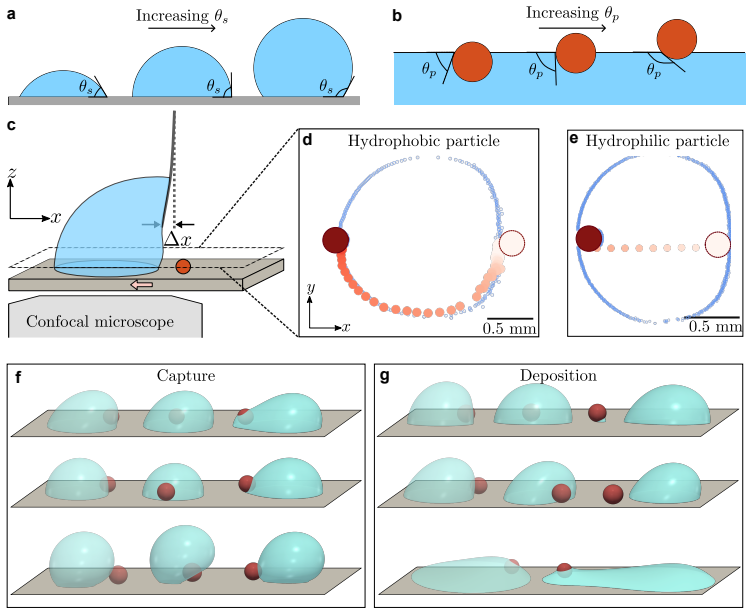
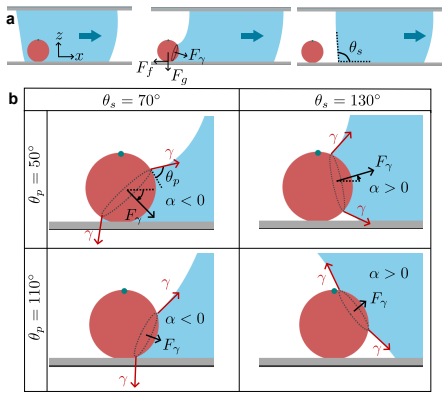
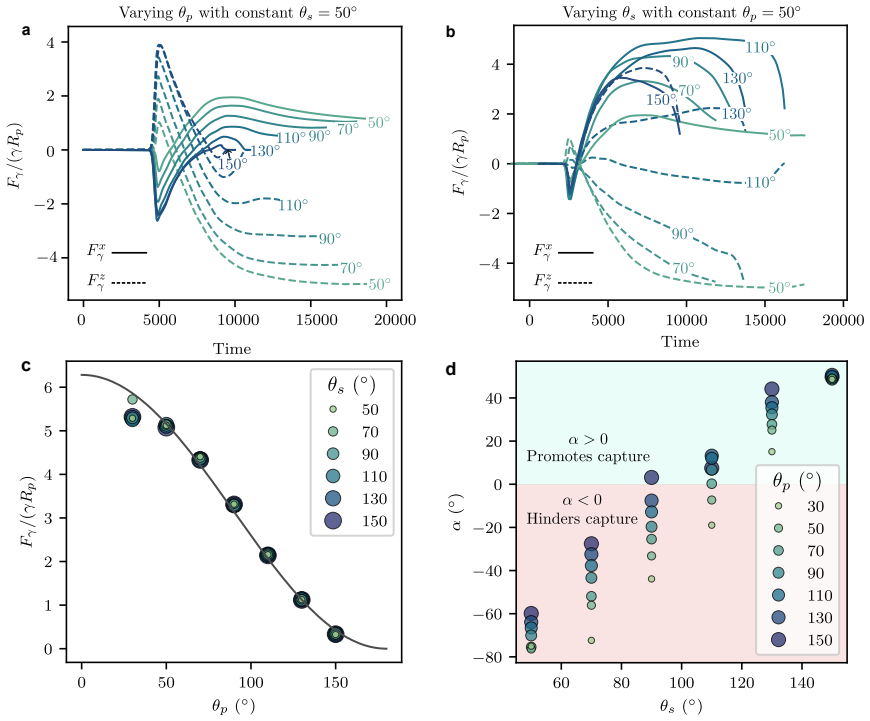
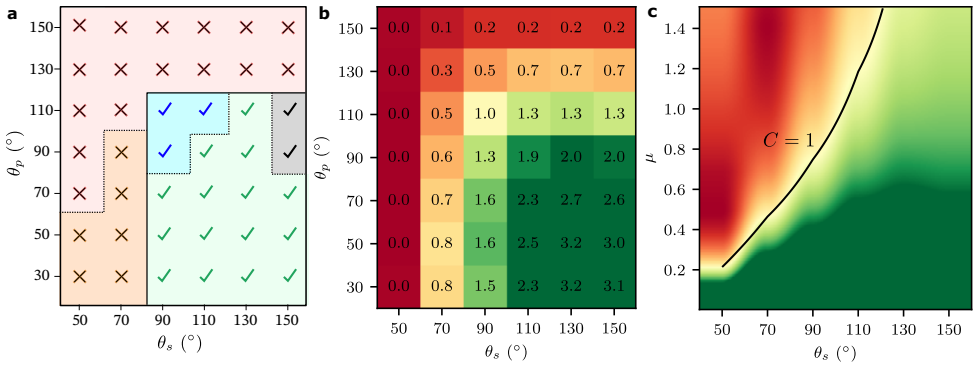
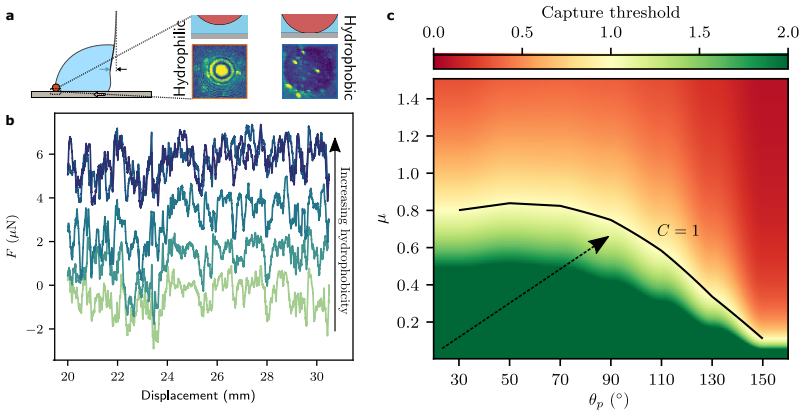
When a drop collides with a particle on a surface, at least six different scenarios arise from the complex interplay between capillary and friction forces. The capillary force plays a dual role in particle removal: while its tangential component always drives removal, its normal component can also hinder it. By introducing a dimensionless capillary capture parameter, particle removal can be predicted across a wide range of particle and surface properties.
What carries the argument
The dimensionless capillary capture parameter, which balances the driving capillary forces against frictional resistance to determine removal outcome.
If this is right
- Surfaces can be engineered for reliable particle removal by tuning properties that enter the capillary capture parameter.
- Cleaning protocols can be optimized to use less water and fewer chemicals while still achieving removal.
- Particle removal success becomes predictable without running new simulations for each combination of particle size and surface.
- The same parameter distinguishes the six collision scenarios and explains why some drops clean while others do not.
Where Pith is reading between the lines
- The parameter could be tested on surfaces with controlled roughness or coatings to check whether it still collapses data when additional length scales appear.
- Extending the model to moving drops or multiple particles in succession might reveal whether the capture parameter remains sufficient for realistic contamination patterns.
- Applications to solar-panel maintenance would benefit from checking how the parameter changes when particles are embedded rather than loosely adhered.
Load-bearing premise
The six scenarios and the forces modeled in the simulations and experiments together capture every relevant physical effect that determines whether a drop removes a particle.
What would settle it
An experiment or simulation in which the capillary capture parameter predicts removal but particles remain attached, or predicts attachment but particles are removed, for parameters outside the tested range.
Figures
read the original abstract
Particulate contaminants decrease the power output of solar panels, the transparency of windows, and are detrimental to microelectronics, where even a single particle can induce a short circuit. Despite significant research on particle adhesion and self-cleaning, it remains unclear when and how a drop can remove a particle from a surface, thus efficiently cleaning the surface. Here, by combining lattice Boltzmann simulations and confocal microscopy experiments, we show that at least six different scenarios arise from the complex interplay between capillary and friction forces when a drop collides with a particle. Notably, the capillary force plays a dual role in particle removal: while its tangential component always drives removal, its normal component can also hinder it. By introducing a dimensionless capillary capture parameter, we can predict particle removal across a wide range of particle and surface properties. These results provide quantitative design principles for easy-to-clean surfaces that minimize water and chemical usage.
Editorial analysis
A structured set of objections, weighed in public.
Referee Report
Summary. The paper combines lattice Boltzmann simulations and confocal microscopy experiments to study particle removal by impacting drops. It identifies at least six distinct scenarios arising from the interplay of capillary and friction forces, notes that the capillary force has a dual role (tangential component drives removal while normal component can hinder it), and introduces a dimensionless capillary capture parameter claimed to predict removal across a wide range of particle and surface properties, yielding quantitative design principles for easy-to-clean surfaces.
Significance. If the central predictive claim holds, the work supplies practical, parameter-based guidelines for minimizing water and chemical use in cleaning applications such as solar panels and microelectronics. The dual simulation-experiment approach and identification of multiple scenarios are strengths that could advance the field beyond purely empirical or single-mechanism models.
major comments (1)
- [Abstract] Abstract and § on the capillary capture parameter: the claim that this single dimensionless parameter predicts removal 'across a wide range of particle and surface properties' is load-bearing for the central result, yet the manuscript does not appear to test or incorporate variations in electrostatic double-layer forces, van der Waals contributions, or pH-dependent surface chemistry; if these were held fixed in the LB runs and confocal experiments, the parameter's claimed generality requires explicit justification or additional terms.
minor comments (2)
- Clarify the exact definition and derivation of the capillary capture parameter (including which forces enter the normal and tangential components) so that readers can reproduce the threshold without ambiguity.
- Provide error bars, number of independent runs, and exclusion criteria for both the lattice Boltzmann trajectories and the confocal observations to allow assessment of statistical robustness.
Simulated Author's Rebuttal
We thank the referee for the constructive comments. We address the major comment below.
read point-by-point responses
-
Referee: [Abstract] Abstract and § on the capillary capture parameter: the claim that this single dimensionless parameter predicts removal 'across a wide range of particle and surface properties' is load-bearing for the central result, yet the manuscript does not appear to test or incorporate variations in electrostatic double-layer forces, van der Waals contributions, or pH-dependent surface chemistry; if these were held fixed in the LB runs and confocal experiments, the parameter's claimed generality requires explicit justification or additional terms.
Authors: The capillary capture parameter is derived specifically from the balance of capillary and frictional forces that control the six removal scenarios identified in the work. Both the lattice Boltzmann simulations and confocal experiments systematically varied particle radius, density, surface wettability (contact angle), and friction coefficient while holding electrostatic double-layer, van der Waals, and pH-dependent contributions fixed at representative values for neutral aqueous systems. These DLVO-type interactions are typically screened or secondary under the dynamic conditions of drop impact. We will revise the abstract and the dedicated section on the parameter to state this scope explicitly, qualify the generality claim to the capillary-friction regime, and note that additional terms would be needed if DLVO forces dominate. This constitutes a clarification rather than an expansion of the model. revision: partial
Circularity Check
No circularity; parameter derived from independent LB simulations and confocal experiments
full rationale
The abstract describes combining lattice Boltzmann simulations and confocal microscopy to identify six scenarios from capillary-friction interplay, then introducing a dimensionless capillary capture parameter to predict removal. No quoted equations or text in the provided material show the parameter being defined in terms of the removal outcome itself, a fitted subset being relabeled as a prediction, or load-bearing self-citations/ansatzes. The derivation chain remains self-contained against the external simulation and experimental benchmarks rather than reducing to its own inputs by construction.
Axiom & Free-Parameter Ledger
Reference graph
Works this paper leans on
-
[1]
Adebiyi, J
A. Adebiyi, J. F. Kok, B. J. Murray, C. L. Ryder, J.-B. W. Stuut, R. A. Kahn, P. Knippertz, P. Formenti, N. M. Mahowald, C. P´ erez Garc´ ıa-Pando, M. Klose, A. Ansmann, B. H. Samset, A. Ito, Y. Balkanski, C. Di Biagio, M. N. Romanias, Y. Huang, and J. Meng, A review of coarse mineral dust in the Earth system, Aeolian Res.60, 100849 (2023)
2023
-
[2]
Brahney, M
J. Brahney, M. Hallerud, E. Heim, M. Hahnenberger, and S. Sukumaran, Plastic rain in protected areas of the United States, Science368, 1257 (2020)
2020
-
[3]
Soheili, S
F. Soheili, S. Woodward, H. Abdul-Hamid, and H. R. Naji, The effect of dust deposition on the morphology and physiology of tree foliage, Water Air Soil Pollut.234, 339 (2023)
2023
-
[4]
K. P. Beckett, P. H. Freer-Smith, and G. Taylor, Urban woodlands: their role in reducing the effects of particulate pollution, Environ. Pollut.99, 347 (1998). 21
1998
-
[5]
K. Ilse, L. Micheli, B. W. Figgis, K. Lange, D. Daßler, H. Hanifi, F. Wolfertstetter, V. Nau- mann, C. Hagendorf, R. Gottschalg, and J. Bagdahn, Techno-Economic Assessment of Soiling Losses and Mitigation Strategies for Solar Power Generation, Joule3, 2303 (2019)
2019
-
[6]
A. Naga, A. Kaltbeitzel, W. S. Y. Wong, L. Hauer, H.-J. Butt, and D. Vollmer, How a water drop removes a particle from a hydrophobic surface, Soft Matter17, 1746 (2021)
2021
-
[7]
T. Yin, D. Shin, J. Frechette, C. E. Colosqui, and G. Drazer, Dynamic effects on the mobi- lization of a deposited nanoparticle by a moving liquid-liquid interface, Phys. Rev. Lett.121, 238002 (2018)
2018
-
[8]
Geyer, M
F. Geyer, M. D’Acunzi, A. Sharifi-Aghili, A. Saal, N. Gao, A. Kaltbeitzel, T.-F. Sloot, R. Berger, H.-J. Butt, and D. Vollmer, When and how self-cleaning of superhydrophobic surfaces works, Sci. Adv.6, eaaw9727 (2020)
2020
-
[9]
Perumanath, R
S. Perumanath, R. Pillai, and M. K. Borg, Contaminant removal from nature’s self-cleaning surfaces, Nano Lett.23, 4234 (2023)
2023
-
[10]
K. M. Wisdom, J. A. Watson, X. Qu, F. Liu, G. S. Watson, and C.-H. Chen, Self-cleaning of superhydrophobic surfaces by self-propelled jumping condensate, Proc. Natl. Acad. Sci. U.S.A.110, 7992 (2013), publisher: Proceedings of the National Academy of Sciences
2013
-
[11]
Heckenthaler, S
T. Heckenthaler, S. Sadhujan, Y. Morgenstern, P. Natarajan, M. Bashouti, and Y. Kaufman, Self-cleaning mechanism: Why nanotexture and hydrophobicity matter, Langmuir35, 15526 (2019)
2019
-
[12]
Leenaars and S
A. Leenaars and S. O’Brien, Particle removal from silicon substrates using surface tension forces, Philips J. Res. , 183 (1989)
1989
-
[13]
Neinhuis and W
C. Neinhuis and W. Barthlott, Characterization and distribution of water-repellent, self- cleaning plant surfaces, Ann. Bot.79, 667 (1997)
1997
-
[14]
Blossey, Self-cleaning surfaces — virtual realities, Nat
R. Blossey, Self-cleaning surfaces — virtual realities, Nat. Mater.2, 301 (2003)
2003
-
[15]
Hassan, B
G. Hassan, B. S. Yilbas, A. Al-Sharafi, and H. Al-Qahtani, Self-cleaning of a hydrophobic surface by a rolling water droplet, Sci. Rep.9, 5744 (2019)
2019
-
[16]
F¨ urstner, W
R. F¨ urstner, W. Barthlott, C. Neinhuis, and P. Walzel, Wetting and self-cleaning properties of artificial superhydrophobic surfaces, Langmuir21, 956 (2005)
2005
-
[17]
Lafuma and D
A. Lafuma and D. Qu´ er´ e, Superhydrophobic states, Nat. Mater.2, 457 (2003)
2003
-
[18]
Wang, C.-S
J.-S. Wang, C.-S. Li, R.-R. Cai, and L.-Z. Zhang, Self-cleaning properties of superhydrophobic surface: Effect of particle wettability, Powder Technol.452, 120536 (2025). 22
2025
-
[19]
Bhushan, Y
B. Bhushan, Y. C. Jung, and K. Koch, Self-cleaning efficiency of artificial superhydrophobic surfaces, Langmuir25, 3240 (2009)
2009
-
[20]
A. Naga, X. Zhang, J. Yang, and H. Kusumaatmaja, Modeling droplet-particle interactions on solid surfaces by coupling the lattice Boltzmann and discrete element methods (2025), 10.48550/arXiv.2505.10171
-
[21]
L. Fei, F. Qin, G. Wang, J. Huang, B. Wen, J. Zhao, K. H. Luo, D. Derome, and J. Carmeliet, Coupled lattice Boltzmann method–discrete element method model for gas–liquid–solid inter- action problems, J. Fluid Mech.975, A20 (2023)
2023
-
[22]
Jiang, H
F. Jiang, H. Liu, X. Chen, and T. Tsuji, A coupled LBM-DEM method for simulating the multiphase fluid-solid interaction problem, J. Comput. Phys.454, 110963 (2022)
2022
-
[23]
N. Sinn, M. Alishahi, and S. Hardt, Detachment of particles and particle clusters from liq- uid/liquid interfaces, J. Colloid Interf. Sci.458, 62 (2015)
2015
-
[24]
W. S. Y. Wong, L. Hauer, A. Naga, A. Kaltbeitzel, P. Baumli, R. Berger, M. D‘Acunzi, D. Vollmer, and H.-J. Butt, Adaptive Wetting of Polydimethylsiloxane, Langmuir36, 7236 (2020)
2020
-
[25]
H.-J. Butt, J. Liu, K. Koynov, B. Straub, C. Hinduja, I. Roismann, R. Berger, X. Li, D. Vollmer, W. Steffen, and M. Kappl, Contact angle hysteresis, Curr. Opin. Colloid Interface Sci.59, 101574 (2022)
2022
-
[26]
A. Naga, D. Vollmer, and H.-J. Butt, Capillary torque on a particle rotating at an interface, Langmuir37, 7457 (2021)
2021
-
[27]
J. S. Marshall, Capillary torque on a rolling particle in the presence of a liquid film at small capillary numbers, Chem. Eng. Sci.108, 87 (2014)
2014
-
[28]
J. Gao, W. D. Luedtke, D. Gourdon, M. Ruths, J. N. Israelachvili, and U. Landman, Frictional forces and Amontons’ law: from the molecular to the macroscopic scale, J. Phys. Chem. B 108, 3410 (2004)
2004
-
[29]
Butt and M
H.-J. Butt and M. Kappl,Surface and interfacial forces, 2nd ed. (Wiley-VCH, 2018)
2018
-
[30]
A. D. Scheludko and D. Nikolov, Measurement of surface tension by pulling a sphere from a liquid, Colloid Polym. Sci.253, 396 (1975)
1975
-
[31]
J. H. Snoeijer and B. Andreotti, Moving contact lines: Scales, regimes, and dynamical tran- sitions, Annu. Rev. Fluid Mech.45, 269 (2013). 23
2013
-
[32]
Hourlier-Fargette, A
A. Hourlier-Fargette, A. Antkowiak, A. Chateauminois, and S. Neukirch, Role of uncrosslinked chains in droplets dynamics on silicone elastomers, Soft Matter13, 3484 (2017)
2017
-
[33]
S. Ni, L. Isa, and H. Wolf, Capillary assembly as a tool for the heterogeneous integration of micro- and nanoscale objects, Soft Matter14, 2978 (2018)
2018
-
[34]
I. B. Liu, N. Sharifi-Mood, and K. J. Stebe, Capillary Assembly of Colloids: Interactions on Planar and Curved Interfaces, Annu. Rev. Condens. Matter Phys.9, 283 (2018)
2018
-
[35]
D. W. Pilat, P. Papadopoulos, D. Sch¨ affel, D. Vollmer, R. Berger, and H.-J. Butt, Dynamic Measurement of the Force Required to Move a Liquid Drop on a Solid Surface, Langmuir28, 16812 (2012)
2012
-
[36]
N. Gao, F. Geyer, D. W. Pilat, S. Wooh, D. Vollmer, H.-J. Butt, and R. Berger, How drops start sliding over solid surfaces, Nat. Phys.14, 191 (2018)
2018
-
[37]
Daniel, J
D. Daniel, J. V. I. Timonen, R. Li, S. J. Velling, and J. Aizenberg, Oleoplaning droplets on lubricated surfaces, Nat. Phys.13, 1020 (2017). 24
2017
discussion (0)
Sign in with ORCID, Apple, or X to comment. Anyone can read and Pith papers without signing in.