Quantum dynamic simulation of triplet formation in an effective model of Y6 (BTP-4F)
Pith reviewed 2026-06-27 09:09 UTC · model grok-4.3
The pith
Y6 aggregation enables fast triplet formation via an intermolecular charge-transfer singlet to Frenkel exciton route unavailable to monomers.
A machine-rendered reading of the paper's core claim, the machinery that carries it, and where it could break.
Core claim
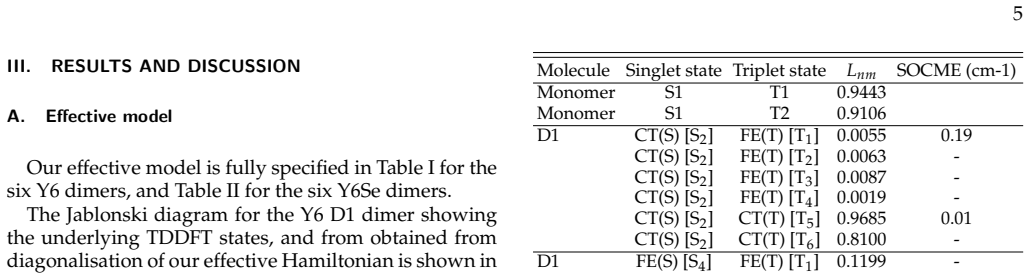
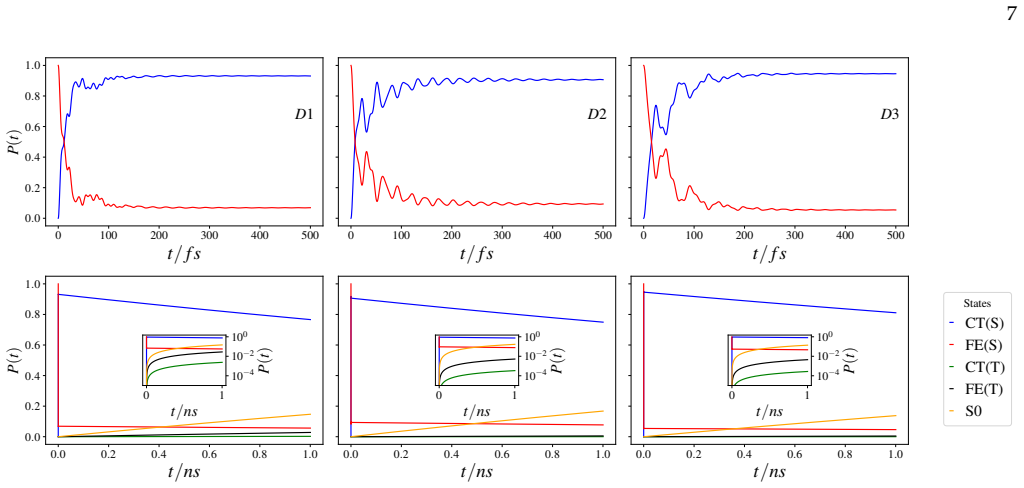
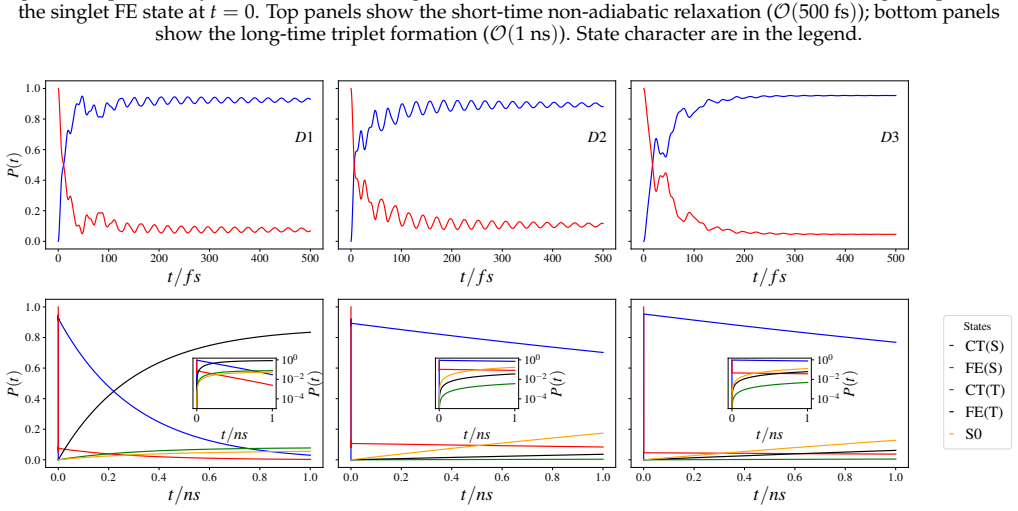
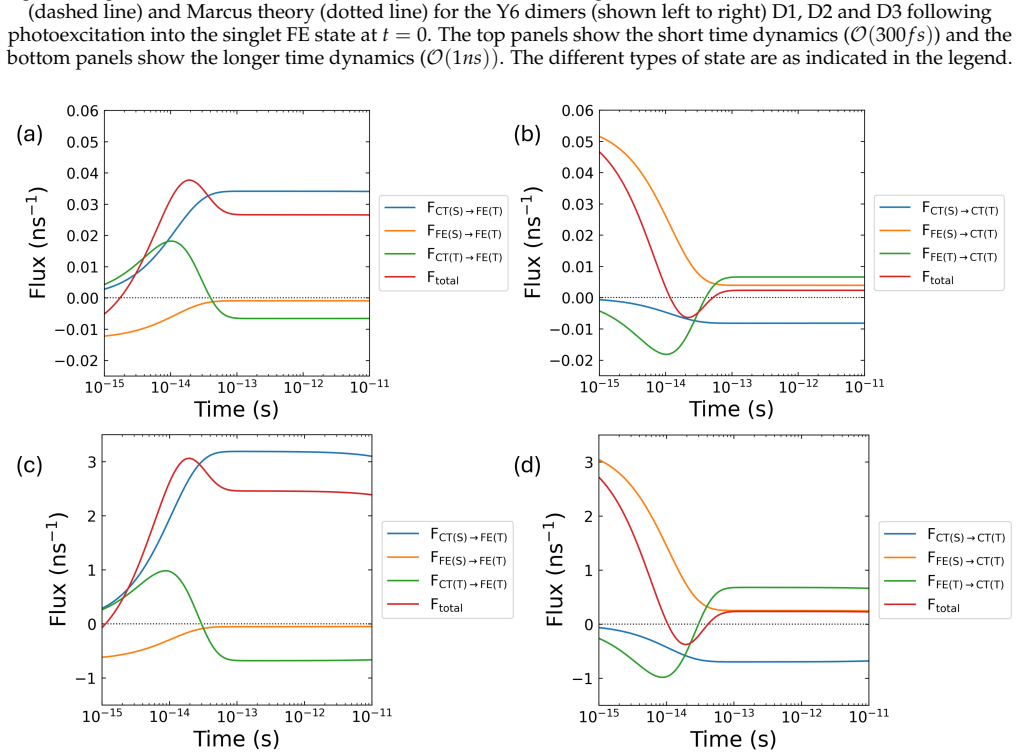
In an effective five-state model of Y6 dimers solved via Hierarchical Equations of Motion, triplets are populated mainly via a transiently excited intermolecular charge-transfer singlet to triplet Frenkel exciton route; this route is not available to the monomer. Analysis of one-particle transition density matrices shows that the charge-transfer states are spatially distinct from the Frenkel exciton states, so the large spin-orbit coupling arises from the associated change in orbital character. Aggregation in Y6 therefore directly enables fast and high-yield intersystem crossing. Selenisation of the model dimers enhances spin-orbit coupling and accelerates the route.
What carries the argument
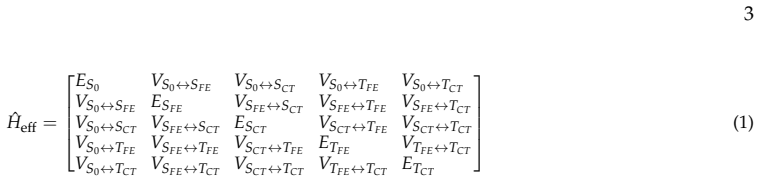
Five-state effective dimer model whose intermolecular charge-transfer singlet to triplet Frenkel exciton transition carries the dominant intersystem crossing pathway under non-adiabatic HEOM dynamics.
If this is right
- Aggregation in Y6 directly enables fast and high-yield intersystem crossing.
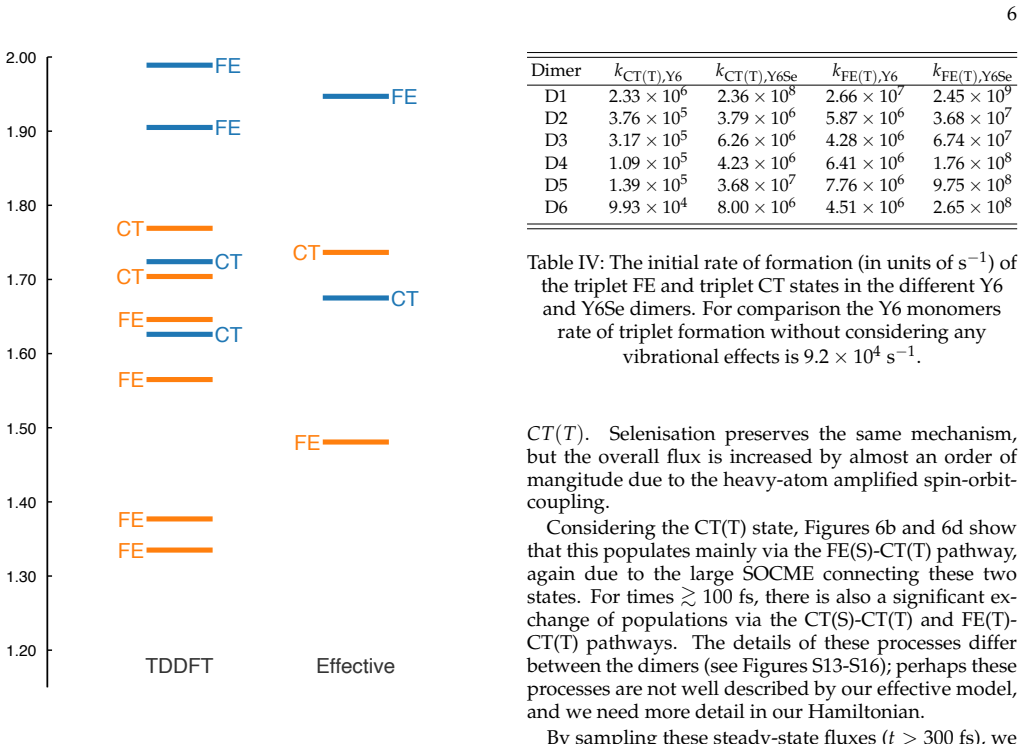
- Selenisation significantly enhances spin-orbit coupling and accelerates the charge-transfer mediated route.
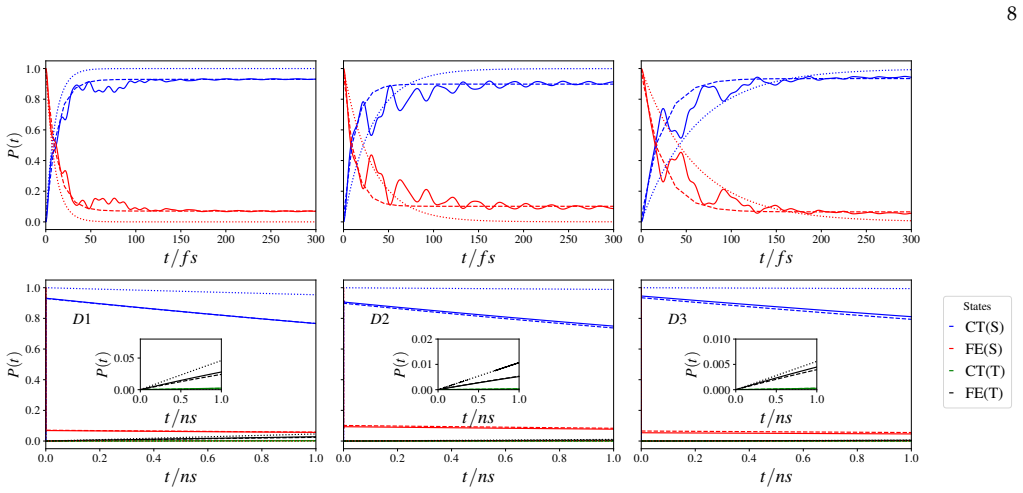
- Marcus theory produces qualitatively correct short-time dynamics but incorrect long-time yields because it omits quantum recurrences.
- The memory-kernel projector method extracts semi-classical rates from the HEOM equations that recover quantitatively correct dynamics and yields.
Where Pith is reading between the lines
- Tuning aggregation morphology in related non-fullerene acceptors could systematically control triplet yields without changing molecular composition.
- Extension of the dimer model to larger clusters may uncover collective effects that further modulate the charge-transfer to Frenkel exciton conversion.
- The spatial separation of charge-transfer and Frenkel states supplies a design principle for enhancing spin-orbit coupling through orbital-character changes rather than heavy-atom substitution.
Load-bearing premise
The five electronic states and the numerical values chosen for their energies, couplings, and spin-orbit matrix elements in the effective dimer model are sufficient to capture the dominant photoexcitation pathways in real Y6 aggregates.
What would settle it
Direct measurement showing that isolated Y6 monomers produce no significant triplet population under photoexcitation, or that the triplet yield in films deviates substantially from the dimer-model prediction.
Figures
read the original abstract
We construct a five-state model for photoexcitation in Y6 (BTP-4F) dimers, and then solve the non-adiabtic dynamics using the Hierarchical Equations of Motion (HEOM) method. We find that triplets are populated mainly via a transiently excited \textit{intermolecular} charge-transfer singlet to triplet Frenkel exciton route; this route is not available to the monomer. Analysis of one-particle transition density matrices suggests that the charge-transfer states are spatially distinct to the Frenkel exciton states, indicating that the large spin-orbit-coupling for this transition is due to it being permitted by an associated change in orbital character. Aggregation in Y6 therefore directly enables fast and high-yield intersystem crossing. We selenise our model dimers, significantly enhancing spin-orbit-coupling, which then accelerates this charge-transfer mediated route. Looking forwards to simulations on larger aggregates, we show that, though Marcus theory gives qualitatively correct dynamics, the long-time yields are incorrect due to it missing quantum recurrences. Instead, we show that the recently developed memory-kernel projector\cite{Gestsson2025-ez} method can produce semi-classical rates directly from the HEOM equations which lead to quantitatively correct dynamics and yields.
Editorial analysis
A structured set of objections, weighed in public.
Referee Report
Summary. The manuscript constructs a five-state effective dimer model for photoexcitation in Y6 (BTP-4F), solves the non-adiabatic dynamics with the Hierarchical Equations of Motion (HEOM) method, and reports that triplets are populated primarily via a transiently excited intermolecular charge-transfer singlet to triplet Frenkel exciton route. This pathway is stated to be unavailable to the monomer, so that aggregation directly enables fast, high-yield intersystem crossing. Additional results include accelerated ISC upon selenisation of the model dimers and a demonstration that the memory-kernel projector method recovers quantitatively correct long-time yields from the HEOM equations while Marcus theory does not.
Significance. If the five-state parameters prove robust, the work supplies a concrete dynamical mechanism linking aggregation to enhanced triplet formation in a technologically relevant non-fullerene acceptor. The explicit comparison of HEOM trajectories against both Marcus theory and the memory-kernel projector method supplies a useful benchmark for the limitations of semiclassical rate theories in systems with quantum recurrences. The analysis of one-particle transition density matrices to rationalize the large SOC is a clear mechanistic insight.
major comments (2)
- [model construction and parameter selection] The central claim that the intermolecular CT-singlet to triplet-Frenkel route dominates (and is aggregation-enabled) rests on the specific choice of five electronic states together with their energies, electronic couplings, and spin-orbit matrix elements. The abstract states these quantities are 'selected for the effective model'; no first-principles derivation, comparison to measured absorption spectra or ISC rates, or sensitivity scan against plausible variations (e.g., ±0.2 eV CT energy shifts typical of aggregate disorder) is referenced. Without such validation the reported dominance of this channel remains model-dependent.
- [monomer vs. dimer comparison] The monomer comparison establishing that the CT-mediated route 'is not available to the monomer' is performed inside the same five-state framework. Because both dimer and monomer results are generated from the identical parameter set, this internal test does not address whether the aggregation-enabled mechanism survives external benchmarks such as experimental aggregate vs. solution ISC yields or ab initio calculations on larger clusters.
minor comments (2)
- [selenisation results] Clarify the precise meaning of 'selenise our model dimers' (substitution of S by Se atoms?) and state whether the enhanced SOC values are taken from literature or recomputed.
- [method comparison] The statement that the memory-kernel projector method produces 'quantitatively correct dynamics and yields' should be accompanied by explicit error metrics (e.g., integrated absolute deviation from HEOM populations) rather than qualitative agreement.
Simulated Author's Rebuttal
We thank the referee for their careful reading and constructive comments. We respond point-by-point to the major comments below.
read point-by-point responses
-
Referee: [model construction and parameter selection] The central claim that the intermolecular CT-singlet to triplet-Frenkel route dominates (and is aggregation-enabled) rests on the specific choice of five electronic states together with their energies, electronic couplings, and spin-orbit matrix elements. The abstract states these quantities are 'selected for the effective model'; no first-principles derivation, comparison to measured absorption spectra or ISC rates, or sensitivity scan against plausible variations (e.g., ±0.2 eV CT energy shifts typical of aggregate disorder) is referenced. Without such validation the reported dominance of this channel remains model-dependent.
Authors: The five-state model is constructed as an effective model whose parameters are chosen to represent the essential physics of Y6 dimers, drawing on literature values for similar non-fullerene acceptors. A complete first-principles derivation of every matrix element lies outside the scope of this dynamics study. To address the concern we will add to the revised manuscript a dedicated paragraph justifying the parameter selection with supporting references, together with a sensitivity scan in which the CT energy is varied by ±0.2 eV; the scan confirms that the dominance of the CT-to-triplet-Frenkel channel is preserved. revision: yes
-
Referee: [monomer vs. dimer comparison] The monomer comparison establishing that the CT-mediated route 'is not available to the monomer' is performed inside the same five-state framework. Because both dimer and monomer results are generated from the identical parameter set, this internal test does not address whether the aggregation-enabled mechanism survives external benchmarks such as experimental aggregate vs. solution ISC yields or ab initio calculations on larger clusters.
Authors: The monomer-dimer comparison isolates the role of the intermolecular CT state, which by construction exists only in the dimer. This establishes that the route is aggregation-enabled within the effective model. The manuscript already cites experimental reports of enhanced triplet formation in Y6 aggregates relative to solution; we will expand the discussion section to make this link explicit and to note the limitations of the five-state dimer size. New ab initio calculations on larger clusters are not feasible in the present revision. revision: partial
Circularity Check
No circularity; derivation is self-contained HEOM dynamics on constructed model
full rationale
The paper constructs a five-state effective dimer model, selects its energies/couplings/SOC elements as inputs, and computes time-dependent populations via HEOM. The reported dominant ISC route is an output of that propagation, not equivalent to the inputs by construction. The monomer comparison and the auxiliary memory-kernel projector result (cited as Gestsson2025-ez) are separate; neither reduces the central claim to a fitted quantity or self-citation chain. No quoted step exhibits self-definitional, fitted-prediction, or load-bearing self-citation patterns.
Axiom & Free-Parameter Ledger
free parameters (2)
- state energies and electronic couplings
- spin-orbit coupling matrix elements
axioms (2)
- standard math The Hierarchical Equations of Motion method correctly propagates the reduced density matrix for the chosen system-bath model.
- domain assumption The five chosen electronic states dominate the photoexcitation dynamics on the relevant timescale.
Reference graph
Works this paper leans on
-
[1]
doi:10.6084/m9.figshare.32634777 , howpublished=
Isabel Creed and Jarvist Moore Frost , year=. doi:10.6084/m9.figshare.32634777 , howpublished=
-
[2]
Harvey, Matthew , title =. 2017 , copyright =. doi:10.14469/HPC/2232 , url =
-
[3]
The Original Design Principles of the Y-Series Nonfullerene Acceptors, from Y1 to Y6 , volume =
Yang, Yang , year =. The Original Design Principles of the Y-Series Nonfullerene Acceptors, from Y1 to Y6 , volume =. ACS Nano , publisher =. doi:10.1021/acsnano.1c10365 , number =
-
[4]
Nature Photonics , volume=
Efficient solid-state photon upconversion enabled by triplet formation at an organic semiconductor interface , author=. Nature Photonics , volume=. 2021 , publisher=
2021
-
[5]
Nature Communications , volume=
Free charge photogeneration in a single component high photovoltaic efficiency organic semiconductor , author=. Nature Communications , volume=. 2022 , publisher=
2022
-
[6]
Nature communications , volume=
Probing the pathways of free charge generation in organic bulk heterojunction solar cells , author=. Nature communications , volume=. 2018 , publisher=
2018
-
[7]
Journal of the Chinese Chemical Society , volume=
Photo-induced energy and charge transfer dynamics in Y6 dimers , author=. Journal of the Chinese Chemical Society , volume=. 2023 , publisher=
2023
-
[8]
Materials Today , volume=
On the role of charge transfer excitations in non-fullerene acceptors for organic photovoltaics , author=. Materials Today , volume=. 2024 , publisher=
2024
-
[9]
Journal of Photochemistry and Photobiology A: Chemistry , volume=
Correction of the calculation method of CT state energy in ITIC and Y6 acceptor systems , author=. Journal of Photochemistry and Photobiology A: Chemistry , volume=. 2024 , publisher=
2024
-
[10]
Xiao, Chengyi and Li, Cheng and Liu, Feng and Zhang, Lei and Li, Weiwei , year =. Single-crystal field-effect transistors based on a fused-ring electron acceptor with high ambipolar mobilities , volume =. Journal of Materials Chemistry C , publisher =. doi:10.1039/d0tc00587h , number =
-
[11]
Zhang, Guichuan and Chen, Xian-Kai and Xiao, Jingyang and Chow, Philip C. Y. and Ren, Minrun and Kupgan, Grit and Jiao, Xuechen and Chan, Christopher C. S. and Du, Xiaoyan and Xia, Ruoxi and Chen, Ziming and Yuan, Jun and Zhang, Yunqiang and Zhang, Shoufeng and Liu, Yidan and Zou, Yingping and Yan, He and Wong, Kam Sing and Coropceanu, Veaceslav and Li, N...
-
[12]
Exciton Binding Energy of Non‐Fullerene Electron Acceptors , volume =
Zhu, Yufan and Zhao, Fuwen and Wang, Wei and Li, Yawen and Zhang, Shiming and Lin, Yuze , year =. Exciton Binding Energy of Non‐Fullerene Electron Acceptors , volume =. Advanced Energy and Sustainability Research , publisher =. doi:10.1002/aesr.202100184 , number =
-
[13]
Jiang, Kui and Zhang, Jie and Zhong, Cheng and Lin, Francis R. and Qi, Feng and Li, Qian and Peng, Zhengxing and Kaminsky, Werner and Jang, Sei-Hum and Yu, Jianwei and Deng, Xiang and Hu, Huawei and Shen, Dong and Gao, Feng and Ade, Harald and Xiao, Min and Zhang, Chunfeng and Jen, Alex K.-Y. , year =. Suppressed recombination loss in organic photovoltaic...
-
[14]
Hart, Lucy J. F. and Medranda, Daniel G. and Yuan, Shi Wei and Lindh, Linnea and M\". Molecular factors controlling charge pair generation in organic photovoltaic materials , ISSN =. doi:10.1038/s41563-026-02509-6 , journal =
-
[15]
Souza, J.P.A. and Benatto, L. and Candiotto, G. and Wouk, L. and Koehler, M. , year =. Dynamics of vibrationally coupled intersystem crossing in state-of-the-art organic optoelectronic materials , volume =. Communications Chemistry , publisher =. doi:10.1038/s42004-025-01485-3 , number =
-
[16]
Correcting hybrid density functionals to model Y6 and other non-fullerene acceptors
Ward, Tom and Creed, Isabel and Rein, Tim and Frost, Jarvist Moore , keywords =. Correcting hybrid density functionals to model Y6 and other non-fullerene acceptors , publisher =. 2026 , copyright =. doi:10.48550/ARXIV.2603.05379 , url =
work page internal anchor Pith review Pith/arXiv arXiv doi:10.48550/arxiv.2603.05379 2026
-
[17]
Marcus, R. A. , year =. Theory of Electron-Transfer Reaction Rates of Solvated Electrons , volume =. The Journal of Chemical Physics , publisher =. doi:10.1063/1.1696504 , number =
-
[18]
Tanimura, Yoshitaka and Kubo, Ryogo , year =. Time Evolution of a Quantum System in Contact with a Nearly Gaussian-Markoffian Noise Bath , volume =. Journal of the Physical Society of Japan , publisher =. doi:10.1143/jpsj.58.101 , number =
-
[19]
Neese, Frank , year =. The ORCA program system , volume =. WIREs Computational Molecular Science , publisher =. doi:10.1002/wcms.81 , number =
-
[20]
Journal of chemical theory and computation , volume=
Analysis of excitonic and charge transfer interactions from quantum chemical calculations , author=. Journal of chemical theory and computation , volume=. 2012 , publisher=
2012
-
[21]
The Journal of chemical physics , volume=
TheoDORE: A toolbox for a detailed and automated analysis of electronic excited state computations , author=. The Journal of chemical physics , volume=. 2020 , publisher=
2020
-
[22]
The Journal of Physical Chemistry Letters , volume=
Effect of solid-state polarization on charge-transfer excitations and transport levels at organic interfaces from a screened range-separated hybrid functional , author=. The Journal of Physical Chemistry Letters , volume=. 2017 , publisher=
2017
-
[23]
The energy gap law for radiationless transitions in large molecules , volume =
Englman, Robert and Jortner, Joshua , year =. The energy gap law for radiationless transitions in large molecules , volume =. Molecular Physics , publisher =. doi:10.1080/00268977000100171 , number =
-
[24]
Heß, Bernd A. and Marian, Christel M. and Wahlgren, Ulf and Gropen, Odd , year =. A mean-field spin-orbit method applicable to correlated wavefunctions , volume =. Chemical Physics Letters , publisher =. doi:10.1016/0009-2614(96)00119-4 , number =
-
[25]
van Lenthe, E. and Snijders, J. G. and Baerends, E. J. , year =. The zero-order regular approximation for relativistic effects: The effect of spin–orbit coupling in closed shell molecules , volume =. The Journal of Chemical Physics , publisher =. doi:10.1063/1.472460 , number =
-
[26]
berkelbach-group/pyrho v1.0 , publisher =
Berkelbach, Timothy and Fetherolf, Jonathan and Shih, Petra and. berkelbach-group/pyrho v1.0 , publisher =. 2020 , copyright =. doi:10.5281/ZENODO.4015527 , url =
-
[27]
An efficient Julia framework for hierarchical equations of motion in open quantum systems , volume =
Huang, Yi-Te and Kuo, Po-Chen and Lambert, Neill and Cirio, Mauro and Cross, Simon and Yang, Shen-Liang and Nori, Franco and Chen, Yueh-Nan , year =. An efficient Julia framework for hierarchical equations of motion in open quantum systems , volume =. Communications Physics , publisher =. doi:10.1038/s42005-023-01427-2 , number =
-
[28]
The Journal of Chemical Physics , volume =
Bose, Amartya , title = ". The Journal of Chemical Physics , volume =. 2023 , month =. doi:10.1063/5.0151483 , url =
-
[29]
and Sánchez, Darío Puchán and David, Arthur H
Mutovska, Monika G. and Sánchez, Darío Puchán and David, Arthur H. G. and Cabanetos, Clément and Le Bahers, Tangui and Zagranyarski, Yulian and Monnereau, Cyrille and Toldo, Josene M. , year =. Revisiting the intersystem crossing mechanisms in chromophore dimers through the lens of excitonic coupling: a case study of naphthalimide , volume =. Physical Che...
-
[30]
Tree tensor network state approach for solving hierarchical equations of motion , volume =
Ke, Yaling , year =. Tree tensor network state approach for solving hierarchical equations of motion , volume =. The Journal of Chemical Physics , publisher =. doi:10.1063/5.0153870 , number =
-
[31]
M. J. Frisch and G. W. Trucks and H. B. Schlegel and G. E. Scuseria and M. A. Robb and J. R. Cheeseman and G. Scalmani and V. Barone and G. A. Petersson and H. Nakatsuji and X. Li and M. Caricato and A. V. Marenich and J. Bloino and B. G. Janesko and R. Gomperts and B. Mennucci and H. P. Hratchian and J. V. Ortiz and A. F. Izmaylov and J. L. Sonnenberg an...
2016
-
[32]
The ORCA quantum chemistry program package
Neese, Frank and Wennmohs, Frank and Becker, Ute and Riplinger, Christoph , year =. The ORCA quantum chemistry program package , volume =. The Journal of Chemical Physics , publisher =. doi:10.1063/5.0004608 , number =
-
[33]
Software update: the ORCA program system, version 4.0 , volume =
Neese, Frank , year =. Software update: the ORCA program system, version 4.0 , volume =. WIREs Computational Molecular Science , publisher =. doi:10.1002/wcms.1327 , number =
-
[34]
Izsák, Róbert and Neese, Frank and Klopper, Wim , year =. Robust fitting techniques in the chain of spheres approximation to the Fock exchange: The role of the complementary space , volume =. The Journal of Chemical Physics , publisher =. doi:10.1063/1.4819264 , number =
-
[35]
, year = 2012, month = oct, journal =
Izsák, Róbert and Hansen, Andreas and Neese, Frank , year =. The resolution of identity and chain of spheres approximations for the LPNO-CCSD singles Fock term , volume =. Molecular Physics , publisher =. doi:10.1080/00268976.2012.687466 , number =
-
[36]
An overlap fitted chain of spheres exchange method , volume =
Izsák, Róbert and Neese, Frank , year =. An overlap fitted chain of spheres exchange method , volume =. The Journal of Chemical Physics , publisher =. doi:10.1063/1.3646921 , number =
-
[37]
and Nation, Charlie and Higgins, Jacob S
Gestsson, Hallmann O. and Nation, Charlie and Higgins, Jacob S. and Engel, Gregory S. and Olaya-Castro, Alexandra , year =. Non-perturbative exciton transfer rate analysis of the Fenna–Matthews–Olson photosynthetic complex under reducing and oxidizing conditions , volume =. The Journal of Chemical Physics , publisher =. doi:10.1063/5.0251613 , number =
-
[38]
An Insight into the Excitation States of Small Molecular Semiconductor Y6 , volume =
Zou, Xianshao and Wen, Guanzhao and Hu, Rong and Dong, Geng and Zhang, Chengyun and Zhang, Wei and Huang, Hao and Dang, Wei , year =. An Insight into the Excitation States of Small Molecular Semiconductor Y6 , volume =. Molecules , publisher =. doi:10.3390/molecules25184118 , number =
-
[39]
Kupgan, G. and Chen, X.K. and Brédas, J.L. , year =. Molecular packing of non-fullerene acceptors for organic solar cells: Distinctive local morphology in Y6 vs. ITIC derivatives , volume =. doi:10.1016/j.mtadv.2021.100154 , journal =
-
[40]
Guan, Zhiqiang and Li, Ho-Wa and Cheng, Yuanhang and Yang, Qingdan and Lo, Ming-Fai and Ng, Tsz-Wai and Tsang, Sai-Wing and Lee, Chun-Sing , year =. Charge-Transfer State Energy and Its Relationship with Open-Circuit Voltage in an Organic Photovoltaic Device , volume =. The Journal of Physical Chemistry C , publisher =. doi:10.1021/acs.jpcc.6b02375 , number =
-
[41]
Energy transfer from F
Olaya-Castro, Alexandra and Scholes, Gregory D , journal=. Energy transfer from F. 2011 , publisher=
2011
-
[42]
Mahadevan, Sudhi and Liu, Taili and Pratik, Saied Md and Li, Yuhao and Ho, Hang Yuen and Ouyang, Shanchao and Lu, Xinhui and Yip, Hin-Lap and Chow, Philip C. Y. and Brédas, Jean-Luc and Coropceanu, Veaceslav and So, Shu Kong and Tsang, Sai-Wing , year =. Assessing intra- and inter-molecular charge transfer excitations in non-fullerene acceptors using elec...
-
[43]
Woon, Kai‐Lin and Nikishau, Pavel A. and Sini, Gjergji , year =. Fast and Accurate Determination of the Singlet–Triplet Gap in Donor–Acceptor and Multiresonance TADF Molecules by Using Hole–Hole Tamm–Dancoff Approximated Density Functional Theory , volume =. Advanced Theory and Simulations , publisher =. doi:10.1002/adts.202200056 , number =
-
[44]
Marian, Christel M. , year =. Understanding and Controlling Intersystem Crossing in Molecules , volume =. Annual Review of Physical Chemistry , publisher =. doi:10.1146/annurev-physchem-061020-053433 , number =
-
[45]
Hart, Lucy J. F. and Gr\". Understanding the Role of Triplet‐Triplet Annihilation in Non‐Fullerene Acceptor Organic Solar Cells , volume =. Advanced Energy Materials , publisher =. doi:10.1002/aenm.202301357 , number =
-
[46]
Carr, Joshua M. and Allen, Taylor G. and Larson, Bryon W. and Davydenko, Iryna G. and Dasari, Raghunath R. and Barlow, Stephen and Marder, Seth R. and Reid, Obadiah G. and Rumbles, Garry , year =. Short and long-range electron transfer compete to determine free-charge yield in organic semiconductors , volume =. Materials Horizons , publisher =. doi:10.103...
-
[47]
Yan, Yaming and Xu, Meng and Liu, Yanying and Shi, Qiang , year =. Theoretical study of charge carrier transport in organic molecular crystals using the Nakajima-Zwanzig-Mori generalized master equation , volume =. The Journal of Chemical Physics , publisher =. doi:10.1063/1.5096214 , number =
-
[48]
Ishizaki, Akihito and Fleming, Graham R. , year =. Theoretical examination of quantum coherence in a photosynthetic system at physiological temperature , volume =. Proceedings of the National Academy of Sciences , publisher =. doi:10.1073/pnas.0908989106 , number =
-
[49]
Bai, Shuming and Zhang, Shuocang and Huang, Chenghong and Shi, Qiang , year =. Hierarchical Equations of Motion for Quantum Chemical Dynamics: Recent Methodology Developments and Applications , volume =. Accounts of Chemical Research , publisher =. doi:10.1021/acs.accounts.4c00492 , number =
-
[50]
Baumeier, Bj\". Density-functional based determination of intermolecular charge transfer properties for large-scale morphologies , volume =. Physical Chemistry Chemical Physics , publisher =. 2010 , pages =. doi:10.1039/c002337j , number =
-
[51]
An approximate method for calculating transfer integrals based on the ZINDO Hamiltonian , volume =
Kirkpatrick, James , year =. An approximate method for calculating transfer integrals based on the ZINDO Hamiltonian , volume =. International Journal of Quantum Chemistry , publisher =. doi:10.1002/qua.21378 , number =
-
[52]
and Vura-Weis, Josh and Michl, Josef and Ratner, Mark A
Greyson, Eric C. and Vura-Weis, Josh and Michl, Josef and Ratner, Mark A. , year =. Maximizing Singlet Fission in Organic Dimers: Theoretical Investigation of Triplet Yield in the Regime of Localized Excitation and Fast Coherent Electron Transfer , volume =. The Journal of Physical Chemistry B , publisher =. doi:10.1021/jp907392q , number =
-
[53]
and Seideman, Tamar and Ratner, Mark A
Parker, Shane M. and Seideman, Tamar and Ratner, Mark A. and Shiozaki, Toru , year =. Model Hamiltonian Analysis of Singlet Fission from First Principles , volume =. The Journal of Physical Chemistry C , publisher =. doi:10.1021/jp505082a , number =
discussion (0)
Sign in with ORCID, Apple, or X to comment. Anyone can read and Pith papers without signing in.