Superconductivity in the pressure-amorphized topological insulator CrP₄
Pith reviewed 2026-06-27 07:59 UTC · model grok-4.3
The pith
Pressure amorphizes the Cr-based topological insulator CrP4, inducing superconductivity with Tc reaching 4.8 K.
A machine-rendered reading of the paper's core claim, the machinery that carries it, and where it could break.
Core claim
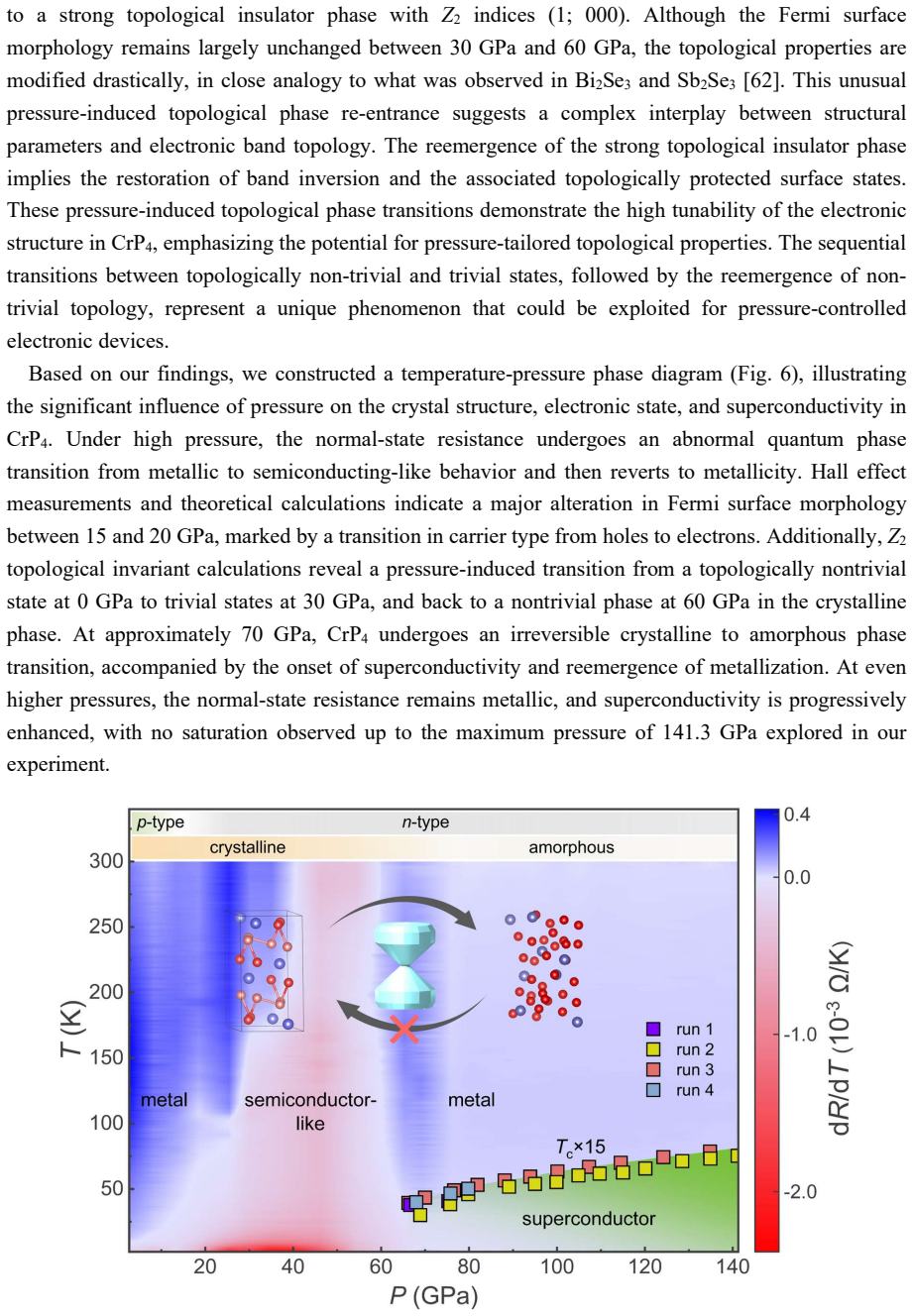
We report the observation of superconductivity in pressure-amorphized CrP4. The material undergoes a metal-to-semiconductor transition at 15 GPa. At 70 GPa re-metallization coincides with irreversible amorphization and the appearance of superconductivity, with Tc rising to 4.8 K at 141 GPa. Calculations predict multiple topological phase transitions under pressure.
What carries the argument
Irreversible amorphization under pressure that drives re-metallization and superconductivity while the system traverses several topological phases.
If this is right
- CrP4 is the first known Cr-based amorphous superconductor.
- Amorphous materials can support both superconductivity and nontrivial topology.
- The superconducting transition temperature increases with pressure beyond the amorphization point.
- Pressure can induce multiple topological phase transitions in CrP4.
- New routes exist to combine superconductivity with topological properties via amorphization.
Where Pith is reading between the lines
- Other Cr-containing topological insulators may also become superconducting if amorphized by pressure or other means.
- The disorder from amorphization could modify the pairing interaction in ways distinct from crystalline superconductors.
- This method might apply to additional 3d transition-metal compounds that are hard to make superconducting in ordered forms.
Load-bearing premise
The onset of superconductivity at 70 GPa is caused by the irreversible amorphization and not by some other pressure-driven change that happens to occur at the same pressure.
What would settle it
Structural measurements that find the material remains crystalline above 70 GPa while superconductivity is observed, or transport data showing no superconductivity in a confirmed amorphous sample at those pressures.
Figures
read the original abstract
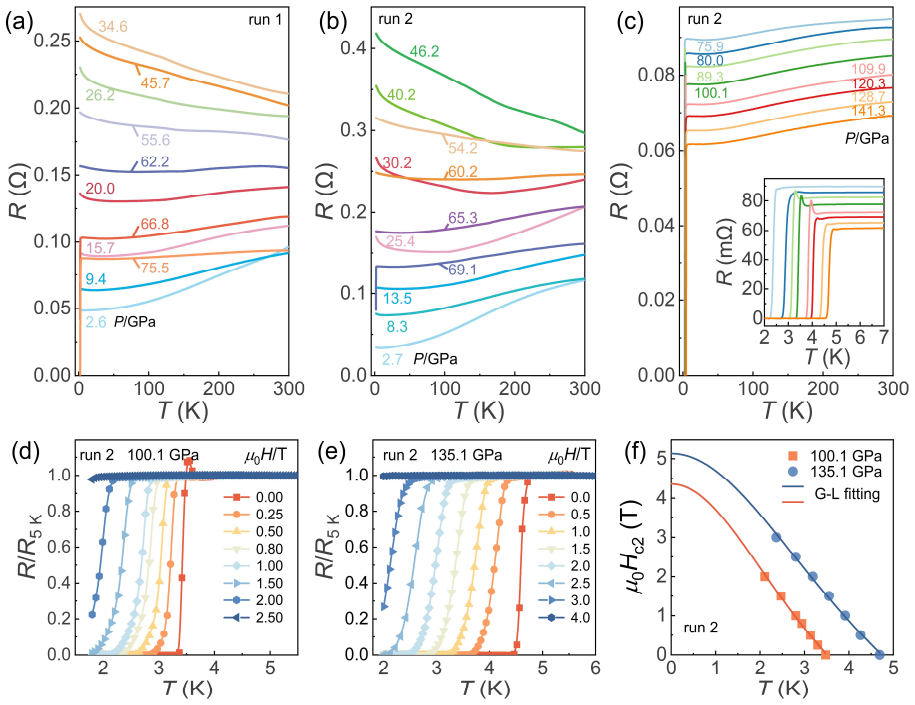
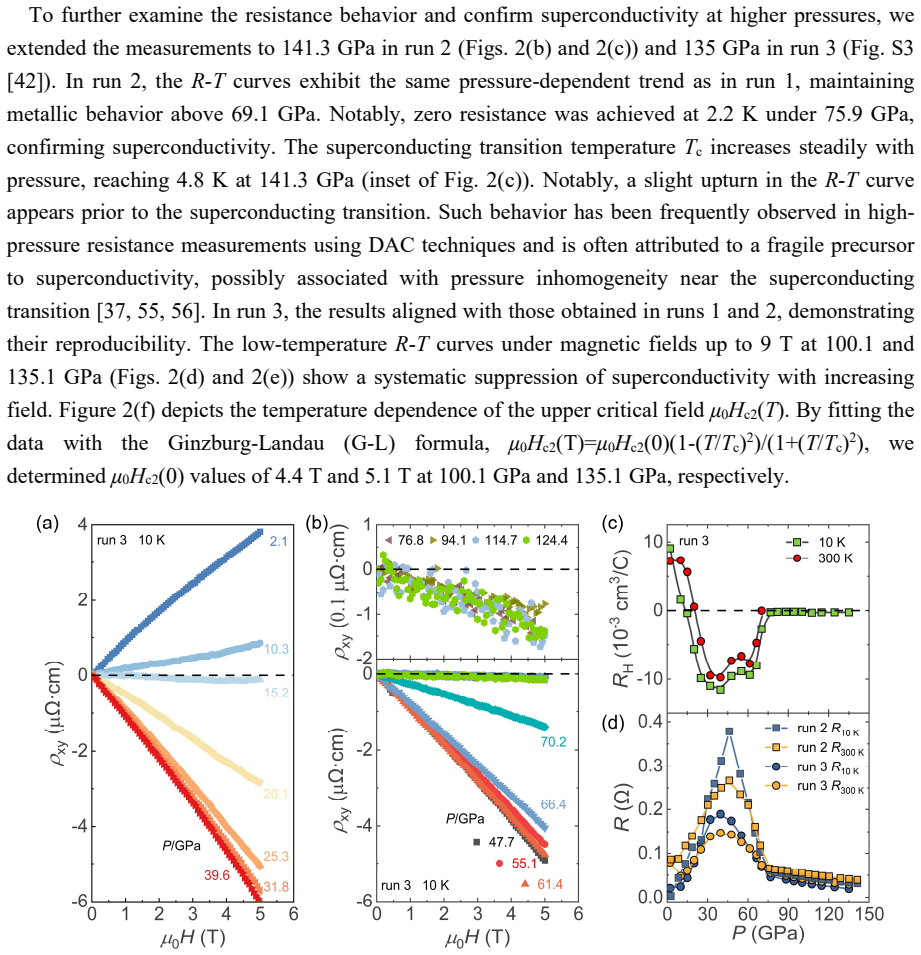
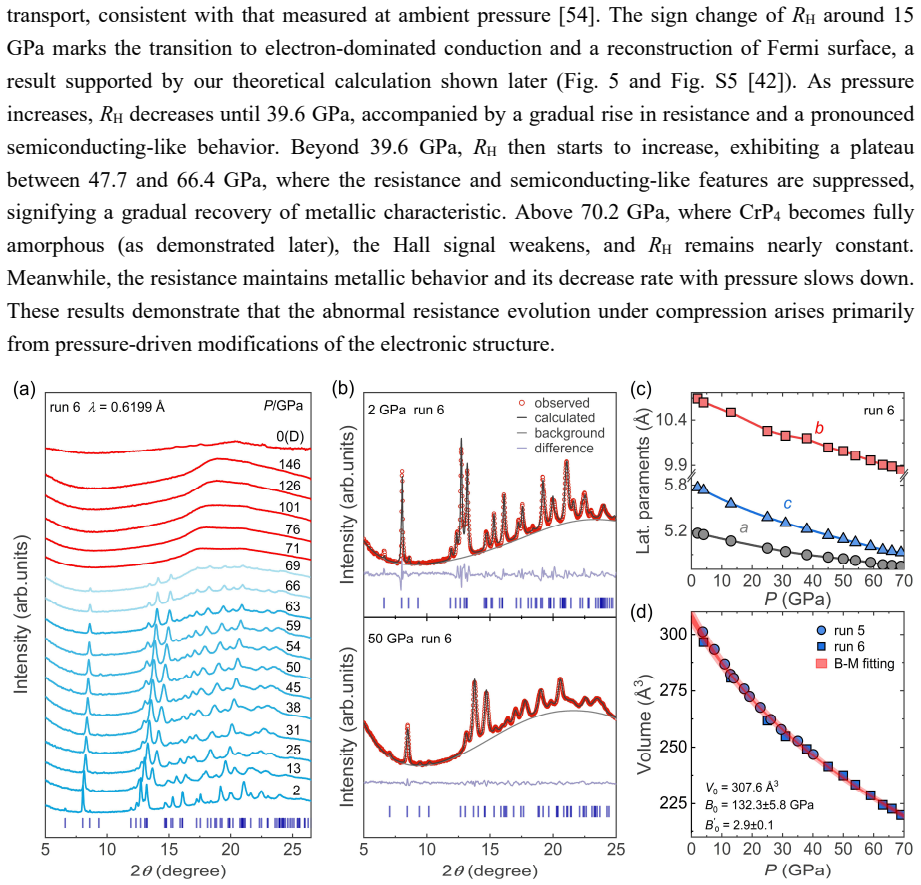
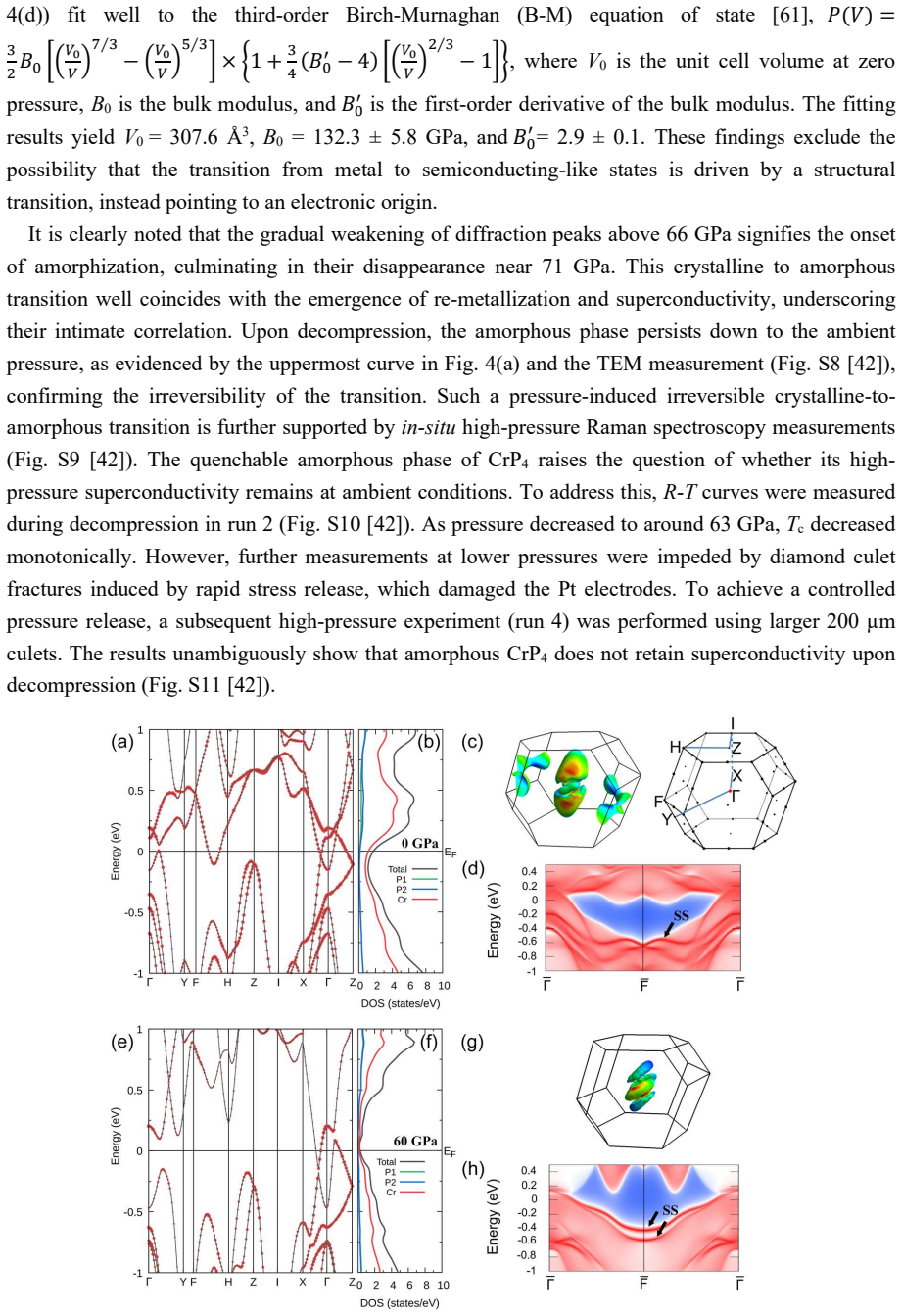
The interplay among superconductivity, magnetism, and nontrivial band topology represents one of the most compelling frontiers in condensed matter physics. The exploration of novel superconductivity in 3d transition-metal compounds, particularly the rare Cr-based systems containing strongly magnetic Cr ions, has long attracted attention owing to their unconventional pairing mechanisms that challenge conventional wisdom. Yet, Cr-based superconductors remain scarce, especially those possessing nontrivial topological character, underscoring the urgent need to uncover new members. Here we report the observation of superconductivity in pressure-amorphized Cr-based topological insulator CrP$_4$. Upon compression, CrP$_4$ undergoes an anomalous quantum phase transition from a metallic to a semiconducting-like state at around 15 GPa, driven by significant changes in the electronic structure. At approximately 70 GPa, re-metallization with superconductivity occurs alongside an irreversible amorphization. The superconducting transition temperature Tc increases monotonically with pressure, reaching 4.8 K at 141.3 GPa. Furthermore, theoretical calculations predict multiple topological phase transitions from a strong topological insulator to a trivial state and finally back to a strong topological state under pressure. Our study not only establishes CrP$_4$ as the first Cr-based amorphous superconductor but also opens a new paradigm for exploring superconducting and topological properties in amorphous materials.
Editorial analysis
A structured set of objections, weighed in public.
Referee Report
Summary. The manuscript reports the experimental observation of superconductivity in the topological insulator CrP₄ upon irreversible pressure-induced amorphization at approximately 70 GPa, following a metallic-to-semiconducting-like transition at ~15 GPa. The superconducting Tc increases monotonically with pressure, reaching 4.8 K at 141.3 GPa. Theoretical calculations predict multiple topological phase transitions (strong TI to trivial to strong TI) under compression. The work claims CrP₄ as the first Cr-based amorphous superconductor.
Significance. If the data establish that superconductivity emerges specifically in the fully amorphous phase and is not attributable to residual crystalline domains or separate electronic mechanisms, the result would be significant: Cr-based superconductors are rare, and the work would demonstrate a route to superconductivity in pressure-amorphized topological materials, potentially enabling new studies of pairing and topology in disordered systems.
major comments (2)
- [Abstract] Abstract: the central claim that superconductivity occurs in the pressure-amorphized phase (and thus that CrP₄ is the 'first Cr-based amorphous superconductor') requires that the irreversible amorphization be confirmed to coincide with the re-metallization and Tc onset at ~70 GPa. The abstract asserts these phenomena occur 'alongside' each other but supplies no structural metric (disappearance of Bragg peaks, emergence of diffuse scattering, or pair-distribution-function data) to establish that the sample is fully amorphous precisely when superconductivity appears. This attribution is load-bearing for the headline result.
- [Abstract] Abstract: the observation of superconductivity is stated without reference to the primary data (resistivity vs. temperature curves, critical-field measurements, or zero-resistance confirmation) or the experimental methods used to establish the transition. Because the soundness of the SC claim rests on these measurements, their absence from the summary prevents evaluation of whether the reported Tc values are robust.
Simulated Author's Rebuttal
We thank the referee for their detailed and constructive review. The comments highlight opportunities to strengthen the abstract's clarity regarding the linkage between structural and transport data. We have revised the abstract to address both points directly while preserving the manuscript's core claims, which are supported by the full dataset in the main text and SI.
read point-by-point responses
-
Referee: [Abstract] Abstract: the central claim that superconductivity occurs in the pressure-amorphized phase (and thus that CrP₄ is the 'first Cr-based amorphous superconductor') requires that the irreversible amorphization be confirmed to coincide with the re-metallization and Tc onset at ~70 GPa. The abstract asserts these phenomena occur 'alongside' each other but supplies no structural metric (disappearance of Bragg peaks, emergence of diffuse scattering, or pair-distribution-function data) to establish that the sample is fully amorphous precisely when superconductivity appears. This attribution is load-bearing for the headline result.
Authors: We agree that the abstract would benefit from an explicit reference to the structural evidence. The revised abstract now states that re-metallization and superconductivity onset coincide with irreversible amorphization, as confirmed by the disappearance of Bragg peaks in synchrotron XRD at ~70 GPa. The full pressure-dependent XRD patterns, including the transition to diffuse scattering, are presented in Figure 2 and the associated discussion in the main text, establishing that the superconducting state emerges in the amorphous phase. revision: yes
-
Referee: [Abstract] Abstract: the observation of superconductivity is stated without reference to the primary data (resistivity vs. temperature curves, critical-field measurements, or zero-resistance confirmation) or the experimental methods used to establish the transition. Because the soundness of the SC claim rests on these measurements, their absence from the summary prevents evaluation of whether the reported Tc values are robust.
Authors: We accept this observation and have revised the abstract to note that superconductivity is established via zero-resistance transitions in four-probe resistivity measurements under pressure, with Tc reaching 4.8 K at 141.3 GPa. The primary ρ(T) curves, upper-critical-field data, and experimental details (including pressure calibration and sample environment) are provided in Figures 3–5 and the Methods section. revision: yes
Circularity Check
No circularity; experimental observation with separate theoretical support
full rationale
The paper reports direct experimental measurements (resistivity, XRD under pressure) of a metallization transition and superconductivity onset near 70 GPa coinciding with amorphization. The topological phase transitions are stated as outputs of standard first-principles calculations, not derived from or fitted to the superconductivity data. No equations, fitted parameters, or self-citations reduce the central claim to its own inputs by construction. The derivation chain is self-contained against external benchmarks.
Axiom & Free-Parameter Ledger
axioms (1)
- domain assumption High-pressure measurements accurately determine the applied pressure and detect electronic and structural transitions via resistivity and diffraction.
Reference graph
Works this paper leans on
-
[1]
To ensure a comprehensive and accurate description of the electronic structure, both relativistic effects and spin- orbit coupling (SOC) were incorporated in all calculations
for the exchange-correlation functional, which has been shown to provide superior accuracy in determining crystal structure parameters compared to conventional functionals. To ensure a comprehensive and accurate description of the electronic structure, both relativistic effects and spin- orbit coupling (SOC) were incorporated in all calculations. The Ferm...
-
[2]
Bednorz, and K.A
J.G. Bednorz, and K.A. Müller, Possible high Tc superconductivity in Ba-La-Cu-O system, Z. Phys. B 64, 189 (1986)
1986
-
[3]
Kamihara, T
Y. Kamihara, T. Watanabe, M. Hirano, and H. Hosono, Iron-Based Layered Superconductor La[O1-xFx]FeAs ( x = 0.05-0.12) with Tc=26 K, J. Am. Chem. Soc. 130, 3296 (2008)
2008
-
[4]
H. Sun, M. Huo, X. Hu, J. Li, Z. Liu, Y. Han, L. Tang, Z. Mao, P. Yang, B. Wang, et al., Signatures of superconductivity near 80 K in a nickelate under high pressure, Nature 621, 493 (2023)
2023
-
[5]
Jin, N.P
K. Jin, N.P. Butch, K. Kirshenbaum, J. Paglione, and R.L. Greene, Link between spin fluctuations and electron pairing in copper oxide superconductors, Nature 476, 73-75 (2011)
2011
-
[6]
P. Dai, J. Hu, and E. Dagotto, Magnetism and its microscopic origin in iron-based high- temperature superconductors, Nat. Phys. 8, 709-718 (2012)
2012
-
[7]
Chubukov, Pairing Mechanism in Fe-Based Superconductors, Annu
A. Chubukov, Pairing Mechanism in Fe-Based Superconductors, Annu. Rev. Condens. Matter Phys. 3, 57-92 (2012)
2012
-
[8]
W. Wu, J. Cheng, K. Matsubayashi, P. Kong, F. Lin, C. Jin, N. Wang, Y. Uwatoko, and J. Luo, Superconductivity in the vicinity of antiferromagnetic order in CrAs, Nat. Commun. 5, 5508 (2014)
2014
-
[9]
W. Cai, H. Sun, W. Xia, C. Wu, Y. Liu, H. Liu, Y. Gong, D.-X. Yao, Y. Guo, and M. Wang, Pressure-induced superconductivity and structural transition in ferromagnetic CrSiTe3, Phys. Rev. B 102, 144525 (2020)
2020
-
[10]
C. Li, Y. Wang, K. Liu, D. Jiang, J. Feng, T. Wen, B. Yue, Y. Zhou, L. Sun, and Y. Wang, Superconductivity in Quasi-One-Dimensional Ferromagnet CrSbSe3 under High Pressure, J. Am. Chem. Soc 146, 9688 (2024)
2024
-
[11]
Liu, Z.-Y
Y. Liu, Z.-Y. Liu, J.-K. Bao, P.-T. Yang, L.-W. Ji, S.-Q. Wu, Q.-X. Shen, J. Luo, J. Yang, J.-Y. Liu, et al., Superconductivity under pressure in a chromium-based kagome metal, Nature 632, 1032- 1037 (2024)
2024
-
[12]
Bao, J.-Y
J.-K. Bao, J.-Y. Liu, C.-W. Ma, Z.-H. Meng, Z.-T. Tang, Y.-L. Sun, H.-F. Zhai, H. Jiang, H. Bai, C.-M. Feng, et al., Superconductivity in Quasi-One-Dimensional K2Cr3As3 with Significant Electron Correlations, Phys. Rev. X 5, 011013 (2015)
2015
-
[13]
Mu, B.-B
Q.-G. Mu, B.-B. Ruan, B.-J. Pan, T. Liu, J. Yu, K. Zhao, G.-F. Chen, and Z.-A. Ren, Ion- exchange synthesis and superconductivity at 8.6 K of Na2Cr3As3 with quasi-one-dimensional crystal structure, Phys. Rev. Mater. 2, 034803 (2018)
2018
-
[14]
Cao, J.-K
G.-H. Cao, J.-K. Bao, Z.-T. Tang, Y. Liu, and H. Jiang, Peculiar properties of Cr3As3-chain-based superconductors, Philos. Mag. 97, 591-611 (2017)
2017
-
[15]
W. Wu, K. Liu, Y. Li, Z. Yu, D. Wu, Y. Shao, S. Na, G. Li, R. Huang, T. Xiang, et al., Superconductivity in chromium nitrides Pr3Cr10-xN11 with strong electron correlations, Natl. Sci. Rev. 7, 21-26 (2020)
2020
-
[16]
Jiang, G
H. Jiang, G. Cao, and C. Cao, Electronic structure of quasi-one-dimensional superconductor K2Cr3As3 from first-principles calculations, Sci. Rep. 5, 16054 (2015)
2015
-
[17]
J. Luo, J. Yang, R. Zhou, Q.G. Mu, T. Liu, Z.-a. Ren, C.J. Yi, Y.G. Shi, and G.-q. Zheng, Tuning the Distance to a Possible Ferromagnetic Quantum Critical Point in A2Cr3As3, Phys. Rev. Lett. 123, 047001 (2019). 16
2019
-
[18]
C.S. Chen, Q. Wu, M.Y. Zou, Z.H. Zhu, Y.X. Yang, C. Tan, A.D. Hillier, J. Chang, J.L. Luo, W. Wu, et al., Unconventional superconductivity in Cr-based compound Pr3Cr10−xN11, npj Quan. Mater. 9, 22 (2024)
2024
-
[19]
Yang, Z.T
J. Yang, Z.T. Tang, G.H. Cao, and G.-q. Zheng, Ferromagnetic Spin Fluctuation and Unconventional Superconductivity in Rb2Cr3As3 Revealed by 75As NMR and NQR, Phys. Rev. Lett. 115, 147002 (2015)
2015
-
[20]
Gu, T.-C
K.-Y. Gu, T.-C. Luo, J. Ge, and J. Wang, Superconductivity in topological materials, Acta Phys. Sin. 69, 020301 (2020)
2020
-
[21]
Sato, and Y
M. Sato, and Y. Ando, Topological superconductors: a review, Rep. Prog. Phys. 80, 076501 (2017)
2017
-
[22]
Qi, and S.-C
X.-L. Qi, and S.-C. Zhang, Topological insulators and superconductors, Rev. Mod. Phys. 83, 1057 (2011)
2011
-
[23]
Ando, and L
Y. Ando, and L. Fu, Topological Crystalline Insulators and Topological Superconductors: From Concepts to Materials, Annu. Rev. Condens. Matter Phys. 6, 361-381 (2015)
2015
-
[24]
Kirshenbaum, P.S
K. Kirshenbaum, P.S. Syers, A.P. Hope, N.P. Butch, J.R. Jeffries, S.T. Weir, J.J. Hamlin, M.B. Maple, Y.K. Vohra, and J. Paglione, Pressure-induced unconventional superconducting phase in the topological insulator Bi2Se3, Phys. Rev. Lett. 111, 087001 (2013)
2013
-
[25]
Bernevig, C
B.A. Bernevig, C. Felser, and H. Beidenkopf, Progress and prospects in magnetic topological materials, Nature 603, 41-51 (2022)
2022
-
[26]
D. Wang, L. Kong, P. Fan, H. Chen, S. Zhu, W. Liu, L. Cao, Y. Sun, S. Du, J. Schneeloch, et al., Evidence for Majorana bound states in an iron-based superconductor, Science 362, 333 (2018)
2018
-
[27]
W. Liu, L. Cao, S. Zhu, L. Kong, G. Wang, M. Papaj, P. Zhang, Y.-B. Liu, H. Chen, G. Li, et al., A new Majorana platform in an Fe-As bilayer superconductor, Nat. Commun. 11, 5688 (2020)
2020
-
[28]
C. Pei, M. Xi, Q. Wang, W. Shi, J. Wu, L. Gao, Y. Zhao, S. Tian, W. Cao, C. Li, et al., Pressure- induced superconductivity in magnetic topological insulator candidate MnSb4Te7, Phys. Rev. Mater. 6, L101801 (2022)
2022
-
[29]
Jeitschko, and P.C
W. Jeitschko, and P.C. Donohue, The High Pressure Synthesis, Crystal Structure, and Properties of CrP4 and MoP4, Acta Cryst. B28, 1893 (1972)
1972
-
[30]
Xiang, G.J
Z.J. Xiang, G.J. Ye, C. Shang, B. Lei, N.Z. Wang, K.S. Yang, D.Y. Liu, F.B. Meng, X.G. Luo, L.J. Zou, et al., Pressure-Induced Electronic Transition in Black Phosphorus, Phys. Rev. Lett. 115, 186403 (2015)
2015
-
[31]
Li, Y.-J
C.-H. Li, Y.-J. Long, L.-X. Zhao, L. Shan, Z.-A. Ren, J.-Z. Zhao, H.-M. Weng, X. Dai, Z. Fang, C. Ren, et al. , Pressure-induced topological phase transitions and strongly anisotropic magnetoresistance in bulk black phosphorus, Phys. Rev. B 95, 125417 (2017)
2017
-
[32]
J. Guo, H. Wang, F. von Rohr, W. Yi, Y. Zhou, Z. Wang, S. Cai, S. Zhang, X. Li, Y. Li, et al., Electron-hole balance and the anomalous pressure-dependent superconductivity in black phosphorus, Phys. Rev. B 96, 224513 (2017)
2017
-
[33]
X. Li, J. Sun, P. Shahi, M. Gao, A.H. MacDonald, Y. Uwatoko, T. Xiang, J.B. Goodenough, J. Cheng, and J. Zhou, Pressure-induced phase transitions and superconductivity in a black phosphorus single crystal, Proc. Natl. Acad. Sci. U. S. A. 115, 9935-9940 (2018)
2018
-
[34]
Ashcroft, Metallic Hydrogen: A High-Temperature Superconductor?, Phys
N.W. Ashcroft, Metallic Hydrogen: A High-Temperature Superconductor?, Phys. Rev. Lett. 21, 1748-1749 (1968)
1968
-
[35]
Ashcroft, Hydrogen dominant metallic alloys: high temperature superconductors?, Phys
N.W. Ashcroft, Hydrogen dominant metallic alloys: high temperature superconductors?, Phys. Rev. Lett. 92, 187002 (2004). 17
2004
-
[36]
Huang, C
J. Huang, C. Zhang, K. Zhai, F. Qin, L. Ao, Z. Li, L. Zhou, M. Tang, X. Dai, C. Qiu, et al., Pressure-driven superconductivity in layered isostructural germanium phosphides, 2D Mater. 11, 025003 (2024)
2024
-
[37]
J. Song, G. Fei, X. Liu, S. Duan, B. Yang, X. Chen, D.J. Singh, Y. Liu, L. Yang, J. Guo, et al., Pressure-driven significant phonon mode softening and robust superconductivity in layered germanium phosphide, J. Mater. Chem. A 8, 20054-20061 (2020)
2020
-
[38]
Zhang, X
C. Zhang, X. Xing, S. Huang, X. Tang, L. Yu, N. Zuo, B. Li, X. Yi, YanMeng, X. Zhang, et al., Pressure-induced superconductivity, amorphization, and topological phase transitions in the topological semimetal MoP4, Phys. Rev. B 111, L140502 (2025)
2025
-
[39]
N. Zuo, B. Zheng, C. Zhang, X. Xing, Y. Huang, H. Yu, B. Li, X. Yi, Y. Meng, X. Zhang, et al., Pressure-driven amorphous superconductivity in the topological semimetal VP4, Phys. Rev. B 112, 184508 (2025)
2025
-
[40]
Xiang, Y.J
Z.N. Xiang, Y.J. Zhang, Q. Lu, Q. Li, Y. Li, T. Huang, Y. Zhu, Y. Ye, J. Sun, and H.H. Wen, Superconductivity up to 14.2 K in MnB4 Under Pressure, Adv. Mater. 2416882 (2024)
2024
-
[41]
Zhang, Y
T. Zhang, Y. Jiang, Z. Song, H. Huang, Y. He, Z. Fang, H. Weng, and C. Fang, Catalogue of topological electronic materials, Nature 566, 475 (2019)
2019
-
[42]
M. Yang, X. Li, S. Duan, X. Zhang, H. Sun, X. Chen, T. Su, L. Gu, and X. Liu, Superior Thermoelectric Performance of Black Phosphorus in Elemental Tellurium, Adv. Energy Mater. 12, 2203014 (2022)
2022
-
[43]
See Supplemental Material at http://link.aps.org/supplemental/xxxxxx for details of the DAC setup, EDX spectrum, high-pressure R-T curves, Hall effect at 300 K, high-pressure Raman spectroscopy, additional high-pressure XRD data and peak-splitting analysis, the HRTEM image of the amorphous phase, and theoretical calculations
-
[44]
Prescher, and V.B
C. Prescher, and V.B. Prakapenka, DIOPTAS: a program for reduction of two-dimensional X-ray diffraction data and data exploration, High Pressure Res. 35, 223 (2015)
2015
-
[45]
Toby, and R.B
B.H. Toby, and R.B. Von Dreele, GSAS-II: the genesis of a modern open-source all purpose crystallography software package, J. Appl. Cryst. 46, 544 (2013)
2013
-
[46]
H.K. Mao, J. Xu, and P.M. Bell, Calibration of the ruby pressure gauge to 800 kbar under quasi- hydrostatic conditions, J. Geophys. Res. 91, 4673 (1986)
1986
-
[47]
Akahama, and H
Y. Akahama, and H. Kawamura, Pressure calibration of diamond anvil Raman gauge to 310 GPa, J. Appl. Phys. 100, 043516 (2006)
2006
-
[48]
Anderson, D.G
O.L. Anderson, D.G. Isaak, and S. Yamamoto, Anharmonicity and the equation of state for gold, J. Appl. Phys. 65, 1534-1543 (1989)
1989
-
[49]
Schwarz, P.Blaha, and G.K.H.Madsen, Electronic structure calculations of solids using the WIEN2k package for material sciences, Comput
K. Schwarz, P.Blaha, and G.K.H.Madsen, Electronic structure calculations of solids using the WIEN2k package for material sciences, Comput. Phys. Commun. 147, 71 (2002)
2002
-
[50]
Wu, and R.E
Z. Wu, and R.E. Cohen, More accurate generalized gradient approximation for solids, Phys. Rev. B 73, 235116 (2006)
2006
-
[51]
A. A. Mostofi, J.R. Yates, G. Pizzi, Y.-S. Lee, I. Souza, D. Vanderbilt, and N. Marzari, An updated version of wannier90: A tool for obtaining maximally-localised Wannier functions, Comput. Phys. Commun. 185, 2309 (2014)
2014
-
[52]
Q. S. Wu, S.N. Zhang, H.F. Song, M. Troyer, and A.A. Soluyanov, WannierTools: An open- source software package for novel topological materials Comput. Phys. Commun. 224, 405 (2018)
2018
-
[53]
Madsen, and D
G.K.H. Madsen, and D. J. Singh, BoltzTraP. A code for calculating band-structure dependent quantities, Compu. Phys. Commun. 175, 67-71 (2006). 18
2006
-
[54]
Momma, and F
K. Momma, and F. Izumi, VESTA 3 for three-dimensional visualization of crystal, volumetric and morphology data, J. Appl. Cryst. 44, 1272-1276 (2011)
2011
-
[55]
W. Wu, Z.H. Yu, M. Xu, X.L. Liu, J.G. Zhao, Z.Y. Liu, W. Xia, Z.Y. Li, C.Y. Zhou, J.J. Feng, et al., Large magnetoresistance and unexpected low thermal conductivity in topological semimetal CrP4 single crystal, Appl. Phys. A 128, 196 (2022)
2022
-
[56]
Z. Chi, X. Chen, C. An, L. Yang, J. Zhao, Z. Feng, Y. Zhou, Y. Zhou, C. Gu, B. Zhang, et al., Pressure-induced superconductivity in MoP, npj Quantum Mater. 3, 28 (2018)
2018
-
[57]
X. Xu, J. Nie, C. Xu, Z. Zhu, X. Xing, Y. Huang, C. Zhang, N. Zuo, C. Zhao, Z. Zhang, et al., Pressure-driven reentrant superconductivity in the heavy d-electron superconductor Rh17S15 with weak ferromagnetism in the normal state, Phys. Rev. B 111, L161113 (2025)
2025
-
[58]
Y. Zhou, J. Guo, S. Cai, J. Zhao, G. Gu, C. Lin, H. Yan, C. Huang, C. Yang, S. Long, et al., Quantum phase transition from superconducting to insulating-like state in a pressurized cuprate superconductor, Nat. Phys. 18, 406 (2022)
2022
-
[59]
Q. Dong, J. Pan, S. Li, C. Li, T. Lin, B. Liu, R. Liu, Q. Li, F. Huang, and B. Liu, Abnormal Metal–Semiconductor-Like Transition and Exceptional Enhanced Superconducting State in Pressurized Restacked TaS2, J. Am. Chem. Soc. 145, 14581 (2023)
2023
-
[60]
Zhang, W
H. Zhang, W. Zhong, B. Yue, X. Yu, and F. Hong, Anomalous metal-semiconductor transition and superconductivity in van der Waals TiS2 under pressure, Phys. Rev. B 110, 134525 (2024)
2024
-
[61]
C. Li, X. Liu, Z. Yu, W. Wu, L. Zhang, C. Zhou, J. Zhao, Y. Guo, and J. Luo, The Remarkable Anisotropic Compressibility and Metallic Cr-Cr Chains in Topological Semimetal CrP4 under High Pressure, Phys. Status Solidi B 258, 2000544 (2021)
2021
-
[62]
Birch, Finite Elastic Strain of Cubic Crystals, Phys
F. Birch, Finite Elastic Strain of Cubic Crystals, Phys. Rev. 71, 809-824 (1947)
1947
-
[63]
Zhang, C.-X
H. Zhang, C.-X. Liu, X.-L. Qi, X. Dai, Z. Fang, and S.-C. Zhang, Topological insulators in Bi2Se3, Bi2Te3 and Sb2Te3 with a single Dirac cone on the surface, Nat. Phys. 5, 438 (2009)
2009
-
[64]
C. Pei, P. Yang, C. Gong, Q. Wang, Y. Zhao, L. Gao, K. Chen, Q. Yin, S. Tian, C. Li, et al., Pressure-induced superconductivity in itinerant antiferromagnet CrB2, DOI, arXiv:2109.15213 (2021)
arXiv 2021
-
[65]
Y. Zhao, T. Ying, L. Zhao, J. Wu, C. Pei, J. Chen, J. Deng, Q. Zhang, L. Gu, Q. Wang, et al., Disorder‐Broadened Phase Boundary with Enhanced Amorphous Superconductivity in Pressurized In2Te5, Adv. Mater. 36, 2401118 (2024)
2024
-
[66]
Zhang, M
K. Zhang, M. Xu, N. Li, M. Xu, Q. Zhang, E. Greenberg, V.B. Prakapenka, Y.-S. Chen, M. Wuttig, H.-K. Mao, et al., Superconducting Phase Induced by a Local Structure Transition in Amorphous Sb2Se3 under High Pressure, Phys. Rev. Lett. 127, 127002 (2021)
2021
-
[67]
Wang, X.-L
Q. Wang, X.-L. Qiu, C. Pei, B.-C. Gong, L. Gao, Y. Zhao, W. Cao, C. Li, S. Zhu, M. Zhang, et al., Superconductivity emerging from a pressurized van der Waals kagome material Pd3P2S8, New J. Phys. 25, 043001 (2023)
2023
-
[68]
N. Qian, Z. Chen, Y. Zhou, L. Li, C. Chen, S. Wang, R. Zhang, X. Chen, C. An, Y. Zhou, et al., Pressure-induced superconductivity and enhanced optoelectronic property in the ternary pentagonal semiconductor PdPSe, Phys. Rev. B 109, 054517 (2024)
2024
-
[69]
W. Cao, H. Yang, Y. Li, C. Pei, Q. Wang, Y. Zhao, C. Li, M. Zhang, S. Zhu, J. Wu, et al., Pressure-induced superconductivity in the Zintl topological insulator SrIn2As2 Phys. Rev. B 108, 224510 (2023)
2023
-
[70]
J. Zhao, H. Liu, L. Ehm, D. Dong, Z. Chen, and G. Gu, High-pressure phase transitions, amorphization, and crystallization behaviors in Bi2Se3, J. Phys.: Condens. Matter 25, 125602 (2013). 19
2013
-
[71]
C. An, Y. Zhou, C. Chen, F. Fei, F. Song, C. Park, J. Zhou, H.G. Rubahn, V.V. Moshchalkov, X. Chen, et al. , Long‐Range Ordered Amorphous Atomic Chains as Building Blocks of a Superconducting Quasi‐One‐Dimensional Crystal, Adv. Mater. 32, 2002352 (2020)
2020
-
[72]
Fujiwara, Y
K. Fujiwara, Y. Kato, H. Abe, S. Noguchi, J. Shiogai, Y. Niwa, H. Kumigashira, Y. Motome, and A. Tsukazaki, Berry curvature contributions of kagome-lattice fragments in amorphous Fe–Sn thin films, Nat. Commun. 14, 3399 (2023)
2023
-
[73]
Agarwala, and V.B
A. Agarwala, and V.B. Shenoy, Topological Insulators in Amorphous Systems, Phys. Rev. Lett. 118, 236402 (2017)
2017
-
[74]
Y.-B. Yang, T. Qin, D.-L. Deng, L.M. Duan, and Y. Xu, Topological Amorphous Metals, Phys. Rev. lett. 123, 076401 (2019)
2019
-
[75]
Mitchell, L.M
N.P. Mitchell, L.M. Nash, D. Hexner, A.M. Turner, and W.T.M. Irvine, Amorphous topological insulators constructed from random point sets, Nat. Phys. 14, 380-385 (2018)
2018
-
[76]
Pöyhönen, I
K. Pöyhönen, I. Sahlberg, A. Westström, and T. Ojanen, Amorphous topological superconductivity in a Shiba glass, Nat. Commun. 9, 2103 (2018)
2018
discussion (0)
Sign in with ORCID, Apple, or X to comment. Anyone can read and Pith papers without signing in.