Knowing the Rules Is Not Enough: Student Regulatory Awareness and Use of GenAI in Higher Education
Pith reviewed 2026-06-30 19:38 UTC · model grok-4.3
The pith
Awareness of GenAI regulations shows only weak to moderate links to how students actually use the tools.
A machine-rendered reading of the paper's core claim, the machinery that carries it, and where it could break.
Core claim
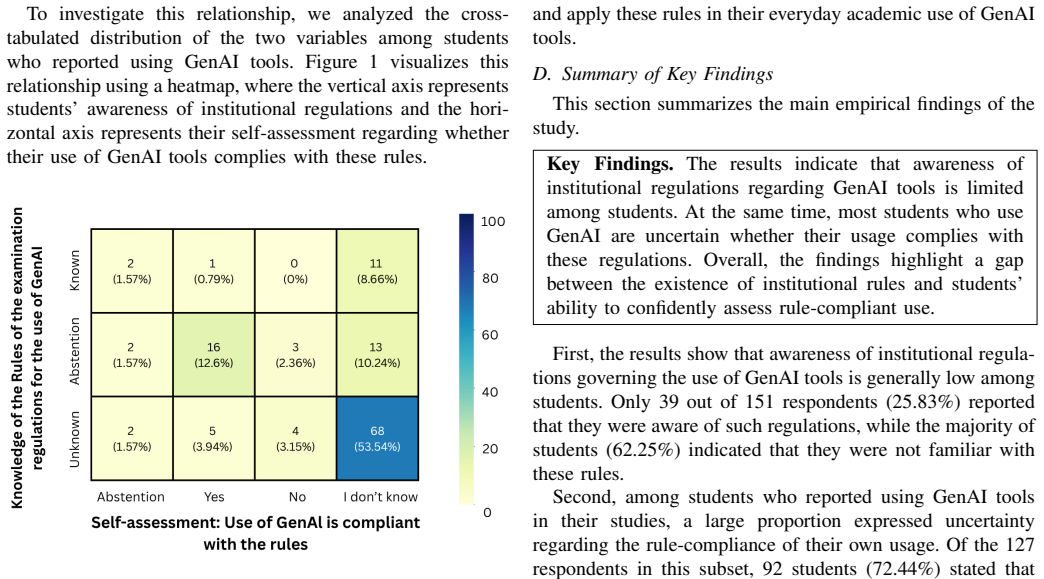
Most students actively use GenAI tools, but regulatory awareness shows only weak to moderate associations with actual usage behavior. Students primarily rely on privately accessed GenAI tools rather than institutionally provided solutions, and over half are uncertain whether their usage complies with institutional regulations.
What carries the argument
Correlation and cross-tabulation analysis of self-reported survey data on regulatory awareness, perceived compliance, and GenAI usage collected from 151 students.
If this is right
- Policy communication by itself is unlikely to produce strong shifts in student GenAI practices.
- Institutions may need to supply official GenAI tools that students find convenient if they want usage to align with rules.
- Educators could explore ways to embed rule guidance inside coursework rather than treating it as separate information.
Where Pith is reading between the lines
- The weak association points toward testing whether required training sessions or course-integrated examples change usage more than passive awareness does.
- Similar gaps between private-tool preference and institutional options may appear with other new classroom technologies.
- Policy design might benefit from studying how students discover and adopt tools outside official channels.
Load-bearing premise
Students' answers on a survey accurately reflect their real GenAI usage, knowledge of rules, and sense of compliance without substantial bias from social pressure or faulty memory.
What would settle it
A follow-up study that records actual GenAI tool access through system logs or direct observation and then compares those records against the same students' stated regulatory awareness.
Figures
read the original abstract
Context: Generative Artificial Intelligence (GenAI) tools such as ChatGPT are increasingly integrated into students learning practices. While previous research mainly examines adoption rates and attitudes, students awareness of institutional regulations and their perceived compliance remain unexplored. Understanding whether regulatory awareness influences student behavior is therefore important as higher education institutions create and apply AI policies. Objective: This study investigates how students awareness of GenAI regulations relates to their perceived compliance and actual usage behavior. Our research objective is to examine the association between regulatory knowledge, GenAI use, and perceived rule conformity among students in computer science related study programs. Method: A survey with 151 undergraduate students in Business Information Systems and E-Government programs at the University of Applied Sciences and Arts Hannover (Germany) collected data on GenAI usage, tools used, awareness of institutional regulations, and perceived compliance. Descriptive statistics, cross-tabulations, and correlation analyzes were applied. Results: Most students actively use GenAI tools, but over half are uncertain whether their usage complies with institutional regulations. Regulatory awareness shows only weak to moderate associations with actual usage behavior. Students primarily rely on privately accessed GenAI tools rather than institutionally provided solutions. Contributions: The study contributes empirical evidence on the relationship between regulatory awareness and GenAI usage in higher education. Our findings highlight a gap between institutional regulations and student practices and provide insights for educators and institutions on improving policy communication and integrating GenAI more effectively into teaching and learning contexts.
Editorial analysis
A structured set of objections, weighed in public.
Referee Report
Summary. The manuscript reports results from a survey of 151 undergraduate students in Business Information Systems and E-Government programs at a German university of applied sciences. It examines associations between regulatory awareness of institutional GenAI policies, perceived compliance, and self-reported usage behavior, concluding that most students use GenAI tools (primarily private rather than institutional ones), over half are uncertain about compliance, and regulatory awareness shows only weak to moderate associations with usage behavior.
Significance. If the central empirical claims hold after addressing measurement and sampling limitations, the study supplies timely descriptive evidence on the disconnect between institutional GenAI regulations and student practices. This can usefully inform policy communication efforts in higher education. The application of standard cross-tabulations and correlations to a targeted convenience sample is appropriate for an exploratory contribution in the cs.CY domain.
major comments (2)
- [Method] Method section: the description of the sampling frame, recruitment process, and response rate for the 151 respondents is absent. These details are load-bearing for interpreting the reported associations as representative of the target population rather than artifacts of convenience sampling.
- [Results] Results section: the headline finding of 'weak to moderate associations' between regulatory awareness and usage behavior rests entirely on self-reported survey items with no external validation (e.g., tool-access logs, diary data, or institutional records). Social-desirability or recall bias could systematically affect either variable and thereby attenuate or inflate the observed correlations; this measurement assumption directly underpins the central claim.
minor comments (1)
- [Abstract] Abstract: 'correlation analyzes' should read 'correlation analyses'.
Simulated Author's Rebuttal
We thank the referee for the detailed and constructive review. The comments highlight important aspects of methodological transparency and measurement limitations in our exploratory survey study. We address each major comment below and indicate planned revisions to the manuscript.
read point-by-point responses
-
Referee: [Method] Method section: the description of the sampling frame, recruitment process, and response rate for the 151 respondents is absent. These details are load-bearing for interpreting the reported associations as representative of the target population rather than artifacts of convenience sampling.
Authors: We agree that the Method section requires expansion for full transparency. In the revised version, we will add details specifying that the sampling frame consisted of all undergraduate students enrolled in the Business Information Systems and E-Government programs at the University of Applied Sciences and Arts Hannover during the survey period. Recruitment occurred through voluntary announcements in relevant courses and a single email invitation to program mailing lists. As this was a convenience sample with no mandatory participation or tracking of non-respondents, a precise response rate cannot be calculated; we will explicitly note this and clarify that the sample is not claimed to be representative of broader student populations but provides targeted exploratory data from computer science-related programs. revision: yes
-
Referee: [Results] Results section: the headline finding of 'weak to moderate associations' between regulatory awareness and usage behavior rests entirely on self-reported survey items with no external validation (e.g., tool-access logs, diary data, or institutional records). Social-desirability or recall bias could systematically affect either variable and thereby attenuate or inflate the observed correlations; this measurement assumption directly underpins the central claim.
Authors: We acknowledge the inherent limitations of relying solely on self-reported measures for usage behavior and perceived compliance. External validation data were not available or collected in this study design, which focused on students' awareness and perceptions. We will revise the manuscript to include an expanded limitations discussion that directly addresses potential social-desirability and recall biases and their possible impact on the observed weak-to-moderate associations. At the same time, self-report remains the appropriate method for assessing subjective constructs like regulatory awareness and perceived compliance; the findings are presented descriptively as evidence of a gap rather than as validated behavioral measures. No changes will be made to the core results or claims, as the exploratory nature of the work already frames the associations cautiously. revision: partial
Circularity Check
No circularity: purely empirical survey with independent data collection and analysis.
full rationale
The paper reports results from a one-time survey of 151 students using descriptive statistics, cross-tabulations, and correlations on self-reported variables. No equations, fitted models, predictions, or derivations are present that could reduce to their own inputs by construction. No self-citations are invoked as load-bearing uniqueness theorems or ansatzes for any central claim. The analysis stands on the collected data and standard statistical methods without any feedback loop to prior author work or definitional equivalence.
Axiom & Free-Parameter Ledger
axioms (1)
- domain assumption Survey respondents provide honest and accurate self-reports of their GenAI usage, regulatory awareness, and perceived compliance.
Reference graph
Works this paper leans on
-
[1]
How are ai assistants changing higher education?
E.-M. Sch ¨on, M. Neumann, C. Hofmann-St ¨olting, R. Baeza-Yates, and M. Rauschenberger, “How are ai assistants changing higher education?” Frontiers in Computer Science, vol. 5, 2023
2023
-
[2]
“we need to analyze students genai use
L. Bischof, E.-M. Sch ¨on, M. Rauschenberger, and M. Neumann, ““we need to analyze students genai use”: Towards an ai adoption frame- work for higher education,” inProceedings of the 21st International Conference on Web Information Systems and Technologies, INSTICC. SciTePress, 2025, pp. 429–438
2025
-
[3]
C. Wang, “Exploring students’ generative ai-assisted writing processes: Perceptions and experiences from native and nonnative english speakers,”Technology, Knowledge and Learning, vol. 30, pp. 1825–1846, 2025. [Online]. Available: https://doi.org/10.1007/s10758- 024-09744-3
-
[4]
Artificial intelligence in higher education: exploring faculty use, self-efficacy, distinct profiles, and professional development needs,
D. K. Mah and N. Groß, “Artificial intelligence in higher education: exploring faculty use, self-efficacy, distinct profiles, and professional development needs,”International Journal of Educational Technology in Higher Education, vol. 21, p. 58, 2024
2024
-
[5]
How chatgpt will change software engineering education,
M. Daun and J. Brings, “How chatgpt will change software engineering education,” inProceedings of the 2023 Conference on Innovation and Technology in Computer Science Education V . 1, ser. ITiCSE 2023. New York, NY , USA: Association for Computing Machinery, 2023, p. 110–116
2023
-
[6]
An exploratory study on the impact of ai tools on the student experience in programming courses: an intersectional analysis approach,
M. L. Maher, S. Y . Tadimalla, and D. Dhamani, “An exploratory study on the impact of ai tools on the student experience in programming courses: an intersectional analysis approach,” inProc. of the Frontiers in Education Conference, 2023, pp. 1–5
2023
-
[7]
Investigating the use of ai- generated exercises for beginner and intermediate programming courses: A chatgpt case study,
S. Speth, N. Meißner, and S. Becker, “Investigating the use of ai- generated exercises for beginner and intermediate programming courses: A chatgpt case study,” inProc. of the 35th Intnl. Conf. on Software Engineering Education and Training, 2023, pp. 142–146
2023
-
[8]
Work-in-progress: Integrating generative ai with evidence-based learning strategies in computer science and engineering education,
P. Lauren and P. Watta, “Work-in-progress: Integrating generative ai with evidence-based learning strategies in computer science and engineering education,” in2023 IEEE Frontiers in Education Conference (FIE), 2023, pp. 1–5
2023
-
[9]
The role of generative ai in education: Perceptions of saudi students,
A. S. Aldossary, A. A. Aljindi, and J. M. Alamri, “The role of generative ai in education: Perceptions of saudi students,”Contemporary Educational Technology, vol. 16, no. 4, 2015
2015
-
[10]
“we need to talk about chatgpt
M. Neumann, M. Rauschenberger, and E.-M. Sch ¨on, ““we need to talk about chatgpt”: The future of ai and higher education,” inProc. of the 5th Intnl. Workshop on Software Engineering Education for the Next Generation, 2023, pp. 29–32
2023
-
[11]
I. A. Rizki and R. Daoud, “Generative artificial intelligence in higher education: Review of institutional policies and practices across new zealand,”New Zealand Journal of Educational Studies, 2025. [Online]. Available: https://doi.org/10.1007/s40841-025-00417-y
-
[12]
Framework for adoption of generative artificial intelligence (genai) in education,
S. Shailendra, R. Kadel, and A. Sharma, “Framework for adoption of generative artificial intelligence (genai) in education,”IEEE Transactions on Education, vol. 67, no. 5, pp. 777–785, 2024
2024
-
[13]
Developing a model for ai across the curriculum: Transforming the higher education landscape via innovation in ai literacy,
J. Southworth, K. Migliaccio, J. Glover, J. Glover, D. Reed, C. McCarty, J. Brendemuhl, and A. Thomas, “Developing a model for ai across the curriculum: Transforming the higher education landscape via innovation in ai literacy,”Computers and Education: Artificial Intelligence, vol. 4, p. 100127, 2023
2023
-
[14]
Ai ethics education: A systematic literature review,
L. J. Wiese, I. Patil, D. S. Schiff, and A. J. Magana, “Ai ethics education: A systematic literature review,”Computers and Education: Artificial Intelligence, vol. 8, p. 100405, 2025. [Online]. Available: https://www.sciencedirect.com/science/article/pii/S2666920X25000451
2025
-
[15]
Unlocking the power of chatgpt: A framework for applying generative ai in education,
J. Su and W. Yang, “Unlocking the power of chatgpt: A framework for applying generative ai in education,”ECNU Rev. Educ., vol. 6, no. 3, p. 355–366, 2023
2023
-
[16]
How students use generative ai: Insights from conversation log analysis,
Z. Li, S. Koloutsou-Vakakis, T. Kozlowski, V . Kindratenko, and A. Alawini, “How students use generative ai: Insights from conversation log analysis,” inProceedings of the 55th IEEE Frontiers in Education Conference, Nov. 2025, pp. 1–7
2025
-
[17]
Exploring undergraduate students’ utilization and perceptions of generative ai in engineering: Insights from an introductory statics and mechanics of materials course,
D. A. DeFrancisis, D. Pabst, L. A. Dosse, J. F. Wyszynski, and M. M. Barry, “Exploring undergraduate students’ utilization and perceptions of generative ai in engineering: Insights from an introductory statics and mechanics of materials course,” inProceedings of the 55th IEEE Frontiers in Education Conference, Nov. 2025
2025
-
[18]
The future of generative ai in software engineering: A vision from industry and academia in the european genius project,
R. Gr ¨opler, S. Klepke, J. Johns, A. Dreschinski, K. Schmid, B. Dornauer, E. T ¨uz¨un, J. Noppen, M. R. Mousavi, Y . Tang, J. Viehmann, S. S ¸. Aslang¨ul, B. S. Lee, A. Ziolkowski, and E. Zie, “The future of generative ai in software engineering: A vision from industry and academia in the european genius project,” inProceedings of the 2nd IEEE/ACM Intern...
2025
-
[19]
Human-in-the-loop systems for adaptive learning using generative ai,
B. Tarun, H. Du, D. Kannan, and E. F. Gehringer, “Human-in-the-loop systems for adaptive learning using generative ai,” inProceedings of the 55th IEEE Frontiers in Education Conference, Nov. 2025, pp. 1–7
2025
-
[20]
Using prompt engineer- ing to enhance a project-based learning course on project management,
P. Mendonc ¸a, J. R. H. Carvalho, and A. Oran, “Using prompt engineer- ing to enhance a project-based learning course on project management,” inProceedings of the 55th IEEE Frontiers in Education Conference, Nov. 2025, pp. 1–9
2025
-
[21]
Systematic literature review on opportunities, challenges, and future research rec- ommendations of artificial intelligence in education,
T. K. Chiu, Q. Xia, X. Zhou, C. S. Chai, and M. Cheng, “Systematic literature review on opportunities, challenges, and future research rec- ommendations of artificial intelligence in education,”Computers and Education: Artificial Intelligence, vol. 4, p. 100118, 2023
2023
-
[22]
Artificial intelligence in education: A systematic literature review,
S. Wang, F. Wang, Z. Zhu, J. Wang, T. Tran, and Z. Du, “Artificial intelligence in education: A systematic literature review,”Expert Systems with Applications, vol. 252, p. 124167, 2024
2024
-
[23]
K ¨unstliche intelligenz im studium eine quantitative befragung von studierenden zur nutzung von ChatGPT & co
J. von Garrel, J. Mayer, and M. M ¨uhlfeld, “K ¨unstliche intelligenz im studium eine quantitative befragung von studierenden zur nutzung von ChatGPT & co.” 2023. [Online]. Available: https://opus4.kobv.de/opus4-h-da/395
2023
-
[24]
Nutzung von KI-tools durch studierende,
S. Gottschling, T. Seidl, and C. V onhof, “Nutzung von KI-tools durch studierende,” no. 11, 2024
2024
-
[25]
Feedback on feedback: Student’s perceptions for feedback from teachers and few- shot llms,
S. R ¨udian, J. Podelo, J. Ku ˇz´ılek, and N. Pinkwart, “Feedback on feedback: Student’s perceptions for feedback from teachers and few- shot llms,” inProceedings of the 15th International Learning Analytics and Knowledge Conference, ser. LAK ’25. New York, NY , USA: Association for Computing Machinery, 2025, p. 82–92
2025
-
[26]
Unveiling hurdles in software engineering education: The role of learning management systems,
N. Meißner, N. Koch, S. Speth, U. Breitenb ¨ucher, and S. Becker, “Unveiling hurdles in software engineering education: The role of learning management systems,” inProc. of the 46th Intnl. Conf. on Software Engineering: Software Engineering Education and Training, ser. ICSE-SEET ’24. New York, NY , USA: Association for Computing Machinery, 2024, p. 242–252
2024
-
[27]
Moral awareness of college students regarding artificial intelligence,
N. Ghotbi and M. Ho, “Moral awareness of college students regarding artificial intelligence,”Asian Bioethics Review, vol. 13, pp. 421–433, 2021
2021
-
[28]
Artificial intelligence awareness levels of students,
Y . Dergunova, R. Aubakirova, B. Yelmuratova, T. Gulmira, P. Yuzikovna, and S. Antikeyeva, “Artificial intelligence awareness levels of students,”International Journal of Emerging Technologies in Learning (iJET), vol. 17, no. 18, pp. 26–37, September 2022. [Online]. Available: https://www.learntechlib.org/p/223076
2022
-
[29]
Simon, S
S. Simon, S. P. Suresh, S. Nithyananda, R. K. Unnikrishnan, S. P. Suresh, and D. Manayath,Exploring the Role of Generative AI Awareness in Shaping Student Perceptions. Cham: Springer Nature Switzerland, 2024, pp. 519–531
2024
-
[30]
Understanding gai risk awareness among higher vocational education students: An ai literacy perspective,
H. Wu, D. Li, and X. Mo, “Understanding gai risk awareness among higher vocational education students: An ai literacy perspective,”Educ Inf Technol, vol. 30, p. 14273–14304, 2025
2025
-
[31]
Ethical concerns in ai development: analyzing students’ perspectives on robotics and society,
A. Ferhataj, F. Memaj, R. Sahatcija, A. Ora, and E. Koka, “Ethical concerns in ai development: analyzing students’ perspectives on robotics and society,”Journal of Information, Communication and Ethics in Society, vol. 23, no. 2, pp. 165–187, 01 2025. [Online]. Available: https://doi.org/10.1108/JICES-08-2024-0111
-
[32]
Assessing strategic use of artificial intelli- gence in self-regulated learning: Instrument development and evidence from chinese university students,
X. Liu, Y . Xiao, and D. Li, “Assessing strategic use of artificial intelli- gence in self-regulated learning: Instrument development and evidence from chinese university students,”Int J Educ Technol High Educ, vol. 22, no. 69, pp. 165–187, 2025
2025
-
[33]
Regulating artificial intelligence in education: Analyzing legal and ethical frameworks for the deployment of ai and machine learning models in u.s. educational institutions,
M. N. I. Miah, M. J. Uddin, and M. W. Ahmed, “Regulating artificial intelligence in education: Analyzing legal and ethical frameworks for the deployment of ai and machine learning models in u.s. educational institutions,”Journal of Computer Science and Technology Studies, vol. 7, no. 11, p. 387–404, Nov. 2025
2025
-
[34]
Evaluating the extent of copyright law awareness among lecturers in regulating ai use by students in higher education,
G. Stephano, “Evaluating the extent of copyright law awareness among lecturers in regulating ai use by students in higher education,”NG Journal of Social Development, vol. 16, no. 2, p. 63–74, Apr. 2025
2025
-
[35]
Student perceptions of generative artificial intelligence regulations: A mixed-methods study of higher education in singapore,
M. X. Y . Tan, Y . Qu, and J. Wang, “Student perceptions of generative artificial intelligence regulations: A mixed-methods study of higher education in singapore,”Higher Education Quarterly, vol. 79, no. 3, p. e70038, 2025
2025
-
[36]
Preliminary guidelines for empirical research in software engineering,
B. Kitchenham, S. Pfleeger, L. Pickard, P. Jones, D. Hoaglin, K. El Emam, and J. Rosenberg, “Preliminary guidelines for empirical research in software engineering,”IEEE Transactions on Software Engineering, vol. 28, no. 8, pp. 721–734, 2002
2002
-
[37]
F. J. F. Jr.,Survey Research Methods, 5th ed. SAGE Publications, 2014
2014
-
[38]
Questionnaire genai usage by students,
L. Bischof, M. Rauschenberger, E.-M. Sch ¨on, and M. Neumann, “Questionnaire genai usage by students,” 2024. [Online]. Available: https://doi.org/10.5281/zenodo.15017474
-
[39]
Guidelines for conducting and reporting case study research in software engineering,
P. Runeson and M. H ¨ost, “Guidelines for conducting and reporting case study research in software engineering,”Empirical Software Engineer- ing, vol. 14, no. 2, pp. 131–164, 2009
2009
discussion (0)
Sign in with ORCID, Apple, or X to comment. Anyone can read and Pith papers without signing in.