Algorithmic Constitutionalism
Pith reviewed 2026-06-30 19:21 UTC · model grok-4.3
The pith
Algorithmic constitutionalism replaces ethical engineering with a layered code architecture, meta-reasoning, and deliberation to govern AI systems.
A machine-rendered reading of the paper's core claim, the machinery that carries it, and where it could break.
Core claim
Ethical engineering is inadequate for the governance challenges posed by AI. Algorithmic constitutionalism offers an alternative resting on three pillars: a layered architecture with operative and meta levels of code, algorithmic meta-reasoning for real-time monitoring and correction, and correction through deliberation. This structure can be applied to Facebook's content moderation regime while navigating the paradox that external deliberative control may enable AI intervention in that process.
What carries the argument
Layered architecture of operative object-level code and meta-level code that protects core principles from algorithmically initiated change, paired with meta-reasoning for simultaneous operation at both levels.
If this is right
- Content moderation algorithms can be monitored and corrected in real time against principles stored at the meta level.
- Platforms gain a mechanism to shield core rules from self-modification by their own AI components.
- Deliberative input from outside the system can still guide corrections without being fully displaced by algorithmic processes.
- Regulatory instruments such as the European Digital Services Act can draw on the layered structure to impose oversight on AI-driven moderation.
- The tension between algorithmic and societal constitutionalism requires explicit management of the noted paradox.
Where Pith is reading between the lines
- The three-pillar structure could be tested in other AI domains such as recommendation engines or automated decision systems beyond social media.
- Isolation protocols for deliberative processes might be needed to reduce the risk of AI interference identified in the paradox.
- Empirical pilots could measure whether meta-reasoning successfully flags and halts object-level departures from protected principles.
- Hybrid designs might combine the meta-layer with periodic human audits to strengthen insulation from algorithmic change.
Load-bearing premise
A meta-level code layer can be designed and maintained to protect core principles from algorithmically initiated change while enabling effective real-time meta-reasoning and deliberative correction without the AI system undermining the external deliberative process.
What would settle it
An implemented meta-code layer that is breached by an AI system attempting to alter protected principles or that allows the AI to disrupt an external deliberative correction process.
Figures
read the original abstract
The increasing encroachment of artificial intelligence (AI) on social life raises significant risks for society, particularly within the infospheres created and controlled by companies such as Google, Facebook, Apple, and Amazon. This article examines these risks through an in-depth analysis of Facebook's content moderation regime, which is already partially governed by algorithms. We argue that the idea of ethical engineering, often proposed in the literature as a solution to the governance challenges posed by AI, is inadequate for several reasons. In response, we develop an alternative framework, which we term "algorithmic constitutionalism." Our approach rests on three pillars: (a) a layered architecture consisting of two levels of code: (i) an operative or object level and (ii) a meta level designed to protect the system's core principles from algorithmically initiated change; (b) algorithmic meta-reasoning, which enables the system to operate simultaneously at both levels so that it can monitor, verify, and potentially correct in real time operations at the object level that depart from principles protected at the meta-code level; and (c) correction through deliberation. The article elaborates the concept of algorithmic constitutionalism and demonstrates how it may be applied to Facebook's content moderation regime. As part of this analysis, we examine the tension between societal constitutionalism and algorithmic constitutionalism. Paradoxically, attempts to subject AI systems to external deliberative control may also enable AI agents to intervene in that process, potentially undermining its purpose. The article concludes by considering the implications of this argument for the European Digital Services Act, which entered into force in October 2022.
Editorial analysis
A structured set of objections, weighed in public.
Referee Report
Summary. The paper argues that ethical engineering is inadequate to address governance risks from AI systems in platforms such as Facebook's content moderation regime. It proposes 'algorithmic constitutionalism' as an alternative resting on three pillars: (a) a layered code architecture with an operative/object level and a meta level that protects core principles from algorithmic change; (b) algorithmic meta-reasoning enabling real-time monitoring, verification, and correction across layers; and (c) correction through external deliberation. The framework is applied conceptually to Facebook, the tension with societal constitutionalism is examined, a paradox concerning AI intervention in deliberative processes is noted, and implications for the European Digital Services Act are considered.
Significance. If operationalized, the proposal could supply a structured governance model that combines internal technical safeguards with external democratic oversight, offering a distinct alternative to purely ethical or regulatory approaches and potentially informing implementation of the DSA. The manuscript receives credit for grounding the framework in a detailed case analysis of an existing platform and for explicitly surfacing the paradox of AI influence on deliberation.
major comments (1)
- [Abstract] Abstract and concluding discussion of the three pillars: the central claim that algorithmic constitutionalism provides a workable alternative rests on the three pillars functioning together, yet the acknowledged paradox (that external deliberative control may enable AI agents to intervene and undermine the process) receives no architectural mechanism or safeguard within pillars (a) or (b) to preserve the independence required by pillar (c); this tension is load-bearing because, without such a mechanism, the separation between meta-level protection and external correction cannot be maintained.
Simulated Author's Rebuttal
We thank the referee for identifying a key tension in the integration of the three pillars. The comment correctly notes that the acknowledged paradox requires further attention to ensure the framework's internal coherence. We respond point by point below and indicate where revisions will be made.
read point-by-point responses
-
Referee: [Abstract] Abstract and concluding discussion of the three pillars: the central claim that algorithmic constitutionalism provides a workable alternative rests on the three pillars functioning together, yet the acknowledged paradox (that external deliberative control may enable AI agents to intervene and undermine the process) receives no architectural mechanism or safeguard within pillars (a) or (b) to preserve the independence required by pillar (c); this tension is load-bearing because, without such a mechanism, the separation between meta-level protection and external correction cannot be maintained.
Authors: We agree that the manuscript surfaces the paradox without supplying explicit architectural safeguards in pillars (a) or (b) to protect the independence of pillar (c). The paper is primarily conceptual and uses the paradox to illustrate an unresolved challenge rather than claiming a complete technical resolution. In a revised version we will (i) expand the concluding discussion to articulate high-level design constraints (e.g., mandatory human oversight thresholds at the meta-level and verifiable input channels for external deliberation) that aim to limit AI intervention, and (ii) qualify the central claim to reflect that the framework identifies necessary conditions whose full operationalization remains an open research question. These additions will make the load-bearing nature of the tension explicit while preserving the paper's exploratory character. revision: partial
Circularity Check
No circularity: conceptual framework defined and applied without reduction to inputs or self-citations
full rationale
The paper introduces algorithmic constitutionalism as a new framework resting on three explicitly defined pillars (layered code architecture, meta-reasoning, and deliberative correction) and applies the definition conceptually to Facebook's moderation regime while noting an acknowledged paradox. No equations, fitted parameters, predictions derived from subsets of data, or load-bearing self-citations appear in the provided text. The central argument is a definitional proposal rather than a derivation that reduces by construction to prior inputs, making the analysis self-contained.
Axiom & Free-Parameter Ledger
axioms (2)
- domain assumption Ethical engineering is inadequate for addressing AI governance challenges in infospheres
- ad hoc to paper A meta-level code layer can protect core principles from algorithmically initiated change
Reference graph
Works this paper leans on
-
[1]
A robot may not injure a human being or, through inaction, allow a human being to come to harm
-
[2]
A robot must obey orders given it by human beings except where such orders would conflict with the First Law
-
[3]
if it is neither true that one is better than the other nor true that they are of equal value
A robot must protect its own existence as long as such protection does not conflict with the First or Second Law. We argue that the approach of ethical engineering is problematic in two respects. First, given the condition of moral pluralism it is difficult to see how one can develop an algorithm that can perfectly reconcile between competing moral answer...
-
[4]
35 See Violence and Incitement, META: TRANSPARENCY CENTER, (last visited May 27, 2022), https://tinyurl.com/2p9c4bvp
Preliminary ( prima faci e) flagging of content as breaching the community standards. 35 See Violence and Incitement, META: TRANSPARENCY CENTER, (last visited May 27, 2022), https://tinyurl.com/2p9c4bvp. 10
2022
-
[5]
Investigation of the preliminary flagging and a determination whether a violation has in fact occurred
-
[6]
Imposition of sanction or other administrative response
-
[7]
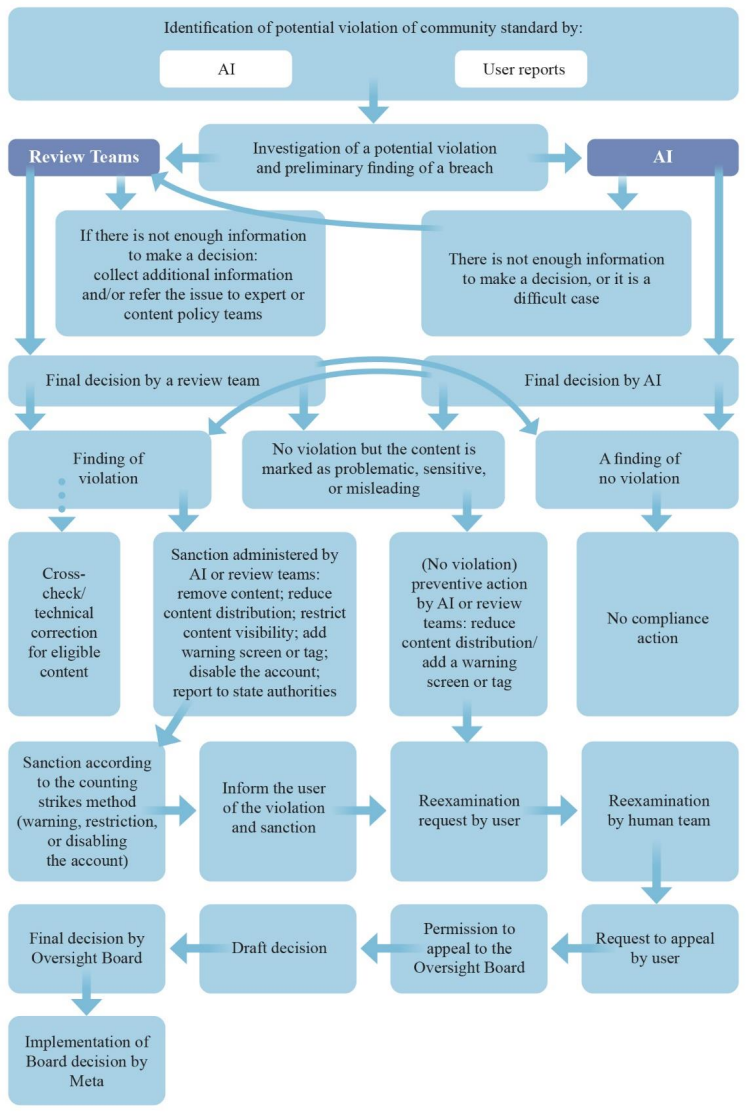
Re-examination and appeal concerning the punitive action. In addition to these four steps Meta has employed in the past few years a system called cross -check, which provides some categories of entities and content special consideration and is governed by a distinct set of rules. Below we briefly describe how AI and human agents intersect in the enforceme...
-
[8]
Preliminary (prima facie) finding of a violating content The enforcement process is initiated by flagging an item of content as potentially violating. Such flagging can occur either through user reports or through AI detection, based on NLP technology. Every post on Facebook (and Instagram) is scanned 36 immediately after its publication.37 To enhance its...
-
[9]
This determination can be made either by AI algorithm or a review team
Investigation of a prima facie flagging and determination of violation After content has been flagged as potentially in violation, a determination must be made whether it violates the community standards. This determination can be made either by AI algorithm or a review team. Usually, content flagged as potentially violating (by AI or by user reports) is ...
-
[10]
There is a violation
-
[11]
There is no violation
-
[12]
There is no violation, but the content is sensitive or misleading
-
[13]
There is no violation, but the content is problematic
-
[14]
clickbait,
Unable to decide if there is a violation. If it is determined that there was no violation, the suspicious content is ‘acquitted’ and the inquiry is concluded. If the content is found to be violating a decision is required regarding the appropriate sanction. If the content is determined to be sensitive or misleading (but not violating), it will usually not...
2022
-
[15]
offense
Compliance action Once a decision has been made whether an item of content violates the community standards, compliance action is taken against the user. A decision on that action can be made by either a review team or by AI algorithm.62 The nature of the sanction or 58 Id, at 14, 21. 59 Id, at 19-20. Unlike ERSR, content in the GSR is put in a queue pend...
2022
-
[16]
Appeal and reexamination procedures If user s believe that they hav e been subject to a compliance action for no justified reason, and that the content that they shared does not violate Facebook’s community standards, they can request that the post be reexamined.78 The reexamination process usually takes up to 24 hours. 79 If the reexamination reveals tha...
-
[17]
The only objective of the machine is to maximize the realization of human preferences
-
[18]
The machine is initially uncertain about what those preferences are
-
[19]
Stop, you’re going to destroy the world!
The ultimate source of information about human preferences is human behavior. Consistent with Russell’s argument, we want to instill in the AI governance system uncertainty about human preferences, which consequentially would be reflected in uncertainty about the correct or optimal interpretation of the rules (in our case, Facebook community standards) an...
discussion (0)
Sign in with ORCID, Apple, or X to comment. Anyone can read and Pith papers without signing in.