Charting the emergent low-dimensional manifold of quantum materials
Pith reviewed 2026-06-27 07:50 UTC · model grok-4.3
The pith
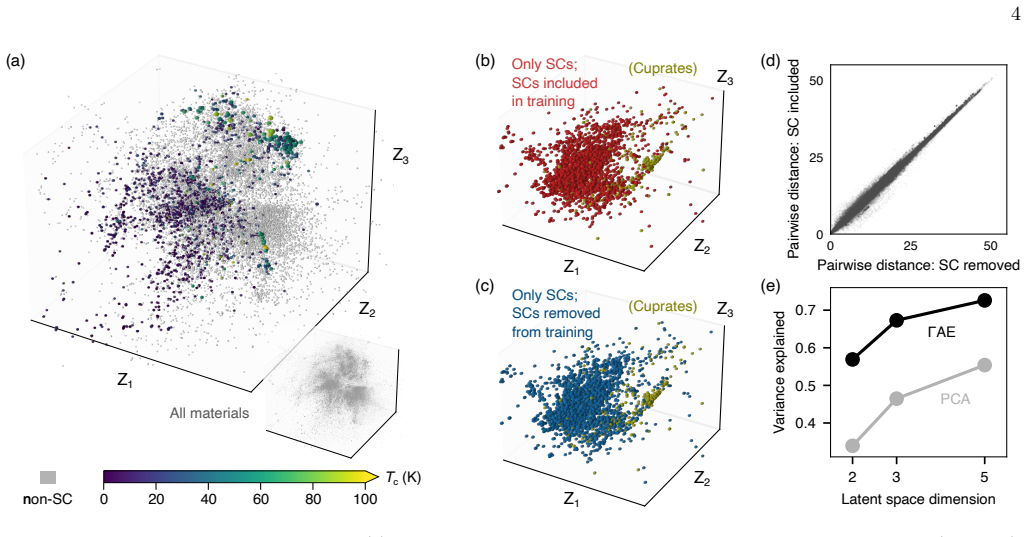
Unsupervised nonlinear reduction of the ICSD reveals a low-dimensional manifold that segregates superconductors and directly governs their critical temperatures.
A machine-rendered reading of the paper's core claim, the machinery that carries it, and where it could break.
Core claim
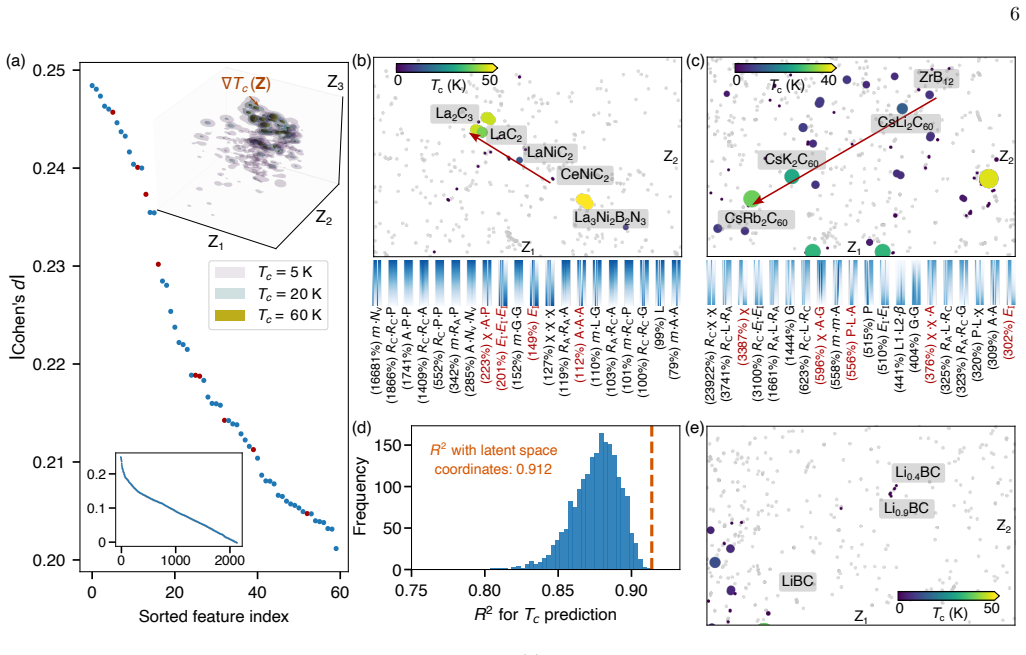
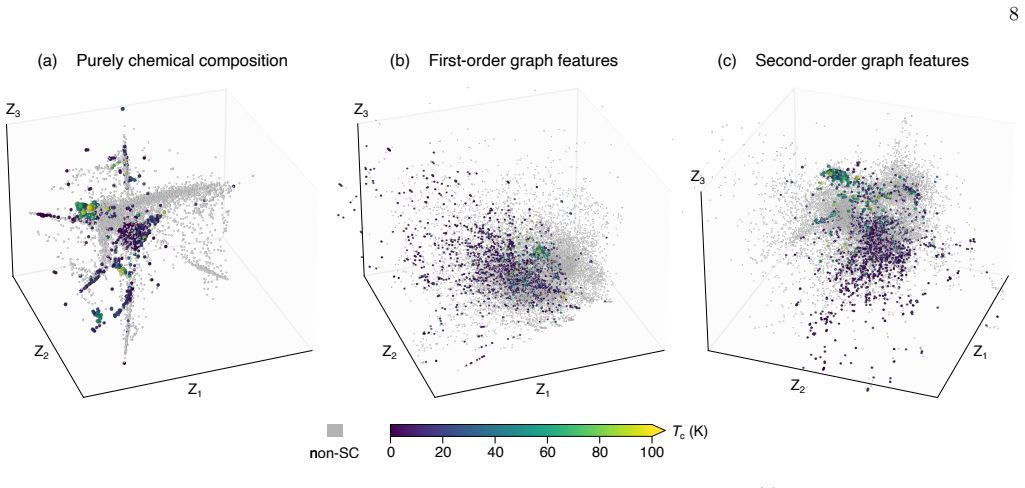
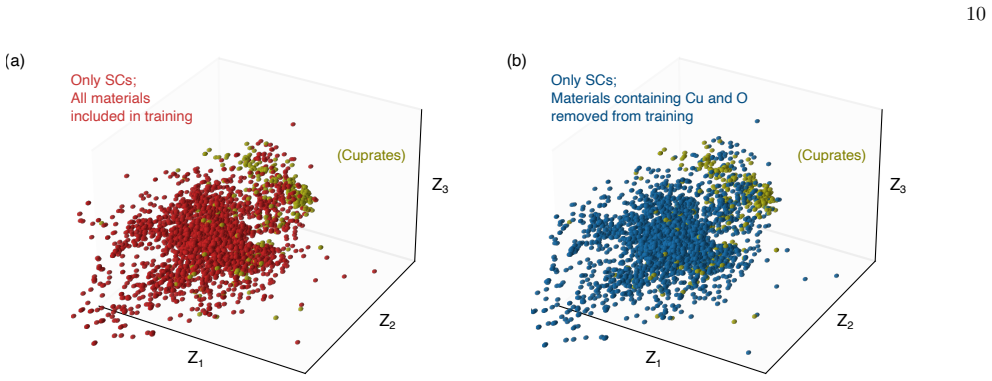
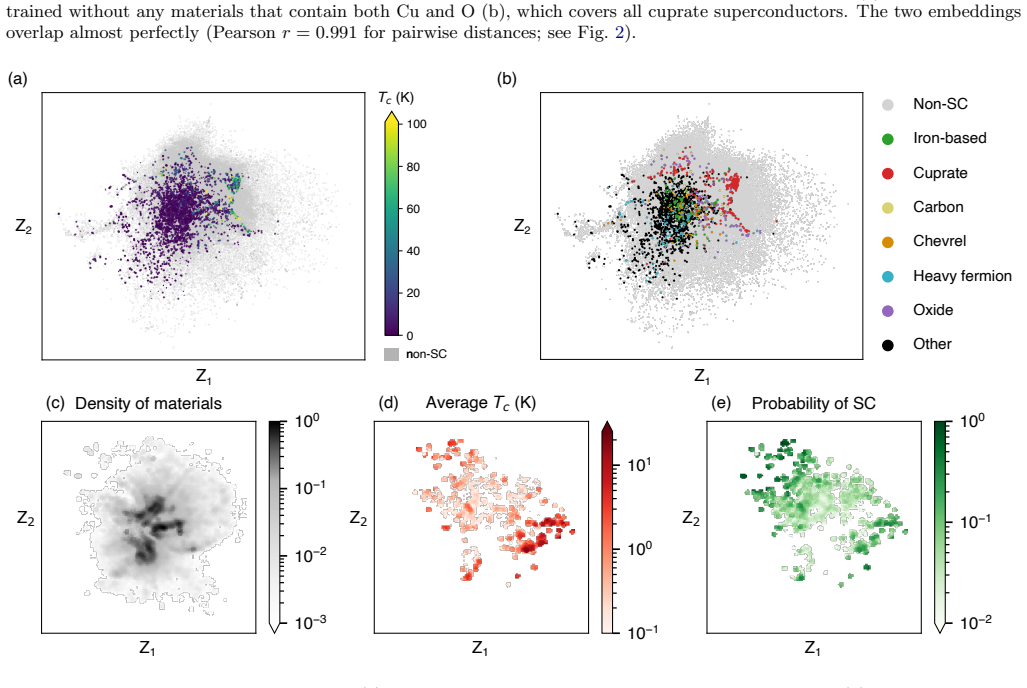
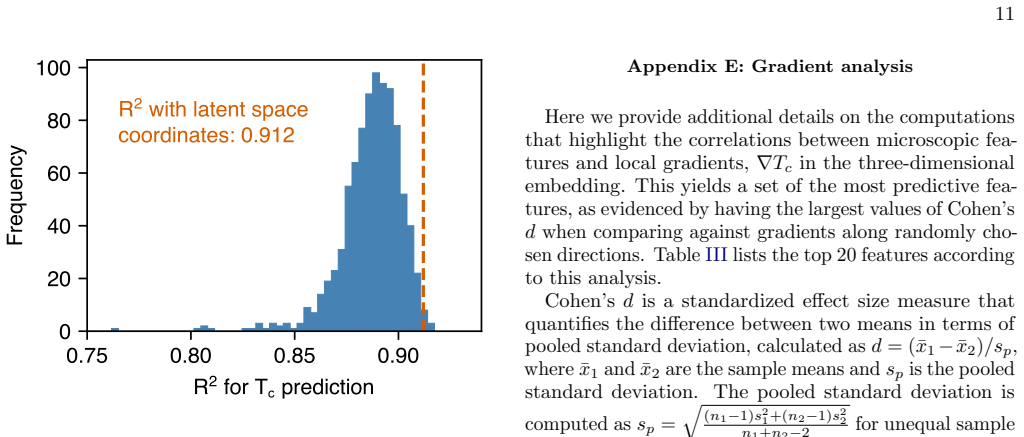
The materials landscape possesses a hidden geometric organization that can be unveiled through unsupervised nonlinear dimensionality reduction on the ICSD. Just a few combinations of microscopic descriptors capture the vast majority of variance in material properties. This low-dimensional embedding autonomously segregates superconductors from ordinary materials and further distinguishes superconducting families in ways that transcend chemical similarity alone. The discovered geometric organization directly governs critical temperatures across diverse superconducting families, enabling accurate Tc predictions without any knowledge of the pairing mechanism.
What carries the argument
the low-dimensional embedding produced by unsupervised nonlinear dimensionality reduction on ICSD crystal-structure data, which acts as an emergent manifold that organizes material properties and controls Tc
If this is right
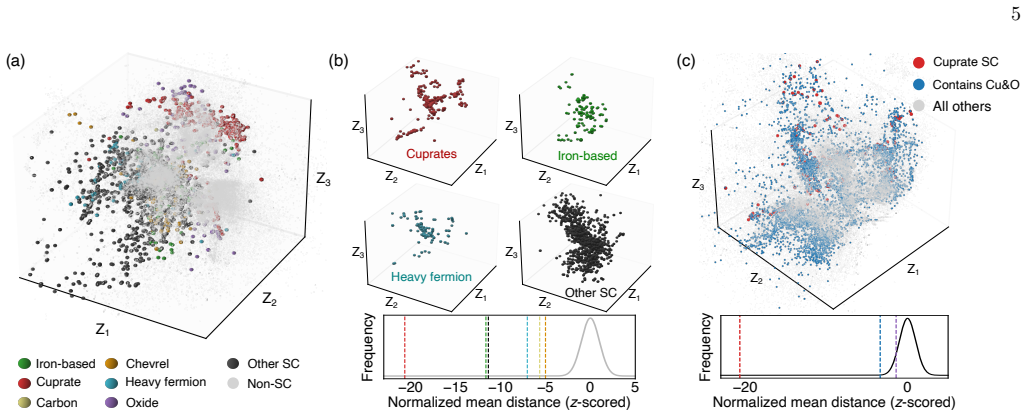
- Superconducting families can be classified and distinguished geometrically rather than by chemical composition.
- Critical temperatures for new materials can be forecast from their structural descriptors alone by locating them in the embedding.
- Organizing principles for quantum behavior can be extracted directly from experimental databases without microscopic models.
- Models of complex quantum materials can be constructed from data-driven geometry instead of assumed pairing interactions.
Where Pith is reading between the lines
- The same embedding procedure might be applied to databases of other quantum phases to test whether similar manifolds appear for magnetism or topology.
- If the manifold reflects physical constraints, targeted synthesis could aim to move candidate materials along specific directions in the embedding to raise Tc.
- Validation on materials synthesized after the database cutoff would provide an out-of-sample test of the predictive accuracy.
- The approach could be combined with existing high-throughput screening pipelines to prioritize candidates for experimental measurement.
Load-bearing premise
The low-dimensional embedding obtained from dimensionality reduction on the database captures governing principles for critical temperatures rather than only statistical correlations present in the data.
What would settle it
A collection of experimentally measured superconductors whose critical temperatures deviate substantially and systematically from the values predicted by their coordinates in the low-dimensional embedding.
Figures
read the original abstract
The periodic table of elements transformed chemistry by revealing simple organizing principles underlying atomic behavior. Despite decades of effort, no analogous framework has emerged for crystalline materials -- their microscopic complexity and vast configurational space have defied reduction to fundamental organizing principles. Current databases catalog thousands of synthesized materials, but extracting predictive, interpretable models from this wealth of data remains a formidable challenge. Here we demonstrate that the materials landscape possesses a hidden geometric organization that can be unveiled through unsupervised nonlinear dimensionality reduction. Applying differential geometry techniques to the Inorganic Crystal Structure Database (ICSD), we reveal that just a few combinations of microscopic descriptors capture the vast majority of variance in material properties. This low-dimensional embedding autonomously segregates superconductors from ordinary materials and further distinguishes superconducting families in ways that transcend chemical similarity alone. Remarkably, the discovered geometric organization directly governs critical temperatures ($T_c$) across diverse superconducting families, enabling accurate $T_c$ predictions without any knowledge of the pairing mechanism. Our approach uncovers emergent organizing principles that control macroscopic quantum behavior, offering a new paradigm in how we build models of complex quantum materials directly from experimental data.
Editorial analysis
A structured set of objections, weighed in public.
Referee Report
Summary. The paper applies unsupervised nonlinear dimensionality reduction to microscopic descriptors extracted from the full ICSD to reveal a low-dimensional manifold. This embedding is reported to autonomously segregate superconductors from non-superconductors, distinguish superconducting families beyond chemical similarity, and directly govern critical temperatures Tc across families, enabling accurate Tc predictions without input on the pairing mechanism.
Significance. If the central claim holds after addressing validation gaps, the work would offer a genuinely new data-driven paradigm for quantum materials, demonstrating that geometric organization extracted from existing databases can yield mechanism-agnostic predictions of macroscopic quantum properties. The unsupervised construction and explicit avoidance of pairing-mechanism details are clear strengths that distinguish it from supervised or physics-informed approaches.
major comments (3)
- [§3.2] §3.2 (Embedding construction): The manuscript must explicitly confirm and demonstrate that no Tc values, superconducting labels, or any proxy quantities correlated with Tc entered the input descriptor set or the nonlinear reduction step; without this, the claim that the manifold 'directly governs' Tc (abstract and §4.3) risks circularity even if the reduction is formally unsupervised.
- [§4.3] §4.3 and Figure 6 (Tc prediction): The reported prediction accuracy on known superconductors must be accompanied by an ablation or baseline comparison (e.g., regression from raw compositional statistics or from a random projection of the same descriptors) to establish that the low-dimensional coordinates add predictive power beyond database compositional biases; current results on in-sample families do not yet rule out spurious correlation.
- [§5.1] §5.1 (Validation): The distinction between statistical correlation and governance requires at least one out-of-sample test on held-out superconductor families or on hypothetical/unsynthesized compounds; without such controls, the stronger claim that the manifold 'governs' Tc across diverse families cannot be separated from ICSD selection effects.
minor comments (2)
- [Figure 4] Figure 4 caption: clarify the precise nonlinear reduction algorithm (e.g., Isomap, UMAP, or diffusion maps) and the criterion used to select the embedding dimension.
- [§2.1] Notation in §2.1: the symbol for the microscopic descriptor vector is introduced without an explicit list of its components; a table would improve reproducibility.
Simulated Author's Rebuttal
We thank the referee for the constructive comments that help clarify the unsupervised nature and predictive claims of our work. We address each major point below with revisions where appropriate.
read point-by-point responses
-
Referee: [§3.2] §3.2 (Embedding construction): The manuscript must explicitly confirm and demonstrate that no Tc values, superconducting labels, or any proxy quantities correlated with Tc entered the input descriptor set or the nonlinear reduction step; without this, the claim that the manifold 'directly governs' Tc (abstract and §4.3) risks circularity even if the reduction is formally unsupervised.
Authors: The input descriptors are strictly microscopic (lattice parameters, atomic coordinates, bond lengths, elemental electronegativities, and ionic radii) extracted directly from ICSD entries. No Tc values, labels, or correlated proxies were included at any stage. We have revised §3.2 to include an explicit statement of this independence together with a supplementary table enumerating every descriptor and its source, thereby removing any ambiguity about circularity. revision: yes
-
Referee: [§4.3] §4.3 and Figure 6 (Tc prediction): The reported prediction accuracy on known superconductors must be accompanied by an ablation or baseline comparison (e.g., regression from raw compositional statistics or from a random projection of the same descriptors) to establish that the low-dimensional coordinates add predictive power beyond database compositional biases; current results on in-sample families do not yet rule out spurious correlation.
Authors: We agree that baselines are required. We have performed and now report regressions using (i) raw compositional statistics and (ii) random projections of the identical high-dimensional descriptor set. These comparisons are added to the revised §4.3 and Figure 6; the low-dimensional manifold coordinates consistently outperform both baselines, confirming that the embedding supplies genuine predictive structure beyond compositional biases present in the database. revision: yes
-
Referee: [§5.1] §5.1 (Validation): The distinction between statistical correlation and governance requires at least one out-of-sample test on held-out superconductor families or on hypothetical/unsynthesized compounds; without such controls, the stronger claim that the manifold 'governs' Tc across diverse families cannot be separated from ICSD selection effects.
Authors: We acknowledge that prospective out-of-sample tests on entirely new families would further strengthen the governance interpretation. The present study is confined to the existing ICSD; no additional held-out or hypothetical compounds were available for such a test. We have expanded §5.1 to discuss this limitation explicitly and to outline how the observed cross-family organization (transcending chemical similarity) already distinguishes the manifold from simple selection effects, while noting that future validation on newly synthesized materials is planned. revision: partial
Circularity Check
Unsupervised dimensionality reduction on ICSD descriptors yields post-hoc Tc correlation with no definitional reduction
full rationale
The derivation begins with unsupervised nonlinear dimensionality reduction applied to microscopic descriptors drawn from the ICSD (a structural database containing no Tc values). The resulting low-dimensional embedding is then observed to segregate superconductors and correlate with Tc. Because the reduction step itself is unsupervised and does not incorporate Tc or any fitted superconducting property, the subsequent correlation is an independent empirical finding rather than a quantity recovered by construction. No self-citation chain, ansatz smuggling, or renaming of known results is required to reach the reported organization; the central claim therefore remains self-contained against external benchmarks.
Axiom & Free-Parameter Ledger
axioms (1)
- domain assumption ICSD entries are sufficiently representative of crystalline materials for the discovered manifold to generalize
invented entities (1)
-
emergent low-dimensional manifold of quantum materials
no independent evidence
Reference graph
Works this paper leans on
-
[1]
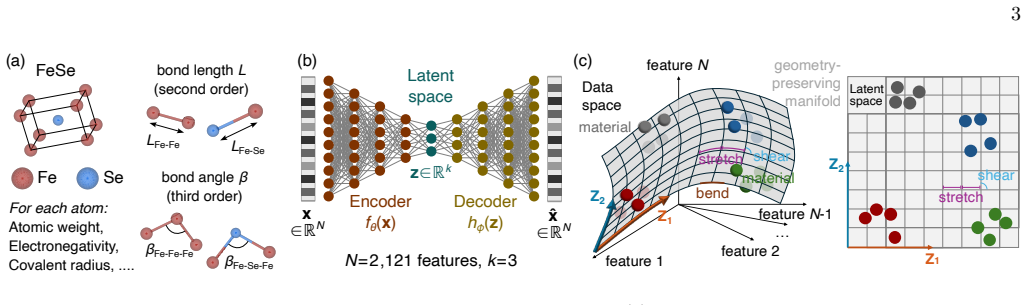
Triple product of atomic features, e.g., atomic mass of the first atom times covalent radius of the second atom times electronegativity of the third atom (165 features)
-
[2]
Two atomic features multiplied by the bond length connecting them, e.g., atomic mass of the first atom times covalent radius of the second atom times the length of the bond linking the two atoms (81 fea- tures)
-
[3]
Bond angle ( β), another geometric feature appear- ing for the first time in three-site clusters
-
[4]
Overall, there are 248 third-order features
Bond angle β multiplied by the two bond lengths L1,L 2 forming it. Overall, there are 248 third-order features. For the three- dimensional embedding discussed in the main text, we include up to these third-order features. The resulting feature vector has 303 × (2 + nmoments) entries, and since we take nmoments = 5, our feature vector has 2 ,121 dimen- sio...
-
[5]
Jumper, R
J. Jumper, R. Evans, A. Pritzel, T. Green, M. Figurnov, O. Ronneberger, K. Tunyasuvunakool, R. Bates, A. ˇZ´ ıdek, A. Potapenko, A. Bridgland, C. Meyer, S. A. A. Kohl, A. J. Ballard, A. Cowie, B. Romera-Paredes, S. Nikolov, R. Jain, J. Adler, T. Back, S. Petersen, D. Reiman, E. Clancy, M. Zielinski, M. Steinegger, M. Pacholska, T. Berghammer, S. Bodenstei...
2021
-
[6]
Tunyasuvunakool, J
K. Tunyasuvunakool, J. Adler, Z. Wu, T. Green, M. Zielin- ski, A. ˇZ´ ıdek, A. Bridgland, A. Cowie, C. Meyer, A. Lay- don, S. Velankar, G. J. Kleywegt, A. Bateman, R. Evans, A. Pritzel, M. Figurnov, O. Ronneberger, R. Bates, S. A. A. Kohl, A. Potapenko, A. J. Ballard, B. Romera- Paredes, S. Nikolov, R. Jain, E. Clancy, D. Reiman, S. Pe- tersen, A. W. Seni...
2021
-
[7]
Noy and W
S. Noy and W. Zhang, Science381, 187 (2023)
2023
-
[8]
Vaswani, N
A. Vaswani, N. Shazeer, N. Parmar, J. Uszkoreit, L. Jones, A. N. Gomez, L. ukasz Kaiser, and I. Polosukhin, inAd- vances in Neural Information Processing Systems, Vol. 30 (Curran Associates, Inc., 2017)
2017
-
[9]
OpenAI, GPT-4 Technical Report (2024), arXiv:2303.08774 [cs]
Pith/arXiv arXiv 2024
-
[10]
K. Meng, D. Bau, A. Andonian, and Y. Belinkov, Ad- vances in Neural Information Processing Systems35, 17359 (2022)
2022
-
[11]
H. Cunningham, A. Ewart, L. Riggs, R. Huben, and L. Sharkey, Sparse Autoencoders Find Highly Interpretable Features in Language Models (2023), arXiv:2309.08600 [cs]
Pith/arXiv arXiv 2023
-
[12]
R. Rao, J. Meier, T. Sercu, S. Ovchinnikov, and A. Rives, Transformer protein language models are unsupervised structure learners (2020)
2020
-
[13]
Zhang, H
Z. Zhang, H. K. Wayment-Steele, G. Brixi, H. Wang, D. Kern, and S. Ovchinnikov, Proceedings of the National Academy of Sciences121, e2406285121 (2024)
2024
-
[14]
Zagorac, H
D. Zagorac, H. M¨ uller, S. Ruehl, J. Zagorac, and S. Rehme, Journal of Applied Crystallography52, 918 (2019)
2019
-
[15]
Sommer, R
T. Sommer, R. Willa, J. Schmalian, and P. Friederich, Scientific Data10, 816 (2023)
2023
-
[16]
P. Chen, L. Peng, R. Jiao, Q. Mo, Z. Wang, W. Huang, Y. Liu, and Y. Lu, Advances in Neural Information Pro- cessing Systems37, 108902 (2024)
2024
-
[17]
Merchant, S
A. Merchant, S. Batzner, S. S. Schoenholz, M. Aykol, G. Cheon, and E. D. Cubuk, Nature624, 80 (2023). 12
2023
-
[18]
Gashmard, H
H. Gashmard, H. Shakeripour, and M. Alaei, Scientific Reports14, 3965 (2024)
2024
-
[19]
M. Cheng, C.-L. Fu, R. Okabe, A. Chotrattanapituk, A. Boonkird, N. T. Hung, and M. Li, AI-driven materials design: A mini-review (2025), arXiv:2502.02905 [cond- mat]
arXiv 2025
- [20]
-
[21]
F. Wang, A. G. Iwanicki, A. T. Sose, L. A. Pressley, T. M. McQueen, and S. A. Deshmukh, npj Computational Materials11, 124 (2025)
2025
-
[22]
A. Ma, Y. Zhang, T. Christensen, H. C. Po, L. Jing, L. Fu, and M. Soljaˇ ci´ c, Nano Letters23, 772 (2023)
2023
- [23]
-
[24]
O. Lesser, Y. Liu, N. Maus, A. Panigrahi, K. Mallayya, A. Gong, A. Kabra, S. B. Lee, S. Chatterjee, A. Merino, K. Q. Weinberger, L. M. Schoop, J. R. Gardner, and E.-A. Kim, Electron affinity difference distributions guide the discovery of the superconductor PtPb 3Bi (2026), arXiv:2510.07373 [cond-mat.supr-con]
arXiv 2026
-
[25]
A. Panigrahi, Y. Liu, O. Lesser, K. Mallayya, and E.-A. Kim, Graphlet Histogram Representation Database of In- organic Crystals (2026), arXiv:2606.10195 [cond-mat.mtrl- sci]
Pith/arXiv arXiv 2026
-
[26]
Stanev, C
V. Stanev, C. Oses, A. G. Kusne, E. Rodriguez, J. Paglione, S. Curtarolo, and I. Takeuchi, npj Com- putational Materials4, 1 (2018)
2018
-
[27]
Hamidieh, Computational Materials Science154, 346 (2018)
K. Hamidieh, Computational Materials Science154, 346 (2018)
2018
-
[28]
Roter and S
B. Roter and S. Dordevic, Physica C: Superconductivity and its Applications575, 1353689 (2020)
2020
-
[29]
Pereti, K
C. Pereti, K. Bernot, T. Guizouarn, F. Laufek, A. Vy- mazalov´ a, L. Bindi, R. Sessoli, and D. Fanelli, npj Com- putational Materials9, 71 (2023)
2023
-
[30]
E. A. Pogue, A. New, K. McElroy, N. Q. Le, M. J. Pekala, I. McCue, E. Gienger, J. Domenico, E. Hedrick, T. M. Mc- Queen, B. Wilfong, C. D. Piatko, C. R. Ratto, A. Lennon, C. Chung, T. Montalbano, G. Bassen, and C. D. Stiles, npj Computational Materials9, 181 (2023)
2023
-
[31]
Kaplan, A
D. Kaplan, A. Zheng, J. Blawat, R. Jin, R. J. Cava, V. Oudovenko, G. Kotliar, A. M. Sengupta, and W. Xie, The European Physical Journal Plus140, 58 (2025)
2025
-
[32]
S. R. Xie, Y. Quan, A. C. Hire, B. Deng, J. M. DeStefano, I. Salinas, U. S. Shah, L. Fanfarillo, J. Lim, J. Kim, G. R. Stewart, J. J. Hamlin, P. J. Hirschfeld, and R. G. Hennig, npj Computational Materials8, 14 (2022)
2022
-
[33]
J. B. Gibson, A. C. Hire, P. M. Dee, B. Geisler, J. S. Kim, Z. Li, J. J. Hamlin, G. R. Stewart, P. J. Hirschfeld, and R. G. Hennig, Developing a Complete AI-Accelerated Workflow for Superconductor Discovery (2025), arXiv:2503.20005 [cond-mat]
arXiv 2025
-
[34]
P. Prakash, J. B. Gibson, Z. Li, G. D. Gianluca, J. Es- quivel, E. Fuemmeler, B. Geisler, J. S. Kim, A. Roitberg, E. B. Tadmor, M. Liu, S. Martiniani, G. R. Stewart, J. J. Hamlin, P. J. Hirschfeld, and R. G. Hennig, Guided Dif- fusion for the Discovery of New Superconductors (2025), arXiv:2509.25186 [cond-mat]
arXiv 2025
-
[35]
J. Tahmassebpur, S. Chaudhari, C. M´ endez, R. Choud- hary, S. Kundu, R. E. Schaak, H. Abru˜ na, P. Frazier, and T. Arias, A seven-facet polyhedron captures the composition-only formation-energy landscape of inorganic solids (2026), arXiv:2602.00254 [cond-mat]
arXiv 2026
-
[36]
L. McInnes, J. Healy, and J. Melville, arXiv preprint arXiv:1802.03426 (2018)
Pith/arXiv arXiv 2018
-
[37]
W. Ye, X. Lei, M. Aykol, and J. H. Montoya, Scientific Data9, 302 (2022)
2022
-
[38]
B. D. Lee, J.-W. Lee, W. B. Park, J. Park, M.-Y. Cho, S. Pal Singh, M. Pyo, and K.-S. Sohn, Advanced Intelli- gent Systems4, 2200042 (2022)
2022
-
[39]
G. Arvanitidis, L. K. Hansen, and S. Hauberg, arXiv preprint arXiv:1710.11379 (2017)
arXiv 2017
-
[40]
J. Z. Kim, N. Perrin-Gilbert, E. Narmanli, P. Klein, C. R. Myers, I. Cohen, J. J. Waterfall, and J. P. Sethna, arXiv preprint arXiv:2403.01078 (2024)
arXiv 2024
-
[41]
Scarselli, M
F. Scarselli, M. Gori, A. C. Tsoi, M. Hagenbuchner, and G. Monfardini, IEEE Transactions on Neural Networks 20, 61 (2009)
2009
-
[42]
Isayev, C
O. Isayev, C. Oses, C. Toher, E. Gossett, S. Curtarolo, and A. Tropsha, Nature Communications8, 15679 (2017)
2017
-
[43]
M. M. Bronstein, J. Bruna, T. Cohen, and P. Veliˇ ckovi´ c, Geometric Deep Learning: Grids, Groups, Graphs, Geodesics, and Gauges (2021), arXiv:2104.13478 [cs]
Pith/arXiv arXiv 2021
-
[44]
Reiser, M
P. Reiser, M. Neubert, A. Eberhard, L. Torresi, C. Zhou, C. Shao, H. Metni, C. van Hoesel, H. Schopmans, T. Som- mer, and P. Friederich, Communications Materials3, 93 (2022)
2022
-
[45]
V. Fung, J. Zhang, E. Juarez, and B. G. Sumpter, npj Computational Materials7, 84 (2021)
2021
-
[46]
Zhang, Z
X. Zhang, Z. Zhou, C. Ming, and Y.-Y. Sun, The Journal of Physical Chemistry Letters14, 11342 (2023)
2023
-
[47]
Choudhary and B
K. Choudhary and B. DeCost, npj Computational Mate- rials7, 185 (2021)
2021
-
[48]
D. P. Kingma, M. Welling,et al., Foundations and Trends®in Machine Learning12, 307 (2019)
2019
-
[49]
P. Li, Y. Pei, and J. Li, Applied Soft Computing138, 110176 (2023)
2023
-
[50]
Hornik, M
K. Hornik, M. Stinchcombe, and H. White, Neural net- works2, 359 (1989)
1989
-
[51]
MDR: NIMS Materials Data Repository, https://mdr.nims.go.jp
-
[52]
Pearson, Proceedings of the Royal Society of London 58, 240 (1997)
K. Pearson, Proceedings of the Royal Society of London 58, 240 (1997)
1997
-
[53]
I. T. Jolliffe and J. Cadima, Philosophical Transactions of the Royal Society A: Mathematical, Physical and En- gineering Sciences374, 20150202 (2016)
2016
-
[54]
R. J. Freund and W. J. Wilson,Statistical Methods(Else- vier, 2003)
2003
-
[55]
C. E. Rasmussen and C. K. I. Williams,Gaussian Pro- cesses for Machine Learning, Adaptive Computation and Machine Learning (MIT Press, Cambridge, Mass, 2006)
2006
-
[56]
Kohn and L
W. Kohn and L. J. Sham, Physical Review140, A1133 (1965)
1965
-
[57]
R. G. Parr and Y. Weitao,Density-Functional Theory of Atoms and Molecules (International Series of Monographs on Chemistry)(Oxford University Press, USA, 1994)
1994
-
[58]
Marsiglio, Annals of Physics Eliashberg Theory at 60: Strong-coupling Superconductivity and Beyond,417, 168102 (2020)
F. Marsiglio, Annals of Physics Eliashberg Theory at 60: Strong-coupling Superconductivity and Beyond,417, 168102 (2020)
2020
-
[59]
Sanna, C
A. Sanna, C. Pellegrini, and E. K. U. Gross, Physical Review Letters125, 057001 (2020)
2020
-
[60]
Bharathi, S
A. Bharathi, S. Jemima Balaselvi, M. Premila, T. N. Sairam, G. L. N. Reddy, C. S. Sundar, and Y. Hariharan, Solid State Communications124, 423 (2002)
2002
-
[61]
A. M. Fogg, J. B. Claridge, G. R. Darling, and M. J. 13 Rosseinsky, Chemical Communications , 1348 (2003)
2003
-
[62]
Rosner, A
H. Rosner, A. Kitaigorodsky, and W. E. Pickett, Physical Review Letters88, 127001 (2002)
2002
-
[63]
A. M. Fogg, J. Meldrum, G. R. Darling, J. B. Claridge, and M. J. Rosseinsky, Journal of the American Chemical Society128, 10043 (2006)
2006
-
[64]
Akashi, K
R. Akashi, K. Nakamura, R. Arita, and M. Imada, Physi- cal Review B86, 054513 (2012)
2012
-
[65]
Borinaga, U
M. Borinaga, U. Aseginolaza, I. Errea, M. Calandra, F. Mauri, and A. Bergara, Physical Review B96, 184505 (2017)
2017
-
[66]
K. A. Szewczyk, I. A. Domagalska, A. P. Durajski, and R. Szczesniak, Beilstein Journal of Nanotechnology11, 1178 (2020)
2020
-
[67]
L. Barroso-Luque, M. Shuaibi, X. Fu, B. M. Wood, M. Dzamba, M. Gao, A. Rizvi, C. L. Zitnick, and Z. W. Ulissi, Open Materials 2024 (OMat24) Inorganic Materials Dataset and Models (2024), arXiv:2410.12771 [cond-mat]
Pith/arXiv arXiv 2024
- [68]
- [69]
-
[70]
U. Petralanda, Y. Jiang, B. A. Bernevig, N. Regnault, and L. Elcoro, Two-dimensional Topological Quantum Chemistry and Catalog of Topological Materials (2024), arXiv:2411.08950 [cond-mat]
arXiv 2024
-
[71]
E. Y. Andrei, D. K. Efetov, P. Jarillo-Herrero, A. H. MacDonald, K. F. Mak, T. Senthil, E. Tutuc, A. Yazdani, and A. F. Young, Nature Reviews Materials6, 201 (2021)
2021
-
[72]
K. P. Nuckolls and A. Yazdani, Nature Reviews Materials 9, 460 (2024)
2024
-
[73]
H. Park, A. Onwuli, K. T. Butler, and A. Walsh, Faraday Discussions256, 601 (2025)
2025
-
[74]
Van der Maaten and G
L. Van der Maaten and G. Hinton, Journal of Machine Learning Research9(2008)
2008
-
[75]
Kobak and G
D. Kobak and G. C. Linderman, Nature Biotechnology 39, 156 (2021)
2021
-
[76]
Meil˘ a and H
M. Meil˘ a and H. Zhang, Annual Review of Statistics and Its Application11, 393 (2024)
2024
-
[77]
Choquet-Bruhat, C
Y. Choquet-Bruhat, C. DeWitt-Morette, and M. Dillard- Bleick,Analysis, Vol. 1 (Gulf Professional Publishing, 1982). 14 Embedding Iron- Cuprate Carbon Chevrel Heavy Other based Fermion SC 3D embedding, chemical composition features−10.01−43.41−11.05−1.38−15.88−48.77 2D embedding, third-order graph features−10.09−19.27−5.86−3.84−9.13−13.25 3D embedding, fir...
1982
discussion (0)
Sign in with ORCID, Apple, or X to comment. Anyone can read and Pith papers without signing in.