Dynamical Control of Superconductivity in Superconductor-Ferromagnet Bilayers
Pith reviewed 2026-06-27 07:48 UTC · model grok-4.3
The pith
Driven magnon-polaritons convert nodal p-wave superconductivity to a fully gapped chiral state in bilayers
A machine-rendered reading of the paper's core claim, the machinery that carries it, and where it could break.
Core claim
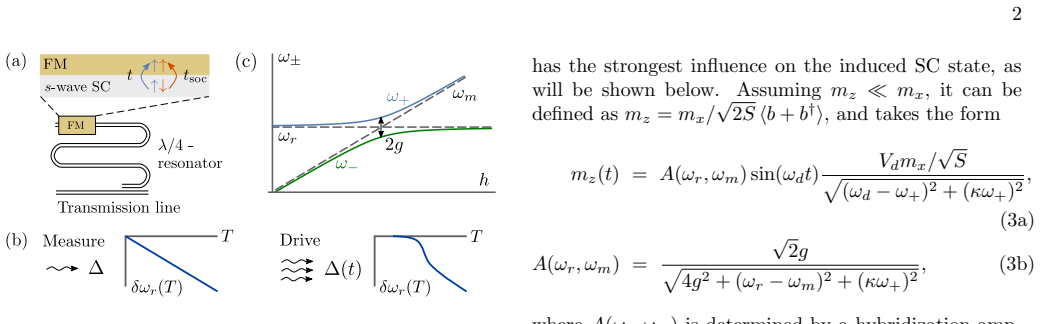
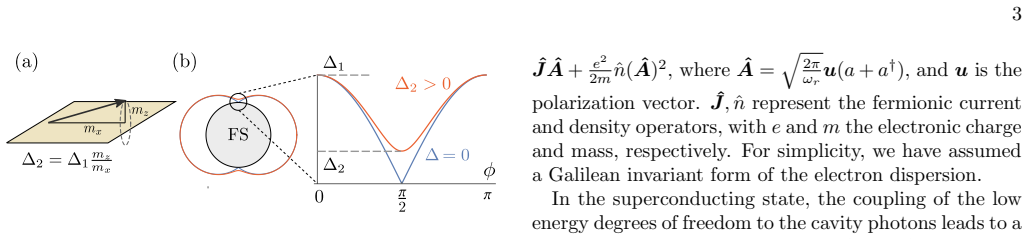
In a simplified model of a ferromagnetic metal proximitized by a fully-gapped s-wave superconductor and integrated with a microwave resonator, when the magnons and photons have comparable frequencies and are subject to an external drive, the hybridized driven magnon-polaritons induce a non-equilibrium crossover from the expected proximitized nodal p-wave superconductor to a fully gapped (p_x + i p_y)-superconductor, with the characteristic crossover temperature inversely related to the magnon-photon detuning.
What carries the argument
Hybridized driven magnon-polaritons, formed from the coupling of ferromagnetic magnons and cavity photons under external drive, which generate an effective pairing interaction that gaps the nodes.
Load-bearing premise
The driven magnon-polariton hybridization produces a non-equilibrium steady state whose effective pairing interaction is sufficient to gap the nodes.
What would settle it
Tunneling spectroscopy or specific-heat data showing whether the superconducting nodes close below a temperature that scales inversely with measured magnon-photon detuning under continuous external drive.
Figures

read the original abstract
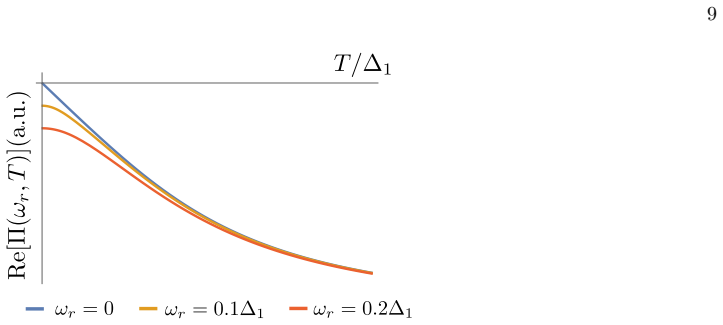
We study a simplified model of a ferromagnetic metal proximitized by a fully-gapped $s-$wave superconductor and integrated with a microwave resonator. The low-energy excitations in the combined system consist of ferromagnetic magnons, Bogoliubov excitations of the superconductor, and cavity photons. We show here that when the magnons and photons have comparable frequencies and are subject to an external drive, the hybridized driven magnon-polaritons induce a non-equilibrium crossover from the expected proximitized nodal $p-$wave superconductor to a fully gapped $(p_x+ip_y)-$superconductor. Moreover, the characteristic crossover temperature is inversely related to the magnon-photon detuning. We compute the temperature-dependent renormalization of the cavity photon frequencies across this nodal to nodeless evolution, which modifies the kinetic inductance of the resonator, and find a number of non-trivial features tied to the non-equilibrium (i.e., driven) nature of the problem. We compare and contrast these results with a recent circuit quantum electrodynamics (cQED) based experiment studying a permalloy-niobium bilayer, where a non-trivial dependence of the low-temperature cavity response on the magnon-photon detuning was observed. Our results pave the way for a principled exploration of engineering novel states of matter by coupling cavity photons to electronic collective modes in correlated two-dimensional materials and interfaces.
Editorial analysis
A structured set of objections, weighed in public.
Referee Report
Summary. The manuscript studies a model of a ferromagnetic metal proximitized by an s-wave superconductor and coupled to a microwave resonator. It claims that when magnon and photon frequencies are comparable and an external drive is applied, hybridized driven magnon-polaritons induce a non-equilibrium crossover from the expected proximitized nodal p-wave superconductor to a fully gapped (p_x + i p_y) state. The crossover temperature scales inversely with magnon-photon detuning. The authors compute the resulting temperature-dependent renormalization of cavity photon frequencies (affecting kinetic inductance) and compare the detuning dependence to a recent Nb-Py cQED experiment.
Significance. If the central claim is substantiated, the work identifies a cavity-mediated route to dynamical control of pairing symmetry and node gapping in proximitized ferromagnet-superconductor bilayers. The explicit connection to measured cavity response and the non-equilibrium character of the drive distinguish it from equilibrium proximity-effect studies and could motivate cavity engineering of topological superconductivity in 2D interfaces.
major comments (2)
- [Model and effective interaction section (near the statement of the crossover)] The load-bearing step—derivation of an effective node-gapping pairing correction from the driven magnon-polariton hybridization—is asserted but not shown with an explicit expression or numerical diagonalization of the resulting Bogoliubov-de Gennes Hamiltonian. Without this (e.g., via Schrieffer-Wolff or self-energy calculation on the magnon-polariton subspace), it is impossible to verify that the correction is strong enough to gap the nodes for the quoted detunings and drive strengths.
- [Results on temperature-dependent renormalization] The claimed inverse scaling of crossover temperature with magnon-photon detuning is stated without the supporting steady-state or effective-interaction formula. This scaling is central to the comparison with experiment and must be derived from the non-equilibrium condition.
minor comments (2)
- Notation for the magnon-photon detuning and drive amplitude should be defined once at first use and used consistently in all figures and equations.
- The comparison to the Nb-Py experiment would benefit from a table listing the experimental detuning values alongside the corresponding theoretical crossover temperatures.
Simulated Author's Rebuttal
We thank the referee for their careful reading of the manuscript and for the positive assessment of its potential significance. We address each major comment below and will revise the manuscript to incorporate the requested explicit derivations.
read point-by-point responses
-
Referee: [Model and effective interaction section (near the statement of the crossover)] The load-bearing step—derivation of an effective node-gapping pairing correction from the driven magnon-polariton hybridization—is asserted but not shown with an explicit expression or numerical diagonalization of the resulting Bogoliubov-de Gennes Hamiltonian. Without this (e.g., via Schrieffer-Wolff or self-energy calculation on the magnon-polariton subspace), it is impossible to verify that the correction is strong enough to gap the nodes for the quoted detunings and drive strengths.
Authors: We agree that the explicit derivation of the effective node-gapping pairing correction was not included in the submitted manuscript. In the revised version we will add a detailed Schrieffer-Wolff transformation on the driven magnon-polariton subspace that yields the effective pairing term, together with numerical diagonalization of the resulting Bogoliubov-de Gennes Hamiltonian confirming node gapping for the quoted detunings and drive amplitudes. revision: yes
-
Referee: [Results on temperature-dependent renormalization] The claimed inverse scaling of crossover temperature with magnon-photon detuning is stated without the supporting steady-state or effective-interaction formula. This scaling is central to the comparison with experiment and must be derived from the non-equilibrium condition.
Authors: We acknowledge that the inverse scaling of the crossover temperature with magnon-photon detuning was stated without the supporting derivation. In the revision we will derive this scaling explicitly from the non-equilibrium steady-state condition and the effective interaction formula, including the relevant expressions that connect the detuning to the crossover temperature. revision: yes
Circularity Check
No circularity detected; derivation chain not reducible to inputs from given text
full rationale
The abstract and description present a model of magnon-polariton hybridization inducing a non-equilibrium crossover in pairing symmetry, with temperature-dependent cavity renormalization compared to an external Nb-Py experiment. No equations, fitted parameters, self-citations, or ansatze are quoted that would allow any load-bearing step to reduce by construction to its own inputs. The central claim is asserted as a result of the model without visible self-referential fitting or uniqueness theorems imported from the authors' prior work. This is the normal case of a self-contained theoretical proposal whose validity rests on external benchmarks rather than definitional equivalence.
Axiom & Free-Parameter Ledger
axioms (2)
- domain assumption Proximity effect in superconductor-ferromagnet bilayers produces a nodal p-wave state.
- domain assumption Magnon-photon hybridization under drive can modify the effective superconducting pairing.
Reference graph
Works this paper leans on
-
[1]
weighted
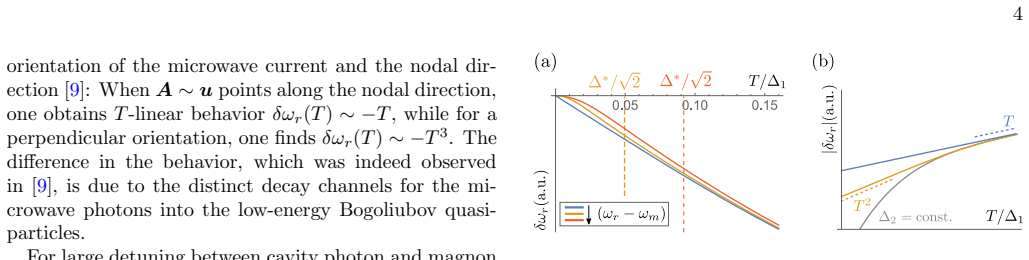
(b) Log-Log plot of|δω r|. The gray curve showsδω r evaluated with a time-independent gap ∆2 = 0.5∆∗ for comparison. dependent ∆2(t), note that there are certain time inter- vals over whichT >∆ 2(t), whileT <∆ 2(t) over the remaining time interval. For the former, the response should not reflect that of a fully gapped superconductor. Thus, when computing ...
-
[2]
Blais, A
A. Blais, A. L. Grimsmo, S. M. Girvin, and A. Wallraff, Rev. Mod. Phys.93, 025005 (2021)
2021
-
[3]
de la Torre, D
A. de la Torre, D. M. Kennes, M. Claassen, S. Gerber, J. W. McIver, and M. A. Sentef, Rev. Mod. Phys.93, 041002 (2021)
2021
-
[4]
Mivehvar, F
F. Mivehvar, F. Piazza, T. Donner, and H. Ritsch, Ad- vances in Physics70, 1 (2021)
2021
-
[5]
Schlawin, D
F. Schlawin, D. M. Kennes, and M. A. Sentef, Applied Physics Reviews9, 011312 (2022)
2022
-
[6]
F. P. Laussy, A. V. Kavokin, and I. A. Shelykh, Phys. Rev. Lett.104, 106402 (2010)
2010
-
[7]
D. J. Goldie and S. Withington, Superconductor Science and Technology26, 015004 (2012)
2012
-
[8]
P. J. de Visser, D. J. Goldie, P. Diener, S. Withington, J. J. A. Baselmans, and T. M. Klapwijk, Phys. Rev. Lett. 112, 047004 (2014)
2014
-
[9]
D. Phan, J. Senior, A. Ghazaryan, M. Hatefipour, W. M. Strickland, J. Shabani, M. Serbyn, and A. P. Higgin- botham, Phys. Rev. Lett.128, 107701 (2022)
2022
-
[10]
C. G. L. Bøttcher, N. R. Poniatowski, A. Grankin, M. E. Wesson, Z. Yan, U. Vool, V. M. Galitski, and A. Yacoby, Nature Physics20, 1609 (2024)
2024
-
[11]
S. S. Babkin, A. P. Higginbotham, and M. Serbyn, SciPost Phys.16, 115 (2024)
2024
-
[12]
Kreidel, X
M. Kreidel, X. Chu, J. Balgley, A. Antony, N. Verma, J. Ingham, L. Ranzani, R. Queiroz, R. M. Westervelt, J. Hone, and K. C. Fong, Phys. Rev. Res.6, 043245 (2024)
2024
-
[13]
Ghirri, C
A. Ghirri, C. Bonizzoni, M. Maksutoglu, and M. Affronte, Phys. Rev. Appl.22, 034004 (2024)
2024
-
[14]
Tanaka, J
M. Tanaka, J. j. Wang, T. H. Dinh, D. Rodan-Legrain, S. Zaman, M. Hays, A. Almanakly, B. Kannan, D. K. Kim, B. M. Niedzielski, K. Serniak, M. E. Schwartz, K. Watanabe, T. Taniguchi, T. P. Orlando, S. Gustavs- son, J. A. Grover, P. Jarillo-Herrero, and W. D. Oliver, Nature638, 99 (2025)
2025
-
[15]
Banerjee, Z
A. Banerjee, Z. Hao, M. Kreidel, P. Ledwith, I. Phinney, J. M. Park, A. Zimmerman, M. E. Wesson, K. Watanabe, T. Taniguchi, R. M. Westervelt, A. Yacoby, P. Jarillo- Herrero, P. A. Volkov, A. Vishwanath, K. C. Fong, and P. Kim, Nature638, 93 (2025)
2025
-
[16]
H. Jin, G. Serpico, Y. Lee, T. Confalone, C. N. Saggau, F. Lo Sardo, G. Gu, B. H. Goodge, E. Lesne, D. Mon- temurro, K. Nielsch, N. Poccia, and U. Vool, Nano Let- ters 10.1021/acs.nanolett.4c05793 (2025)
-
[17]
S. Zaman, J. Wang, T. Werkmeister, M. Tanaka, T. Dinh, M. Hays, D. Rodan-Legrain, A. Goswami, R. Assouly, A. K. Demir, D. K. Kim, B. M. Niedzielski, K. Serniak, M. E. Schwartz, K. Watanabe, T. Taniguchi, P. Kim, 6 R. Comin, J. A. Grover, T. P. Orlando, P. Jarillo-Herrero, and W. D. Oliver, Kinetic inductance of few-layer nbse 2 in the two-dimensional limi...
-
[18]
Contactless cavity sensing of superfluid stiffness in atomically thin 4Hb-TaS$_2$
T. Chistolini, H.-L. Kim, Q. Wang, S.-D. Chen, L. P. Cairns, R. P. Day, C. Sanborn, H. Kim, Z. Pedramrazi, R. Qi, T. Taniguchi, K. Watanabe, J. G. Analytis, D. I. Santiago, I. Siddiqi, and F. Wang, Contactless cavity sensing of superfluid stiffness in atomically thin 4hb-tas 2 (2025), arXiv:2510.25124 [cond-mat.supr-con]
work page internal anchor Pith review Pith/arXiv arXiv 2025
-
[19]
W. N. Hardy, D. A. Bonn, D. C. Morgan, R. Liang, and K. Zhang, Phys. Rev. Lett.70, 3999 (1993)
1993
-
[20]
Prozorov and R
R. Prozorov and R. W. Giannetta, Superconductor Sci- ence and Technology19, R41 (2006)
2006
-
[21]
D. D. Stancil and A. Prabhakar,Spin waves, Vol. 5 (Springer, 2009)
2009
-
[22]
Takahashi, S
S. Takahashi, S. Hikino, M. Mori, J. Martinek, and S. Maekawa, Phys. Rev. Lett.99, 057003 (2007)
2007
-
[23]
C. G. L. Boettcher,New avenues in circuit QED: from quantum information to quantum sensing, Ph.D. thesis, Harvard University (2022)
2022
-
[24]
Haug and S
H. Haug and S. W. Koch,Quantum theory of the op- tical and electronic properties of semiconductors(world scientific, 2009)
2009
-
[25]
J. Xu, C. Zhong, X. Han, D. Jin, L. Jiang, and X. Zhang, Phys. Rev. Lett.125, 237201 (2020)
2020
-
[26]
Ghirri, C
A. Ghirri, C. Bonizzoni, M. Maksutoglu, A. Mercurio, O. Di Stefano, S. Savasta, and M. Affronte, Phys. Rev. Appl.20, 024039 (2023)
2023
-
[27]
see the supplemantary material under
-
[28]
Takei and V
S. Takei and V. Galitski, Phys. Rev. B86, 054521 (2012)
2012
-
[29]
F. S. Bergeret and I. V. Tokatly, Phys. Rev. B89, 134517 (2014)
2014
-
[30]
Amundsen, J
M. Amundsen, J. Linder, J. W. A. Robinson, I. ˇZuti´ c, and N. Banerjee, Rev. Mod. Phys.96, 021003 (2024)
2024
- [31]
-
[32]
Inoue, M
M. Inoue, M. Ichioka, and H. Adachi, Phys. Rev. B96, 024414 (2017)
2017
-
[33]
S. J. Carreira, D. Sanchez-Manzano, M.-W. Yoo, K. Seurre, V. Rouco, A. Sander, J. Santamar´ ıa, A. Anane, and J. E. Villegas, Phys. Rev. B104, 144428 (2021)
2021
-
[34]
Yokoyama and Y
T. Yokoyama and Y. Tserkovnyak, Phys. Rev. B80, 104416 (2009)
2009
-
[35]
J. P. Morten, A. Brataas, G. E. W. Bauer, W. Belzig, and Y. Tserkovnyak, Europhysics Letters84, 57008 (2008)
2008
-
[36]
Funaki, A
H. Funaki, A. Yamakage, and M. Matsuo, Phys. Rev. B 107, 184437 (2023)
2023
-
[37]
I. V. Bobkova, A. M. Bobkov, and M. A. Silaev, Phys. Rev. Lett.127, 147701 (2021)
2021
-
[38]
R. A. Barankov, L. S. Levitov, and B. Z. Spivak, Phys. Rev. Lett.93, 160401 (2004)
2004
- [39]
-
[40]
M. Knap, M. Babadi, G. Refael, I. Martin, and E. Demler, Phys. Rev. B94, 214504 (2016)
2016
-
[41]
Fischer and G
P. Fischer and G. Catelani, Phys. Rev. Appl.19, 054087 (2023)
2023
-
[42]
Breuer and F
H.-P. Breuer and F. Petruccione,The theory of open quantum systems(Oxford University Press, USA, 2002)
2002
-
[43]
P. J. Hirschfeld and N. Goldenfeld, Phys. Rev. B48, 4219 (1993)
1993
-
[44]
Altland and B
A. Altland and B. D. Simons,Condensed matter field theory(Cambridge university press, 2010)
2010
-
[45]
Dynamical Control of Superconductivity in Superconductor–Ferromagnet Bilayers
G. D. Mahan,Many-particle physics(Springer Science & Business Media, 2000). 7 Supplementary material for “Dynamical Control of Superconductivity in Superconductor–Ferromagnet Bilayers” Driven magnon-polaritons In the rotating-wave approximation, the coupled photon-magnon system can be described by the Hamiltonian introduced in Eq. (1) of the main text. Th...
2000
discussion (0)
Sign in with ORCID, Apple, or X to comment. Anyone can read and Pith papers without signing in.