Constraining the Low-p_T η/π⁰ Ratio for Direct-Photon Analyses with Blast-Wave Fits to π, K, and p Spectra
Pith reviewed 2026-06-27 07:24 UTC · model grok-4.3
The pith
Blast-wave fits to measured K/π ratios constrain the low-p_T η/π⁰ ratio and limit its decay-photon uncertainty to 10% of the direct-photon signal.
A machine-rendered reading of the paper's core claim, the machinery that carries it, and where it could break.
Core claim
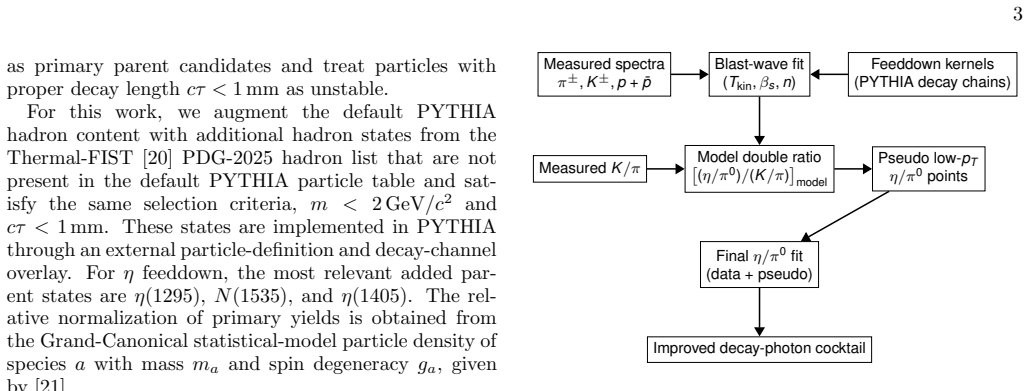
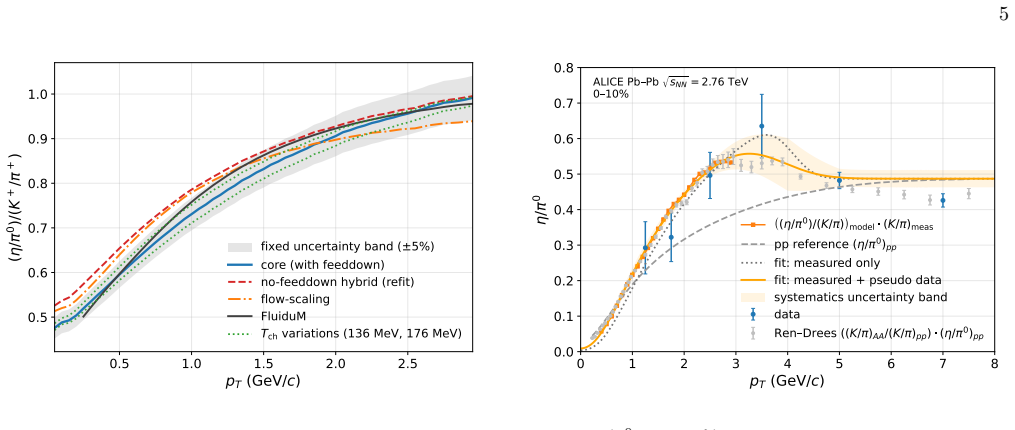
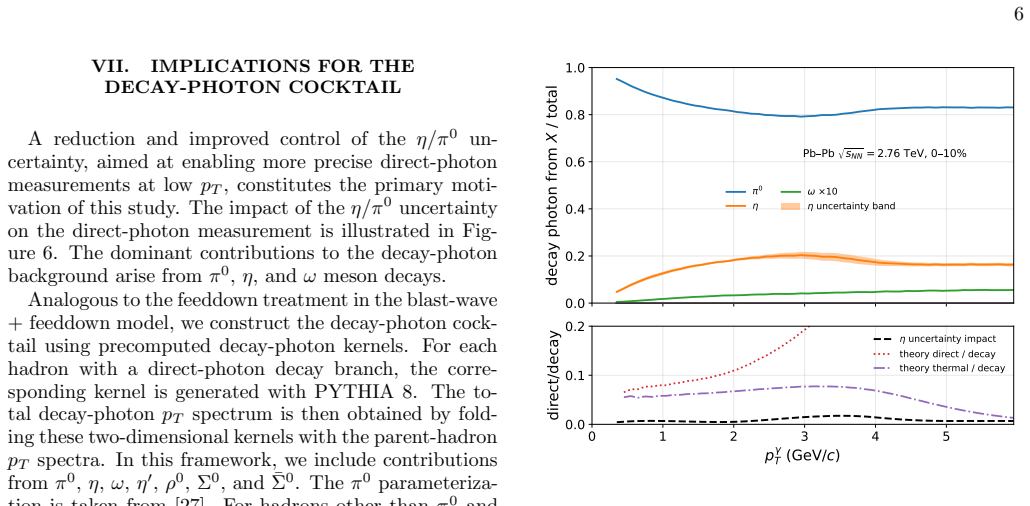
We predict the η/π⁰ ratio at low p_T (p_T ≲ 3 GeV/c) using the measured charged K/π ratio and model input from a blast-wave framework with feeddown contributions. This approach can provide improved, data-constrained background estimates for direct-photon and dilepton measurements in heavy-ion collisions. Using central Pb-Pb collisions at √s_NN=2.76 TeV as an example, we find that the η-related decay-photon uncertainty at p_T ≈ 1 GeV/c is of order 10% of the expected direct-photon signal.
What carries the argument
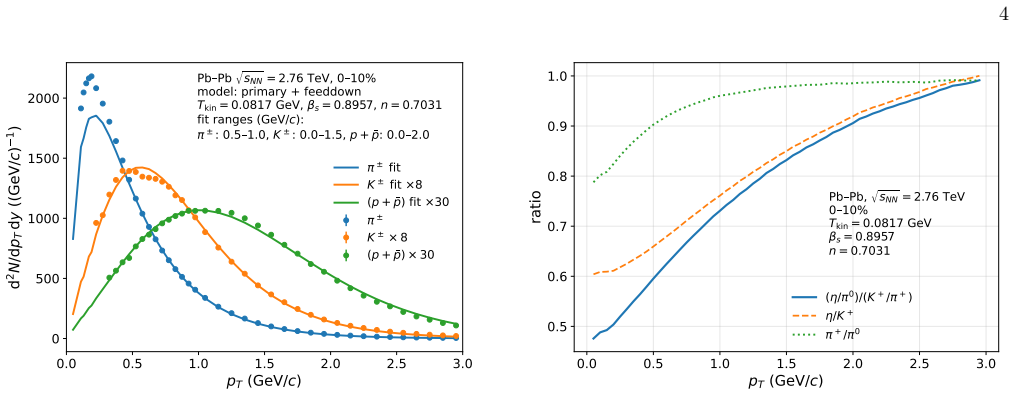
Blast-wave framework with radial flow and feeddown contributions, fixed by the measured K/π ratio, which extrapolates the low-p_T η/π⁰ ratio.
If this is right
- Data-constrained background estimates become available for direct-photon analyses in heavy-ion collisions.
- The eta-related decay-photon uncertainty is quantified at order 10% of the direct-photon signal near 1 GeV/c.
- The same framework supplies improved background subtraction for dilepton measurements.
- The method can be repeated for other collision energies or systems once the relevant K/π spectra are measured.
Where Pith is reading between the lines
- Direct low-p_T eta measurements in the same system would provide an immediate test of the extrapolation.
- If the assumption holds, the approach lowers model dependence compared with purely hydrodynamic or statistical hadronization predictions for the eta yield.
- The technique could be applied to other unmeasured meson ratios once their parent spectra and K/π anchors are available.
Load-bearing premise
The blast-wave model with parameters fixed by the K/π ratio correctly extrapolates the low-p_T η/π⁰ ratio without missing important differences in eta versus pion production or feeddown.
What would settle it
A direct experimental measurement of the η/π⁰ ratio at p_T below 3 GeV/c in central Pb-Pb collisions at 2.76 TeV that deviates substantially from the blast-wave prediction.
Figures
read the original abstract
We predict the $\eta/\pi^0$ ratio at low $p_T$ ($p_T \lesssim 3~\mathrm{GeV}/c$) using the measured charged $K/\pi$ ratio and model input from a blast-wave framework with feeddown contributions. This approach can provide improved, data-constrained background estimates for direct-photon and dilepton measurements in heavy-ion collisions. In this approach, the explicit modeling of radial flow and hadronic feeddown enables an uncertainty estimate for the low-$p_T$ extrapolation of the $\eta/\pi^0$ ratio. Using central Pb-Pb collisions at $\sqrt{s_{NN}}=2.76$ TeV as an example, we find that the $\eta$-related decay-photon uncertainty at $p_T \approx 1~\mathrm{GeV}/c$ is of order 10\% of the expected direct-photon signal.
Editorial analysis
A structured set of objections, weighed in public.
Referee Report
Summary. The manuscript proposes using blast-wave fits (with radial flow and feeddown) to measured π, K, and p spectra, constrained specifically by the K/π ratio, to predict the low-p_T (p_T ≲ 3 GeV/c) η/π⁰ ratio in heavy-ion collisions. This is intended to improve background estimates for direct-photon analyses. For central Pb-Pb collisions at √s_NN = 2.76 TeV, the authors conclude that the η-related decay-photon uncertainty at p_T ≈ 1 GeV/c is of order 10% of the expected direct-photon signal.
Significance. If the blast-wave extrapolation is reliable, the method would supply a data-constrained estimate for an important background component in direct-photon and dilepton measurements, which is a useful contribution to heavy-ion physics analyses. The explicit use of measured K/π ratios to anchor the model parameters is a positive feature.
major comments (2)
- [Abstract] Abstract: the central 10% uncertainty claim is obtained by fitting blast-wave parameters to the same π, K, p spectra whose ratios are used as input; without an explicit demonstration that the fit is unique or that the parameters transfer to η (e.g., via comparison to independent η spectra or variation of resonance feeddown channels), the quoted uncertainty cannot be verified as model-independent.
- [Abstract] Abstract: the manuscript states the η-related uncertainty is 'of order 10%' but provides no visible error propagation from the blast-wave parameters (flow velocity, temperature, feeddown) or sensitivity tests to η-specific effects such as strangeness-dependent flow; this makes the numerical claim load-bearing yet unsupported in the presented form.
Simulated Author's Rebuttal
We thank the referee for the careful review and constructive feedback on our manuscript. We address the major comments below, focusing on the points raised regarding the uncertainty estimate in the abstract.
read point-by-point responses
-
Referee: [Abstract] Abstract: the central 10% uncertainty claim is obtained by fitting blast-wave parameters to the same π, K, p spectra whose ratios are used as input; without an explicit demonstration that the fit is unique or that the parameters transfer to η (e.g., via comparison to independent η spectra or variation of resonance feeddown channels), the quoted uncertainty cannot be verified as model-independent.
Authors: The blast-wave parameters are determined from simultaneous fits to the measured π, K, and p spectra, with the K/π ratio serving as an explicit constraint on the relative normalization and flow parameters in the strangeness sector. This ratio provides an independent handle beyond the absolute spectra alone. The extrapolation to the η/π⁰ ratio follows from the mass-dependent radial flow and resonance feeddown in the same framework. While direct comparisons to independent low-p_T η spectra are not included (such data being sparse at the relevant energies), we agree that additional explicit tests of fit uniqueness and variations in resonance feeddown channels would better substantiate the uncertainty. We will incorporate these sensitivity studies in the revised manuscript. revision: yes
-
Referee: [Abstract] Abstract: the manuscript states the η-related uncertainty is 'of order 10%' but provides no visible error propagation from the blast-wave parameters (flow velocity, temperature, feeddown) or sensitivity tests to η-specific effects such as strangeness-dependent flow; this makes the numerical claim load-bearing yet unsupported in the presented form.
Authors: The quoted uncertainty of order 10% is intended to reflect the range obtained from blast-wave parameter sets that describe the input spectra and K/π ratio. However, we acknowledge that the manuscript does not present a detailed, visible error propagation or dedicated sensitivity tests for η-specific effects such as possible strangeness-dependent flow differences. We will revise the manuscript to include explicit propagation of uncertainties from the fit parameters (flow velocity, temperature, and feeddown contributions) along with sensitivity tests addressing η-specific modeling assumptions. revision: yes
Circularity Check
No significant circularity; model-based extrapolation from measured K/π to predicted η/π⁰
full rationale
The derivation fits blast-wave parameters (radial flow, feeddown) to measured π, K, p spectra and the K/π ratio, then applies the same framework to predict the low-p_T η/π⁰ ratio. This is a standard model extrapolation, not a self-definitional loop or a fit to the target η/π⁰ quantity itself. The quoted 10% uncertainty at p_T ≈ 1 GeV/c is an output of that model application, not forced by construction from the inputs. No self-citation chains, uniqueness theorems, or ansatz smuggling appear in the provided text. The central claim remains an independent model prediction whose validity rests on the blast-wave assumptions rather than tautological reduction to the fitted data.
Axiom & Free-Parameter Ledger
free parameters (1)
- blast-wave flow velocity and temperature parameters
axioms (1)
- domain assumption Blast-wave model with radial flow and feeddown accurately captures the low-pT spectra of light mesons
Reference graph
Works this paper leans on
-
[1]
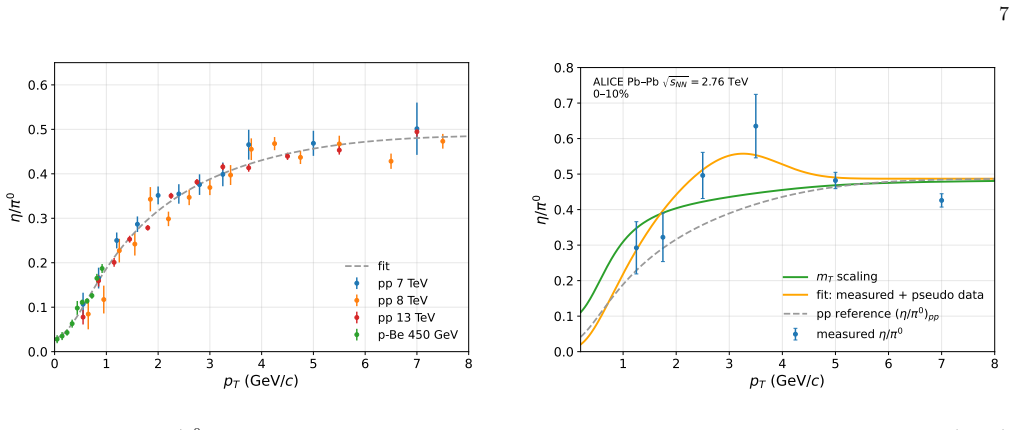
For heavy-ion collisions at the LHC we useT ch = 156 MeV and a chemical potentialµ a = 0 [4]. B. Parameterization of theη/π 0 ratio at low and high transverse momentum Eq. 2 provides pseudo-data points forp T ≲3 GeV/c which are then used along with the measuredη/π 0 data points to obtain a parameterization over a large trans- verse momentum range. Forp T ...
-
[2]
W. Busza, K. Rajagopal, and W. van der Schee, Heavy Ion Collisions: The Big Picture, and the Big Questions, Ann. Rev. Nucl. Part. Sci.68, 339 (2018), arXiv:1802.04801 [hep-ph]
Pith/arXiv arXiv 2018
-
[3]
S. Borsanyi, Z. Fodor, J. N. Guenther, S. K. Katz, K. K. Szabo, A. Pasztor, I. Portillo, and C. Ratti, Higher order fluctuations and correlations of conserved charges from lattice QCD, JHEP10, 205, arXiv:1805.04445 [hep-lat]
-
[4]
Bazavovet al.(HotQCD), Chiral crossover in QCD at zero and non-zero chemical potentials, Phys
A. Bazavovet al.(HotQCD), Chiral crossover in QCD at zero and non-zero chemical potentials, Phys. Lett. B 795, 15 (2019), arXiv:1812.08235 [hep-lat]
arXiv 2019
-
[5]
A. Andronic, P. Braun-Munzinger, K. Redlich, J. Stachel, et al., Decoding the phase structure of QCD via parti- cle production at high energy, Nature561, 321 (2018), arXiv:1710.09425 [nucl-th]
Pith/arXiv arXiv 2018
-
[6]
Adamet al.(ALICE), Direct photon production in Pb- Pb collisions at √sN N = 2.76 TeV, Phys
J. Adamet al.(ALICE), Direct photon production in Pb- Pb collisions at √sN N = 2.76 TeV, Phys. Lett. B754, 235 (2016), arXiv:1509.07324 [nucl-ex]
Pith/arXiv arXiv 2016
-
[7]
David, Direct real photons in relativistic heavy ion collisions, Rept
G. David, Direct real photons in relativistic heavy ion collisions, Rept. Prog. Phys.83, 046301 (2020), arXiv:1907.08893 [nucl-ex]
arXiv 2020
-
[8]
A. Mazeliauskas and V. Vislavicius, Temperature and fluid velocity on the freeze-out surface fromπ,K,pspec- tra in pp, p-Pb and Pb-Pb collisions, Phys. Rev. C101, 014910 (2020), arXiv:1907.11059 [hep-ph]
arXiv 2020
-
[9]
M. M. Aggarwalet al.(WA98), Observation of direct photons in central 158-A-GeV Pb-208 + Pb-208 col- lisions, Phys. Rev. Lett.85, 3595 (2000), arXiv:nucl- ex/0006008
arXiv 2000
-
[10]
Albrechtet al.(WA80), Production ofπ 0,ηand direct photons in O+Au collisions at 200A GeV, Phys
R. Albrechtet al.(WA80), Production ofπ 0,ηand direct photons in O+Au collisions at 200A GeV, Phys. Rev. C 44, 2736 (1991)
1991
-
[11]
A. Adareet al.(PHENIX), Enhanced production of di- rect photons in Au+Au collisions at √sN N = 200 GeV and implications for the initial temperature, Phys. Rev. Lett.104, 132301 (2010), arXiv:0804.4168 [nucl-ex]
Pith/arXiv arXiv 2010
-
[12]
L. Adamczyket al.(STAR), Direct virtual photon pro- duction in Au+Au collisions at √sN N = 200 GeV, Phys. Lett. B770, 451 (2017), arXiv:1607.01447 [nucl-ex]
Pith/arXiv arXiv 2017
- [13]
-
[14]
U. A. Acharyaet al.(PHENIX), Nonprompt direct- photon production in Au+Au collisions at √sN N = 200 GeV, (2022), arXiv:2203.17187 [nucl-ex]
arXiv 2022
-
[15]
Schnedermann, J
E. Schnedermann, J. Sollfrank, and U. W. Heinz, Fire- ball spectra,NATO Advanced Study Institute on Particle Production in Highly Excited Matter Castelvecchio Pas- coli, Italy, July 12-24, 1992, NATO Sci. Ser. B303, 175 (1993)
1992
-
[16]
E. Schnedermann, J. Sollfrank, and U. W. Heinz, Ther- mal phenomenology of hadrons from 200-A/GeV S+S collisions, Phys. Rev.C48, 2462 (1993), arXiv:nucl- th/9307020 [nucl-th]
arXiv 1993
-
[17]
Cooper and G
F. Cooper and G. Frye, Comment on the Single Particle Distribution in the Hydrodynamic and Statistical Ther- modynamic Models of Multiparticle Production, Phys. Rev.D10, 186 (1974)
1974
-
[18]
A. Mazeliauskas, S. Floerchinger, E. Grossi, and D. Teaney, Fast resonance decays in nuclear collisions, Eur. Phys. J. C79, 284 (2019), arXiv:1809.11049 [nucl- th]
Pith/arXiv arXiv 2019
-
[19]
Mazeliauskas, S
A. Mazeliauskas, S. Floerchinger, E. Grossi, and D. Teaney, FastReso (2018)
2018
-
[20]
T. Sjostrand, S. Ask, J. R. Christiansen, R. Corke, N. De- sai, P. Ilten, S. Mrenna, S. Prestel, C. O. Rasmussen, and P. Z. Skands, An Introduction to PYTHIA 8.2, Comput. Phys. Commun.191, 159 (2015), arXiv:1410.3012 [hep- ph]
Pith/arXiv arXiv 2015
-
[21]
V. Vovchenko and H. Stoecker, Thermal-FIST: A pack- age for heavy-ion collisions and hadronic equation of state, Comput. Phys. Commun.244, 295 (2019), arXiv:1901.05249 [nucl-th]
arXiv 2019
-
[22]
J. Cleymans and K. Redlich, Unified description of freeze- out parameters in relativistic heavy ion collisions, Phys. Rev. C60, 054908 (1999), arXiv:nucl-th/9903063
Pith/arXiv arXiv 1999
-
[23]
B. B. Abelevet al.(ALICE), Production of charged pi- ons, kaons and protons at large transverse momenta in pp and Pb–Pb collisions at √sNN =2.76 TeV, Phys. Lett. B736, 196 (2014), arXiv:1401.1250 [nucl-ex]
Pith/arXiv arXiv 2014
-
[24]
P. Lu, R. Kavak, A. Dubla, S. Masciocchi, and I. Se- lyuzhenkov, Quantification of the low-p T pion excess in heavy-ion collisions at the LHC and top RHIC energy, Nucl. Sci. Tech.36, 142 (2025), arXiv:2407.09207 [hep- ph]
arXiv 2025
-
[25]
G. Nijs, W. van der Schee, U. G¨ ursoy, and R. Snellings, Bayesian analysis of heavy ion collisions with the heavy ion computational framework Trajectum, Phys. Rev. C 103, 054909 (2021), arXiv:2010.15134 [nucl-th]
arXiv 2021
-
[26]
S. Floerchinger, E. Grossi, and J. Lion, Fluid dynamics of heavy ion collisions with mode expansion, Phys. Rev. C100, 014905 (2019), arXiv:1811.01870 [nucl-th]
Pith/arXiv arXiv 2019
-
[27]
L. Vermunt, Y. Seemann, A. Dubla, S. Floerchinger, E. Grossi, A. Kirchner, S. Masciocchi, and I. Se- lyuzhenkov, Mapping properties of the quark gluon plasma in Pb-Pb and Xe-Xe collisions at energies avail- able at the CERN Large Hadron Collider, Phys. Rev. C 108, 064908 (2023), arXiv:2308.16722 [hep-ph]
arXiv 2023
-
[28]
S. Acharyaet al.(ALICE), Neutral pion andηme- son production at mid-rapidity in Pb-Pb collisions at√sN N = 2.76 TeV, Phys. Rev. C98, 044901 (2018), arXiv:1803.05490 [nucl-ex]
Pith/arXiv arXiv 2018
-
[29]
C. Gale, J.-F. Paquet, B. Schenke, and C. Shen, Multi- messenger heavy-ion collision physics, Phys. Rev. C105, 10 014909 (2022), arXiv:2106.11216 [nucl-th]
arXiv 2022
-
[30]
Kirchner, A
A. Kirchner, A. Mazeliauskas, and K. Reygers, eta- pi0-blastwave-feeddown,https://github.com/reygers/ eta-pi0-blastwave-feeddown(2026), gitHub reposi- tory, accessed 2026-03-13
2026
-
[31]
B. Abelevet al.(ALICE), Neutral pion andηme- son production in proton-proton collisions at √s= 0.9 TeV and √s= 7 TeV, Phys. Lett. B717, 162 (2012), arXiv:1205.5724 [hep-ex]
Pith/arXiv arXiv 2012
-
[32]
Acharyaet al.(ALICE),π 0 andηmeson production in proton-proton collisions at √s= 8 TeV, Eur
S. Acharyaet al.(ALICE),π 0 andηmeson production in proton-proton collisions at √s= 8 TeV, Eur. Phys. J. C78, 263 (2018), arXiv:1708.08745 [hep-ex]
Pith/arXiv arXiv 2018
-
[33]
S. Acharyaet al.(ALICE), Light neutral-meson produc- tion in pp collisions at √s= 13 TeV, JHEP08, 035, arXiv:2411.09560 [hep-ex]
discussion (0)
Sign in with ORCID, Apple, or X to comment. Anyone can read and Pith papers without signing in.