From Loss Diagnosis to Rational Design: A Unified Analytical Model for Photoelectrochemical Cells
Pith reviewed 2026-06-27 07:46 UTC · model grok-4.3
The pith
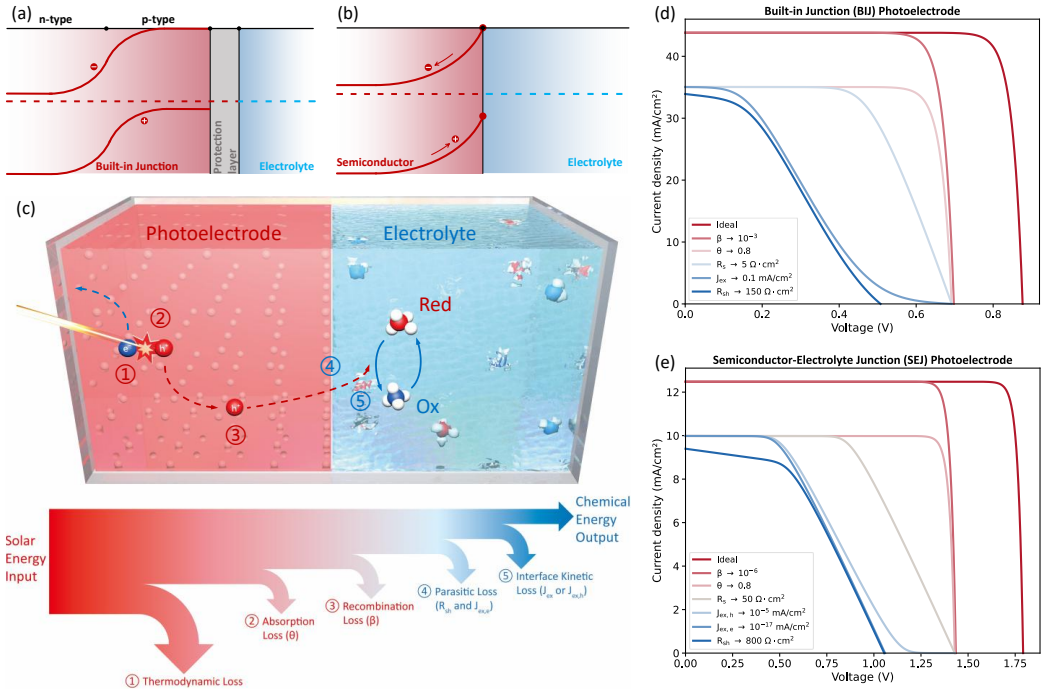
A unified analytical model decomposes energy losses in photoelectrochemical cells from experimental current-voltage data using one parameter set for both junction types.
A machine-rendered reading of the paper's core claim, the machinery that carries it, and where it could break.
Core claim
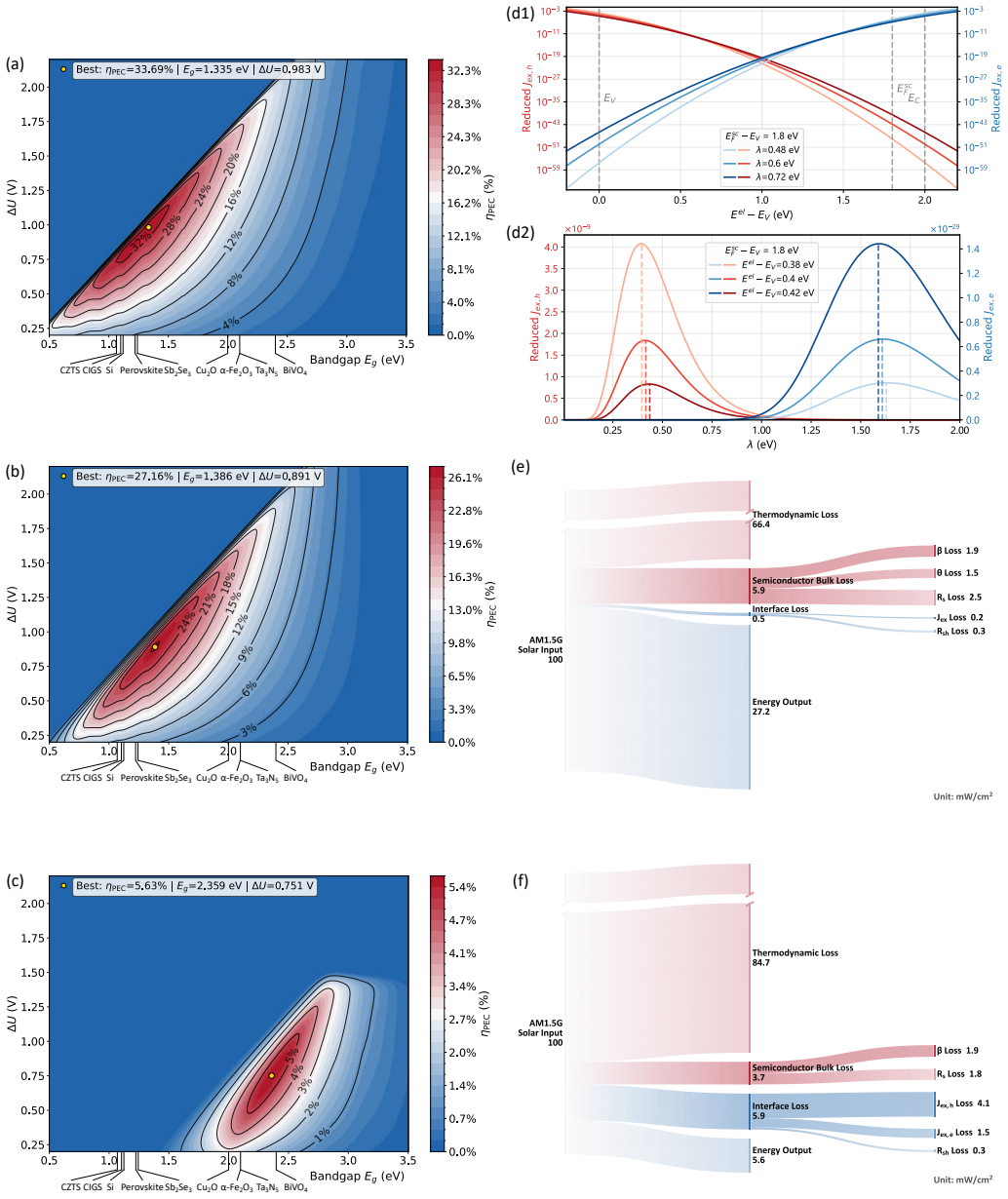
The framework delivers current-voltage curves and efficiency metrics under ideal and real conditions, constructing efficiency maps to delineate theoretical limits and material-selection windows. By fitting experimental current-voltage data, it enables quantitative energy-loss decomposition into thermodynamic, optical, recombination, and interfacial contributions, pinpointing performance bottlenecks in real devices and mapping them directly onto optimization strategies such as co-catalyst integration or nanostructuring. Energy flows are visualized through Sankey diagrams, and the approach is validated against results from solar water splitting, CO2 reduction, NH3 synthesis, and solar redox fl
What carries the argument
The unified analytical model that applies a single consistent set of physically meaningful parameters to describe losses across both built-in junction and semiconductor-electrolyte junction architectures.
If this is right
- Efficiency maps delineate theoretical limits and material-selection windows for different photoelectrochemical applications.
- Quantitative loss decomposition maps performance bottlenecks directly onto optimization strategies such as co-catalyst integration or nanostructuring.
- Sankey diagrams provide an intuitive visualization of how incident solar energy is absorbed, dissipated, or converted into chemical output.
- The framework enables systematic comparison of photovoltaic-grade absorbers with intermediate-bandgap semiconductors to identify class-specific limiting factors.
Where Pith is reading between the lines
- The approach could support screening of candidate materials by predicting dominant loss channels from limited I-V measurements alone.
- It might be extended to model performance variations with changing light intensity or electrolyte conditions using the same parameter structure.
- This suggests device design can move from empirical iteration toward direct targeting of identified loss mechanisms through material or interface changes.
Load-bearing premise
A single consistent set of physically meaningful parameters can accurately describe losses across both built-in junction and semiconductor-electrolyte junction architectures without requiring architecture-specific adjustments or additional hidden variables.
What would settle it
Fitting the model to experimental current-voltage curves from both a built-in junction device and a semiconductor-electrolyte junction device using exactly the same parameter values; failure to achieve accurate fits for both without architecture-specific changes or extra variables would disprove the unified applicability.
Figures
read the original abstract
Photoelectrochemical (PEC) cells are a compelling route to solar-driven chemical energy storage and feedstock synthesis, yet their deployment is hindered by coupled losses spanning light absorption, carrier transport, interfacial charge transfer, and semiconductor-electrolyte matching. Existing models address these losses in an architecture-specific manner and fall short of quantitative experimental diagnosis or actionable design guidance. Here, we introduce a unified loss-analysis framework applicable to both built-in junction (BIJ) and semiconductor-electrolyte junction (SEJ) photoelectrodes within a consistent set of physically meaningful parameters. The framework delivers current-voltage curves and efficiency metrics under ideal and real conditions, constructing efficiency maps to delineate theoretical limits and material-selection windows. Critically, by fitting experimental current-voltage data, it enables quantitative energy-loss decomposition into thermodynamic, optical, recombination, and interfacial contributions, pinpointing performance bottlenecks in real devices and mapping them directly onto optimization strategies such as co-catalyst integration or nanostructuring. Energy flows are visualized through Sankey diagrams, providing an intuitive picture of how incident solar energy is absorbed, dissipated, or converted into chemical output. Validated against state-of-the-art literature results spanning solar water splitting, CO2 reduction, NH3 synthesis, and solar redox flow batteries, the framework further enables systematic comparison of photovoltaic-grade absorbers (e.g., Si, perovskites) with intermediate-bandgap semiconductors (e.g., hematite, BiVO4), identifying key factors limiting each material class. Together, these capabilities support a paradigm shift from empirical optimization to mechanism-informed rational design of high-efficiency PEC energy-conversion systems.
Editorial analysis
A structured set of objections, weighed in public.
Referee Report
Summary. The paper introduces a unified analytical loss-analysis framework for photoelectrochemical cells applicable to both built-in junction (BIJ) and semiconductor-electrolyte junction (SEJ) photoelectrodes using a single consistent set of physically meaningful parameters. It generates ideal and real current-voltage curves, efficiency metrics, and efficiency maps; fits experimental I-V data to decompose losses quantitatively into thermodynamic, optical, recombination, and interfacial contributions; visualizes energy flows via Sankey diagrams; and validates the approach against literature results for solar water splitting, CO2 reduction, NH3 synthesis, and redox flow batteries while comparing photovoltaic-grade and intermediate-bandgap absorbers.
Significance. If the central fitting procedure yields unique, physically interpretable parameters that unambiguously assign loss fractions across architectures without post-hoc adjustments, the framework would offer a practical tool for mechanism-informed diagnosis and design in PEC systems, moving beyond architecture-specific models and enabling direct mapping of bottlenecks to strategies such as co-catalyst addition or nanostructuring.
major comments (2)
- [Fitting and loss-decomposition procedure (likely §3–4)] The central claim of quantitative, unambiguous loss decomposition rests on the fitting procedure producing a unique parameter set. No demonstration is provided that the multi-parameter inverse problem is well-posed (e.g., via sensitivity analysis, multiple initial guesses, or Hessian inspection) or that alternative parameter combinations yielding equivalent I-V fits assign materially different loss fractions. This directly affects the mapping to optimization strategies.
- [Model formulation and validation sections] The assertion of a single consistent parameter set applicable to both BIJ and SEJ architectures without architecture-specific adjustments or hidden variables is load-bearing for the unified-framework claim, yet no explicit cross-architecture validation (e.g., simultaneous fit to representative BIJ and SEJ datasets with shared parameters) is shown to rule out the need for such adjustments.
minor comments (1)
- [Abstract and §2] The abstract and early sections would benefit from an explicit statement of the number of free parameters and any constraints or priors used in fitting to aid reproducibility.
Simulated Author's Rebuttal
We thank the referee for the constructive feedback on the fitting robustness and cross-architecture validation. We address each major comment below and will revise the manuscript to incorporate the requested demonstrations.
read point-by-point responses
-
Referee: [Fitting and loss-decomposition procedure (likely §3–4)] The central claim of quantitative, unambiguous loss decomposition rests on the fitting procedure producing a unique parameter set. No demonstration is provided that the multi-parameter inverse problem is well-posed (e.g., via sensitivity analysis, multiple initial guesses, or Hessian inspection) or that alternative parameter combinations yielding equivalent I-V fits assign materially different loss fractions. This directly affects the mapping to optimization strategies.
Authors: We agree that explicit demonstration of well-posedness is needed to support unambiguous loss decomposition. The manuscript validates the framework against multiple literature datasets but does not include sensitivity analysis, multiple-initial-guess tests, or Hessian inspection. In revision we will add an appendix performing these checks on representative fits (including the water-splitting and CO2-reduction cases), confirming that loss fractions remain stable and that alternative parameter sets do not produce materially different decompositions. revision: yes
-
Referee: [Model formulation and validation sections] The assertion of a single consistent parameter set applicable to both BIJ and SEJ architectures without architecture-specific adjustments or hidden variables is load-bearing for the unified-framework claim, yet no explicit cross-architecture validation (e.g., simultaneous fit to representative BIJ and SEJ datasets with shared parameters) is shown to rule out the need for such adjustments.
Authors: The model is formulated with a single parameter set and is applied to both BIJ and SEJ examples drawn from the literature, but we acknowledge that a simultaneous shared-parameter fit across architectures is not shown. We will add a dedicated validation subsection that performs a joint fit to one BIJ and one SEJ dataset using identical parameters, demonstrating that no architecture-specific adjustments are required. revision: yes
Circularity Check
No significant circularity; model is self-contained analytical framework
full rationale
The paper presents a unified analytical model whose core output is loss decomposition obtained by fitting experimental I-V curves to a multi-parameter construct. No derivation step, equation, or self-citation is exhibited that reduces the claimed quantitative decomposition, efficiency maps, or optimization mapping to a tautology or to the fitted inputs by construction. The framework is described as delivering current-voltage curves under ideal and real conditions, constructing efficiency maps, and being validated against literature results across multiple reactions and materials. The fitting step is a standard application of the model rather than a renamed prediction; parameter identifiability and uniqueness are separate concerns about empirical validation, not circularity. No self-citation load-bearing, ansatz smuggling, or renaming of known results is detectable from the provided text. The derivation chain therefore remains independent of the inputs.
Axiom & Free-Parameter Ledger
Reference graph
Works this paper leans on
-
[1]
1 M. R. Shaner, K. T. Fountaine and H.-J. Lewerenz, Appl. Phys. Lett., 2013, 103, 143905. 2 J. Reichman, Applied Physics Letters, 1980, 36, 574–577. 3 A. J. Nozik and R. Memming, J. Phys. Chem., 1996, 100, 13061–13078. 4 M. A. Green, Solar Cells: Operating Principles, Technology and System Applications, Prentice-Hall, Englewood Cliffs, NJ,
2013
-
[2]
5 L. S. Shapley, in Contributions to the Theory of Games (AM-28), Volume II, eds H. W. Kuhn and A. W. Tucker, Princeton University Press, 1953, pp. 307–318. 6 PlotDigitizer Online App, https://plotdigitizer.com/app, (accessed 9 April 2026). 7 R. Fan, J. Zhou, W. Xun, S. Cheng, S. Vanka, T. Cai, S. Ju, Z. Mi and M. Shen, Nano Energy, 2020, 71, 104631. 8 M....
1953
-
[3]
13 Y . Zhao, G. Liu, H. Wang, Y . Gao, T. Yao, W. Shi and C. Li, J. Mater. Chem. A, 2021, 9, 11285–11290. 14 X. Zhou, B. Fu, L. Li, Z. Tian, X. Xu, Z. Wu, J. Yang and Z. Zhang, Nat Commun, 2022, 13,
2021
-
[4]
15 M. G. Lee, J. W. Yang, I. J. Park, T. H. Lee, H. Park, W. S. Cheon, S. A. Lee, H. Lee, S. G. Ji, J. M. Suh, J. Moon, J. Y . Kim and H. W. Jang, Carbon Energy, 2023, 5, e321. 16 J. T. Song, H. Ryoo, M. Cho, J. Kim, J.-G. Kim, S.-Y . Chung and J. Oh, Advanced Energy Materials, 2017, 7, 1601103. 17 S. Liao, X. Zong, B. Seger, T. Pedersen, T. Yao, C. Ding,...
2023
-
[5]
20 Copper(I) oxide powder, = 7um, 97 1317 -39-1, https://www.sigmaaldrich.com/CH/fr/product/sigald/208825, (accessed 7 April 2026). 21 R. Tan, Y . J. Jeong, H. S. Han, S. Kapse, S. S. Shin, X. Zheng and I. S. Cho, Nano-Micro Lett., 2026, 18,
2026
-
[6]
22 Tantalum(V) chloride 99.99 trace metals 7721-01-9, https://www.sigmaaldrich.com/CH/fr/product/aldrich/400475, (accessed 7 April 2026). 23 Z. Zhang, X. Huang, B. Zhang and Y . Bi, Energy Environ. Sci., 2022, 15, 2867–2873. 24 S. Wang, K. Wan, J. Feng, Y . Yang and S. Wang, Journal of Materials Science & Technology, 2025, 217, 182–220. 25 Ammonium metava...
2026
-
[7]
30 Lead(II) iodide beads, -10mesh, 99.999 trace metals 10101 -63-0, https://www.sigmaaldrich.com/CH/fr/product/aldrich/554359, (accessed 7 April 2026)
29 Tin(II) iodide anhydrous, beads, -10mesh, 99.99 trace metals 10294 -70-9, https://www.sigmaaldrich.com/CH/fr/product/aldrich/409308, (accessed 7 April 2026). 30 Lead(II) iodide beads, -10mesh, 99.999 trace metals 10101 -63-0, https://www.sigmaaldrich.com/CH/fr/product/aldrich/554359, (accessed 7 April 2026). 31 Selenium powder, -100mesh, = 99.5 trace m...
2026
-
[8]
Huang, K
34 D. Huang, K. Wang, L. Li, K. Feng, N. An, S. Ikeda, Y . Kuang, Y . Ng and F. Jiang, Energy Environ. Sci., 2021, 14, 1480–
2021
-
[9]
36 Tin(II) chloride dihydrate for analysis (max
35Thiourea for synthesis 62-56-6, https://www.sigmaaldrich.com/CH/fr/product/mm/818591, (accessed 7 April 2026). 36 Tin(II) chloride dihydrate for analysis (max. 0.000001 Hg) EMSURE 10025 -69-1, https://www.sigmaaldrich.com/CH/fr/product/mm/107814, (accessed 7 April 2026). 37 Tin(IV) chloride 98 10026 -06-9, https://www.sigmaaldrich.com/CH/fr/product/siga...
2026
discussion (0)
Sign in with ORCID, Apple, or X to comment. Anyone can read and Pith papers without signing in.