A Zero-shot Generalized Graph Anomaly Detection Framework via Node Reconstruction
Pith reviewed 2026-06-27 10:10 UTC · model grok-4.3
The pith
AlignGAD performs zero-shot graph anomaly detection by aligning features across domains and scoring node reconstruction discrepancies.
A machine-rendered reading of the paper's core claim, the machinery that carries it, and where it could break.
Core claim
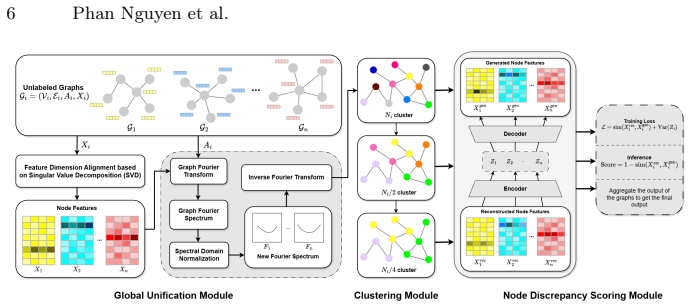
AlignGAD consists of a Global Unification Module to align heterogeneous node features and normalize graph signals in the spectral domain, a Clustering Module to construct cluster-aware graph views for capturing group-level patterns, and a Node Discrepancy Scoring Module to measure reconstruction discrepancy and aggregate anomaly evidence, allowing effective anomaly detection on unseen target graphs.
What carries the argument
The Global Unification Module that aligns heterogeneous node features and normalizes graph signals in the spectral domain to enable cross-domain transfer.
If this is right
- Zero-shot GAD becomes feasible on new graphs without domain-specific retraining.
- Node reconstruction discrepancies can serve as reliable anomaly indicators across different graph structures.
- Cluster-aware views help capture abnormal patterns at the group level in heterogeneous data.
- Generalization across domains reduces the need for labeled data in each new graph application.
Where Pith is reading between the lines
- Similar unification techniques could apply to other cross-domain graph tasks such as classification or link prediction.
- Success would imply that spectral domain normalization captures transferable anomaly signals better than raw features.
- The framework might be extended by incorporating additional view constructions beyond clustering.
Load-bearing premise
The Global Unification Module can align heterogeneous node features and normalize graph signals in the spectral domain without losing critical information needed to detect anomalies in unseen target graphs.
What would settle it
A counterexample would be a target graph where AlignGAD's anomaly scores do not correlate with actual anomalies despite successful feature alignment, or where it performs no better than a random baseline.
Figures
read the original abstract
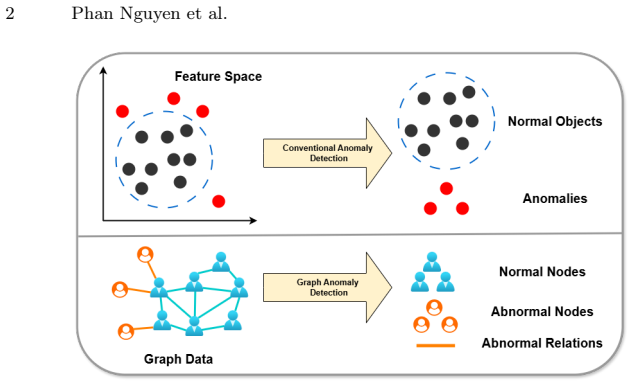
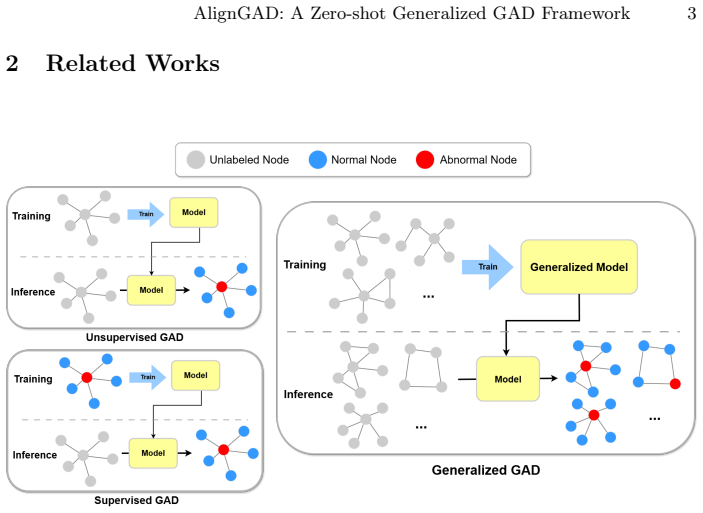
Cross-domain graph anomaly detection (GAD) aims to identify abnormal nodes in unseen target graphs, showing strong potential in real-world applications with heterogeneous graph data. However, existing methods often depend on dataset-specific feature semantics and structural patterns, which limits their ability to generalize across different domains. To address this challenge, we propose AlignGAD, a zero-shot generalized graph anomaly detection framework. Our framework is built upon three key components: a Global Unification Module that aligns heterogeneous node features and normalizes graph signals in the spectral domain; a Clustering Module that constructs cluster-aware graph views to capture group-level abnormal patterns; and a Node Discrepancy Scoring Module that measures reconstruction discrepancy and aggregates anomaly evidence from different graph views. Experiments on multiple real-world datasets demonstrate the effectiveness of AlignGAD under the zero-shot GAD setting.
Editorial analysis
A structured set of objections, weighed in public.
Referee Report
Summary. The manuscript proposes AlignGAD, a zero-shot generalized graph anomaly detection framework consisting of three modules: a Global Unification Module that aligns heterogeneous node features and normalizes graph signals in the spectral domain, a Clustering Module that constructs cluster-aware graph views to capture group-level abnormal patterns, and a Node Discrepancy Scoring Module that measures reconstruction discrepancy and aggregates anomaly evidence from different graph views. The central claim is that experiments on multiple real-world datasets demonstrate the effectiveness of AlignGAD under the zero-shot GAD setting.
Significance. Cross-domain zero-shot GAD addresses a practically relevant challenge in handling heterogeneous graph data without domain-specific retraining. If the framework's modules enable reliable generalization while preserving anomaly signals, the work could contribute to broader applicability of GAD methods. However, the provided text supplies no quantitative results, baselines, error bars, implementation details, or ablation studies, preventing assessment of whether the claims are supported or whether the approach advances the state of the art.
major comments (1)
- Abstract: the claim that 'experiments on multiple real-world datasets demonstrate the effectiveness' is unsupported because the text supplies no quantitative results, baselines, error bars, dataset descriptions, or performance metrics, making it impossible to evaluate whether the data supports the central claim.
Simulated Author's Rebuttal
We thank the referee for the detailed review and the identification of the unsupported claim in the abstract. We address this point directly below.
read point-by-point responses
-
Referee: Abstract: the claim that 'experiments on multiple real-world datasets demonstrate the effectiveness' is unsupported because the text supplies no quantitative results, baselines, error bars, dataset descriptions, or performance metrics, making it impossible to evaluate whether the data supports the central claim.
Authors: We agree with the referee that the abstract claim is currently unsupported in the provided manuscript text. The current version lacks a dedicated experiments section containing quantitative results, baselines, error bars, dataset descriptions, and performance metrics. We will revise the manuscript to incorporate a full experimental evaluation on multiple real-world datasets under the zero-shot GAD setting, including all requested details, to substantiate the abstract claim. revision: yes
Circularity Check
No significant circularity detected
full rationale
The abstract and available text describe AlignGAD via three high-level modules (Global Unification, Clustering, Node Discrepancy Scoring) without any equations, derivations, fitted parameters, or self-citations. No load-bearing step reduces a claimed prediction or result to its own inputs by construction, and no uniqueness theorem or ansatz is invoked. The zero-shot GAD claim rests on experimental effectiveness statements that are not mathematically derived in the visible content, leaving the derivation chain empty of circular reductions.
Axiom & Free-Parameter Ledger
Reference graph
Works this paper leans on
-
[1]
Bruna, J., Zaremba, W., Szlam, A., LeCun, Y.: Spectral networks and locally connected networks on graphs. In: Bengio, Y., LeCun, Y. (eds.) 2nd International Conference on Learning Representations, ICLR 2014, Banff, AB, Canada, April 14- 16, 2014, Conference Track Proceedings (2014), http://arxiv.org/abs/1312.6203
Pith/arXiv arXiv 2014
-
[2]
In: Proceedings of the Thirty-Third International Joint Conference on Artificial Intelligence
Cai, J., Zhang, Y., Fan, J., Ng, S.K.: Lg-fgad: an effective federated graph anomaly detection framework. In: Proceedings of the Thirty-Third International Joint Conference on Artificial Intelligence. IJCAI ’24 (2024). https://doi.org/10.24963/ijcai.2024/416, https://doi.org/10.24963/ijcai.2024/416
-
[3]
In: The Twelfth International Conference on Learning Representations (2024), https://openreview.net/forum?id=CanomFZssu
Chen, J., Zhu, G., Yuan, C., Huang, Y.: Boosting graph anomaly detection with adaptive message passing. In: The Twelfth International Conference on Learning Representations (2024), https://openreview.net/forum?id=CanomFZssu
2024
-
[4]
Ding, K., Li, J., Bhanushali, R., Liu, H.: Deep Anomaly Detection on At- tributed Networks, pp. 594–602. https://doi.org/10.1137/1.9781611975673.67, https://epubs.siam.org/doi/abs/10.1137/1.9781611975673.67
-
[5]
IEEE Transactions on Neural Networks and Learning Systems33(6), 2406–2415 (2022)
Ding, K., Shu, K., Shan, X., Li, J., Liu, H.: Cross-domain graph anomaly detection. IEEE Transactions on Neural Networks and Learning Systems33(6), 2406–2415 (2022). https://doi.org/10.1109/TNNLS.2021.3110982 AlignGAD: A Zero-shot Generalized GAD Framework 13
-
[6]
Specaugment on large scale datasets
Fan, H., Zhang, F., Li, Z.: Anomalydae: Dual autoencoder for anomaly detec- tion on attributed networks. In: 2020 IEEE International Conference on Acoustics, Speech and Signal Processing, ICASSP 2020, Barcelona, Spain, May 4-8, 2020. pp. 5685–5689. IEEE (2020). https://doi.org/10.1109/ICASSP40776.2020.9053387, https://doi.org/10.1109/ICASSP40776.2020.9053387
-
[7]
In: Proceedings of the ACM Web Conference 2023
Gao, Y., Wang, X., He, X., Liu, Z., Feng, H., Zhang, Y.: Addressing heterophily in graph anomaly detection: A perspective of graph spectrum. In: Proceedings of the ACM Web Conference 2023. p. 1528–1538. WWW ’23, Association for Computing Machinery,NewYork,NY,USA(2023).https://doi.org/10.1145/3543507.3583268, https://doi.org/10.1145/3543507.3583268
-
[8]
In: Proceed- ings of the Sixteenth ACM International Conference on Web Search and Data Mining
Gao, Y., Wang, X., He, X., Liu, Z., Feng, H., Zhang, Y.: Alleviat- ing structural distribution shift in graph anomaly detection. In: Proceed- ings of the Sixteenth ACM International Conference on Web Search and Data Mining. p. 357–365. WSDM ’23, Association for Computing Machin- ery, New York, NY, USA (2023). https://doi.org/10.1145/3539597.3570377, https...
-
[9]
Guo, J., Tang, S., Li, J., Pan, K., Wu, L.: Rustgraph: Robust anomaly detection in dynamic graphs by jointly learning structural- temporal dependency. IEEE Trans. on Knowl. and Data Eng.36(7), 3472–3485 (Jul 2024). https://doi.org/10.1109/TKDE.2023.3328645, https://doi.org/10.1109/TKDE.2023.3328645
-
[10]
IEEE Transactions on Information Forensics and Security19, 8760–8772 (2024)
He, S., Li, G., Xie, K., Sharma, P.K.: Fusion graph structure learning-based multivariate time series anomaly detection with structured prior knowledge. IEEE Transactions on Information Forensics and Security19, 8760–8772 (2024). https://doi.org/10.1109/TIFS.2024.3459631
-
[11]
Ivanov, S., Prokhorenkova, L.: Boost then convolve: Gradient boosting meets graph neural networks (2021), https://arxiv.org/abs/2101.08543
arXiv 2021
-
[12]
Webb, Irwin King, and Shirui Pan
Jin, M., Koh, H.Y., Wen, Q., Zambon, D., Alippi, C., Webb, G.I., King, I., Pan, S.: A Survey on Graph Neural Networks for Time Se- ries: Forecasting, Classification, Imputation, and Anomaly Detection . IEEE Transactions on Pattern Analysis & Machine Intelligence46(12), 10466–10485 (Dec 2024). https://doi.org/10.1109/TPAMI.2024.3443141, https://doi.ieeecom...
-
[13]
In: 5th International Conference on Learning Representations, ICLR 2017, Toulon, France, April 24-26, 2017, Conference Track Proceedings
Kipf, T.N., Welling, M.: Semi-supervised classification with graph convolutional networks. In: 5th International Conference on Learning Representations, ICLR 2017, Toulon, France, April 24-26, 2017, Conference Track Proceedings. OpenRe- view.net (2017), https://openreview.net/forum?id=SJU4ayYgl
2017
-
[14]
In: Globerson, A., Mackey, L., Bel- grave, D., Fan, A., Paquet, U., Tomczak, J., Zhang, C
Liu, Y., Li, S., Zheng, Y., Chen, Q., Zhang, C., Pan, S.: Arc: A generalist graph anomaly detector with in-context learning. In: Globerson, A., Mackey, L., Bel- grave, D., Fan, A., Paquet, U., Tomczak, J., Zhang, C. (eds.) Advances in Neural Information Processing Systems. vol. 37, pp. 50772–50804. Curran Associates, Inc. (2024). https://doi.org/10.52202/...
-
[15]
IEEE Transactions on Neural Networks and Learning Systems 33(6), 2378–2392 (2022)
Liu, Y., Li, Z., Pan, S., Gong, C., Zhou, C., Karypis, G.: Anomaly detection on attributed networks via contrastive self-supervised learn- ing. IEEE Transactions on Neural Networks and Learning Systems 33(6), 2378–2392 (2022). https://doi.org/10.1109/tnnls.2021.3068344, http://dx.doi.org/10.1109/TNNLS.2021.3068344
-
[16]
Luo, X., Wu, J., Beheshti, A., Yang, J., Zhang, X., Wang, Y., Xue, S.: Comga: Community-aware attributed graph anomaly detection. In: Proceed- ings of the Fifteenth ACM International Conference on Web Search and 14 Phan Nguyen et al. Data Mining. p. 657–665. WSDM ’22, Association for Computing Machin- ery, New York, NY, USA (2022). https://doi.org/10.1145...
-
[17]
Niu, C., Qiao, H., Chen, C., Chen, L., Pang, G.: Zero-shot generalist graph anomaly detection with unified neighborhood prompts. In: Kwok, J. (ed.) Pro- ceedings of the Thirty-Fourth International Joint Conference on Artificial In- telligence, IJCAI-25. pp. 3226–3234. International Joint Conferences on Artifi- cial Intelligence Organization (8 2025). http...
-
[18]
Proceedings of the AAAI Conference on Artificial Intelligence 38(21), 23610–23612 (Mar 2024)
Pang, S., Xiao, C., Tai, W., Cheng, Z., Zhou, F.: Graph anomaly de- tection with diffusion model-based graph enhancement (student ab- stract). Proceedings of the AAAI Conference on Artificial Intelligence 38(21), 23610–23612 (Mar 2024). https://doi.org/10.1609/aaai.v38i21.30494, https://ojs.aaai.org/index.php/AAAI/article/view/30494
-
[19]
Pazho, A.D., Noghre, G.A., Purkayastha, A.A., Vempati, J., Martin, O., Tabkhi, H.: A survey of graph-based deep learning for anomaly detection in distributed systems. IEEE Trans. on Knowl. and Data Eng.36(1), 1–20 (Jan 2024). https://doi.org/10.1109/TKDE.2023.3282898, https://doi.org/10.1109/TKDE.2023.3282898
-
[20]
In: Proceedings of the 37th International Conference on Neural Information Processing Systems
Qiao,H.,Pang,G.:Truncatedaffinitymaximization:one-classhomophilymodeling for graph anomaly detection. In: Proceedings of the 37th International Conference on Neural Information Processing Systems. NIPS ’23, Curran Associates Inc., Red Hook, NY, USA (2023)
2023
-
[21]
In: Proceedings of the 38th International Conference on Neural Information Processing Systems
Qiao, H., Wen, Q., Li, X., Lim, E.P., Pang, G.: Generative semi-supervised graph anomaly detection. In: Proceedings of the 38th International Conference on Neural Information Processing Systems. NIPS ’24, Curran Associates Inc., Red Hook, NY, USA (2024)
2024
-
[22]
In: The Thirty-eighth Annual Conference on Neural Informa- tion Processing Systems (2024), https://openreview.net/forum?id=zqLAMwVLkt
Qiao, H., Wen, Q., Li, X., Lim, E.P., Pang, G.: Generative semi-supervised graph anomaly detection. In: The Thirty-eighth Annual Conference on Neural Informa- tion Processing Systems (2024), https://openreview.net/forum?id=zqLAMwVLkt
2024
-
[23]
In: International Conference on Machine Learning (2022)
Tang, J., Li, J., Gao, Z., Li, J.: Rethinking graph neural networks for anomaly detection. In: International Conference on Machine Learning (2022)
2022
-
[24]
In: 6th International Conference on Learning Representations, ICLR 2018, Vancouver,BC, Canada, April30 -May 3,2018, ConferenceTrack Pro- ceedings
Velickovic, P., Cucurull, G., Casanova, A., Romero, A., Liò, P., Bengio, Y.: Graph attention networks. In: 6th International Conference on Learning Representations, ICLR 2018, Vancouver,BC, Canada, April30 -May 3,2018, ConferenceTrack Pro- ceedings. OpenReview.net (2018), https://openreview.net/forum?id=rJXMpikCZ
2018
-
[25]
AAAI’23/IAAI’23/EAAI’23, AAAI Press (2023)
Wang, Q., Pang, G., Salehi, M., Buntine, W., Leckie, C.: Cross-domain graph anomaly detection via anomaly- aware contrastive alignment. AAAI’23/IAAI’23/EAAI’23, AAAI Press (2023). https://doi.org/10.1609/aaai.v37i4.25591, https://doi.org/10.1609/aaai.v37i4.25591
-
[26]
In: Proceedings of the Thirty- Third International Joint Conference on Artificial Intelligence
Wu, J., Hu, R., Li, D., Huang, Z., Ren, L., Zang, Y.: Robust heterophilic graph learning against label noise for anomaly detection. In: Proceedings of the Thirty- Third International Joint Conference on Artificial Intelligence. IJCAI ’24 (2024). https://doi.org/10.24963/ijcai.2024/271, https://doi.org/10.24963/ijcai.2024/271
-
[27]
Xiao, C., Pang, S., Xu, X., Li, X., Trajcevski, G., Zhou, F.: Counterfactual data augmentation with denoising diffusion for graph anomaly detection (2024), https://arxiv.org/abs/2407.02143
arXiv 2024
-
[28]
In: Proceedings of the Thirty-Fourth In- ternational Joint Conference on Artificial Intelligence
Zhang, X., Peng, H., He, Z., Xie, C., Jin, X., Jiang, H.: Gctam: global and contextual truncated affinity combined maximization model for unsu- AlignGAD: A Zero-shot Generalized GAD Framework 15 pervised graph anomaly detection. In: Proceedings of the Thirty-Fourth In- ternational Joint Conference on Artificial Intelligence. IJCAI ’25 (2025). https://doi....
-
[29]
Zheng, B., Ming, L., Zeng, K., Zhou, M., Zhang, X., Ye, T., Yang, B., Zhou, X., Jensen, C.S.: Adversarial graph neural network for multivari- ate time series anomaly detection. IEEE Trans. on Knowl. and Data Eng. 36(12), 7612–7626 (Dec 2024). https://doi.org/10.1109/TKDE.2024.3419891, https://doi.org/10.1109/TKDE.2024.3419891
-
[30]
IEEE Transactions on Neural Networks and Learning Systems (TNNLS) (2023)
Zheng, Y., Koh, H.Y., Jin, M., Chi, L., Phan, K.T., Pan, S., Chen, Y.P.P., Xiang, W.: Correlation-aware Spatial-Temporal Graph Learning for Multivariate Time- series Anomaly Detection. IEEE Transactions on Neural Networks and Learning Systems (TNNLS) (2023)
2023
discussion (0)
Sign in with ORCID, Apple, or X to comment. Anyone can read and Pith papers without signing in.