Quantum Gravity Induced Entanglement from Propagating Gravitons
Pith reviewed 2026-06-27 06:19 UTC · model grok-4.3
The pith
Quantized gravitons entangle two trapped particles after a time delay set by their separation.
A machine-rendered reading of the paper's core claim, the machinery that carries it, and where it could break.
Core claim
In the model, the interaction between the propagating modes of the quantized gravitational field and the two particles produces entanglement whose strength is fixed by the graviton commutation relations inside the Feynman-Vernon influence functional. Entanglement does not appear at once; a delay proportional to the particle separation must elapse first, reflecting the causal character of gravitational propagation. The effect remains tiny for ordinary initial states but can be increased by preparing the particles in squeezed states.
What carries the argument
The operator-based Feynman-Vernon influence functional applied to the propagating graviton modes, whose commutation relations alone determine the generated entanglement.
If this is right
- Entanglement forms only after a delay proportional to the distance between the particles.
- The entanglement is generated exclusively by the quantum contributions of the gravitational field.
- Squeezed initial states of the particles increase the amount of entanglement produced.
- The overall size of the effect remains very small under the conditions examined.
Where Pith is reading between the lines
- The same influence-functional method could be applied to other quantized fields to compare how quickly each generates entanglement.
- Timing measurements of entanglement onset might offer a route to test the causal structure even when the magnitude stays below direct detection thresholds.
- Extending the model to include more particles or different potentials would show whether the distance-dependent delay persists as a general feature.
Load-bearing premise
The gravitational field admits a quantized description whose propagating modes interact with the particles in a way that is completely captured by the influence functional and the graviton commutation relations.
What would settle it
An experiment or calculation that produces entanglement between the particles at a time shorter than the light-travel time across their separation would contradict the claimed causal delay.
Figures
read the original abstract
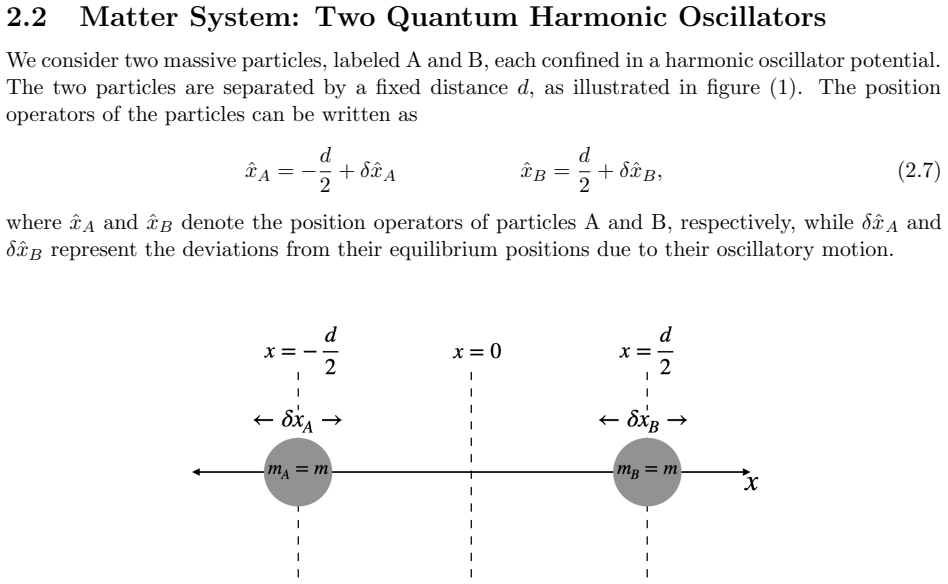
In this work, we show how the interaction between propagating modes of the quantized gravitational field and two massive particles trapped in a harmonic oscillator potential can cause the two particles to become entangled. To demonstrate this, we employ an operator-based approach within the framework of the Feynman-Vernon influence functional. Through this method, we find that the effect of the gravitational field on the generated entanglement is encoded in the commutation relations of the gravitational field. This result indicates that, within the framework of the model considered, entanglement arises through the quantum contributions of the gravitational field. Furthermore, this work also shows that entanglement is not formed instantaneously after the two particles interact with the gravitational field. Instead, there exists a time delay, proportional to the distance between the particles, before entanglement is established. This result reflects the causal propagation nature of gravitational interactions. In general, the entanglement generated through this mechanism is extremely small. Nevertheless, if the initial quantum states of the two massive particles are chosen to be squeezed states, the amount of generated entanglement can be enhanced, although the resulting effect remains very small.
Editorial analysis
A structured set of objections, weighed in public.
Referee Report
Summary. The manuscript shows that the interaction between propagating modes of the quantized gravitational field and two massive particles trapped in a harmonic oscillator potential can cause the two particles to become entangled. Using an operator-based approach within the Feynman-Vernon influence functional, the effect is encoded in the commutation relations of the gravitational field, leading to a time delay proportional to the distance between the particles before entanglement is established. The entanglement is extremely small but can be enhanced with squeezed states.
Significance. If substantiated by explicit calculations, this provides a useful model for how quantum contributions from the gravitational field can generate entanglement with causal propagation properties. The approach is appropriate for open quantum systems coupled to a bosonic field, and the result aligns with the expected light-cone structure for massless gravitons. This could stimulate further work on quantum gravity effects in tabletop experiments, though the smallness of the effect is a limitation.
major comments (1)
- [Abstract] Abstract: The abstract asserts that the entanglement arises through the quantum contributions of the gravitational field and is encoded in the commutation relations but supplies no explicit derivation steps, quantitative estimates, or checks against classical limits; the central claim therefore rests on an unshown calculation.
Simulated Author's Rebuttal
We thank the referee for their careful reading of the manuscript and for their positive assessment of its potential significance. We address the single major comment below.
read point-by-point responses
-
Referee: [Abstract] Abstract: The abstract asserts that the entanglement arises through the quantum contributions of the gravitational field and is encoded in the commutation relations but supplies no explicit derivation steps, quantitative estimates, or checks against classical limits; the central claim therefore rests on an unshown calculation.
Authors: We agree that the abstract is concise and therefore omits explicit derivation steps, quantitative estimates, and classical-limit checks, which are instead provided in the body of the manuscript. The operator-based Feynman-Vernon influence functional calculation, the encoding of the effect in graviton commutators, the explicit time delay, and the comparison to the commuting (classical) case are all derived in Sections 3–5. To address the referee’s concern we will revise the abstract to include a brief reference to the influence-functional method and the causal time delay. This change will make the central claim more self-contained in the abstract without altering its length substantially. revision: yes
Circularity Check
No significant circularity detected
full rationale
The paper computes entanglement between two harmonic oscillators coupled to linearized quantized metric perturbations via the Feynman-Vernon influence functional. Entanglement generation is traced to the graviton commutator, whose light-cone support produces the reported time delay; this follows directly from standard QFT causality and is not redefined or fitted to match the target result. No self-citation chain, ansatz smuggling, or reduction of the central claim to its own inputs is present. The derivation remains self-contained against external benchmarks of open-system QFT.
Axiom & Free-Parameter Ledger
axioms (1)
- domain assumption The gravitational field can be quantized and treated with propagating modes whose interaction with matter is captured by the Feynman-Vernon influence functional
Reference graph
Works this paper leans on
-
[1]
Abbotet al.[LIGO Scientific and Virgo],Phys
B.P. Abbotet al.[LIGO Scientific and Virgo],Phys. Rev. Lett.116, 6, 061102 (2016). 18
2016
-
[2]
Parikh, F
M. Parikh, F. Wilczek and G. Zahariade,Phys. Rev. D104, 046021 (2021)
2021
-
[3]
Maity and S
D. Maity and S. Pal,Physics Letters B,835, 137503 (2022)
2022
-
[4]
H. T. Cho and B. L. HuPhys. Rev. D105086004 (2022)
2022
-
[5]
R. J. Marshman, A. Mazumdar and S. BosePhys. Rev. A101052110 (2020)
2020
-
[6]
S. Bose, I. Fuentes, A. A. Geraci, S. M. Khan, S. Qvarfort, M. Rademacher, M. Rashid, M. Toros, H. Ulbricht and C. C. Wanjura,Rev. Mod. Phys.,97, 015003 (2025)
2025
-
[7]
S. Sen, S. Gangopadhyay and S. Bhattacharyya,Phys. Rev. D110, 026008 (2024)
2024
-
[8]
Bhattacharyya, S
S. Bhattacharyya, S. Gangopadhyay and A. SahaClass. Quantum Grav.37195006 (2020)
2020
-
[9]
Penrose,Foundations of Physics44(5), 557–575 (2014)
R. Penrose,Foundations of Physics44(5), 557–575 (2014)
2014
-
[10]
Kanno and J
S. Kanno and J. Soda,Phys. Rev. D8, 0840100 (2019)
2019
-
[11]
Kanno, J
S. Kanno, J. Soda, and J. TokudaPhys. Rev. D104, 083516 (2021)
2021
-
[12]
Ikeda, Y
T. Ikeda, Y. Kaku, S. Kanno and J. SodaPhys. Rev. D112, 103504 (2025)
2025
-
[13]
Kanno, J
S. Kanno, J. Soda, and A. TaniguchiPhys. Rev. Lett.136, 061404 (2026)
2026
-
[14]
Trenggana, F
A. Trenggana, F. P. Zen, and G. HikmawanAnnals of Physics469, 169770 (2024)
2024
-
[15]
Trenggana, F
A. Trenggana, F. P. Zen, and S. AriwahjoediInt J Theor Phys65, 153 (2026)
2026
-
[16]
C. H. Bennett, D. P. DiVincenzo, J. A. Smolin, and W. K. Wootters,Physical Review A54, 5 (1996)
1996
-
[17]
S. Bose, A. Mazumdar, G. W. Morley, H. Ulbricht,M. Toroˇ s, M. Paternostro, A. Geraci, P. Barker, M. S. Kim and G. Milburn,Phys. Rev. Lett.119, 240401 (2017)
2017
-
[18]
R. J. Marshman, A. Mazumdar and S. Bose,Phys. Rev. A101, 052110 (2020)
2020
-
[19]
Mazundar, A
Bose, S. Mazundar, A. Schut, M. dan Toros, M.,Phys. Rev. D105, 106028 (2022)
2022
-
[20]
P. G. C. Rufo, A. Mazumdar, and C. Sabin, ”Evolution of tripartite entanglement in three- qubit Quantum Gravity-Induced Entanglement of Masses (QGEM) with quantum decoher- ence”, arXiv: 2507.01007 (2025)
work page internal anchor Pith review Pith/arXiv arXiv 2025
-
[21]
Toros, M
M. Toros, M. Schut, P. Andriolo, S. Bose and A. MazumdarPhys. Rev. D111, 036026 (2025)
2025
-
[22]
Schut., J
M. Schut., J. Tilly, R. J. Marshman, S. Bose, and A. Mazumdar,Phys. Rev. A105, 032411 (2022)
2022
-
[23]
S. N. Gupta,Proc. Phys. Soc. A65161,(1952)
1952
-
[24]
H P Breuer and F Petruccione,Phys. Rev. A63, 032102 (2001)
2001
-
[25]
Feynman and F
R. Feynman and F. VernonAnn. Phys. (N.Y.)24, 118 (1963). 19
1963
-
[26]
Feynman and A
R. Feynman and A. Hibbs,Quantum Mechanics and Path Integral(1965) McGraw-Hill, Newyork
1965
-
[27]
W. K. Wootters,”Entanglement of Formation and Concurrence”,Quantum Information and Computation1, 1 (2001)
2001
-
[28]
M. A. Nielsen and I. L. Chuang,Quantum Computation and Quantum Information, (2010) Cambridge University Press
2010
-
[29]
C. C. Gerry, and P. L. Knight,Introductory Quantum Optics, (2005) Cambridge Univ. Press
2005
-
[30]
Fox,Quantum Optic: An Introduction, (2006) Oxford Univ
M. Fox,Quantum Optic: An Introduction, (2006) Oxford Univ. Press
2006
-
[31]
Weinberg,Cosmology(1968) Oxford Univ
S. Weinberg,Cosmology(1968) Oxford Univ. Press. 20
1968
discussion (0)
Sign in with ORCID, Apple, or X to comment. Anyone can read and Pith papers without signing in.