Continuum Neural Momentum Eigenstate for Variationally Solving Quasiparticles
Pith reviewed 2026-06-27 05:22 UTC · model grok-4.3
The pith
A neural quantum state is constructed to be an exact eigenstate of total momentum for any chosen value, allowing standard variational Monte Carlo to target ground states in fixed momentum sectors.
A machine-rendered reading of the paper's core claim, the machinery that carries it, and where it could break.
Core claim
The EVE architecture constructs a neural quantum state that is by design an exact eigenstate of the total momentum operator with eigenvalue equal to any chosen allowed momentum vector k. This property permits standard variational Monte Carlo procedures to variationally minimize the energy within a fixed momentum sector. When applied to two-dimensional bosons with mutual 1/r interactions, the same ansatz form describes four distinct phases—superfluid, roton, crystal, and phonon—across a range of densities, with phase identification following from the shape of the computed dispersion relation and confirmed by correlation functions.
What carries the argument
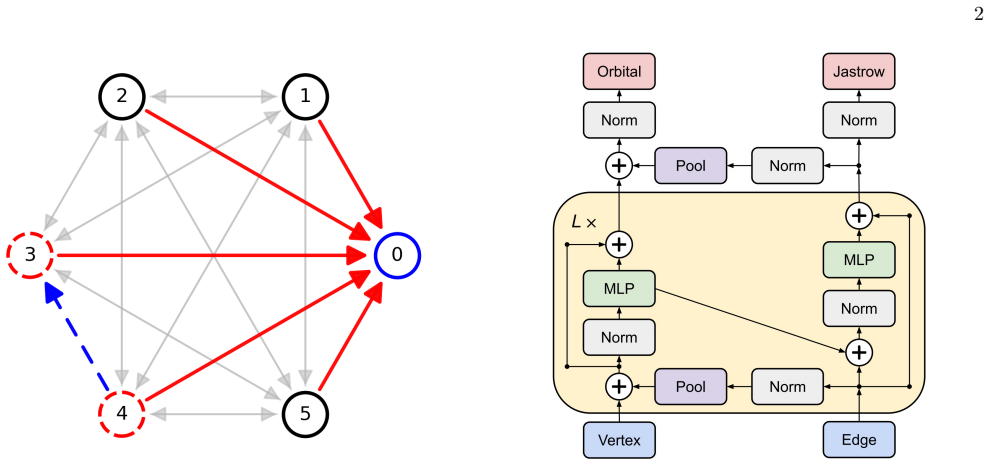
The EVE neural quantum state architecture, which enforces the exact momentum eigenstate property by construction for any selected total momentum k.
If this is right
- A single unified variational ansatz can describe four qualitatively different quantum phases: superfluid, roton, crystal, and phonon.
- The phase of matter can be identified directly from the shape of the dispersion relation extracted at different densities.
- Density-density correlation functions confirm the phase diagnoses and reveal the correlation structure of the excitations.
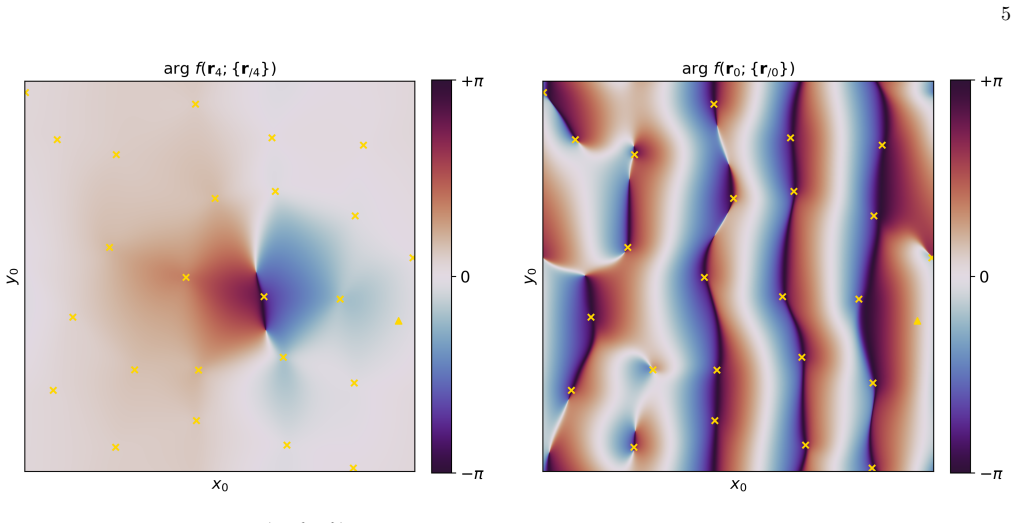
- The roton minimum exhibits multi-particle phase strings formed when several vortex dipoles merge.
Where Pith is reading between the lines
- The construction could be combined with additional symmetry constraints to target states carrying other quantum numbers in the same systems.
- The approach may allow mapping of quasiparticle dispersions across wider ranges of density and interaction strength than previously accessible with continuum neural states.
- Extension to three dimensions or to fermionic statistics would test whether the momentum-eigenstate property remains equally effective.
Load-bearing premise
Variational Monte Carlo optimization of the EVE ansatz converges to the true ground state in each momentum sector without the network form introducing a bias that prevents access to the reported phases.
What would settle it
An independent calculation at the same densities and interaction strengths that produces lower variational energies than those obtained with EVE would show that the ansatz has not reached the ground state.
Figures
read the original abstract
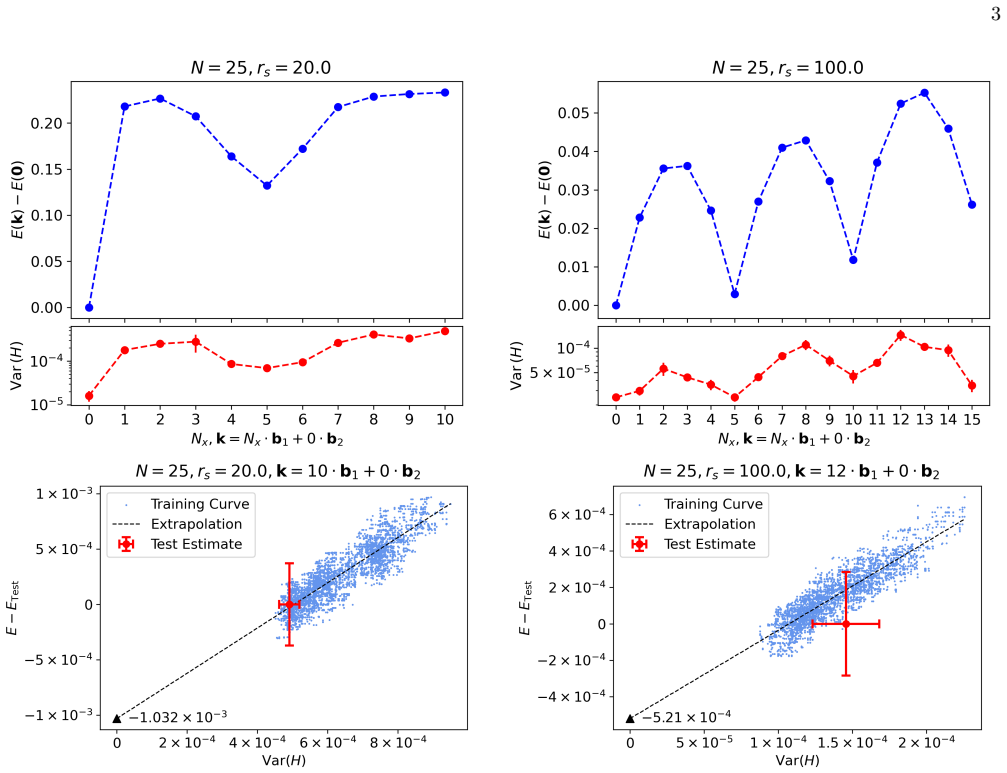
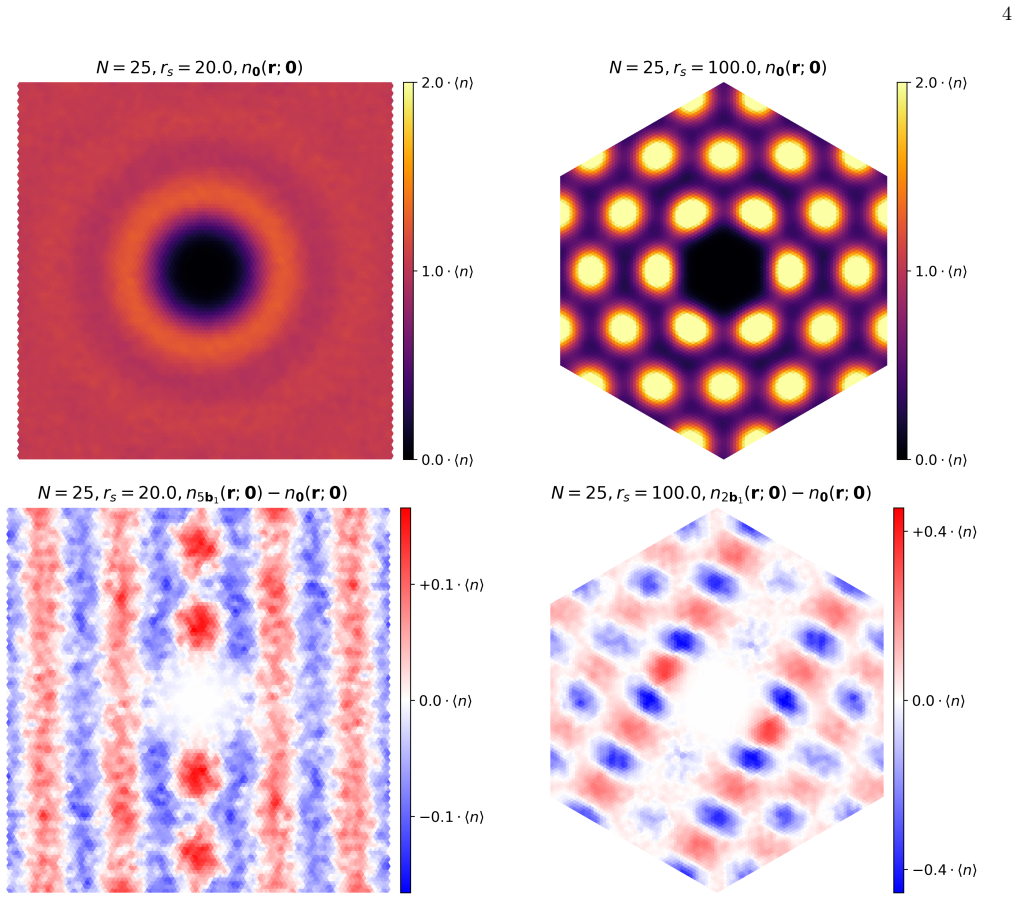
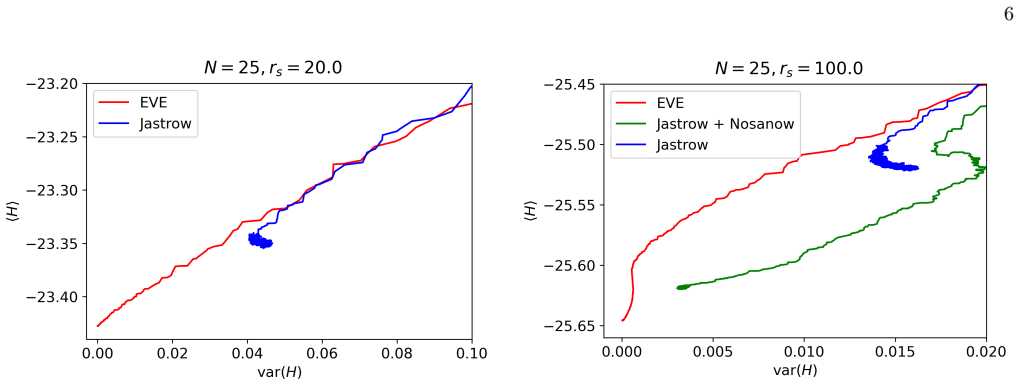
We design the first neural quantum state for continuum particles that, for any chosen allowed momentum $\mathbf{k}$, is by construction an exact eigenstate of total momentum with eigenvalue $\mathbf{k}$. Our architecture, EVE, enables off-the-shelf VMC to solve for momentum-sector ground states. We test EVE on 2D bosons with mutual $1/r$ interactions, finding that a single unified ansatz is capable of describing four qualitatively different states: superfluid, roton, crystal, and phonon. At different densities, we extract the underlying phase of matter from the dispersion's shape. At $r_s = 20.0$, we see the roton minimum at finite $k$ expected of a superfluid. At $r_s = 100.0$, we see striking zone folding indicative of crystalline order, with periodically spaced minima representing floating crystals connected by phonon arcs in between. Using density-density correlation functions, we confirm the phase diagnoses and probe the excitations' correlation structures. Finally, we analyze the roton's phase texture and find unexpected multi-particle phase strings, formed when several vortex dipoles merge, leaving two vortices connected by a phase slip.
Editorial analysis
A structured set of objections, weighed in public.
Referee Report
Summary. The manuscript introduces the EVE neural quantum state architecture for continuum particles that is, by construction, an exact eigenstate of the total momentum operator for any chosen allowed momentum k. This enables off-the-shelf variational Monte Carlo (VMC) to target momentum-sector ground states. Applied to 2D bosons with mutual 1/r interactions, a single unified ansatz is shown to capture four qualitatively different states—superfluid (roton minimum at finite k for rs=20), crystal (zone folding with periodic minima at rs=100), and phonon—diagnosed from dispersion shapes, confirmed via density-density correlation functions, and further analyzed through the roton's phase texture revealing multi-particle phase strings.
Significance. The exact momentum eigenstate construction by design is a clear technical strength that directly supports dispersion calculations without additional symmetry enforcement. If the VMC optimizations reach the true ground states, the unified ansatz across phases offers a practical route to quasiparticle studies in long-range interacting continuum systems. The work demonstrates qualitative access to multiple phases with one network, which could aid exploration of exotic states, though quantitative validation against benchmarks would strengthen its utility.
major comments (1)
- [Results (rs=20 and rs=100 cases)] The central claim that a single EVE ansatz plus off-the-shelf VMC solves for the true momentum-sector ground states (enabling the reported phase identifications) is load-bearing but rests on an unverified assumption of convergence without representational bias. For the crystal phase at rs=100 and roton features at rs=20, the risk of metastable trapping or bias against broken translational symmetry in long-range 1/r systems is not addressed by the described evidence; explicit multi-seed energy comparisons or small-system benchmarks against exact methods are required to substantiate that the observed dispersion shapes and correlations reflect ground states rather than ansatz artifacts.
minor comments (2)
- [Abstract and Numerical Results] The abstract and results would benefit from reporting particle number N, system size, and any convergence metrics (e.g., energy variance or statistical error bars on the dispersion) to allow assessment of the quantitative reliability of the phase diagnoses.
- [Introduction/Methods] Notation for the momentum k and the interaction parameter rs should be defined at first use with explicit reference to the Hamiltonian to improve clarity for readers outside the immediate subfield.
Simulated Author's Rebuttal
We thank the referee for their careful reading and constructive criticism. We agree that stronger evidence of convergence is needed to support the central claims and will revise the manuscript accordingly.
read point-by-point responses
-
Referee: [Results (rs=20 and rs=100 cases)] The central claim that a single EVE ansatz plus off-the-shelf VMC solves for the true momentum-sector ground states (enabling the reported phase identifications) is load-bearing but rests on an unverified assumption of convergence without representational bias. For the crystal phase at rs=100 and roton features at rs=20, the risk of metastable trapping or bias against broken translational symmetry in long-range 1/r systems is not addressed by the described evidence; explicit multi-seed energy comparisons or small-system benchmarks against exact methods are required to substantiate that the observed dispersion shapes and correlations reflect ground states rather than ansatz artifacts.
Authors: We acknowledge that the original manuscript lacks explicit multi-seed statistics and small-system exact benchmarks, which leaves open the possibility of metastable trapping or representational bias in long-range 1/r systems. Our optimizations used standard VMC with random initializations of network parameters and selected the lowest-energy runs, but we did not report seed-to-seed variance or direct comparisons to exact methods. The qualitative features (roton minimum at rs=20, zone folding at rs=100) together with density-density correlations provide supporting evidence, yet we agree these are indirect. In the revised manuscript we will add: (i) energy distributions and dispersion consistency across at least five independent random seeds for representative k-points at both rs values, and (ii) for small particle numbers (N=4,6) where exact diagonalization is feasible, direct energy and correlation comparisons in the relevant momentum sectors. These additions will allow readers to assess convergence and any bias against broken translational symmetry. We therefore accept the referee's request for additional validation. revision: yes
Circularity Check
No significant circularity; momentum eigenstate property is explicitly constructed rather than derived
full rationale
The paper explicitly designs the EVE architecture so that the neural quantum state is an exact momentum eigenstate by construction for any chosen k, then applies standard VMC to variationally optimize within each sector. The reported phase diagnoses (roton minimum, zone folding, phonon arcs) are obtained by inspecting the resulting dispersion and density-density correlations from the optimized states. No load-bearing step reduces a claimed prediction to a fitted input, self-citation chain, or ansatz smuggled via prior work; the symmetry enforcement is openly stated as a design choice rather than presented as a novel derived result. The derivation chain therefore remains self-contained as a variational method without circular reduction.
Axiom & Free-Parameter Ledger
Reference graph
Works this paper leans on
-
[1]
Landau,Theoryofthesuperfluidityofhelium II,Phys
L. Landau,Theoryofthesuperfluidityofhelium II,Phys. Rev.60, 356 (1941)
1941
-
[2]
R. P. Feynman, Atomic theory of the two-fluid model of liquid helium, Phys. Rev.94, 262 (1954)
1954
-
[3]
R. P. Feynman and M. Cohen, Energy spectrum of the excitations in liquid helium, Phys. Rev.102, 1189 (1956)
1956
-
[4]
Nambu, Quasi-particles and gauge invariance in the theory of superconductivity, Phys
Y. Nambu, Quasi-particles and gauge invariance in the theory of superconductivity, Phys. Rev.117, 648 (1960)
1960
-
[5]
Goldstone, Field theories with «superconductor» solu- tions, Il Nuovo Cimento19, 154–164 (1961)
J. Goldstone, Field theories with «superconductor» solu- tions, Il Nuovo Cimento19, 154–164 (1961)
1961
-
[6]
Goldstone, A
J. Goldstone, A. Salam, and S. Weinberg, Broken sym- metries, Phys. Rev.127, 965 (1962)
1962
-
[7]
D. C. Tsui, H. L. Stormer, and A. C. Gossard, Two- dimensional magnetotransport in the extreme quantum limit, Phys. Rev. Lett.48, 1559 (1982)
1982
-
[8]
R. B. Laughlin, Anomalous quantum hall effect: An in- compressible quantum fluid with fractionally charged ex- citations, Phys. Rev. Lett.50, 1395 (1983)
1983
-
[9]
Arovas, J
D. Arovas, J. R. Schrieffer, and F. Wilczek, Fractional statistics and the quantum hall effect, Phys. Rev. Lett. 53, 722 (1984)
1984
-
[10]
Moore and N
G. Moore and N. Read, Nonabelions in the fractional quantum hall effect, Nuclear Physics B360, 362 (1991)
1991
-
[11]
X. G. Wen, Topological orders in rigid states, Interna- tional Journal of Modern Physics B04, 239 (1990)
1990
-
[12]
X. G. Wen and Q. Niu, Ground-state degeneracy of the fractional quantum hall states in the presence of a ran- dom potential and on high-genus riemann surfaces, Phys. Rev. B41, 9377 (1990)
1990
-
[13]
W. L. McMillan, Ground state of liquidHe4, Phys. Rev. 138, A442 (1965)
1965
-
[14]
Ceperley, G
D. Ceperley, G. V. Chester, and M. H. Kalos, Monte Carlo simulation of a many-fermion study, Phys. Rev. B 16, 3081 (1977)
1977
-
[15]
D. M. Ceperley and B. J. Alder, Ground state of the electron gas by a stochastic method, Phys. Rev. Lett. 45, 566 (1980)
1980
-
[16]
Tanatar and D
B. Tanatar and D. M. Ceperley, Ground state of the two- 9 dimensional electron gas, Phys. Rev. B39, 5005 (1989)
1989
-
[17]
W. M. C. Foulkes, L. Mitas, R. J. Needs, and G. Ra- jagopal, Quantum Monte Carlo simulations of solids, Rev. Mod. Phys.73, 33 (2001)
2001
-
[18]
R. J. Needs, M. D. Towler, N. D. Drummond, and P.LópezRíos,Continuumvariationalanddiffusionquan- tum Monte Carlo calculations, Journal of Physics: Con- densed Matter22, 023201 (2009)
2009
-
[19]
Zhao and E
L. Zhao and E. Neuscamman, An efficient variational principle for the direct optimization of excited states, Journal of Chemical Theory and Computation12, 3436–3440 (2016)
2016
-
[20]
K. Choo, G. Carleo, N. Regnault, and T. Neupert, Sym- metries and many-body excitations with neural-network quantum states, Phys. Rev. Lett.121, 167204 (2018)
2018
-
[21]
Pathak, B
S. Pathak, B. Busemeyer, J. N. B. Rodrigues, and L. K. Wagner, Excited states in variational Monte Carlo using a penalty method, The Journal of Chemical Physics154, 034101 (2021)
2021
-
[22]
M. T. Entwistle, Z. Schätzle, P. A. Erdman, J. Hermann, and F. Noé, Electronic excited states in deep variational Monte Carlo, Nature Communications14, 274 (2023)
2023
-
[23]
W. A. Wheeler, K. G. Kleiner, and L. K. Wagner, En- semble variational Monte Carlo for optimization of corre- lated excited state wave functions, Electronic Structure 6, 025001 (2024)
2024
-
[24]
D. Pfau, S. Axelrod, H. Sutterud, I. von Glehn, and J. S. Spencer, Accurate computation of quantum ex- cited states with neural networks, Science385, eadn0137 (2024)
2024
-
[25]
H. Lange, F. Döschl, J. Carrasquilla, and A. Bohrdt, Neural network approach to quasiparticle dispersions in doped antiferromagnets, Communications Physics7, 10.1038/s42005-024-01678-7 (2024)
-
[26]
I. Romero, J. Nys, and G. Carleo, Spectroscopy of two- dimensional interacting lattice electrons using symmetry- aware neural backflow transformations, Communications Physics8, 10.1038/s42005-025-01955-z (2025)
-
[27]
N. Yoshioka, W. Mizukami, and F. Nori, Solving quasiparticle band spectra of real solids using neural- network quantum states, Communications Physics4, 10.1038/s42005-021-00609-0 (2021)
-
[28]
L. Fu, Y. Wu, H. Shang, and J. Yang, Transformer- based neural-network quantum state method for elec- tronic band structures of real solids, Journal of Chemical Theory and Computation20, 6218–6226 (2024)
2024
-
[29]
L. Zhang and D. Luo, Neural transformer backflow for solving momentum-resolved ground states of strongly correlated materials (2025), arXiv:2509.09275 [cond- mat.str-el]
-
[30]
Carleo and M
G. Carleo and M. Troyer, Solving the quantum many- body problem with artificial neural networks, Science 355, 602 (2017)
2017
-
[31]
Nomura, A
Y. Nomura, A. S. Darmawan, Y. Yamaji, and M. Imada, Restricted Boltzmann machine learning for solving strongly correlated quantum systems, Phys. Rev. B96, 205152 (2017)
2017
-
[32]
Carleo, K
G. Carleo, K. Choo, D. Hofmann, J. E. Smith, T. Wester- hout, F. Alet, E. J. Davis, S. Efthymiou, I. Glasser, S.-H. Lin, M.Mauri, G.Mazzola, C.B.Mendl, E.vanNieuwen- burg, O. O’Reilly, H. Théveniaut, G. Torlai, F. Vicen- tini, and A. Wietek, NetKet: A machine learning toolkit for many-body quantum systems, SoftwareX10, 100311 (2019)
2019
-
[33]
K. Choo, T. Neupert, and G. Carleo, Two-dimensional frustratedJ 1−J2 model studied with neural network quantum states, Phys. Rev. B100, 125124 (2019)
2019
-
[34]
O.Sharir, Y.Levine, N.Wies, G.Carleo,andA.Shashua, Deep autoregressive models for the efficient variational simulation of many-body quantum systems, Phys. Rev. Lett.124, 020503 (2020)
2020
-
[35]
D. Pfau, J. S. Spencer, A. G. D. G. Matthews, and W. M. C. Foulkes, Ab initio solution of the many-electron Schrödinger equation with deep neural networks, Phys. Rev. Res.2, 033429 (2020)
2020
-
[36]
Hermann, Z
J. Hermann, Z. Schätzle, and F. Noé, Deep-neural- network solution of the electronic Schrödinger equation, Nature Chemistry12, 891–897 (2020)
2020
- [37]
-
[38]
L. L. Viteritti, R. Rende, and F. Becca, Transformer vari- ational wave functions for frustrated quantum spin sys- tems, Phys. Rev. Lett.130, 236401 (2023)
2023
-
[39]
von Glehn, J
I. von Glehn, J. S. Spencer, and D. Pfau, A self-attention ansatz for ab-initio quantum chemistry, inThe Eleventh International Conference on Learning Representations (2023)
2023
-
[40]
Hermann, J
J. Hermann, J. Spencer, K. Choo, A. Mezzacapo, W. M. Foulkes, D. Pfau, G. Carleo, and F. Noé, Ab initio quan- tum chemistry with neural-network wavefunctions, Na- ture Reviews Chemistry7, 692–709 (2023)
2023
-
[41]
H.Lange, A.VandeWalle, A.Abedinnia,andA.Bohrdt, From architectures to applications: a review of neural quantum states, Quantum Science and Technology9, 040501 (2024)
2024
-
[42]
W. Fu, W. Ren, and J. Chen, Variance extrapola- tion method for neural-network variational Monte Carlo, Machine Learning: Science and Technology5, 015016 (2024)
2024
-
[43]
In other words, we scan the phase diagram by changing the kinetic energy’s coefficient instead of scaling the system area
To stabilize the overall energy scale in the low-density regime, we choosea i such that the area per particle is alwaysπ. In other words, we scan the phase diagram by changing the kinetic energy’s coefficient instead of scaling the system area
-
[44]
Neural Machine Translation by Jointly Learning to Align and Translate
D. Bahdanau, K. Cho, and Y. Bengio, Neural machine translation by jointly learning to align and translate, CoRRabs/1409.0473(2014)
work page internal anchor Pith review Pith/arXiv arXiv 2014
-
[45]
Effective Approaches to Attention-based Neural Machine Translation
T. Luong, H. Pham, and C. D. Manning, Effective ap- proaches to attention-based neural machine translation, ArXivabs/1508.04025(2015)
work page internal anchor Pith review Pith/arXiv arXiv 2015
-
[46]
Vaswani, N
A. Vaswani, N. Shazeer, N. Parmar, J. Uszkoreit, L. Jones, A. N. Gomez, L. Kaiser, and I. Polosukhin, Attention is all you need, inAdvances in Neural Infor- mation Processing Systems, Vol. 30, edited by I. Guyon, U.V.Luxburg, S.Bengio, H.Wallach, R.Fergus, S.Vish- wanathan, and R. Garnett (Curran Associates, Inc., 2017)
2017
-
[47]
Gaussian Error Linear Units (GELUs)
D. Hendrycks and K. Gimpel, Gaussian error linear units (GELUs) (2023), arXiv:1606.08415 [cs.LG]
work page internal anchor Pith review Pith/arXiv arXiv 2023
-
[48]
Zhang and R
B. Zhang and R. Sennrich, Root mean square layer nor- malization, inAdvances in Neural Information Process- ing Systems,Vol.32, editedby H.Wallach, H.Larochelle, A. Beygelzimer, F. d'Alché-Buc, E. Fox, and R. Garnett (Curran Associates, Inc., 2019)
2019
-
[49]
Xiong, Y
R. Xiong, Y. Yang, D. He, K. Zheng, S. Zheng, C. Xing, H. Zhang, Y. Lan, L. Wang, and T. Liu, On layer normal- ization in the Transformer architecture, inProceedings 10 of the 37th International Conference on Machine Learn- ing, Proceedings of Machine Learning Research, Vol. 119, edited by H. D. III and A. Singh (PMLR, 2020) pp. 10524–10533
2020
-
[50]
Cassella, H
G. Cassella, H. Sutterud, S. Azadi, N. D. Drummond, D. Pfau, J. S. Spencer, and W. M. C. Foulkes, Discov- ering quantum phase transitions with fermionic neural networks, Phys. Rev. Lett.130, 036401 (2023)
2023
-
[51]
Kato, On the eigenfunctions of many-particle systems in quantum mechanics, Communications on Pure and Applied Mathematics10, 151 (1957)
T. Kato, On the eigenfunctions of many-particle systems in quantum mechanics, Communications on Pure and Applied Mathematics10, 151 (1957)
1957
-
[52]
N. D. Drummond, M. D. Towler, and R. J. Needs, Jas- trow correlation factor for atoms, molecules, and solids, Phys. Rev. B70, 235119 (2004)
2004
-
[53]
We fix this be- cause the wavefunction’s overall scale is pure gauge, so the linear kernel could always be rescaled to make the bias1
The addition of1is structurally a bias. We fix this be- cause the wavefunction’s overall scale is pure gauge, so the linear kernel could always be rescaled to make the bias1
-
[54]
De Palo, S
S. De Palo, S. Conti, and S. Moroni, Monte Carlo simu- lations of two-dimensional charged bosons, Phys. Rev. B 69, 035109 (2004)
2004
-
[55]
B. K. Clark, M. Casula, and D. M. Ceperley, Hexatic and mesoscopic phases in a 2D quantum coulomb system, Phys. Rev. Lett.103, 055701 (2009)
2009
-
[56]
Boninsegni, Bose one-component plasma in two di- mensions: A Monte Carlo study, Phys
M. Boninsegni, Bose one-component plasma in two di- mensions: A Monte Carlo study, Phys. Rev. B113, 094508 (2026)
2026
-
[57]
Geier, K
M. Geier, K. Nazaryan, T. Zaklama, and L. Fu, Self- attention neural network for solving correlated electron problems in solids, Phys. Rev. B112, 045119 (2025)
2025
-
[58]
L. H. Nosanow and G. L. Shaw, Hartree calculations for the ground state of solid He and other noble gas crystals, Phys. Rev.128, 546 (1962)
1962
-
[59]
W. R. Magro and D. M. Ceperley, Ground-state prop- erties of the two-dimensional bose coulomb liquid, Phys. Rev. Lett.73, 826 (1994)
1994
-
[60]
R. S. Sutton, The bitter lesson,http://www. incompleteideas.net/IncIdeas/BitterLesson.html (2019), accessed: 2026-06-09
2019
-
[61]
Goodfellow, Y
I. Goodfellow, Y. Bengio, and A. Courville,Deep Learn- ing(MIT Press, 2016)http://www.deeplearningbook. org
2016
-
[62]
Westerhout, N
T. Westerhout, N. Astrakhantsev, K. S. Tikhonov, M. I. Katsnelson, and A. A. Bagrov, Generalization properties of neural network approximations to frustrated magnet ground states, Nature Communications11, 1593 (2020)
2020
-
[63]
Zhang, R
H. Zhang, R. J. Webber, M. Lindsey, T. C. Berkelbach, and J. Weare, Understanding and eliminating spurious modes in variational Monte Carlo using collective vari- ables, Phys. Rev. Res.5, 023101 (2023)
2023
-
[64]
Sorella, Green function Monte Carlo with stochastic reconfiguration, Phys
S. Sorella, Green function Monte Carlo with stochastic reconfiguration, Phys. Rev. Lett.80, 4558 (1998)
1998
-
[65]
Sorella, Generalized Lanczos algorithm for variational quantum Monte Carlo, Phys
S. Sorella, Generalized Lanczos algorithm for variational quantum Monte Carlo, Phys. Rev. B64, 024512 (2001)
2001
-
[66]
S.-i.Amari,Naturalgradientworksefficientlyinlearning, Neural Computation10, 251 (1998)
1998
-
[67]
Chen and M
A. Chen and M. Heyl, Empowering deep neural quantum states through efficient optimization, Nature Physics20, 1476 (2024)
2024
-
[68]
Rende, L
R. Rende, L. L. Viteritti, L. Bardone, F. Becca, and S. Goldt, A simple linear algebra identity to optimize large-scale neural network quantum states, Communica- tions Physics7, 260 (2024)
2024
-
[69]
R. Li, H. Ye, D. Jiang, X. Wen, C. Wang, Z. Li, X. Li, D. He, J. Chen, W. Ren, and et al., A computational framework for neural network-based variational Monte Carlo with forward laplacian, Nature Machine Intelli- gence6, 209–219 (2024)
2024
- [70]
-
[71]
Efron and R
B. Efron and R. Tibshirani,An introduction to the boot- strap(Chapman et Hall/CRC, 1994)
1994
-
[72]
K. T. Schütt, P.-J. Kindermans, H. E. Sauceda, S. Chmiela, A. Tkatchenko, and K.-R. Müller, Schnet: a continuous-filter convolutional neural network for model- ing quantum interactions, inProceedings of the 31st In- ternational Conference on Neural Information Processing Systems, NIPS’17 (Curran Associates Inc., Red Hook, NY, USA, 2017) p. 992–1002
2017
-
[73]
Gerard, M
L. Gerard, M. Scherbela, P. Marquetand, and P. Grohs, Gold-standard solutions to the Schrödinger equation us- ing deep learning: How much physics do we need?, inAd- vances in Neural Information Processing Systems, edited by A. H. Oh, A. Agarwal, D. Belgrave, and K. Cho (2022)
2022
-
[74]
Pescia, J
G. Pescia, J. Nys, J. Kim, A. Lovato, and G. Carleo, Message-passing neural quantum states for the homoge- neous electron gas, Phys. Rev. B110, 035108 (2024)
2024
-
[75]
D. Luo, D. D. Dai, and L. Fu, Pairing-based graph neural network for simulating quantum materials, Phys. Rev. B 113, 165107 (2026)
2026
discussion (0)
Sign in with ORCID, Apple, or X to comment. Anyone can read and Pith papers without signing in.