Exact Relevant Stress-Tensor Flows and a Causality No-Go in Self-Dual Electrodynamics
Pith reviewed 2026-06-27 06:13 UTC · model grok-4.3
The pith
Undeformed Maxwell theory is the only causal point among relevant stress-tensor deformations in self-dual electrodynamics.
A machine-rendered reading of the paper's core claim, the machinery that carries it, and where it could break.
Core claim
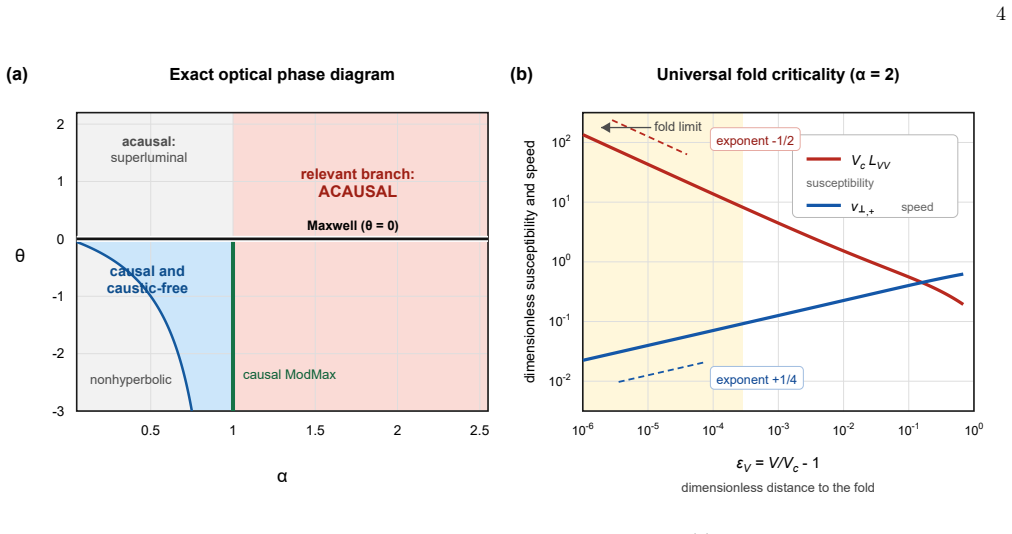
We construct an exact power-law family of nonlinear electrodynamics preserving electromagnetic duality, together with a parallel two-dimensional Lax-integrable realization. Its auxiliary geometry yields the full characteristic-cone phase diagram and a universal finite-energy fold. For the Maxwell seed, every nonzero relevant branch is acausal, whereas every causal branch is caustic-free; undeformed Maxwell theory is the only causal point in the relevant regime.
What carries the argument
The auxiliary geometry attached to the power-law family, which supplies the complete characteristic-cone phase diagram and thereby fixes causality properties for each deformation branch.
If this is right
- Every nonzero relevant branch of the family is acausal.
- Every causal branch remains caustic-free.
- Undeformed Maxwell theory is the sole causal point inside the relevant regime.
- The auxiliary geometry produces a universal finite-energy fold for the family.
- A parallel two-dimensional Lax-integrable realization exists alongside the four-dimensional theory.
Where Pith is reading between the lines
- Causality may act as a strong selector among possible nonlinear extensions that preserve duality.
- The auxiliary-geometry technique could be reused on other seed theories to test similar no-go statements.
- Exact solvability of the power-law family opens the possibility of closed-form wave solutions that can be checked for superluminal modes.
- The result indicates that relevant flows away from Maxwell theory generically violate causality when duality is kept.
Load-bearing premise
The power-law family exhausts every relevant duality-preserving stress-tensor deformation and the auxiliary geometry completely determines the characteristic cones that control causality.
What would settle it
An explicit construction or numerical check that produces causal propagation for any nonzero value of the relevant deformation parameter in the power-law family would falsify the no-go statement.
Figures
read the original abstract
Can a classically relevant stress-tensor deformation be exactly solvable, duality preserving, and physically causal? We construct an exact power-law family of nonlinear electrodynamics preserving electromagnetic duality, together with a parallel two-dimensional Lax-integrable realization. Its auxiliary geometry yields the full characteristic-cone phase diagram and a universal finite-energy fold. For the Maxwell seed, every nonzero relevant branch is acausal, whereas every causal branch is caustic-free; undeformed Maxwell theory is the only causal point in the relevant regime.
Editorial analysis
A structured set of objections, weighed in public.
Referee Report
Summary. The paper constructs an exact power-law family of nonlinear electrodynamics that preserves electromagnetic duality, together with a parallel two-dimensional Lax-integrable realization. Its auxiliary geometry supplies the full characteristic-cone phase diagram and a universal finite-energy fold. For the Maxwell seed, the analysis concludes that every nonzero relevant branch is acausal while every causal branch is caustic-free, so that undeformed Maxwell theory is the only causal point in the relevant regime.
Significance. If the central no-go holds, the result is significant: it supplies an exactly solvable, duality-preserving family of relevant deformations together with a geometric criterion for causality, showing that the only causal point in the relevant regime is the undeformed Maxwell theory. The exact power-law construction, the Lax-integrable realization, and the auxiliary-geometry phase diagram constitute concrete, reusable tools for the study of stress-tensor flows in nonlinear electrodynamics.
minor comments (2)
- [Introduction] The abstract and introduction would benefit from a brief statement of the precise definition of 'relevant' used throughout (e.g., the scaling dimension or the form of the stress-tensor deformation).
- [Section 3] Notation for the auxiliary geometry and the characteristic cones should be introduced once with a single table or diagram that collects all symbols.
Simulated Author's Rebuttal
We thank the referee for their positive assessment of the manuscript and for recommending acceptance.
Circularity Check
No significant circularity in derivation chain
full rationale
The paper constructs an explicit power-law family of duality-preserving nonlinear electrodynamics from a Maxwell seed, derives the auxiliary geometry, and computes the characteristic cones and causality properties directly from that geometry. The central no-go result (only undeformed Maxwell remains causal in the relevant regime) is obtained by classifying branches within the constructed family; it does not reduce to a self-definition, a fitted parameter renamed as prediction, or a load-bearing self-citation. The derivation is self-contained against the stated assumptions and the explicit Lax-integrable realization, with no quoted step where an output is forced by construction to equal its input.
Axiom & Free-Parameter Ledger
axioms (1)
- domain assumption Electromagnetic duality is preserved by the deformation family
Reference graph
Works this paper leans on
-
[1]
F. A. Smirnov and A. B. Zamolodchikov, On space of integrable quantum field theories, Nucl. Phys. B915, 363 (2017), arXiv:1608.05499 [hep-th]
Pith/arXiv arXiv 2017
-
[2]
A. Cavaglià, S. Negro, I. M. Szécsényi, and R. Tateo,T¯T- deformed 2D Quantum Field Theories, JHEP10, 112, arXiv:1608.05534 [hep-th]
-
[3]
Jiang, A pedagogical review on solvable irrelevant de- formations of 2D quantum field theory, Commun
Y. Jiang, A pedagogical review on solvable irrelevant de- formations of 2D quantum field theory, Commun. Theor. Phys.73, 057201 (2021), arXiv:1904.13376 [hep-th]
arXiv 2021
-
[4]
S. He, Y. Li, H. Ouyang, and Y. Sun,TTdeformation: Introduction and some recent advances, Sci. China Phys. Mech. Astron.68, 101001 (2025), arXiv:2503.09997 [hep- th]
arXiv 2025
-
[5]
R.Conti, L.Iannella, S.Negro,andR.Tateo,Generalised Born-Infeld models, Lax operators and theTTperturba- tion, JHEP11, 007, arXiv:1806.11515 [hep-th]
-
[6]
H. Babaei-Aghbolagh, K. Babaei Velni, D. M. Yekta, and H. Mohammadzadeh,T T-like flows in non-linear electrodynamic theories and S-duality, JHEP04, 187, arXiv:2012.13636 [hep-th]
arXiv 2012
-
[7]
Tateo, TT¯-like Flows of Yang-Mills Theories, Phys
C.Ferko, J.Hou, T.Morone, G.Tartaglino-Mazzucchelli, and R. Tateo, TT¯-like Flows of Yang-Mills Theories, Phys. Rev. Lett.134, 101603 (2025), arXiv:2409.18740 [hep-th]
arXiv 2025
- [8]
-
[9]
H. Babaei-Aghbolagh, K. B. Velni, D. M. Yekta, and H. Mohammadzadeh, Emergence of non-linear electrody- namic theories from TT¯-like deformations, Phys. Lett. B829, 137079 (2022), arXiv:2202.11156 [hep-th]
arXiv 2022
- [10]
- [11]
-
[12]
H. Babaei-Aghbolagh, B. Chen, and S. He, Root-TT¯ flows unify 4D duality-invariant electrodynamics and 2D integrable sigma models, Phys. Rev. D112, L101702 (2025), arXiv:2507.22808 [hep-th]
arXiv 2025
-
[13]
H. Babaei-Aghbolagh, B. Chen, and S. He, Inte- grable sigma models and universal rootT Tdefor- mation via Courant-Hilbert approach, JHEP01, 108, arXiv:2509.17075 [hep-th]
-
[14]
M. K. Gaillard and B. Zumino, Duality Rotations for Interacting Fields, Nucl. Phys. B193, 221 (1981)
1981
-
[15]
G. W. Gibbons and D. A. Rasheed, Electric - magnetic duality rotations in nonlinear electrodynamics, Nucl. Phys. B454, 185 (1995), arXiv:hep-th/9506035
Pith/arXiv arXiv 1995
-
[16]
D. P. Sorokin, Introductory Notes on Non-linear Elec- trodynamics and its Applications, Fortsch. Phys.70, 2200092 (2022), arXiv:2112.12118 [hep-th]
arXiv 2022
-
[17]
R. Borsato, C. Ferko, and A. Sfondrini, Classical inte- grability of root-TT¯flows, Phys. Rev. D107, 086011 (2023), arXiv:2209.14274 [hep-th]
arXiv 2023
- [18]
-
[19]
J. G. Russo and P. K. Townsend, Dualities of self-dual nonlinear electrodynamics, JHEP09, 107, arXiv:2407.02577 [hep-th]
-
[20]
J.G.RussoandP.K.Townsend,Simplifiedself-dualelec- trodynamics, JHEP10, 120, arXiv:2505.08869 [hep-th]
-
[21]
J. G. Russo and P. K. Townsend, Causal self-dual electrodynamics, Phys. Rev. D109, 105023 (2024), arXiv:2401.06707 [hep-th]
arXiv 2024
-
[22]
J. G. Russo and P. K. Townsend, Causality and energy conditions in nonlinear electrodynamics, JHEP06, 191, arXiv:2404.09994 [hep-th]
-
[23]
J. G. Russo and P. K. Townsend, Black holes and causal nonlinear electrodynamics, arXiv e-prints (2026), arXiv:2601.07789 [hep-th]
Pith/arXiv arXiv 2026
-
[24]
S. M. Kuzenko and J. Ruhl, Causal self-dual nonlinear electrodynamics from the Born-Infeld theory, arXiv e- prints (2026), arXiv:2605.06193 [hep-th]
Pith/arXiv arXiv 2026
-
[25]
S. Murk and I. Soranidis, Light rings and causality for nonsingular ultracompact objects sourced by nonlin- ear electrodynamics, Phys. Rev. D110, 044064 (2024), arXiv:2406.07957 [gr-qc]
arXiv 2024
-
[26]
S. Rychkov,EPFL Lectures on Conformal Field The- ory in D>= 3 Dimensions, SpringerBriefs in Physics (Springer, 2017) arXiv:1601.05000 [hep-th]. 7 END MATTER The following appendices provide the specialist deriva- tions cited at their points of use in the Letter. Appendix A resolves the auxiliary geometry, response eigenmodes, full Fresnel cones, Hamiltoni...
Pith/arXiv arXiv 2017
discussion (0)
Sign in with ORCID, Apple, or X to comment. Anyone can read and Pith papers without signing in.