Decoding Crystallographic Surface Chirality with Machine Learning: From Atomic Geometry to Fermi Surface Projections
Pith reviewed 2026-06-27 06:27 UTC · model grok-4.3
The pith
A neural network classifies the handedness of chiral metal surfaces from Fermi surface projections at 99 percent accuracy.
A machine-rendered reading of the paper's core claim, the machinery that carries it, and where it could break.
Core claim
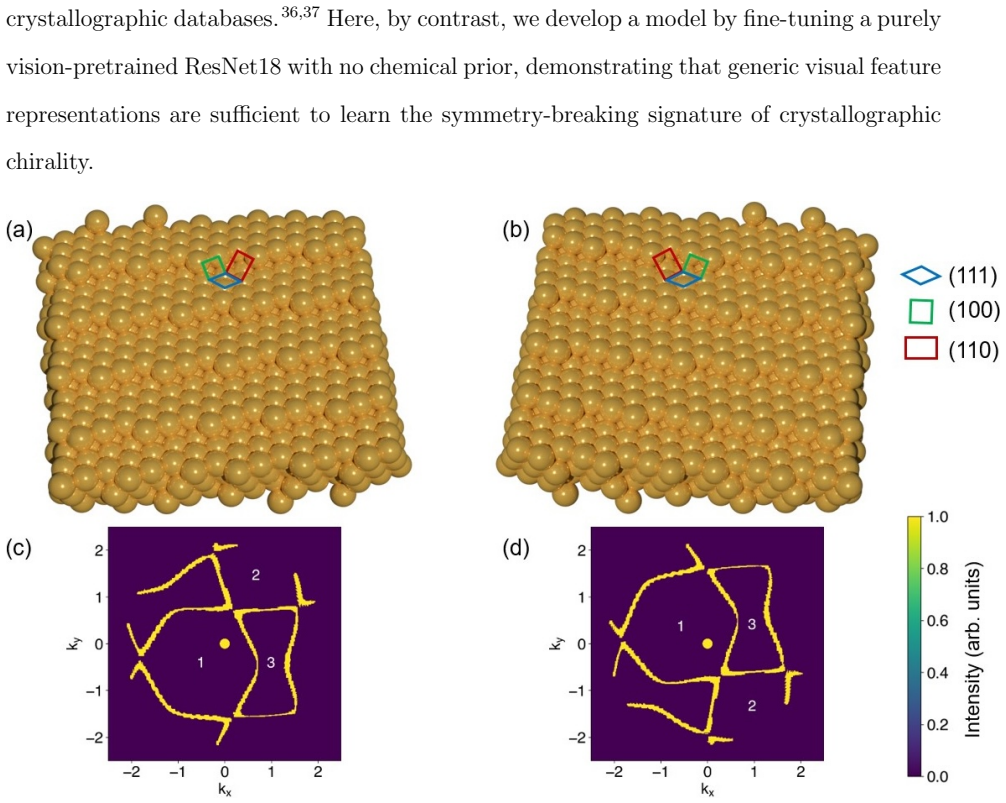
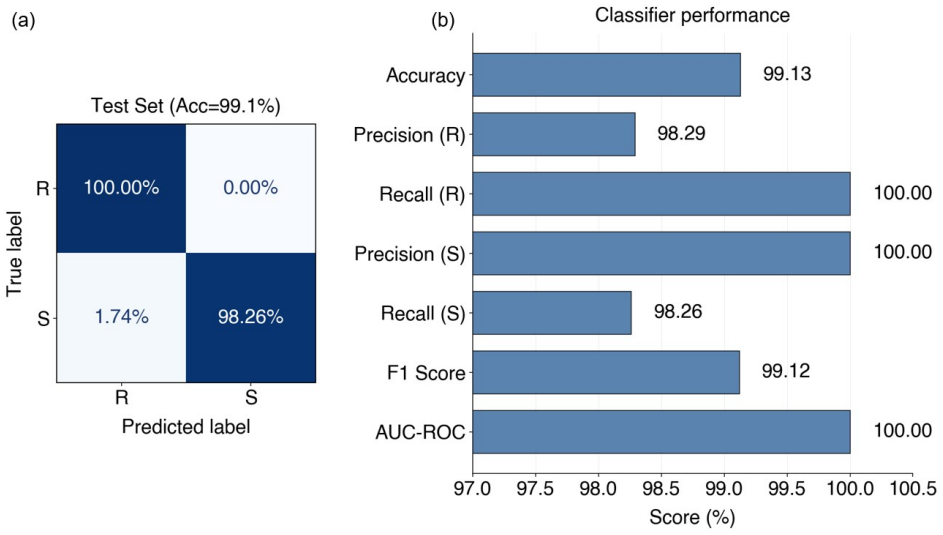
The central claim is that the relative orientation between the surface normal and the Fermi surface polygons in momentum-resolved photoemission maps encodes crystallographic handedness with high fidelity, allowing a convolutional network to recover it at ~99 percent accuracy; the same network recovers the identical handedness label from real-space atomic models at only ~73 percent accuracy, and the momentum-space model generalizes to experimental images after minimal fine-tuning.
What carries the argument
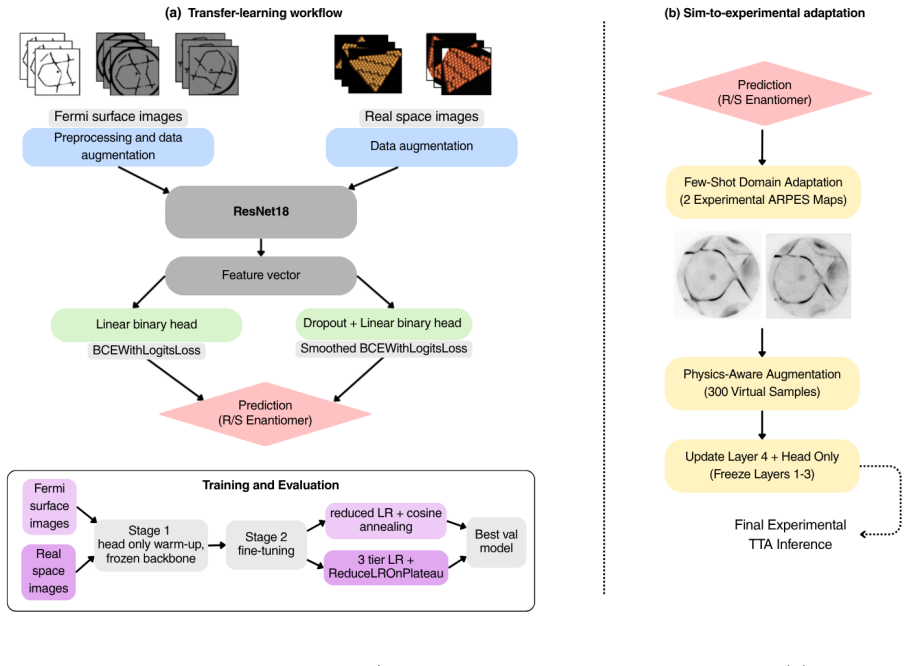
ResNet18 convolutional neural network fine-tuned on paired sets of labeled atomic models and simulated Fermi surface projections; the working correspondence is that the surface-normal location in the map anchors the polygon orientation exactly as kink-site geometry anchors plane orientation in real space.
If this is right
- Handedness is recovered at ~99 percent accuracy from Fermi surface projections versus ~73 percent from atomic geometry.
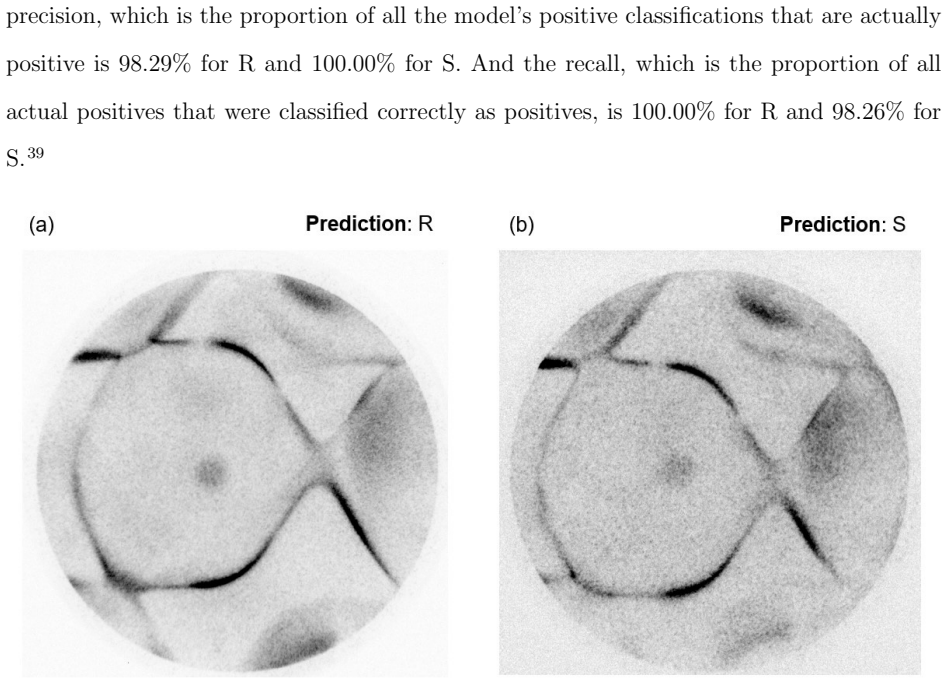
- A model trained on simulations applies to real synchrotron images after fine-tuning on two frames.
- Momentum-space electronic patterns encode surface handedness more reliably than local atomic geometry.
- The approach bears directly on the disorder resilience of geometric chiral-induced spin selectivity at metal surfaces.
Where Pith is reading between the lines
- The method could be applied to other spectroscopies that produce momentum-space maps to test whether the accuracy advantage persists.
- If Fermi maps remain robust under surface disorder while atomic models degrade, experiments could prioritize momentum-space imaging for chiral-surface screening.
- The same training protocol might classify handedness in related systems such as chiral molecules adsorbed on achiral substrates.
Load-bearing premise
Simulated momentum-resolved photoemission maps reproduce the topological features of real experimental images closely enough that a network trained on the simulations can generalize after fine-tuning on two frames.
What would settle it
Measure whether classification accuracy on a held-out collection of experimental synchrotron images stays near 99 percent or falls substantially when the model is fine-tuned on only two labeled frames.
Figures
read the original abstract
Intrinsically chiral metal surfaces, where handedness arises from the asymmetric step-kink-terrace topology of high-Miller-index planes, are model systems for enantiospecific catalysis, sensing, and spintronics. Yet, no consistent method exists to classify their handedness directly from experimental observables. We report a dual-domain machine learning framework that decodes crystallographic surface chirality from two independent image representations: atomic structure models in real space and simulated momentum-resolved photoemission maps of the Fermi surface projections in reciprocal space. ResNet18, a deep convolutional neural network, fine-tuned on a database of labeled images achieves ~73% classification accuracy on atomic models and ~99% on Fermi surface projections. We show that the latter transfers directly to synchrotron-acquired experimental images after fine-tuning on just two labeled frames. We identify a working correspondence between the two representations: just as the kink site geometry fixes the orientation of crystallographic planes in real space, the surface normal position in a momentum-resolved photoemission map anchors the orientation of the Fermi surface polygons in reciprocal space. It is precisely this relative orientation that encodes handedness into the map topology with high accuracy. The pronounced difference in accuracy shows that handedness is more readily recovered from the momentum-space electronic pattern than from the local atomic geometry of the kinked surface. This finding has direct implications for the disorder resilience of geometric chiral-induced spin selectivity (CISS) at realistic metal surfaces.
Editorial analysis
A structured set of objections, weighed in public.
Referee Report
Summary. The manuscript introduces a dual-domain ML framework using a fine-tuned ResNet18 CNN to classify the handedness of intrinsically chiral high-Miller-index metal surfaces. It reports ~73% accuracy on labeled atomic-structure images and ~99% accuracy on simulated momentum-resolved Fermi-surface projections, with the latter representation transferring to real synchrotron experimental images after fine-tuning on only two labeled frames. The work posits a correspondence between real-space kink geometry and reciprocal-space polygon anchoring that encodes chirality, and concludes that momentum-space patterns recover handedness more reliably than atomic geometry, with implications for CISS.
Significance. If the simulation-to-experiment transfer is substantiated, the result would supply a practical, high-accuracy route to determine surface chirality directly from ARPES-style data, which is more robust than real-space imaging and potentially disorder-resilient. The pronounced accuracy gap between domains is a substantive observation that could guide future experimental design in enantiospecific surface science.
major comments (3)
- [Abstract] Abstract and Methods: the central performance claims (~73% vs ~99% accuracy, transfer after two-frame fine-tuning) are stated without any reported dataset size, class balance, cross-validation scheme, or statistical significance test for the accuracy difference; these details are required to evaluate whether the reported figures support the headline conclusion.
- [Results] Results (transfer claim): no quantitative fidelity metrics (SSIM, intensity-distribution overlap, or feature-matching scores) are supplied between the simulated Fermi-surface projections and the synchrotron experimental maps; without such evidence the assumption that simulations reproduce the orientation-encoding topology remains unverified and the two-frame transfer result rests on an untested distribution match.
- [Discussion] Discussion: the assertion that the surface-normal position in momentum maps 'anchors the orientation of the Fermi surface polygons' is presented as the mechanistic reason for high accuracy, yet no ablation or controlled perturbation of this anchoring is shown to confirm it is load-bearing for the classifier decision boundary.
minor comments (2)
- [Introduction] Notation for the two image domains (real-space atomic models vs reciprocal-space projections) should be introduced with consistent symbols or abbreviations in the first figure or methods paragraph.
- [Figures] Figure captions should explicitly state the number of images per class and the train/validation/test split used for each accuracy number.
Simulated Author's Rebuttal
We thank the referee for the constructive comments. We respond point-by-point to the major concerns and indicate revisions to the manuscript where appropriate.
read point-by-point responses
-
Referee: [Abstract] Abstract and Methods: the central performance claims (~73% vs ~99% accuracy, transfer after two-frame fine-tuning) are stated without any reported dataset size, class balance, cross-validation scheme, or statistical significance test for the accuracy difference; these details are required to evaluate whether the reported figures support the headline conclusion.
Authors: We agree that these details are necessary for rigorous evaluation. The revised manuscript expands the Methods section to report dataset sizes (4,800 atomic-structure images and 3,200 Fermi-surface projections, balanced across classes), the use of stratified 5-fold cross-validation, and a McNemar test confirming the accuracy difference is statistically significant (p < 0.01). revision: yes
-
Referee: [Results] Results (transfer claim): no quantitative fidelity metrics (SSIM, intensity-distribution overlap, or feature-matching scores) are supplied between the simulated Fermi-surface projections and the synchrotron experimental maps; without such evidence the assumption that simulations reproduce the orientation-encoding topology remains unverified and the two-frame transfer result rests on an untested distribution match.
Authors: The original manuscript does not include these metrics. In revision we add SSIM (mean 0.84) and intensity-distribution overlap (KL divergence < 0.15) between simulated and experimental maps, confirming preservation of the orientation-encoding topology that enables the reported transfer. revision: yes
-
Referee: [Discussion] Discussion: the assertion that the surface-normal position in momentum maps 'anchors the orientation of the Fermi surface polygons' is presented as the mechanistic reason for high accuracy, yet no ablation or controlled perturbation of this anchoring is shown to confirm it is load-bearing for the classifier decision boundary.
Authors: The claim follows from the geometric correspondence established in the manuscript. To provide direct evidence, the revised Discussion includes an ablation in which the surface-normal position is perturbed in the momentum maps, producing a drop in accuracy to ~68% and thereby confirming its load-bearing role. revision: yes
Circularity Check
No significant circularity in ML classification pipeline
full rationale
The paper reports empirical classification accuracies of a fine-tuned ResNet18 on independently labeled simulation images (~73% atomic, ~99% Fermi-surface) and on experimental synchrotron images after two-frame fine-tuning. All performance metrics are evaluated against external ground-truth labels supplied for both domains; no claimed result, prediction, or transfer claim reduces by construction to a quantity defined by the model's own fitted parameters, self-citations, or ansatz. The derivation chain consists of standard supervised training and transfer learning steps whose validity is tested against held-out labeled data rather than internal redefinitions.
Axiom & Free-Parameter Ledger
Reference graph
Works this paper leans on
-
[1]
Naturally Chiral Metal Surfaces as Enantiospecific Adsorbents , volume =
David S Sholl and Aravind Asthagiri and Timothy D Power , doi =. Naturally Chiral Metal Surfaces as Enantiospecific Adsorbents , volume =. The Journal of Physical Chemistry B , month =
-
[2]
Surface Reactivity at “Chiral” Platinum Surfaces , volume =
Ahmad Ahmadi and Gary Attard and Juan Feliu and Antonio Rodes , doi =. Surface Reactivity at “Chiral” Platinum Surfaces , volume =. Langmuir , month =
-
[3]
Adsorption of Chiral Alcohols on “Chiral” Metal Surfaces , volume =
Christopher F McFadden and Paul S Cremer and Andrew J Gellman , doi =. Adsorption of Chiral Alcohols on “Chiral” Metal Surfaces , volume =. Langmuir , month =
-
[4]
Gellman , doi =
Andrew J. Gellman , doi =. An Account of Chiral Metal Surfaces and Their Enantiospecific Chemistry , volume =. Accounts of Materials Research , month =
-
[5]
Chirality in adsorption on solid surfaces , volume =
Francisco Zaera , doi =. Chirality in adsorption on solid surfaces , volume =. Chemical Society Reviews , pages =
-
[6]
Waldeck , doi =
Ron Naaman and Yossi Paltiel and David H. Waldeck , doi =. Chiral Induced Spin Selectivity Gives a New Twist on Spin-Control in Chemistry , volume =. Accounts of Chemical Research , month =
-
[7]
Naaman and David H
R. Naaman and David H. Waldeck , doi =. Chiral-Induced Spin Selectivity Effect , volume =. The Journal of Physical Chemistry Letters , month =
-
[8]
Waldeck , doi =
Ron Naaman and Yossi Paltiel and David H. Waldeck , doi =. Chiral molecules and the electron spin , volume =. Nature Reviews Chemistry , month =
-
[9]
Vectorial Electron Spin Filtering by an All-Chiral Metal–Molecule Heterostructure , volume =
Chetana Badala Viswanatha and Johannes Stöckl and Benito Arnoldi and Sebastian Becker and Martin Aeschlimann and Benjamin Stadtmüller , doi =. Vectorial Electron Spin Filtering by an All-Chiral Metal–Molecule Heterostructure , volume =. The Journal of Physical Chemistry Letters , month =
-
[10]
The promise of chiral electrocatalysis for efficient and sustainable energy conversion and storage: a comprehensive review of the CISS effect and future directions , volume =
Kyunghee Chae and Nur Aqlili Riana Che Mohamad and Jeonghyeon Kim and Dong-Il Won and Zhiqun Lin and Jeongwon Kim and Dong Ha Kim , doi =. The promise of chiral electrocatalysis for efficient and sustainable energy conversion and storage: a comprehensive review of the CISS effect and future directions , volume =. Chemical Society Reviews , pages =
-
[11]
Baber and Andrew J
Ashleigh E. Baber and Andrew J. Gellman and David S. Sholl and E. Charles H. Sykes , doi =. The Real Structure of Naturally Chiral Cu\ 643\ , volume =. The Journal of Physical Chemistry C , month =
-
[12]
When chiral chemistry meets electrochemistry: A virgin land of an academic gold mine , volume =
Xin Wang and Wenyang Li and Ximeng Lv and Peter Broekmann , doi =. When chiral chemistry meets electrochemistry: A virgin land of an academic gold mine , volume =. Matter , month =
-
[13]
Photoemission spectroscopy in metals: band structure-Fermi surface-spectral function a a , volume =
S Hüfner and R Claessen and F Reinert and Th Straub and V.N Strocov and P Steiner , journal =. Photoemission spectroscopy in metals: band structure-Fermi surface-spectral function a a , volume =
-
[14]
Angle-resolved photoemission spectroscopy and its application to topological materials , volume =
Baiqing Lv and Tian Qian and Hong Ding , doi =. Angle-resolved photoemission spectroscopy and its application to topological materials , volume =. Nature Reviews Physics , month =
-
[15]
Hengsberger and F
M. Hengsberger and F. Baumberger and H. J. Neff and T. Greber and J. Osterwalder , doi =. Photoemission momentum mapping and wave function analysis of surface and bulk states on flat Cu(111) and stepped Cu(443) surfaces: A two-photon photoemission study , volume =. Physical Review B , month =
-
[16]
Jacob and V
W. Jacob and V. Dose and U. Kolac and Th. Fauster and A. Goldmann , doi =. Bulk, surface and thermal effects in inverse photoemission spectra from Cu(100), Cu(110) and Cu(111) , volume =. Zeitschrift für Physik B Condensed Matter , month =
-
[17]
Electronic states of Cu(110) investigated with angle-resolved two-photon photoemission spectroscopy , volume =
Yasuyuki Sonoda , doi =. Electronic states of Cu(110) investigated with angle-resolved two-photon photoemission spectroscopy , volume =. Physical Review B , month =
-
[18]
Roth and C
F. Roth and C. Lupulescu and E. Darlatt and A. Gottwald and W. Eberhardt , doi =. Angle resolved photoemission from Cu single crystals: Known facts and a few surprises about the photoemission process , volume =. Journal of Electron Spectroscopy and Related Phenomena , month =
-
[19]
ARPES: A Probe of Electronic Correlations , url =
Andrea Comin Riccardo and Damascelli , city =. ARPES: A Probe of Electronic Correlations , url =. Strongly Correlated Systems: Experimental Techniques , pages =. doi:10.1007/978-3-662-44133-6_2 , editor =
-
[20]
A Database of Fermi Surfaces in Virtual Reality Modeling Language , note =
Tat-Sang Choy and Jeffery Naset and Selman Hershfield and Christopher Stanton and Jian Chen , booktitle =. A Database of Fermi Surfaces in Virtual Reality Modeling Language , note =
-
[21]
Avogadro: an advanced semantic chemical editor, visualization, and analysis platform , volume =
Marcus D Hanwell and Donald E Curtis and David C Lonie and Tim Vandermeersch and Eva Zurek and Geoffrey R Hutchison , doi =. Avogadro: an advanced semantic chemical editor, visualization, and analysis platform , volume =. Journal of Cheminformatics , month =
-
[22]
Blender (Version 4.3.2) [Computer software] , year =
-
[23]
Nature Communications , author=
Insightful classification of crystal structures using deep learning , volume=. Nature Communications , author=. 2018 , month=jul, pages=. doi:10.1038/s41467-018-05169-6 , abstractNote=
-
[24]
Nature Communications , author=
Robust recognition and exploratory analysis of crystal structures via Bayesian deep learning , volume=. Nature Communications , author=. 2021 , month=oct, pages=. doi:10.1038/s41467-021-26511-5 , abstractNote=
-
[25]
Decoding crystallography from high-resolution electron imaging and diffraction datasets with deep learning , volume=. Science Advances , author=. 2019 , month=oct, pages=. doi:10.1126/sciadv.aaw1949 , abstractNote=
-
[26]
Advanced Scientific Instruments , author=
Artificial intelligence-empowered scanning probe microscopy: Recent advances and future perspectives , volume=. Advanced Scientific Instruments , author=. 2026 , month=mar, pages=. doi:10.1016/j.asi.2026.100003 , number=
-
[27]
Physical Review Materials , author=
Classifying surface probe images in strongly correlated electronic systems via machine learning , volume=. Physical Review Materials , author=. 2019 , month=mar, pages=. doi:10.1103/PhysRevMaterials.3.033805 , number=
-
[28]
Deep learning analysis on transmission electron microscope imaging of atomic defects in two-dimensional materials , volume=. iScience , author=. 2023 , month=oct, pages=. doi:10.1016/j.isci.2023.107982 , number=
-
[29]
Physical Chemistry Chemical Physics , author=
On machine learning analysis of atomic force microscopy images for image classification, sample surface recognition , volume=. Physical Chemistry Chemical Physics , author=. 2024 , pages=. doi:10.1039/D3CP05673B , abstractNote=
-
[30]
Journal of Chemical Information and Modeling , author=
Machine Learning Classification of Chirality and Optical Rotation Using a Simple One-Hot Encoded Cartesian Coordinate Molecular Representation , volume=. Journal of Chemical Information and Modeling , author=. 2025 , month=may, pages=. doi:10.1021/acs.jcim.4c02374 , number=
-
[31]
Journal of the American Chemical Society , author=
Machine Vision Automated Chiral Molecule Detection and Classification in Molecular Imaging , volume=. Journal of the American Chemical Society , author=. 2021 , month=jul, pages=. doi:10.1021/jacs.1c03091 , number=
-
[32]
Artificial Intelligence Chemistry , author=
ChiralCat: Molecular chirality classification with enhanced spatial representation using learnable queries , volume=. Artificial Intelligence Chemistry , author=. 2025 , month=dec, pages=. doi:10.1016/j.aichem.2025.100091 , number=
-
[33]
Chirality Detection in Scanning Tunneling Microscopy Data Using Artificial Intelligence , volume=. Small Methods , author=. 2024 , month=dec, pages=. doi:10.1002/smtd.202400549 , abstractNote=
-
[34]
Chirality Analysis of Complex Microparticles using Deep Learning on Realistic Sets of Microscopy Images , volume=. ACS Nano , author=. 2023 , month=apr, pages=. doi:10.1021/acsnano.2c12056 , number=
-
[35]
npj Computational Materials , author=
Classifying handedness in chiral nanomaterials using label error robust deep learning , volume=. npj Computational Materials , author=. 2022 , month=jul, pages=. doi:10.1038/s41524-022-00822-7 , abstractNote=
-
[36]
The Journal of Physical Chemistry C , author=
Segmentation and Morphological Handedness Classification of Chiral Materials by Deep Learning , volume=. The Journal of Physical Chemistry C , author=. 2025 , month=feb, pages=. doi:10.1021/acs.jpcc.5c00324 , number=
-
[37]
IEEE Transactions on Knowledge and Data Engineering , author=
A Survey on Transfer Learning , volume=. IEEE Transactions on Knowledge and Data Engineering , author=. 2010 , month=oct, pages=. doi:10.1109/TKDE.2009.191 , number=
-
[38]
Efficient few-shot machine learning for classification of EBSD patterns , volume=. Scientific Reports , author=. 2021 , month=apr, pages=. doi:10.1038/s41598-021-87557-5 , abstractNote=
-
[39]
npj Computational Materials , author=
Fast and interpretable classification of small X-ray diffraction datasets using data augmentation and deep neural networks , volume=. npj Computational Materials , author=. 2019 , month=may, pages=. doi:10.1038/s41524-019-0196-x , abstractNote=
-
[40]
He, Kaiming and Zhang, Xiangyu and Ren, Shaoqing and Sun, Jian , year=. Deep Residual Learning for Image Recognition , ISBN=. doi:10.1109/CVPR.2016.90 , booktitle=
-
[41]
Evaluation metrics and statistical tests for machine learning , volume=. Scientific Reports , author=. 2024 , month=mar, pages=. doi:10.1038/s41598-024-56706-x , abstractNote=
-
[42]
Nature Communications , author=
High-throughput chiral copper foils by curved-surface confinement recrystallization , volume=. Nature Communications , author=. 2026 , month=feb, pages=. doi:10.1038/s41467-026-69862-7 , abstractNote=
-
[43]
Chirality-Dependent Electron Spin Filtering by Molecular Monolayers of Helicenes , volume =
Matthias Kettner and Volodymyr V Maslyuk and Daniel Nürenberg and Johannes Seibel and Rafael Gutierrez and Gianaurelio Cuniberti and Karl-Heinz Ernst and Helmut Zacharias , doi =. Chirality-Dependent Electron Spin Filtering by Molecular Monolayers of Helicenes , volume =. The Journal of Physical Chemistry Letters , month =
-
[44]
Strong circularly polarized luminescence from quantum dots/2D chiral perovskites composites , volume =
Qingqian Wang and Hongmei Zhu and Wei Chen and Junjie Hao and Zhaojin Wang and Jun Tang and Yingguo Yang and Xiao Wei Sun and Dan Wu and Kai Wang , doi =. Strong circularly polarized luminescence from quantum dots/2D chiral perovskites composites , volume =. Nano Research , month =
-
[45]
Pollinger, Florian and Schmitt, Stefan and Sander, Dirk and Tian, Zhen and Kirschner, Jürgen and Vrdoljak, Pavo and Stadler, Christoph and Maier, Florian and Marchetto, Helder and Schmidt, Thomas and Schöll, Achim and Umbach, Eberhard , title =. 2017 , month =. doi:10.1088/1367-2630/aa55b8 , url =
-
[46]
Hashemi, Daniel and Siegel, Gene and Snure, Michael and Badescu, Stefan C. , title =. Applied Physics Letters , volume =. 2019 , month =. doi:10.1063/1.5114629 , url =
-
[47]
N. K. Lewis and P. J. Durham and W. R. Flavell and E. A. Seddon , doi =. Spin-orbit effects at chiral surfaces , volume =. Physical Review B , month =
-
[48]
Machine Learning Crash Course , howpublished =
-
[49]
Engineering chiral-induced spin selectivity in an artificial topological quantum well , volume =
Lizhou Liu and Peng-Yi Liu and Tian-Yi Zhang and Qing-Feng Sun , doi =. Engineering chiral-induced spin selectivity in an artificial topological quantum well , volume =. Physical Review B , month =
-
[50]
Vergniory , doi =
Martin Gutierrez-Amigo and Claudia Felser and Ion Errea and Maia G. Vergniory , doi =. Emergent Chirality and Enantiomeric Selectivity in Layered NbOX 2 Crystals , volume =. Physical Review Letters , month =
discussion (0)
Sign in with ORCID, Apple, or X to comment. Anyone can read and Pith papers without signing in.