Real-time quantification of fluid flows around bubbles during directional solidification
Pith reviewed 2026-06-27 05:39 UTC · model grok-4.3
The pith
Volumetric expansion drives fluid flows around bubbles during solidification while Marangoni flows remain negligible.
A machine-rendered reading of the paper's core claim, the machinery that carries it, and where it could break.
Core claim
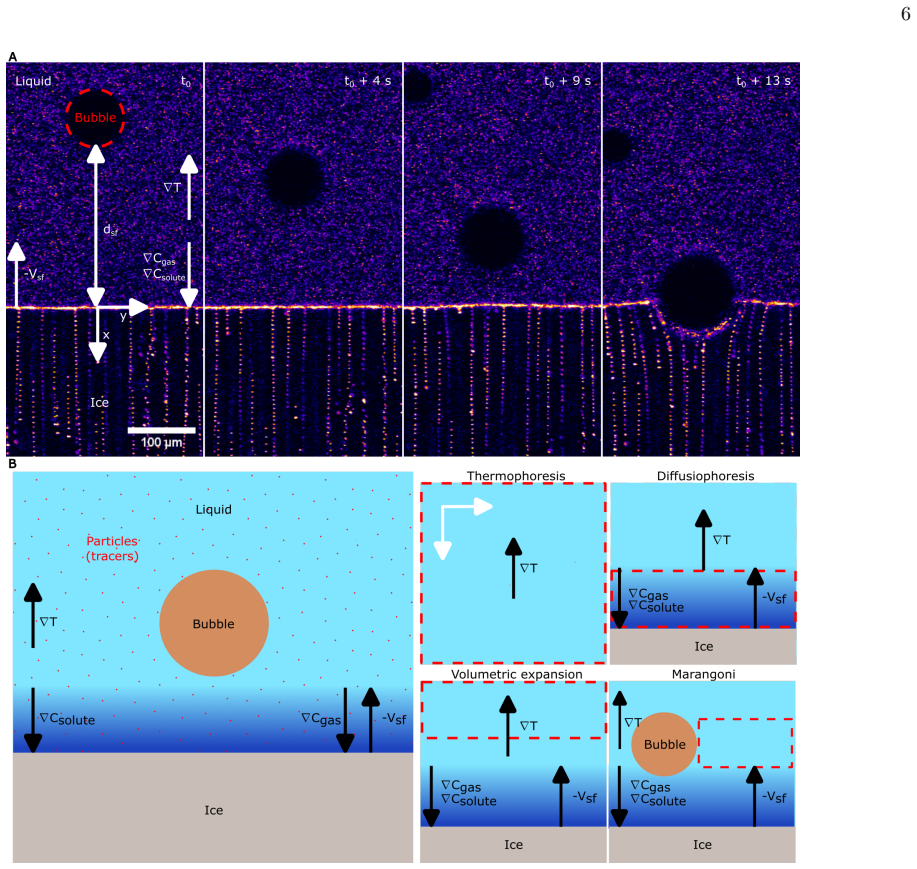
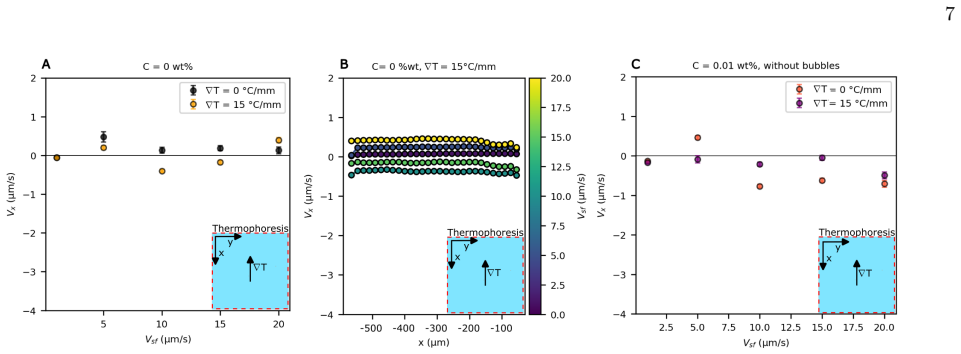
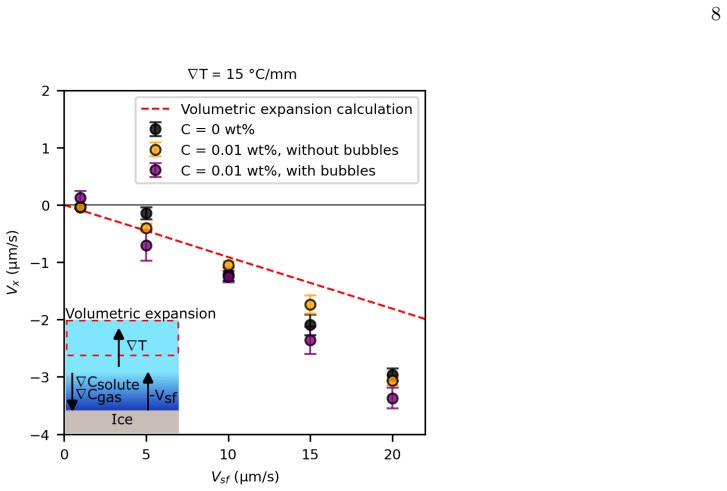
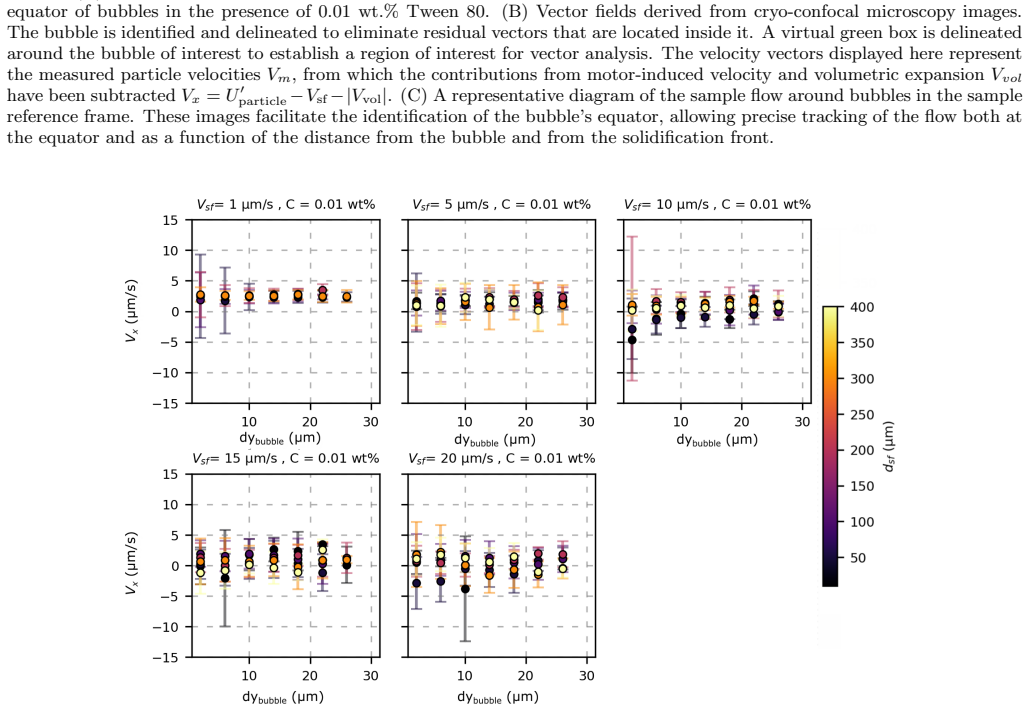
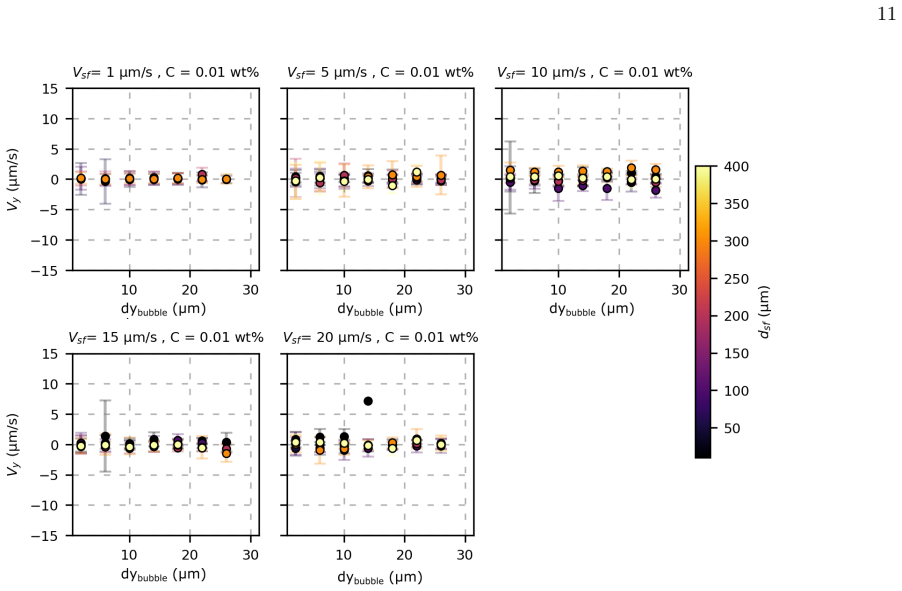
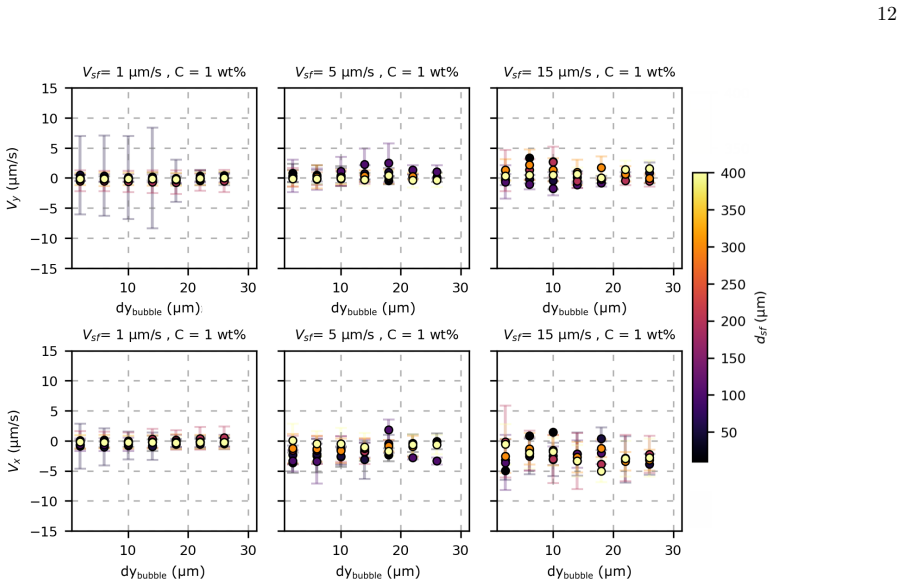
Using cryo-confocal microscopy and particle image velocimetry on water with surfactants and tracers, the authors show that fluid velocities around bubbles scale linearly with solidification rate between 1 and 20 micrometers per second and are produced by the volumetric expansion of the freezing front; Marangoni flows hypothesized in prior models stay below 5 micrometers per second and therefore play no measurable role under these conditions.
What carries the argument
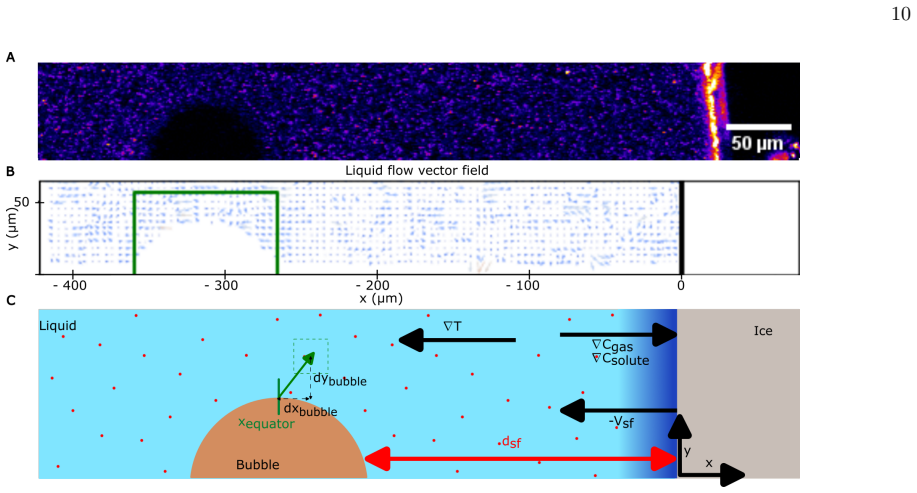
Particle image velocimetry applied to tracer particles imaged by cryo-confocal microscopy, used to map velocity fields around individual bubbles as the solidification front advances.
If this is right
- Bubble trapping or migration in solidified materials is governed primarily by the solidification rate rather than temperature or concentration gradients at the bubble surface.
- Process models for directional solidification must incorporate volumetric expansion as the leading term when predicting bubble positions.
- Marangoni, diffusiophoresis, and thermophoresis contributions can be neglected when designing freezing protocols in the 1-20 micrometer-per-second range.
- Adjusting the front speed offers a direct lever for controlling bubble distribution without needing surface-active additives.
Where Pith is reading between the lines
- The same volumetric-expansion mechanism may dominate in other aqueous or organic systems used for tissue cryopreservation or metal casting.
- If the linear scaling holds at higher rates, industrial processes could use front speed as a single parameter to tune porosity without additional chemistry.
- Extending the measurements to non-planar fronts or confined geometries would test whether the dominance of expansion persists when bubble shape changes.
Load-bearing premise
The tracers and surfactants added to enable imaging do not change the fluid velocities that would exist in the pure system.
What would settle it
Repeat the experiment in surfactant-free water without tracers and observe whether the measured velocities around bubbles remain linearly proportional to solidification rate and stay above 5 micrometers per second.
Figures
read the original abstract
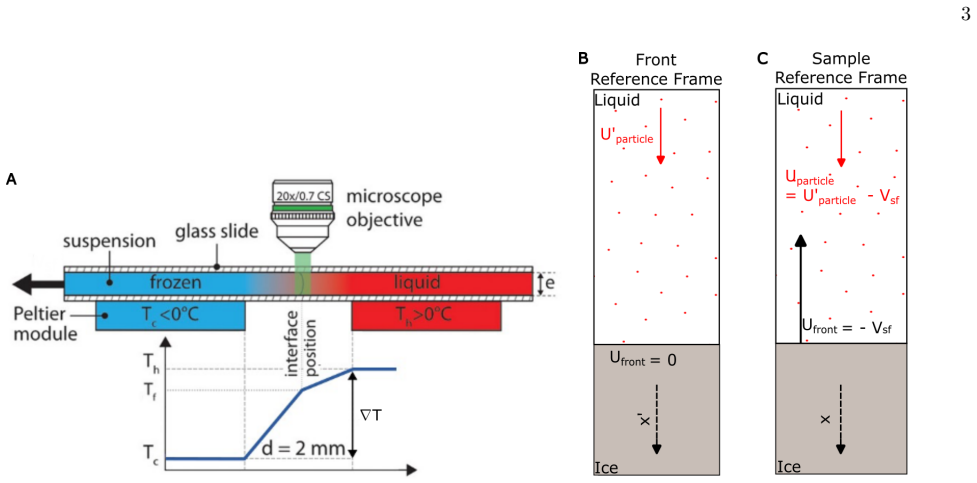
Directional solidification of bubbly liquids plays a critical role in shaping the microstructure and properties of many materials, yet the fluid dynamics governing bubble behavior during solidification remain poorly understood. Using cryo-confocal microscopy and particle image velocimetry, we quantify fluid flows around bubbles during solidification of water containing surfactants and tracers. Our results reveal that volumetric expansion dominates fluid motion, with velocities scaling linearly with the solidification rate (1-20$~\mu m/s$), while Marangoni flows-hypothesized to play a key role-are negligible ($< 5~\mu m/s$) under our experimental conditions. Diffusiophoresis and thermophoresis also contribute minimally. These findings challenge existing theoretical models and provide a framework for controlling bubble distribution in solidified materials
Editorial analysis
A structured set of objections, weighed in public.
Referee Report
Summary. The manuscript reports experimental measurements of fluid flows around bubbles during directional solidification of water using cryo-confocal microscopy combined with particle image velocimetry (PIV). It claims that volumetric expansion due to the phase change dominates the observed flows, producing velocities that scale linearly with solidification rate over 1-20 μm/s, while Marangoni flows are negligible (<5 μm/s) and diffusiophoresis/thermophoresis contribute minimally under the tested conditions. These results are presented as challenging existing theoretical models of bubble behavior in solidification.
Significance. If the measurements accurately isolate the physical mechanisms, the work supplies direct, real-time experimental constraints on flow velocities that could inform models of microstructure formation in solidified materials. The use of confocal PIV in a directional solidification setup represents a useful technical advance for quantifying flows at relevant length and time scales.
major comments (1)
- [Abstract, Methods] Abstract and Methods: The central claim that Marangoni flows are negligible (<5 μm/s) and volumetric expansion is the sole driver rests on PIV velocity fields obtained in the presence of added surfactants and tracers. No control experiments (e.g., surfactant-free or tracer-free runs) or quantitative bounds on possible phoretic/inertial artifacts from the additives are described; a systematic offset of even a few μm/s from these components would undermine the negligibility conclusion and the linear scaling attribution.
minor comments (2)
- [Abstract] The abstract states velocities scale linearly with solidification rate but does not specify the fitting procedure, number of independent runs, or uncertainty on the slope; this detail belongs in the results section.
- [Figures] Figure captions and text should explicitly state the PIV interrogation window size, seeding density, and time interval between frames to allow assessment of spatial and temporal resolution relative to the reported 5 μm/s threshold.
Simulated Author's Rebuttal
We thank the referee for their constructive feedback on our manuscript. We address the concern regarding control experiments and potential artifacts from additives below, and will revise the manuscript to strengthen the presentation of our experimental controls and bounds.
read point-by-point responses
-
Referee: [Abstract, Methods] Abstract and Methods: The central claim that Marangoni flows are negligible (<5 μm/s) and volumetric expansion is the sole driver rests on PIV velocity fields obtained in the presence of added surfactants and tracers. No control experiments (e.g., surfactant-free or tracer-free runs) or quantitative bounds on possible phoretic/inertial artifacts from the additives are described; a systematic offset of even a few μm/s from these components would undermine the negligibility conclusion and the linear scaling attribution.
Authors: We acknowledge that the absence of explicit surfactant-free or tracer-free control experiments represents a limitation in the current manuscript. Surfactants were included to stabilize bubble interfaces and prevent coalescence in the aqueous system, while tracers are required for PIV; performing runs without them would fundamentally alter the experimental conditions and bubble dynamics under study. Nevertheless, the linear scaling of measured velocities with solidification rate (varied independently from 1-20 μm/s) provides evidence against a dominant constant artifact, as any fixed offset from phoretic or inertial effects would not produce the observed proportionality. We will revise the Methods and Discussion sections to add quantitative bounds on possible contributions from the additives, drawing on literature values for the surfactant concentrations and tracer properties used, and to explicitly discuss why these are expected to remain below the reported <5 μm/s threshold for Marangoni flows. This will better support the attribution to volumetric expansion under the tested conditions. revision: yes
Circularity Check
Purely experimental reporting; no derivation chain present
full rationale
The manuscript contains no mathematical model, equations, predictions, or first-principles derivation. All claims rest on direct PIV and microscopy measurements of velocities in the experimental system. No load-bearing step reduces by construction to a fit, self-citation, or input; the work is self-contained as observational reporting.
Axiom & Free-Parameter Ledger
axioms (1)
- domain assumption Cryo-confocal microscopy combined with particle image velocimetry can accurately quantify fluid velocities around bubbles in solidifying liquids.
Reference graph
Works this paper leans on
-
[1]
J. Ahn, M. Headly, M. Wahlen, E. J. Brook, P. A. Mayewski, and K. C. Taylor, Co2 diffusion in polar ice: observations from naturally formed co2 spikes in the siple dome (antarctica) ice core, Journal of Glaciology54, 685 (2008)
2008
-
[2]
A. J. Gow and D. Langston,Growth history of lake ice in relation to its stratigraphic, crystalline and mechanical structure, 77 (Department of Defense, Army, Corps of Engineers, Cold Regions Research and . . . , 1977)
1977
-
[3]
Zhang, Nucleation, growth, transport, and entrapment of inclusions during steel casting, Jom65, 1138 (2013)
L. Zhang, Nucleation, growth, transport, and entrapment of inclusions during steel casting, Jom65, 1138 (2013)
2013
-
[4]
H. Li, E. Ghezal, A. Nehari, G. Alombert-Goget, A. Brenier, and K. Lebbou, Bubbles defects distribution in sapphire bulk crystals grown by czochralski technique, Optical Materials35, 1071 (2013)
2013
-
[5]
Bouaita, G
R. Bouaita, G. Alombert-Goget, E. Ghezal, A. Nehari, O. Benamara, M. Benchiheub, G. Cagnoli, K. Yamamoto, X. Xu, V. Motto-Ros,et al., Seed orientation and pulling rate effects on bubbles and strain distribution on a sapphire crystal grown by the micro-pulling down method, CrystEngComm21, 4200 (2019)
2019
-
[6]
Ghezal, A
E. Ghezal, A. Nehari, K. Lebbou, and T. Duffar, Observation of gas bubble incorporation during micropulling-down growth of sapphire, Crystal growth & design12, 5715 (2012)
2012
-
[7]
Bronstein, Y
V. Bronstein, Y. Itkin, and G. Ishkov, Rejection and capture of cells by ice crystals on freezing aqueous solutions, Journal of Crystal Growth52, 345 (1981)
1981
-
[8]
K¨ orber, Phenomena at the advancing ice–liquid interface: solutes, particles and biological cells, Quarterly reviews of biophysics21, 229 (1988)
C. K¨ orber, Phenomena at the advancing ice–liquid interface: solutes, particles and biological cells, Quarterly reviews of biophysics21, 229 (1988)
1988
-
[9]
Tiller, K
W. Tiller, K. Jackson, J. Rutter, and B. Chalmers, The redistribution of solute atoms during the solidification of metals, Acta metallurgica1, 428 (1953)
1953
-
[10]
Tyagi, C
S. Tyagi, C. Monteux, and S. Deville, Solute effects on the dynamics and deformation of emulsion droplets during freezing, Soft Matter18, 4178 (2022)
2022
-
[11]
Lubetkin and M
S. Lubetkin and M. Blackwell, The nucleation of bubbles in supersaturated solutions, Journal of colloid and interface science126, 610 (1988)
1988
-
[12]
Y. E. Geguzin and A. Dzuba, Crystallization of a gas-saturated melt, Journal of Crystal Growth52, 337 (1981)
1981
-
[13]
B. Isabella, C. Monteux, and S. Deville, Coupled gas and bubble dynamics at the solidification front (2026), arXiv:2601.15045 [cond-mat.soft]
Pith/arXiv arXiv 2026
-
[14]
Meulenbroek, A
A. Meulenbroek, A. Vreman, and N. Deen, Competing marangoni effects form a stagnant cap on the interface of a hydrogen bubble attached to a microelectrode, Electrochimica Acta385, 138298 (2021)
2021
-
[15]
Young, J
N. Young, J. S. Goldstein, and M. Block, The motion of bubbles in a vertical temperature gradient, Journal of Fluid Mechanics6, 350 (1959)
1959
-
[16]
R. M. Merritt and R. S. Subramanian, The migration of isolated gas bubbles in a vertical temperature gradient, Journal of colloid and interface science125, 333 (1988)
1988
-
[17]
Takagi and Y
S. Takagi and Y. Matsumoto, Surfactant effects on bubble motion and bubbly flows, Annual Review of Fluid Mechanics 43, 615 (2011)
2011
-
[18]
Zheng, Thermophoresis of spherical and non-spherical particles: a review of theories and experiments, Advances in colloid and interface science97, 255 (2002)
F. Zheng, Thermophoresis of spherical and non-spherical particles: a review of theories and experiments, Advances in colloid and interface science97, 255 (2002)
2002
-
[19]
J. L. Anderson, Colloid transport by interfacial forces, Annual review of fluid mechanics21, 61 (1989)
1989
-
[20]
J. G. Meijer, D. Rocha, A. M. Linnenbank, C. Diddens, and D. Lohse, Enhanced bubble growth near an advancing solidification front, Journal of Fluid Mechanics996, A22 (2024)
2024
-
[21]
V. F. Petrenko and R. W. Whitworth,Physics of ice(OUP Oxford, 1999). 14
1999
-
[22]
Lorenceau, Y
E. Lorenceau, Y. Y. C. Sang, R. H¨ ohler, and S. Cohen-Addad, A high rate flow-focusing foam generator, Physics of fluids 18(2006)
2006
-
[23]
D. Dedovets, C. Monteux, and S. Deville, A temperature-controlled stage for laser scanning confocal microscopy and case studies in materials science, Ultramicroscopy195, 1 (2018), 1712.08510
Pith/arXiv arXiv 2018
-
[24]
Schindelin, I
J. Schindelin, I. Arganda-Carreras, E. Frise, V. Kaynig, M. Longair, T. Pietzsch, S. Preibisch, C. Rueden, S. Saalfeld, B. Schmid, J.-Y. Tinevez, D. J. White, V. Hartenstein, K. Eliceiri, P. Tomancak, and A. Cardona, Fiji: an open-source platform for biological-image analysis, Nat. Methods9, 676 (2012)
2012
-
[25]
Liberzon, T
A. Liberzon, T. K¨ aufer, A. Bauer, P. Vennemann, and E. Zimmer, Openpiv/openpiv-python: Openpiv-python v0.23.4 (2021)
2021
-
[26]
K. J. Mysels, The maximum bubble pressure method of measuring surface tension, revisited, Colloids and surfaces43, 241 (1990)
1990
-
[27]
Piazza and A
R. Piazza and A. Parola, Thermophoresis in colloidal suspensions, Journal of Physics: Condensed Matter20, 153102 (2008)
2008
-
[28]
S. R. De Groot and P. Mazur,Non-equilibrium thermodynamics(Courier Corporation, 2013)
2013
-
[29]
Duhr and D
S. Duhr and D. Braun, Why molecules move along a temperature gradient, Proceedings of the National Academy of Sciences103, 19678 (2006)
2006
-
[30]
Braibanti, D
M. Braibanti, D. Vigolo, and R. Piazza, Does thermophoretic mobility depend on particle size?, Physical review letters 100, 108303 (2008)
2008
-
[31]
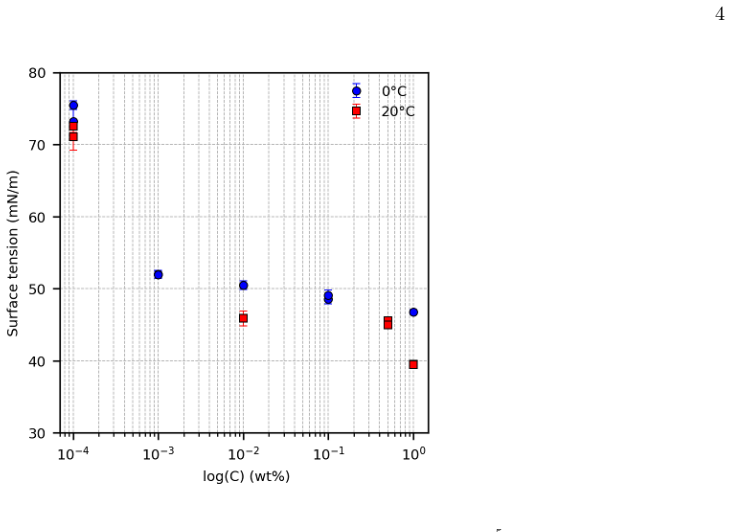
R. G. Pohl, Solute redistribution by recrystallization, Journal of Applied Physics25, 1170 (1954). V. APPENDIXES Table I summarizes the experimental conditions and sample compositions used to determine their influence on flow patterns in the liquid phase. The surfactant used is Tween 80, with concentration C ranging from 0.001 to 1 wt.%. Experiments were ...
1954
discussion (0)
Sign in with ORCID, Apple, or X to comment. Anyone can read and Pith papers without signing in.