REVIEW 2 major objections 24 references
Decoding Insect Song: A Multitask Semisupervised Orthoptera Bioacoustic Classifier
T0 review · 2 major / 0 minor · reviewed 2026-06-27 · grok-4.3
Pith's one-line read A multi-task semi-supervised model adapted to Orthoptera bioacoustics outperforms a general-purpose bioacoustic classifier on species identification.
desk verdict PULSE applies standard semi-supervised and distillation tricks to Orthoptera audio and reports better numbers than a general model, but the abstract gives no dataset sizes, splits, or validation steps so the gains are hard to trust. read the letter →
The pith
A machine-rendered reading of the paper's core claim, the machinery that carries it, and where it could break.
The reading
What carries the argument
PULSE, the semi-supervised multi-task framework that combines weak supervision, self-supervision on field audio, and distillation to adapt a general bioacoustic model to Orthoptera.
What would settle it
A new held-out set of Orthoptera field recordings, collected and labeled independently of the training distribution, on which the specialist model shows no metric improvement over the general model would falsify the performance claim.
Extended reading notes
Core claim
PULSE integrates weakly-supervised species classification, self-supervised learning on unlabelled field audio, and knowledge distillation from a general-purpose bioacoustic model to produce a domain-adapted specialist for Orthoptera that records macro F1 of 0.21, AUC of 0.74 and AP of 0.32 versus 0.07, 0.45 and 0.19 for the general model, with active learning lifting those figures to 0.34 and 0.84; the learned embeddings encode ecologically meaningful structure that an interactive visualisation tool exposes for ecological discovery.
Load-bearing premise
The weakly-supervised species labels and unlabeled field audio are sufficiently representative and free of major domain-shift or labeling biases.
Editorial extensions
If this is right
- The domain-adapted model records macro F1 of 0.21 versus 0.07, AUC of 0.74 versus 0.45, and AP of 0.32 versus 0.19 on the target Orthoptera task.
- Active learning applied after the multi-task adaptation further raises macro F1 to 0.34 and AUC to 0.84.
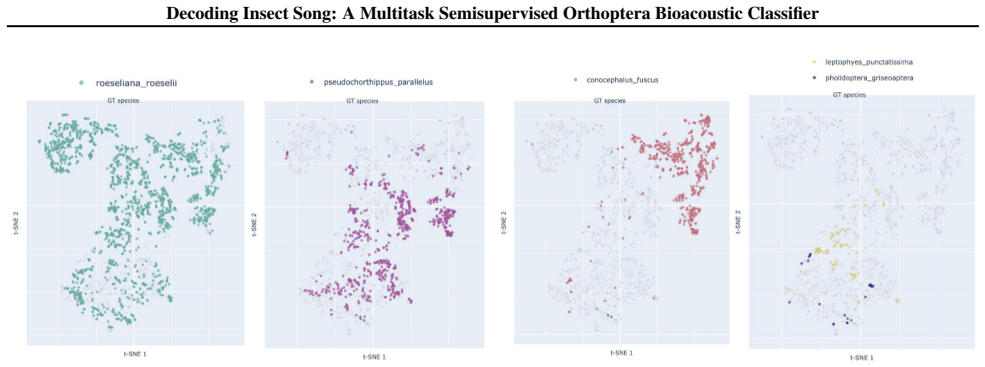
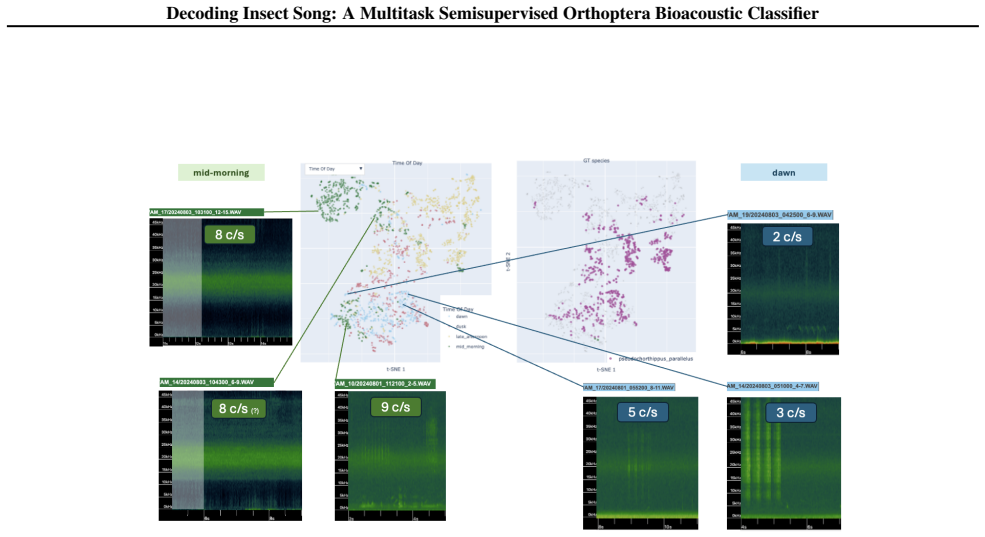
- The embeddings produced by the adapted model contain structure that matches ecological variables and can be explored with an interactive visualisation tool.
- The same combination of weak labels, self-supervision, and distillation offers a route to specialist models for other narrowly distributed bioacoustic tasks.
Reading between the lines
- The same adaptation recipe could be tested on other insect orders or vertebrate vocalizations where only weak labels exist.
- The visualisation tool might allow ecologists to spot previously unnoticed species associations or habitat preferences directly from the embedding space.
- If the method scales, passive acoustic monitoring networks could shift from generic detectors to lightweight specialists tuned to local fauna without large labeled datasets.
- The performance gap between general and specialist models suggests that domain adaptation remains valuable even when strong general models are already available.
Editorial analysis
A structured set of objections, weighed in public.
Referee Report
Summary. The paper introduces PULSE, a semi-supervised multi-task framework for Orthoptera bioacoustics that combines weakly-supervised species classification, self-supervised learning on unlabeled field audio, and knowledge distillation from a general-purpose bioacoustic model. It claims the resulting domain-adapted specialist outperforms a state-of-the-art general model (macro F1 0.21 vs. 0.07; AUC 0.74 vs. 0.45; AP 0.32 vs. 0.19), with active learning further improving to F1 0.34 and AUC 0.84, and that the learned embeddings encode ecologically meaningful structure revealed via an interactive visualization tool.
Significance. If the empirical claims hold after verification, the work would be significant for passive acoustic monitoring in ecology by demonstrating a practical route to domain-adapted specialist models for insect bioacoustics, potentially improving transferability over general-purpose tools and enabling new ecological insights from embeddings.
major comments (2)
- [Abstract] Abstract: performance metrics (macro F1, AUC, AP) are reported without any information on dataset size, train/test splits, baseline implementation details, statistical tests, or error bars, preventing verification that the numbers support the central claim of reliable adaptation.
- [Abstract] The framework relies on weakly-supervised species labels and unlabeled field audio, yet no validation is described for label noise, systematic errors in citizen-science tags, or acoustic covariate matching between unlabeled and test partitions; this directly undermines attribution of gains to the multi-task combination rather than training artifacts.
Simulated Author's Rebuttal
We thank the referee for these constructive comments on the abstract. Both points identify areas where additional detail will improve verifiability and strengthen the manuscript. We address each below and will revise accordingly.
read point-by-point responses
-
Referee: [Abstract] Abstract: performance metrics (macro F1, AUC, AP) are reported without any information on dataset size, train/test splits, baseline implementation details, statistical tests, or error bars, preventing verification that the numbers support the central claim of reliable adaptation.
Authors: We agree the abstract should supply enough context for immediate assessment of the metrics. The full manuscript already reports dataset scale, train/test splits, and baseline implementation details in the Methods and Experiments sections, along with statistical analysis in Results. To address the concern directly, we will revise the abstract to include a concise statement on dataset size and splits and will add a parenthetical note that error bars and full implementation details appear in the main text. This is a targeted change to the abstract only. revision: yes
-
Referee: [Abstract] The framework relies on weakly-supervised species labels and unlabeled field audio, yet no validation is described for label noise, systematic errors in citizen-science tags, or acoustic covariate matching between unlabeled and test partitions; this directly undermines attribution of gains to the multi-task combination rather than training artifacts.
Authors: This is a fair observation. The current manuscript describes the citizen-science origin of the weakly-supervised Orthoptera labels and the use of unlabeled field recordings but does not include explicit validation experiments for label noise, tag errors, or acoustic covariate alignment between partitions. We will add a short subsection in Methods that (a) summarizes any filtering steps applied to the tags, (b) reports any available label-quality checks, and (c) acknowledges the limitation on covariate matching. This addition will allow readers to evaluate the attribution of gains to the multi-task framework more rigorously. revision: yes
Circularity Check
No circularity; purely empirical ML evaluation
full rationale
The paper reports an empirical comparison of a semi-supervised multi-task classifier against an external general-purpose baseline on held-out metrics (F1, AUC, AP). No derivation chain, equations, fitted parameters renamed as predictions, or self-citation load-bearing steps are present in the provided text. The central claims rest on direct performance numbers and visualization of embeddings rather than any self-referential construction or reduction to inputs by definition.
Assumptions & free parameters
free parameters (1)
- Model hyperparameters and task weighting coefficients
assumptions (2)
- domain assumption Knowledge from a general-purpose bioacoustic model transfers usefully via distillation to the Orthoptera domain.
- domain assumption Unlabeled field audio contains learnable structure that improves supervised classification when used in self-supervision.
Cite this review
Pith. "Pith review of Decoding Insect Song: A Multitask Semisupervised Orthoptera Bioacoustic Classifier." pith.science (2026). https://pith.science/paper/7XP2SNRR
@misc{pith2026260613236,
  author       = {Pith},
  title        = {Pith review of: Decoding Insect Song: A Multitask Semisupervised Orthoptera Bioacoustic Classifier},
  year         = {2026},
  howpublished = {\url{https://pith.science/paper/7XP2SNRR}},
  note         = {Machine review of arXiv:2606.13236}
}
read the original abstract
Passive acoustic monitoring holds great promise for ecological inference, yet existing automated tools are typically narrowly trained and non-transferable. We address these limitations with PULSE, a semi-supervised, multi-task framework for Orthoptera bioacoustics, combining weakly-supervised species classification, self-supervised learning on unlabelled field audio, and knowledge distillation from a general-purpose bioacoustic model. Our domain-adapted specialist model outperforms a state-of-the-art general model across all metrics (macro F1: 0.21 vs. 0.07; AUC: 0.74 vs. 0.45; AP: 0.32 vs. 0.19), with active learning further raising F1 to 0.34 and AUC to 0.84. Beyond classification, the learned embeddings encode ecologically meaningful structure, exposed through an interactive visualisation tool for ecological discovery.
Figures


Figures from the paper (8 more)





Reference graph
Works this paper leans on
-
[1]
Basic and Applied Ecology , volume=
Recent technological developments allow for passive acoustic monitoring of Orthoptera (grasshoppers and crickets) in research and conservation across a broad range of temporal and spatial scales , author=. Basic and Applied Ecology , volume=. 2025 , publisher=
2025
-
[2]
Machine learning , volume=
Multitask learning , author=. Machine learning , volume=. 1997 , publisher=
1997
-
[3]
PLOS Computational Biology , volume=
Adaptive representations of sound for automatic insect recognition , author=. PLOS Computational Biology , volume=. 2023 , publisher=
2023
-
[4]
2021 , publisher=
Fonseca, Eduardo and Favory, Xavier and Pons, Jordi and Font, Frederic and Serra, Xavier , journal=. 2021 , publisher=
2021
-
[5]
The archive of animal sounds at the
Frommolt, Karl-Heinz , journal=. The archive of animal sounds at the. 1996 , publisher=
1996
-
[6]
Scientific Data , year=
A finely annotated dataset for the automated acoustic identification of European Orthoptera and Cicadidae , author=. Scientific Data , year=
-
[7]
Methods in Ecology and Evolution , volume=
Emerging opportunities and challenges for passive acoustics in ecological assessment and monitoring , author=. Methods in Ecology and Evolution , volume=. 2019 , publisher=
2019
-
[8]
Advances in Neural Information Processing Systems , volume=
Bootstrap your own latent-a new approach to self-supervised learning , author=. Advances in Neural Information Processing Systems , volume=
Show all 24 references
-
[9]
arXiv preprint arXiv:2312.07439 , year=
Birb: A generalization benchmark for information retrieval in bioacoustics , author=. arXiv preprint arXiv:2312.07439 , year=
-
[10]
2017 , organization=
Hershey, Shawn and Chaudhuri, Sourish and Ellis, Daniel PW and Gemmeke, Jort F and Jansen, Aren and Moore, R Channing and Plakal, Manoj and Platt, Devin and Saurous, Rif A and Seybold, Bryan and others , booktitle=. 2017 , organization=
2017
-
[11]
Ecological Informatics , year =
Kahl, Stefan and Wood, Connor M and Eibl, Maximilian and Klinck, Holger , title =. Ecological Informatics , year =
-
[12]
Methods in Ecology and Evolution , volume=
Whombat: An open-source audio annotation tool for machine learning assisted bioacoustics , author=. Methods in Ecology and Evolution , volume=. 2025 , publisher=
2025
-
[13]
bioRxiv , pages=
Towards a general approach for bat echolocation detection and classification , author=. bioRxiv , pages=. 2022 , publisher=
2022
-
[14]
International Conference on Learning Representations , year=
On the importance of single directions for generalization , author=. International Conference on Learning Representations , year=
-
[15]
Methods in Ecology and Evolution , volume=
Potential for coupling the monitoring of bush-crickets with established large-scale acoustic monitoring of bats , author=. Methods in Ecology and Evolution , volume=. 2017 , publisher=
2017
-
[16]
IEEE/ACM Transactions on Audio, Speech, and Language Processing , volume=
BYOL for audio: Exploring pre-trained general-purpose audio representations , author=. IEEE/ACM Transactions on Audio, Speech, and Language Processing , volume=. 2022 , publisher=
2022
-
[17]
International Conference on Machine Learning , pages=
Improved Algorithm for Deep Active Learning under Imbalance via Optimal Separation , author=. International Conference on Machine Learning , pages=. 2025 , organization=
2025
-
[18]
Philosophical Transactions of the Royal Society B: Biological Sciences , volume=
Acoustic monitoring for tropical insect conservation , author=. Philosophical Transactions of the Royal Society B: Biological Sciences , volume=. 2025 , publisher=
2025
-
[19]
Functional Ecology , volume=
Passive acoustic monitoring provides a fresh perspective on fundamental ecological questions , author=. Functional Ecology , volume=. 2023 , publisher=
2023
-
[20]
International Conference on Machine Learning , pages=
Axiomatic attribution for deep networks , author=. International Conference on Machine Learning , pages=. 2017 , organization=
2017
-
[21]
arXiv preprint arXiv:2508.04665 , year=
Perch 2.0: The bittern lesson for bioacoustics , author=. arXiv preprint arXiv:2508.04665 , year=
-
[22]
Xeno-canto Foundation for Nature Sounds
Xeno-canto -- Orthoptera sounds from around the world , author=. Xeno-canto Foundation for Nature Sounds. Occurrence dataset https://doi.org/10.15468/76yp6j , pages=
-
[23]
The effects of temperature and age on calling song in a field cricket with a complex calling song,
Walker, Sean E and Cade, William H , journal=. The effects of temperature and age on calling song in a field cricket with a complex calling song,. 2003 , publisher=
2003
-
[24]
2022 , publisher=
Xiao, Hanguang and Liu, Daidai and Chen, Kai and Zhu, Mi , journal=. 2022 , publisher=
2022
Reviewed June 27, 2026 · model on record in the stance chip above.
Discussion (0). Continue with ORCID to comment.