Detection and characterisation of binary asteroid candidates through stellar occultations
Pith reviewed 2026-06-27 05:43 UTC · model grok-4.3
The pith
Stellar occultations confirm binary features in four Gaia-selected asteroid candidates.
A machine-rendered reading of the paper's core claim, the machinery that carries it, and where it could break.
Core claim
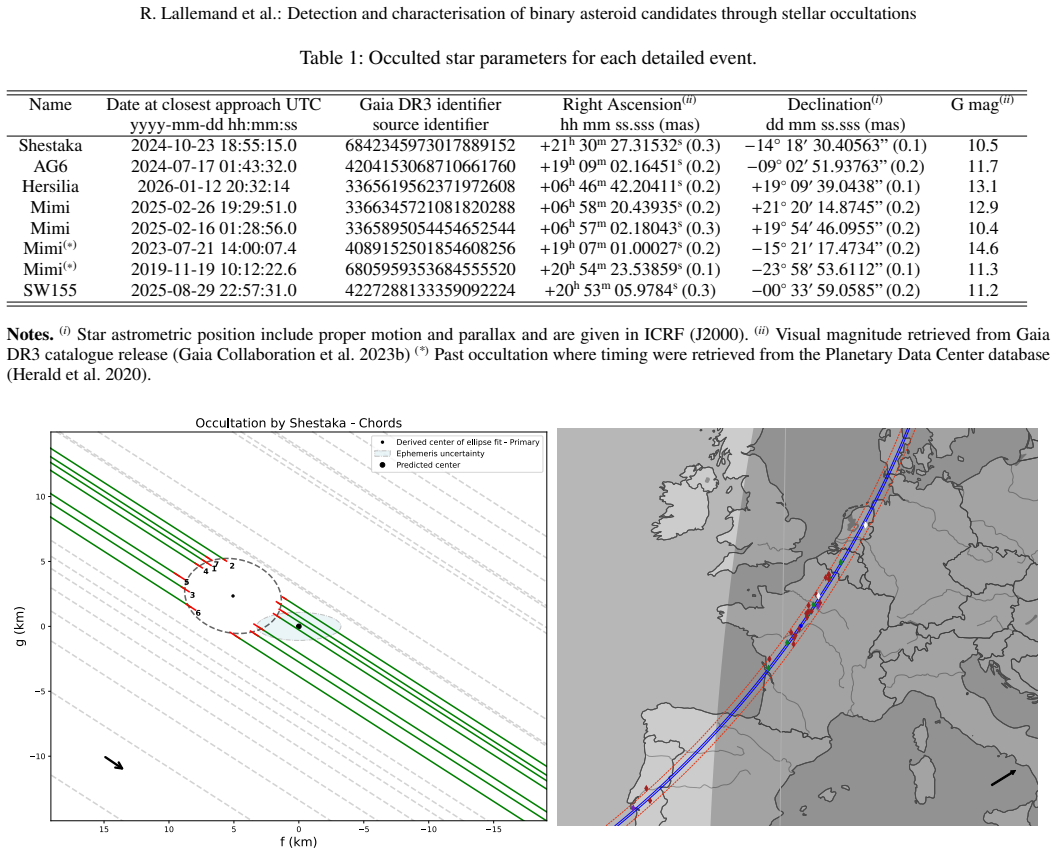
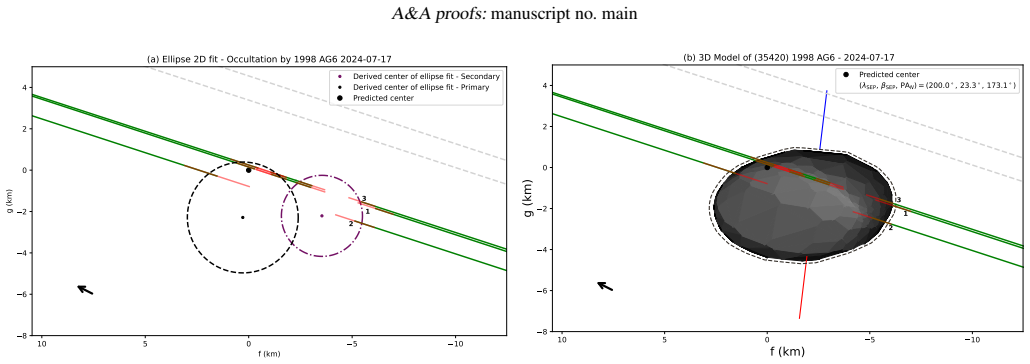
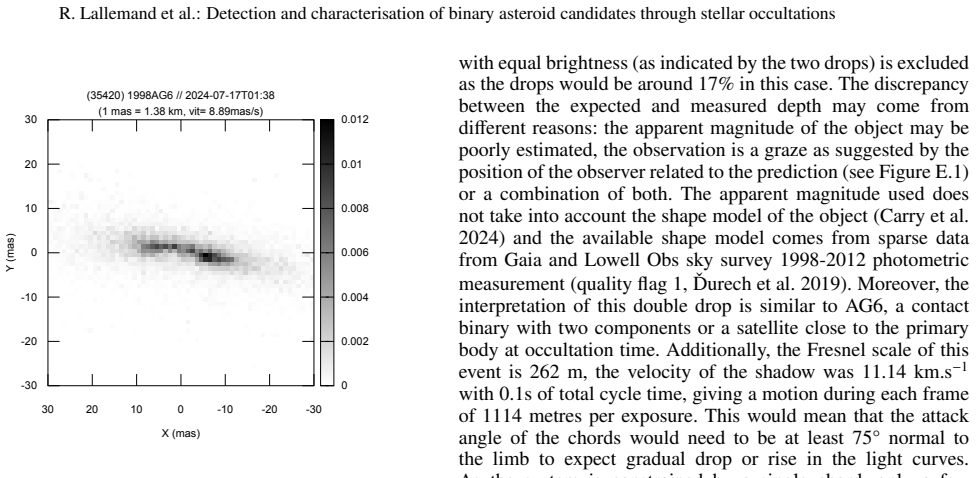
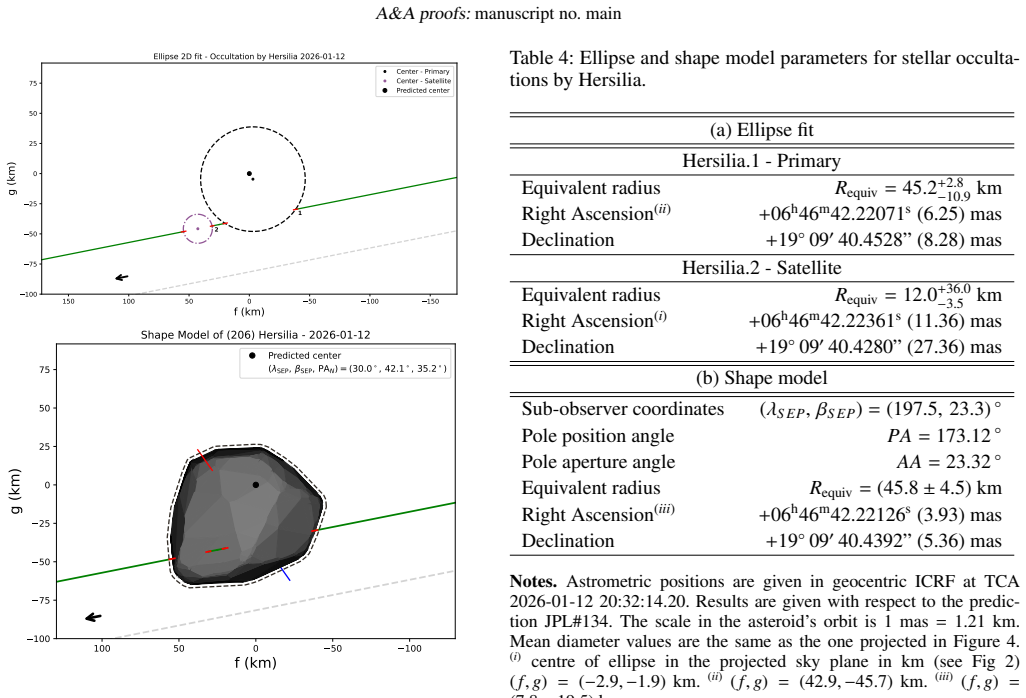
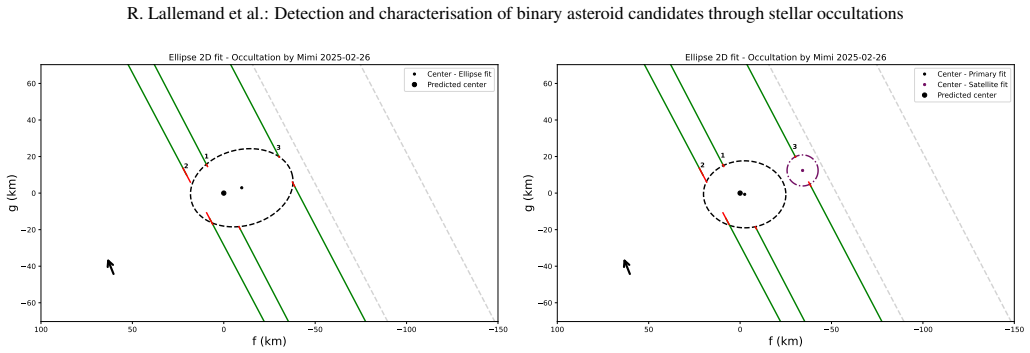
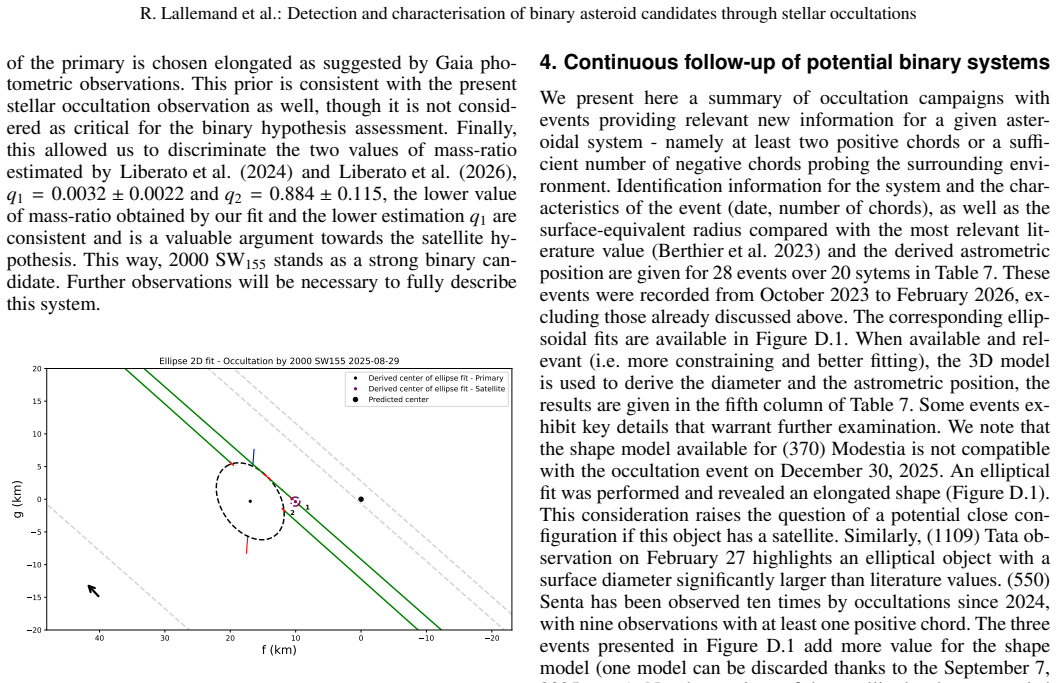
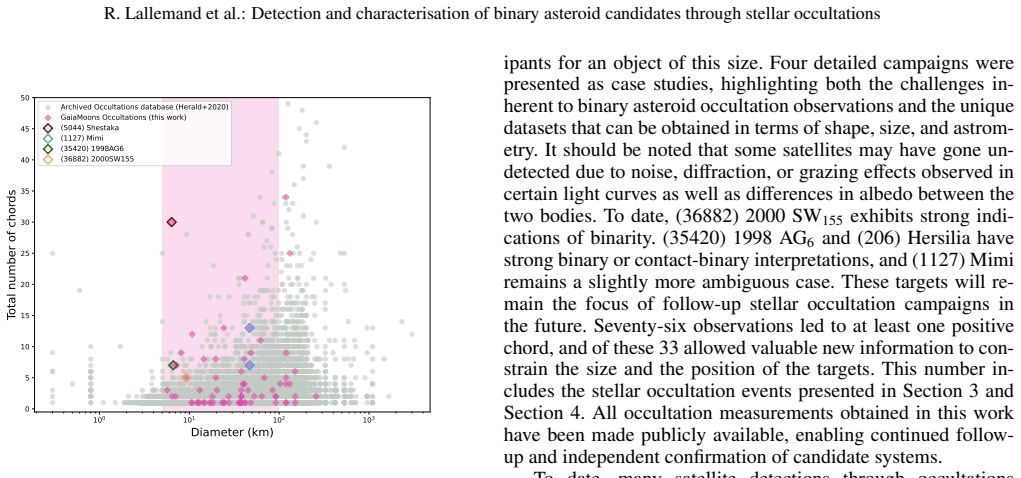
Analysis of the occultation dataset shows that 1127 Mimi, 35420 1998 AG6, 206 Hersilia, and 36882 2000 SW155 exhibit indications of binary or contact-binary structure, while the full set of observations supplies previously unavailable physical and astrometric constraints on 24 objects.
What carries the argument
Stellar occultation chords, timed to millisecond precision and combined with Gaia astrometric wobbles, to detect unresolved companions.
If this is right
- Size and shape models for 24 asteroids now rest on direct chord measurements instead of light-curve inversion alone.
- The same Gaia-plus-occultation pipeline can be applied to additional candidates to increase the known binary population in the main belt.
- Repeated occultations of the same object can track orbital motion of the secondary and thereby measure mass.
- The method supplies an independent check on binary frequency estimates derived from other techniques.
Where Pith is reading between the lines
- If the four detections hold, the fraction of contact binaries among small main-belt objects may be higher than current surveys indicate.
- Extending the campaign to fainter Gaia candidates would test whether the wobble signature remains reliable at lower signal-to-noise.
Load-bearing premise
Gaia astrometric wobbles are produced by unresolved companions rather than by shape irregularities, rotational effects, or measurement systematics.
What would settle it
High-resolution imaging or radar observations of any of the four flagged objects that show a single body with no detectable companion or contact-binary shape.
Figures
read the original abstract
Binary asteroids provide key access to fundamental parameters of Solar System remnants and planetary formations. However, the current knowledge of binary asteroids remains strongly biased by observational limitations, and main belt binary systems are still poorly characterised since current techniques preferentially detect either widely separated binaries close and bright systems. In this context, the high-precision astrometry of the Gaia mission has revealed a new population of candidate binaries exhibiting dynamical signatures consistent with unresolved companions. This work is part of the GaiaMoons program, and our aim with it was to characterise a sample of 357 potential binary asteroid targets and confirm or refute their binary nature. The properties of these candidates were derived from the high-precision photometric and astrometric observations provided by Gaia. We adopted stellar occultation as the observational method to study these targets. Between October 2023 and February 2026, we successfully carried out 165 observations for 101 targets. We subsequently analysed these events in the context of the available literature and previously reported observations. Thirty three observation led at least two positives for 24 objects that have undergone unprecedented occultation observation campaigns, with four objects showing indications of binary or contact binary features, namely 1127 Mimi, 35420 1998 AG6, 206 Hersilia, and 36882 2000 SW155. For the vast majority of these objects, the resulting dataset from all reduced observations provides unique physical and astrometric constraints, as they had never been observed through stellar occultations before. GaiaMoons illustrates how stellar occultation campaigns associated with Gaia observations generate a self-improving cycle to find new binary, thereby probing size and shape to constrain future observations.
Editorial analysis
A structured set of objections, weighed in public.
Referee Report
Summary. The manuscript reports on the GaiaMoons program using stellar occultations to characterize 357 Gaia-identified binary asteroid candidates. The authors conducted 165 observations for 101 targets between October 2023 and February 2026, resulting in 33 multi-chord events for 24 objects. Four objects—1127 Mimi, 35420 1998 AG6, 206 Hersilia, and 36882 2000 SW155—are reported to show indications of binary or contact-binary features based on comparison with literature. The work emphasizes that many targets received their first occultation observations, providing new physical and astrometric constraints.
Significance. If the reported binary indications are robust, this study would represent a significant advance in detecting main-belt binary asteroids by combining Gaia astrometry with occultation campaigns. It could help mitigate observational biases in binary detection and generate a cycle for improved future observations. The provision of new data on previously unobserved objects adds value to the field of asteroid characterization.
major comments (1)
- [Abstract] Abstract: The claim that four objects show indications of binary or contact-binary features lacks any description of error budgets on the chord measurements, explicit selection criteria for identifying positive binary events, or quantitative comparison to null hypotheses of single-body shapes or noise; these details are load-bearing for validating the central claim.
Simulated Author's Rebuttal
We thank the referee for their review and constructive comment on our manuscript. We address the major comment below.
read point-by-point responses
-
Referee: [Abstract] Abstract: The claim that four objects show indications of binary or contact-binary features lacks any description of error budgets on the chord measurements, explicit selection criteria for identifying positive binary events, or quantitative comparison to null hypotheses of single-body shapes or noise; these details are load-bearing for validating the central claim.
Authors: The abstract is intended as a concise summary and therefore omits the detailed methodological elements. The error budgets on chord measurements, the explicit criteria for classifying an event as binary or contact-binary (inconsistencies between observed chords and single-body shape models that exceed the combined astrometric and timing uncertainties), and the comparisons against single-body null hypotheses are presented in Sections 3 (data reduction) and 4 (results for the four objects) of the manuscript, with supporting figures and tables. We agree that a brief reference to these elements would improve the abstract's self-containment. We will therefore revise the abstract to include one additional sentence summarizing the identification approach and the role of measurement uncertainties. revision: yes
Circularity Check
No significant circularity detected
full rationale
The manuscript reports new stellar occultation observations (165 events, 33 multi-positive chords across 24 targets) used to flag binary indications in four specific objects. These results are derived from direct chord measurements compared against prior literature, with no equations, fitted parameters, or self-referential definitions that reduce the detections to the Gaia selection inputs by construction. The upstream Gaia astrometric wobble premise is external to the occultation dataset and does not create a self-definitional or fitted-input loop within the reported findings. No self-citation chains or ansatzes are load-bearing for the central claims.
Axiom & Free-Parameter Ledger
Reference graph
Works this paper leans on
-
[1]
, year = 2006, month = mar, volume =
Photometric survey of binary near-Earth asteroids. , year = 2006, month = mar, volume =. doi:10.1016/j.icarus.2005.10.014 , adsurl =
-
[2]
, year = 2010, month = jun, volume =
Orbital evolution of small binary asteroids. , year = 2010, month = jun, volume =. doi:10.1016/j.icarus.2009.12.005 , adsurl =
-
[3]
Binaries in the Kuiper Belt. The Solar System Beyond Neptune , year = 2008, editor =. doi:10.48550/arXiv.astro-ph/0703134 , adsurl =
work page internal anchor Pith review Pith/arXiv arXiv doi:10.48550/arxiv.astro-ph/0703134 2008
-
[4]
Asteroids IV , year = 2015, editor =
Asteroid Systems: Binaries, Triples, and Pairs. Asteroids IV , year = 2015, editor =. doi:10.2458/azu_uapress_9780816532131-ch019 , adsurl =
-
[5]
The Gaia mission. , keywords =. doi:10.1051/0004-6361/201629272 , archivePrefix =. 1609.04153 , primaryClass =
work page internal anchor Pith review Pith/arXiv arXiv doi:10.1051/0004-6361/201629272
-
[6]
Annual Review of Earth and Planetary Sciences , year = 2006, month = may, volume =
Binary Minor Planets. Annual Review of Earth and Planetary Sciences , year = 2006, month = may, volume =. doi:10.1146/annurev.earth.32.101802.120208 , adsurl =
-
[7]
Asteroids III , year = 2002, editor =
Asteroid Radar Astronomy. Asteroids III , year = 2002, editor =
2002
-
[8]
VLT/SPHERE imaging survey of the largest main-belt asteroids: Final results and synthesis. , keywords =. doi:10.1051/0004-6361/202141781 , adsurl =
-
[9]
Asteroids were born big. , keywords =. doi:10.1016/j.icarus.2009.07.011 , archivePrefix =. 0907.2512 , primaryClass =
work page internal anchor Pith review Pith/arXiv arXiv doi:10.1016/j.icarus.2009.07.011 2009
-
[10]
Asteroids III , year = 2002, editor =
Asteroids Do Have Satellites. Asteroids III , year = 2002, editor =
2002
-
[11]
Gaia Data Release 3. The Solar System survey. , keywords =. doi:10.1051/0004-6361/202243796 , archivePrefix =. 2206.05561 , primaryClass =
-
[12]
Stellar occultations by trans-Neptunian objects. , keywords =. doi:10.1007/s00159-024-00156-x , archivePrefix =. 2411.07026 , primaryClass =
-
[13]
Binary asteroid candidates in Gaia DR3 astrometry. , keywords =. doi:10.1051/0004-6361/202349122 , archivePrefix =. 2406.07195 , primaryClass =
-
[14]
Based on Gaia astrometric data
Asteroid (4337) Arecibo: Two ice-rich bodies forming a binary. Based on Gaia astrometric data. , keywords =. doi:10.1051/0004-6361/202450586 , archivePrefix =. 2503.13375 , primaryClass =
-
[15]
, year = 2023, month = feb, volume =
A dense ring of the trans-Neptunian object Quaoar outside its Roche limit. , year = 2023, month = feb, volume =. doi:10.1038/s41586-022-05629-6 , adsurl =
-
[16]
Asteroids, Comets, Meteors 2012 , year = 2012, editor =
Shape and Size of (90) ANTIOPE Derived from an Exceptional Stellar Occultation on July 19, 2011. Asteroids, Comets, Meteors 2012 , year = 2012, editor =
2011
-
[17]
Orbit determination of trans-Neptunian objects and Centaurs for the prediction of stellar occultations. , keywords =. doi:10.1051/0004-6361/201526498 , archivePrefix =. 1509.08674 , primaryClass =
work page internal anchor Pith review Pith/arXiv arXiv doi:10.1051/0004-6361/201526498
-
[18]
Density of asteroids. , keywords =. doi:10.1016/j.pss.2012.03.009 , archivePrefix =. 1203.4336 , primaryClass =
work page internal anchor Pith review Pith/arXiv arXiv doi:10.1016/j.pss.2012.03.009 2012
-
[19]
SsODNet: Solar system Open Database Network. , keywords =. doi:10.1051/0004-6361/202244878 , archivePrefix =. 2209.10697 , primaryClass =
-
[20]
Lecture Notes in Physics, Berlin Springer Verlag , year = 2010, editor =
The Gaia Mission and the Asteroids. Lecture Notes in Physics, Berlin Springer Verlag , year = 2010, editor =. doi:10.1007/978-3-642-04458-8_6 , adsurl =
-
[21]
, year = 2008, month = jul, volume =
Rotational breakup as the origin of small binary asteroids. , year = 2008, month = jul, volume =. doi:10.1038/nature07078 , adsurl =
-
[22]
Occultation portal: A web-based platform for data collection and analysis of stellar occultations. , keywords =. doi:10.1093/mnras/stac1595 , archivePrefix =. 2206.09615 , primaryClass =
-
[23]
The Journal of Open Source Software , keywords =
Siril: An Advanced Tool for Astronomical Image Processing. The Journal of Open Source Software , keywords =. doi:10.21105/joss.07242 , archivePrefix =. 2408.03346 , primaryClass =
-
[24]
Journal for Occultation Astronomy , year = 2019, month = oct, volume =
PyMovie - A Stellar-Occultation Aperture-Photometry Program. Journal for Occultation Astronomy , year = 2019, month = oct, volume =
2019
-
[25]
IEEE Transactions on Communications , keywords =
Internet time synchronization: the network time protocol. IEEE Transactions on Communications , keywords =. doi:10.1109/26.103043 , adsurl =
-
[26]
Gaia follow-up network for the solar system objects : Gaia FUN-SSO workshop proceedings , year = 2011, editor =
PRAIA - Platform for Reduction of Astronomical Images Automatically. Gaia follow-up network for the solar system objects : Gaia FUN-SSO workshop proceedings , year = 2011, editor =
2011
-
[27]
Differential aperture photometry and digital coronagraphy with PRAIA. , keywords =. doi:10.1016/j.pss.2023.105816 , archivePrefix =. 2311.14152 , primaryClass =
-
[28]
SORA: Stellar occultation reduction and analysis. , keywords =. doi:10.1093/mnras/stac032 , archivePrefix =. 2201.01799 , primaryClass =
-
[29]
The size, shape, density and ring of the dwarf planet Haumea from a stellar occultation. , keywords =. doi:10.1038/nature24051 , archivePrefix =. 2006.03113 , primaryClass =
-
[30]
, year = 2011, month = oct, volume =
A Pluto-like radius and a high albedo for the dwarf planet Eris from an occultation. , year = 2011, month = oct, volume =. doi:10.1038/nature10550 , adsurl =
-
[31]
Journal for Occultation Astronomy , year = 2021, month = jan, volume =
The Shelyak TimeBox - A Device Allowing Multi-Mode Accurate UTC Time Recordings for Digital Video Cameras. Journal for Occultation Astronomy , year = 2021, month = jan, volume =
2021
-
[32]
Planetary Science Journal , keywords =
Analysis of Four-band WISE Observations of Asteroids. Planetary Science Journal , keywords =. doi:10.3847/PSJ/ac3232 , archivePrefix =. 2110.12098 , primaryClass =
-
[33]
Main Belt Asteroids with WISE/NEOWISE. I. Preliminary Albedos and Diameters. , keywords =. doi:10.1088/0004-637X/741/2/68 , archivePrefix =. 1109.4096 , primaryClass =
work page internal anchor Pith review Pith/arXiv arXiv doi:10.1088/0004-637x/741/2/68
-
[34]
Preliminary Analysis of WISE/NEOWISE 3-Band Cryogenic and Post-cryogenic Observations of Main Belt Asteroids. , keywords =. doi:10.1088/2041-8205/759/1/L8 , archivePrefix =. 1209.5794 , primaryClass =
work page internal anchor Pith review Pith/arXiv arXiv doi:10.1088/2041-8205/759/1/l8 2041
-
[35]
Stellar occultations by small bodies - Diffraction effects. , keywords =. doi:10.1086/114438 , adsurl =
-
[36]
(216) Kleopatra, a low density critically rotating M-type asteroid. , keywords =. doi:10.1051/0004-6361/202140874 , archivePrefix =. 2108.07207 , primaryClass =
-
[37]
Detection of the YORP @ARTICLE 2005Icar..176..418C, author = \'C uk , Matija and Burns , Joseph A. , title =. , keywords =. doi:10.1093/mnras/stab2476 , archivePrefix =. 2108.13494 , primaryClass =
-
[38]
, year = 2005, month = aug, volume =
Effects of thermal radiation on the dynamics of binary NEAs. , year = 2005, month = aug, volume =. doi:10.1016/j.icarus.2005.02.001 , adsurl =
-
[39]
Dynamics of rotationally fissioned asteroids: Source of observed small asteroid systems
Dynamics of rotationally fissioned asteroids: Source of observed small asteroid systems. , keywords =. doi:10.1016/j.icarus.2011.04.009 , archivePrefix =. 1404.0801 , primaryClass =
work page internal anchor Pith review Pith/arXiv arXiv doi:10.1016/j.icarus.2011.04.009 2011
-
[40]
DAMIT: a database of asteroid models. , keywords =. doi:10.1051/0004-6361/200912693 , adsurl =
-
[41]
Reconstruction of asteroid spin states from Gaia DR3 photometry. , keywords =. doi:10.1051/0004-6361/202345889 , archivePrefix =. 2305.10798 , primaryClass =
-
[42]
New and updated convex shape models of asteroids based on optical data from a large collaboration network. , keywords =. doi:10.1051/0004-6361/201527441 , archivePrefix =. 1510.07422 , primaryClass =
work page internal anchor Pith review Pith/arXiv arXiv doi:10.1051/0004-6361/201527441
-
[43]
Thermophysical modeling of main-belt asteroids from WISE thermal data
Thermophysical modeling of main-belt asteroids from WISE thermal data. , keywords =. doi:10.1016/j.icarus.2018.03.016 , archivePrefix =. 1803.06116 , primaryClass =
work page internal anchor Pith review Pith/arXiv arXiv doi:10.1016/j.icarus.2018.03.016 2018
-
[44]
Asteroid models from the Lowell Photometric Database
Asteroid models from the Lowell photometric database. , keywords =. doi:10.1051/0004-6361/201527573 , archivePrefix =. 1601.02909 , primaryClass =
work page internal anchor Pith review Pith/arXiv arXiv doi:10.1051/0004-6361/201527573
-
[45]
Orbital properties of binary minor planets
The Observed Orbital Properties of Binary Minor Planets. , keywords =. doi:10.1088/0004-637X/719/2/1775 , archivePrefix =. 1001.2558 , primaryClass =
work page internal anchor Pith review Pith/arXiv arXiv doi:10.1088/0004-637x/719/2/1775
-
[46]
Binary asteroid population. 2. Anisotropic distribution of orbit poles of small, inner main-belt binaries. , year = 2012, month = mar, volume =. doi:10.1016/j.icarus.2011.11.026 , adsurl =
-
[47]
Orbits of very distant asteroid satellites. , keywords =. doi:10.1051/0004-6361/202451124 , archivePrefix =. 2503.15081 , primaryClass =
-
[48]
Formation and Destruction of Small Binary Asteroids. , keywords =. doi:10.1086/516572 , adsurl =
-
[49]
Rubin Observatory's Legacy Survey of Space and Time (LSST) for Solar System Science
The Scientific Impact of the Vera C. Rubin Observatory's Legacy Survey of Space and Time (LSST) for Solar System Science. arXiv e-prints , keywords =. doi:10.48550/arXiv.2009.07653 , archivePrefix =. 2009.07653 , primaryClass =
-
[50]
ADAM: a general method for using various data types in asteroid reconstruction
ADAM: a general method for using various data types in asteroid reconstruction. , keywords =. doi:10.1051/0004-6361/201425259 , archivePrefix =. 1501.05958 , primaryClass =
work page internal anchor Pith review Pith/arXiv arXiv doi:10.1051/0004-6361/201425259
-
[51]
Precise astrometry and diameters of asteroids from occultations - a data set of observations and their interpretation. , keywords =. doi:10.1093/mnras/staa3077 , archivePrefix =. 2010.06086 , primaryClass =
-
[52]
Astropy: A Community Python Package for Astronomy
Astropy: A community Python package for astronomy. , keywords =. doi:10.1051/0004-6361/201322068 , archivePrefix =. 1307.6212 , primaryClass =
work page internal anchor Pith review Pith/arXiv arXiv doi:10.1051/0004-6361/201322068
-
[53]
Unresolved stellar companions with Gaia DR2 astrometry. , keywords =. doi:10.1093/mnras/staa1522 , archivePrefix =. 2003.05467 , primaryClass =
-
[54]
A large topographic feature on the surface of the trans-Neptunian object (307261) 2002 MS _ 4 measured from stellar occultations. , keywords =. doi:10.1051/0004-6361/202346892 , archivePrefix =. 2308.08062 , primaryClass =
-
[55]
Summary of the content and survey properties
Gaia Data Release 3. Summary of the content and survey properties. , keywords =. doi:10.1051/0004-6361/202243940 , archivePrefix =. 2208.00211 , primaryClass =
-
[56]
Planetary Science Journal , keywords =
Thermal Properties of 1847 WISE-observed Asteroids. Planetary Science Journal , keywords =. doi:10.3847/PSJ/ac4d1f , archivePrefix =. 2201.05164 , primaryClass =
-
[57]
Binary asteroid population. 1. Angular momentum content. , year = 2007, month = sep, volume =. doi:10.1016/j.icarus.2007.02.023 , adsurl =
-
[58]
``TNOs are Cool'': A survey of the trans-Neptunian region. XIII. Statistical analysis of multiple trans-Neptunian objects observed with Herschel Space Observatory. , keywords =. doi:10.1051/0004-6361/201730588 , adsurl =
-
[59]
SF2A-2024: Proceedings of the Annual meeting of the French Society of Astronomy and Astrophysics , year = 2024, editor =
GAIAMOONS : Study of binary asteroids with stellar occultation and GAIA astrometry. SF2A-2024: Proceedings of the Annual meeting of the French Society of Astronomy and Astrophysics , year = 2024, editor =
2024
-
[60]
SF2A-2025: Proceedings of the Annual meeting of the French Society of Astronomy and Astrophysics
First GAIAMOONS occultation results with features suggestive of binarity. SF2A-2025: Proceedings of the Annual meeting of the French Society of Astronomy and Astrophysics. Eds.: A. Siebert , year = 2025, editor =
2025
-
[61]
Inversion of asteroid photometry from Gaia DR2 and the Lowell Observatory photometric database. , keywords =. doi:10.1051/0004-6361/201936341 , archivePrefix =. 1909.09395 , primaryClass =
-
[62]
Pluto's ephemeris from ground-based stellar occultations (1988-2016)
Pluto's ephemeris from ground-based stellar occultations (1988-2016). , keywords =. doi:10.1051/0004-6361/201834958 , archivePrefix =. 1903.04800 , primaryClass =
work page internal anchor Pith review Pith/arXiv arXiv doi:10.1051/0004-6361/201834958 1988
-
[63]
Stellar occultations enable milliarcsecond astrometry for Trans-Neptunian objects and Centaurs. , keywords =. doi:10.1051/0004-6361/202039054 , archivePrefix =. 2010.12708 , primaryClass =
-
[64]
A ring system detected around the Centaur (10199) Chariklo
A ring system detected around the Centaur (10199) Chariklo. , keywords =. doi:10.1038/nature13155 , archivePrefix =. 1409.7259 , primaryClass =
work page internal anchor Pith review Pith/arXiv arXiv doi:10.1038/nature13155
-
[65]
Size and Shape Constraints of (486958) Arrokoth from Stellar Occultations. , keywords =. doi:10.3847/1538-3881/ab6ced , archivePrefix =. 2001.00125 , primaryClass =
-
[66]
Frontiers in Astronomy and Space Sciences , year = 2022, month = feb, volume =
Rotation Periods of Asteroids Determined With Bootstrap Convex Inversion From ATLAS Photometry. Frontiers in Astronomy and Space Sciences , year = 2022, month = feb, volume =. doi:10.3389/fspas.2022.809771 , adsurl =
-
[67]
Gaia Focused Product Release: Asteroid orbital solution. Properties and assessment. , keywords =. doi:10.1051/0004-6361/202347270 , archivePrefix =. 2310.14699 , primaryClass =
-
[68]
SF2A-2022: Proceedings of the Annual meeting of the French Society of Astronomy and Astrophysics , year = 2022, editor =
A coordinated French network of occultations observers. SF2A-2022: Proceedings of the Annual meeting of the French Society of Astronomy and Astrophysics , year = 2022, editor =
2022
-
[69]
Philosophical Transactions of the Royal Society of London Series A , keywords =
Centaur 29P/Schwassmann-Wachmann 1 and its near-nucleus environment from a stellar occultation. Philosophical Transactions of the Royal Society of London Series A , keywords =. doi:10.1098/rsta.2024.0189 , archivePrefix =. 2411.16358 , primaryClass =
-
[70]
Journal for Occultation Astronomy , year = 2018, month = jan, volume =
Studying Comets by the Stellar Occultation Method. Journal for Occultation Astronomy , year = 2018, month = jan, volume =
2018
-
[71]
The homogeneous internal structure of CM-like asteroid (41) Daphne
Homogeneous internal structure of CM-like asteroid (41) Daphne. , keywords =. doi:10.1051/0004-6361/201833898 , archivePrefix =. 1901.01890 , primaryClass =
work page internal anchor Pith review Pith/arXiv arXiv doi:10.1051/0004-6361/201833898 1901
-
[72]
A dynamical dichotomy in large binary asteroids. , keywords =. doi:10.1051/0004-6361/202554973 , archivePrefix =. 2507.13072 , primaryClass =
-
[73]
Evidence for differentiation of the most primitive small bodies. , keywords =. doi:10.1051/0004-6361/202140342 , archivePrefix =. 2103.06349 , primaryClass =
-
[74]
Binary Asteroids in the Near-Earth Object Population. Science , keywords =. doi:10.1126/science.1072094 , adsurl =
-
[75]
Minor Planet Bulletin , keywords =
A New Satellite of 4337 Arecibo Detected and Confirmed by stellar Occultation. Minor Planet Bulletin , keywords =
-
[76]
doi:10.3847/PSJ/abd858 , archivePrefix =
Binary Planetesimal Formation from Gravitationally Collapsing Pebble Clouds. doi:10.3847/PSJ/abd858 , archivePrefix =. 2011.07042 , primaryClass =
-
[77]
Asteroid Mass Estimation by Mutual Perturbations During Close Encounters After Gaia Focused Product Release. , keywords =. doi:10.3847/1538-3881/ae0cc9 , adsurl =
-
[78]
Physical and dynamical properties of the main belt triple asteroid (87) Sylvia
Physical and dynamical properties of the main belt triple Asteroid (87) Sylvia. , keywords =. doi:10.1016/j.icarus.2014.05.046 , archivePrefix =. 1407.1292 , primaryClass =
work page internal anchor Pith review Pith/arXiv arXiv doi:10.1016/j.icarus.2014.05.046 2014
-
[79]
Triplicity and Physical Characteristics of Asteroid (216) Kleopatra
Triplicity and physical characteristics of Asteroid (216) Kleopatra. , keywords =. doi:10.1016/j.icarus.2010.11.016 , archivePrefix =. 1011.5263 , primaryClass =
work page internal anchor Pith review Pith/arXiv arXiv doi:10.1016/j.icarus.2010.11.016 2010
-
[80]
Observed tidal evolution of Kleopatra's outer satellite. , keywords =. doi:10.1051/0004-6361/202142055 , archivePrefix =. 2110.12702 , primaryClass =
discussion (0)
Sign in with ORCID, Apple, or X to comment. Anyone can read and Pith papers without signing in.