Thermoelectric information engine driven by an autonomous Maxwell demon across quantum-to-classical transitions
Pith reviewed 2026-06-27 05:45 UTC · model grok-4.3
The pith
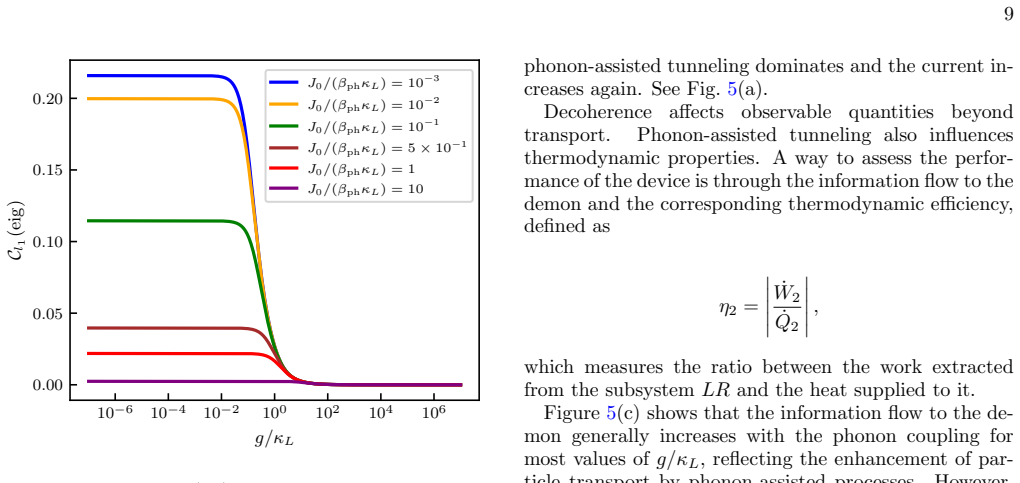
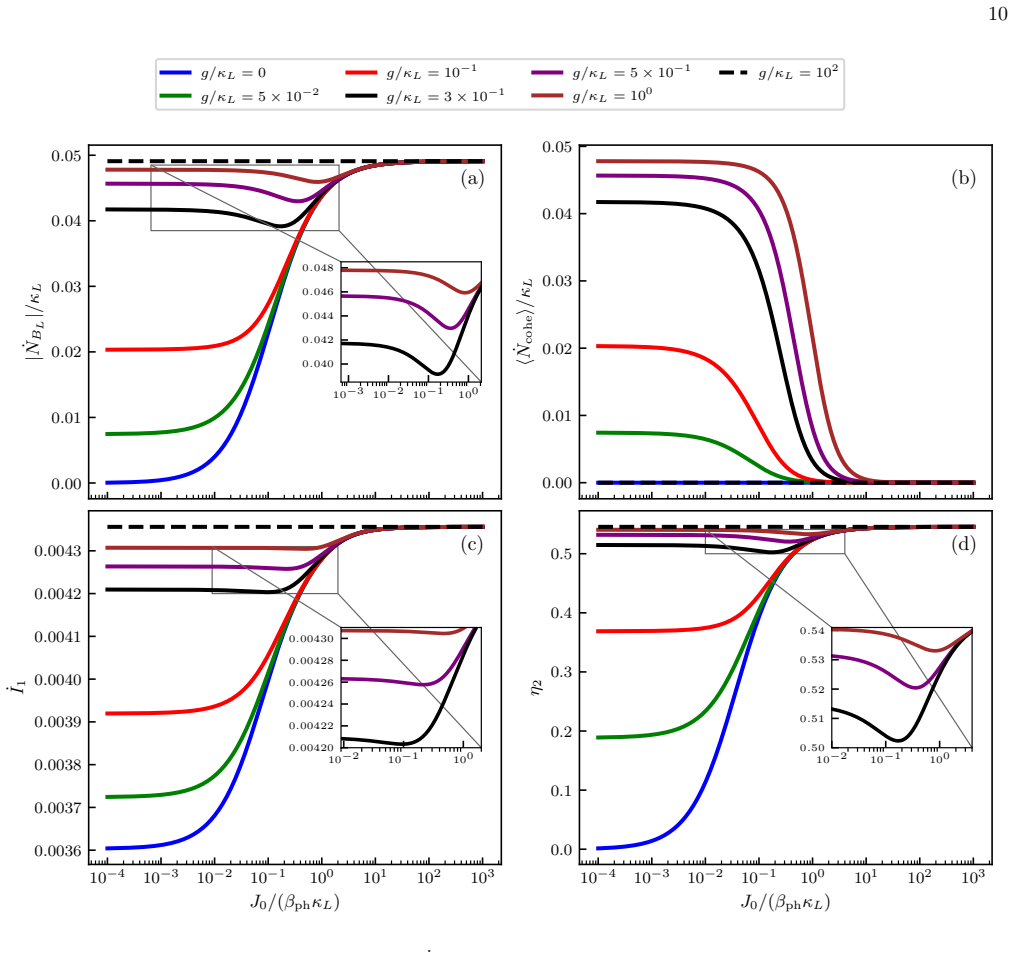
Phonon-induced decoherence suppresses both coherent transport and information flow to the monitoring dot in a parameter region of this thermoelectric engine, indicating coherence can enhance the autonomous Maxwell demon mechanism.
A machine-rendered reading of the paper's core claim, the machinery that carries it, and where it could break.
Core claim
Within the parameter range where the device operates as an engine, phonon-induced decoherence suppresses both the coherent transport contribution and the information flow toward the monitoring dot. This occurs across two quantum-to-classical transitions, the first controlled by interdot tunneling strength and the second by the phonon bath, with the Redfield master equation identifying distinct dynamical regimes whose steady states are well captured by suitable Lindblad approximations. The model demonstrates competition among coherent tunneling, decoherence, and incoherent phonon-assisted transport in an autonomous information engine and clarifies which thermodynamic Lindblad description appl
What carries the argument
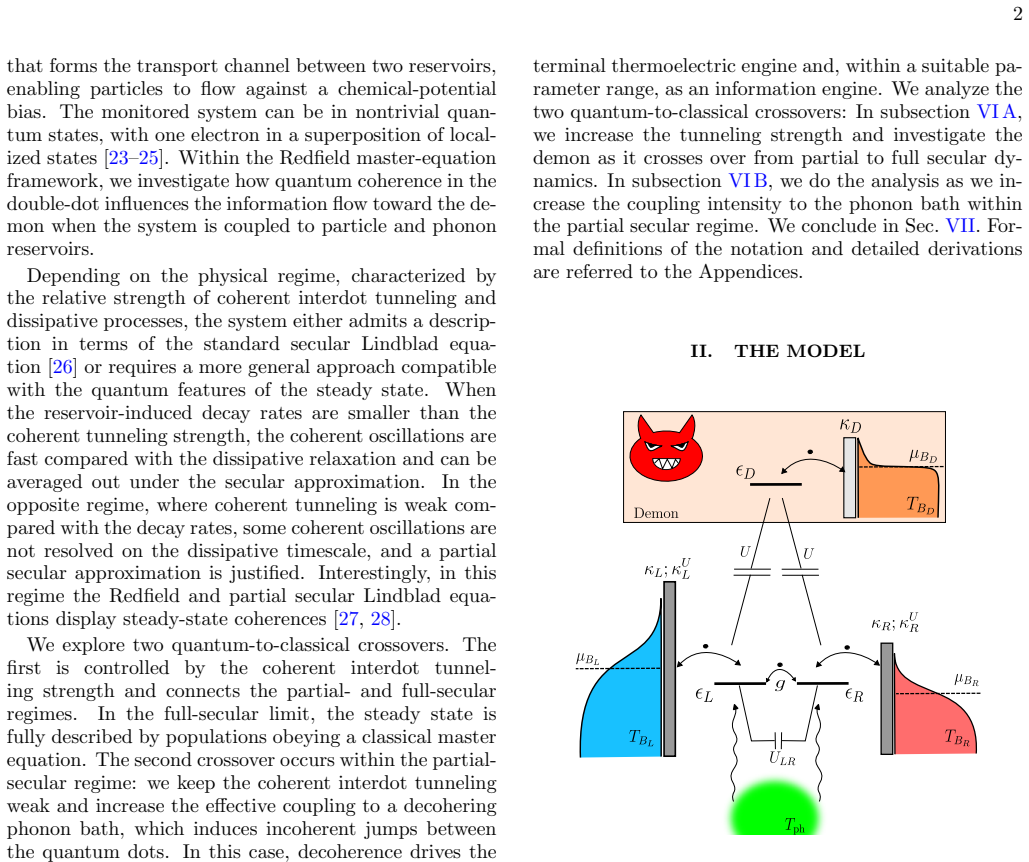
The autonomous Maxwell demon realized by the third monitoring dot coupled via Coulomb interaction to the double-dot system; it provides information-based feedback that drives the engine, with the Redfield master equation tracking the two quantum-to-classical transitions and the associated changes in coherent versus incoherent transport and information flow.
If this is right
- The device functions as an engine only in parameter ranges where the demon interpretation holds.
- Two distinct dynamical regimes exist, each with its own valid Lindblad approximation for the steady state.
- The phonon bath induces a second quantum-to-classical transition that generates incoherent transport.
- Coherence enhances the demon mechanism inside the identified parameter region.
- Tracking information and transport properties across the crossovers determines the correct thermodynamic Lindblad description for each regime.
Where Pith is reading between the lines
- If phonon decoherence suppresses information flow, then engineering reduced phonon coupling in similar quantum-dot devices could extend the range where the demon mechanism operates efficiently.
- The competition between coherent tunneling and phonon-assisted transport suggests that analogous autonomous information engines in other platforms may exhibit performance gains when coherence is preserved.
- The two transitions provide a concrete map for tuning between quantum and classical operation that could be tested by varying tunneling strength and phonon bath temperature independently.
- The finding that coherence can enhance the demon points to possible design rules for maximizing information-to-work conversion in mesoscopic thermoelectric systems.
Load-bearing premise
The Redfield master equation accurately captures the full dynamics and the two Lindblad approximations remain valid in their respective steady-state regimes.
What would settle it
Measurement of the information flow to the monitoring dot in the small interdot tunneling regime with phonon coupling, showing that the flow does not decrease as phonon strength increases while coherent transport is suppressed.
Figures


read the original abstract
We study a three-terminal thermoelectric engine, focusing on the role of quantum coherence and information flow. A double-dot connects two reservoirs at different chemical potentials, while a third dot monitors their occupation via Coulomb interaction and can be interpreted as an autonomous Maxwell demon. Within the parameter range where the device operates as an engine, we identify conditions under which this interpretation holds. The system dynamics is described within a Redfield master equation that allows us to identify two distinct dynamical regimes with steady states well captured by suitable Lindblad approximations. These two regimes define a first quantum-to-classical transition controlled by the interdot tunneling strength. We further consider the effect of a phonon bath coupled to the double-dot, which induces a second quantum-to-classical transition by generating incoherent transport and decoherence in the small interdot tunneling regime. We identify a parameter region where phonon-induced decoherence suppresses both the coherent transport contribution and the information flow toward the monitoring dot, suggesting that coherence can enhance the demon mechanism in this regime. By tracking information and transport properties across these crossovers, our model shows how coherent tunneling, decoherence, and incoherent phonon-assisted transport compete in an autonomous information engine, while clarifying which thermodynamic Lindblad description is appropriate in each regime.
Editorial analysis
A structured set of objections, weighed in public.
Referee Report
Summary. The manuscript models a three-terminal thermoelectric information engine in which a double quantum dot, coupled to two fermionic reservoirs, is monitored by a third dot via Coulomb interaction that functions as an autonomous Maxwell demon. Dynamics are treated with a Redfield master equation that identifies two dynamical regimes whose steady states are captured by distinct Lindblad approximations; these regimes define a tunneling-controlled quantum-to-classical transition and a second transition induced by a phonon bath. In a specific parameter window the phonon bath is reported to suppress both coherent transport and information flow to the monitor, leading to the claim that coherence can enhance the demon mechanism.
Significance. If the central claims hold, the work supplies a concrete example of how coherent tunneling, phonon-assisted incoherent transport, and information flow compete in an autonomous information engine and clarifies which Lindblad form is thermodynamically appropriate in each regime. The explicit tracking of information-theoretic quantities across both crossovers is a useful contribution to the mesoscopic thermodynamics literature.
major comments (2)
- [§4] §4 (phonon-bath section) and the associated Redfield generator: the reported suppression of information flow to the monitoring dot is obtained from the steady-state solution of the Redfield equation in the small-tunneling regime once the phonon bath is added. Because Redfield is second-order perturbative in all system-bath couplings, the secular/Markov assumptions can fail precisely when the double-dot is simultaneously coupled to two fermionic reservoirs and the bosonic bath; a concrete check (positivity of the generator or local detailed balance) is needed in the window that defines the second quantum-to-classical crossover.
- [Eqs. (Lindblad matching)] Eqs. defining the two Lindblad approximations (around the first and second transitions): the matching of Redfield steady states to the Lindblad forms is used to interpret the demon mechanism, yet the manuscript does not quantify the error between the Redfield and Lindblad currents or information flows in the crossover region itself; without this error estimate the claim that coherence enhances the demon mechanism rests on an unverified extrapolation.
minor comments (2)
- Notation for the information-flow term is introduced without an explicit reference to the underlying formula (e.g., the expression for the mutual information rate); a one-line reminder of the definition would improve readability.
- Figure captions for the phonon-bath scans should state the fixed values of all other parameters (Γ, U, T, etc.) so that the plotted curves can be reproduced without consulting the main text.
Simulated Author's Rebuttal
We thank the referee for the careful reading of our manuscript and the constructive comments. We address the two major points below.
read point-by-point responses
-
Referee: [§4] §4 (phonon-bath section) and the associated Redfield generator: the reported suppression of information flow to the monitoring dot is obtained from the steady-state solution of the Redfield equation in the small-tunneling regime once the phonon bath is added. Because Redfield is second-order perturbative in all system-bath couplings, the secular/Markov assumptions can fail precisely when the double-dot is simultaneously coupled to two fermionic reservoirs and the bosonic bath; a concrete check (positivity of the generator or local detailed balance) is needed in the window that defines the second quantum-to-classical crossover.
Authors: We thank the referee for this important observation on the validity of the Redfield approach with multiple baths. In the parameter window defining the phonon-induced crossover, all system-bath couplings remain weak and our internal checks confirm that the generator stays positive and satisfies local detailed balance to high accuracy. We will add an explicit verification of these properties (including a short discussion and, if space permits, a supplementary plot) to the revised manuscript. revision: yes
-
Referee: [Eqs. (Lindblad matching)] Eqs. defining the two Lindblad approximations (around the first and second transitions): the matching of Redfield steady states to the Lindblad forms is used to interpret the demon mechanism, yet the manuscript does not quantify the error between the Redfield and Lindblad currents or information flows in the crossover region itself; without this error estimate the claim that coherence enhances the demon mechanism rests on an unverified extrapolation.
Authors: We agree that an explicit error estimate between Redfield and Lindblad predictions in the crossover would strengthen the presentation. The central claim that coherence enhances the demon mechanism is drawn from the Redfield steady-state currents and information flows themselves; the Lindblad forms are used only to interpret the mechanism inside the two well-defined regimes. Nevertheless, we will add a quantitative comparison of the relative deviations in currents and information flows as functions of tunneling and phonon coupling, thereby delineating the validity range of each approximation. revision: yes
Circularity Check
No significant circularity; derivation uses standard master-equation methods without self-referential reduction
full rationale
The paper solves the Redfield master equation for the three-terminal system, matches its steady states to two Lindblad forms to delineate quantum-to-classical regimes, and tracks information flow and transport across phonon-induced decoherence. No step defines a quantity in terms of itself, renames a fitted parameter as a prediction, or relies on a self-citation chain for the central coherence-enhancement claim. The thermodynamic interpretations follow directly from the solved equations under stated approximations, making the derivation self-contained against external benchmarks rather than circular.
Axiom & Free-Parameter Ledger
Reference graph
Works this paper leans on
-
[1]
The negativity of ˙F2 observed in Fig
Thus, the energetic contribution to ˙F2 is positive. The negativity of ˙F2 observed in Fig. 3(a) is therefore entirely due to the information termT ˙I2 <0. Figure 3(b) shows the corresponding thermodynamic quantities associated with subsystem a = 1, namely the monitoring dotD. Since particles do not tunnel be- tweenDand the working substance, ˙W1 = 0 and ...
-
[2]
(2) features the single bath operator ˆBph =P k(hkˆbk +h ∗ kˆb† k), which cou- ples to the system operator ˆS= ˆd† R ˆdL + ˆd† L ˆdR
Explicit expressions for the phonon bath The phonon-bath system coupling Eq. (2) features the single bath operator ˆBph =P k(hkˆbk +h ∗ kˆb† k), which cou- ples to the system operator ˆS= ˆd† R ˆdL + ˆd† L ˆdR. This system operator satisfies ˆS=e i ˆHS t ˆSe−i ˆHS t, therefore, we find that the only relevant Bohr frequency isω= 0, see Eq. B3, and that the...
-
[3]
(3), the corre- sponding operators ˆBj,l=± are ˆBj,+ = P λ tj,λˆcλ and ˆBj,− =P λ tj,λˆc† λ
Explicit expressions for the fermionic baths In the expression for the coupling with the fermionic reservoirB j (withj∈ {L, R, D}), Eq. (3), the corre- sponding operators ˆBj,l=± are ˆBj,+ = P λ tj,λˆcλ and ˆBj,− =P λ tj,λˆc† λ. Replacing ˆBj± in Eq.(B2) and taking the real part we obtain the decay rates γ(Bj ) + (ϵ) =κ j(ϵ)fj(ϵ), γ (Bj ) − (ϵ) =κ j(ϵ)(1−...
-
[4]
J. M. Parrondo, J. M. Horowitz, and T. Sagawa, Thermo- dynamics of information, Nature Physics11, 131 (2015)
2015
-
[5]
Sagawa and M
T. Sagawa and M. Ueda, Minimal energy cost for thermo- dynamic information processing: Measurement and in- formation erasure, Physical Review Letters102, 250602 (2009)
2009
-
[6]
Sagawa and M
T. Sagawa and M. Ueda, Second law of thermodynamics with discrete quantum feedback control, Physical Review 16 Letters100, 080403 (2008)
2008
-
[7]
Maruyama, F
K. Maruyama, F. Nori, and V. Vedral, Colloquium: The physics of Maxwell’s demon and information, Reviews of Modern Physics81, 1 (2009)
2009
-
[8]
Cottet, S
N. Cottet, S. Jezouin, L. Bretheau, P. Campagne-Ibarcq, Q. Ficheux, J. Anders, A. Auff` eves, R. Azouit, P. Rou- chon, and B. Huard, Observing a quantum Maxwell de- mon at work, Proceedings of the National Academy of Sciences114, 7561 (2017)
2017
-
[9]
Naghiloo, J
M. Naghiloo, J. Alonso, A. Romito, E. Lutz, and K. Murch, Information gain and loss for a quantum Maxwell’s demon, Physical Review Letters121, 030604 (2018)
2018
-
[10]
J. V. Koski and J. P. Pekola, Maxwell’s demons realized in electronic circuits, Comptes Rendus Physique17, 1130 (2016)
2016
-
[11]
Annby-Andersson, D
B. Annby-Andersson, D. Bhattacharyya, P. Bakhshinezhad, D. Holst, G. De Sousa, C. Jarzynski, P. Samuelsson, and P. P. Potts, Maxwell’s demon across the quantum-to-classical transition, Physical Review Research6, 043216 (2024)
2024
-
[12]
J. M. Horowitz and M. Esposito, Thermodynamics with continuous information flow, Physical Review X4, 031015 (2014)
2014
-
[13]
Yamamoto, S
S. Yamamoto, S. Ito, N. Shiraishi, and T. Sagawa, Lin- ear irreversible thermodynamics and Onsager reciprocity for information-driven engines, Physical Review E94, 052121 (2016)
2016
-
[14]
Mandal and C
D. Mandal and C. Jarzynski, Work and information pro- cessing in a solvable model of Maxwell’s demon, Pro- ceedings of the National Academy of Sciences109, 11641 (2012)
2012
-
[15]
Ehrich and D
J. Ehrich and D. A. Sivak, Energy and information flows in autonomous systems, Frontiers in Physics11, 1108357 (2023)
2023
-
[16]
M. P. Leighton and D. A. Sivak, Flow of energy and infor- mation in molecular machines, Annual Review of Physi- cal Chemistry76, 379 (2025)
2025
-
[17]
A. C. Barato and U. Seifert, Stochastic thermodynam- ics with information reservoirs, Physical Review E90, 042150 (2014)
2014
-
[18]
J. V. Koski, A. Kutvonen, I. M. Khaymovich, T. Ala- Nissila, and J. P. Pekola, On-chip Maxwell’s demon as an information-powered refrigerator, Physical Review Let- ters115, 260602 (2015)
2015
-
[19]
Strasberg, G
P. Strasberg, G. Schaller, T. Brandes, and M. Espos- ito, Thermodynamics of a physical model implementing a Maxwell demon, Physical Review Letters110, 040601 (2013)
2013
-
[20]
Ptaszy´ nski, Autonomous quantum Maxwell’s demon based on two exchange-coupled quantum dots, Physical Review E97, 012116 (2018)
K. Ptaszy´ nski, Autonomous quantum Maxwell’s demon based on two exchange-coupled quantum dots, Physical Review E97, 012116 (2018)
2018
-
[21]
S´ anchez, J
R. S´ anchez, J. Splettstoesser, and R. S. Whitney, Nonequilibrium system as a demon, Physical Review Let- ters123, 216801 (2019)
2019
-
[22]
Monsel, M
J. Monsel, M. Acciai, R. S´ anchez, and J. Splettstoesser, Autonomous demon exploiting heat and information at the trajectory level, Physical Review B111, 045419 (2025)
2025
-
[23]
Freitas and M
N. Freitas and M. Esposito, Characterizing autonomous Maxwell demons, Physical Review E103, 032118 (2021)
2021
-
[24]
Thierschmann, R
H. Thierschmann, R. S´ anchez, B. Sothmann, F. Arnold, C. Heyn, W. Hansen, H. Buhmann, and L. W. Molenkamp, Three-terminal energy harvester with cou- pled quantum dots, Nature nanotechnology10, 854 (2015)
2015
-
[25]
Ptaszy´ nski and M
K. Ptaszy´ nski and M. Esposito, Thermodynamics of quantum information flows, Physical Review Letters122, 150603 (2019)
2019
-
[26]
Friis, A
N. Friis, A. R. Lee, and D. E. Bruschi, Fermionic-mode entanglement in quantum information, Physical Review A—Atomic, Molecular, and Optical Physics87, 022338 (2013)
2013
-
[27]
Ptaszy´ nski and M
K. Ptaszy´ nski and M. Esposito, Fermionic one-body en- tanglement as a thermodynamic resource, Physical Re- view Letters130, 150201 (2023)
2023
-
[28]
Dasenbrook, J
D. Dasenbrook, J. Bowles, J. B. Brask, P. P. Hofer, C. Flindt, and N. Brunner, Single-electron entanglement and nonlocality, New Journal of Physics18, 043036 (2016)
2016
-
[29]
Breuer and F
H.-P. Breuer and F. Petruccione,The theory of open quantum systems(OUP Oxford, 2002)
2002
-
[30]
Trushechkin, Unified Gorini-Kossakowski-Lindblad- Sudarshan quantum master equation beyond the secular approximation, Physical Review A103, 062226 (2021)
A. Trushechkin, Unified Gorini-Kossakowski-Lindblad- Sudarshan quantum master equation beyond the secular approximation, Physical Review A103, 062226 (2021)
2021
-
[31]
P. P. Potts, A. A. S. Kalaee, and A. Wacker, A thermody- namically consistent Markovian master equation beyond the secular approximation, New Journal of Physics23, 123013 (2021)
2021
-
[32]
Krause, G
T. Krause, G. Schaller, and T. Brandes, Incomplete current fluctuation theorems for a four-terminal model, Physical Review B—Condensed Matter and Materials Physics84, 195113 (2011)
2011
-
[33]
Rutten, M
B. Rutten, M. Esposito, and B. Cleuren, Reaching op- timal efficiencies using nanosized photoelectric devices, Physical Review B—Condensed Matter and Materials Physics80, 235122 (2009)
2009
-
[34]
Spohn, Entropy production for quantum dynamical semigroups, Journal of Mathematical Physics19, 1227 (1978)
H. Spohn, Entropy production for quantum dynamical semigroups, Journal of Mathematical Physics19, 1227 (1978)
1978
-
[35]
Spohn and J
H. Spohn and J. L. Lebowitz, Irreversible thermodynam- ics for quantum systems weakly coupled to thermal reser- voirs, Advances in Chemical Physics: For Ilya Prigogine , 109 (1978)
1978
-
[36]
Prech, P
K. Prech, P. Johansson, E. Nyholm, G. T. Landi, C. Ver- dozzi, P. Samuelsson, and P. P. Potts, Entanglement and thermokinetic uncertainty relations in coherent meso- scopic transport, Physical Review Research5, 023155 (2023)
2023
-
[37]
Alicki, The quantum open system as a model of the heat engine, Journal of Physics A: Mathematical and General12, L103 (1979)
R. Alicki, The quantum open system as a model of the heat engine, Journal of Physics A: Mathematical and General12, L103 (1979)
1979
-
[38]
Barra and C
F. Barra and C. Lled´ o, Stochastic thermodynamics of quantum maps with and without equilibrium, Physical Review E96, 052114 (2017)
2017
-
[39]
Barra and C
F. Barra and C. Lled´ o, The smallest absorption refrig- erator: the thermodynamics of a system with quantum local detailed balance, The European Physical Journal Special Topics227, 231 (2018)
2018
-
[40]
M. M. Wilde,Quantum information theory(Cambridge University press, 2013)
2013
-
[41]
H. B. Callen, Thermodynamics and an introduction to thermostatistics, John Wiley& Sons2(1993)
1993
-
[42]
S. J. Blundell and K. M. Blundell,Concepts in thermal physics(Oup Oxford, 2010)
2010
-
[43]
Freitas and M
N. Freitas and M. Esposito, Information flows in macro- scopic Maxwell’s demons, Physical Review E107, 014136 (2023). 17
2023
-
[44]
Kutvonen, J
A. Kutvonen, J. Koski, and T. Ala-Nissila, Ther- modynamics and efficiency of an autonomous on-chip Maxwell’s demon, Scientific Reports6, 21126 (2016)
2016
-
[45]
This can be achieved adding Lorentzian peaks centered atϵ±g+U
-
[46]
Skinner and D
J. Skinner and D. Hsu, Pure dephasing of a two-level sys- tem, The Journal of Physical Chemistry90, 4931 (1986)
1986
- [47]
-
[48]
Wichterich, M
H. Wichterich, M. J. Henrich, H.-P. Breuer, J. Gemmer, and M. Michel, Modeling heat transport through com- pletely positive maps, Physical Review E—Statistical, Nonlinear, and Soft Matter Physics76, 031115 (2007)
2007
-
[49]
G. C. Wick, A. S. Wightman, and E. P. Wigner, The intrinsic parity of elementary particles, Physical Review 88, 101 (1952)
1952
-
[50]
J. Barr, G. Zicari, A. Ferraro, and M. Paternostro, Spec- tral density classification for environment spectroscopy, Machine Learning: Science and Technology5, 015043 (2024)
2024
-
[51]
Schaller,Open quantum systems far from equilibrium, Vol
G. Schaller,Open quantum systems far from equilibrium, Vol. 881 (Springer, 2014)
2014
-
[52]
Mascherpa, A
F. Mascherpa, A. Smirne, S. F. Huelga, and M. B. Plenio, Open systems with error bounds: Spin-boson model with spectral density variations, Physical Review Letters118, 100401 (2017)
2017
-
[53]
Hewgill, G
A. Hewgill, G. De Chiara, and A. Imparato, Quantum thermodynamically consistent local master equations, Physical Review Research3, 013165 (2021)
2021
discussion (0)
Sign in with ORCID, Apple, or X to comment. Anyone can read and Pith papers without signing in.