Quantum Logic Codes: Complete Transversal Logical Clifford Instruction Sets for High-Rate Stabilizer Quantum Error Correcting Codes
Pith reviewed 2026-06-27 06:34 UTC · model grok-4.3
The pith
A high-rate family of CSS codes supports a complete set of constant-depth transversal logical Clifford gates.
A machine-rendered reading of the paper's core claim, the machinery that carries it, and where it could break.
Core claim
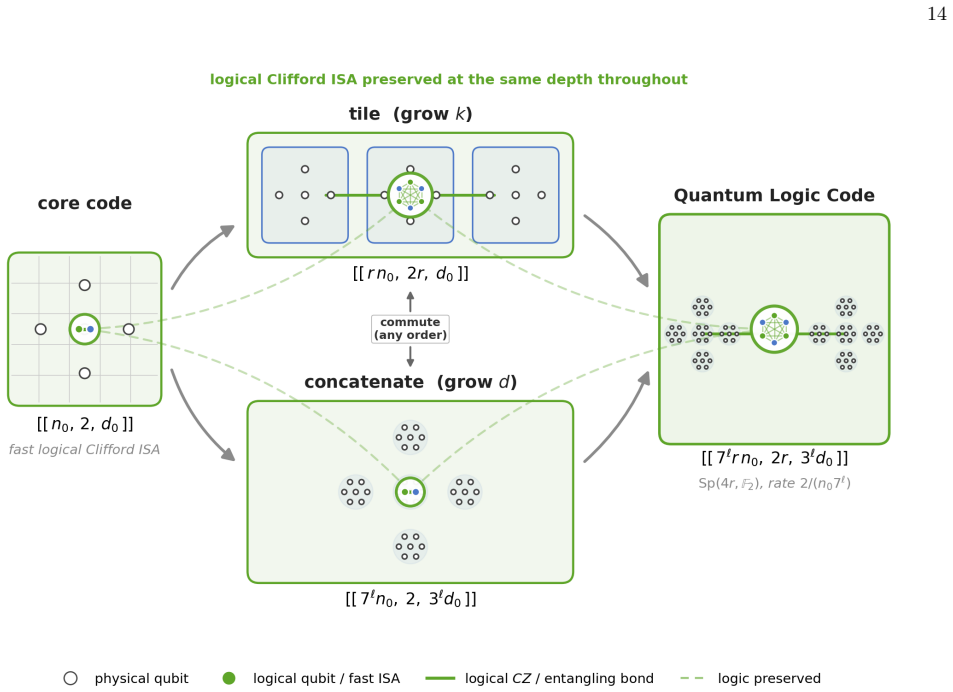
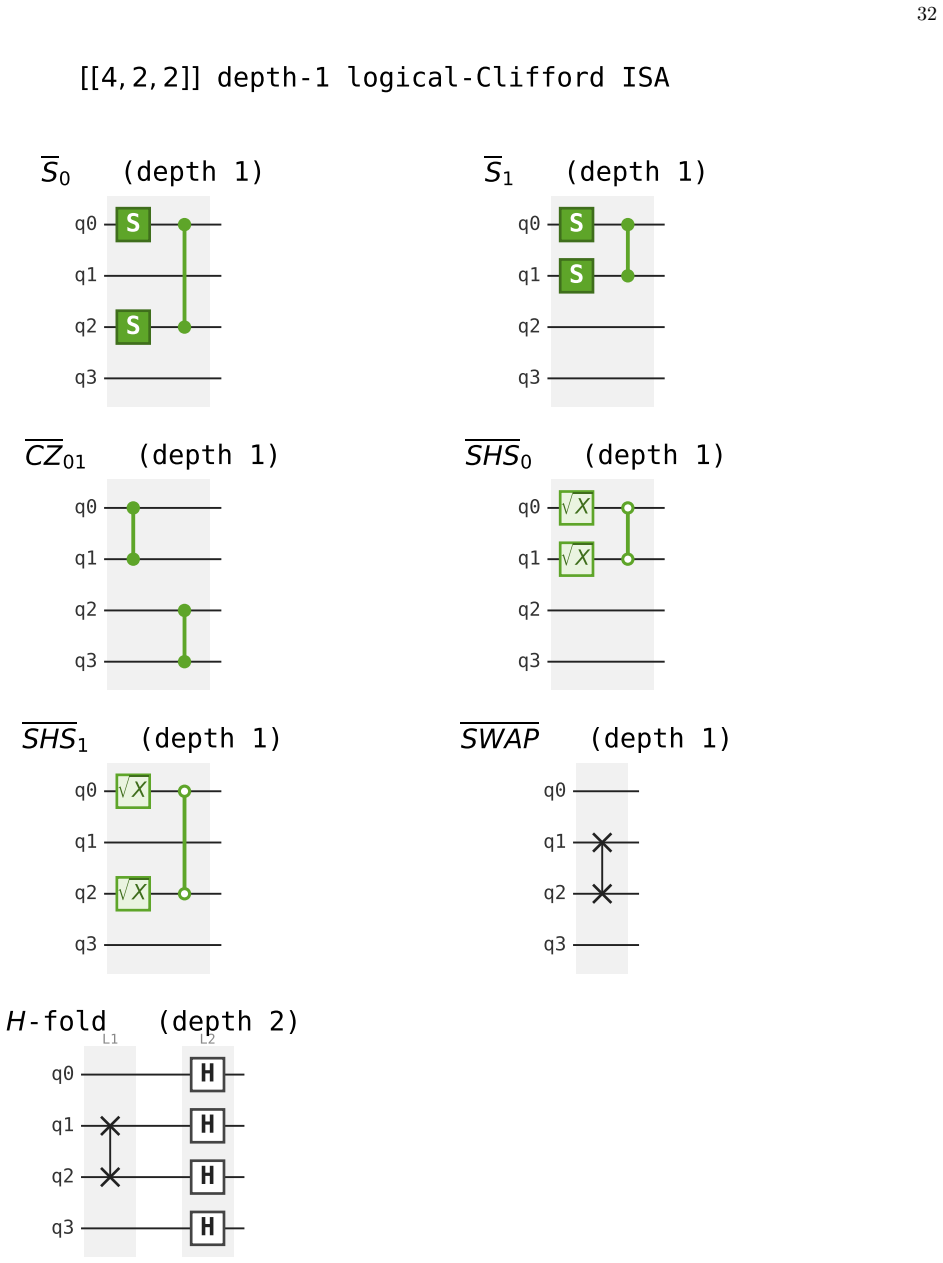
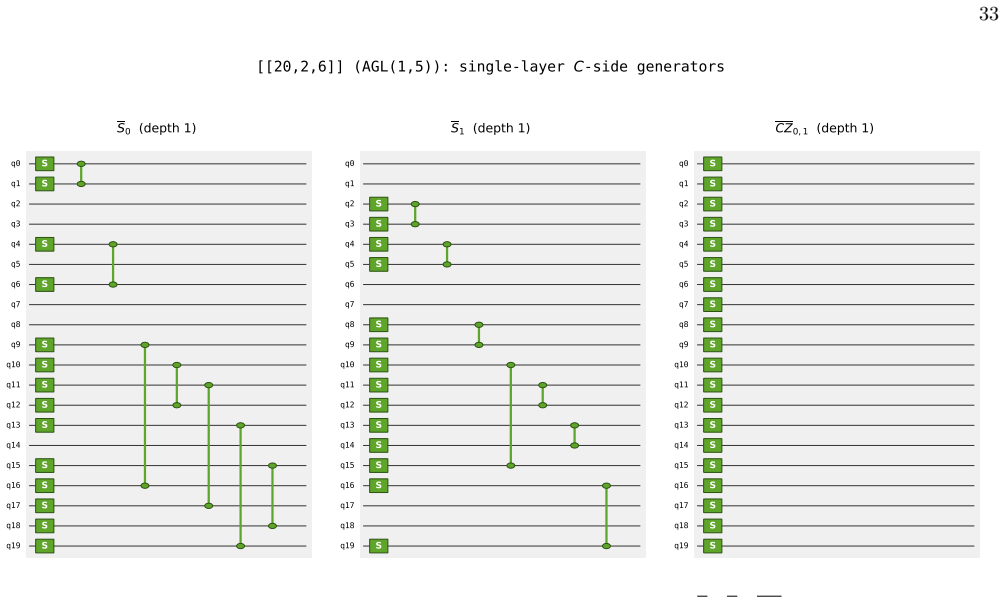
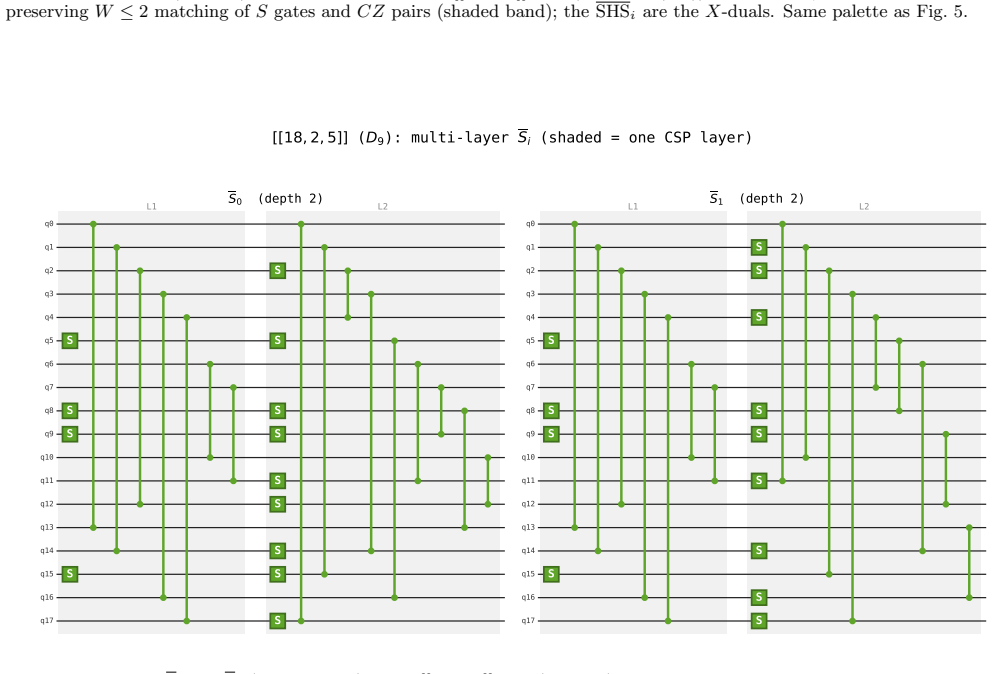
We construct a high-rate non-LDPC CSS code family with parameters [[n, √n, Θ(n^β)]] where β ≈ 0.2823 in one demonstrated case, that provably possesses a constant-depth complete 2-local transversal logical Clifford basis instruction set architecture composed of all individually targeted S̄, SHS̄ = √X̄, and CZ̄ gates. This ISA is depth-one for certain subfamilies and generally constant-depth under certain conditions. The code family is built from a small code with parameters [[n0, 2, d0]] and is tunable through tiling to form utility-scale logical qubit counts and through concatenation to achieve higher distances, with the construction preserving the depth-one complete transversal logical Clif
What carries the argument
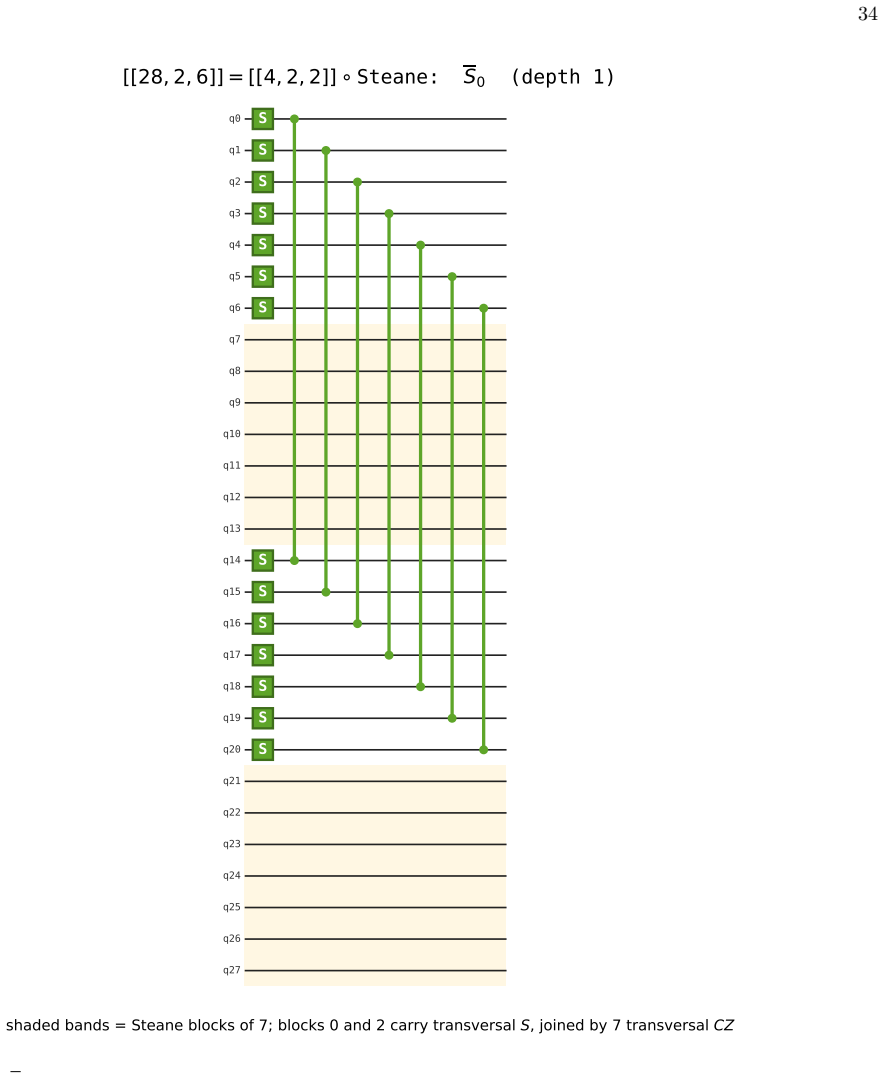
Tiling and concatenation of a base [[n0, 2, d0]] code that commutes with and preserves the complete depth-one transversal Clifford ISA.
If this is right
- Tiling produces utility-scale numbers of logical qubits while the complete ISA remains depth-one for designed subfamilies.
- Concatenation increases distance and error suppression while the ISA stays constant-depth up to depth-two operations between tiled cores.
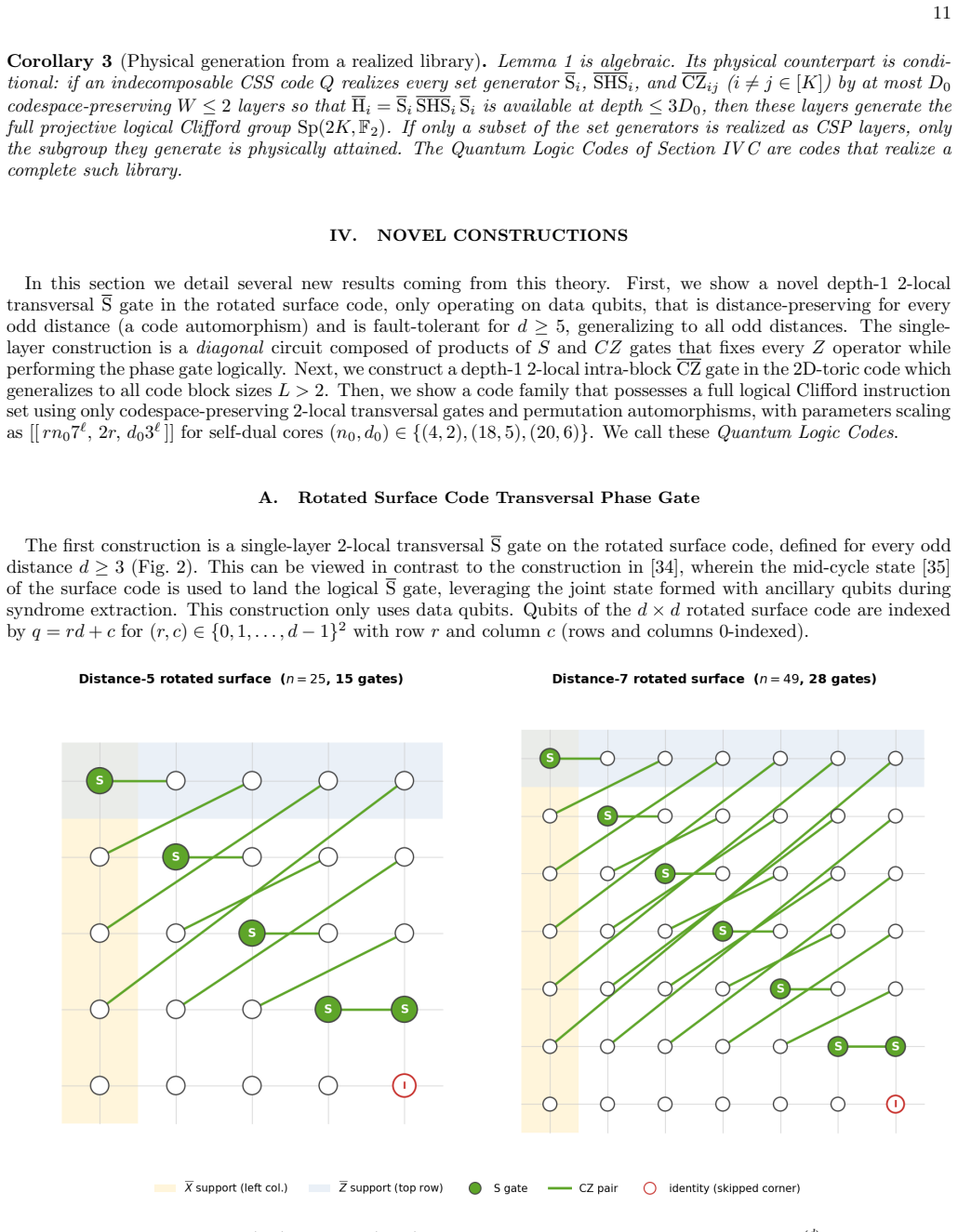
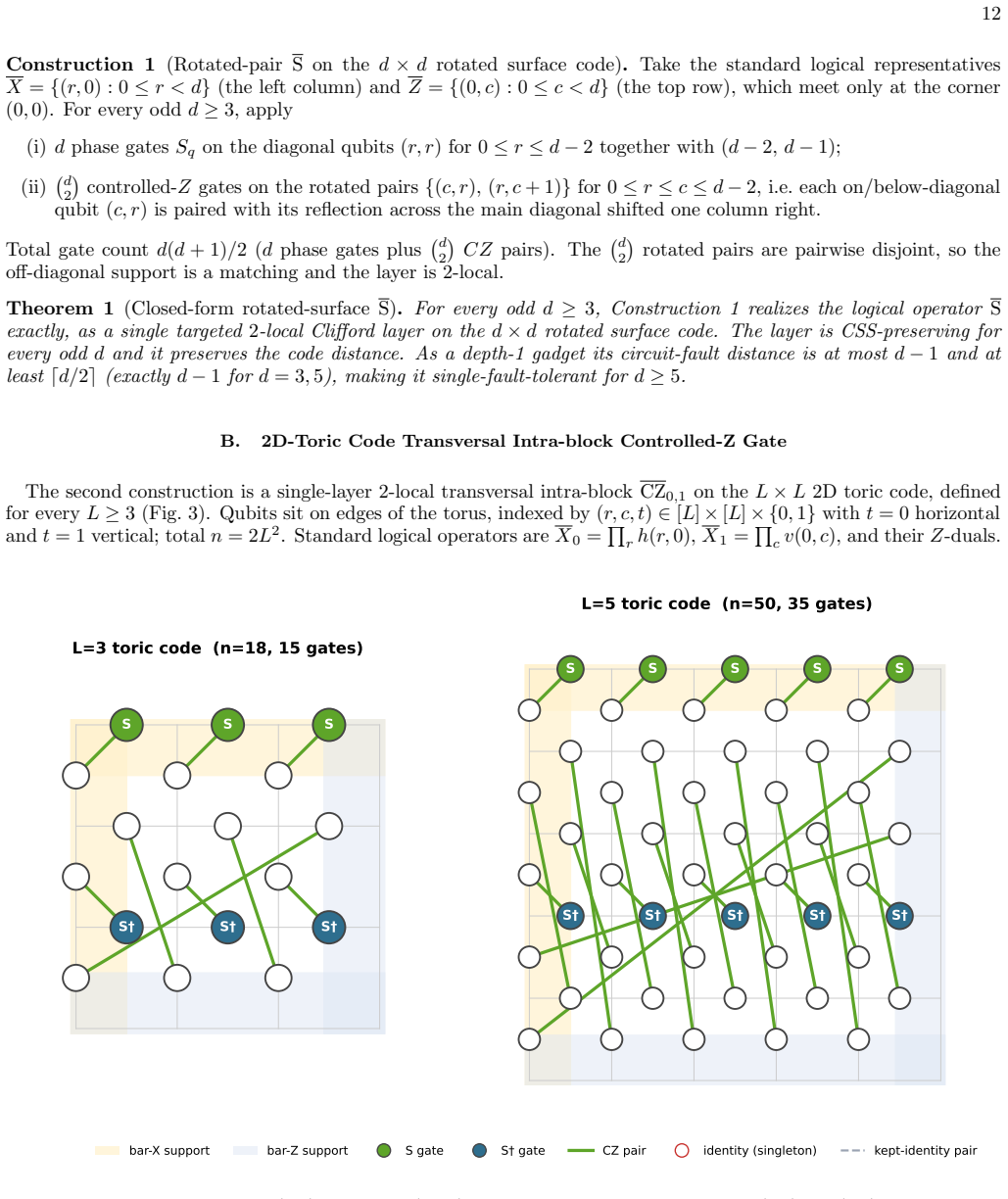
- The construction supplies a depth-one transversal phase gate in the rotated surface code and a depth-one intra-block CZ gate in the 2D-toric code for all odd distances and lengths at least three.
- The family remains non-LDPC while achieving the stated rate and distance scaling.
Where Pith is reading between the lines
- The preservation of transversality under scaling may allow Clifford operations on many logical qubits with error rates that accumulate more slowly than in layered gate decompositions.
- Similar preservation arguments could be tested on other base codes or for gate sets beyond Clifford to address neighbouring problems in fault-tolerant compilation.
- An immediate testable step is to enumerate small candidate base codes [[n0, 2, d0]] and verify whether any satisfy the transversal gate conditions needed to start the family.
Load-bearing premise
A small base code with two logical qubits must exist that already has the required transversal Clifford gate properties, and these properties must survive the tiling and concatenation operations.
What would settle it
An explicit check on the smallest tiled instance of the base code showing that any one of the logical S, √X, or CZ gates requires circuit depth greater than two after construction.
Figures
read the original abstract
We study the structure and transversal logical capabilities of stabilizer quantum error correcting codes. Among our results, we identify universal lower bounds on circuit depth to generate a full logical Clifford algebra, and develop novel constructions of logical transversal gates including a new depth-one transversal phase $\mathrm{\overline{S}}$ gate in the rotated surface code and a depth-one intra-block $\mathrm{\overline{CZ}}$ gate in the 2D-toric code that generalizes to all odd distances and all lengths $L\ge3$, respectively. Finally, we construct a high-rate non-LDPC CSS code family with parameters $[[n,\sqrt{n},\Theta({n^{\beta}})]]$ where $\beta \approx 0.2823$ in one demonstrated case, that provably possesses a constant-depth complete 2-local transversal logical Clifford basis instruction set architecture (ISA) composed of all individually targeted $\mathrm{\overline{S}}$, $\mathrm{\overline{SHS}} = \sqrt{X}$, and $\mathrm{\overline{CZ}}$ gates. This ISA is depth-one for certain subfamilies that we design and generally constant-depth under certain conditions. The code family is built from a small code with parameters $[[n_0, 2, d_0]]$, and is tunable in the standard way: it tiles out to form utility-scale logical qubit counts, and it scales up through concatenation to achieve higher distances and error suppression. We show that this construction preserves the depth-one complete transversal logical Clifford basis ISA when composed with these commuting construction actions, inheriting structure from the core codes so that at scale the complete logical Clifford basis ISA remains depth-one up to depth-two addressable operations between tiled cores. We call these Quantum Logic Codes.
Editorial analysis
A structured set of objections, weighed in public.
Referee Report
Summary. The manuscript identifies lower bounds on circuit depth for generating a full logical Clifford algebra and constructs new depth-one transversal gates (phase S̄ in the rotated surface code; intra-block CZ̄ in the 2D toric code for odd distances and L≥3). It then presents a high-rate non-LDPC CSS code family with parameters [[n, √n, Θ(n^β)]] (β≈0.2823 in one case) that is asserted to possess a constant-depth (sometimes depth-one) complete 2-local transversal logical Clifford ISA consisting of individually targeted S̄, SHS̄=√X̄, and CZ̄ gates. The family is obtained from a base [[n0,2,d0]] CSS code by tiling (to achieve k=√n) and concatenation (to raise distance), with the ISA claimed to be preserved under these operations.
Significance. If the central claims hold, the construction would supply a concrete route to high-rate stabilizer codes equipped with a full transversal Clifford ISA at scale. This addresses a longstanding tension between rate, distance, and logical-gate overhead in fault-tolerant quantum computation. The explicit use of standard tiling/concatenation operations that are shown to commute with the ISA is a methodological strength, as is the provision of concrete new transversal gates in well-studied codes such as the surface and toric codes.
major comments (2)
- [Construction of the code family (core-code section)] The headline claim that the family 'provably possesses' the complete depth-one (or constant-depth) transversal Clifford ISA rests on the existence of a base [[n0,2,d0]] CSS code that itself supports individually targeted depth-one S̄, √X̄, and CZ̄ gates. No explicit parameters, stabilizer generators, or logical-operator definitions for any such base code are supplied, rendering the inheritance argument unverifiable.
- [Preservation under tiling and concatenation] The assertion that tiling and concatenation preserve the 2-local depth-one ISA (including that these operations commute with the gates and do not introduce extra depth or non-2-local interactions) is load-bearing for the scaled parameters [[n,√n,Θ(n^β)]]. The manuscript states the preservation but does not provide the explicit commutation relations, depth accounting, or inductive argument that would establish this for arbitrary numbers of tiles or concatenation levels.
minor comments (1)
- [Abstract and parameter section] The numerical value β≈0.2823 is stated without an accompanying derivation, table of exponents, or reference to the underlying rate-distance calculation; a short appendix or inline equation showing how this exponent arises from the tiling/concatenation parameters would aid reproducibility.
Simulated Author's Rebuttal
We thank the referee for their thorough review and for recognizing the potential significance of the construction. We address the two major comments below and will incorporate clarifications and additional details into the revised manuscript.
read point-by-point responses
-
Referee: [Construction of the code family (core-code section)] The headline claim that the family 'provably possesses' the complete depth-one (or constant-depth) transversal Clifford ISA rests on the existence of a base [[n0,2,d0]] CSS code that itself supports individually targeted depth-one S̄, √X̄, and CZ̄ gates. No explicit parameters, stabilizer generators, or logical-operator definitions for any such base code are supplied, rendering the inheritance argument unverifiable.
Authors: We agree that an explicit base code would render the inheritance argument more immediately verifiable. The manuscript defines the required properties of the base [[n0,2,d0]] CSS code (support for individually targeted depth-one S̄, √X̄, and CZ̄) and shows how these properties are inherited under the stated operations, but does not exhibit a concrete stabilizer tableau or logical-operator matrix for any specific (n0,d0) instance. We will add a new subsection in the core-code section that supplies one explicit base code (including generators and logical operators) together with a verification that it satisfies the required transversal-gate conditions. revision: yes
-
Referee: [Preservation under tiling and concatenation] The assertion that tiling and concatenation preserve the 2-local depth-one ISA (including that these operations commute with the gates and do not introduce extra depth or non-2-local interactions) is load-bearing for the scaled parameters [[n,√n,Θ(n^β)]]. The manuscript states the preservation but does not provide the explicit commutation relations, depth accounting, or inductive argument that would establish this for arbitrary numbers of tiles or concatenation levels.
Authors: The manuscript argues preservation on the basis that both tiling and concatenation act block-wise on the logical operators and stabilizers while preserving the 2-local support of the target gates. However, we acknowledge that the commutation relations, depth accounting, and an inductive argument for arbitrary numbers of tiles or concatenation levels are stated at a high level rather than derived in full detail. We will add an appendix that (i) lists the explicit commutation relations between the tiling/concatenation maps and each gate in the ISA, (ii) provides a depth tally showing that the logical gates remain depth-one (or constant-depth) after each operation, and (iii) supplies a short inductive proof covering multiple concatenation levels and arbitrary tile counts. revision: yes
Circularity Check
No significant circularity; derivation relies on explicit preservation proof from base code
full rationale
The paper constructs the high-rate family from a base [[n0,2,d0]] code and states that it 'show[s] that this construction preserves the depth-one complete transversal logical Clifford basis ISA when composed with these commuting construction actions, inheriting structure from the core codes'. This is presented as a demonstrated result rather than a definitional reduction or fitted input. No equations reduce claimed properties to self-referential inputs, no self-citation chains are load-bearing in the abstract, and the novel gate constructions (e.g., depth-one S̄ in rotated surface code) are independent. The derivation is therefore self-contained against external benchmarks of base-code existence and preservation proofs.
Axiom & Free-Parameter Ledger
free parameters (1)
- β ≈ 0.2823
axioms (1)
- domain assumption Tiling and concatenation of a base [[n0,2,d0]] stabilizer code preserve the complete transversal Clifford ISA when the base code possesses the required gates.
Reference graph
Works this paper leans on
-
[1]
The complete logical Clifford basis ISA Definition 5(Complete transversal logical Clifford basis ISA).LetQ= CSS(H X , HZ) encodeklogical qubits with canonical representatives (L X , LZ),L X L⊤ Z =I k, and stabilizer rowspansS X , SZ. Acomplete transversal logical Clifford basis ISAforQis a finite library of circuits whose logical symplectic images generat...
-
[2]
(7) is generated by the following theorem, which gives sufficient conditions under which the two composition operations preserve a complete ISA
Bounded-depth self-dual composition The family of Eq. (7) is generated by the following theorem, which gives sufficient conditions under which the two composition operations preserve a complete ISA. Theorem 3(Bounded-depth self-dual composition).LetQ= [[n, k, d]]carry a complete transversal logical Clifford basis ISA (Def. 5) that isbounded-depth (D 0)and...
-
[3]
The combined family Theorem 3 generates Eq. (7) from each core:ℓ[[7,1,3]] levels multiply (n, d) by (7,3) per level at fixedkand fixed depth, whiler-fold tiling multiplies (n, k) byrat fixedd, sok= 2randd=d 03ℓ are independently tunable and the rate 2/(n 07ℓ) depends only on the core and the concatenation depth. Table I lists representative members; every...
-
[4]
Table II records the depth-optimized layer counts
First concatenation level By Theorem 3 the first [[7,1,3]] level of each core, [[28,2,6]] = [[4,2,2]]◦[[7,1,3]], [[126,2,15]] = [[18,2,5]]◦[[7,1,3]], and [[140,2,18]] = [[20,2,6]]◦[[7,1,3]] carries the complete logical-Clifford basis ISA at thesameper-generator layer count as its core: each outerW≤2 layer lifts to exactly one innerW≤2 layer, so the distan...
-
[5]
Stabilizer codes and quantum error correction.arXiv, 1997
Daniel Gottesman. Stabilizer codes and quantum error correction.arXiv, 1997. URLhttp://arxiv.org/abs/quant-ph/ 9705052v1
1997
-
[6]
Paul Webster, Samuel C Smith, and Lawrence Z Cohen. Explicit construction of low-overhead gadgets for gates on quantum ldpc codes.arXiv preprint arXiv:2511.15989, 2025. 19
arXiv 2025
-
[7]
Fault-tolerant quantum computation with constant overhead.Quantum Information and Computation, 14(15–16):1338–1372, 2014
Daniel Gottesman. Fault-tolerant quantum computation with constant overhead.Quantum Information and Computation, 14(15–16):1338–1372, 2014
2014
-
[8]
Adam Paetznick and Ben W. Reichardt. Universal fault-tolerant quantum computation with only transversal gates and error correction.Physical Review Letters, 111(9):090505, 2013. doi:10.1103/PhysRevLett.111.090505
-
[9]
Cross, Jay M
Sergey Bravyi, Andrew W. Cross, Jay M. Gambetta, Dmitri Maslov, Patrick Rall, and Theodore J. Yoder. High-threshold and low-overhead fault-tolerant quantum memory.Nature, 627:778–782, 2024
2024
-
[10]
Pablo Bonilla Ataides, Christopher A
Qian Xu, J. Pablo Bonilla Ataides, Christopher A. Pattison, Nithin Raveendran, Dolev Bluvstein, Jonathan Wurtz, Bane Vasi´ c, Mikhail D. Lukin, Liang Jiang, and Hengyun Zhou. Constant-overhead fault-tolerant quantum computation with reconfigurable atom arrays.Nature Physics, 20:1084–1090, 2024
2024
-
[11]
Construction of the full logical clifford group for high-rate quantum reed-muller codes using only transversal and fold-transversal gates.arXiv preprint, 2026
Theerapat Tansuwannont, Tim Chan, and Ryuji Takagi. Construction of the full logical clifford group for high-rate quantum reed-muller codes using only transversal and fold-transversal gates.arXiv preprint, 2026
2026
-
[12]
No-go theorem on fault tolerant gadgets for multiple logical qubits.arXiv,
Aranya Chakraborty and Daniel Gottesman. No-go theorem on fault tolerant gadgets for multiple logical qubits.arXiv,
-
[13]
URLhttp://arxiv.org/abs/2602.13395v2
-
[14]
On the addressability problem on css codes
J´ erˆ ome Guyot and Samuel Jaques. On the addressability problem on css codes. 2025
2025
-
[15]
Jonathan E. Moussa. Transversal clifford gates on folded surface codes.Physical Review A, 94(4):042316, 2016. doi: 10.1103/PhysRevA.94.042316
-
[16]
Tomas Jochym-O’Connor and Raymond Laflamme. Using concatenated quantum codes for universal fault-tolerant quantum gates.Physical Review Letters, 112(1):010505, 2014. doi:10.1103/PhysRevLett.112.010505
-
[17]
Madelyn Cain, Qian Xu, Robbie King, Lewis R. B. Picard, Harry Levine, Manuel Endres, John Preskill, Hsin-Yuan Huang, and Dolev Bluvstein. Shor’s algorithm is possible with as few as 10,000 reconfigurable atomic qubits. 2026
2026
-
[18]
Hockings, Nouedyn Baspin, Felix Thomsen, Samuel C
Paul Webster, Lucas Berent, Omprakash Chandra, Evan T. Hockings, Nouedyn Baspin, Felix Thomsen, Samuel C. Smith, and Lawrence Z. Cohen. The pinnacle architecture: Reducing the cost of breaking rsa-2048 to 100,000 physical qubits using quantum ldpc codes. 2026
2048
-
[19]
How to factor 2048 bit rsa integers with less than a million noisy qubits
Craig Gidney. How to factor 2048 bit rsa integers with less than a million noisy qubits. 2025
2048
-
[20]
Felix Tripier, Woo Chang Chung, Jacob Young, Safwan Alam, Bryce Bjork, Aharon Brodutch, Finn Lasse Buessen, Nolan J. Coble, Thomas Dellaert, Dmitri Maslov, Martin Roetteler, Edwin Tham, Mark Webster, Min Ye, John Gamble, Andrii Maksymov, J. P. Marceaux, and Nicolas Delfosse. Fault-tolerant quantum computing with trapped ions: The walking cat architecture....
Pith/arXiv arXiv 2026
-
[21]
Targeted clifford logical gates for hypergraph product codes.Quantum, 9:1842, 2025
Adway Patra and Alexander Barg. Targeted clifford logical gates for hypergraph product codes.Quantum, 9:1842, 2025
2025
-
[22]
Narayanan Rengaswamy, Robert Calderbank, Swanand Kadhe, and Henry D. Pfister. Synthesis of logical clifford operators via symplectic geometry. 2018
2018
-
[23]
Self-dual bivariate bicycle codes with transversal clifford gates.arXiv preprint, 2025
Zijian Liang and Yu-An Chen. Self-dual bivariate bicycle codes with transversal clifford gates.arXiv preprint, 2025
2025
-
[24]
Hasan Sayginel, Stergios Koutsioumpas, Mark Webster, Abhishek Rajput, and Dan E. Browne. Fault-tolerant logical clifford gates from code automorphisms.PRX Quantum, 6:030343, 2025
2025
-
[25]
Leveraging automorphisms of quantum codes for fault-tolerant quantum computation
Markus Grassl and Martin R¨ otteler. Leveraging automorphisms of quantum codes for fault-tolerant quantum computation. In2013 IEEE International Symposium on Information Theory (ISIT), pages 534–538, 2013
2013
-
[26]
Restrictions on transversal encoded quantum gate sets.Physical Review Letters, 102 (11):110502, 2009
Bryan Eastin and Emanuel Knill. Restrictions on transversal encoded quantum gate sets.Physical Review Letters, 102 (11):110502, 2009. doi:10.1103/PhysRevLett.102.110502
-
[27]
Sergey Bravyi and Robert K¨ onig. Classification of topologically protected gates for local stabilizer codes.Physical Review Letters, 110(17):170503, 2013. doi:10.1103/PhysRevLett.110.170503
-
[28]
Fault-tolerant logical gates in quantum error-correcting codes.Physical Review A, 91(1):012305, 2015
Fernando Pastawski and Beni Yoshida. Fault-tolerant logical gates in quantum error-correcting codes.Physical Review A, 91(1):012305, 2015. doi:10.1103/PhysRevA.91.012305
-
[29]
Tomas Jochym-O’Connor, Aleksander Kubica, and Theodore J. Yoder. Disjointness of stabilizer codes and limitations on fault-tolerant logical gates.Physical Review X, 8(2):021047, 2018. doi:10.1103/PhysRevX.8.021047
-
[30]
Cross, and Isaac L
Bei Zeng, Andrew W. Cross, and Isaac L. Chuang. Transversality versus universality for additive quantum codes.IEEE Transactions on Information Theory, 57(9):6272–6284, 2011
2011
-
[31]
Anderson and Tomas Jochym-O’Connor
Jonas T. Anderson and Tomas Jochym-O’Connor. Classification of transversal gates in qubit stabilizer codes.Quantum Information and Computation, 16(9–10):771–802, 2016
2016
-
[32]
E. X. Fu, H. Zheng, Z. Li, and Zi-Wen Liu. No-go theorems for logical gates on product quantum codes.arXiv preprint, 2025
2025
-
[33]
Malcolm, Andrew N
Alexander J. Malcolm, Andrew N. Glaudell, Patricio Fuentes, Daryus Chandra, Alexis Schotte, Colby DeLisle, Rafael Haenel, Amir Ebrahimi, Joschka Roffe, Armanda O. Quintavalle, Stefanie J. Beale, Nicholas R. Lee-Hone, and Stephanie Simmons. Computing efficiently in qldpc codes. 2025
2025
-
[34]
Yoder, Ryuji Takagi, and Isaac L
Theodore J. Yoder, Ryuji Takagi, and Isaac L. Chuang. Universal fault-tolerant gates on concatenated stabilizer codes. Physical Review X, 6(3), Sept 2016. ISSN 2160-3308. doi:10.1103/physrevx.6.031039. URLhttp://dx.doi.org/10.1103/ physrevx.6.031039
-
[35]
Self-dual stacked quantum low-density parity-check codes.arXiv preprint arXiv:2602.15372, 2026
Ze-Chuan Liu, Chong-Yuan Xu, and Yong Xu. Self-dual stacked quantum low-density parity-check codes.arXiv preprint arXiv:2602.15372, 2026
arXiv 2026
-
[36]
Breuckmann, Margarita Davydova, Jens N
Nikolas P. Breuckmann, Margarita Davydova, Jens N. Eberhardt, and Nathanan Tantivasadakarn. Cups and gates i: Cohomology invariants and logical quantum operations.Communications in Mathematical Physics, 407(5), Apr 2026. ISSN 1432-0916. doi:10.1007/s00220-026-05570-z. URLhttp://dx.doi.org/10.1007/s00220-026-05570-z
-
[37]
Breuckmann and Simon Burton
Nikolas P. Breuckmann and Simon Burton. Fold-transversal clifford gates for quantum codes.Quantum, 8:1372, 2024
2024
-
[38]
Scott Aaronson and Daniel Gottesman. Improved simulation of stabilizer circuits.Physical Review A, 70(5):052328, 2004. doi:10.1103/PhysRevA.70.052328. 20
-
[39]
Zi-Han Chen, Ming-Cheng Chen, Chao-Yang Lu, and Jian-Wei Pan. Transversal logical clifford gates on the rotated surface code with reconfigurable neutral atom arrays.Physical Review Letters, 136(13), Mar 2026. ISSN 1079-7114. doi:10.1103/m7tq-9v3g. URLhttp://dx.doi.org/10.1103/m7tq-9v3g
-
[40]
Relaxing Hardware Requirements for Surface Code Circuits using Time-dynamics , volume=
Matt McEwen, Dave Bacon, and Craig Gidney. Relaxing hardware requirements for surface code circuits using time- dynamics.Quantum, 7:1172, Nov 2023. ISSN 2521-327X. doi:10.22331/q-2023-11-07-1172. URLhttp://dx.doi.org/10. 22331/q-2023-11-07-1172
-
[41]
Taylor.The Geometry of the Classical Groups, volume 9 ofSigma Series in Pure Mathematics
Donald E. Taylor.The Geometry of the Classical Groups, volume 9 ofSigma Series in Pure Mathematics. Heldermann Verlag, 1992
1992
-
[42]
Dickson.Linear Groups with an Exposition of the Galois Field Theory
Leonard E. Dickson.Linear Groups with an Exposition of the Galois Field Theory. B. G. Teubner, Leipzig, 1901. 21 VI. SUPPLEMENTARY MATERIAL In this Supplementary Material, we provide formal rigorous proofs of propositions, lemmas, theorems, and con- structions present in the main text. We go through this in a sequence matching the presentation of the main...
1901
discussion (0)
Sign in with ORCID, Apple, or X to comment. Anyone can read and Pith papers without signing in.