Contrast-Informed Augmentation and Domain-Adversarial Training for Adult-to-Neonatal MR Reconstruction Generalization
Pith reviewed 2026-06-27 06:47 UTC · model grok-4.3
The pith
Contrast-informed augmentation and domain-adversarial training improve generalization of adult-trained MR reconstruction models to neonatal brain scans.
A machine-rendered reading of the paper's core claim, the machinery that carries it, and where it could break.
Core claim
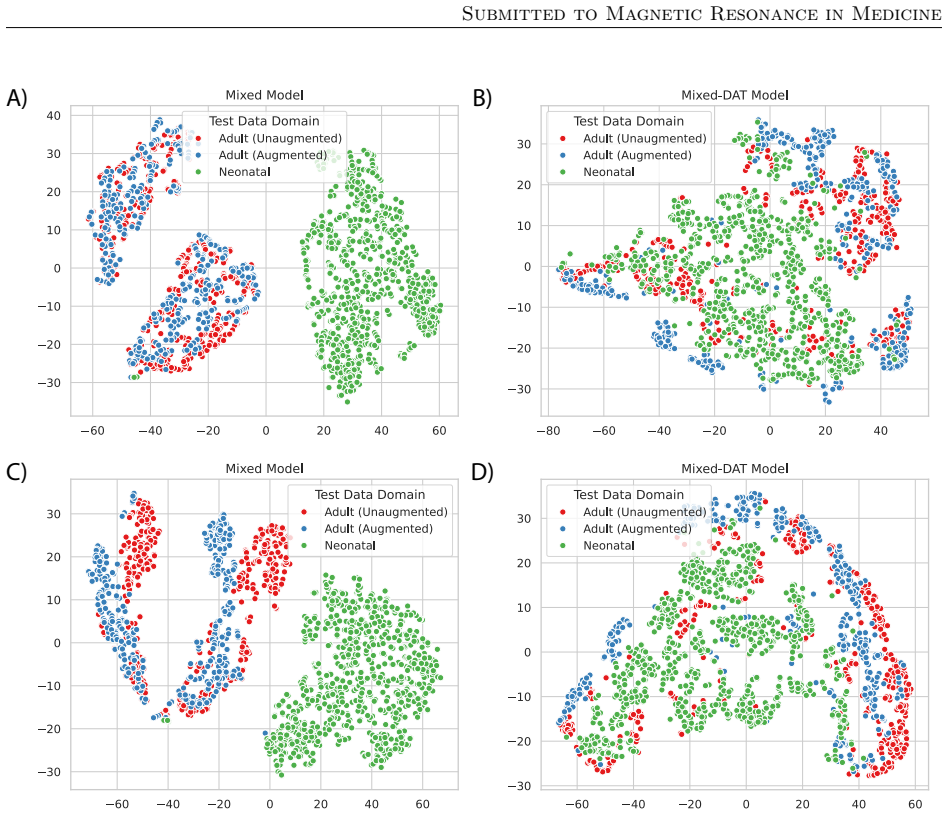
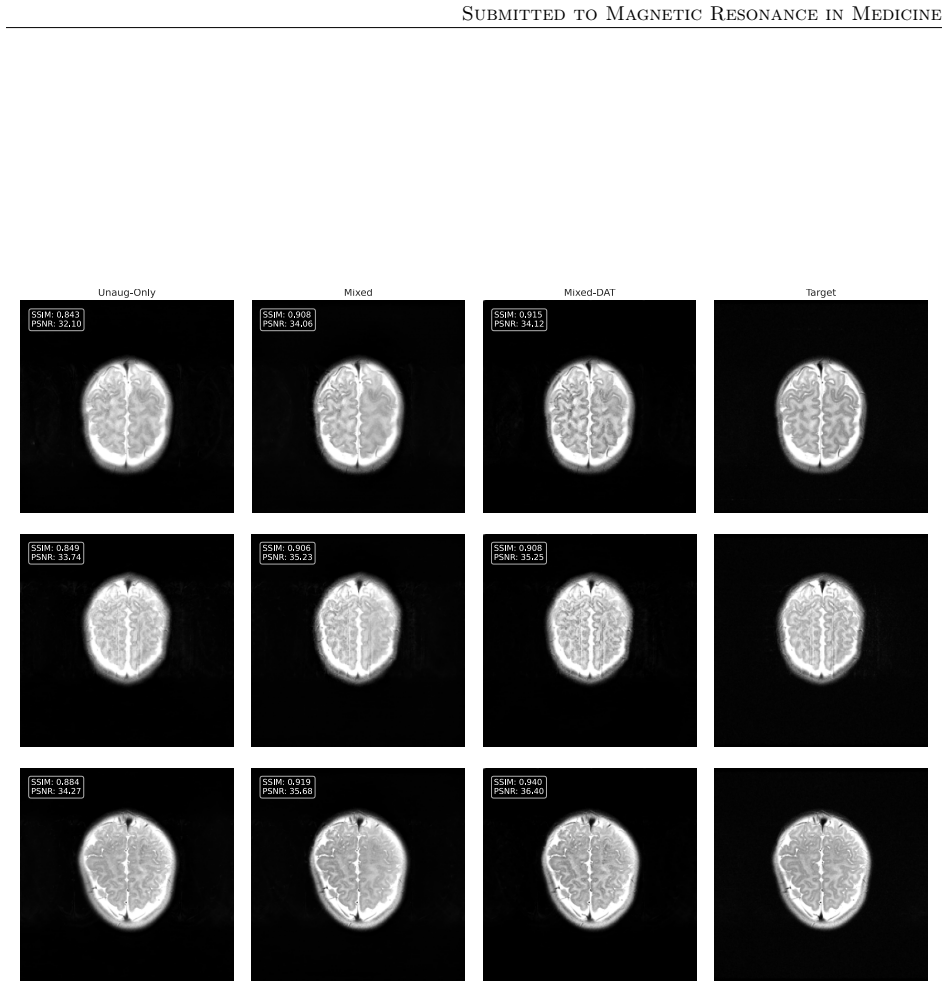
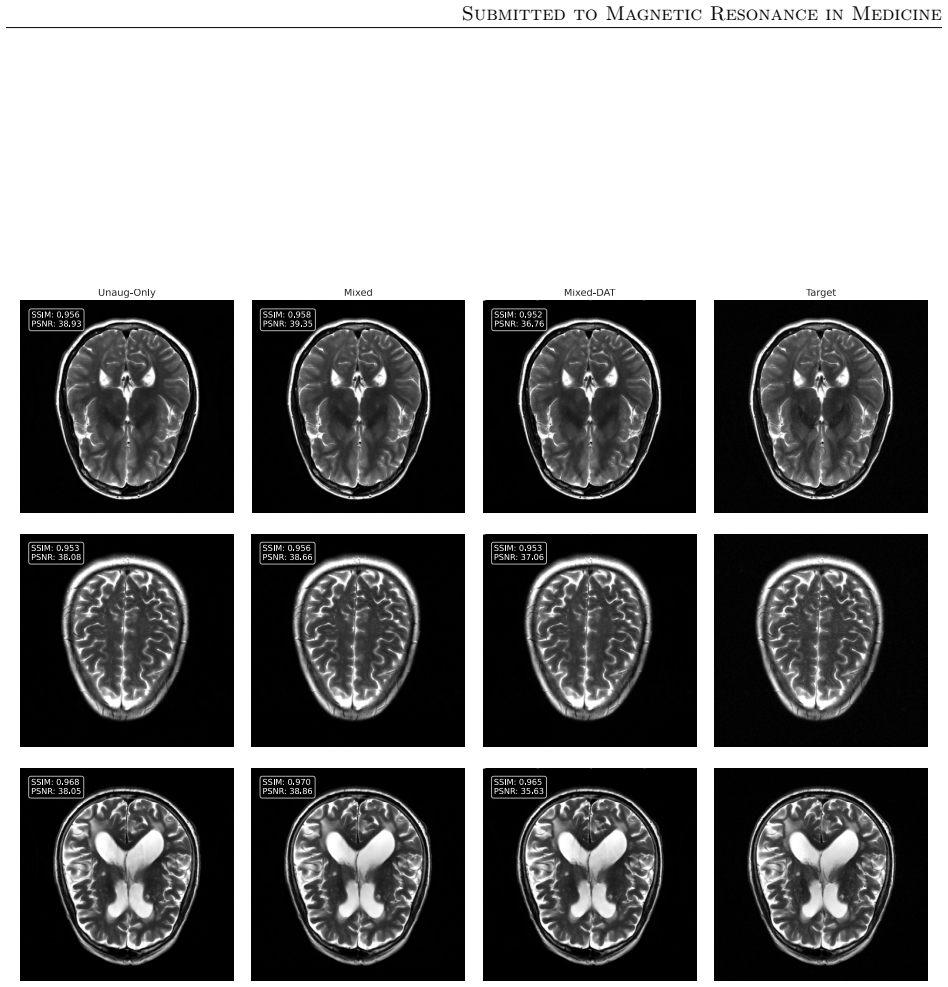
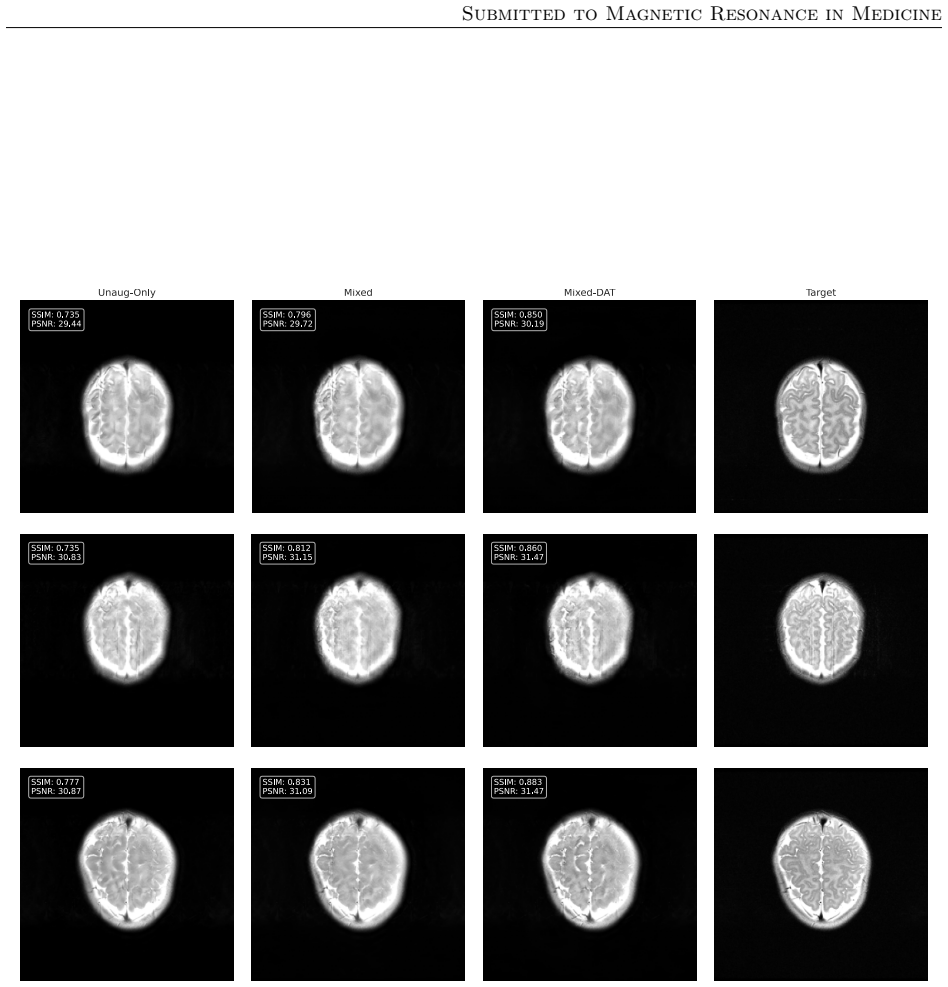
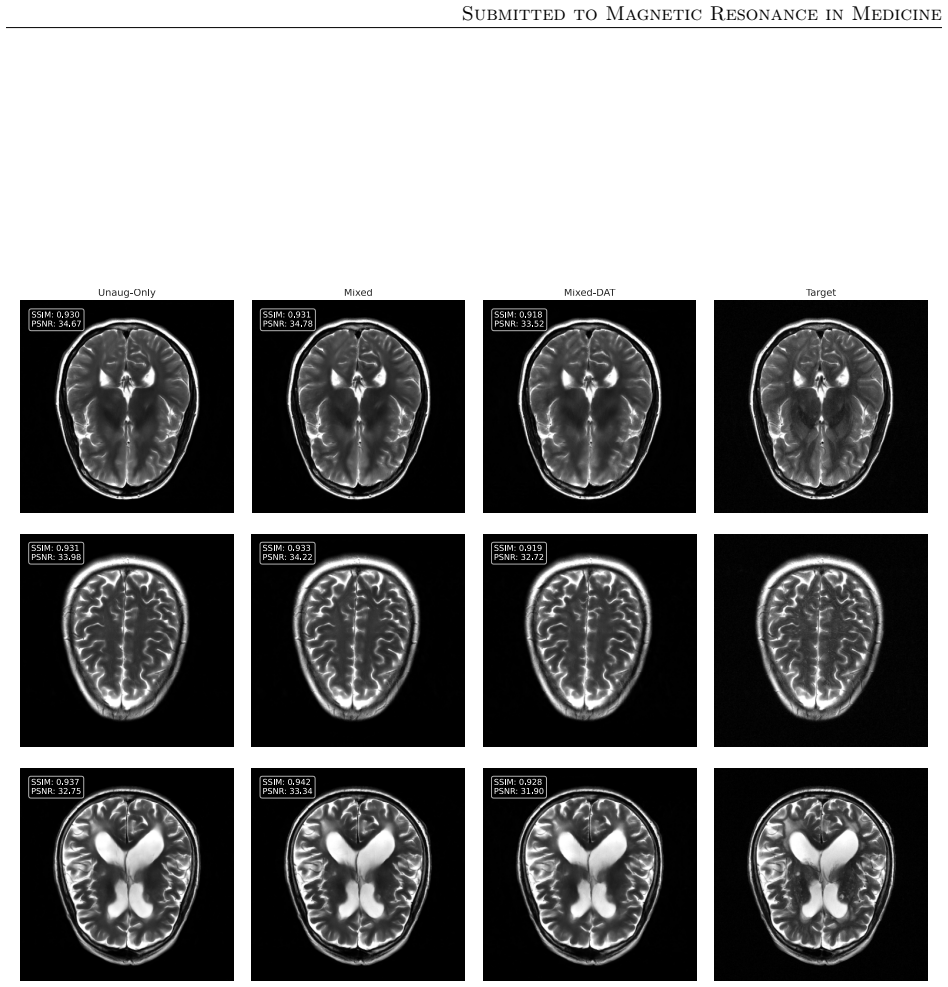
Mixed training that includes contrast-informed augmentation of adult data, and especially the version that adds domain-adversarial training, outperforms unaugmented adult-only training when the models are tested on neonatal T2-weighted brain MR data. At R=4 the adversarial version reaches the highest scores; at R=8 it reaches the highest SSIM while the non-adversarial mixed version reaches the highest PSNR. t-SNE visualizations indicate that the adversarial objective increases overlap among the latent representations of unaugmented adult, augmented adult, and neonatal samples.
What carries the argument
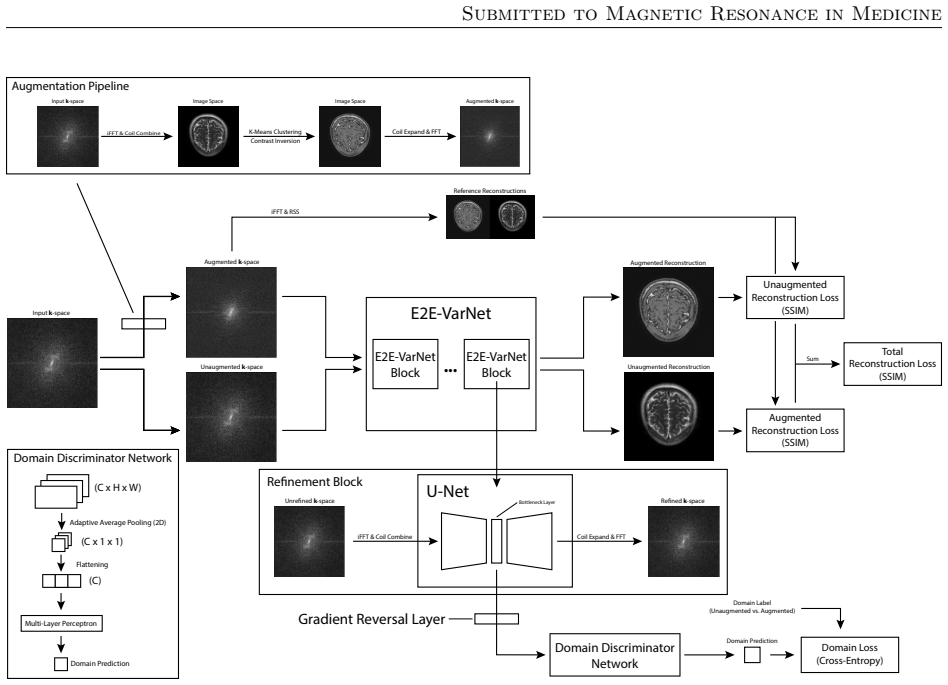
Contrast-informed data augmentation that modifies adult image contrast to better match neonatal appearance, paired with a domain-adversarial objective that encourages the E2E-VarNet encoder to produce domain-invariant features.
If this is right
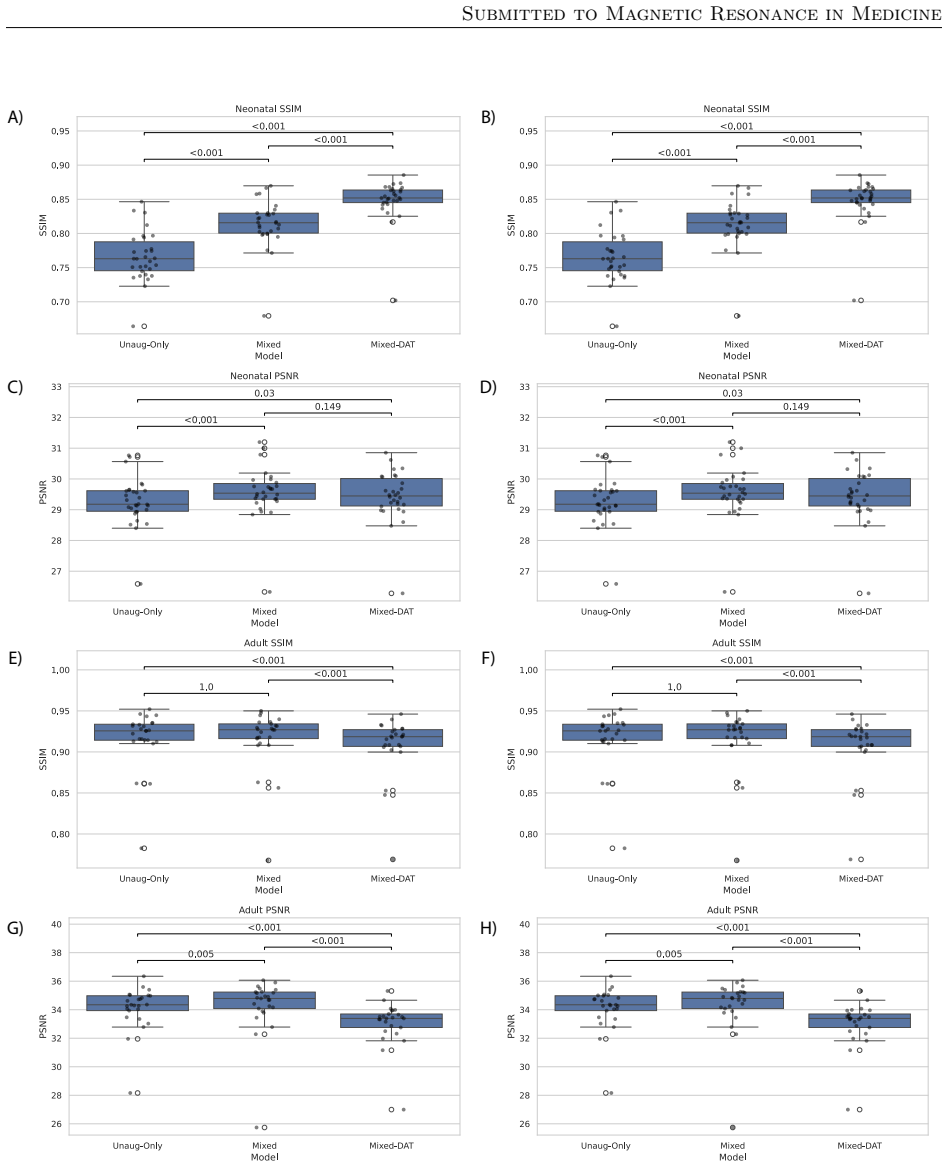
- At acceleration factor 4 the domain-adversarial mixed model achieves SSIM of 0.924 and PSNR of 33.98 dB on neonatal test data.
- At acceleration factor 8 the domain-adversarial mixed model achieves the highest SSIM of 0.848 while the non-adversarial mixed model achieves the highest PSNR of 29.56 dB.
- Domain-adversarial training visibly increases overlap of latent representations across unaugmented adult, augmented adult, and neonatal samples in t-SNE plots.
- The combination of contrast-informed augmentation and adversarial training may increase robustness to domain shift for other undersampled neonatal MR reconstruction tasks.
Where Pith is reading between the lines
- If the augmentation faithfully reproduces neonatal contrast differences, the same recipe could be applied to other pediatric or low-data MR contrasts without collecting large new training sets.
- Making the latent space domain-invariant appears to be the main driver of improved neonatal performance, suggesting the approach could be tested in other reconstruction architectures beyond E2E-VarNet.
- Clinical deployment would still require prospective validation because retrospective undersampling may underestimate real motion and coil-sensitivity differences present in live neonatal scans.
- The method could reduce the data-collection burden for rare neonatal conditions by letting models trained on common adult exams generalize more reliably.
Load-bearing premise
The retrospectively undersampled neonatal test data and the chosen contrast-informed augmentation accurately capture the real clinical domain shift that exists between adult and neonatal T2-weighted acquisitions.
What would settle it
Prospectively acquired, truly undersampled neonatal and adult scans collected under identical hardware and protocol conditions on which the mixed adversarial model no longer outperforms adult-only training on the neonatal cases.
Figures
read the original abstract
Purpose: To investigate whether contrast-informed data augmentation and domain-adversarial training improve the adult-to-neonatal generalization of the E2E-VarNet. Methods: Three training regimes were investigated: (1) adult-only training with unaugmented adult data, (2) mixed training with paired unaugmented and neonatal-informed augmented adult data, and (3) mixed training with a domain-adversarial objective. Models were trained on retrospectively undersampled multi-coil adult T2-weighted brain MR data and evaluated on neonatal and adult test data at acceleration factors $R=4$ and $R=8$ using quantitative metrics and qualitative evaluation. Feature analyses assessed whether domain-adversarial training altered the latent representations of unaugmented adult, augmented adult, and neonatal test samples. Results: Mixed training (Mixed) and mixed domain-adversarial training (Mixed-DAT) outperformed unaugmented adult-only training (Unaug-Only) when evaluated on neonatal data. At R=4, Mixed-DAT achieved the best performance (SSIM = 0.924 +/- 0.027, PSNR = 33.98 +/- 1.15 dB). At R=8, Mixed-DAT performed best when measured using SSIM (0.848 +/- 0.031 vs. 0.766 +/- 0.037 for Unaug-Only and 0.814 +/- 0.035 for Mixed) and Mixed performed best when measured using PSNR (29.56 +/- 0.83 dB vs. 26.26 +/- 0.78 dB for Unaug-Only and 29.43 +/- 0.83 dB for Mixed-DAT). Qualitative assessment of t-SNE plots suggested that Mixed-DAT increased the overlap among the latent representations of the unaugmented adult, augmented adult, and neonatal test data. Conclusion: Contrast-informed augmentation and domain-adversarial training improved adult-to-neonatal generalization of deep learning-based MR reconstruction. These findings suggest that contrast-informed data augmentation combined with adversarial training may improve robustness to domain shift in undersampled neonatal MR reconstruction.
Editorial analysis
A structured set of objections, weighed in public.
Referee Report
Summary. The manuscript claims that contrast-informed data augmentation and domain-adversarial training improve adult-to-neonatal generalization of the E2E-VarNet model for T2-weighted brain MR reconstruction. Three regimes are compared (adult-only unaugmented, mixed unaugmented+augmented, and mixed with domain-adversarial training), with evaluation on retrospectively undersampled neonatal and adult test data at R=4 and R=8 showing quantitative gains in SSIM/PSNR for the mixed and Mixed-DAT regimes, plus qualitative t-SNE evidence of increased latent feature overlap.
Significance. If the results hold, the work provides empirical support for using targeted augmentation and adversarial objectives to leverage abundant adult data for neonatal MRI reconstruction, where data scarcity is a practical barrier. The reported metric improvements (e.g., Mixed-DAT SSIM 0.924 vs. 0.766 at R=4) and t-SNE overlap offer a concrete, reproducible strategy that could be extended to other domain-shift scenarios in medical imaging.
major comments (1)
- [Abstract] Abstract (Results and Conclusion): The central generalization claim rests on the assumption that retrospectively undersampled neonatal test data plus contrast-informed augmentation faithfully proxy real adult-to-neonatal domain shift. Real acquisitions differ in coil geometry, field inhomogeneity, motion, and k-space trajectory, none of which are modeled here; without prospective undersampled neonatal cohorts or hardware-matched controls, the observed SSIM/PSNR gains do not establish robustness beyond the simulated contrast shift.
minor comments (2)
- [Abstract] Abstract: The precise definition and parameters of the 'contrast-informed' augmentation (e.g., how neonatal contrast statistics are injected into adult data) are not stated, limiting assessment of reproducibility.
- [Abstract] Abstract: No mention of statistical testing (e.g., paired t-tests or confidence intervals beyond ± std) for the reported metric differences between regimes.
Simulated Author's Rebuttal
We thank the referee for the constructive feedback. The major comment raises a valid point about the scope of domain shift modeled in the study, which we address below with proposed revisions.
read point-by-point responses
-
Referee: [Abstract] Abstract (Results and Conclusion): The central generalization claim rests on the assumption that retrospectively undersampled neonatal test data plus contrast-informed augmentation faithfully proxy real adult-to-neonatal domain shift. Real acquisitions differ in coil geometry, field inhomogeneity, motion, and k-space trajectory, none of which are modeled here; without prospective undersampled neonatal cohorts or hardware-matched controls, the observed SSIM/PSNR gains do not establish robustness beyond the simulated contrast shift.
Authors: We agree that the study primarily addresses contrast differences via neonatal-informed augmentation of adult data and evaluates on real neonatal test sets acquired with retrospective undersampling. This isolates the impact of T2 contrast mismatch, a key practical barrier in neonatal MRI. Other real-acquisition factors (coil geometry, field inhomogeneity, motion, k-space trajectory) are indeed not explicitly modeled or controlled. The quantitative gains therefore demonstrate benefit under the contrast shift considered here rather than full prospective domain robustness. We will revise the abstract to explicitly bound the generalization claim to the modeled contrast shift and add a limitations paragraph in the Discussion acknowledging the retrospective undersampling and unaddressed acquisition differences, along with suggestions for future prospective validation. revision: yes
Circularity Check
No circularity: empirical evaluation on held-out test sets
full rationale
The paper reports results from three training regimes for E2E-VarNet on retrospectively undersampled adult T2-weighted data, with quantitative evaluation (SSIM/PSNR) on separate neonatal and adult test sets at R=4 and R=8. No derivation, prediction, or uniqueness claim reduces to a fitted input or self-citation by construction; all load-bearing steps are direct empirical comparisons of model outputs against ground-truth images. Feature analyses (t-SNE) are post-hoc visualizations of the same held-out data. The study is self-contained against external benchmarks.
Axiom & Free-Parameter Ledger
Reference graph
Works this paper leans on
-
[1]
Journal of Machine Learning Research , author =
Domain-. Journal of Machine Learning Research , author =. 2016 , pages =
2016
-
[2]
Proceedings of the National Academy of Sciences , author =
Implicit data crimes:. Proceedings of the National Academy of Sciences , author =. 2022 , note =. doi:10.1073/pnas.2117203119 , abstract =
-
[3]
Magnetic Resonance in Medicine , volume=
Effect of MR head coil geometry on deep-learning-based MR image reconstruction , author=. Magnetic Resonance in Medicine , volume=. 2024 , publisher=
2024
-
[4]
IEEE transactions on medical imaging , volume=
Results of the 2020 fastMRI challenge for machine learning MR image reconstruction , author=. IEEE transactions on medical imaging , volume=. 2021 , publisher=
2020
-
[5]
International conference on medical image computing and computer-assisted intervention , pages=
End-to-end variational networks for accelerated MRI reconstruction , author=. International conference on medical image computing and computer-assisted intervention , pages=. 2020 , organization=
2020
-
[6]
Frontiers in neuroscience , volume=
Multi-coil mri reconstruction challenge—assessing brain mri reconstruction models and their generalizability to varying coil configurations , author=. Frontiers in neuroscience , volume=. 2022 , publisher=
2022
-
[7]
Magnetic resonance in medicine , volume=
ESPIRiT—an eigenvalue approach to autocalibrating parallel MRI: where SENSE meets GRAPPA , author=. Magnetic resonance in medicine , volume=. 2014 , publisher=
2014
-
[8]
, author=
Visualizing data using t-SNE. , author=. Journal of machine learning research , volume=
-
[9]
Computers in Biology and Medicine , volume=
Improving skull-stripping for infant MRI via weakly supervised domain adaptation using adversarial learning , author=. Computers in Biology and Medicine , volume=. 2025 , publisher=
2025
-
[10]
Medical Imaging with Deep Learning , year=
Unsupervised domain adaptation of brain MRI skull stripping trained on adult data to newborns: Combining synthetic data with domain invariant features , author=. Medical Imaging with Deep Learning , year=
-
[11]
IEEE Transactions on Image Processing 13(4), 600–612 (Apr 2004)
Image quality assessment: from error visibility to structural similarity , volume =. IEEE Transactions on Image Processing , author =. 2004 , note =. doi:10.1109/TIP.2003.819861 , abstract =
-
[12]
Physics in Medicine & Biology , author =
Parallel magnetic resonance imaging , volume =. Physics in Medicine & Biology , author =. 2007 , pages =. doi:10.1088/0031-9155/52/7/R01 , abstract =
-
[13]
Topics in Magnetic Resonance Imaging , author =
Prevalence and. Topics in Magnetic Resonance Imaging , author =. 2020 , pages =. doi:10.1097/RMR.0000000000000243 , abstract =
-
[15]
Pruessmann, Markus Weiger, Markus B
Magnetic Resonance in Medicine , author =. 1999 , note =. doi:10.1002/(SICI)1522-2594(199911)42:5<952::AID-MRM16>3.0.CO;2-S , abstract =
-
[17]
IEEE Signal Processing Magazine , author =
Deep-. IEEE Signal Processing Magazine , author =. 2020 , keywords =. doi:10.1109/MSP.2019.2950640 , abstract =
-
[18]
Frontiers in Neuroscience , author =
The. Frontiers in Neuroscience , author =. 2022 , note =. doi:10.3389/fnins.2022.886772 , abstract =
-
[19]
Magnetic Resonance in Medicine , author =
Assessment of the generalization of learned image reconstruction and the potential for transfer learning , volume =. Magnetic Resonance in Medicine , author =. 2019 , note =. doi:10.1002/mrm.27355 , abstract =
-
[20]
Magnetic Resonance Imaging , author =
Evaluation on the generalization of a learned convolutional neural network for. Magnetic Resonance Imaging , author =. 2022 , keywords =. doi:10.1016/j.mri.2021.12.003 , abstract =
-
[23]
Kamnitsas, Konstantinos and Baumgartner, Christian and Ledig, Christian and Newcombe, Virginia and Simpson, Joanna and Kane, Andrew and Menon, David and Nori, Aditya and Criminisi, Antonio and Rueckert, Daniel and Glocker, Ben , editor =. Unsupervised. Information. 2017 , keywords =. doi:10.1007/978-3-319-59050-9_47 , abstract =
-
[24]
Radiology: Artificial Intelligence , author =. 2020 , note =. doi:10.1148/ryai.2020190007 , number =
-
[25]
, year =
Guo, Pengfei and Wang, Puyang and Zhou, Jinyuan and Jiang, Shanshan and Patel, Vishal M. , year =. Multi-
-
[26]
and Slater, Donna and Metcalfe, Amy , month = dec, year =
Pekarsky, Chloe and Skiffington, Janice and Leijser, Lara M. and Slater, Donna and Metcalfe, Amy , month = dec, year =. Social. Journal of Medical Internet Research , publisher =. doi:10.2196/40298 , abstract =
-
[27]
Adam: A Method for Stochastic Optimization
Kingma, Diederik P. and Ba, Jimmy , month = jan, year =. Adam:. doi:10.48550/arXiv.1412.6980 , abstract =
work page internal anchor Pith review Pith/arXiv arXiv doi:10.48550/arxiv.1412.6980
-
[28]
Parallel magnetic resonance imaging
Larkman David J, Nunes Rita G. Parallel magnetic resonance imaging. Physics in Medicine & Biology. 2007;52(7):R15
2007
-
[29]
Prevalence and Financial Impact of Claustrophobia , Anxiety , Patient Motion , and Other Patient Events in Magnetic Resonance Imaging
Nguyen Xuan V., Tahir Sana, Bresnahan Brian W., et al. Prevalence and Financial Impact of Claustrophobia , Anxiety , Patient Motion , and Other Patient Events in Magnetic Resonance Imaging . Topics in Magnetic Resonance Imaging. 2020;29(3):125
2020
-
[30]
Sodickson Daniel K., Manning Warren J.. Simultaneous acquisition of spatial harmonics ( SMASH ): Fast imaging with radiofrequency coil arrays. Magnetic Resonance in Medicine. 1997;38(4):591--603. \_eprint: https://onlinelibrary.wiley.com/doi/pdf/10.1002/mrm.1910380414
-
[31]
SENSE : Sensitivity encoding for fast MRI
Pruessmann Klaas P., Weiger Markus, Scheidegger Markus B., Boesiger Peter. SENSE : Sensitivity encoding for fast MRI . Magnetic Resonance in Medicine. 1999;42(5):952--962. \_eprint: https://onlinelibrary.wiley.com/doi/pdf/10.1002/\
1999
-
[32]
Griswold Mark A., Jakob Peter M., Heidemann Robin M., et al. Generalized autocalibrating partially parallel acquisitions ( GRAPPA ). Magnetic Resonance in Medicine. 2002;47(6):1202--1210. \_eprint: https://onlinelibrary.wiley.com/doi/pdf/10.1002/mrm.10171
-
[33]
Deep- Learning Methods for Parallel Magnetic Resonance Imaging Reconstruction : A Survey of the Current Approaches , Trends , and Issues
Knoll Florian, Hammernik Kerstin, Zhang Chi, et al. Deep- Learning Methods for Parallel Magnetic Resonance Imaging Reconstruction : A Survey of the Current Approaches , Trends , and Issues . IEEE Signal Processing Magazine. 2020;37(1):128--140
2020
-
[34]
Results of the 2020 fastMRI challenge for machine learning MR image reconstruction
Muckley Matthew J, Riemenschneider Bruno, Radmanesh Alireza, et al. Results of the 2020 fastMRI challenge for machine learning MR image reconstruction. IEEE transactions on medical imaging. 2021;40(9):2306--2317
2020
-
[35]
Effect of MR head coil geometry on deep-learning-based MR image reconstruction
Dubljevic Natalia, Moore Stephen, Lauzon Michel Louis, Souza Roberto, Frayne Richard. Effect of MR head coil geometry on deep-learning-based MR image reconstruction. Magnetic Resonance in Medicine. 2024;92(4):1404--1420
2024
-
[36]
David, Rueckert Daniel, Smith Stephen M., et al
Edwards A. David, Rueckert Daniel, Smith Stephen M., et al. The Developing Human Connectome Project Neonatal Data Release . Frontiers in Neuroscience. 2022;16. Publisher: Frontiers
2022
-
[37]
Implicit data crimes: Machine learning bias arising from misuse of public data
Shimron Efrat, Tamir Jonathan I., Wang Ke, Lustig Michael. Implicit data crimes: Machine learning bias arising from misuse of public data. Proceedings of the National Academy of Sciences. 2022;119(13):e2117203119. Publisher: Proceedings of the National Academy of Sciences
2022
-
[38]
Assessment of the generalization of learned image reconstruction and the potential for transfer learning
Knoll Florian, Hammernik Kerstin, Kobler Erich, Pock Thomas, Recht Michael P, Sodickson Daniel K. Assessment of the generalization of learned image reconstruction and the potential for transfer learning. Magnetic Resonance in Medicine. 2019;81(1):116--128. Publisher: John Wiley & Sons, Ltd
2019
-
[39]
Evaluation on the generalization of a learned convolutional neural network for MRI reconstruction
Huang Jinhong, Wang Shoushi, Zhou Genjiao, Hu Wenyu, Yu Gaohang. Evaluation on the generalization of a learned convolutional neural network for MRI reconstruction. Magnetic Resonance Imaging. 2022;87:38--46
2022
-
[40]
David, O'Muircheartaigh Jonathan
Batalle Dafnis, Edwards A. David, O'Muircheartaigh Jonathan. Annual Research Review : Not just a small adult brain: understanding later neurodevelopment through imaging the neonatal brain. Journal of Child Psychology and Psychiatry. 2018;59(4):350--371. \_eprint: https://onlinelibrary.wiley.com/doi/pdf/10.1111/jcpp.12838
-
[41]
MRI of the Neonatal Brain : A Review of Methodological Challenges and Neuroscientific Advances
Dubois Jessica, Alison Marianne, Counsell Serena J., Hertz-Pannier Lucie, Hüppi Petra S., Benders Manon J.N.L.. MRI of the Neonatal Brain : A Review of Methodological Challenges and Neuroscientific Advances . Journal of Magnetic Resonance Imaging. 2021;53(5):1318--1343. \_eprint: https://onlinelibrary.wiley.com/doi/pdf/10.1002/jmri.27192
-
[42]
Domain- Adversarial Training of Neural Networks
Ganin Yaroslav, Ustinova Evgeniya, Ajakan Hana, et al. Domain- Adversarial Training of Neural Networks . Journal of Machine Learning Research. 2016;17(59):1--35
2016
-
[43]
Unsupervised Domain Adaptation in Brain Lesion Segmentation with Adversarial Networks
Kamnitsas Konstantinos, Baumgartner Christian, Ledig Christian, et al. Unsupervised Domain Adaptation in Brain Lesion Segmentation with Adversarial Networks . In: Niethammer Marc, Styner Martin, Aylward Stephen, et al. , eds. Information Processing in Medical Imaging , :597--609Springer International Publishing; 2017; Cham
2017
-
[44]
Improving skull-stripping for infant MRI via weakly supervised domain adaptation using adversarial learning
Omidi Abbas, Shamaei Amirmohammad, Aktar Mumu, King Regan, Leijser Lara, Souza Roberto. Improving skull-stripping for infant MRI via weakly supervised domain adaptation using adversarial learning. Computers in Biology and Medicine. 2025;196:110903
2025
-
[45]
End-to-end variational networks for accelerated MRI reconstruction
Sriram Anuroop, Zbontar Jure, Murrell Tullie, et al. End-to-end variational networks for accelerated MRI reconstruction. In: :64--73Springer; 2020
2020
-
[46]
Multi-coil mri reconstruction challenge—assessing brain mri reconstruction models and their generalizability to varying coil configurations
Beauferris Youssef, Teuwen Jonas, Karkalousos Dimitrios, et al. Multi-coil mri reconstruction challenge—assessing brain mri reconstruction models and their generalizability to varying coil configurations. Frontiers in neuroscience. 2022;16:919186
2022
-
[47]
fastMRI : A Publicly Available Raw k- Space and DICOM Dataset of Knee Images for Accelerated MR Image Reconstruction Using Machine Learning
Knoll Florian, Zbontar Jure, Sriram Anuroop, et al. fastMRI : A Publicly Available Raw k- Space and DICOM Dataset of Knee Images for Accelerated MR Image Reconstruction Using Machine Learning . Radiology: Artificial Intelligence. 2020;2(1):e190007. Publisher: Radiological Society of North America
2020
-
[48]
ESPIRiT—an eigenvalue approach to autocalibrating parallel MRI: where SENSE meets GRAPPA
Uecker Martin, Lai Peng, Murphy Mark J, et al. ESPIRiT—an eigenvalue approach to autocalibrating parallel MRI: where SENSE meets GRAPPA. Magnetic resonance in medicine. 2014;71(3):990--1001
2014
-
[49]
Social Media Recruitment Strategies to Recruit Pregnant Women Into a Longitudinal Observational Cohort Study : Usability Study
Pekarsky Chloe, Skiffington Janice, Leijser Lara M., Slater Donna, Metcalfe Amy. Social Media Recruitment Strategies to Recruit Pregnant Women Into a Longitudinal Observational Cohort Study : Usability Study . Journal of Medical Internet Research. 2022;24(12):e40298
2022
-
[50]
Image quality assessment: from error visibility to structural similarity
Wang Zhou, Bovik A.C., Sheikh H.R., Simoncelli E.P.. Image quality assessment: from error visibility to structural similarity. IEEE Transactions on Image Processing. 2004;13(4):600--612. Conference Name: IEEE Transactions on Image Processing
2004
-
[51]
Adam: A Method for Stochastic Optimization
Kingma Diederik P., Ba Jimmy. Adam: A Method for Stochastic Optimization . arXiv:1412.6980 [cs]; 2017
Pith/arXiv arXiv 2017
-
[52]
Visualizing data using t-SNE
Maaten Laurens, Hinton Geoffrey. Visualizing data using t-SNE.. Journal of machine learning research. 2008;9(11)
2008
-
[53]
Unsupervised domain adaptation of brain MRI skull stripping trained on adult data to newborns: Combining synthetic data with domain invariant features
Omidi Abbas, Shamaei Amirmohammad, Verschuu Anouk, King Regan, Leijser Lara, Souza Roberto. Unsupervised domain adaptation of brain MRI skull stripping trained on adult data to newborns: Combining synthetic data with domain invariant features. In: ; 2024
2024
-
[54]
Multi- Institutional Collaborations for Improving Deep Learning - Based Magnetic Resonance Image Reconstruction Using Federated Learning
Guo Pengfei, Wang Puyang, Zhou Jinyuan, Jiang Shanshan, Patel Vishal M.. Multi- Institutional Collaborations for Improving Deep Learning - Based Magnetic Resonance Image Reconstruction Using Federated Learning . In: :2423--2432; 2021
2021
discussion (0)
Sign in with ORCID, Apple, or X to comment. Anyone can read and Pith papers without signing in.