Observable Dependence of Viscous Corrections in QGP: Heavy Quarks and Dileptons in Chapman--Enskog Theory
Pith reviewed 2026-06-27 05:02 UTC · model grok-4.3
The pith
Viscous corrections modify heavy quark drag and dilepton rates through magnitude and momentum kernel interplay.
A machine-rendered reading of the paper's core claim, the machinery that carries it, and where it could break.
Core claim
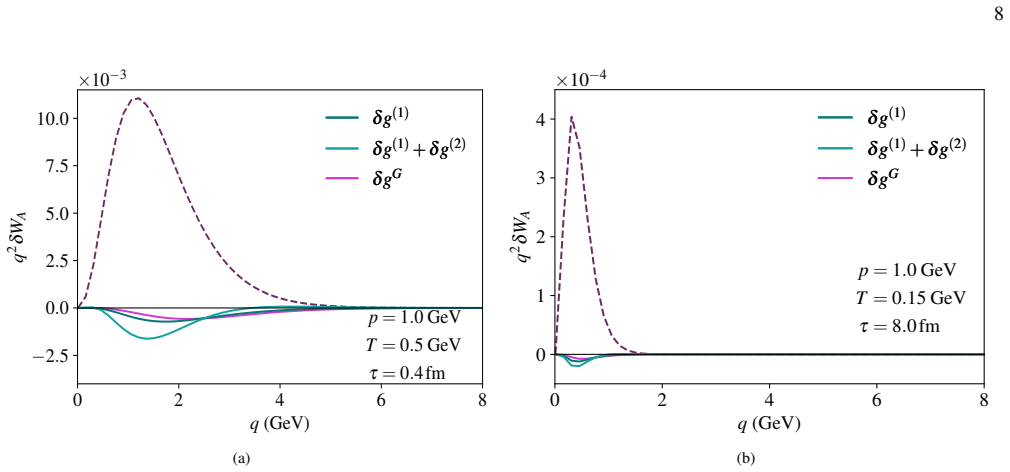
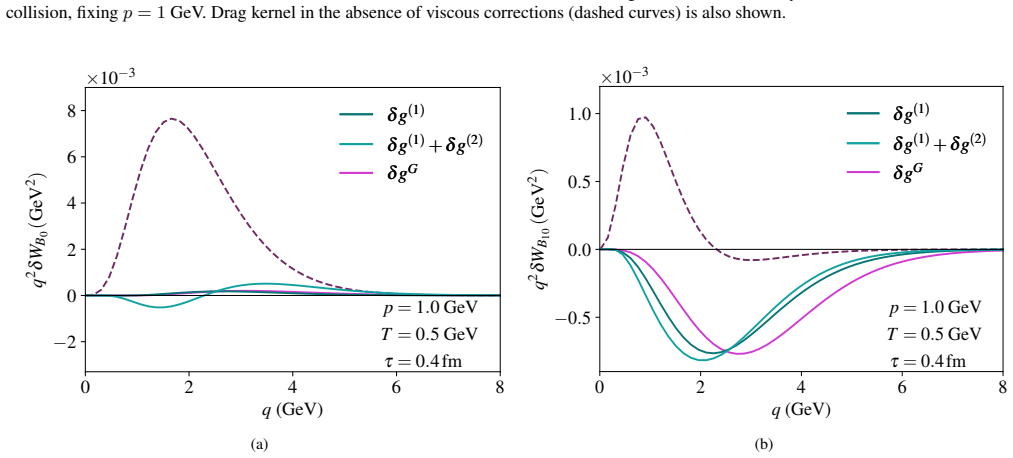
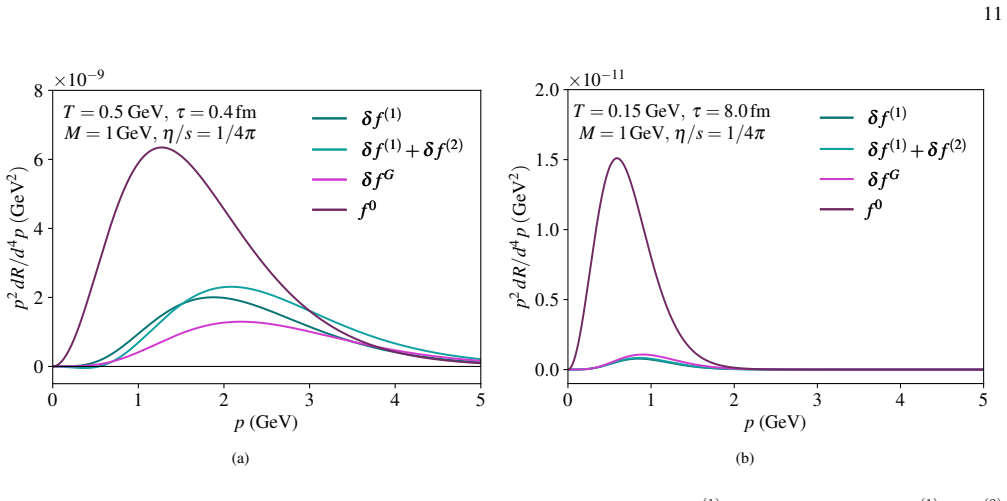
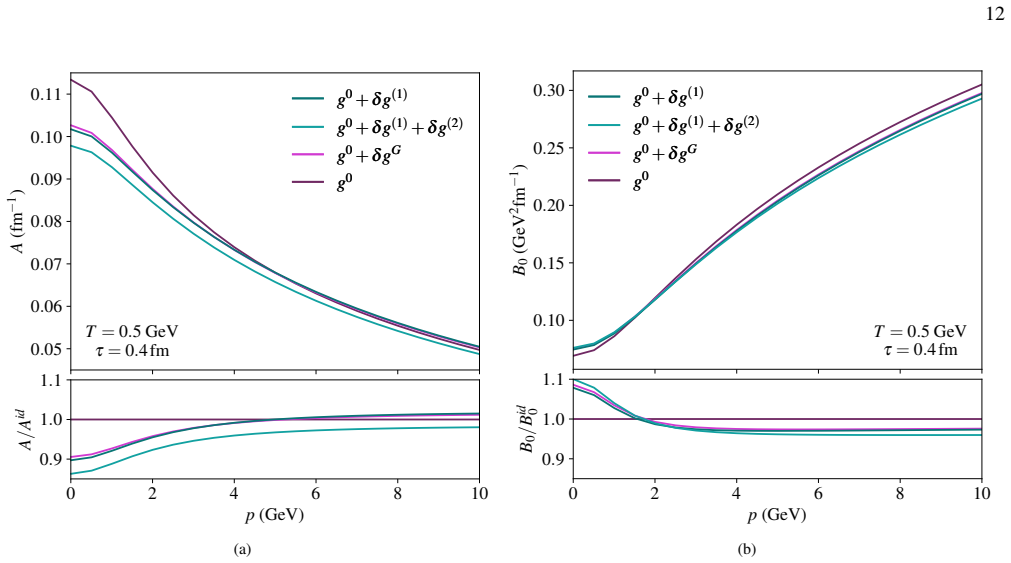
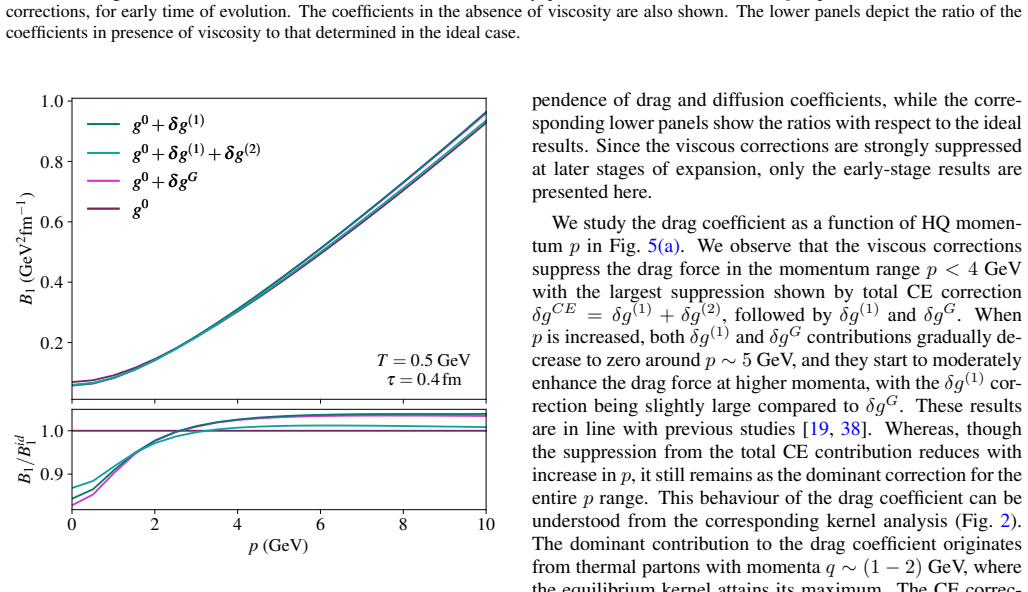
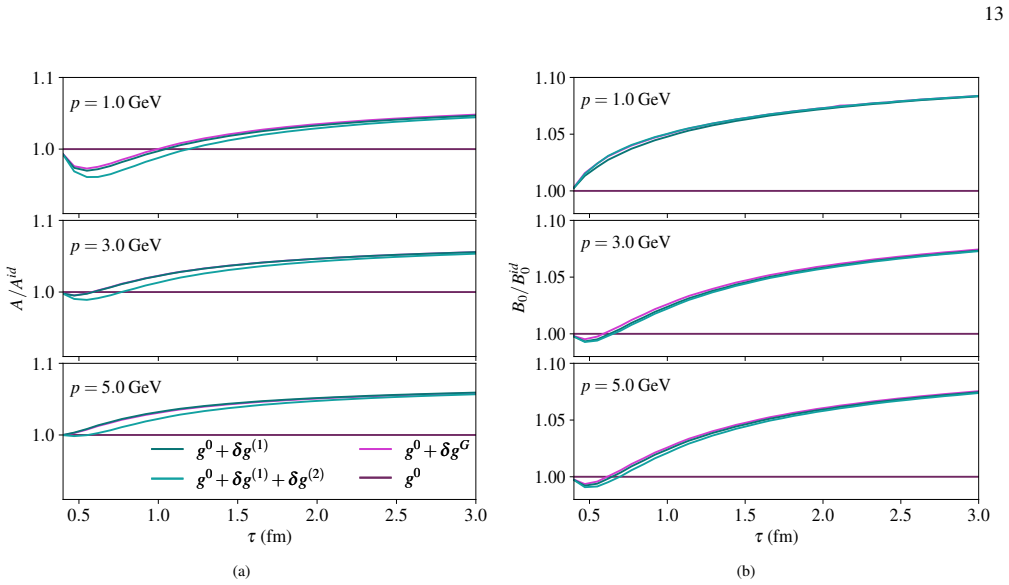
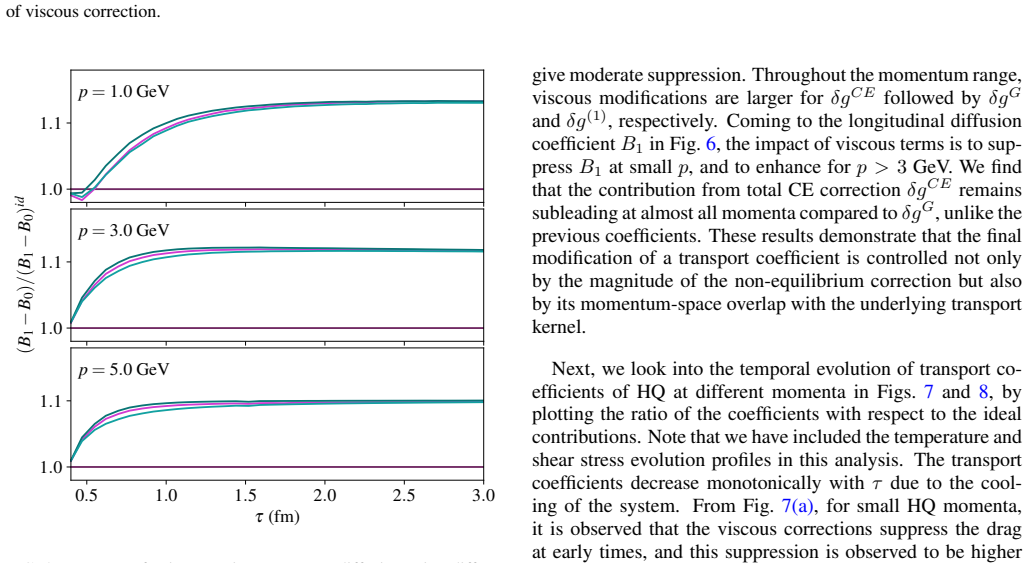
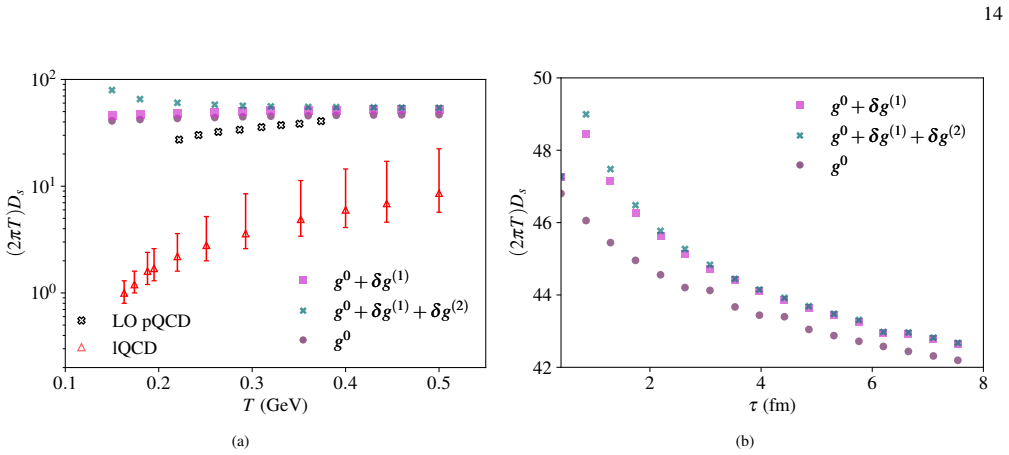
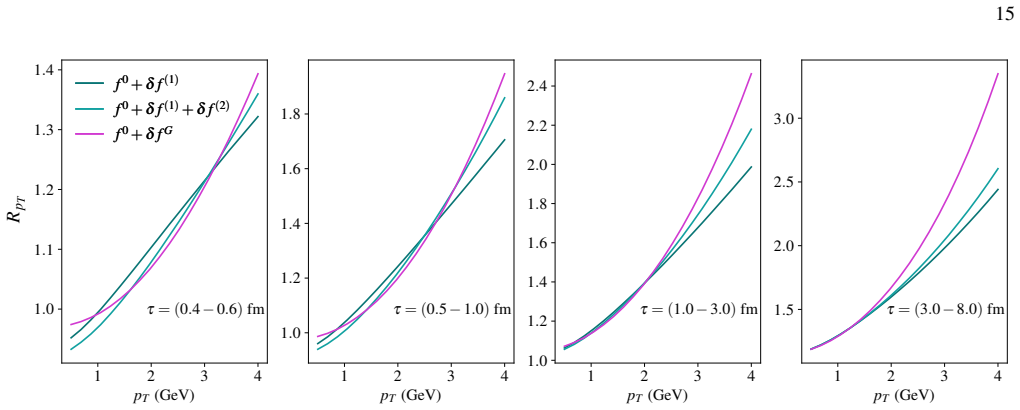
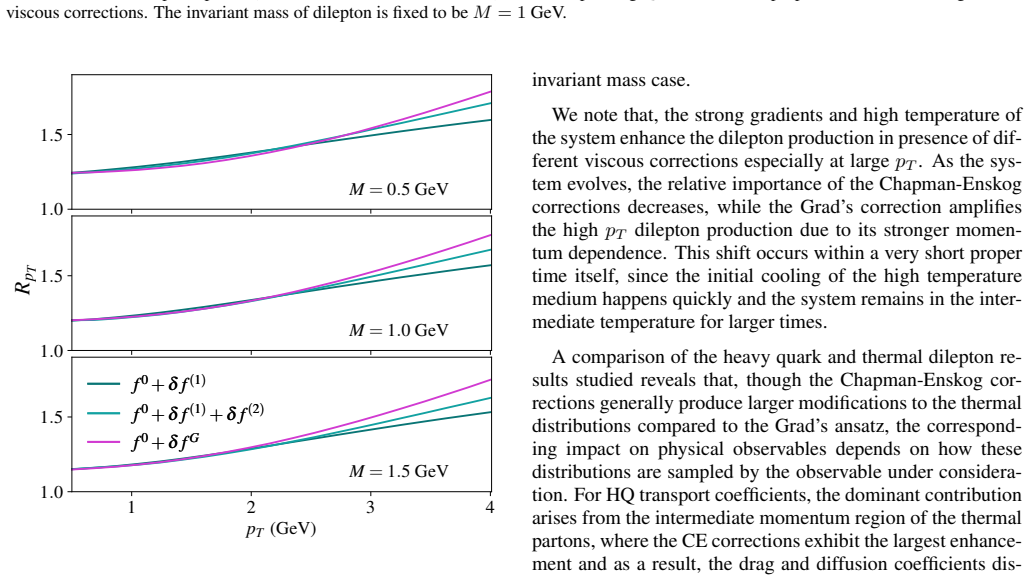
Using the Chapman-Enskog expansion up to second order, the viscous corrections suppress the heavy quark drag force substantially, induce non-trivial momentum dependence in transverse momentum diffusion with comparatively less modification to longitudinal diffusion, and produce an enhanced early-time contribution to thermal dilepton production that decreases and converges to the first-order result during QGP evolution while remaining well behaved; the modification of any observable is governed by the magnitude of the corrections together with the interplay between their momentum dependence and the momentum weighting of the transport and emission kernels, so that the momentum structure at the
What carries the argument
Chapman-Enskog like expansion of the Boltzmann transport equation in relaxation time approximation, which supplies the form of the viscous correction to the distribution function up to second order in gradients.
If this is right
- The drag force on heavy quarks is suppressed substantially by the second-order Chapman-Enskog corrections.
- Transverse momentum diffusion acquires non-trivial momentum dependence while longitudinal diffusion is modified less.
- Thermal dilepton production receives an enhanced early-time contribution that decreases and converges to the first-order result as the system evolves.
- The corrections remain well behaved compared with Grad's approximation throughout the evolution.
- Observable modifications are set by the size of corrections and their momentum interplay with the kernels rather than by direct translation of the distribution-function momentum structure.
Where Pith is reading between the lines
- Different QGP probes may require separate evaluation of viscous corrections because each weights distinct momentum regions.
- The approach points toward the value of testing hydro-kinetic consistency by feeding the corrected distribution functions back into hydrodynamic evolution equations.
- Heavy-quark and dilepton data from heavy-ion collisions could be re-analyzed with these momentum-dependent corrections to extract transport coefficients more precisely.
Load-bearing premise
The temperature and shear-stress evolution profiles obtained from second-order causal relativistic viscous hydrodynamics are sufficiently accurate inputs that the subsequent Chapman-Enskog corrections to the distribution function can be applied without further consistency checks between the hydro and kinetic stages.
What would settle it
A measurement of heavy quark transverse momentum spectra or elliptic flow that shows no substantial suppression of the drag force or no non-trivial momentum dependence in the diffusion coefficients when the second-order Chapman-Enskog corrections are included.
Figures
read the original abstract
We calculate, for the first time, heavy quark transport and thermal dilepton production from QGP using viscous correction up to second order in gradients. We use the form of viscous correction obtained from Chapman-Enskog like expansion of the Boltzmann transport equation in relaxation time approximation, and compare our results with that of Grad's 14-moment approximation. By employing the temperature and shear stress evolution profiles of QGP obtained from second-order causal relativistic viscous hydrodynamics, we study the heavy quark transport coefficients and thermal dilepton production from an evolving QGP. In the case of HQ transport, the CE corrections suppress the drag force substantially, induce a non-trivial momentum dependence in transverse momentum diffusion, and result in a comparatively less modification in longitudinal momentum diffusion. Whereas, for thermal dileptons, the CE corrections result in an enhanced early-time contribution which decreases and become converging to the first-order CE correction with the evolution of QGP, and remain well behaved compared to that of Grad's correction. Our results indicate that the modification of the observable due to viscous corrections is governed by the magnitude of the corrections as well as the interplay between their momentum dependence and momentum weighting of the transport and emission kernels. We demonstrate that the momentum structure of the various viscous corrections at the level of distribution function is not directly translated to the observables since the different observables are sensitive to distinct regions of momentum space.
Editorial analysis
A structured set of objections, weighed in public.
Referee Report
Summary. The manuscript computes heavy-quark drag and diffusion coefficients together with thermal dilepton rates in an evolving QGP, employing second-order viscous corrections to the distribution function obtained from a Chapman–Enskog expansion in the relaxation-time approximation. These corrections are contrasted with Grad’s 14-moment form. Temperature and shear-stress profiles are taken from generic second-order causal viscous hydrodynamics; the resulting observables exhibit a suppressed drag, a non-trivial transverse-momentum dependence in diffusion, and an enhanced yet convergent early-time dilepton yield. The central claim is that observable modifications are controlled by the magnitude of the corrections and by the interplay between their momentum dependence and the momentum weighting of the transport and emission kernels.
Significance. If the input profiles are compatible with the RTA used for the CE expansion, the work supplies a concrete demonstration that the momentum structure of δf does not translate directly into observables because different kernels probe distinct momentum regions. This distinction between CE and Grad corrections, together with the controlled early-time dilepton enhancement, is relevant for precision heavy-ion phenomenology.
major comments (1)
- [Hydrodynamic input profiles (implicit in Sec. on evolution and results)] The temperature and shear-stress evolution profiles are taken from a generic second-order causal relativistic viscous hydrodynamics simulation without stated matching of the relaxation time or transport coefficients to the RTA employed in the Chapman–Enskog derivation of δf. Because the shear-stress term enters the correction linearly, any mismatch modifies the effective momentum weighting before the kernels are applied, directly affecting the claimed non-trivial p_T dependence in HQ diffusion and the early-time dilepton enhancement. A consistency check or explicit statement of the hydro transport coefficients is required to support the central claim.
minor comments (1)
- [Abstract] The abstract states that the CE corrections remain “well behaved” relative to Grad’s; a quantitative measure (e.g., integrated deviation or stability criterion) would strengthen this statement.
Simulated Author's Rebuttal
We thank the referee for the careful review and the constructive major comment. We address the point below and will revise the manuscript accordingly to strengthen the presentation of our results.
read point-by-point responses
-
Referee: The temperature and shear-stress evolution profiles are taken from a generic second-order causal relativistic viscous hydrodynamics simulation without stated matching of the relaxation time or transport coefficients to the RTA employed in the Chapman–Enskog derivation of δf. Because the shear-stress term enters the correction linearly, any mismatch modifies the effective momentum weighting before the kernels are applied, directly affecting the claimed non-trivial p_T dependence in HQ diffusion and the early-time dilepton enhancement. A consistency check or explicit statement of the hydro transport coefficients is required to support the central claim.
Authors: We agree that an explicit statement of the hydrodynamic transport coefficients is necessary for full transparency. The profiles employed originate from a standard second-order causal viscous hydrodynamics implementation that adopts the same relaxation-time approximation as the Chapman–Enskog expansion used for δf; this ensures a baseline level of consistency in the underlying microscopic dynamics. Nevertheless, we acknowledge that a quantitative matching of all parameters would eliminate any residual ambiguity in the effective momentum weighting. In the revised manuscript we will add a dedicated paragraph in the section describing the hydrodynamic input that specifies the relaxation time and shear viscosity to entropy density ratio employed in the hydro evolution, together with a brief discussion of how moderate variations in these parameters affect the reported observables. This addition directly supports the central claim that observable modifications arise from the interplay between the momentum dependence of δf and the kernels, rather than from absolute normalization. A complete re-simulation of the hydrodynamic evolution with identical parameters lies beyond the present scope but can be pursued in follow-up work. revision: yes
Circularity Check
No circularity; derivation applies external hydro profiles to independent CE expansion
full rationale
The paper computes heavy-quark transport and dilepton rates by feeding second-order hydro profiles (T(τ), π^{μν}(τ)) into a Chapman-Enskog δf derived from the Boltzmann equation in RTA, then compares the result with Grad's 14-moment form. No equation reduces an observable to a quantity fitted inside the paper, nor does any load-bearing premise rest on a self-citation whose content is itself unverified. The claimed interplay between correction magnitude, momentum dependence, and kernel weighting is obtained after the kernels are applied; it is not presupposed by definition. The hydro inputs are treated as given external data, satisfying the self-contained criterion for score 0.
Axiom & Free-Parameter Ledger
Reference graph
Works this paper leans on
-
[1]
Rewriting Eq
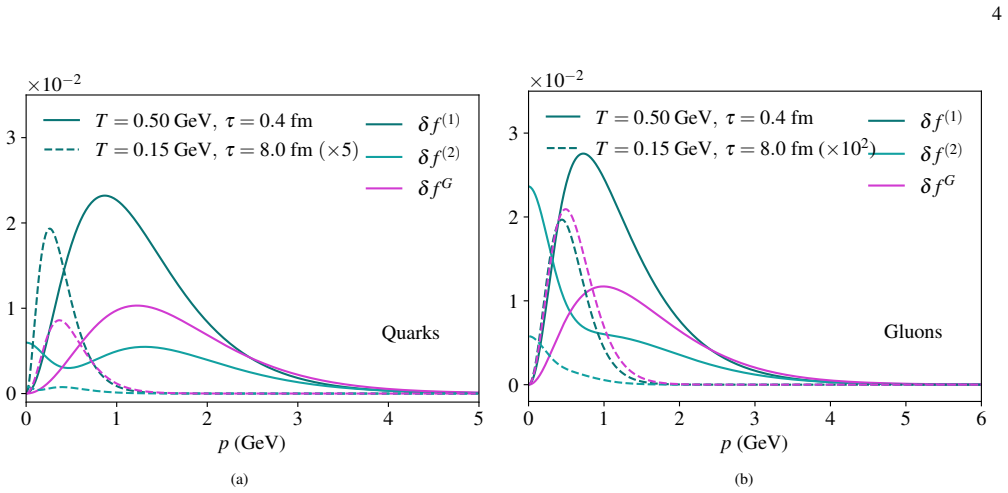
Chapman-Enskog like expansion In the Chapman-Enskog method, the distribution function is expanded in powers of space-time gradients, about its equi- librium value [13], δfi =δf (1) i +δf (2) i +· · ·,(3) whereδf (1) i is first-order in gradients and so on. Rewriting Eq. (2) in the formf=f 0 −(τ R/(u·p))p µ∂µf, the Boltz- mann equation can be solved iterat...
-
[2]
1 2E 5 −M 2E((u·p) 2 + 2M2) + 3 2(u·p)M 4Y gαγpβ + 1 2E 7 (5(u·p) 2 −4E 2)E 3 − 15 2 (u·p) 2M 2E+ 15 4 (u·p)M 4Y pαpβpγ # ∇γπαβ + β 16β2π 1 E 5
Grad’s ansatz In the Grad’s 14-moment approximation, the viscous cor- rection can be determined from a Taylor-like expansion in powers of momenta. Approximating the expansion up to sec- ond order in momenta, we get the function [12, 14] δf G i =f 0 i ˜f 0 i ϕ(x) +ϕ α(x)pα +ϕ αβ(x)pαpβ ;(10) whereϕs contain the information regarding dissipation and are ind...
-
[3]
J. Adamset al.(STAR), Experimental and theoretical chal- lenges in the search for the quark gluon plasma: The STAR Col- laboration’s critical assessment of the evidence from RHIC col- lisions, Nucl. Phys. A757, 102 (2005), arXiv:nucl-ex/0501009
Pith/arXiv arXiv 2005
-
[4]
K. Adcoxet al.(PHENIX), Formation of dense partonic matter in relativistic nucleus-nucleus collisions at RHIC: Experimental evaluation by the PHENIX collaboration, Nucl. Phys. A757, 184 (2005), arXiv:nucl-ex/0410003
Pith/arXiv arXiv 2005
-
[5]
I. Arseneet al.(BRAHMS), Quark gluon plasma and color glass condensate at RHIC? The Perspective from the BRAHMS experiment, Nucl. Phys. A757, 1 (2005), arXiv:nucl-ex/0410020
arXiv 2005
-
[6]
B. B. Backet al.(PHOBOS), The PHOBOS perspective on dis- coveries at RHIC, Nucl. Phys. A757, 28 (2005), arXiv:nucl- ex/0410022
arXiv 2005
-
[7]
P. Kovtun, D. T. Son, and A. O. Starinets, Viscosity in strongly interacting quantum field theories from black hole physics, Phys. Rev. Lett.94, 111601 (2005), arXiv:hep-th/0405231
Pith/arXiv arXiv 2005
-
[8]
T. Hirano and M. Gyulassy, Perfect fluidity of the quark gluon plasma core as seen through its dissipative hadronic corona, Nucl. Phys. A769, 71 (2006), arXiv:nucl-th/0506049
Pith/arXiv arXiv 2006
-
[9]
P. Romatschke and U. Romatschke, Viscosity information from relativistic nuclear collisions: how perfect is the fluid observed at RHIC?, Phys. Rev. Lett.99, 172301 (2007), arXiv:0706.1522 [nucl-th]
Pith/arXiv arXiv 2007
-
[10]
U. Heinz and R. Snellings, Collective flow and viscosity in rel- ativistic heavy-ion collisions, Ann. Rev. Nucl. Part. Sci.63, 123 (2013), arXiv:1301.2826 [nucl-th]. 17
Pith/arXiv arXiv 2013
-
[11]
K. Yagi, T. Hatsuda, and Y . Miake,Quark-gluon plasma: From big bang to little bang, V ol. 23 (2005)
2005
-
[12]
P. Romatschke and U. Romatschke,Relativistic Fluid Dy- namics In and Out of Equilibrium, Cambridge Monographs on Mathematical Physics (Cambridge University Press, 2019) arXiv:1712.05815 [nucl-th]
Pith/arXiv arXiv 2019
-
[13]
G. S. Rocha, D. Wagner, G. S. Denicol, J. Noronha, and D. H. Rischke, Theories of Relativistic Dissipative Fluid Dynamics, Entropy26, 189 (2024), arXiv:2311.15063 [nucl-th]
arXiv 2024
-
[14]
Grad, On the kinetic theory of rarefied gases, Commun
H. Grad, On the kinetic theory of rarefied gases, Commun. Pure Appl. Math.2, 331 (1949)
1949
-
[15]
Chapman and T
S. Chapman and T. G. Cowling, The Mathematical Theory of Non- Uniform Gases, 3rd ed, Cambridge University Press, Cambridge (1970)
1970
-
[16]
Israel and J
W. Israel and J. M. Stewart, Transient relativistic thermodynam- ics and kinetic theory, Annals Phys.118, 341 (1979)
1979
-
[17]
Teaney, The Effects of viscosity on spectra, elliptic flow, and HBT radii, Phys
D. Teaney, The Effects of viscosity on spectra, elliptic flow, and HBT radii, Phys. Rev. C68, 034913 (2003), arXiv:nucl- th/0301099
arXiv 2003
-
[18]
K. Dusling and D. Teaney, Simulating elliptic flow with viscous hydrodynamics, Phys. Rev.C77, 034905 (2008), arXiv:0710.5932 [nucl-th]
Pith/arXiv arXiv 2008
-
[19]
J. R. Bhatt, H. Mishra, and V . Sreekanth, Thermal photons in QGP and non-ideal effects, JHEP11, 106, arXiv:1011.1969 [hep-ph]
Pith/arXiv arXiv 1969
-
[20]
J. R. Bhatt, H. Mishra, and V . Sreekanth, Cavitation and thermal dilepton production in QGP, Nucl. Phys. A875, 181 (2012), arXiv:1101.5597 [hep-ph]
Pith/arXiv arXiv 2012
-
[21]
S. K. Das, V . Chandra, and J.-e. Alam, Heavy-quark transport coefficients in a hot viscous quark–gluon plasma medium, J. Phys. G41, 015102 (2013), arXiv:1210.3905 [nucl-th]
Pith/arXiv arXiv 2013
-
[22]
S. R. De Groot,Relativistic Kinetic Theory. Principles and Ap- plications, edited by W. A. Van Leeuwen and C. G. Van Weert (North-Holland, Amsterdam, 1980)
1980
-
[23]
R. S. Bhalerao, A. Jaiswal, S. Pal, and V . Sreekanth, Relativistic viscous hydrodynamics for heavy-ion collisions: A comparison between the Chapman-Enskog and Grad methods, Phys. Rev. C 89, 054903 (2014), arXiv:1312.1864 [nucl-th]
Pith/arXiv arXiv 2014
-
[24]
Svetitsky, Diffusion of charmed quarks in the quark-gluon plasma, Phys
B. Svetitsky, Diffusion of charmed quarks in the quark-gluon plasma, Phys. Rev. D37, 2484 (1988)
1988
-
[25]
R. Rapp and H. van Hees, Heavy Quarks in the Quark-Gluon Plasma (2010) pp. 111–206, arXiv:0903.1096 [hep-ph]
Pith/arXiv arXiv 2010
-
[26]
M. He, H. van Hees, and R. Rapp, Heavy-quark diffusion in the quark–gluon plasma, Prog. Part. Nucl. Phys.130, 104020 (2023), arXiv:2204.09299 [hep-ph]
arXiv 2023
-
[27]
M. Golam Mustafa, D. Pal, and D. Kumar Srivastava, Propa- gation of charm quarks in equilibrating quark - gluon plasma, Phys. Rev. C57, 889 (1998), [Erratum: Phys.Rev.C 57, 3499– 3499 (1998)], arXiv:nucl-th/9706001
Pith/arXiv arXiv 1998
-
[28]
G. D. Moore and D. Teaney, How much do heavy quarks ther- malize in a heavy ion collision?, Phys. Rev. C71, 064904 (2005), arXiv:hep-ph/0412346
Pith/arXiv arXiv 2005
-
[29]
H. van Hees, V . Greco, and R. Rapp, Heavy-quark probes of the quark-gluon plasma at RHIC, Phys. Rev. C73, 034913 (2006), arXiv:nucl-th/0508055
Pith/arXiv arXiv 2006
-
[30]
H. Berrehrah, P. B. Gossiaux, J. Aichelin, W. Cassing, J. M. Torres-Rincon, and E. Bratkovskaya, Transport coefficients of heavy quarks aroundT c at finite quark chemical potential, Phys. Rev. C90, 051901 (2014), arXiv:1406.5322 [hep-ph]
Pith/arXiv arXiv 2014
-
[31]
S. K. Das, M. Ruggieri, S. Mazumder, V . Greco, and J.-e. Alam, Heavy quark diffusion in the pre-equilibrium stage of heavy ion collisions, J. Phys. G42, 095108 (2015), arXiv:1501.07521 [nucl-th]
Pith/arXiv arXiv 2015
-
[32]
P. K. Srivastava and B. K. Patra, Drag and Diffusion of Heavy Quarks in a hot and anisotropic QCD medium, Eur. Phys. J. A 53, 116 (2017), arXiv:1601.02341 [hep-ph]
Pith/arXiv arXiv 2017
-
[33]
T. Song, P. Moreau, J. Aichelin, and E. Bratkovskaya, Ex- ploring non-equilibrium quark-gluon plasma effects on charm transport coefficients, Phys. Rev. C101, 044901 (2020), arXiv:1910.09889 [nucl-th]
arXiv 2020
- [34]
-
[35]
J. Prakash, M. Kurian, S. K. Das, and V . Chandra, Heavy quark transport in an anisotropic hot QCD medium: Collisional and Radiative processes, Phys. Rev. D103, 094009 (2021), arXiv:2102.07082 [hep-ph]
arXiv 2021
-
[36]
Du, Heavy quark drag and diffusion coefficients in the pre- hydrodynamic QCD plasma, Phys
X. Du, Heavy quark drag and diffusion coefficients in the pre- hydrodynamic QCD plasma, Phys. Rev. C109, 014901 (2024), arXiv:2306.02530 [hep-ph]
arXiv 2024
-
[37]
S. Chen, V . Nugara, M. L. Sambataro, S. Plumari, and V . Greco, Non-equilibrium Dynamical Attractors and Thermalisation of Charm Quarks in Nuclear Collisions at the LHC Energy, (2026), arXiv:2604.02944 [hep-ph]
Pith/arXiv arXiv 2026
- [38]
-
[39]
B. Singh and H. Mishra, Heavy quark transport in a viscous semi QGP, Phys. Rev. D101, 054027 (2020), arXiv:1911.06764 [hep-ph]
arXiv 2020
- [40]
- [41]
-
[42]
P. Salabura and J. Stroth, Dilepton radiation from strongly in- teracting systems, Prog. Part. Nucl. Phys.120, 103869 (2021), arXiv:2005.14589 [nucl-ex]
arXiv 2021
-
[43]
V . Chandra and V . Sreekanth, Quark and gluon distribution functions in a viscous quark-gluon plasma medium and dilep- ton production viaq¯qannihilation, Phys. Rev. D92, 094027 (2015), arXiv:1511.01208 [nucl-th]
Pith/arXiv arXiv 2015
-
[44]
V . Chandra and V . Sreekanth, Impact of momentum anisotropy and turbulent chromo-fields on thermal particle production in quark–gluon-plasma medium, Eur. Phys. J. C77, 427 (2017), arXiv:1602.07142 [nucl-th]
Pith/arXiv arXiv 2017
-
[45]
B. S. Kasmaei and M. Strickland, Dilepton production and el- liptic flow from an anisotropic quark-gluon plasma, Phys. Rev. D99, 034015 (2019), arXiv:1811.07486 [hep-ph]
Pith/arXiv arXiv 2019
- [46]
-
[47]
L. J. Naik, V . Sreekanth, M. Kurian, and V . Chandra, Thermal dilepton production in collisional hot QCD medium in the pres- ence of chromo-turbulent fields, J. Phys. G49, 075103 (2022), arXiv:2003.13645 [hep-ph]
arXiv 2022
-
[48]
L. J. Naik and V . Sreekanth, Second order hydrodynamics based on effective kinetic theory and electromagnetic signals from QGP, J. Phys. G50, 025102 (2023), arXiv:2207.05310 [nucl- th]
arXiv 2023
- [49]
-
[50]
L. J. Naik and V . Sreekanth, Thermal dilepton production within conformal viscous Gubser flow, Eur. Phys. J. C85, 664 (2025), arXiv:2506.01500 [hep-ph]
arXiv 2025
-
[51]
O. Garcia-Montero, P. Plaschke, and S. Schlichting, Scaling of pre-equilibrium dilepton production in QCD kinetic theory, Phys. Rev. D111, 034036 (2025), arXiv:2403.04846 [hep-ph]
arXiv 2025
-
[52]
X.-Y . Wu, H. Gao, B. Forster, C. Gale, G. Jackson, and S. Jeon, Thermal Dilepton Polarization and Dynamics of the QCD Plasma in Relativistic Heavy-Ion Collisions, Phys. Rev. Lett.134, 242301 (2025), arXiv:2412.15052 [nucl-th]
arXiv 2025
-
[53]
A. Dwibedi, A. K. Panda, S. Ghosh, and V . Roy, Probing dynamical electrical conductivity via dilepton emission: A kinetic theory approach, Phys. Rev. D113, 014004 (2026), arXiv:2508.16988 [nucl-th]
arXiv 2026
-
[54]
K. Dusling and S. Lin, Dilepton production from a viscous QGP, Nucl. Phys. A809, 246 (2008), arXiv:0803.1262 [nucl- th]
Pith/arXiv arXiv 2008
-
[55]
R. S. Bhalerao, A. Jaiswal, S. Pal, and V . Sreekanth, Parti- cle production in relativistic heavy-ion collisions: A consis- tent hydrodynamic approach, Phys. Rev. C88, 044911 (2013), arXiv:1305.4146 [nucl-th]
Pith/arXiv arXiv 2013
-
[56]
G. Vujanovic, C. Young, B. Schenke, R. Rapp, S. Jeon, and C. Gale, Dilepton emission in high-energy heavy-ion collisions with viscous hydrodynamics, Phys. Rev. C89, 034904 (2014), arXiv:1312.0676 [nucl-th]
Pith/arXiv arXiv 2014
-
[57]
J. D. Bjorken, Highly relativistic nucleus-nucleus collisions: the central rapidity region, Phys. Rev.D27, 140 (1983)
1983
-
[58]
J. L. Anderson and H. R. Witting, A relativistic relaxation-time model for the Boltzmann equation, Physica74, 466 (1974)
1974
-
[59]
A. Jaiswal, Relativistic dissipative hydrodynamics from ki- netic theory in relaxation time approximation, Phys. Rev.C87, 051901 (2013), arXiv:1302.6311 [nucl-th]
Pith/arXiv arXiv 2013
-
[60]
A. Jaiswal, R. S. Bhalerao, and S. Pal, Complete relativistic second-order dissipative hydrodynamics from the entropy prin- ciple, Phys. Rev. C87, 021901 (2013), arXiv:1302.0666 [nucl- th]
Pith/arXiv arXiv 2013
-
[61]
L. D. Landau, Zh. Eksp. Teor. Fiz.7, 203 (1937)
1937
-
[62]
D. Bollweg, J. L. Dasilva Gol ´an, O. Kaczmarek, R. N. Larsen, G. D. Moore, S. Mukherjee, P. Petreczky, H.-T. Shu, S. Stende- bach, and J. H. Weber (HotQCD), Temperature dependence of heavy quark diffusion from (2+1)-flavor lattice QCD, JHEP09, 180, arXiv:2506.11958 [hep-lat]
-
[63]
V ogt,Ultrarelativistic heavy-ion collisions(Elsevier, Ams- terdam, 2007)
R. V ogt,Ultrarelativistic heavy-ion collisions(Elsevier, Ams- terdam, 2007)
2007
-
[64]
T. Song, K. C. Han, and C. M. Ko, Dilepton production in a schematic causal viscous hydrodynamics, Phys. Rev. C83, 024904 (2011), arXiv:1012.0798 [nucl-th]
Pith/arXiv arXiv 2011
-
[65]
L. J. Naik, S. Jaiswal, K. Sreelakshmi, A. Jaiswal, and V . Sreekanth, Hydrodynamical attractor and thermal particle production in heavy-ion collision, (2021), arXiv:2107.08791 [hep-ph]
arXiv 2021
-
[66]
L. J. Naik, S. Jaiswal, K. Sreelakshmi, A. Jaiswal, and V . Sreekanth, Analytical attractors and thermal particle spec- tra from quark-gluon plasma, DAE Symp. Nucl. Phys.65, 660 (2021)
2021
-
[67]
H. van Hees and R. Rapp, Thermalization of heavy quarks in the quark-gluon plasma, Phys. Rev. C71, 034907 (2005), arXiv:nucl-th/0412015
Pith/arXiv arXiv 2005
discussion (0)
Sign in with ORCID, Apple, or X to comment. Anyone can read and Pith papers without signing in.