REVIEW 4 major objections 2 references
Non-detections of receding relativistic jets cut parameter uncertainty by over 40% and expose strong observational bias against fast off-axis ejecta.
Reviewed by Pith at T0; open to challenge. T0 means a machine referee read the full paper against a public rubric. the ladder, T0–T4 →
T0 review · grok-4.5
2026-07-12 14:07 UTC pith:JCVYI2BB
load-bearing objection Solid methodological paper: non-detection likelihood penalty tightens posteriors ~40% on MAXI J1535 and rest-frame maps show clear high-Γ bias; symmetry assumption is load-bearing but standard and partially checked on the two-sided source. the 4 major comments →
Observational Biases and Improved Modelling of Off-axis Relativistic Jets
The pith
A machine-rendered reading of the paper's core claim, the machinery that carries it, and where it could break.
Core claim
Incorporating the non-detection of a receding jet into kinematic modelling of the one-sided ejecta of MAXI J1535-571 reduces average 1-sigma posterior uncertainties by more than 40 percent, while the rest-frame emission recovered from the double-sided jets of MAXI J1820+070 follows a common power-law decay that, when mapped across parameter space, demonstrates that current observing cadences strongly suppress detections of high-Gamma0 and receding components.
What carries the argument
Likelihood penalisation that converts predicted receding-jet flux into a soft constraint whenever that flux would have exceeded a realistic signal-to-noise and angular-separation threshold (Eq. 7), together with Doppler de-boosting that recovers a shared rest-frame power-law light curve used as a template across the Gamma0-theta_v plane.
Load-bearing premise
The two jets are assumed to be intrinsically identical so that only the Doppler factor differs; if the approaching and receding sides have different energies or ambient densities the conversion and the likelihood penalty both fail.
What would settle it
A second double-sided X-ray binary jet whose approaching and receding rest-frame light curves, after Doppler correction, do not lie on a common power-law, or a kinematic fit of a one-sided source in which adding the non-detection penalty does not shrink the posteriors.
Editorial analysis
A structured set of objections, weighed in public.
Referee Report
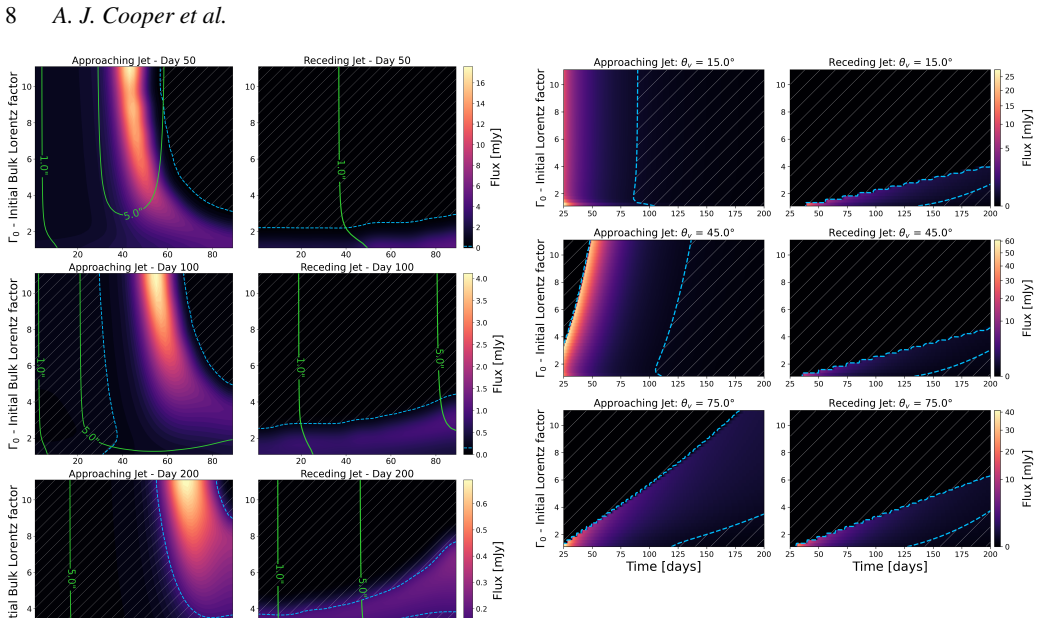
Summary. The paper studies how relativistic Doppler boosting biases observations and modelling of discrete X-ray binary jet ejecta, using two case studies. For the one-sided ejecta of MAXI J1535−571, nested-sampling kinematic fits that penalise parameter sets predicting a detectable receding component (Eqs. 3–7; Figs. 2–3) reduce average 1σ posterior uncertainties by ~40% relative to kinematics alone. For the bipolar ejecta of MAXI J1820+070, deboosting and rest-frame time correction of both components (using the Carotenuto et al. 2024 deceleration profile) yield a common power-law rest-frame light curve (Eq. 12; Fig. 5). That template is then mapped across the Γ0–θv plane to produce detectability maps (Figs. 6–7, A2), arguing that current strategies miss high-Γ0 (≳5) approaching ejecta and receding components over much of parameter space, and that early- and late-time high-resolution observations plus non-detection constraints improve modelling of off-axis jetted transients.
Significance. If the methodology holds, the work supplies a practical, immediately usable way to fold receding-jet non-detections into kinematic inference and a concrete map of observational bias in the Γ0–θv plane for XRB-like ejecta. The side-by-side nested-sampling posteriors (Figs. 2–3), the collapse of both J1820 components onto a single rest-frame power law (Fig. 5), and the explicit detectability contours (Figs. 6–7, A2) are reproducible and falsifiable contributions. The framing toward GW-triggered and orphan off-axis afterglows is timely. The main numerical claims (∼40% uncertainty reduction; strong bias against Γ0 ≳ 5) rest on the intrinsic symmetry of approaching and receding sides and on a fixed Doppler exponent; quantifying robustness to those choices would make the result more durable for the community.
major comments (4)
- Sections 2.1 and 3.2 (Eqs. 3–5, 7, 11–12): both the J1535 likelihood penalty and the J1820 rest-frame template / Γ0–θv maps assume intrinsically identical approaching and receding jets (same E0, n0, opening angle, and rest-frame emission history), so that Doppler factor and light-travel time alone convert one light curve into the other. Fig. 5’s alignment is obtained under that same assumption and therefore does not independently validate it for the one-sided case or for the bias maps. A load-bearing sensitivity test is needed: e.g. allow O(1) side-to-side differences in energy or ambient density, and/or vary the Doppler exponent in the documented range ∼2–3 (and the GRS 1915 estimates cited), and show how the 40% uncertainty reduction and the detectability contours in Figs. 6–7 and A2 change.
- Section 2.1, Eq. 7 and surrounding text: the non-detection penalty for MAXI J1535 is applied to synthesised receding fluxes at the observer times of the approaching detections, with fixed SNR>8 (Fnoise=10 μJy) and θlim from a constant 5″ beam (Eq. 6), explicitly without requiring that real observations existed at those receding arrival times. That choice makes the reported 41.5% (49.7% excluding Γ0) uncertainty reduction specific to an idealised observing cadence rather than to the actual ATCA/MeerKAT campaign. Either re-run the penalty only at epochs when the source was observed (or when a receding component would have fallen in the FoV/beam), or clearly reframe the 40% figure as an upper bound under continuous monitoring and show the degradation when real epochs are used.
- Section 3.2–3.3 and Eq. 12: the rest-frame power-law template is fitted only for t_rest ≥ 25 d and then forced to zero flux at earlier rest-frame times when generating synthetic light curves. The paper notes that reverse-shock crossing depends on Γ0, E0 and n0, so a fixed 25 d cut-off is not self-consistent across the Γ0–θv grid. Because early rest-frame emission maps to late observer times for the receding jet (and to early times for low-θv approaching jets), this cut-off materially shapes the hatched non-detectable regions in Figs. 6–7 and A2. Provide at least one alternative (earlier cut-off, reverse-shock rise, or Γ0-dependent crossing time) and show which qualitative bias conclusions survive.
- Section 3.1 and Appendix Fig. A1: nested sampling leaves Γ0 essentially unconstrained for J1820 kinematics alone, while the same-separation flux argument yields only Γ(r_sep)≈1.28 with large systematic uncertainty from non-identical separations and frequencies. The subsequent bias maps nonetheless adopt the Carotenuto et al. (2024) Γ0≈2.6 and E_eff as the baseline. State explicitly how the detectability conclusions change if Γ0 is drawn from the broad nested-sampling posterior rather than fixed at the MCMC best-fit, or justify why the MCMC value is preferred for the template.
Circularity Check
No significant circularity: non-detection penalties and Γ0–θv bias maps are genuine model applications, not results forced by definition from their inputs.
full rationale
The paper’s two central numerical claims do not reduce to their inputs by construction. For MAXI J1535, the kinematic likelihood (Eq. 2) is first fit to approaching-jet separations alone; a separate penalty (Eq. 7) is then applied only when the Doppler-mapped receding prediction would have exceeded stated SNR and resolution thresholds. The reported ~40% shrinkage of posterior widths is an empirical comparison of two nested-sampling runs, not a tautology. For MAXI J1820, rest-frame fluxes are recovered by applying kinematic Γ(t) profiles (from position data) to independent flux measurements; the subsequent power-law fit (Eq. 12) is used only as a template for hypothetical jets at other (Γ0, θv). That is standard forward modelling, not a fitted quantity re-labelled as a prediction of the same data. The mild self-consistency that both de-boosted light curves land on a common power law is acknowledged by the authors as relying on the symmetry assumption already used in the joint kinematic fit; it is presented as a consistency check, not as an independent derivation. Self-citations (Cooper et al. 2025 for fixed θc, n0; Carotenuto et al. 2024 for the baseline kinematic solution) supply fixed parameters or prior results but are not load-bearing uniqueness theorems that force the present conclusions. The symmetry assumption itself is a modelling premise whose validity is a correctness/robustness question, not a circularity. Overall circularity is negligible.
Axiom & Free-Parameter Ledger
free parameters (6)
- Γ0 (initial bulk Lorentz factor)
- E_iso (isotropic-equivalent energy)
- θv (viewing angle)
- D (source distance)
- S0, γ (rest-frame power-law amplitude and index)
- SNR threshold and beam size
axioms (4)
- domain assumption Approaching and receding jets are intrinsically identical in energy, opening angle, ambient density and rest-frame emission history.
- domain assumption Observed flux scales as δ^{3−α} with α ≈ −0.5 (or 2–3 range).
- domain assumption Blast-wave energy conservation and conical geometry (Huang et al. 1999 style) correctly describe the deceleration profile.
- ad hoc to paper Early-time (t_rest < 25 d) emission can be set to zero when extrapolating the power-law template.
read the original abstract
Relativistic Doppler boosting significantly affects the observed emission of astrophysical jets resulting in observational biases. In this work we investigate the observational biases and modelling opportunities which arise due to relativistic boosting using two X-ray binary case studies. Using the one-sided jet ejecta from MAXI J1535-571, we demonstrate that incorporating non-detections of the receding jet ejecta into kinematic modelling can significantly improve parameter estimation, reducing posterior uncertainties by over 40%. For the bipolar jets of MAXI J1820+070, we recover the intrinsic jet rest-frame emission of both approaching and receding jet components, demonstrating that they follow a common powerlaw evolution. Using this rest-frame emission profile as a base model, we show that current observational strategies strongly bias against detecting ejecta with high initial Lorentz factors >5 and receding ejecta components across a broad region of parameter space. These results highlight the importance of observational strategy selection, particularly early-time and late-time observations, and leveraging non-detections in the modelling of relativistic jets. More generally, quantifying observational biases and maximising modelling capabilities by incorporating the non-detection of receding jets can be employed to enhance interpretation of future gravitational-wave/optically-triggered observations of off-axis, extragalactic jetted transients.
Figures



Reference graph
Works this paper leans on
-
[1]
Alexander K. D., et al., 2018, ApJ, 863, L18 Andreoni I., et al., 2019, PASP, 131, 068004 Atri P., et al., 2020, MNRAS, 493, L81 Bacon N. J., Cooper A. J., Kantzas D., Matthews J. H., Fender R., 2026, MNRAS, 546, stag080 Bahramian A., et al., 2023, ApJ, 948, L7 Blandford R. D., Payne D. G., 1982, MNRAS, 199, 883 Blandford R. D., Znajek R. L., 1977, MNRAS,...
-
[2]
MNRAS000, 1–10 (2026)
FigureA2.DetectabilityofMAXIJ1820-likeejectaat60,120,200,and280 days post launch at1.28GHz, as a function of the initial Lorentz factorΓ0 andthe viewingangle𝜃 v.Dark bluecorresponds toregions ofthe parameter spacewherebothjetsaresimultaneouslydetectable,lighterblueonlytheap- proachingjet,andgreenonlytherecedingjet.Theyellowregioncorresponds to the case wh...
2026
discussion (0)
Sign in with ORCID, Apple, or X to comment. Anyone can read and Pith papers without signing in.