Thermal dileptons to probe the baryon-rich QCD matter in the forward region of LHC energy heavy-ion collisions
Pith reviewed 2026-06-27 05:05 UTC · model grok-4.3
The pith
Finite baryon density suppresses thermal dilepton yields by 3-4% in the forward rapidity region of LHC heavy-ion collisions.
A machine-rendered reading of the paper's core claim, the machinery that carries it, and where it could break.
Core claim
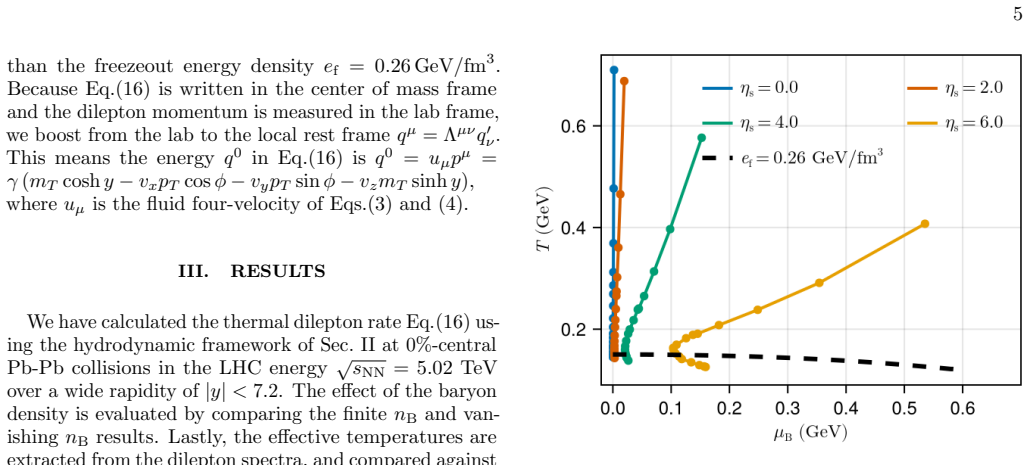
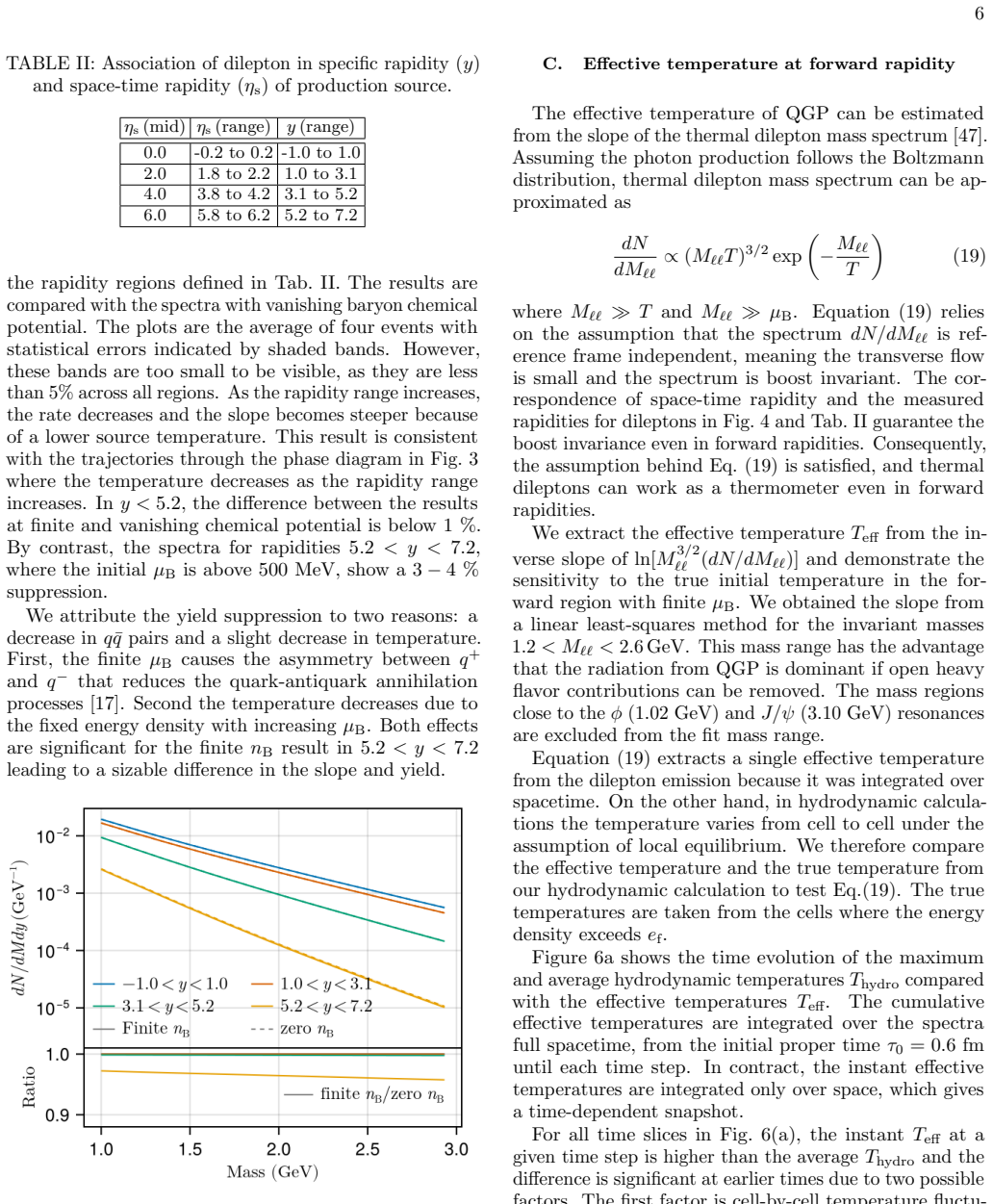
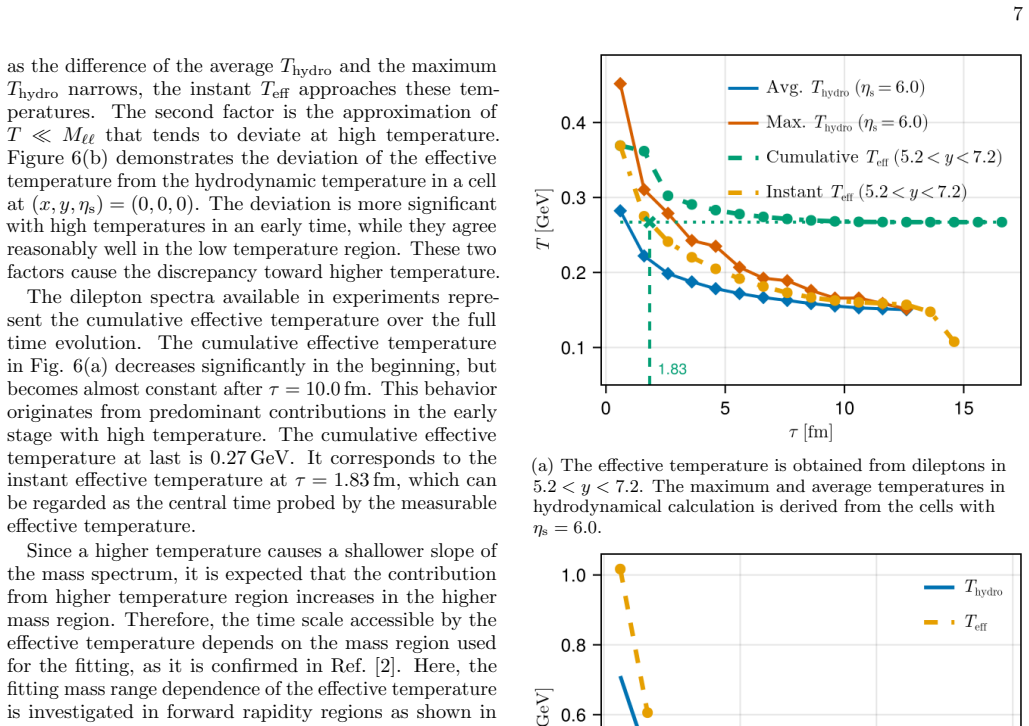
In central Pb-Pb collisions at √s_NN = 5.02 TeV a (3+1)-dimensional hydrodynamic model with finite baryon chemical potential predicts μ_B > 500 MeV near η_s = 6. This density reduces the quark-antiquark abundance and therefore suppresses the thermal dilepton yield by 3-4% in the forward interval 5.2 < y < 7.2. The effective temperature obtained from the dilepton mass spectrum in 1.2 < M_ℓℓ < 2.6 GeV stays strongly correlated with the hydrodynamic temperature and retains sensitivity to the early high-temperature phase of the evolution.
What carries the argument
A (3+1)-dimensional hydrodynamic framework that evolves finite baryon chemical potential μ_B and feeds the resulting space-time profiles into the calculation of thermal dilepton spectra across a wide rapidity window.
If this is right
- μ_B exceeds 500 MeV near η_s = 6 throughout the medium evolution.
- Thermal dilepton production is suppressed by 3-4% in the forward rapidity window 5.2 < y < 7.2.
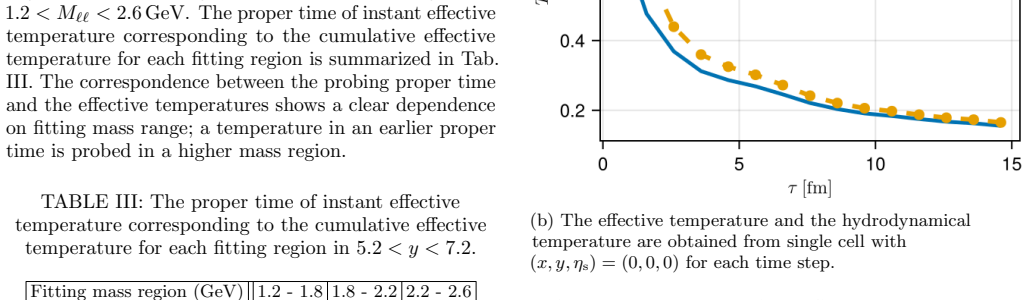
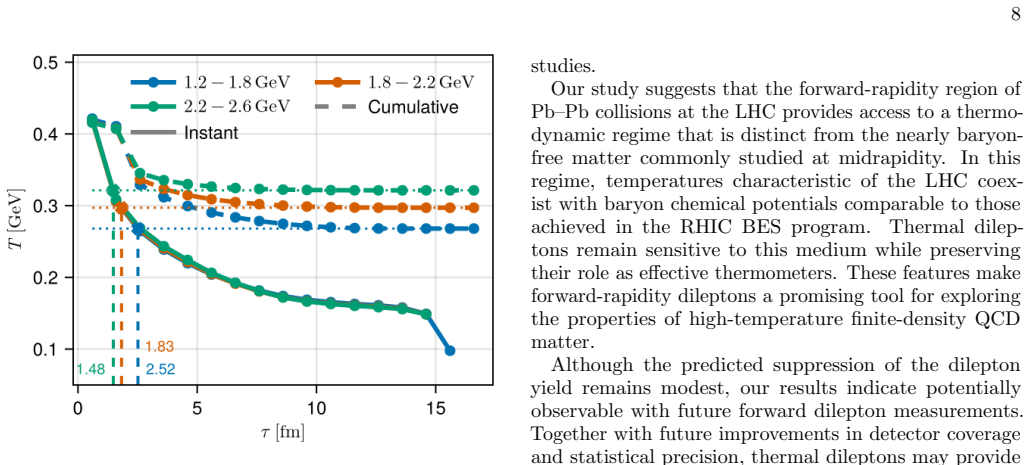
- The effective temperature extracted from intermediate-mass dileptons remains correlated with the early hydrodynamic temperature.
- Forward-rapidity dileptons continue to function as thermometers while acquiring sensitivity to finite baryon density.
Where Pith is reading between the lines
- Forward dilepton data already collected at the LHC could be reanalyzed to extract baryon-density information without new lower-energy runs.
- The same hydrodynamic profiles could be used to predict finite-μ_B corrections to other electromagnetic probes such as real photons.
- The small size of the suppression indicates that existing mid-rapidity calculations remain a good first approximation but can be refined by including forward μ_B effects.
Load-bearing premise
The hydrodynamic evolution accurately reproduces the space-time profile of baryon density at forward rapidities in these collisions.
What would settle it
A precision measurement of the dilepton yield ratio between the forward interval 5.2 < y < 7.2 and mid-rapidity that shows either zero suppression or a suppression outside the 3-4% range would falsify the predicted effect of finite μ_B.
Figures
read the original abstract
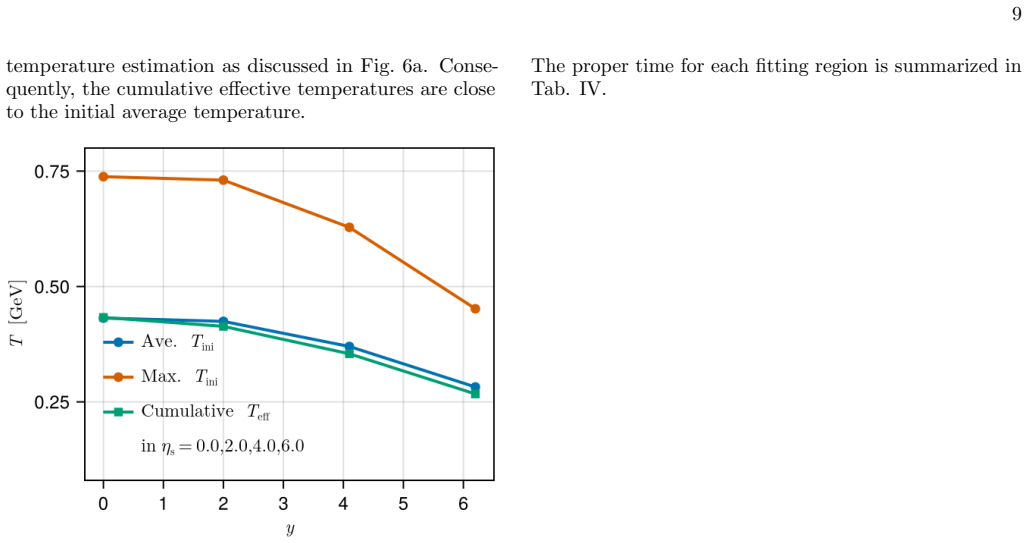
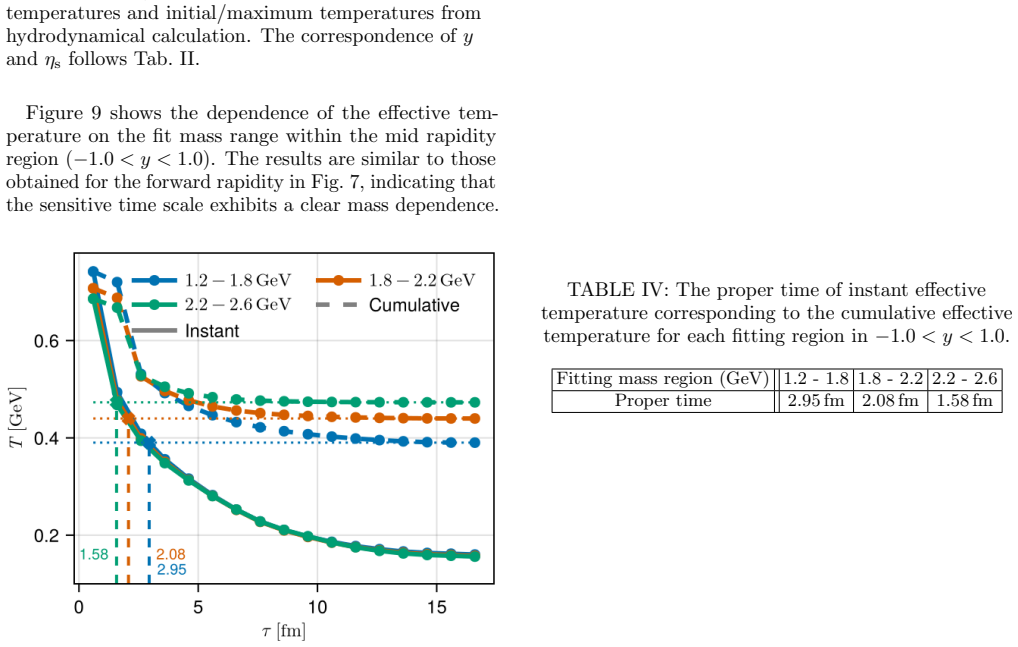
We investigate thermal dilepton production from a quark-gluon plasma (QGP) with finite baryon chemical potential ($\mu_{\text{B}}$) in central Pb-Pb collisions at $\sqrt{s_{\text{NN}}}=5.02~\text{TeV}$. Recent studies suggest that sizable baryon densities can be achieved at forward rapidity even at LHC energies. We incorporate finite $\mu_{\text{B}}$ into a (3+1)-dimensional hydrodynamic framework and find that $\mu_{\text{B}}$ exceeds 500 MeV around $\eta_\text{s} = 6$ during the medium evolution. Using this framework, we calculate thermal dilepton spectra over a wide rapidity range and evaluate the impact of finite $\mu_{\text{B}}$ on dilepton production. A suppression of 3-4% is observed in the forward-rapidity region $5.2 < y < 7.2$ due to the reduced quark-antiquark abundance at finite baryon density. We further examine the effective temperature extracted from dilepton mass spectra in the intermediate-mass region $1.2 < M_{\ell \ell} < 2.6~\text{GeV}$ . The effective temperature remains strongly correlated with the underlying hydrodynamic temperature and retains sensitivity to the early high-temperature stage of the QGP evolution. These results demonstrate that forward-rapidity dileptons remain effective thermometers while providing sensitivity to finite baryon density at the LHC.
Editorial analysis
A structured set of objections, weighed in public.
Referee Report
Summary. The paper claims that incorporating finite μ_B into a (3+1)D hydrodynamic model for central Pb-Pb collisions at √s_NN=5.02 TeV yields μ_B >500 MeV near η_s=6, producing a 3-4% suppression of thermal dilepton yields in 5.2<y<7.2 from reduced q q-bar abundance; it further claims that the effective temperature extracted from intermediate-mass dilepton spectra (1.2<M_ℓℓ<2.6 GeV) remains strongly correlated with the hydrodynamic temperature and retains sensitivity to the early high-T stage of the QGP.
Significance. If the hydrodynamic prediction of sizable forward μ_B is robust, the work provides concrete, falsifiable predictions for how forward-rapidity dileptons can simultaneously probe baryon-rich matter and serve as early-stage thermometers at LHC energies. The small quantified suppression and temperature correlation constitute specific, testable outputs from the model.
major comments (1)
- [Hydrodynamic framework] Hydrodynamic framework section: the 3-4% suppression and the claimed temperature sensitivity both rest on the specific prediction that μ_B exceeds 500 MeV around η_s=6; the manuscript presents no variation over initial conditions, transport coefficients, or comparison to other (3+1)D hydro codes or baryon-stopping data to establish robustness of this μ_B value.
minor comments (1)
- [Abstract] Abstract and results: numerical outcomes (3-4% suppression, effective-temperature correlation) are stated without explicit reference to the dilepton rate formula, hydrodynamic parameters, or uncertainty quantification used to obtain them.
Simulated Author's Rebuttal
We thank the referee for the constructive feedback. We address the major comment on the hydrodynamic framework below.
read point-by-point responses
-
Referee: Hydrodynamic framework section: the 3-4% suppression and the claimed temperature sensitivity both rest on the specific prediction that μ_B exceeds 500 MeV around η_s=6; the manuscript presents no variation over initial conditions, transport coefficients, or comparison to other (3+1)D hydro codes or baryon-stopping data to establish robustness of this μ_B value.
Authors: We agree that additional checks would strengthen the robustness claim for μ_B > 500 MeV at η_s ≈ 6. The present work employs a standard (3+1)D hydrodynamic setup calibrated to existing LHC data, with the forward μ_B arising from baryon stopping as reported in recent studies. In the revised manuscript we will add a dedicated paragraph (or short subsection) that (i) varies the initial baryon density profile within the range consistent with lower-energy stopping data, (ii) shows the effect of modest changes in shear viscosity, and (iii) compares the resulting μ_B(η_s) profiles to those obtained with other (3+1)D codes. These additions will demonstrate that the 3–4 % suppression remains stable while the temperature–dilepton correlation is largely insensitive to the precise μ_B value. revision: yes
Circularity Check
No significant circularity detected
full rationale
The paper computes μ_B(η_s) as an output of its (3+1)D hydrodynamic evolution, then feeds the resulting space-time profiles into standard thermal dilepton rate integrals that depend on local T and μ_B. The quoted 3-4% suppression and the effective-temperature correlation are direct numerical consequences of those integrals evaluated on the hydro output; neither quantity is inserted by hand nor recovered by fitting the same data that the model was tuned on. No self-citation, ansatz, or uniqueness theorem is invoked to force the result, and the derivation chain remains a forward model calculation rather than a tautology.
Axiom & Free-Parameter Ledger
free parameters (1)
- hydrodynamic initial conditions and transport coefficients
axioms (1)
- domain assumption The hydrodynamic evolution with finite baryon chemical potential accurately describes the medium at forward rapidities.
Reference graph
Works this paper leans on
-
[1]
The switch from hydrodynamics to microscopic ki- netic theory on the particlization hypersurface is defined by an energy density of 0.26 GeV/fm 3
-
[2]
The open-source tool iS3D [ 38, 39] samples hadrons from the hypersurface using the Cooper-Frye for- mula [40]
-
[3]
1 +e −β(q −+µq/2) 1 +e −β(q ++µq/2) # − 1 β|q| ln
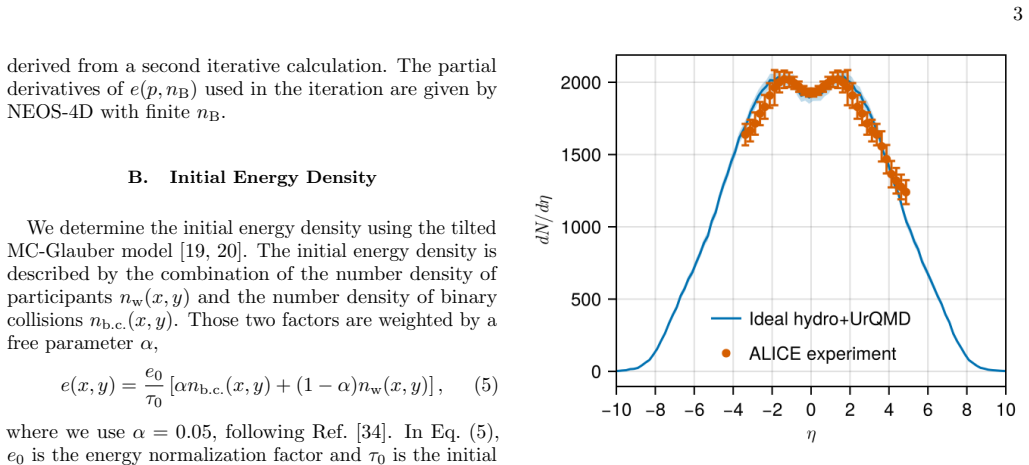
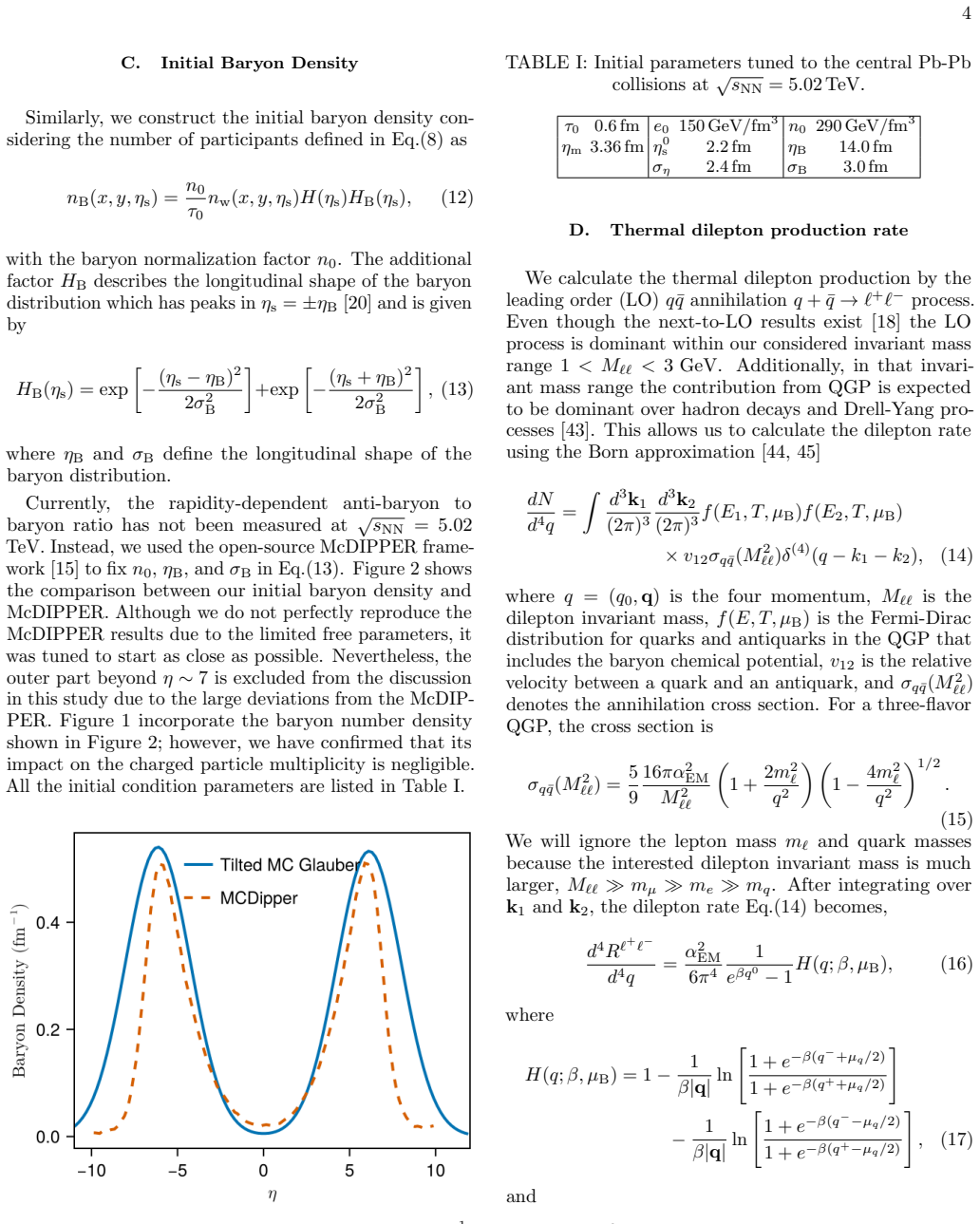
Final state interactions between the hadrons are handled using UrQMD model [ 41, 42] until kinetic freezeout. Figure 1 illustrates that our model reproduces the charged particles multiplicity dNch/dη for central collisions [ 37]. The impact parameter b in the initial condition is fixed tob= 0 fm. 4 C. Initial Baryon Density Similarly, we construct the ini...
-
[4]
Churchill, L
J. Churchill, L. Du, C. Gale, G. Jackson, and S. Jeon, Virtual photons shed light on the early temperature of dense qcd matter, Phys. Rev. Lett.132, 172301 (2024)
2024
-
[5]
O. Massen, G. Nijs, M. Sas, W. van der Schee, and R. Snellings, Effective temperatures of the qgp from thermal photon and dilepton production., Phys.J.C85, 10.1140/epjc/s10052-025-14072-6 (2025)
-
[6]
H. J. Specht (NA60), Thermal Dileptons from Hot and Dense Strongly Interacting Matter, AIP Conf. Proc.1322, 1 (2010), arXiv:1011.0615 [nucl-ex]
arXiv 2010
-
[7]
Agakichievet al.(CERES), Enhanced production of low mass electron pairs in 200-GeV/u S - Au collisions at the CERN SPS, Phys
G. Agakichievet al.(CERES), Enhanced production of low mass electron pairs in 200-GeV/u S - Au collisions at the CERN SPS, Phys. Rev. Lett.75, 1272 (1995)
1995
-
[8]
A. Angelis et al. (The HELIOS/3 Collaboration), Ex- cess of continuum dimuon production at masses be- tween threshold and the j/ψin s–w interactions at 200 gev/c/nucleo, The European Physical Journal C13, 10.1007/s100520000314 (2000)
-
[9]
A. Adareet al.(PHENIX), Detailed measurement of the e+e− pair continuum in p + p and Au+Au collisions at√sN N = 200 GeV and implications for direct photon pro- duction, Phys. Rev. C81, 034911 (2010), arXiv:0912.0244 [nucl-ex]
Pith/arXiv arXiv 2010
-
[10]
Acharyaet al.(ALICE), Dielectron production in cen- tral Pb-Pb collisions at sNN=5.02TeV, Phys
S. Acharyaet al.(ALICE), Dielectron production in cen- tral Pb-Pb collisions at sNN=5.02TeV, Phys. Rev. C112, 054906 (2025), arXiv:2308.16704 [nucl-ex]
arXiv 2025
-
[11]
Linnyk, E
O. Linnyk, E. Bratkovskaya, and W. Cassing, Effective qcd and transport description of dilepton and photon pro- duction in heavy-ion collisions and elementary processes, Progress in Particle and Nuclear Physics87, 50 (2016)
2016
-
[12]
C. GALE, S. JEON, and B. SCHENKE, Hydrody- namic modeling of heavy-ion collisions, International Journal of Modern Physics A28, 1340011 (2013), https://doi.org/10.1142/S0217751X13400113
-
[13]
P. F. Kolb and U. W. Heinz, in quark-gluon plasma 3 (2003), arXiv:nucl-th/0305084
Pith/arXiv arXiv 2003
-
[14]
McLerran and R
L. McLerran and R. Venugopalan, Computing quark and gluon distribution functions for very large nuclei, Phys. Rev. D49, 2233 (1994)
1994
-
[15]
McLerran and R
L. McLerran and R. Venugopalan, Gluon distribution functions for very large nuclei at small transverse momen- tum, Phys. Rev. D49, 3352 (1994)
1994
-
[16]
McLerran and R
L. McLerran and R. Venugopalan, Green’s function in the color field of a large nucleus, Phys. Rev. D50, 2225 (1994)
1994
-
[17]
Li and J
M. Li and J. I. Kapusta, Large baryon densities achievable in high-energy heavy-ion collisions outside the central rapidity region, Phys. Rev. C99, 014906 (2019)
2019
-
[18]
Garcia-Montero, H
O. Garcia-Montero, H. Elfner, and S. Schlichting, Mcdip- per: A novel saturation-based 3 + 1D initial-state model for heavy ion collisions, Phys. Rev. C109, 044916 (2024)
2024
-
[19]
Fujii, Y
S.-E. Fujii, Y. Tachibana, and T. Hirano, Rapidity scan with dcci at lhc energy, Journal of Subatomic Particles and Cosmology5, 100289 (2026)
2026
-
[20]
Dumitru, D
A. Dumitru, D. H. Rischke, T. Sch¨ onfeld, L. Winckelmann, H. St¨ ocker, and W. Greiner, Suppression of dilepton pro- duction at finite baryon density, Phys. Rev. Lett.70, 2860 (1993)
1993
-
[21]
Churchill, L
J. Churchill, L. Du, C. Gale, G. Jackson, and S. Jeon, Dilepton production at next-to-leading order and inter- mediate invariant-mass observables, Phys. Rev. C109, 044915 (2024)
2024
-
[22]
Bo˙ zek and I
P. Bo˙ zek and I. Wyskiel, Directed flow in ultrarelativistic heavy-ion collisions, Phys. Rev. C81, 054902 (2010)
2010
-
[23]
Bo˙ zek, Splitting of proton-antiproton directed flow in relativistic heavy-ion collisions, Phys
P. Bo˙ zek, Splitting of proton-antiproton directed flow in relativistic heavy-ion collisions, Phys. Rev. C106, L061901 (2022)
2022
-
[24]
Hirano, U
T. Hirano, U. Heinz, D. Kharzeev, R. Lacey, and Y. Nara, Hadronic dissipative effects on elliptic flow in ultrarela- tivistic heavy-ion collisions, Physics Letters B636, 299 (2006)
2006
-
[25]
Nonaka and S
C. Nonaka and S. A. Bass, Space-time evolution of bulk qcd matter, Phys. Rev. C75, 014902 (2007)
2007
-
[26]
Hirano, P
T. Hirano, P. Huovinen, and Y. Nara, Elliptic flow in U + U collisions at √sNN = 200 gev and in Pb + Pb collisions at √sNN = 2.76 tev: Prediction from a hybrid approach, Phys. Rev. C83, 021902(R) (2011)
2011
-
[27]
Hirano, P
T. Hirano, P. Huovinen, and Y. Nara, Elliptic flow in pb+pb collisions at √sNN = 2.76 tev: Hybrid model assessment of the first data, Phys. Rev. C84, 011901(R) (2011)
2011
-
[28]
Petersen, G.-Y
H. Petersen, G.-Y. Qin, S. A. Bass, and B. M¨ uller, Tri- angular flow in event-by-event ideal hydrodynamics in au+au collisions at √sNN = 200a gev, Phys. Rev. C82, 041901(R) (2010)
2010
-
[29]
I. A. Karpenko and Y. M. Sinyukov, Kaon and pion femtoscopy at the highest energies available at the bnl relativistic heavy ion collider (rhic) in a hydrokinetic model, Phys. Rev. C81, 054903 (2010)
2010
-
[30]
Holopainen, H
H. Holopainen, H. Niemi, and K. J. Eskola, Event-by- event hydrodynamics and elliptic flow from fluctuating initial states, Phys. Rev. C83, 034901 (2011)
2011
-
[31]
L. Pang, Q. Wang, and X.-N. Wang, Effects of initial flow velocity fluctuation in event-by-event (3+1)d hydrody- namics, Phys. Rev. C86, 024911 (2012)
2012
-
[32]
Vujanovic, J.-F
G. Vujanovic, J.-F. m. c. Paquet, C. Shen, G. S. Denicol, S. Jeon, C. Gale, and U. Heinz, Exploring the influence of bulk viscosity of qcd on dilepton tomography, Phys. Rev. C101, 044904 (2020)
2020
-
[33]
Monnai, G
A. Monnai, G. Pihan, B. Schenke, and C. Shen, Four- dimensional qcd equation of state with multiple chemical potentials, Phys. Rev. C110, 044905 (2024)
2024
-
[34]
Akihiko, Official website for neos-4d (2024), https: //sites.google.com/view/qcdneos4d/
M. Akihiko, Official website for neos-4d (2024), https: //sites.google.com/view/qcdneos4d/
2024
-
[35]
Mignone, T
A. Mignone, T. Plewa, and G. Bodo, The piecewise parabolic method for multidimensional relativistic fluid dynamics, The Astrophysical Journal Supplement Series 160, 199 (2005)
2005
-
[36]
Akamatsu, S
Y. Akamatsu, S. ichiro Inutsuka, C. Nonaka, and M. Takamoto, A new scheme of causal viscous hydro- dynamics for relativistic heavy-ion collisions: A riemann solver for quark–gluon plasma, Journal of Computational Physics256, 34 (2014)
2014
-
[37]
Jiang, X.-Y
Z.-F. Jiang, X.-Y. Wu, S. Cao, and B.-W. Zhang, Hy- peron polarization and its relation with directed flow in high-energy nuclear collisions, Phys. Rev. C108, 064904 (2023)
2023
-
[38]
dapos;Enterria and C
D. dapos;Enterria and C. Loizides, Progress in the glauber model at collider energies, Annual Review of Nuclear and Particle Science71, 315 (2021)
2021
-
[39]
Q. Shou, Y. Ma, P. Sorensen, A. Tang, F. Videbæk, and H. Wang, Parameterization of deformed nuclei for glauber 11 modeling in relativistic heavy ion collisions, Physics Let- ters B749, 215 (2015)
2015
-
[40]
J. Adamet al.(ALICE), Centrality Dependence of the Charged-Particle Multiplicity Density at Midrapidity in Pb-Pb Collisions at √sNN = 5.02 TeV, Phys. Rev. Lett. 116, 222302 (2016), arXiv:1512.06104 [nucl-ex]
Pith/arXiv arXiv 2016
-
[41]
M. McNelis, D. Everett, and U. Heinz, Particlization in fluid dynamical simulations of heavy-ion collisions: The i S3D module, Comput. Phys. Commun.258, 107604 (2021), arXiv:1912.08271 [nucl-th]
arXiv 2021
-
[42]
S. P. Mike McNelis, Derek Everett and L. Du, is3d (2021)
2021
-
[43]
Cooper and G
F. Cooper and G. Frye, Single-particle distribution in the hydrodynamic and statistical thermodynamic models of multiparticle production, Phys. Rev. D10, 186 (1974)
1974
-
[44]
S. Bass, M. Belkacem, M. Bleicher, M. Brandstetter, L. Bravina, C. Ernst, L. Gerland, M. Hofmann, S. Hof- mann, J. Konopka, G. Mao, L. Neise, S. Soff, C. Spieles, H. Weber, L. Winckelmann, H. St¨ ocker, W. Greiner, C. Hartnack, J. Aichelin, and N. Amelin, Microscopic models for ultrarelativistic heavy ion collisions, Progress in Particle and Nuclear Physi...
1998
-
[45]
Bleicher, E
M. Bleicher, E. Zabrodin, C. Spieles, S. A. Bass, C. Ernst, S. Soff, L. Bravina, M. Belkacem, H. Weber, H. St¨ ocker, and W. Greiner, Relativistic hadron-hadron collisions in the ultra-relativistic quantum molecular dynamics model, Journal of Physics G: Nuclear and Particle Physics25, 1859 (1999)
1999
-
[46]
A. N. et al., Heavy-ion collisions at the lhc—last call for predictions, Journal of Physics G: Nuclear and Particle Physics35, 054001 (2008)
2008
-
[47]
Cleymans, J
J. Cleymans, J. Fingberg, and K. Redlich, Transverse- momentum distribution of dileptons in different scenarios for the qcd phase transition, Phys. Rev. D35, 2153 (1987)
1987
-
[48]
Vujanovic, C
G. Vujanovic, C. Young, B. Schenke, R. Rapp, S. Jeon, and C. Gale, Dilepton emission in high-energy heavy-ion collisions with viscous hydrodynamics, Phys. Rev. C89, 034904 (2014)
2014
-
[49]
Wang, G.-L
H.-S. Wang, G.-L. Ma, Z.-W. Lin, and W.-j. Fu, Ther- modynamics of partonic matter in relativistic heavy-ion collisions from a multiphase transport model, Phys. Rev. C105, 034912 (2022)
2022
-
[50]
Geurts and R.-A
F. Geurts and R.-A. Tripolt, Electromagnetic probes: Theory and experiment, Progress in Particle and Nuclear Physics128, 104004 (2023)
2023
discussion (0)
Sign in with ORCID, Apple, or X to comment. Anyone can read and Pith papers without signing in.