REVIEW 4 major objections 4 minor 39 references
Semi-annihilating dark matter in early cosmic clumps yields a boosted flux that sets a structure-formation bound and could sharpen direct-detection searches by up to 1000x.
Reviewed by Pith at T0; open to challenge. T0 means a machine referee read the full paper against a public rubric. the ladder, T0–T4 →
T0 review · deepseek-v4-flash
2026-08-02 11:28 UTC pith:S43WMK6Z
load-bearing objection New, mostly sound calculation of cosmological semi-annihilation BDM; the 'three orders of magnitude' claim over the galactic signal needs an apples-to-apples substructure comparison before it can be trusted. the 4 major comments →
Cosmological signals of dark matter semi-annihilation
The pith
A machine-rendered reading of the paper's core claim, the machinery that carries it, and where it could break.
Core claim
The paper's central claim is that semi-annihilation of dark matter in cosmological structures at high redshift — not just in the Milky Way center — generates a population of boosted dark matter (BDM) particles with kinetic energy mχ/4, and this population has observable consequences. On the structure-formation side, imposing that the boosted fraction today be at most 1% yields the bound ⟨σ_{2→1}v⟩ ≤ 4.2×10⁻¹⁹ (mχ/1 GeV) cm³/s, which applies independently of the underlying particle-physics model. On the direct-detection side, the cosmological BDM flux induces nuclear recoils at energies well above the halo component; the authors find it can exceed the galactic-center contribution by up to thr
What carries the argument
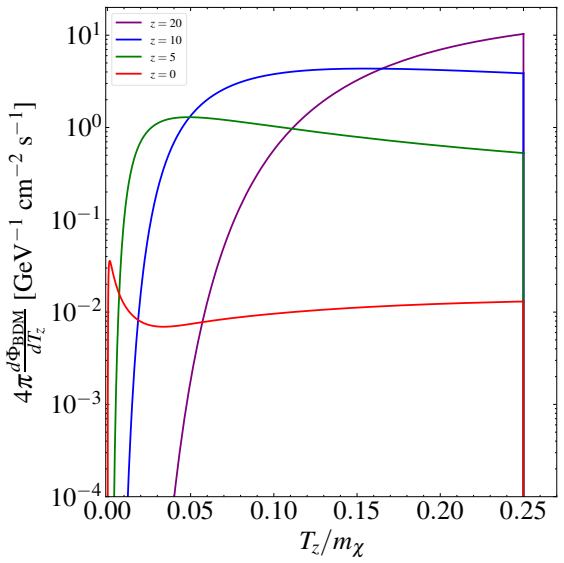
The central mechanism is the cosmological boost factor G(z), a function that quantifies how the clumpiness of dark matter at a given redshift enhances the semi-annihilation rate relative to a smooth background. The paper feeds this into a source term Q_BDM that produces BDM particles with a fixed injection kinetic energy T_z = mχ/4, then integrates the source over the cosmological line of sight — including energy redshift and the expansion history — to obtain the flux at Earth. The structure-formation limit follows from the ratio f_BDM(z) = n_BDM(z)/n_χ(z), which is proportional to ⟨σv⟩/mχ and therefore scales linearly with the adopted 1% cap. The direct-detection analysis converts the same
Load-bearing premise
The load-bearing premise is that capping the boosted fraction of dark matter today at 1% — a round-number benchmark that the paper concedes is only bracketed by recasts of decaying-dark-matter limits (0.022 and 0.055) and not derived from a dedicated analysis — correctly captures the structure-formation constraint on warm dark matter produced by semi-annihilation; if the true cap differs by a factor of a few, the headline bound changes by the same factor.
What would settle it
A dedicated computation of the maximal allowed warm dark matter fraction from cold dark matter semi-annihilations (via N-body simulations or Lyman-alpha forest data) would settle the structure-formation bound; if the true cap exceeds 1% by a factor of ten, Eq. (9) is too strong by ten. On the detection side, a low-threshold direct-detection experiment that measures a recoil excess with a spectrum matching the predicted redshift-integrated BDM flux (peak at mχ/4 with a characteristic shape) would confirm the enhancement, while a null result consistent with the galactic-only prediction would fal
If this is right
- The semi-annihilation cross section is capped at ⟨σ_{2→1}v⟩ ≤ 4.2×10⁻¹⁹ (mχ/1 GeV) cm³/s by structure formation, a bound that holds even where neutrino telescopes are blind (mχ ≲ 2 MeV) and for 'secluded' final states that produce no standard-model particles.
- For a thermal-relic-sized cross section, the cosmological BDM flux dominates the galactic-center flux for sub-GeV masses, making the cosmological component the limiting factor for direct-detection constraints.
- Current direct-detection experiments can exclude DM-nucleon cross sections as low as 10⁻³³ cm² at mχ ~ 10 MeV and 10⁻³⁷ cm² at ~300 MeV through this channel.
- Future detectors could reach DM-nucleon cross sections around 10⁻⁴⁰ cm², entering the femtobarn regime and covering a substantial slice of the sub-GeV parameter space.
- The structure-formation limit provides a model-independent test of semi-annihilating dark matter even if the boosted component never reaches Earth in detectable numbers.
Where Pith is reading between the lines
- The headline bound scales exactly linearly with the adopted 1% warm-fraction cap; a dedicated structure-formation analysis could shift it by an order of magnitude, so the number should be read as a benchmark tied to that assumption.
- The claimed three-orders-of-magnitude enhancement rests on the adopted boost factor G(z); the paper itself notes that cutting off the halo mass function at small scales reduces the low-redshift boost by a factor of about 2–5, which would soften but not erase the effect.
- The same line-of-sight machinery applies to other velocity-boosted dark matter production channels (annihilation into light states, decay of heavy dark matter, cosmic-ray upscattering), so the framework is a template for computing cosmological boosted backgrounds in general.
- A distinguishing prediction: the cosmological flux's energy spectrum peaks at lower recoil energies than the galactic signal and evolves with redshift, which future experiments with directional or spectral information could use to separate the two components.
Editorial analysis
A structured set of objections, weighed in public.
Referee Report
Summary. The paper considers semi-annihilation processes chi chi -> chi^c nu (and, in the secluded case, chi chi -> chi^c psi) occurring in cosmological structures, using the redshift-dependent substructure boost factor G(z) of Ref. [21]. It derives the boosted dark matter (BDM) flux (Eqs. 1-5), the BDM number density and fraction (Eqs. 6-8), and imposes f_BDM(z=0) <= 0.01 to obtain the cross-section bound Eq. (9). It then computes direct-detection recoil rates (Eqs. 10-20) and compares the extragalactic flux with the Galactic Center contribution from Ref. [17], reporting an enhancement of up to three orders of magnitude and deriving projected sensitivities for XENONnT, CRESST, DARWIN, and DUNE.
Significance. If substantiated, this work would open a new, competitive direct-detection channel for sub-GeV semi-annihilating dark matter, especially in the mass range where neutrino telescopes are blind and for secluded final states where only structure-formation constraints apply. The analytic machinery is transparent and internally consistent; Eq. (9) follows directly from the adopted cap with no fitted-to-target circularity, and the calculation is benchmarked against external data and literature. These are genuine strengths. However, the headline enhancement and the claimed model independence rest on three points that need repair: an internal abstract/body contradiction, an asymmetric treatment of substructure in the comparison of extragalactic and galactic fluxes, and an ad hoc warm-DM cap whose uncertainty propagates linearly into the main bound.
major comments (4)
- [Abstract and Section 3] The full-text abstract and the body text (Section 3, after Fig. 3, and Conclusions) claim that the cosmological contribution can 'exceed the Galactic Center contribution by up to three orders of magnitude' and that DARWIN may probe the femtobarn regime. The arXiv abstract supplied with the manuscript instead says the enhancement is 'comparable' and 'O(1)'. This is not a wording nuance; it changes the central quantitative claim. The authors must determine which statement is supported by their calculation after the comparison issue below is fixed, and ensure the abstract matches the body.
- [Section 3, Figs. 3 and 4] The 'up to three orders of magnitude' enhancement compares the extragalactic flux computed with the redshift-dependent substructure boost factor G(z) (Eq. 4 and Ref. [21]) with Galactic Center curves taken from Ref. [17], which use a smooth NFW profile only (as stated in the Fig. 4 caption for the dotted curves). This is an apples-to-oranges comparison: the extragalactic flux inherits a potentially large subhalo boost at every redshift, while the Milky Way halo is treated without substructure. A fair comparison would either apply the z=0 boost to the Galactic J-factor or remove G(z) from the cosmological calculation. If the Milky Way substructure boost is O(10), the claimed three orders reduce to roughly two, and the abstract's O(1) phrasing becomes the more accurate statement. The authors should repeat the comparison on equal footing and revise all consequent sensitivity claims.
- [Section 2, Eq. (9) and footnote 2] The main bound Eq. (9) is imposed by requiring f_BDM(z=0) <= 0.01, but footnote 2 concedes that no dedicated analysis exists for the maximally allowed warm fraction produced in cold dark matter semi-annihilations. The cap is bracketed only by recasts of DCDM limits (0.022 and 0.055), and the actual constraint could be different by a factor of a few. Since Eq. (9) is exactly linear in this cap, the statement that Eq. (9) is a 'model independent upper limit' is not justified. The authors should either provide a derivation of the cap from actual structure-formation data for a warm component produced with the redshift distribution of Eq. (6), or present Eq. (9) with an explicit uncertainty/robustness band and soften the 'model independent' wording.
- [Section 2, Eqs. (1)-(4) and footnote 1] The cosmological boost factor G(z) from Ref. [21] carries an acknowledged factor 2-5 uncertainty from the small-scale halo mass function, as noted in footnote 1. This uncertainty propagates directly into the flux Eq. (4), the bound Eq. (9), and the direct-detection rates of Section 3. The current text quotes Eq. (9) with one significant figure and no error bar. The authors should propagate the G(z) uncertainty through the main results, or at least state the resulting range for the bound and for the enhancement ratio, so that the reader can judge the robustness of the central claims.
minor comments (4)
- [Fig. 3 caption] The caption does not specify that the dashed 'Galactic' curves are computed for a smooth NFW profile, whereas the extragalactic curves include subhalo boosts. This information is essential for interpreting the figure; it appears only later in the Fig. 4 caption.
- [Notation] The final state chi^c in chi chi -> chi^c nu is not defined in the text. The authors should state whether chi^c denotes an antiparticle or a distinct dark-sector state, as this affects the kinematics and the particle/antiparticle content of the BDM flux.
- [Abstract version control] The supplied arXiv abstract and the abstract printed in the full text differ substantially (O(1) enhancement vs. three orders of magnitude, and no mention of femtobarn in the supplied arXiv version). This appears to be a version-control error; it must be corrected before publication.
- [References] Ref. [21] is a 2013 paper and is described as 'state-of-the-art'. If a more recent determination of the cosmological boost factor is available, it should be cited and used; otherwise the authors should justify why the older model remains the appropriate choice.
Circularity Check
No circular derivation: Eq. (9) is a direct scaling of the adopted external f_BDM cap, and self-citation [17] only supplies a comparison baseline.
full rationale
The central results are derived from external inputs, not from the quantities they are supposed to predict. The structure-formation bound Eq. (9) follows by computing f_BDM from the semi-annihilation source (Eqs. (1)-(6), (8)) and imposing an adopted cap f_BDM(z=0)≤0.01. That cap is an input assumption, which the paper itself flags: 'there is no dedicated analysis evaluating the maximally allowed fraction of warm DM generated in cold DM (semi-)annihilations. Therefore, we will adopt the conservative upper limit fBDM≤0.01 at z=0' (Section 2, footnote 2). Eq. (9) is the linear rescaling of this cap by the computed f_BDM per unit cross-section; that is a normal parameter limit, not a fitted prediction. The boost factor G(z) is taken from external Ref. [21] with a stated factor-2-5 bracketing in footnote 1. The only self-citation, Ref. [17], provides the Galactic-center comparison curves and dotted NFW baselines in Figs. 3 and 4; it is a benchmark for comparison, not an input to the new flux or to Eq. (9), so it is not load-bearing. The skeptical concerns (boosted extragalactic vs unboosted NFW Galactic baseline; abstract/body mismatch between 'comparable/O(1)' and 'up to three orders of magnitude') are benchmark-consistency and internal-consistency issues, not reductions of an output to its inputs. No circular step can be exhibited from the paper's equations.
Axiom & Free-Parameter Ledger
free parameters (2)
- f_BDM(z=0) ≤ 0.01 warm-fraction cap =
0.01
- Benchmark semi-annihilation cross-section ⟨σ₂→₁v⟩ =
10⁻²⁶ cm³ s⁻¹
axioms (6)
- domain assumption The cosmological boost factor G(z) from Lopez-Honorez et al. (Ref. [21]) correctly captures the substructure enhancement of the semi-annihilation rate at all redshifts 0 ≲ z ≲ 40.
- ad hoc to paper Recasting DCDM warm-component limits into the cap f_BDM(z=0) ≤ 0.01 is a valid, conservative proxy for the actual structure-formation constraint on semi-annihilation-produced BDM.
- domain assumption Standard ΛCDM with Planck 2018 parameters (H₀ = 67 km/s/Mpc, Ωm = 0.31, Ωχ = 0.26) describes the background expansion and DM density.
- domain assumption The BDM particles free-stream from emission redshift to z=0 without significant interactions, losing energy only by redshift (Eq. 3).
- domain assumption The coherent+incoherent nuclear scattering model (Eqs. 12–20) with dipole form factor correctly describes DM–nucleus scattering at momentum transfers q ≳ 1/Λ_T.
- domain assumption The semi-annihilation final state χχ → χᶜν (or χᶜφ with light φ) produces a monochromatic BDM with kinetic energy T_z = mχ/4.
read the original abstract
The growth of primordial density fluctuations in the early Universe leads to an inhomogeneous dark matter distribution at high redshift, where semi-annihilation processes of the form $\chi\chi \rightarrow \chi^c \phi$, with $\phi$ being dark radiation, can occur with a sizable rate. Using a state-of-the-art model for the cosmological boost factor, we compute the resulting redshift-dependent flux of boosted dark matter particles generated by semi-annihilation, and we study the implications of the boosted component for structure formation and direct detection experiments. We find a model independent upper limit on the semi-annihilation cross-section from structure formation, which reads $\langle\sigma_{2\to1} v\rangle\leq4.2\times10^{-19}~\left(m_\chi/1~\rm GeV\right)~\mathrm{cm}^3/{\rm s}$. Further, we find that the cosmological contribution to the boosted dark matter flux can be comparable to the galactic one, providing an $O(1)$ enhancement to the sensitivity of dark matter searches, thus slightly enhancing the discovery potential in direct detection experiments of semi-annihilation scenarios where the dark matter interacts with the nucleus.
Figures


Reference graph
Works this paper leans on
-
[1]
Glennys R. Farrar and Pierre Fayet. “Phenomenology of the Production, Decay, and Detection of New Hadronic States Associated with Supersymmetry”. In:Phys. Lett. B76 (1978), pp. 575–579.doi:10.1016/0370-2693(78)90858-4
-
[2]
Constraint on the Photino Mass from Cosmology
H. Goldberg. “Constraint on the Photino Mass from Cosmology”. In:Phys. Rev. Lett.50 (1983). Ed. by M. A. Srednicki. [Erratum: Phys.Rev.Lett. 103, 099905 (2009)], p. 1419. doi:10.1103/PhysRevLett.50.1419
-
[3]
Supersymmetric Relics from the Big Bang
John R. Ellis et al. “Supersymmetric Relics from the Big Bang”. In:Nucl. Phys. B238 (1984). Ed. by M. A. Srednicki, pp. 453–476.doi:10.1016/0550-3213(84)90461-9
-
[4]
Bounds on universal extra dimensions
Thomas Appelquist, Hsin-Chia Cheng, and Bogdan A. Dobrescu. “Bounds on universal extra dimensions”. In:Phys. Rev. D64 (2001), p. 035002.doi:10.1103/PhysRevD.64. 035002. arXiv:hep-ph/0012100. 9
Pith/arXiv arXiv 2001
-
[5]
Is the lightest Kaluza-Klein particle a viable darkmattercandidate?
Geraldine Servant and Timothy M. P. Tait. “Is the lightest Kaluza-Klein particle a viable darkmattercandidate?” In:Nucl. Phys. B650(2003),pp.391–419.doi:10.1016/S0550- 3213(02)01012-X. arXiv:hep-ph/0206071
Pith/arXiv arXiv 2003
-
[6]
Thomas Hambye. “Hidden vector dark matter”. In:JHEP01 (2009), p. 028.doi:10. 1088/1126-6708/2009/01/028. arXiv:0811.0172 [hep-ph]
Pith/arXiv arXiv 2009
-
[7]
Confined hidden vector dark matter
Thomas Hambye and Michel H. G. Tytgat. “Confined hidden vector dark matter”. In: Phys. Lett. B683 (2010), pp. 39–41.doi:10.1016/j.physletb.2009.11.050. arXiv: 0907.1007 [hep-ph]
Pith/arXiv arXiv 2010
-
[8]
Intense Gamma-Ray Lines from Hidden Vector Dark Matter Decay
Chiara Arina et al. “Intense Gamma-Ray Lines from Hidden Vector Dark Matter Decay”. In:JCAP03 (2010), p. 024.doi:10.1088/1475-7516/2010/03/024. arXiv:0912.4496 [hep-ph]
Pith/arXiv arXiv 2010
-
[9]
Semi-annihilation of Dark Matter
Francesco D’Eramo and Jesse Thaler. “Semi-annihilation of Dark Matter”. In:JHEP06 (2010), p. 109.doi:10.1007/JHEP06(2010)109. arXiv:1003.5912 [hep-ph]
Pith/arXiv arXiv 2010
-
[10]
Genevieve Belanger et al. “Z3 Scalar Singlet Dark Matter”. In:JCAP01 (2013), p. 022. doi:10.1088/1475-7516/2013/01/022. arXiv:1211.1014 [hep-ph]
Pith/arXiv arXiv 2013
-
[11]
Minimal semi-annihilatingZ N scalar dark matter
Geneviève Bélanger et al. “Minimal semi-annihilatingZ N scalar dark matter”. In:JCAP 06 (2014), p. 021.doi:10.1088/1475-7516/2014/06/021. arXiv:1403.4960 [hep-ph]
Pith/arXiv arXiv 2014
-
[12]
Impact of semi-annihilation ofZ 3 symmetric dark matter with radiative neutrino masses
Mayumi Aoki and Takashi Toma. “Impact of semi-annihilation ofZ 3 symmetric dark matter with radiative neutrino masses”. In:JCAP09 (2014), p. 016.doi:10.1088/1475- 7516/2014/09/016. arXiv:1405.5870 [hep-ph]
Pith/arXiv arXiv 2014
-
[13]
Semiannihila- tion of fermionic dark matter
Priyotosh Bandyopadhyay, Debajyoti Choudhury, and Divya Sachdeva. “Semiannihila- tion of fermionic dark matter”. In:Phys. Rev. D107.1 (2023), p. 015020.doi:10.1103/ PhysRevD.107.015020. arXiv:2206.05811 [hep-ph]
Pith/arXiv arXiv 2023
-
[14]
Novel direct detection constraints on light dark matter
Torsten Bringmann and Maxim Pospelov. “Novel direct detection constraints on light dark matter”. In:Phys. Rev. Lett.122.17 (2019), p. 171801.doi:10.1103/PhysRevLett. 122.171801. arXiv:1810.10543 [hep-ph]
Pith/arXiv arXiv 2019
-
[15]
Bounds on Cosmic Ray-Boosted Dark Matter in Simplified Models and its Corresponding Neutrino-Floor
James B. Dent et al. “Bounds on Cosmic Ray-Boosted Dark Matter in Simplified Models and its Corresponding Neutrino-Floor”. In:Phys. Rev. D101.11 (2020), p. 116007.doi: 10.1103/PhysRevD.101.116007. arXiv:1907.03782 [hep-ph]
Pith/arXiv arXiv 2020
-
[16]
Direct detection and complementary constraints for sub-GeV dark matter
Kyrylo Bondarenko et al. “Direct detection and complementary constraints for sub-GeV dark matter”. In:JHEP03 (2020), p. 118.doi:10 . 1007 / JHEP03(2020 ) 118. arXiv: 1909.08632 [hep-ph]
Pith/arXiv arXiv 2020
-
[17]
Boosted dark matter from semi-annihilations in the galactic center
Boris Betancourt Kamenetskaia et al. “Boosted dark matter from semi-annihilations in the galactic center”. In:Phys. Lett. B864 (2025), p. 139425.doi:10.1016/j.physletb. 2025.139425. arXiv:2501.12117 [hep-ph]
arXiv 2025
-
[18]
Spectral gamma-ray signatures of cos- mological dark matter annihilation
Lars Bergstrom, Joakim Edsjo, and Piero Ullio. “Spectral gamma-ray signatures of cos- mological dark matter annihilation”. In:Phys. Rev. Lett.87 (2001), p. 251301.doi: 10.1103/PhysRevLett.87.251301. arXiv:astro-ph/0105048
Pith/arXiv arXiv 2001
-
[19]
Cosmological dark matter annihilations into gamma-rays - a closer look
Piero Ullio et al. “Cosmological dark matter annihilations into gamma-rays - a closer look”. In:Phys. Rev. D66 (2002), p. 123502.doi:10.1103/PhysRevD.66.123502. arXiv: astro-ph/0207125. 10
Pith/arXiv arXiv 2002
-
[20]
Planck 2018 results. VI. Cosmological parameters
N. Aghanim et al. “Planck 2018 results. VI. Cosmological parameters”. In:Astron. Astro- phys.641 (2020). [Erratum: Astron.Astrophys. 652, C4 (2021)], A6.doi:10.1051/0004- 6361/201833910. arXiv:1807.06209 [astro-ph.CO]
Pith/arXiv arXiv 2018
-
[21]
Constraints on dark matter annihilation from CMB obser- vations before Planck
Laura Lopez-Honorez et al. “Constraints on dark matter annihilation from CMB obser- vations before Planck”. In:JCAP07 (2013), p. 046.doi:10.1088/1475-7516/2013/07/
-
[22]
Shadab Alam et al. “The clustering of galaxies in the completed SDSS-III Baryon Oscil- lation Spectroscopic Survey: cosmological analysis of the DR12 galaxy sample”. In:Mon. Not. Roy. Astron. Soc.470.3 (2017), pp. 2617–2652.doi:10.1093/mnras/stx721. arXiv: 1607.03155 [astro-ph.CO]
Pith/arXiv arXiv 2017
-
[23]
Théo Simon et al. “Constraining decaying dark matter with BOSS data and the effective field theory of large-scale structures”. In:Phys. Rev. D106.2 (2022), p. 023516.doi: 10.1103/PhysRevD.106.023516. arXiv:2203.07440 [astro-ph.CO]
Pith/arXiv arXiv 2022
-
[24]
Dark matter annihilation to neutrinos
Carlos A. Argüelles et al. “Dark matter annihilation to neutrinos”. In:Rev. Mod. Phys. 93.3 (2021), p. 035007.doi:10 . 1103 / RevModPhys . 93 . 035007. arXiv:1912 . 09486 [hep-ph]
2021
-
[25]
Neutrino lines from MeV dark matter annihilation and decay in JUNO
Kensuke Akita et al. “Neutrino lines from MeV dark matter annihilation and decay in JUNO”. In:JCAP10 (2022), p. 097.doi:10.1088/1475- 7516/2022/10/097. arXiv: 2206.06755 [hep-ph]
Pith/arXiv arXiv 2022
-
[26]
Coherency and incoherency in neutrino- nucleus elastic and inelastic scattering
Vadim A. Bednyakov and Dmitry V. Naumov. “Coherency and incoherency in neutrino- nucleus elastic and inelastic scattering”. In:Phys. Rev. D98.5 (2018), p. 053004.doi: 10.1103/PhysRevD.98.053004. arXiv:1806.08768 [hep-ph]
Pith/arXiv arXiv 2018
-
[27]
On the Possibility of Separating Coherent and Incoherent (Anti)neutrino Scattering on Nuclei
V. A. Bednyakov, D. V. Naumov, and I. V. Titkova. “On the Possibility of Separating Coherent and Incoherent (Anti)neutrino Scattering on Nuclei”. In:Phys. Atom. Nucl.84.3 (2021), pp. 314–327.doi:10.1134/S1063778821030066
-
[28]
Nucleon Electromagnetic Form Factors
C. F. Perdrisat, V. Punjabi, and M. Vanderhaeghen. “Nucleon Electromagnetic Form Factors”. In:Prog. Part. Nucl. Phys.59 (2007), pp. 694–764.doi:10.1016/j.ppnp. 2007.05.001. arXiv:hep-ph/0612014
Pith/arXiv arXiv 2007
-
[29]
A consistent set of nuclear rms charge radii: properties of the radius surface R(N,Z)
I. Angeli. “A consistent set of nuclear rms charge radii: properties of the radius surface R(N,Z)”. In:Atom. Data Nucl. Data Tabl.87.2 (2004), pp. 185–206.doi:10.1016/j. adt.2004.04.002
doi:10.1016/j 2004
-
[30]
First Dark Matter Search with Nuclear Recoils from the XENONnT Experiment
E. Aprile et al. “First Dark Matter Search with Nuclear Recoils from the XENONnT Experiment”. In:Phys. Rev. Lett.131.4 (2023), p. 041003.doi:10.1103/PhysRevLett. 131.041003. arXiv:2303.14729 [hep-ex]
Pith/arXiv arXiv 2023
-
[31]
Results on light dark matter particles with a low-threshold CRESST- II detector
G. Angloher et al. “Results on light dark matter particles with a low-threshold CRESST- II detector”. In:Eur. Phys. J. C76.1 (2016), p. 25.doi:10.1140/epjc/s10052-016- 3877-3. arXiv:1509.01515 [astro-ph.CO]
Pith/arXiv arXiv 2016
-
[32]
Results on MeV-scale dark matter from a gram-scale cryogenic calorimeter operated above ground
G. Angloher et al. “Results on MeV-scale dark matter from a gram-scale cryogenic calorimeter operated above ground”. In:Eur. Phys. J. C77.9 (2017), p. 637.doi:10. 1140/epjc/s10052-017-5223-9. arXiv:1707.06749 [astro-ph.CO]
Pith/arXiv arXiv 2017
-
[33]
First Dark Matter Search Results from the XENON1T Experiment
E. Aprile et al. “First Dark Matter Search Results from the XENON1T Experiment”. In:Phys. Rev. Lett.119.18 (2017), p. 181301.doi:10.1103/PhysRevLett.119.181301. arXiv:1705.06655 [astro-ph.CO]. 11
Pith/arXiv arXiv 2017
-
[34]
Probing sub-GeV Dark Matter- BaryonScatteringwithCosmologicalObservables
Weishuang Linda Xu, Cora Dvorkin, and Andrew Chael. “Probing sub-GeV Dark Matter- BaryonScatteringwithCosmologicalObservables”.In:Phys. Rev. D97.10(2018),p.103530. doi:10.1103/PhysRevD.97.103530. arXiv:1802.06788 [astro-ph.CO]
Pith/arXiv arXiv 2018
-
[35]
Limits on the Light Dark Mat- ter–Proton Cross Section from Cosmic Large-Scale Structure
Keir K. Rogers, Cora Dvorkin, and Hiranya V. Peiris. “Limits on the Light Dark Mat- ter–Proton Cross Section from Cosmic Large-Scale Structure”. In:Phys. Rev. Lett.128.17 (2022),p.171301.doi:10.1103/PhysRevLett.128.171301.arXiv:2111.10386 [astro-ph.CO]
Pith/arXiv arXiv 2022
-
[36]
Calorimetric Dark Matter Detection With Galactic Center Gas Clouds
Amit Bhoonah et al. “Calorimetric Dark Matter Detection With Galactic Center Gas Clouds”. In:Phys. Rev. Lett.121.13 (2018), p. 131101.doi:10.1103/PhysRevLett.121. 131101. arXiv:1806.06857 [hep-ph]
Pith/arXiv arXiv 2018
-
[37]
DARWIN: towards the ultimate dark matter detector
J. Aalbers et al. “DARWIN: towards the ultimate dark matter detector”. In:JCAP 11 (2016), p. 017.doi:10 . 1088 / 1475 - 7516 / 2016 / 11 / 017. arXiv:1606 . 07001 [astro-ph.IM]
2016
-
[38]
R. Acciarri et al. “Long-Baseline Neutrino Facility (LBNF) and Deep Underground Neu- trino Experiment (DUNE): Conceptual Design Report, Volume 2: The Physics Program for DUNE at LBNF”. In: (Dec. 2015). arXiv:1512.06148 [physics.ins-det]. 12
arXiv 2015
-
[46]
arXiv:1303.5094 [astro-ph.CO]
discussion (0)
Sign in with ORCID, Apple, or X to comment. Anyone can read and Pith papers without signing in.