Fast-reactor neutron sources in evaluated nuclear data library validation
Pith reviewed 2026-07-01 07:00 UTC · model grok-4.3
The pith
ENDF/B-VIII.0 gamma-ray data for inelastic scattering agrees with integral measurements from two fast reactors.
A machine-rendered reading of the paper's core claim, the machinery that carries it, and where it could break.
Core claim
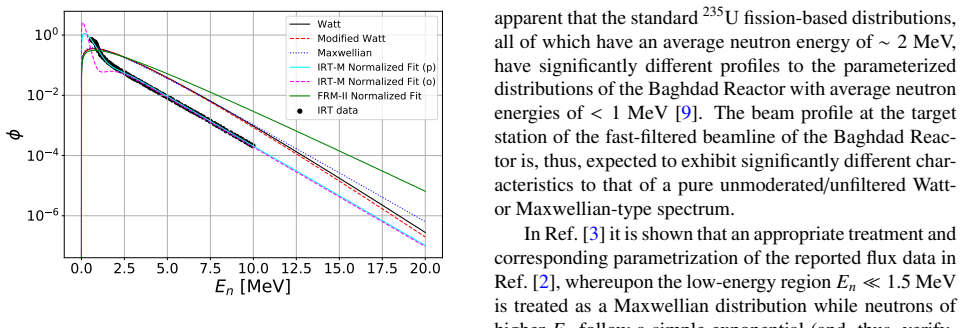
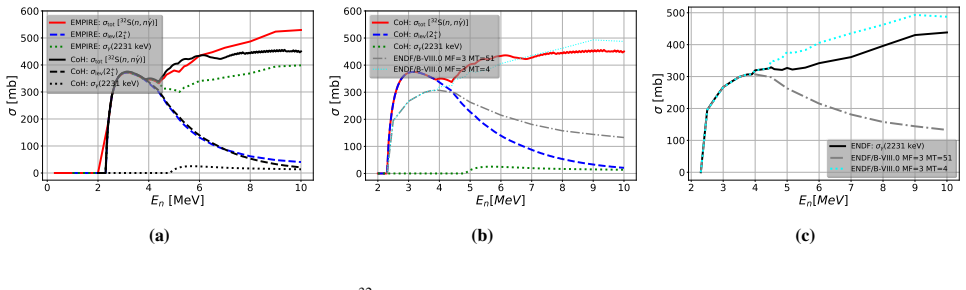
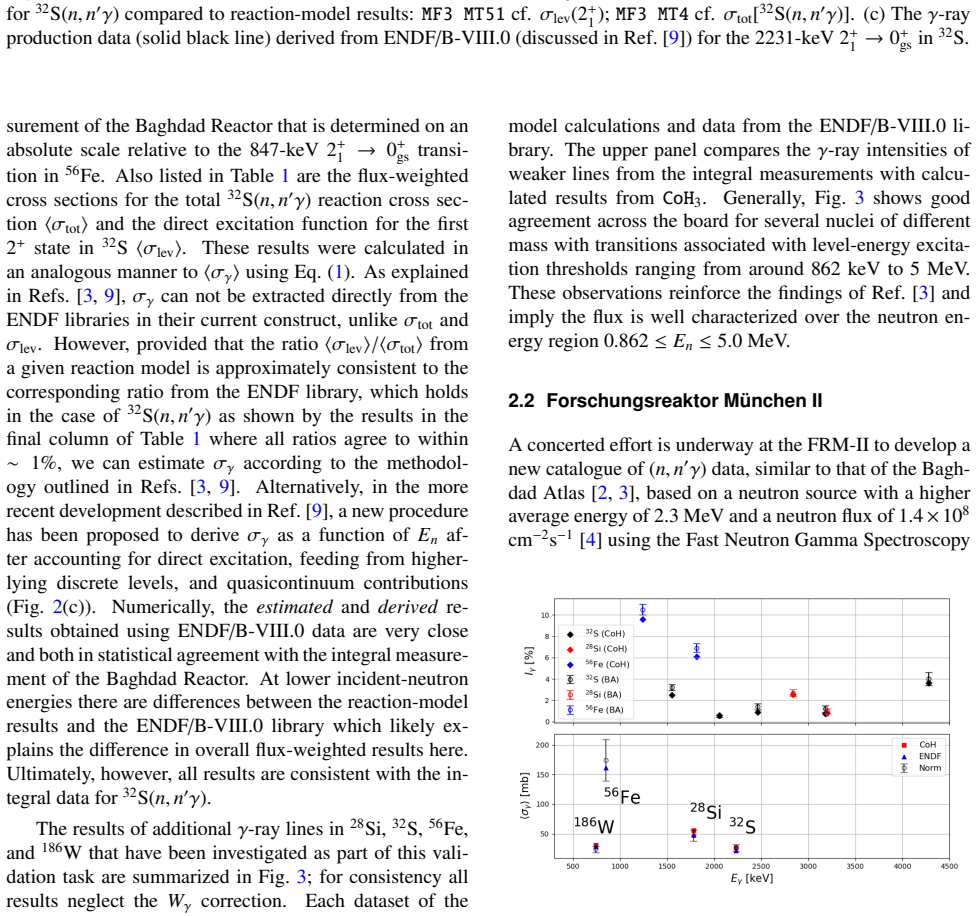
Flux-weighted cross-sections deduced using the ENDF/B-VIII.0 gamma-ray data are in good agreement with the integral measurements performed at the Baghdad Research Reactor in addition to the corresponding results of different reaction-model calculations, CoH3 and EMPIRE. Given the excitation thresholds for the gamma-ray transitions involved, these observations lend further support to the characterization of the IRT-M flux in the fast-neutron energy region 0.862 to 5.0 MeV. The same level of agreement is reported for iron-56 using the FRM-II source.
What carries the argument
Flux-weighted cross sections from ENDF/B-VIII.0 gamma-ray production data compared to integral benchmark measurements at research reactors.
If this is right
- The ENDF/B-VIII.0 gamma-ray production data are consistent with experiment for the inelastic scattering reactions and nuclides examined.
- The IRT-M reactor flux characterization receives additional support in the stated fast-neutron interval.
- The same validation method using flux-weighted library data applies successfully to the FRM-II reactor source.
Where Pith is reading between the lines
- The integral benchmark approach could be repeated with other evaluated libraries to test their gamma-ray data in the same energy window.
- Consistent results across multiple reactors might allow extension of the method to additional nuclides or reaction channels not covered here.
- This style of validation supplies a cross-check that is independent of the differential cross-section experiments normally used to build the libraries.
Load-bearing premise
The neutron flux of the IRT-M Reactor is accurately characterized in the fast-neutron energy region 0.862 to 5.0 MeV.
What would settle it
An independent measurement that shows the actual IRT-M reactor neutron flux deviates from the assumed spectrum in the 0.862 to 5.0 MeV range would remove the basis for claiming agreement between the ENDF/B-VIII.0 data and the integral results.
Figures
read the original abstract
Two different neutron sources, based on $^{235}$U-fission neutrons with different average energies, provide integral benchmark data for validation of $\gamma$-ray production data in the evaluated nuclear data libraries corresponding to fast-neutron-induced inelastic-neutron scattering reactions. Firstly, we consider the IRT-M Research Reactor, formerly located at the Nuclear Research Institute just outside of Baghdad, Iraq, to demonstrate the validation methodology using the associated $\gamma$-ray data in the Evaluated Nuclear Data File, version VIII.0 (ENDF/B-VIII.0), for several $\gamma$-ray transitions over a wide range of nuclides including $^{28}$Si, $^{32}$S, $^{56}$Fe, and $^{186}$W. Using the characterized neutron flux of the Baghdad IRT-M Reactor, we find flux-weighted cross-sections deduced using the ENDF/B-VIII.0 $\gamma$-ray data to be in good agreement with the integral measurements performed at the Baghdad Research Reactor in addition to the corresponding results of different reaction-model calculations, {\tt CoH$_{3}$} and {\tt EMPIRE}. Given the excitation thresholds for the $\gamma$-ray transitions involved in this investigation, these observations lend further support to the characterization of the IRT-M flux in the fast-neutron energy region $0.862 \leq E_{n} \leq 5.0$ MeV. The additional detail devoted to the IRT-M source reflects the broader scope of the validation work carried out at that facility. A second neutron source considered for this validation work is the Forschungsreaktor M{\"u}nich (FRM-II), Garching, Germany. Again, the flux-weighted $\gamma$-ray data from ENDF/B-VIII.0 for $^{56}$Fe compare well to the integral FRM-II measurement and reaction-model calculations.
Editorial analysis
A structured set of objections, weighed in public.
Referee Report
Summary. The manuscript proposes using integral benchmark data from fast-neutron sources at the IRT-M Research Reactor (Baghdad) and FRM-II (Garching) to validate γ-ray production data in ENDF/B-VIII.0 for inelastic neutron scattering. Flux-weighted cross sections derived from the ENDF data are reported to agree with integral measurements at Baghdad and with CoH3/EMPIRE calculations for nuclides including 28Si, 32S, 56Fe and 186W; the agreement is further claimed to lend support to the prior IRT-M flux characterization in the 0.862–5.0 MeV interval.
Significance. If the flux characterization is independently reliable, the work supplies integral benchmarks for γ-production data that are relevant to reactor shielding and heating applications. The explicit comparison against two reaction-model codes (CoH3, EMPIRE) is a constructive element that allows cross-checks beyond the library itself.
major comments (2)
- [Abstract] Abstract: the assertion of 'good agreement' between flux-weighted ENDF/B-VIII.0 cross sections and the Baghdad integral measurements supplies neither quantitative uncertainties, χ² statistics, nor an account of how uncertainties in the IRT-M flux propagate into the weighted integrals, preventing assessment of whether the agreement is statistically meaningful.
- [Abstract] Abstract: the claim that the observed agreement 'lends further support' to the IRT-M flux characterization (0.862 ≤ En ≤ 5.0 MeV) uses the same comparison that is offered as validation of the ENDF γ-ray data; because the flux spectrum is the weighting function, any systematic error in its shape or normalization above the 0.862 MeV threshold can offset the integrals while still appearing consistent with both the measurements and the model calculations, and no independent, flux-independent observable is reported that would resolve the degeneracy.
minor comments (1)
- The manuscript could usefully tabulate the specific γ-ray transitions, their excitation thresholds, and the corresponding flux-weighted cross-section values for each nuclide to make the comparisons reproducible.
Simulated Author's Rebuttal
We thank the referee for the careful reading and constructive comments on the abstract. We address each point below and will revise the manuscript accordingly to improve clarity and rigor.
read point-by-point responses
-
Referee: [Abstract] Abstract: the assertion of 'good agreement' between flux-weighted ENDF/B-VIII.0 cross sections and the Baghdad integral measurements supplies neither quantitative uncertainties, χ² statistics, nor an account of how uncertainties in the IRT-M flux propagate into the weighted integrals, preventing assessment of whether the agreement is statistically meaningful.
Authors: We agree that quantitative metrics are needed. In the revised manuscript we will report the relative differences (in percent) between the flux-weighted ENDF integrals and the Baghdad measurements for each transition, include a brief propagation of the published IRT-M flux uncertainties into the weighted cross sections, and add χ² values (or equivalent) where the number of data points permits a meaningful statistic. revision: yes
-
Referee: [Abstract] Abstract: the claim that the observed agreement 'lends further support' to the IRT-M flux characterization (0.862 ≤ En ≤ 5.0 MeV) uses the same comparison that is offered as validation of the ENDF γ-ray data; because the flux spectrum is the weighting function, any systematic error in its shape or normalization above the 0.862 MeV threshold can offset the integrals while still appearing consistent with both the measurements and the model calculations, and no independent, flux-independent observable is reported that would resolve the degeneracy.
Authors: The referee correctly identifies a potential degeneracy. We will revise the abstract and the corresponding discussion to remove the phrasing that the agreement 'lends further support' to the flux characterization. The primary claim will be limited to validation of the ENDF γ-ray data via consistency with both the integral measurements and the independent CoH₃/EMPIRE calculations; any inference about the flux will be presented only as a consistency check and explicitly qualified as dependent on the same weighting function. revision: yes
Circularity Check
Moderate interdependence between prior flux characterization and ENDF gamma validation via shared agreement
specific steps
-
other
[Abstract]
"Given the excitation thresholds for the γ-ray transitions involved in this investigation, these observations lend further support to the characterization of the IRT-M flux in the fast-neutron energy region 0.862 ≤ En ≤ 5.0 MeV."
The 'observations' are the agreement between Baghdad integral measurements and flux-weighted cross sections computed from ENDF/B-VIII.0 using the IRT-M flux spectrum as input. Claiming this agreement supports the flux characterization makes the flux both the load-bearing input for the weighting and a supported output, without an independent benchmark that would break the degeneracy between flux error and data error.
full rationale
The paper's central validation compares flux-weighted ENDF gamma-production data against integral measurements and model calculations (CoH3, EMPIRE). This comparison has independent empirical content. However, the abstract explicitly uses the resulting agreement to 'lend further support' to the IRT-M flux characterization that served as the weighting input. This creates partial interdependence without a flux-independent observable, but does not reduce the main claim to a self-definition or fitted input by construction. No self-citation chain or ansatz smuggling is exhibited in the provided text.
Axiom & Free-Parameter Ledger
axioms (2)
- domain assumption The neutron flux spectrum of the IRT-M reactor is known in the 0.862-5.0 MeV range.
- domain assumption CoH3 and EMPIRE reaction models are independent of the ENDF/B-VIII.0 gamma-ray data being validated.
Reference graph
Works this paper leans on
-
[1]
Brown et al., ENDF/B-VIII.0: the 8th major release of the nuclear reaction data library with CIELO-project cross sections, new standards and thermal scattering data, Nucl
D.A. Brown et al., ENDF/B-VIII.0: the 8th major release of the nuclear reaction data library with CIELO-project cross sections, new standards and thermal scattering data, Nucl. Data Sheets 148, 1 (2018)
2018
-
[2]
Demidov et al., Atlas of Gamma-Ray Spectra from the Inelastic Scattering of Reactor Fast Neutrons, Nuclear Research Institute, Baghdad, Iraq (Moscow, Atomizdat 1978)
A.M. Demidov et al., Atlas of Gamma-Ray Spectra from the Inelastic Scattering of Reactor Fast Neutrons, Nuclear Research Institute, Baghdad, Iraq (Moscow, Atomizdat 1978)
1978
-
[3]
Hurst et al., The Baghdad Atlas: A relational database of inelastic neutron-scattering ( n,n' ) data, Nucl
A.M. Hurst et al., The Baghdad Atlas: A relational database of inelastic neutron-scattering ( n,n' ) data, Nucl. Instrum. Methods Phys. Res. Sect. A 995, 165095 (2021); https://github.com/AaronMHurst/baghdad_atlas
2021
-
[4]
Ilic et al., Prompt gamma rays induced by inelastic scattering of fission neutrons on iron, J
Z. Ilic et al., Prompt gamma rays induced by inelastic scattering of fission neutrons on iron, J. Radioanal. Nucl. Chem. 325, 641 (2020)
2020
-
[5]
Kolos et al., Current nuclear data needs for applications, Phys
K. Kolos et al., Current nuclear data needs for applications, Phys. Rev. Res. 4, 021001 (2022)
2022
-
[6]
Lewis, L.A
A.M. Lewis, L.A. Bernstein, A.M. Hurst, in Experimental Measurements that Could Become Becnhmarks, https://conferences.lbl.gov/event/504/contributions/4101/attachments/3094/1691/ALewis_WANDA2021.pdf
-
[7]
Unified Coupled-Channels and Hauser-Feshbach Model Calculation for Nuclear Data Evaluation
T. Kawano, Unified coupled-channels and Hauser-Feshbach model calculation for nuclear data, (2019); https://arxiv.org/abs/1901.05641
work page internal anchor Pith review Pith/arXiv arXiv 2019
-
[8]
Herman et al., EMPIRE: Nuclear Reaction Model Code System for Data Evaluation, Nucl
M. Herman et al., EMPIRE: Nuclear Reaction Model Code System for Data Evaluation, Nucl. Data Sheets 108, 2655 (2007)
2007
-
[9]
Hurst, E.V
A.M. Hurst, E.V. Chimanski, D.A. Brown, Validation of evaluated nuclear data for GRIN, LBNL-2001617 (2024)
2024
-
[10]
Randriamala et al., FaNGaS: A new instrument for ( n,n' ) reaction measurements at FRM-II, Nucl
T.H. Randriamala et al., FaNGaS: A new instrument for ( n,n' ) reaction measurements at FRM-II, Nucl. Instrum. Methods Phys. Res. Sect. A 806, 370 (2016)
2016
-
[11]
Evaluated Nuclear Structure Data File (ENSDF), https://www.nndc.bnl/ensdf
discussion (0)
Sign in with ORCID, Apple, or X to comment. Anyone can read and Pith papers without signing in.