Direct Observations of Magnetic Reconnection in the Solar Wind Current Sheets near Mars
Pith reviewed 2026-06-27 02:45 UTC · model grok-4.3
The pith
MAVEN observes the first direct evidence of magnetic reconnection in solar wind current sheets near Mars.
A machine-rendered reading of the paper's core claim, the machinery that carries it, and where it could break.
Core claim
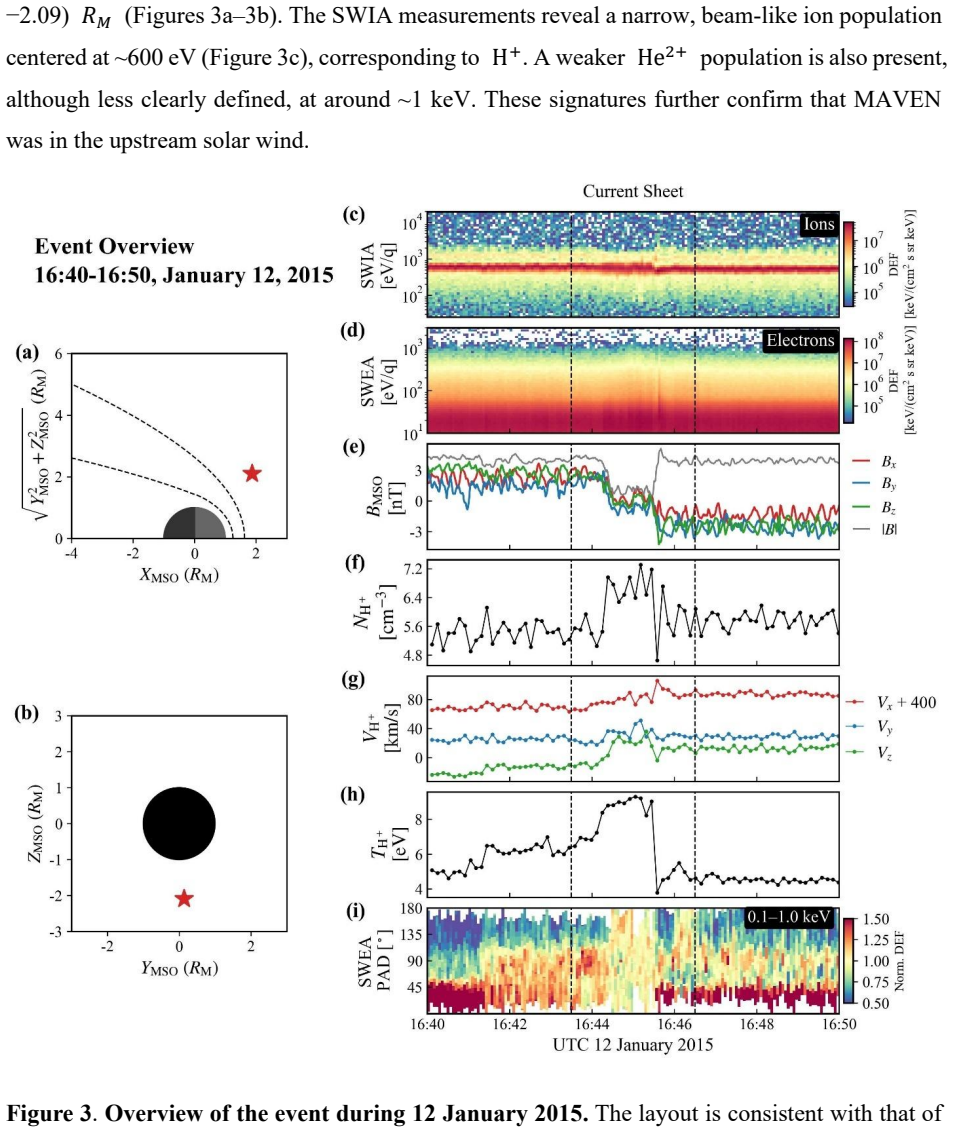
Using measurements from NASA's MAVEN spacecraft, we report the first direct observations of magnetic reconnection occurring within the solar wind current sheets near Mars. MAVEN observed the classic Petschek-type reconnection exhaust regions, evidenced by bifurcated magnetic field signatures and Alfvenic ion outflows. The observed exhaust region appears to be large-scale, significantly exceeding the typical thickness of solar wind current sheets near Mars. This suggests that magnetic reconnection may significantly broaden the current sheet.
What carries the argument
Petschek-type reconnection exhaust region, identified through bifurcated magnetic field signatures and Alfvenic ion outflows, which supplies the direct evidence of reconnection and its broadening effect on the current sheet.
If this is right
- Magnetic reconnection occurs inside solar wind current sheets at the orbital distance of Mars.
- Reconnection exhausts can reach scales much larger than the usual thickness of solar wind current sheets.
- Reconnection can actively broaden current sheets in the solar wind.
- Reconnection operates across a broad range of heliocentric distances in the heliosphere.
- The process supplies new information on how the solar wind evolves at large scales and how turbulence develops within it.
Where Pith is reading between the lines
- Reconnection may serve as a widespread mechanism for converting magnetic energy into plasma energy at many distances from the Sun.
- Similar exhaust signatures could appear in solar wind current sheets observed near other planets or by other spacecraft.
- The broadening of current sheets by reconnection could feed into the cascade that generates solar wind turbulence.
Load-bearing premise
The observed bifurcated magnetic field signatures and Alfvenic ion outflows result from magnetic reconnection rather than other plasma processes or instrument effects, and the exhaust thickness is significantly larger than the typical thickness of solar wind current sheets near Mars.
What would settle it
Further data or re-analysis showing that the reported exhaust regions lack true reconnection signatures such as consistent field reversal across the sheet or strictly Alfvenic flows, or that their thickness falls within the range of ordinary solar wind current sheets near Mars.
Figures
read the original abstract
Magnetic reconnection is a fundamental and ubiquitous process in astrophysical plasmas that converts magnetic energy into plasma kinetic and thermal energy. Throughout the heliosphere, the solar wind is permeated with current sheets (CSs), providing a natural laboratory for investigating this process. Using measurements from NASA's Mars Atmosphere and Volatile EvolutioN (MAVEN) spacecraft, we report the first direct observations of magnetic reconnection occurring within the solar wind CSs near Mars. Specifically, MAVEN observed the classic Petschek-type reconnection exhaust regions, evidenced by bifurcated magnetic field signatures and Alfvenic ion outflows. Notably, the observed exhaust region appears to be large-scale, significantly exceeding the typical thickness of solar wind CSs near Mars. This suggests that magnetic reconnection may significantly broaden the CS. Our results underscore the ubiquity of magnetic reconnection across heliocentric distances and may provide new insights into the large-scale evolution of the solar wind and the development of turbulence within it.
Editorial analysis
A structured set of objections, weighed in public.
Referee Report
Summary. This manuscript reports the first direct in-situ observations of magnetic reconnection within solar wind current sheets near Mars, based on MAVEN measurements. The authors identify classic Petschek-type reconnection exhaust regions via bifurcated magnetic field signatures and Alfvénic ion outflows in specific events, and argue that the observed exhaust thickness significantly exceeds typical solar wind CS thicknesses near Mars, implying that reconnection may broaden the current sheets. The work includes event timing, field/plasma time series, and comparisons to prior CS thickness statistics from the same region.
Significance. If the event identifications hold, the result is significant as the first reported direct evidence of reconnection exhausts in solar wind CSs at ~1.5 AU, extending heliospheric reconnection studies to the Mars environment. The broadening inference, grounded in comparison to reference distributions, offers a concrete mechanism for CS evolution and potential links to turbulence development. Strengths include the provision of raw time-series data and direct statistical anchoring rather than parameter fitting.
minor comments (3)
- The abstract and introduction should explicitly state the quantitative thresholds (e.g., minimum |ΔB| rotation angle, Alfvénicity correlation coefficient >0.8) used to classify an event as a Petschek exhaust, to allow readers to assess uniqueness against other discontinuities.
- Figure captions for the time-series plots should include the exact MAVEN instrument modes, sampling rates, and any data gaps or calibration notes for the magnetic field and ion measurements shown.
- The discussion of exhaust thickness should add a short table or explicit percentile values from the cited prior CS statistics (e.g., median and 95th percentile thicknesses) so the 'significantly exceeding' claim can be evaluated numerically without consulting external references.
Simulated Author's Rebuttal
We thank the referee for the supportive summary, recognition of the significance of the first direct observations of Petschek-type reconnection exhausts in solar wind current sheets near Mars, and the recommendation for minor revision. No specific major comments were provided in the report.
Circularity Check
No significant circularity; pure observational report
full rationale
The manuscript is an observational study reporting MAVEN in-situ measurements of magnetic field and plasma signatures interpreted as Petschek-type reconnection exhausts. No equations, derivations, fitted parameters, or predictions appear in the abstract or described structure. The central claim rests on direct data interpretation and external comparison to prior CS thickness statistics, with no self-referential reduction or load-bearing self-citation chain. This matches the default expectation for non-circular observational papers.
Axiom & Free-Parameter Ledger
Reference graph
Works this paper leans on
-
[1]
I., Suni, J., et al
Ala-Lahti, M., Pulkkinen, T. I., Suni, J., et al. 2025, ApJL, 994, L1
2025
-
[2]
Angelopoulos, V., Harter, B., Grimes, E., Russell, C., Wu, J., Lewis, J., et al. 2026, PySPEDAS (Space Physics Environment Data Analysis System in Python), Zenodo, doi:10.5281/zenodo.17634923
-
[3]
P., Larson, D., et al
Angelopoulos, V., McFadden, J. P., Larson, D., et al. 2008, Sci, 321, 931
2008
-
[4]
L., & Nakamura, R
Burch, J. L., & Nakamura, R. 2025, SSRv, 221, 19
2025
-
[5]
A., & Shay, M
Cassak, P. A., & Shay, M. A. 2007, PhPl, 14, 102114
2007
-
[6]
Chaffin, M. S., et al. 2015, GRL, 42, 9001, doi:10.1002/2015GL065287
-
[7]
2024, ApJ, 974, 1
Chen, Y., Wu, M., Wang, H., et al. 2024, ApJ, 974, 1
2024
-
[8]
2025, JGRA, 130, e2025JA034688
Cheng, Z., Zhang, C., Dong, C., et al. 2025, JGRA, 130, e2025JA034688
2025
-
[9]
Connerney, J. E. P. 2026, MAVEN MAG Calibrated Data Bundle, NASA Planetary Data System, doi:10.17189/1414178
-
[10]
Connerney, J. E. P., Espley, J. R., Lawton, P., et al. 2015, SSRv, 195, 257
2015
-
[11]
-M., Comisso, L., & Bhattacharjee, A
Dong, C., Wang, L., Huang, Y. -M., Comisso, L., & Bhattacharjee, A. 2018, PRL, 121, 165101, doi: 10.1103/PhysRevLett.121.165101
-
[12]
2022, SciA, 8, eabn7627
Dong, C., Wang, L., Huang, Y.-M., et al. 2022, SciA, 8, eabn7627
2022
-
[13]
F., Antiochos, S
Drake, J. F., Antiochos, S. K., Bale, S. D., et al. 2025, SSRv, 221, 2
2025
-
[14]
2017, JGR, 122, 11
Dubinin, E., Fraenz, M., Pä tzold, M., et al. 2017, JGR, 122, 11
2017
-
[15]
M., et al
Eriksson, S., Swisdak, M., Weygand, J. M., et al. 2022, ApJ, 933, 2
2022
-
[16]
J., Fuselier, S
Gershman, D. J., Fuselier, S. A., Cohen, I. J., et al. 2024, SSRv, 220, 1
2024
-
[17]
Gosling, J. T. 2011, SSRv, 172, 187
2011
-
[18]
T., & Phan, T
Gosling, J. T., & Phan, T. D. 2013, ApJL, 763, L39
2013
-
[19]
T., & Szabo, A
Gosling, J. T., & Szabo, A. 2008, JGR, 113, A10103
2008
-
[20]
T., Eriksson, S., Skoug, R., et al
Gosling, J. T., Eriksson, S., Skoug, R., et al. 2006, AJ, 131, 10
2006
-
[21]
H., Perri, S., et al
Greco, A., Matthaeus, W. H., Perri, S., et al. 2017, SSRv, 214, 1
2017
-
[22]
Z., Fu, H
Guo, Z. Z., Fu, H. S., Jin, H. P., et al. 2026, ApJL, 997, L2
2026
-
[23]
Halekas, J. S. 2026, MAVEN SWIA Calibrated Data Bundle, NASA Planetary Data System, doi:10.17189/1414182
-
[24]
S., Taylor, E
Halekas, J. S., Taylor, E. R., Dalton, G., et al. 2015, SSRv, 195, 125
2015
-
[25]
S., McFadden, J
Harada, Y., Halekas, J. S., McFadden, J. P., et al. 2015, GRL, 42, 8838
2015
-
[26]
Hesse, M., & Cassak, P. A. 2020, JGR, 125, e2018JA025935
2020
-
[27]
M., et al
Jakosky, B. M., et al. 2015, SSRv, 195, 3
2015
-
[28]
2022, Nat
Ji, H., Daughton, W., Jara-Almonte, J., et al. 2022, Nat. Rev. Phys., 4, 263
2022
-
[29]
2025, GRL, 52, e2025GL117612
Li, X., Dong, C., Ji, H., et al. 2025, GRL, 52, e2025GL117612
2025
-
[30]
Mitchell, D. L. 2026, MAVEN SWEA Calibrated Data Bundle, NASA Planetary Data System, doi:10.17189/1414181
-
[31]
L., Mazelle, C., Sauvaud, J.-A., et al
Mitchell, D. L., Mazelle, C., Sauvaud, J.-A., et al. 2016, SSRv, 200, 49
2016
-
[32]
L., Birn, J., et al
Nakamura, R., Burch, J. L., Birn, J., et al. 2025, SSRv, 221, 1 Øieroset, M., Phan, T. D., Drake, J. F., et al. 2024, ApJ, 971, 10 Øieroset, M., Phan, T. D., Fujimoto, M., et al. 2001, Nature, 412, 414 Øieroset, M., Phan, T. D., Shay, M. A., et al. 2017, GRL, 44, 7598
2025
-
[33]
2013, SSRv, 178, 385
Paschmann, G., Øieroset, M., & Phan, T. 2013, SSRv, 178, 385
2013
-
[34]
Petschek, H. E. 1964, in Proc. AAS-NASA Symp. on the Physics of Solar Flares, ed. W. N. Hess (NASA SP-50; Washington: NASA), 425
1964
-
[35]
D., Bale, S
Phan, T. D., Bale, S. D., Eastwood, J. P., et al. 2020, ApJS, 246, 2
2020
-
[36]
D., Drake, J
Phan, T. D., Drake, J. F., Larson, D., et al. 2024, ApJL, 971, L2
2024
-
[37]
D., Drake, J
Phan, T. D., Drake, J. F., Shay, M. A., et al. 2014, GRL, 41, 7002
2014
-
[38]
D., Gosling, J
Phan, T. D., Gosling, J. T., & Davis, M. S. 2009, GRL, 36, L09101
2009
-
[39]
D., Gosling, J
Phan, T. D., Gosling, J. T., Davis, M. S., et al. 2006, Nature, 439, 175
2006
-
[40]
D., Lavraud, B., Halekas, J
Phan, T. D., Lavraud, B., Halekas, J. S., et al. 2021, A&A, 650, A3
2021
-
[41]
D., Love, T
Phan, T. D., Love, T. E., Gosling, J. T., et al. 2011, GRL, 38, L17101
2011
-
[42]
D., Verniero, J
Phan, T. D., Verniero, J. L., Larson, D., et al. 2022, GRL, 49, e2021GL096986
2022
-
[43]
J., Tsurutani, B
Smith, E. J., Tsurutani, B. T., & Rosenberg, R. L. 1978, JGR, 83, 717
1978
-
[44]
Sonnerup, B. U. Ö., & Scheible, M. 1998, in Analysis Methods for Multi-Spacecraft Data, ed. G. Paschmann & P. W. Daly (ISSI Sci. Rep. SR-001; Bern: ISSI), 185
1998
-
[45]
2020, ApJS, 246, 2
Szabo, A., Larson, D., Whittlesey, P., et al. 2020, ApJS, 246, 2
2020
-
[46]
2020, NatAs, 4, 721, doi:10.1038/s41550-020-1148-6
Wan, W., Wang, C., Li, C., & Wei, Y. 2020, NatAs, 4, 721, doi:10.1038/s41550-020-1148-6
-
[47]
2024, JGRA, 129, e2023JA031757, doi:10.1029/2023JA031757
Wang, G., Xiao, S., Wu, M., Zhao, Y., Jiang, S., Pan, Z., et al. 2024, JGRA, 129, e2023JA031757, doi:10.1029/2023JA031757
-
[48]
2022, NatAs, 6, 1285
Wang, R., Wang, S., Lu, Q., et al. 2022, NatAs, 6, 1285
2022
-
[49]
2023, ApJ, 947, 100
Wang, R., Yu, X., Wang, Y., et al. 2023, ApJ, 947, 100
2023
-
[50]
2023, EPP, 7, 1, doi:10.26464/epp2023028
Wang, Y., Zhang, T., Wang, G., Xiao, S., Zou, Z., Cheng, L., et al. 2023, EPP, 7, 1, doi:10.26464/epp2023028
-
[51]
S., Shen, H.-W., et al
Wen, Y., Halekas, J. S., Shen, H.-W., et al. 2025, ApJL, 982, L2
2025
-
[52]
2026, JGR: Space Phys., 131, e2026JA035238
Zhang, C., Dong, C., Xu, S., et al. 2026, JGR: Space Phys., 131, e2026JA035238
2026
-
[53]
2022, JGR: Planets, 127, e2022JE007334
Zhang, C., Rong, Z., Klinger, L., et al. 2022, JGR: Planets, 127, e2022JE007334
2022
-
[54]
L., Lu, Q
Zhang, T. L., Lu, Q. M., Baumjohann, W., et al. 2012, Sci, 336, 567
2012
-
[55]
2023, ScChT, 66, 2396, doi:10.1007/s11431-023-2401-2
Zou, Z., Wang, Y., Zhang, T., Wang, G., Xiao, S., Pan, Z., et al. 2023, ScChT, 66, 2396, doi:10.1007/s11431-023-2401-2
discussion (0)
Sign in with ORCID, Apple, or X to comment. Anyone can read and Pith papers without signing in.