Impulsive Hydrodynamic Exfoliation into Monolayer Graphene and Nanofragments by Transonic Flow Focusing
Pith reviewed 2026-06-27 04:59 UTC · model grok-4.3
The pith
Transonic flow focusing exfoliates graphite into monolayer flakes and 10-nm nanofragments using only hydrodynamic stresses in isopropanol or water.
A machine-rendered reading of the paper's core claim, the machinery that carries it, and where it could break.
Core claim
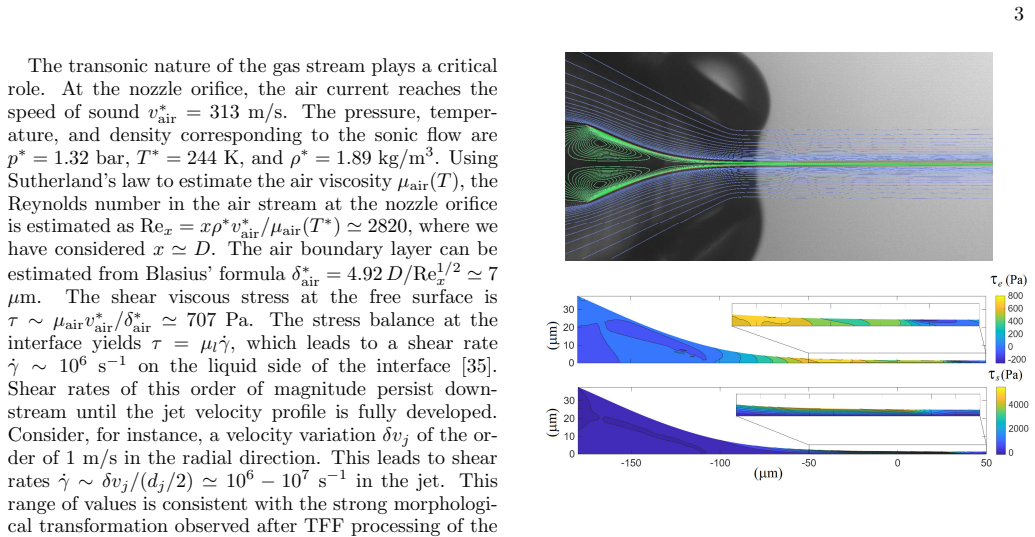
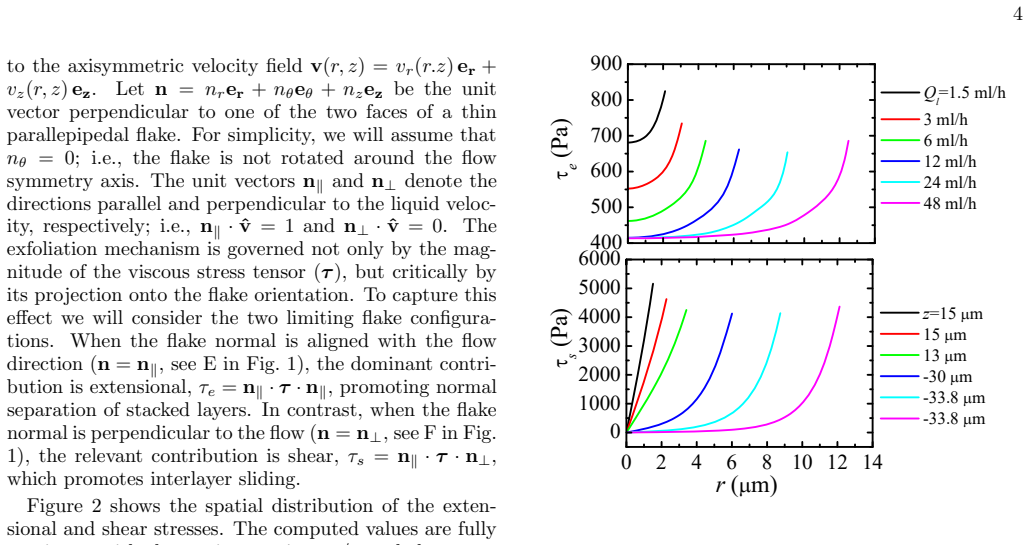
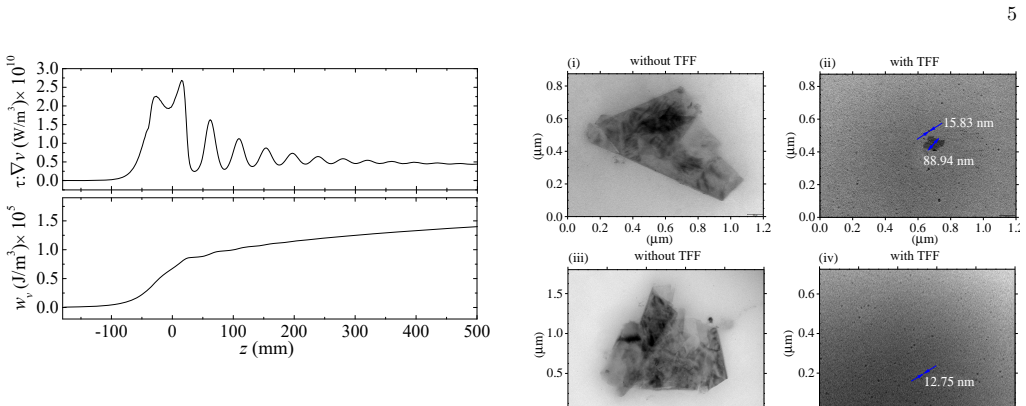
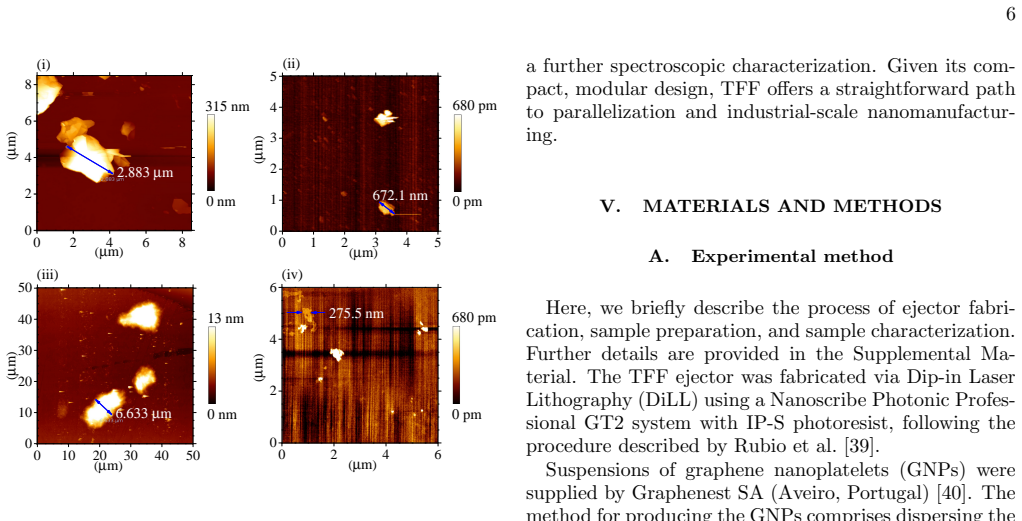
During the microsecond residence time at the meniscus-jet transition, shear and extensional stresses of order 10^6 s^{-1} produce viscous power densities of order 10^{10} W/m^3 that drive exfoliation of graphene nanoplatelets into monolayer flakes of 300-400 nm lateral size and monolayer nanofragments of 10-15 nm, achieving monolayer fractions above 99 percent in isopropanol and 92.9 percent in pure water without surfactants or oxidative chemistry.
What carries the argument
Transonic Flow Focusing (TFF), the process that accelerates a liquid suspension through a small orifice into a high-speed micrometer jet, concentrating extreme shear and elongational stresses in a confined contact-free zone during the meniscus-jet transition.
If this is right
- Graphene monolayers and quantum-dot-sized fragments can be produced in a single continuous step from commercial nanoplatelets.
- The process works in both isopropanol and pure water, removing the need for surfactants or chemical oxidants.
- Exfoliation occurs on microsecond timescales at power densities around 10^10 W/m^3.
- Both 2D flakes and 0D nanofragments appear together in the output stream.
Where Pith is reading between the lines
- The same jet-focusing geometry might be tested on other layered materials such as transition-metal dichalcogenides to check whether the stress levels generalize.
- Because the device is microfluidic in scale, arrays of parallel orifices could be explored for higher throughput without changing the local stress history.
- If the nanofragment size distribution proves narrow enough, the output could be filtered or centrifuged to isolate fractions suitable for optical or electronic quantum-dot studies.
Load-bearing premise
The reported monolayer fractions are produced by the calculated hydrodynamic stresses during the brief jet transition rather than by the initial suspension preparation, solvent properties, or artifacts in the electron microscopy and atomic force measurements.
What would settle it
An experiment that applies the same TFF jet conditions to already-exfoliated monolayer graphene and finds no further size reduction, or a control run with identical suspension but no jet transition that still yields the same high monolayer fraction.
Figures



read the original abstract
We propose using Transonic Flow Focusing (TFF) to produce 2D and 0D nanomaterials. This technique focuses liquid suspensions into high-speed micrometer-scale jets, combining extremely high shear and elongational stresses in a confined, contact-free zone. For the Graphene Nanoplatelets suspensions and TFF operating conditions investigated here, the process promoted exfoliation without added surfactants or oxidative chemistry. Both graphene monolayer flakes ($\sim 300-400$ nm in lateral size) and monolayer graphene nanofragments with lateral sizes compatible with quantum dots ($\sim 10-15$ nm) were obtained in a single TFF step using isopropanol and pure water. Our theoretical analysis reveals that, during microsecond residence times at the meniscus-jet transition, shear and extensional stresses of the order of $10^6$ s$^{-1}$ act on the suspended particles, yielding viscous power densities of the order of $10^{10}$ $\mathrm{W/m^{3}}$. High-resolution transmission electron microscopy and atomic force microscopy show that the monolayer fraction exceeded 99\% for isopropanol and 92.9\% for water. These results suggest that TFF can combine solvent versatility with a high monolayer fraction in a purely mechanical top-down process.
Editorial analysis
A structured set of objections, weighed in public.
Referee Report
Summary. The manuscript claims that Transonic Flow Focusing (TFF) enables surfactant-free exfoliation of graphene nanoplatelets into monolayer flakes (300-400 nm lateral size) and nanofragments (10-15 nm, quantum-dot compatible) in a single step with isopropanol or water, producing monolayer fractions >99% (IPA) and 92.9% (water) via hydrodynamic stresses of order 10^6 s^{-1} and power densities ~10^{10} W/m^3 acting over microsecond meniscus-jet transitions, as shown by HRTEM/AFM and supported by theoretical analysis.
Significance. If the causal link to TFF holds, the work offers a mechanical, contact-free route to high-monolayer-fraction 2D materials and 0D fragments with solvent versatility; the integration of order-of-magnitude stress estimates with direct microscopy is a positive feature.
major comments (3)
- [Abstract] Abstract and Results paragraphs: no pre-TFF characterization (e.g., monolayer fraction, size distribution) of the input Graphene Nanoplatelets suspension is reported, so the central claim that the observed >99% (IPA) and 92.9% (water) monolayer fractions are produced by the calculated TFF stresses cannot be evaluated; this is load-bearing for the exfoliation mechanism.
- [theoretical analysis] Theoretical analysis section: the derivation of the 10^6 s^{-1} shear/extensional rates and 10^{10} W/m^3 power densities over microsecond residence times is stated without the governing equations, assumptions, or sensitivity analysis, preventing assessment of whether these values are sufficient to explain the observed exfoliation.
- [Results] Results paragraphs: the HRTEM/AFM monolayer-fraction statistics lack reported sample sizes, number of flakes counted, error bars, or controls for solvent-induced or preparation artifacts, weakening the quantitative yield claims.
minor comments (1)
- [Abstract] Abstract: the phrase 'lateral sizes compatible with quantum dots' is imprecise; a size histogram or explicit distribution would strengthen the 0D claim.
Simulated Author's Rebuttal
We thank the referee for their constructive and detailed comments. We address each major point below and agree that revisions are needed to strengthen the manuscript.
read point-by-point responses
-
Referee: [Abstract] Abstract and Results paragraphs: no pre-TFF characterization (e.g., monolayer fraction, size distribution) of the input Graphene Nanoplatelets suspension is reported, so the central claim that the observed >99% (IPA) and 92.9% (water) monolayer fractions are produced by the calculated TFF stresses cannot be evaluated; this is load-bearing for the exfoliation mechanism.
Authors: We agree that pre-TFF characterization of the input suspension is essential to substantiate the exfoliation claims. The input was a commercial graphene nanoplatelets suspension, but we did not include its initial monolayer fraction and size distribution in the manuscript. We will perform and report additional AFM and TEM analyses on the pre-TFF suspensions to provide this baseline data, allowing direct comparison of the monolayer fractions before and after TFF. This will strengthen the evidence for the mechanism. revision: yes
-
Referee: [theoretical analysis] Theoretical analysis section: the derivation of the 10^6 s^{-1} shear/extensional rates and 10^{10} W/m^3 power densities over microsecond residence times is stated without the governing equations, assumptions, or sensitivity analysis, preventing assessment of whether these values are sufficient to explain the observed exfoliation.
Authors: We agree that the theoretical section requires more detail for reproducibility and assessment. In the revised manuscript, we will include the governing equations for the flow (e.g., Navier-Stokes simplifications for the jet), the assumptions made (incompressible Newtonian fluid, no-slip boundaries, etc.), the calculation steps for shear rates and power densities, and a sensitivity analysis varying key parameters such as jet velocity and meniscus geometry. This will allow evaluation of the stress magnitudes. revision: yes
-
Referee: [Results] Results paragraphs: the HRTEM/AFM monolayer-fraction statistics lack reported sample sizes, number of flakes counted, error bars, or controls for solvent-induced or preparation artifacts, weakening the quantitative yield claims.
Authors: We will revise the Results section to include the sample sizes (number of flakes analyzed, e.g., over 200 flakes per condition), statistical error bars on the monolayer fractions, and additional control experiments to rule out solvent-induced exfoliation or preparation artifacts (e.g., sonication controls without TFF). This will provide a more robust quantitative basis for the reported yields. revision: yes
Circularity Check
No significant circularity; derivation is self-contained experimental and standard fluid-mechanics analysis
full rationale
The paper's core claims rest on direct post-TFF HRTEM/AFM imaging of monolayer fractions (>99% isopropanol, 92.9% water) and order-of-magnitude estimates of shear/extensional rates (~10^6 s^{-1}) and power densities (~10^{10} W/m^3) during the meniscus-jet transition. These estimates derive from standard transonic flow-focusing fluid mechanics applied to the described geometry and operating conditions, without any fitting to the observed yields or fractions. No equations reduce the reported monolayer percentages to self-referential definitions, fitted inputs renamed as predictions, or self-citation chains. The theoretical analysis is independent of the output statistics, and the experimental results are externally verifiable via microscopy on the processed material. Lack of pre-TFF input characterization is an evidentiary gap but does not create circularity in the reported derivation chain.
Axiom & Free-Parameter Ledger
axioms (1)
- standard math Standard assumptions of incompressible Newtonian fluid flow and continuum mechanics apply to the calculation of shear and extensional rates at the meniscus-jet transition.
Reference graph
Works this paper leans on
-
[1]
Zhang, Y
Y. Zhang, Y. W. Tan, H. L. Stormer, P. Kim, Experi- mental observation of the quantum hall effect and berry’s phase in graphene, Nature 438 (2005) 201–204
2005
-
[2]
K. S. Novoselov, E. McCann, S. V. Morozov, V. I. Falko, M. I. Katsnelson, U. Zeitler, D. Jiang, F. Schedin, A. K. Geim, Unconventional quantum hall effect and berry’s phase of 2pi in bilayer graphene, Nat. Phys. 2 (2006) 177–180
2006
-
[3]
K. S. Novoselov, Z. Jiang, Y. Zhang, S. V. Morozov, H. L. Stormer, U. Zeitler, J. C. Maan, G. S. Boebinger, P. Kim, A. K. Geim, Room-temperature quantum hall effect in graphene, Science 315 (2007) 1379
2007
-
[4]
K. S. Novoselov, A. K. Geim, S. V. Morozov, D. Jiang, M. I. Katsnelson, I. V. Grigorieva, S. V. Dubonos, A. A. Firsov, Two dimensional gas of massless dirac fermion in graphene, Nature 438 (2005) 197–200
2005
-
[5]
A. S. Mayorov, R. V. Gorbachev, S. V. Morozov, L. Britnell, R. Jalil, L. A. Ponomarenko, P. Blake, K. S. Novoselov, K. Watanabe, T. Taniguchi, A. K. Geim, Micrometer-scale ballistic transport in encapsu- lated graphene at room temperature, Nano Lett. 11 (6) (2011) 2396–2399
2011
-
[6]
A. A. Balandin, S. Ghosh, W. Bao, I. Calizo, D. Tewelde- brhan, F. Miao, C. N. Lau, Superior thermal conductivity of single-layer graphene, Nano Lett. 8 (3) (2008) 902–907
2008
-
[7]
R. R. Nair, P. Blake, A. N. Grigorenko, Fine structure constant defines visual transparency of graphene, Science 320 (2008) 1308
2008
-
[8]
C. Lee, X. Wei, J. W. Kysar, J. Hone, Measurement of the elastic properties and intrinsic strength of mono-layer graphene, Science 321 (2008) 385–388
2008
-
[9]
Akbar, M
F. Akbar, M. Kolahdouz, S. Larimian, B. Radfar, H. H. Radamson, Graphene synthesis, characterization and its applications in nanophotonics, nanoelectronics, and nanosensing, Int. Nano Lett. 6 (2016) 65–83
2016
-
[10]
X. Li, M. Rui, J. Song, Z. Shen, H. Zeng, Carbon and graphene quantum dots for optoelectronic and energy de- vices: A review, Adv. Funct. Mater. 25 (2015) 4929–4947
2015
-
[11]
Popinet, Quadtree-adaptive tsunami modelling, Ocean Dynam
S. Popinet, Quadtree-adaptive tsunami modelling, Ocean Dynam. 61 (2011) 1261–1285
2011
-
[12]
S. J. Kim, K. Choi, B. Lee, Y. Kim, B. H. Hong, Materi- als for flexible, stretchable electronics: Graphene and 2d materials, Annu. Rev. Mater. Res. 45 (2015) 63–84
2015
-
[13]
G¨ uler, N
O. G¨ uler, N. Ba˘ gcı, A short review on mechanical prop- erties of graphene reinforced metal matrix composites, J. Mater. Res. Technol. 9 (2020) 6808–6833
2020
-
[14]
Y. Choi, J. Kim, J. Lee, X. Chen, B. Seo, W. Choi, Re- cent progress on 2d-material-based smart textiles: Mate- rials, methods, and multifunctionality, Adv. Eng. Mater. 27 (2025) 2500188
2025
-
[15]
Parvin, V
N. Parvin, V. Kumar, S. W. Joo, S.-S. Park, T. K. Man- dal, Recent advances in the characterized identification of mono-to-multi-layer graphene and its biomedical ap- plications: A Review, Electronics 11 (20) (2022) 3345
2022
-
[16]
Peplow, Coming of age, Science 386 (2024) 138–143
M. Peplow, Coming of age, Science 386 (2024) 138–143
2024
-
[17]
Santra, A
S. Santra, A. Bose, K. Mitra, A. Adalder, Exploring two decades of graphene: The jack of all trades, Appl. Mater. Today 36 (2024) 102066
2024
-
[18]
Ghaffarkhah, E
A. Ghaffarkhah, E. Hosseini, M. Kamkar, A. A. Sehat, S. Dordanihaghighi, A. Allahbakhsh, C. Kuur, M. Arj- mand, Synthesis, applications, and prospects of graphene quantum dots: A comprehensive review, Small 18 (2022) 2102683
2022
-
[19]
Y. Xu, H. Cao, Y. Xue, B. Li, W. Cai, Liquid-phase ex- foliation of graphene: An overview on exfoliation media, techniques, and challenges, Nanomaterials 8 (11) (2018) 942
2018
-
[20]
S. H. Choi, S. J. Yun, Y. S. Won, C. H. Oh, S. M. Kim, K. K. Kim, Y. H. Lee, Large-scale synthesis of graphene and other 2d materials towards industrialization, Nat. Commun. 13 (2022) 1484
2022
-
[21]
K. Jia, J. Zhang, Y. Zhu, L. Sun, L. Lin, Z. Liu, To- ward the commercialization of chemical vapor deposition graphene films, Appl. Phys. Rev. 8 (4) (2021) 041306
2021
-
[22]
Sarno, G
M. Sarno, G. Rossi, C. Cirillo, L. Incarnato, Cold wall chemical vapor deposition graphene-based conductive tunable film barrier, Ind. Eng. Chem. Res. 57 (2018) 4895–4906
2018
-
[23]
T. H. Bointon, M. D. Barnes, S. Russo, M. F. Craciun, High quality monolayer graphene synthesized by resistive heating cold wall chemical vapor deposition, Adv. Mater. 27 (2015) 4200–4206
2015
-
[24]
Khattak, R
F. Khattak, R. Ullah, Microfluidization technique for graphene exfoliation: An overview and recent progress, J. Nanopart. Res. 26 (2024) 178
2024
-
[25]
U. Khan, A. O’Neill, M. Lotya, S. De, J. N. Coleman, High-concentration solvent exfoliation of graphene, Small 6 (2010) 864–871
2010
-
[26]
Stafford, A
J. Stafford, A. Patapas, N. Uzo, O. K. Matar, C. Pe- tit, Towards scale-up of graphene production via nonox- idizing liquid exfoliation methods, AIChE J. 64 (2018) 3246–3276
2018
-
[27]
Z. Wang, X. Yan, Q. Hou, et al., Scalable high yield exfoliation for monolayer nanosheets, Nat. Commun. 14 (2023) 236
2023
-
[28]
Z. Xu, J. Deng, Y. Lai, J. Chen, Y. Chen, S. Huang, A. Chen, J. Zhang, C. Lei, Study on the exfoliation mechanism of graphene nanoplatelets in the polypropy- lene/graphene nanoplatelets composites under the elon- gational flow generated by convergent-divergent chan- nels, J. Mater. Sci. 57 (2022) 5467–5481
2022
-
[29]
Arrigo, G
R. Arrigo, G. Malucelli, F. P. L. Mantia, Effect of the elongational flow on the morphology and properties of polymer systems: A brief review, Polymers 13 (20) (2021) 3529
2021
-
[30]
J. Tang, Y. Liu, Gram-scale synthesis of graphene quan- tum dots via energetic material deflagration for bioimag- ing application, J. Phys. Chem. Sol. 184 (2024) 111718
2024
-
[31]
C. S. Tshangana, A. A. Muleja, A. T. Kuvarega, T. J. Malefetse, B. B. Mamba, The applications of graphene oxide quantum dots in the removal of emerging pollutants in water: An overview, J. Water Process Eng. 43 (2021) 102249
2021
-
[32]
A. M. Ga˜ n´ an-Calvo, Generation of steady liquid mi- crothreads and micron-sized monodisperse sprays in gas streams, Phys. Rev. Lett. 80 (1998) 285–288
1998
-
[33]
H. N. Chapman et al., Femtosecond X-ray protein nanocrystallography, Nature 470 (2011) 73–79
2011
-
[34]
J. M. Montanero, Tip Streaming of Simple and Complex Fluids, Springer Nature, Switzerland, 2024
2024
-
[35]
Vakili et al., PEO-sheathed liquid jets increase sample delivery stability for serial femtosecond X-ray crystallog- 9 raphy, Sci
M. Vakili et al., PEO-sheathed liquid jets increase sample delivery stability for serial femtosecond X-ray crystallog- 9 raphy, Sci. Rep. 16 (2026) 10497
2026
-
[36]
S. Gravelle, C. Kamal, L. Botto, Liquid exfoliation of multilayer graphene in sheared solvents: A molecular dy- namics investigation, The Journal of Chemical Physics 152 (10) (2020) 104701.doi:10.1063/1.5141515
-
[37]
C. Kamal, S. Gravelle, L. Botto, Hydrodynamic slip can align thin nanoplatelets in shear flow, Nature Communications 11 (1) (2020) 2425.doi:10.1038/ s41467-020-15939-w. URLhttps://doi.org/10.1038/s41467-020-15939-w
-
[38]
D. Poustka, J. Havlica, D. Kramoliˇ s, A. Paˇ r´ ıkov´ a, F. J. Galindo-Rosales, M. ˇStofik, J. Mal´ y, Flow-induced parti- cle migration microfluidics—the experimenter’s compre- hensive review, Progress in Biomedical Engineering 7 (3) (2025) 032005.doi:10.1088/2516-1091/add77b. URLhttps://doi.org/10.1088/2516-1091/add77b
-
[39]
Rubio, A
M. Rubio, A. Rubio, M. G. Cabezas, M. A. Herrada, A. M. Ga˜ n´ an-Calvo, J. M. Montanero, Transonic flow focusing: stability analysis and jet diameter, Int. J. Mul- tiphase Flow 142 (2021) 103720
2021
-
[40]
V. E. M. Abrantes, B. R. Figueiredo, R. P. F. F. da Silva, Method and device for production of graphene or graphene-like materials (11 2020). URLhttps://patents.google.com/patent/ US10843145B2
2020
-
[41]
P. C. Rijo, J. M. O. Cremonezzi, R. J. E. Andrade, F. J. Galindo-Rosales, Correlation between the rheology of electronic inks and the droplet size generated from a capillary nozzle in dripping regime, Phys. Fluids 35 (2023) 093116
2023
-
[42]
P. C. Rijo, F. J. Galindo-Rosales, The building blocks behind the electrohydrodynamics of non-polar 2D-inks, Appl. Mater. 36 (2024) 102042
2024
-
[43]
M. A. Herrada, J. M. Montanero, A numerical method to study the dynamics of capillary fluid systems, J. Comput. Phys. 306 (2016) 137–147
2016
-
[44]
M. A. Herrada, Goodbye Christoffel symbols: A flexi- ble and practical approach for solving physical problems in curved spaces, Comput. Phys. Commun. 315 (2025) 109727
2025
-
[45]
Dimakopoulos, J
Y. Dimakopoulos, J. Tsamopoulos, A quasi-elliptic trans- formation for moving boundary problems with large anisotropic deformations, J. Comput. Phys. 192 (2003) 494–522
2003
-
[46]
M. R. Khorrami, Application of spectral collocation tech- niques to the stability of swirling flows, J. Comput. Phys. 81 (1989) 206–229
1989
discussion (0)
Sign in with ORCID, Apple, or X to comment. Anyone can read and Pith papers without signing in.