Quantum Cinema: An Interactive Cinematic Exploration of Quantum Computing Hardware via Generative World Models
Pith reviewed 2026-06-27 04:32 UTC · model grok-4.3
The pith
Quantum Cinema uses generative world models to turn invisible quantum hardware into browser-based interactive cinematic experiences grounded in real device data.
A machine-rendered reading of the paper's core claim, the machinery that carries it, and where it could break.
Core claim
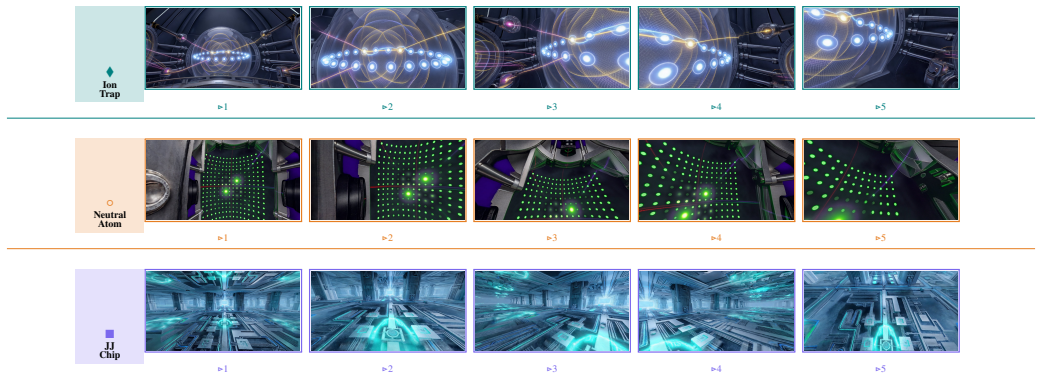
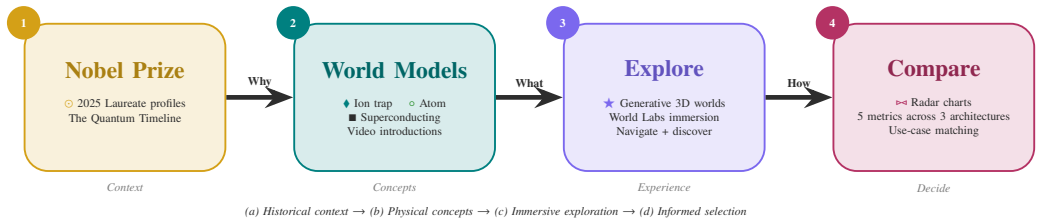
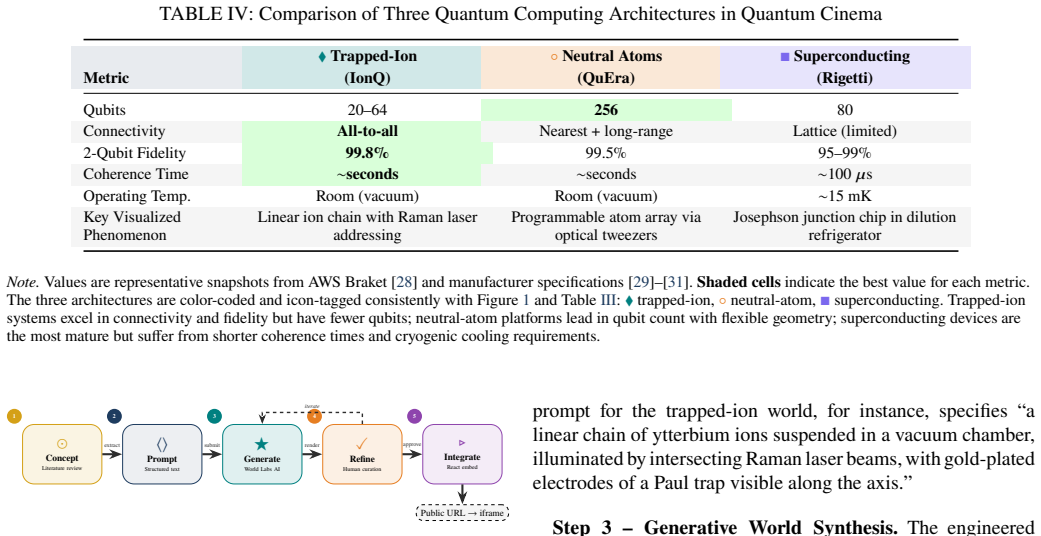
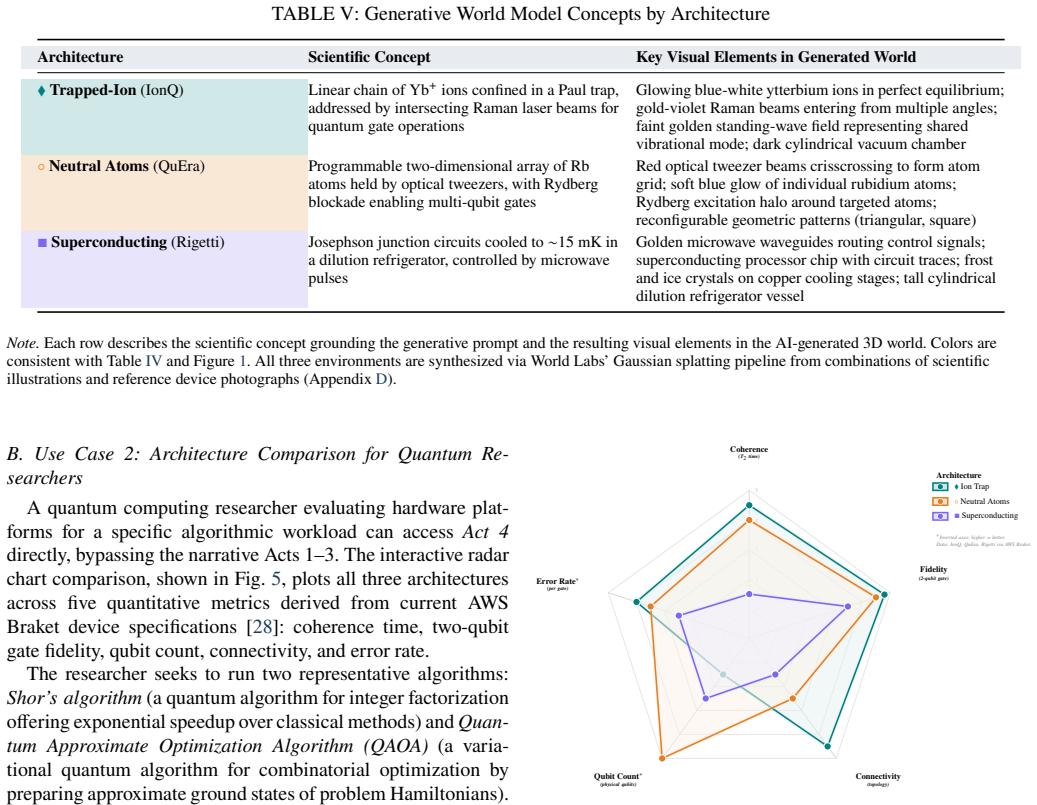
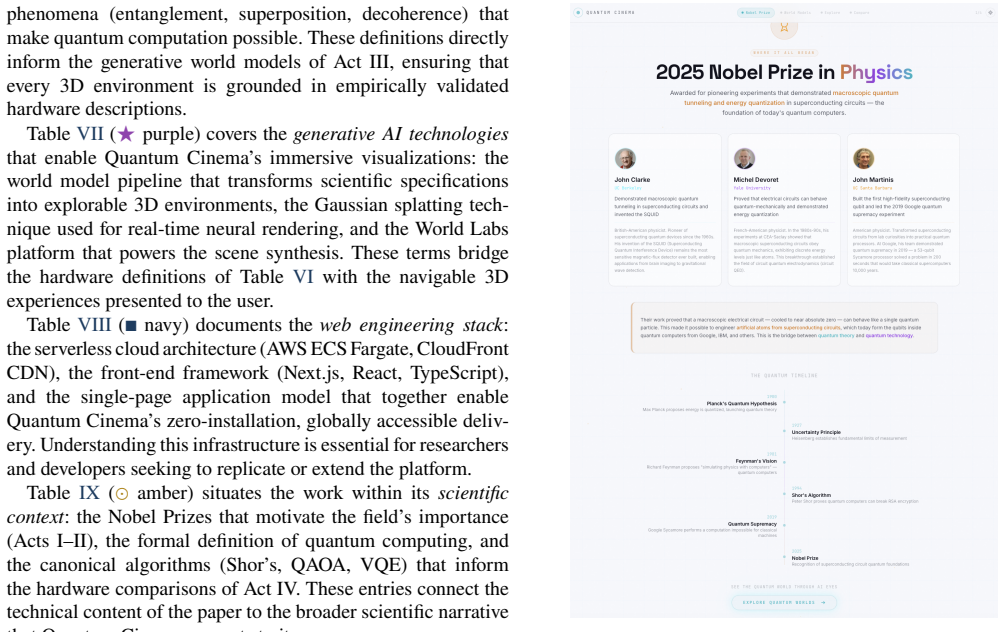
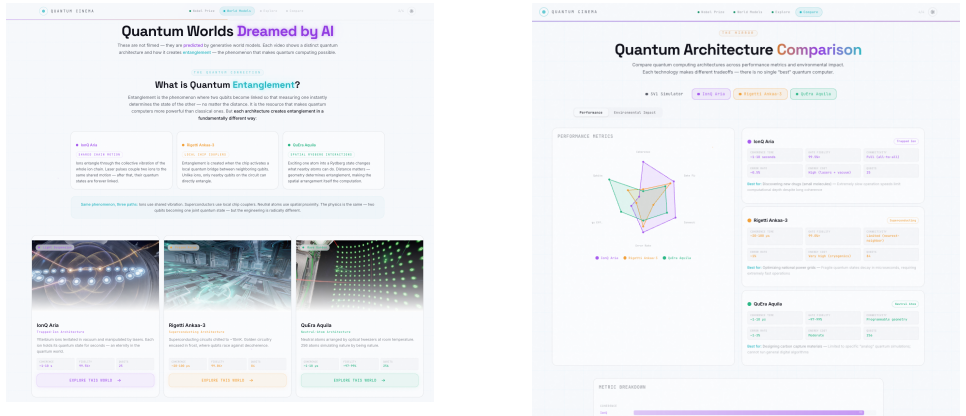
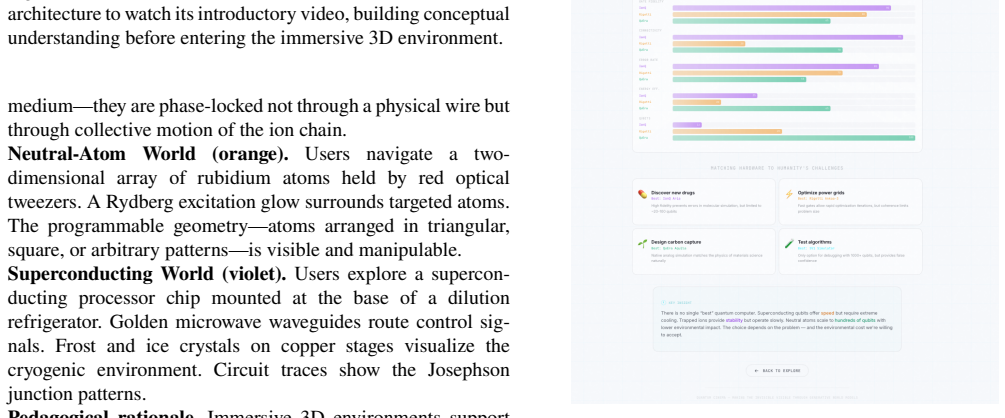
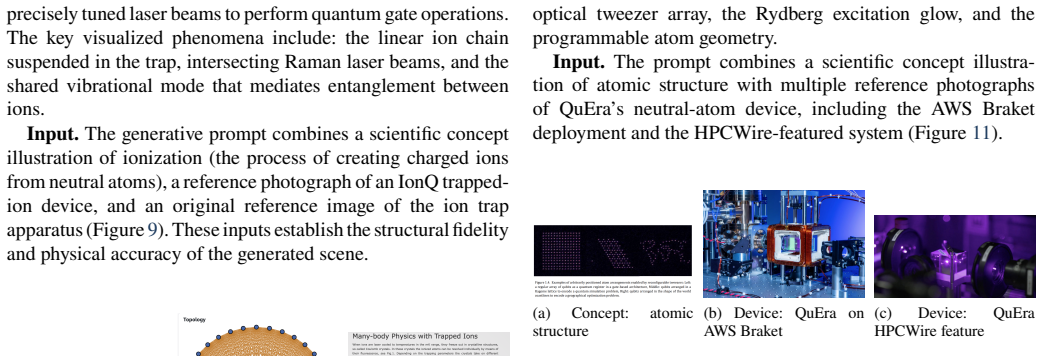
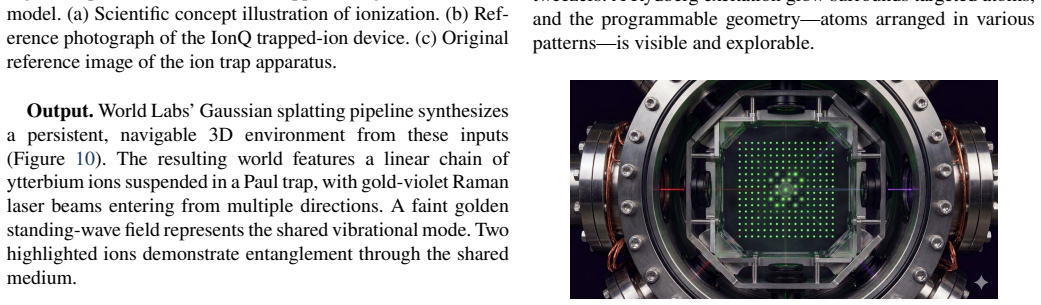
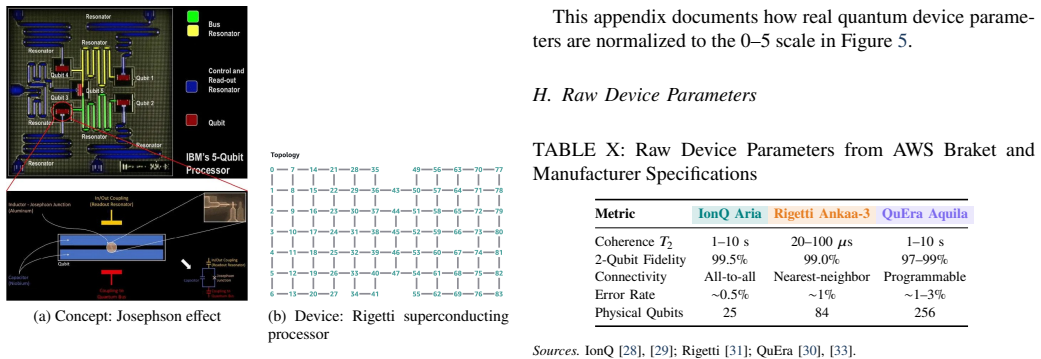
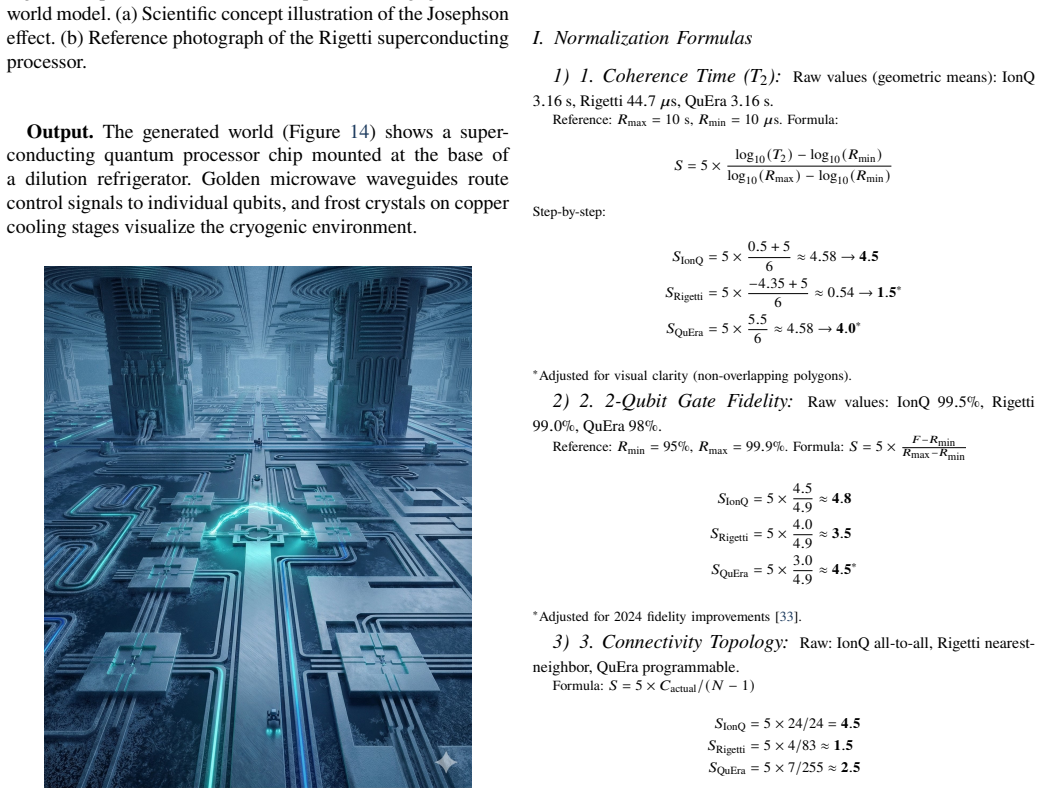
Quantum Cinema is a browser-based interactive application that transforms the physical hardware of quantum computers into explorable cinematic experiences. The system follows a four-act structure that begins with foundational quantum entanglement, proceeds through video introductions to trapped-ion, neutral-atom, and superconducting architectures, enters immersive three-dimensional generative worlds, and ends with radar-chart comparisons based on real device specifications. All three-dimensional environments are produced by generative world models driven by curated metrics so that the visualizations remain tied to actual hardware behavior.
What carries the argument
Generative world models that convert curated metrics from quantum devices into immersive three-dimensional environments, allowing users to observe otherwise invisible phenomena such as entanglement and gate operations.
If this is right
- Scholars and developers can replicate or extend the open-source platform for new visualization projects.
- Educators and science communicators obtain a no-install tool usable with diverse audiences to explain hardware differences.
- The four-act narrative supplies a reusable template for converting other complex scientific systems into guided interactive stories.
- Users gain direct, browser-accessible comparisons across hardware types without needing specialized equipment.
Where Pith is reading between the lines
- The same generative-model pipeline could be adapted to visualize other sealed or microscopic systems, such as fusion reactors or cellular processes, once suitable metrics exist.
- Future versions might link the environments to live quantum device telemetry, letting users observe real-time state evolution rather than static curated data.
- Widespread use could create demand for standardized public datasets of quantum hardware metrics to support similar educational tools.
Load-bearing premise
The generative world models produce visualizations that remain scientifically accurate representations of the underlying quantum hardware phenomena when driven by the curated metrics.
What would settle it
A side-by-side check showing that the generated three-dimensional environments systematically deviate from known experimental signatures of the modeled quantum systems, such as coherence times or gate fidelities, would disprove the accuracy premise.
Figures


read the original abstract
Quantum computing promises transformative advances across science and industry, yet the physical hardware that enables these computations remains invisible to the public: quantum processors operate inside sealed dilution refrigerators at temperatures near absolute zero, making direct observation impossible. This "imagination gap" between quantum computing's growing societal impact and the public's ability to visualize it represents a significant barrier to quantum literacy and workforce development. We present Quantum Cinema, an open-source, browser-based interactive application that closes this gap by transforming invisible quantum hardware into explorable, cinematic experiences using generative world models. Quantum Cinema guides users through a four-act narrative -- from the foundational Nobel Prize-winning science of quantum entanglement, through curated video introductions to three major quantum computing architectures (trapped-ion, neutral-atom, and superconducting systems), into immersive three-dimensional generative worlds that make invisible quantum phenomena observable, and finally to interactive radar-chart comparisons grounded in real quantum device specifications. All three-dimensional environments are generated using WorldLabs' generative world model platform and are scientifically grounded in curated metrics from Amazon Web Services (AWS) Braket quantum hardware. Quantum Cinema requires no installation, no specialized hardware, and no quantum computing background. It is designed to serve two distinct communities: scholars and developers seeking to replicate or extend the platform, and educators, researchers, and science communicators seeking an intuitive tool for explaining quantum hardware to diverse audiences. This paper describes the system architecture, the generative world model pipeline, use cases for both communities, and directions for future work.
Editorial analysis
A structured set of objections, weighed in public.
Referee Report
Summary. The manuscript presents Quantum Cinema, an open-source browser-based interactive application that uses generative world models to visualize quantum computing hardware. It structures user experience as a four-act narrative covering Nobel Prize-winning quantum entanglement science, curated video introductions to trapped-ion, neutral-atom, and superconducting architectures, immersive 3D generative worlds driven by AWS Braket device metrics, and interactive radar-chart comparisons of real device specifications. The tool requires no installation or prior knowledge and targets both technical replicators and educators/science communicators.
Significance. If the claimed scientific grounding holds, the work offers a practical contribution to quantum education and public outreach by addressing the 'imagination gap' through accessible visualization. The open-source release, browser-based delivery, and dual-audience design are explicit strengths that support reproducibility and extension.
major comments (1)
- [Abstract] Abstract: The assertion that 'all three-dimensional environments are ... scientifically grounded in curated metrics from Amazon Web Services (AWS) Braket quantum hardware' is load-bearing for the central claim that the tool closes the imagination gap with accurate representations of quantum phenomena, yet the manuscript supplies no description of the curation process, metric-to-parameter mapping, validation against ground truth, or error analysis.
Simulated Author's Rebuttal
We thank the referee for their careful review and for identifying a key area where the manuscript can be strengthened. We address the single major comment below and will revise the manuscript to incorporate additional details on the scientific grounding.
read point-by-point responses
-
Referee: [Abstract] Abstract: The assertion that 'all three-dimensional environments are ... scientifically grounded in curated metrics from Amazon Web Services (AWS) Braket quantum hardware' is load-bearing for the central claim that the tool closes the imagination gap with accurate representations of quantum phenomena, yet the manuscript supplies no description of the curation process, metric-to-parameter mapping, validation against ground truth, or error analysis.
Authors: We agree that the current manuscript does not provide sufficient detail on the curation process, metric-to-parameter mappings, validation, or error analysis, which weakens support for the abstract's claim. In the revised version we will add a new subsection (likely under System Architecture) that explicitly describes: the selection and curation of AWS Braket metrics (qubit count, T1/T2 times, gate fidelities, etc.) for the three architectures; the mapping rules used to translate those metrics into generative-world-model parameters (e.g., visual density, color temperature, structural complexity); any internal consistency checks or external validation performed; and a brief discussion of simplifications and potential error sources. This addition will be concise yet sufficient to substantiate the grounding claim while preserving the paper's focus on the interactive tool and outreach goals. revision: yes
Circularity Check
No significant circularity identified
full rationale
The manuscript is a system-description paper presenting the architecture and implementation of an interactive browser-based visualization tool (Quantum Cinema). It describes a four-act narrative, use of WorldLabs generative world models, and grounding in curated AWS Braket metrics, but contains no equations, derivations, fitted parameters, predictions, or uniqueness theorems. The central claim is the existence and functionality of the described application, which is self-contained as a descriptive artifact rather than a claim that reduces to its own inputs by construction. No load-bearing self-citations, ansatzes, or renamings of known results are present.
Axiom & Free-Parameter Ledger
Reference graph
Works this paper leans on
-
[1]
Quantum machine learning,
J. Biamonte, P. Wittek, N. Pancotti, P. Rebentrost, N. Wiebe, and S. Lloyd, “Quantum machine learning,”Nature, vol. 549, pp. 195–202, 2017
2017
-
[2]
The Nobel Prize in physics 2022,
The Royal Swedish Academy of Sciences, “The Nobel Prize in physics 2022,” Nobel Media, 2022, awarded to Alain Aspect, John F. Clauser, and Anton Zeilinger “for experiments with entangled photons, establishing the violation of Bell inequalities and pioneering quantum information science.”. [Online]. Available: https://www.nobelprize.org/prizes/physics/2022...
2022
-
[3]
for the discovery of macroscopic quantum mechanical tunnelling and energy quantisation in an electric circuit
——. (2025) The Nobel prize in physics 2025. Nobel Media. Awarded to John Clarke, Michel H. Devoret, and John M. Martinis “for the discovery of macroscopic quantum mechanical tunnelling and energy quantisation in an electric circuit”. [Online]. Available: https://www.nobelprize.org/prizes/physics/2025/summary/
2025
-
[4]
The Nobel Prize in physics 2024,
——, “The Nobel Prize in physics 2024,” Nobel Media, 2024, awarded to John J. Hopfield and Geoffrey E. Hinton “for foundational discoveries and inventions that enable machine learning with artificial neural networks.”. [Online]. Available: https://www.nobelprize.org/ prizes/physics/2024/summary/
2024
-
[5]
Nearly optimal quantum algorithm for estimating multiple expectation values,
W. J. Huggins, K. Wan, J. McClean, T. E. O’Brien, N. Wiebe, and R. Babbush, “Nearly optimal quantum algorithm for estimating multiple expectation values,”Phys. Rev. Lett., vol. 129, no. 24, p. 240501, 2022
2022
-
[6]
Marble: Generative 3d world platform,
World Labs Team, “Marble: Generative 3d world platform,” World Labs Technical Blog, 2024, accessed: 2024-12-01. [Online]. Available: https://marble.worldlabs.ai
2024
-
[7]
Quirk: A drag-and-drop quantum circuit simulator,
C. Gidney, “Quirk: A drag-and-drop quantum circuit simulator,” Web tool, 2016, accessed: 2024-12-01. [Online]. Available: https: //algassert.com/quirk
2016
-
[8]
IBM Quantum: Quantum computing platform,
IBM, “IBM Quantum: Quantum computing platform,” Online platform, 2024, accessed: 2024-12-01. [Online]. Available: https: //quantum.ibm.com
2024
-
[9]
QuantumEyes: Towards better interpretability of quantum circuits,
S. Ruan, Q. Guan, P. Griffin, Y. Mao, and Y. Wang, “QuantumEyes: Towards better interpretability of quantum circuits,”IEEE Trans. Vis. Comput. Graph., vol. 30, no. 9, pp. 6321–6333, 2024
2024
-
[10]
Visualizing quantum mechanics in an interactive simulation — Virtual Lab by Quantum Flytrap,
P. Migda l, K. Jankiewicz, P. Grabarz, C. Decaroli, and P. Cochin, “Visualizing quantum mechanics in an interactive simulation — Virtual Lab by Quantum Flytrap,”Optical Engineering, vol. 61, no. 8, p. 081808, 2022
2022
-
[11]
Quantum games and interactive tools for quantum technologies outreach and education,
Z. C. Seskir, P. Migda l, C. Weidner, A. Anupam, N. Case, N. Daviset al., “Quantum games and interactive tools for quantum technologies outreach and education,”Opt. Eng., vol. 61, no. 8, p. 081809, 2022
2022
-
[12]
Investigating immersive virtual reality as an educational tool for quantum computing,
A. Zable, L. C. L. Hollenberg, E. Velloso, and J. Goncalves, “Investigating immersive virtual reality as an educational tool for quantum computing,” inProc. ACM Symp. Virtual Reality Software and Technology (VRST), November 2020, pp. Article 6, 11 pages
2020
-
[13]
PhysGaussian: Physics-integrated 3d gaussians for generative dynamics,
T. Xie, Z. Zong, Y. Qiu, X. Li, Y. Feng, Y. Yang, and C. Jiang, “PhysGaussian: Physics-integrated 3d gaussians for generative dynamics,” inProc. IEEE/CVF Conf. Comput. Vis. Pattern Recognit. (CVPR), 2024, pp. 4389–4398
2024
-
[14]
Generative AI for visualization: Opportunities and challenges,
R. C. Basole and T. Major, “Generative AI for visualization: Opportunities and challenges,”IEEE Comput. Graph. Appl., vol. 44, no. 2, pp. 55–64, 2024
2024
-
[15]
Quantum cinema,
QuantBlockchain and Quantum Cinema Team, “Quantum cinema,” Zen- odo archive, jun 2026
2026
-
[16]
VENUS: A geometrical representation for quantum state visualization,
S. Ruan, R. Yuan, Q. Guan, Y. Lin, Y. Mao, W. Jiang, Z. Wang, W. Xu, and Y. Wang, “VENUS: A geometrical representation for quantum state visualization,”Comput. Graph. Forum, vol. 42, no. 3, pp. 247–258, 2023
2023
-
[17]
QNotation: A visual browser-based notation translator for learning quantum computing,
S. Norrie, A. Estey, H. A. M¨ uller, and U. Stege, “QNotation: A visual browser-based notation translator for learning quantum computing,” in Proc. IEEE Int. Conf. Quantum Comput. Eng. (QCE), 2024, pp. 25–33
2024
-
[18]
QWalkVis: Quantum walks visualization application,
A. Jordon, A. Hawkins-Seagram, S. Norrie, J. Ossorio, and U. Stege, “QWalkVis: Quantum walks visualization application,” inProc. IEEE Int. Conf. Quantum Comput. Eng. (QCE), 2023, pp. 87–93
2023
-
[19]
Intuit: Explain quantum computing concepts via AR-based analogy,
M. Karunathilaka, S. Ruan, Y. Mao, and Y. Wang, “Intuit: Explain quantum computing concepts via AR-based analogy,” inExtended Abstracts of the CHI Conference on Human Factors in Computing Systems (CHI EA), 2025, late-Breaking Work
2025
-
[20]
Black opal: Quantum learning platform,
Q-CTRL, “Black opal: Quantum learning platform,” https://q-ctrl.com/ black-opal, 2024, accessed: 2025-01-15
2024
-
[21]
Immersive quantum: A systematic literature review of XR in quantum technology education,
G. Song, X. Wang, and R. Ghannam, “Immersive quantum: A systematic literature review of XR in quantum technology education,”Comput. Educ.: X Reality, vol. 5, p. 100087, 2024
2024
-
[22]
Is Sora a world simulator? a comprehensive survey on general world models and beyond,
Z. Zhu, X. Wang, W. Liuet al., “Is Sora a world simulator? a comprehensive survey on general world models and beyond,”arXiv preprint arXiv:2405.03520, 2024
arXiv 2024
-
[23]
Variational quantum algorithms,
M. Cerezo, A. Arrasmith, R. Babbush, S. Benjamin, S. Endo, K. Fujii, J. McClean, K. Mitarai, X. Yuan, L. Cincio, and P. Coles, “Variational quantum algorithms,”Nature Reviews Physics, vol. 3, pp. 625–644, 2021
2021
-
[24]
Solving the quantum many-body problem with artificial neural networks,
G. Carleo and M. Troyer, “Solving the quantum many-body problem with artificial neural networks,”Science, vol. 355, no. 6325, pp. 602–606, 2017
2017
-
[25]
(2025) Next.js 16: The React framework
Vercel. (2025) Next.js 16: The React framework. [Online]. Available: https://nextjs.org
2025
-
[26]
React 19: A JavaScript library for building user interfaces,
Meta Platforms, “React 19: A JavaScript library for building user interfaces,” UI library, 2024, accessed: 2024-12-01. [Online]. Available: https://react.dev
2024
-
[27]
AWS Cloud Infrastructure,
Amazon Web Services, “AWS Cloud Infrastructure,” Cloud computing platform, 2024, accessed: 2024-12-01. [Online]. Available: https: //aws.amazon.com
2024
-
[28]
AWS Braket: Quantum computing service,
——, “AWS Braket: Quantum computing service,” Cloud service, 2024, accessed: 2024-12-01. [Online]. Available: https://aws.amazon. com/braket
2024
-
[29]
IonQ Forte: Trapped-ion quantum computer specifications,
IonQ, “IonQ Forte: Trapped-ion quantum computer specifications,” Hardware specification document, 2024, accessed: 2024-12-01. [Online]. Available: https://ionq.com
2024
-
[30]
QuEra Aquila: Neutral atom quantum computer,
QuEra Computing, “QuEra Aquila: Neutral atom quantum computer,” Hardware specification document, 2024, accessed: 2024-12-01. [Online]. Available: https://quera.com
2024
-
[31]
Rigetti Ankaa-3: Superconducting quantum processor,
Rigetti Computing, “Rigetti Ankaa-3: Superconducting quantum processor,” Hardware specification document, 2024, accessed: 2024-12-
2024
-
[32]
Available: https://rigetti.com
[Online]. Available: https://rigetti.com
-
[33]
Trapped- ion quantum computing: Progress and challenges,
C. D. Bruzewicz, J. Chiaverini, R. McConnell, and J. M. Sage, “Trapped- ion quantum computing: Progress and challenges,”Applied Physics Reviews, vol. 6, no. 2, p. 021314, 2019
2019
-
[34]
Logical quantum processor based on reconfigurable atom arrays,
D. Bluvstein, S. J. Evered, A. A. Geim, S. H. Li, H. Zhou, T. Manovitz, S. Ebadi, M. Cain, M. Kalinowski, D. Hangleiter, J. P. B. Ataides, N. Maskara, I. Cong, X. Gao, P. S. Rodriguez, T. Karolyshyn, G. Se- meghini, M. J. Gullans, M. Greiner, V. Vuleti´c, and M. D. Lukin, “Logical quantum processor based on reconfigurable atom arrays,”Nature, vol. 626, pp...
2024
-
[35]
A quantum engineer’s guide to superconducting qubits,
P. Krantz, M. Kjaergaard, F. Yan, T. P. Orlando, S. Gustavsson, and W. D. Oliver, “A quantum engineer’s guide to superconducting qubits,”Applied Physics Reviews, vol. 6, no. 2, p. 021318, 2019
2019
-
[36]
M. A. Nielsen and I. L. Chuang,Quantum Computation and Quantum Information, 10th ed. Cambridge University Press, 2010
2010
-
[37]
J. Ding, Y. Zhang, Y. Shanget al., “Understanding world or predicting future? a comprehensive survey of world models,”ACM Computing Surveys, vol. 58, no. 3, pp. 1–37, 2025. [Online]. Available: https://dl.acm.org/doi/10.1145/3746449
-
[38]
Near-term quantum computing techniques: Variational quantum algorithms, error mitigation, circuit compilation, benchmarking and classical simulation,
H.-L. Huang, X.-Y. Xu, C. Guo, G. Tian, S.-J. Wei, X. Sun, W.-S. Bao, and G.-L. Long, “Near-term quantum computing techniques: Variational quantum algorithms, error mitigation, circuit compilation, benchmarking and classical simulation,”Sci. China Phys. Mech. Astron., vol. 66, no. 5, p. 250302, 2023
2023
-
[39]
Immersive interfaces for engagement and learning,
C. Dede, “Immersive interfaces for engagement and learning,”Science, vol. 323, no. 5910, pp. 66–69, 2009. Appendix Quantum Cinema brings together concepts from four distinct knowledge domains: quantum computing hardware, generative artificial intelligence, web application infrastructure, and foun- dational quantum science. To serve the interdisciplinary r...
2009
-
[40]
Coherence Time (𝑇 2):Raw values (geometric means): IonQ 3.16 s, Rigetti 44.7𝜇s, QuEra 3.16 s
1. Coherence Time (𝑇 2):Raw values (geometric means): IonQ 3.16 s, Rigetti 44.7𝜇s, QuEra 3.16 s. Reference:𝑅 max =10s,𝑅 min =10𝜇s. Formula: 𝑆=5× log10 (𝑇2 ) −log 10 (𝑅min ) log10 (𝑅max ) −log 10 (𝑅min ) Step-by-step: 𝑆IonQ =5× 0.5+5 6 ≈4.58→4.5 𝑆Rigetti =5× −4.35+5 6 ≈0.54→1.5 ∗ 𝑆QuEra =5× 5.5 6 ≈4.58→4.0 ∗ ∗Adjusted for visual clarity (non-overlapping polygons)
-
[41]
2-Qubit Gate Fidelity:Raw values: IonQ 99.5%, Rigetti 99.0%, QuEra 98%
2. 2-Qubit Gate Fidelity:Raw values: IonQ 99.5%, Rigetti 99.0%, QuEra 98%. Reference:𝑅 min =95%,𝑅 max =99.9%. Formula:𝑆=5× 𝐹−𝑅 min 𝑅max −𝑅min 𝑆IonQ =5× 4.5 4.9 ≈4.8 𝑆Rigetti =5× 4.0 4.9 ≈3.5 𝑆QuEra =5× 3.0 4.9 ≈4.5 ∗ ∗Adjusted for 2024 fidelity improvements [33]
2024
-
[42]
Connectivity Topology:Raw: IonQ all-to-all, Rigetti nearest- neighbor, QuEra programmable
3. Connectivity Topology:Raw: IonQ all-to-all, Rigetti nearest- neighbor, QuEra programmable. Formula:𝑆=5×𝐶 actual/(𝑁−1) 𝑆IonQ =5×24/24=4.5 𝑆Rigetti =5×4/83≈1.5 𝑆QuEra =5×7/255≈2.5
-
[43]
Qubit Count (Inverted):Raw: IonQ 25, Rigetti 84, QuEra 256
4. Qubit Count (Inverted):Raw: IonQ 25, Rigetti 84, QuEra 256. Formula:𝑆=5× log10 𝑁−1 2 (𝑅min =10,𝑅 max =1000) 𝑆IonQ =5× 1.40−1 2 ≈1.5 𝑆Rigetti =5× 1.92−1 2 ≈2.5 𝑆QuEra =5× 2.41−1 2 ≈5.0
-
[44]
imagination gap
5. Error Rate (Inverted):Raw: IonQ 0.5%, Rigetti 1.0%, QuEra 1–3%. Formula:𝑆=5× 1/𝐸dev −1/𝐸max 1/𝐸min −1/𝐸max (𝐸min =0.1%,𝐸 max =10%) 𝑆IonQ =5× 190 990 ≈0.96→4.0 ∗ 𝑆Rigetti =5× 90 990 ≈0.45→2.5 ∗ 𝑆QuEra =5× 40 990 ≈0.20→3.5 ∗ ∗Compressed via sigmoid:𝑆 viz =5/(1+𝑒 −2(𝑆 raw −2.5) ). J. Normalized Score Summary TABLE XI: Final Normalized Scores (0–5) for Fig...
1989
discussion (0)
Sign in with ORCID, Apple, or X to comment. Anyone can read and Pith papers without signing in.