Exciting the Vacuum: Non-Thermal Particle Bursts and Multi-Messenger Signals from Binary Black Holes
Pith reviewed 2026-06-27 02:57 UTC · model grok-4.3
The pith
Binary black holes produce non-thermal particle bursts during inspiral with energy rate scaling as M to the 10/3 times omega to the 16/3.
A machine-rendered reading of the paper's core claim, the machinery that carries it, and where it could break.
Core claim
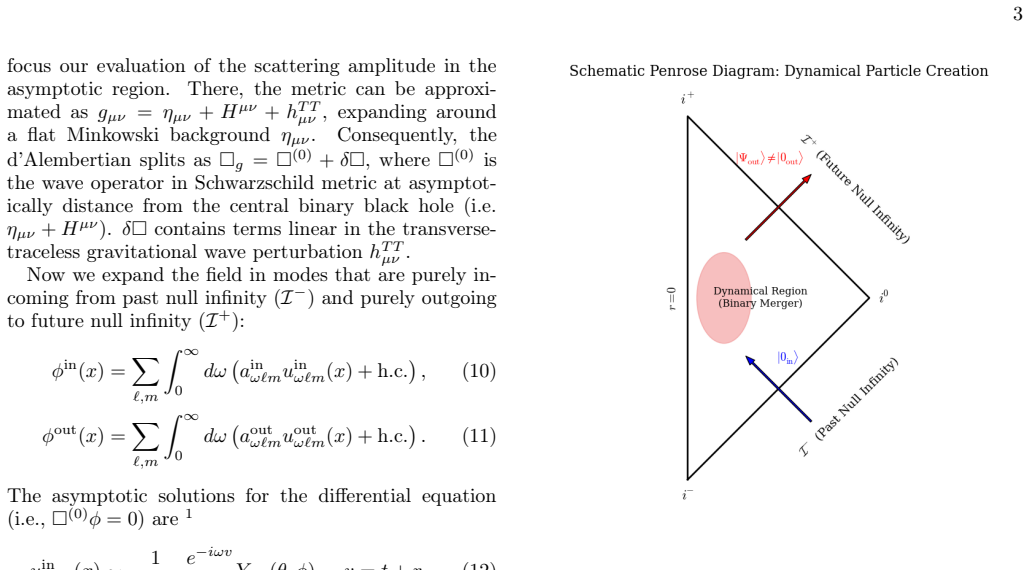
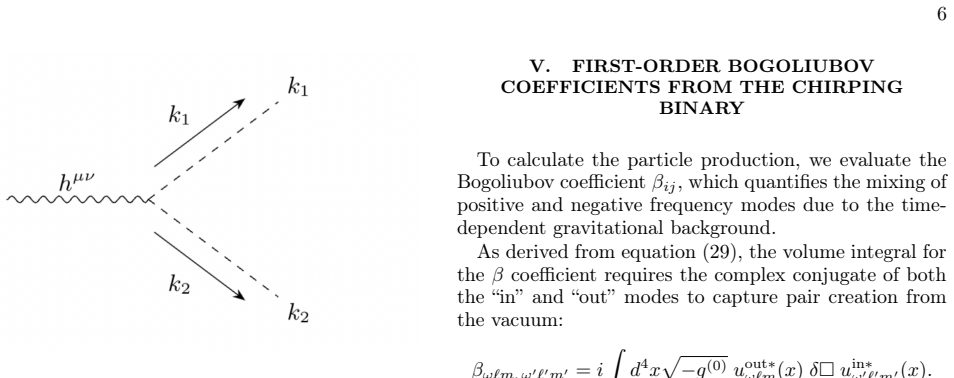
In the weak-field large-separation inspiral regime the time-dependent quadrupolar metric perturbation sourced by a binary black hole excites a massless scalar field, producing particles whose flux and radiated energy are computed to leading order via Bogoliubov coefficients and the S-matrix; the energy emission rate takes the non-thermal form dE/dt proportional to M to the 10/3 times omega to the 16/3.
What carries the argument
The quadrupole approximation for the time-dependent metric perturbation h_{\mu\nu} that sources the scalar field modes and determines the Bogoliubov coefficients.
If this is right
- Particle production remains non-thermal and follows the specific power-law scaling throughout the modeled inspiral phase.
- The effect is distinct from Hawking radiation and arises from the dynamical spacetime rather than horizon properties.
- Signals are expected only in the early inspiral and do not describe the merger itself.
- The radiated particles could accompany gravitational-wave emission as a multi-messenger signature.
- The calculation uses leading-order perturbation theory in the metric deviation.
Where Pith is reading between the lines
- If the scaling holds, high-energy particle detectors could search for bursts temporally correlated with known gravitational-wave events from inspiraling binaries.
- The same vacuum-excitation mechanism might operate in other slowly varying strong gravitational fields such as those around merging neutron stars.
- Including higher multipoles or spin effects in the perturbation could modify the exponent in the power-law spectrum.
Load-bearing premise
The gravitational perturbation around the binary is accurately captured by the linear quadrupole formula in the weak-field limit.
What would settle it
An observed particle energy spectrum from a binary black hole inspiral that follows a thermal distribution rather than the predicted power-law scaling in frequency would contradict the result.
Figures
read the original abstract
We investigate particle production in the dynamical curved spacetime of a binary black hole system. Particle production is a well-known feature of quantum field theory in curved spacetime, underlying the Hawking and Unruh effects. Here we extend it to the time-varying gravitational perturbation sourced by a binary black hole. Treating a massless scalar field coupled to the binary metric, we compute the particle flux and radiated energy to leading order in the metric perturbation $h_{\mu\nu}$, using both the Bogoliubov transformation method and the S-matrix formalism. The perturbation is modeled with the standard quadrupole formalism, retaining the time-domain quadrupolar ($\ell=2$) contribution that dominates gravitational-wave emission. Our calculation is valid in the weak-field, large-separation inspiral regime and is not expected to capture the strong-field, nonlinear merger phase. In this regime we find a characteristic non-thermal, power-law emission with $dE/dt \propto M^{10/3}\omega^{16/3}$, in contrast to a thermal Hawking spectrum. Extending the analysis through merger that uses the numerically-relativistic metric is left to future work.
Editorial analysis
A structured set of objections, weighed in public.
Referee Report
Summary. The paper investigates particle production in the dynamical curved spacetime of a binary black hole system. Treating a massless scalar field coupled to the binary metric, it computes the particle flux and radiated energy to leading order in the metric perturbation h_{\mu\nu} using both the Bogoliubov transformation method and the S-matrix formalism. The perturbation is modeled with the standard quadrupole formalism, retaining the time-domain quadrupolar (ℓ=2) contribution. The calculation is valid in the weak-field, large-separation inspiral regime and yields a characteristic non-thermal, power-law emission with dE/dt ∝ M^{10/3}ω^{16/3}, in contrast to a thermal Hawking spectrum. Extension through merger using numerically-relativistic metrics is left for future work.
Significance. If the central result holds, the work extends quantum field theory in curved spacetime to time-varying binary systems and supplies a parameter-free, falsifiable prediction for non-thermal particle production during inspiral. This could motivate searches for accompanying multi-messenger signals alongside gravitational waves. The approach relies on standard Bogoliubov and S-matrix techniques applied to the quadrupole approximation without introduced free parameters or ad-hoc entities, which is a methodological strength within the explicitly stated regime of validity.
minor comments (2)
- [Abstract] Abstract: the scaling dE/dt ∝ M^{10/3}ω^{16/3} is stated as the characteristic result, but the abstract supplies no reference to the intermediate expressions for the Bogoliubov coefficients or the energy flux integral; a one-sentence outline of the key steps would aid verification.
- The symbol ω appearing in the reported scaling should be defined explicitly (e.g., orbital angular frequency or gravitational-wave frequency) at first use to avoid ambiguity in the power-law exponent.
Simulated Author's Rebuttal
We thank the referee for the positive summary of our work, the assessment of its significance, and the recommendation of minor revision. No major comments were provided in the report.
Circularity Check
No significant circularity; standard methods on external model
full rationale
The derivation applies established Bogoliubov and S-matrix formalisms to a metric perturbation constructed from the standard quadrupole approximation in the weak-field, large-separation inspiral regime. The reported non-thermal power-law dE/dt ∝ M^{10/3}ω^{16/3} is obtained directly from this leading-order calculation within explicitly stated approximations, without any reduction to fitted parameters, self-definitional relations, or load-bearing self-citations. The paper explicitly restricts scope to this regime and leaves the merger phase for future work, rendering the central result self-contained against external benchmarks.
Axiom & Free-Parameter Ledger
axioms (2)
- standard math Bogoliubov transformation and S-matrix formalism apply to particle production in a time-dependent weak gravitational perturbation.
- domain assumption The quadrupole formalism accurately models the dominant time-domain gravitational perturbation from a binary system in the weak-field limit.
Reference graph
Works this paper leans on
-
[1]
Birrell, N. D. and Davies, P. C. W. , title =. 1982 , doi =
1982
-
[2]
Communications in Mathematical Physics , volume =
Particle creation by black holes , author =. Communications in Mathematical Physics , volume =. 1975 , doi =
1975
-
[3]
Did LIGO Detect Dark Matter?. Physical Review Letter , keywords =. doi:10.1103/PhysRevLett.116.201301 , archivePrefix =. 1603.00464 , primaryClass =
work page internal anchor Pith review Pith/arXiv arXiv doi:10.1103/physrevlett.116.201301
-
[4]
Physical Review D , keywords =
Possibility of primordial black holes as the source of gravitational wave events in the advanced LIGO detector. Physical Review D , keywords =. doi:10.1103/PhysRevD.103.084001 , archivePrefix =. 2011.02772 , primaryClass =
-
[5]
Hawking, S. W. , title =. Nature , volume =. 1974 , doi =
1974
-
[6]
Unruh, W. G. , title =. Phys. Rev. D , volume =. 1976 , doi =
1976
-
[7]
Parker, Leonard , title =. Phys. Rev. Lett. , volume =. 1968 , doi =
1968
-
[8]
and Thorne, Kip S
Misner, Charles W. and Thorne, Kip S. and Wheeler, John Archibald , title =. 1973 , isbn =
1973
-
[9]
2007 , doi =
Maggiore, Michele , title =. 2007 , doi =
2007
-
[10]
Living Rev
Blanchet, Luc , title =. Living Rev. Rel. , volume =. 2014 , doi =
2014
-
[11]
Physical Review , volume=
Stability of a Schwarzschild singularity , author=. Physical Review , volume=. 1957 , publisher=
1957
-
[12]
Physical Review D , volume=
Gravitational field of a particle falling in a Schwarzschild geometry analyzed in tensor harmonics , author=. Physical Review D , volume=. 1970 , doi=
1970
-
[13]
Perturbations of a rotating black hole. I. Fundamental equations for gravitational, electromagnetic, and neutrino-field perturbations , author=. The Astrophysical Journal , volume=. 1973 , doi=
1973
-
[14]
Physical Review D , volume=
Gravitational perturbations of the Schwarzschild spacetime: A practical covariant and gauge-invariant formalism , author=. Physical Review D , volume=. 2005 , doi=
2005
-
[15]
Living Reviews in Relativity , volume=
The motion of point particles in curved spacetime , author=. Living Reviews in Relativity , volume=. 2004 , doi=
2004
-
[16]
Reports on Progress in Physics , volume=
Self-force and radiation reaction in general relativity , author=. Reports on Progress in Physics , volume=. 2018 , doi=
2018
-
[17]
Physical Review D , volume=
Gravitational radiation reaction for a particle moving in a Schwarzschild background , author=. Physical Review D , volume=. 1997 , doi=
1997
-
[18]
2014 , doi=
Gravity: Newtonian, Post-Newtonian, Relativistic , author=. 2014 , doi=
2014
-
[19]
Living Reviews in Relativity , volume=
Gravitational radiation from post-Newtonian sources and inspiralling compact binaries , author=. Living Reviews in Relativity , volume=. 2014 , doi=
2014
-
[20]
, title =
Wald, Robert M. , title =. 1994 , isbn =
1994
-
[21]
Communications in Mathematical Physics , volume=
On particle creation by black holes , author=. Communications in Mathematical Physics , volume=. 1975 , doi=
1975
-
[22]
Journal of Mathematical Physics , volume=
Quantum theory of the electromagnetic field in a variable-length one-dimensional cavity , author=. Journal of Mathematical Physics , volume=. 1970 , doi=
1970
-
[23]
Physica Scripta , volume=
Dynamical Casimir effect in a cavity with a moving mirror , author=. Physica Scripta , volume=. 2010 , doi=
2010
-
[24]
Physical Review D , volume=
Hawking radiation from binary black holes? , author=. Physical Review D , volume=. 2021 , doi=
2021
-
[25]
Classical and Quantum Gravity , volume=
Particle creation by a binary black hole system , author=. Classical and Quantum Gravity , volume=. 2022 , doi=
2022
-
[26]
Communications in Mathematical Physics , volume=
Quantized fields propagating in plane-wave spacetimes , author=. Communications in Mathematical Physics , volume=. 1975 , publisher=
1975
-
[27]
The mathematical theory of black holes
-
[28]
Constraints on Primordial Black Holes
Constraints on primordial black holes. Reports on Progress in Physics , keywords =. doi:10.1088/1361-6633/ac1e31 , archivePrefix =. 2002.12778 , primaryClass =
work page internal anchor Pith review Pith/arXiv arXiv doi:10.1088/1361-6633/ac1e31 2002
-
[29]
Monthly Notices of Royal Astronomical Society , keywords =
Possibility of primordial black holes collision with Earth and the consequences of this collision. Monthly Notices of Royal Astronomical Society , keywords =. doi:10.1093/mnras/stab2239 , archivePrefix =. 2107.11139 , primaryClass =
-
[30]
International Journal of Modern Physics D , keywords =
Primordial black hole collision with neutron stars and astrophysical black holes and the observational signatures. International Journal of Modern Physics D , keywords =. doi:10.1142/S0218271823501031 , archivePrefix =. 2304.00348 , primaryClass =
-
[31]
The Oort Cloud as a Gravitational Detector for Primordial Black Holes
-
[32]
Science , volume=
A bright millisecond radio burst of extragalactic origin , author=. Science , volume=. 2007 , publisher=
2007
-
[33]
The Astronomy and Astrophysics Review , volume=
Fast radio bursts , author=. The Astronomy and Astrophysics Review , volume=. 2019 , publisher=
2019
discussion (0)
Sign in with ORCID, Apple, or X to comment. Anyone can read and Pith papers without signing in.