Breaking the bicycle frame: Coset-based quantum LDPC codes
Pith reviewed 2026-06-27 03:07 UTC · model grok-4.3
The pith
Group actions on cosets of subgroups produce quantum LDPC codes outside the two-block group algebra family.
A machine-rendered reading of the paper's core claim, the machinery that carries it, and where it could break.
Core claim
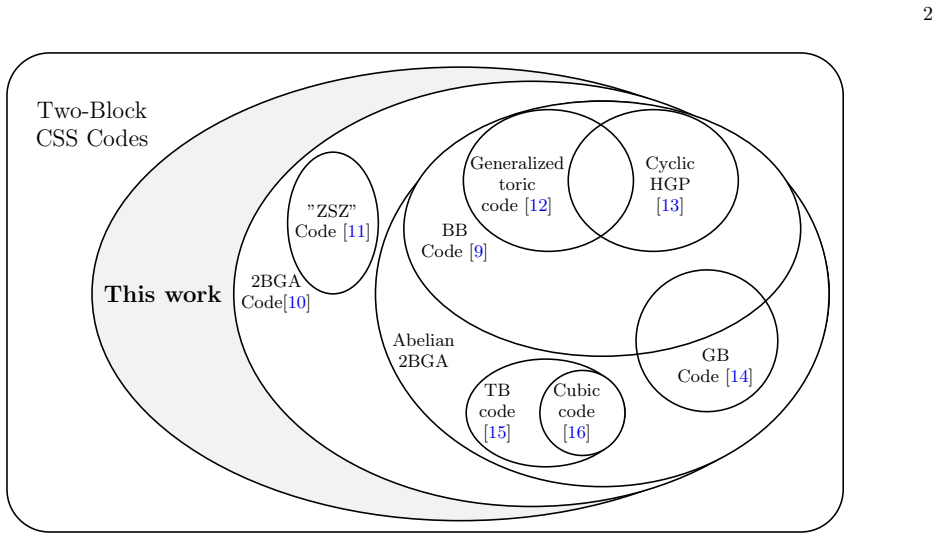
Generalizing the construction of two-block group algebra (2BGA) codes, we introduce a family of two-block quantum LDPC codes constructed using the action of a group on the cosets of its subgroup. This replaces the regular group actions of the earlier two-block constructions and significantly expands the search space, yielding new quantum LDPC codes outside the 2BGA family. Through a computer search, we identify several new quantum LDPC codes with the listed parameters. We introduce a maximally packed syndrome extraction schedule of depth w+2 for any code with maximum stabilizer weight w from our family and show competitive performance with BB codes under circuit-level noise when decoded with
What carries the argument
The action of a group G on the left cosets of a subgroup H, used to define the two blocks of the quantum stabilizer code.
If this is right
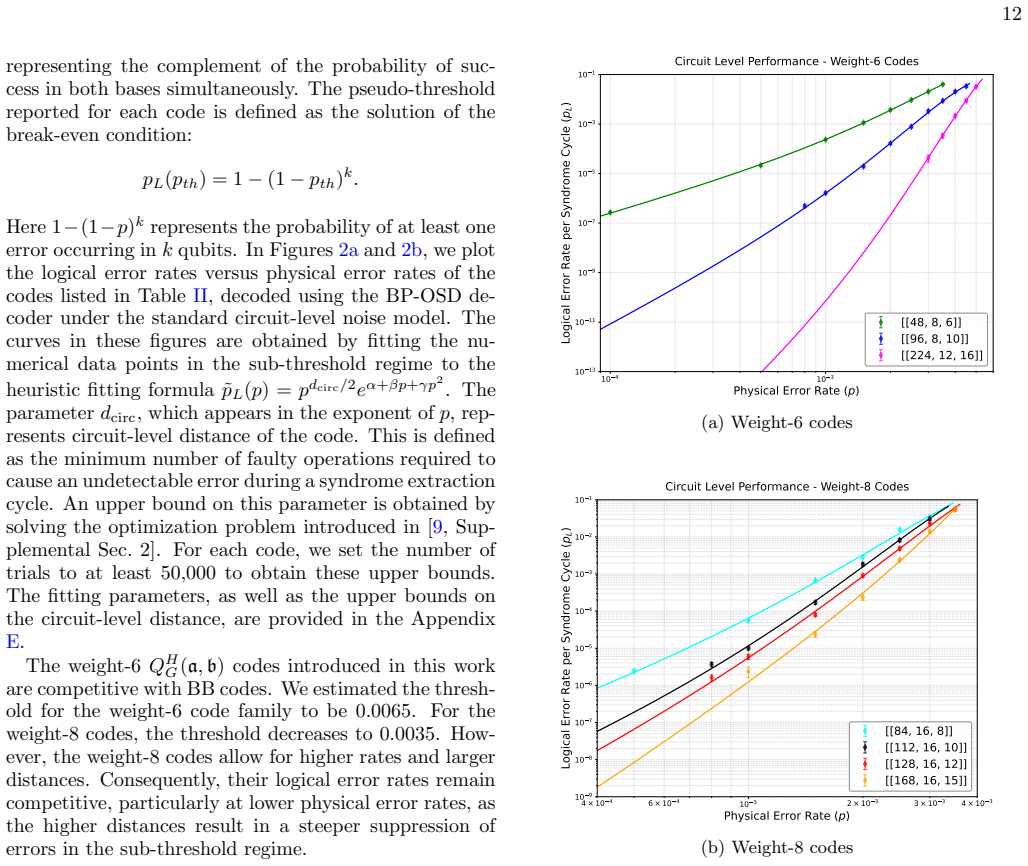
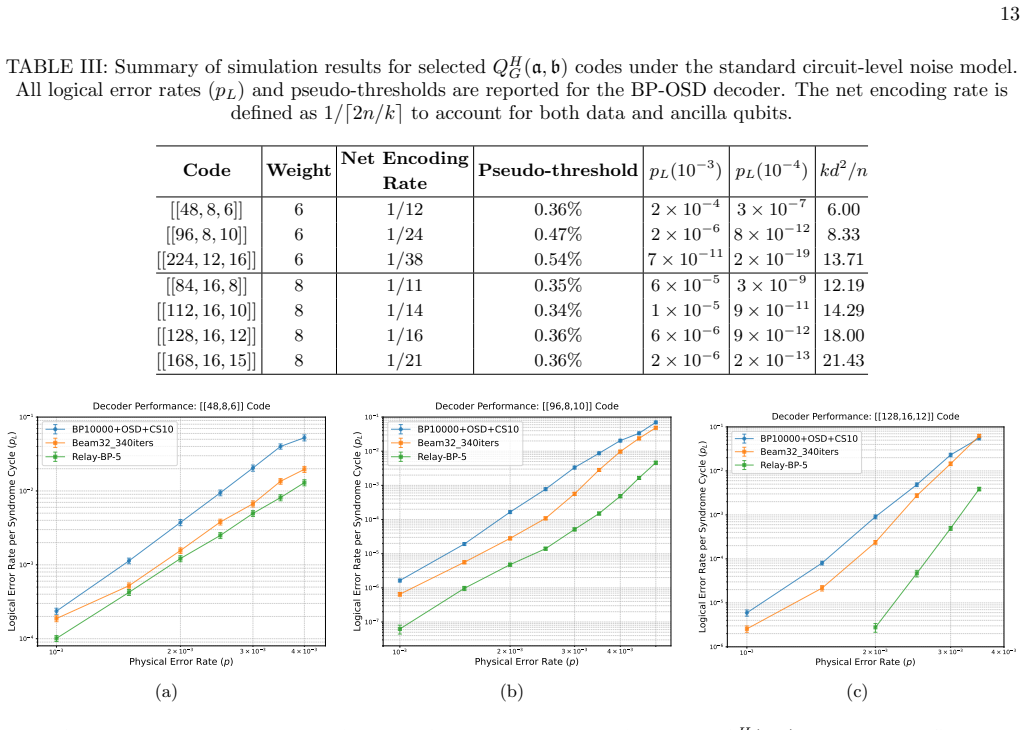
- New quantum LDPC codes exist with parameters [[48,8,6]], [[96,8,10]], [[224,12,16]], [[84,16,8]], [[112,16,10]], [[128,16,12]], and [[168,16,15]].
- A syndrome extraction schedule whose depth is only two more than the maximum stabilizer weight is valid for every code in the family.
- The weight-6 subfamily reaches an error threshold of approximately 0.65 percent and the weight-8 subfamily reaches approximately 0.35 percent under circuit-level noise with BP-OSD decoding.
- A group-theoretic construction generates infinite sequences of graph-based covers of 2BGA codes and recovers earlier results on such covers.
Where Pith is reading between the lines
- Varying the ambient group and the subgroup may systematically produce longer or higher-distance members of the same family.
- The coset formalism could be applied to other algebraic constructions of quantum or classical LDPC codes that rely on group actions.
- The reported thresholds indicate that these codes remain candidates for near-term hardware if the block length can be increased while preserving the relative distance.
Load-bearing premise
The chosen coset actions must produce sets of commuting Pauli operators whose common +1 eigenspace has exactly the distance stated for each listed code.
What would settle it
A direct computation showing that the minimum distance of the [[224,12,16]] code is smaller than 16, or a circuit-level simulation in which the BP-OSD threshold for the weight-8 family falls below 0.3 percent.
Figures
read the original abstract
Generalizing the construction of two-block group algebra (2BGA) codes, we introduce a family of two-block quantum LDPC codes constructed using the action of a group on the cosets of its subgroup. This replaces the regular group actions of the earlier two-block constructions and significantly expands the search space, yielding new quantum LDPC codes outside the 2BGA family. Through a computer search, we identify several new quantum LDPC codes, including weight-6 codes with parameters $[[48,8,6]]$, $[[96,8,10]]$, and $[[224,12,16]]$, as well as weight-8 codes with parameters $[[84,16,8]]$, $[[112,16,10]]$, $[[128,16,12]]$, and $[[168,16,15]]$. Furthermore, we introduce a maximally packed syndrome extraction schedule of depth $w+2$, including initialization and measurement steps, for any code with a maximum stabilizer weight of $w$ from our family. Under a standard circuit-level noise model, our codes, when decoded using BP-OSD, perform competitively with BB codes, achieving thresholds of $\approx0.65\%$ for the weight-6 family and $\approx0.35\%$ for the weight-8 family. Finally, we introduce a group-theoretic framework to generate sequences of graph-based covers of 2BGA codes, recovering and extending recent results on code constructions of this type.
Editorial analysis
A structured set of objections, weighed in public.
Referee Report
Summary. The paper generalizes two-block group algebra (2BGA) quantum LDPC codes to a coset-based construction in which a group acts on the cosets of a subgroup, thereby enlarging the search space. A computer search yields new codes outside the 2BGA family, including weight-6 examples with parameters [[48,8,6]], [[96,8,10]], [[224,12,16]] and weight-8 examples with parameters [[84,16,8]], [[112,16,10]], [[128,16,12]], [[168,16,15]]. The work also presents a maximally packed syndrome-extraction circuit of depth w+2, reports BP-OSD thresholds of approximately 0.65% (weight-6) and 0.35% (weight-8) under circuit-level noise, and supplies a group-theoretic framework that generates sequences of graph-based covers of 2BGA codes.
Significance. If the reported parameters are correct and the codes lie outside prior families, the coset construction meaningfully enlarges the known landscape of quantum LDPC codes and supplies concrete examples with competitive distances and thresholds. The syndrome schedule and cover framework are practical contributions that could be adopted independently of the specific codes found.
major comments (2)
- [Computer-search section (results reported in abstract and §4–5)] Computer-search section (results reported in abstract and §4–5): the central claim that the listed parameters are achieved by valid CSS codes outside the 2BGA family rests on unverified computational output. Explicit group/subgroup pairs, the resulting parity-check matrices, or a certified minimum-weight enumeration procedure must be supplied so that H_X H_Z^T = 0 and the stated distances can be independently recomputed; without them the numerical results cannot be treated as load-bearing evidence.
- [§6 (performance evaluation)] §6 (performance evaluation): the reported thresholds are obtained with BP-OSD on the new codes, yet no comparison is made against the same decoder applied to the nearest 2BGA codes of comparable length and rate; this leaves open whether the observed competitiveness is due to the coset construction or to decoder tuning.
minor comments (2)
- [Abstract] Abstract: the phrase 'weight-6 codes' is ambiguous; it should explicitly state that the maximum stabilizer weight is 6.
- [Construction section] Notation for the coset action is introduced without a compact tabular summary of the group orders and indices used in the search; adding such a table would improve reproducibility.
Simulated Author's Rebuttal
We thank the referee for their thorough review and helpful comments. Below we provide point-by-point responses to the major comments, and we will make the suggested revisions to the manuscript.
read point-by-point responses
-
Referee: Computer-search section (results reported in abstract and §4–5): the central claim that the listed parameters are achieved by valid CSS codes outside the 2BGA family rests on unverified computational output. Explicit group/subgroup pairs, the resulting parity-check matrices, or a certified minimum-weight enumeration procedure must be supplied so that H_X H_Z^T = 0 and the stated distances can be independently recomputed; without them the numerical results cannot be treated as load-bearing evidence.
Authors: We fully agree with this assessment. The computer search results form a key part of our contribution, and independent verification is necessary. In the revised version, we will provide the explicit group/subgroup pairs for each reported code, the corresponding parity-check matrices, and details on the minimum-weight enumeration method used. This will enable readers to confirm the CSS property and the distances. revision: yes
-
Referee: §6 (performance evaluation): the reported thresholds are obtained with BP-OSD on the new codes, yet no comparison is made against the same decoder applied to the nearest 2BGA codes of comparable length and rate; this leaves open whether the observed competitiveness is due to the coset construction or to decoder tuning.
Authors: We appreciate this point. To address it, we will add a comparison in the revised manuscript by applying the BP-OSD decoder to 2BGA codes with similar lengths and rates under the same circuit-level noise model. This will help isolate the benefits of the coset construction. revision: yes
Circularity Check
No circularity: explicit coset construction and search are independent of inputs
full rationale
The paper defines a new family of two-block quantum LDPC codes via the action of a group on cosets of a subgroup, explicitly generalizing (but not presupposing) prior 2BGA constructions. Parameters such as [[48,8,6]] are obtained by computer enumeration over this expanded space, with no equations or claims that reduce a derived quantity to a fitted parameter or self-citation by construction. The syndrome schedule and performance results are likewise downstream of the explicit matrices produced by the search. No load-bearing step matches any of the six enumerated circularity patterns.
Axiom & Free-Parameter Ledger
Forward citations
Cited by 1 Pith paper
-
Topological Codes from Space Groups: A Route beyond Translation Invariance
Framework constructs CSS topological codes from space groups via invariant theory, giving criteria for topological order and anyon counting while claiming enhanced locality.
Reference graph
Works this paper leans on
-
[1]
+ 1. The authors of [32] introduced a generalized syndrome extraction protocol for any CSS code, while a packed syndrome extraction circuit specifically for the family of cyclic HGP codes was proposed in [13]. The circuit de- signs in these works rely on a non-interleaved approach, where all𝑍-type CNOT gates precede all𝑋-type CNOT gates within the same sy...
-
[2]
Following the current stan- dard for benchmarking qLDPC codes in the literature, we used the Belief Propagation with Ordered Statistics Decoding (BP-OSD) algorithm [20, 35]
andqLDPC[34] packages. Following the current stan- dard for benchmarking qLDPC codes in the literature, we used the Belief Propagation with Ordered Statistics Decoding (BP-OSD) algorithm [20, 35]. Specifically, we utilized thestimbposd[36] implementation with 10,000 BP iterations and a combination sweep depth of 10. We numerically computed the logical err...
-
[3]
established conditions guaranteeing that the code de- scribed by the covering Tanner graph is also a BB code. Building on these concepts, in this section, we for- mally define graph-cover-based sequences of 2BGA codes, translating the topological structure into a purely group- theoretic language. We begin by recalling the concept of a covering graph. Give...
-
[4]
Kitaev, Fault-tolerant quantum computation by anyons, Annals of Physics303, 2 (2003)
A. Kitaev, Fault-tolerant quantum computation by anyons, Annals of Physics303, 2 (2003)
2003
-
[5]
A. Y. Kitaev, Quantum computations: algorithms and error correction, Russian Mathematical Surveys52, 1191 (1997)
1997
-
[6]
S. B. Bravyi and A. Y. Kitaev, Quantum codes on a lattice with boundary (1998), arXiv:quant-ph/9811052 [quant-ph]
Pith/arXiv arXiv 1998
-
[7]
Tillich and G
J.-P. Tillich and G. Zemor, Quantum LDPC codes with positive rate and minimum distance proportional to𝑛 1 2 , in2009 IEEE International Symposium on Information Theory(2009) pp. 799–803
2009
-
[8]
M. B. Hastings, J. Haah, and R. O’Donnell, Fiber bundle codes: breaking the𝑛 1/2polylog(𝑛) barrier for quantum LDPC codes, inProceedings of the 53rd Annual ACM SIGACT Symposium on Theory of Computing, STOC 18 2021 (Association for Computing Machinery, New York, NY, USA, 2021) p. 1276–1288
2021
-
[9]
N. P. Breuckmann and J. N. Eberhardt, Balanced prod- uct quantum codes, IEEE Transactions on Information Theory67, 6653 (2021)
2021
-
[10]
Panteleev and G
P. Panteleev and G. Kalachev, Asymptotically good quantum and locally testable classical LDPC codes, in Proceedings of the 54th Annual ACM SIGACT Sympo- sium on Theory of Computing, STOC 2022 (Association for Computing Machinery, New York, NY, USA, 2022) p. 375–388
2022
-
[11]
Leverrier and G
A. Leverrier and G. Zemor, Quantum Tanner codes, in 2022 IEEE 63rd Annual Symposium on Foundations of Computer Science (FOCS)(IEEE Computer Society, Los Alamitos, CA, USA, 2022) pp. 872–883
2022
-
[12]
Bravyi, A
S. Bravyi, A. W. Cross, J. M. Gambetta, D. Maslov, P. Rall, and T. J. Yoder, High-threshold and low- overhead fault-tolerant quantum memory, Nature627, 778 (2024)
2024
-
[13]
Lin and L
H.-K. Lin and L. P. Pryadko, Quantum two-block group algebra codes, Phys. Rev. A109, 022407 (2024)
2024
-
[14]
J. Guo, Y. Hong, A. Kaufman, and A. Lucas, Toward self-correcting quantum codes for neutral atom arrays, PRX Quantum7, 010301 (2026)
2026
-
[15]
Liang, K
Z. Liang, K. Liu, H. Song, and Y.-A. Chen, Generalized toric codes on twisted tori for quantum error correction, PRX Quantum6, 020357 (2025)
2025
- [16]
-
[17]
A. A. Kovalev and L. P. Pryadko, Quantum Kronecker sum-product low-density parity-check codes with finite rate, Phys. Rev. A88, 012311 (2013)
2013
-
[18]
L. Voss, S. J. Xian, T. Haug, and K. Bharti, Multivariate bicycle codes, Phys. Rev. A111, L060401 (2025)
2025
-
[19]
Haah, Local stabilizer codes in three dimensions with- out string logical operators, Physical Review A83, 042330 (2011)
J. Haah, Local stabilizer codes in three dimensions with- out string logical operators, Physical Review A83, 042330 (2011)
2011
-
[20]
Ye and N
M. Ye and N. Delfosse, Quantum error correction for long chains of trapped ions, Quantum9, 1920 (2025)
1920
-
[21]
E. Tham, M. Ye, I. Khait, J. Gamble, and N. Delfosse, Distributed fault-tolerant quantum memories over a 2×𝐿 array of qubit modules (2025), arXiv:2508.01879 [quant- ph]
arXiv 2025
-
[22]
Wang and F
M. Wang and F. Mueller, Coprime bivariate bicycle codes and their layouts on cold atoms, Quantum10, 2009 (2026)
2009
-
[23]
Panteleev and G
P. Panteleev and G. Kalachev, Degenerate quantum LDPC codes with good finite-length performance, Quan- tum5, 585 (2021)
2021
-
[24]
F. Tripier, W. C. Chung, J. Young, S. Alam, B. Bjork, A. Brodutch, F. L. Buessen, N. J. Coble, T. Del- laert, D. Maslov, M. Roetteler, E. Tham, M. Web- ster, M. Ye, J. Gamble, A. Maksymov, J. P. Marceaux, and N. Delfosse, Fault-tolerant quantum computing with trapped ions: The walking cat architecture (2026), arXiv:2604.19481 [quant-ph]
Pith/arXiv arXiv 2026
-
[25]
B. C. B. Symons, A. Rajput, and D. E. Browne, Se- quences of bivariate bicycle codes from covering graphs (2025), arXiv:2511.13560 [quant-ph]
Pith/arXiv arXiv 2025
-
[26]
D. S. Dummit and R. M. Foote,Abstract algebra, 3rd ed. (John Wiley & Sons, Inc., Hoboken, NJ, 2004)
2004
-
[27]
MacKay, G
D. MacKay, G. Mitchison, and P. McFadden, Sparse- graph codes for quantum error correction, IEEE Trans- actions on Information Theory50, 2315 (2004)
2004
-
[28]
M. A. Tremblay, N. Delfosse, and M. E. Beverland, Constant-overhead quantum error correction with thin planar connectivity, Phys. Rev. Lett.129, 050504 (2022)
2022
-
[29]
J. H. Halton, On the thickness of graphs of given degree, Information Sciences54, 219 (1991)
1991
-
[30]
West,Introduction to Graph Theory, 2nd ed
D. West,Introduction to Graph Theory, 2nd ed. (Pearson Education, 2001)
2001
-
[31]
Gottesman, Surviving as a quantum computer in a classical world (2024), textbook manuscript
D. Gottesman, Surviving as a quantum computer in a classical world (2024), textbook manuscript. [29]GAP – Groups, Algorithms, and Programming, Version 4.13.0, The GAP Group (2024)
2024
-
[32]
L. P. Pryadko, V. A. Shabashov, and V. K. Kozin,QDis- tRnd: A GAP package for computing the distance of quantum error-correcting codes, Journal of Open Source Software7, 4120 (2022)
2022
-
[33]
A. J. Landahl, J. T. Anderson, and P. R. Rice, Fault- tolerant quantum computing with color codes (2011), arXiv:1108.5738 [quant-ph]
Pith/arXiv arXiv 2011
-
[34]
A. Strikis, D. E. Browne, and M. E. Beverland, High- performance syndrome extraction circuits for quantum codes (2026), arXiv:2603.05481 [quant-ph]
arXiv 2026
-
[35]
Gidney, Stim: a fast stabilizer circuit simulator, Quan- tum5, 497 (2021)
C. Gidney, Stim: a fast stabilizer circuit simulator, Quan- tum5, 497 (2021)
2021
-
[36]
M. A. Perlin, qLDPC,https://github.com/qLDPCOrg/ qLDPC(2023)
2023
-
[37]
Roffe, D
J. Roffe, D. R. White, S. Burton, and E. Campbell, De- coding across the quantum low-density parity-check code landscape, Phys. Rev. Res.2, 043423 (2020)
2020
-
[38]
Higgott, stimbposd: BP+OSD decoding for Stim cir- cuits,https://github.com/oscarhiggott/stimbposd (2022), accessed: 2026-04-27
O. Higgott, stimbposd: BP+OSD decoding for Stim cir- cuits,https://github.com/oscarhiggott/stimbposd (2022), accessed: 2026-04-27
2022
-
[39]
M. Ye, D. Wecker, and N. Delfosse, Beam search de- coder for quantum LDPC codes (2025), arXiv:2512.07057 [quant-ph]
arXiv 2025
-
[40]
T. M¨ uller, T. Alexander, M. E. Beverland, M. B¨ uhler, B. R. Johnson, T. Maurer, and D. Vandeth, Improved belief propagation is sufficient for real-time decoding of quantum memory (2025), arXiv:2506.01779 [quant-ph]
arXiv 2025
-
[41]
Thorpe, Low-density parity-check (ldpc) codes con- structed from protographs, Interplanetary Network Progress Report42-154, 1 (2003)
J. Thorpe, Low-density parity-check (ldpc) codes con- structed from protographs, Interplanetary Network Progress Report42-154, 1 (2003)
2003
-
[42]
A. E. Pusane, R. Smarandache, P. O. Vontobel, and D. J. Costello, Deriving good LDPC convolutional codes from ldpc block codes, IEEE Transactions on Information The- ory57, 835 (2011)
2011
-
[43]
C. A. Kelley and J. L. Walker, LDPC codes from volt- age graphs, in2008 IEEE International Symposium on Information Theory(2008) pp. 792–796
2008
-
[44]
I. E. Bocharova, F. Hug, R. Johannesson, B. D. Kudryashov, and R. V. Satyukov, Searching for volt- age graph-based LDPC tailbiting codes with large girth, IEEE Transactions on Information Theory58, 2265 (2012)
2012
-
[45]
Fossorier, Quasicyclic low-density parity-check codes from circulant permutation matrices, IEEE Transactions on Information Theory50, 1788 (2004)
M. Fossorier, Quasicyclic low-density parity-check codes from circulant permutation matrices, IEEE Transactions on Information Theory50, 1788 (2004)
2004
-
[46]
Tanner, D
R. Tanner, D. Sridhara, A. Sridharan, T. Fuja, and D. Costello, LDPC block and convolutional codes based on circulant matrices, IEEE Transactions on Information Theory50, 2966 (2004)
2004
-
[47]
Guemard, Lifts of quantum CSS codes, IEEE Trans- actions on Information Theory71, 5418 (2025)
V. Guemard, Lifts of quantum CSS codes, IEEE Trans- actions on Information Theory71, 5418 (2025)
2025
-
[48]
Aydin, I
A. Aydin, I. Tamo, and A. Barg, Coset2BGACodes, https://github.com/aaydinnnn/Coset2BGACodes/ 19 tree/main(2026)
2026
-
[49]
Aaronson and D
S. Aaronson and D. Gottesman, Improved simulation of stabilizer circuits, Phys. Rev. A70, 052328 (2004). Appendix A: Additional Proofs
2004
-
[50]
Proof of Proposition II.1 First, let us prove that𝐿(𝑔) permutes the cosets in 𝐺/𝐻for all𝑔∈𝐺. Let𝑔∈𝐺. The following chain of relationships 𝑥𝐻=𝑦𝐻⇐ ⇒𝑥 −1𝑦∈𝐻 ⇐ ⇒𝑥 −1𝑦=𝑥 −1𝑔−1𝑔𝑦= (𝑔𝑥) −1(𝑔𝑦)∈𝐻 ⇐ ⇒(𝑔𝑥)𝐻= (𝑔𝑦)𝐻 ⇐ ⇒𝐿(𝑔)(𝑥𝐻) =𝐿(𝑔)(𝑦𝐻), shows that𝐿(𝑔) is well defined by reading it from left to right, and it is an injection by reading it from right to left. Hence,𝐿(...
-
[51]
Then 𝐿(𝑔1)∘𝑅(𝑔 2)(𝑥𝐻) =𝐿(𝑔 1)((𝑥𝑔2)𝐻) = (𝑔1(𝑥𝑔2))𝐻 = ((𝑔1𝑥)𝑔2)𝐻 =𝑅(𝑔 2)((𝑔1𝑥)𝐻) =𝑅(𝑔 2)∘𝐿(𝑔 1)(𝑥𝐻)
Proof of Proposition II.2 Let𝑥𝐻be any left coset of𝐻in𝐺. Then 𝐿(𝑔1)∘𝑅(𝑔 2)(𝑥𝐻) =𝐿(𝑔 1)((𝑥𝑔2)𝐻) = (𝑔1(𝑥𝑔2))𝐻 = ((𝑔1𝑥)𝑔2)𝐻 =𝑅(𝑔 2)((𝑔1𝑥)𝐻) =𝑅(𝑔 2)∘𝐿(𝑔 1)(𝑥𝐻)
-
[52]
We have, for all𝑥∈𝐺, 𝑔∈ker𝐿⇐ ⇒𝐿(𝑔)(𝑥𝐻) =𝑥𝐻 ⇐ ⇒(𝑔𝑥)𝐻=𝑥𝐻 ⇐ ⇒𝑥 −1(𝑔𝑥)∈𝐻 ⇐ ⇒𝑔∈𝑥𝐻𝑥 −1 ⇐ ⇒𝑔∈ ⋂︁ 𝑥∈𝐺 𝑥𝐻𝑥 −1 ⇐ ⇒𝑔∈Core 𝐺(𝐻)
Proof of Proposition II.3 [23, Thm.4.2.3] Once we show that ker𝐿= Core 𝐺(𝐻), the claim Im𝐿 ∼= 𝐺/ker𝐿will follow by the first isomorphism the- orem. We have, for all𝑥∈𝐺, 𝑔∈ker𝐿⇐ ⇒𝐿(𝑔)(𝑥𝐻) =𝑥𝐻 ⇐ ⇒(𝑔𝑥)𝐻=𝑥𝐻 ⇐ ⇒𝑥 −1(𝑔𝑥)∈𝐻 ⇐ ⇒𝑔∈𝑥𝐻𝑥 −1 ⇐ ⇒𝑔∈ ⋂︁ 𝑥∈𝐺 𝑥𝐻𝑥 −1 ⇐ ⇒𝑔∈Core 𝐺(𝐻). Similarly, ker𝑅=𝐻since 𝑔∈ker𝑅⇐ ⇒𝑅(𝑔)(𝑥𝐻) =𝑥𝐻 ⇐ ⇒(𝑥𝑔)𝐻=𝑥𝐻 ⇐ ⇒𝑥 −1(𝑥𝑔)∈𝐻 ⇐ ⇒𝑔∈𝐻. Appendix B: D...
discussion (0)
Sign in with ORCID, Apple, or X to comment. Anyone can read and Pith papers without signing in.