Canonical regularization of the stationary Coulomb problem and an Aufbau-like spectral ordering
Pith reviewed 2026-06-27 02:43 UTC · model grok-4.3
The pith
A regularized de Broglie-Bohm treatment of the hydrogen atom adds orbital-dependent shifts that lift Coulomb degeneracy and order levels by the Aufbau sequence.
A machine-rendered reading of the paper's core claim, the machinery that carries it, and where it could break.
Core claim
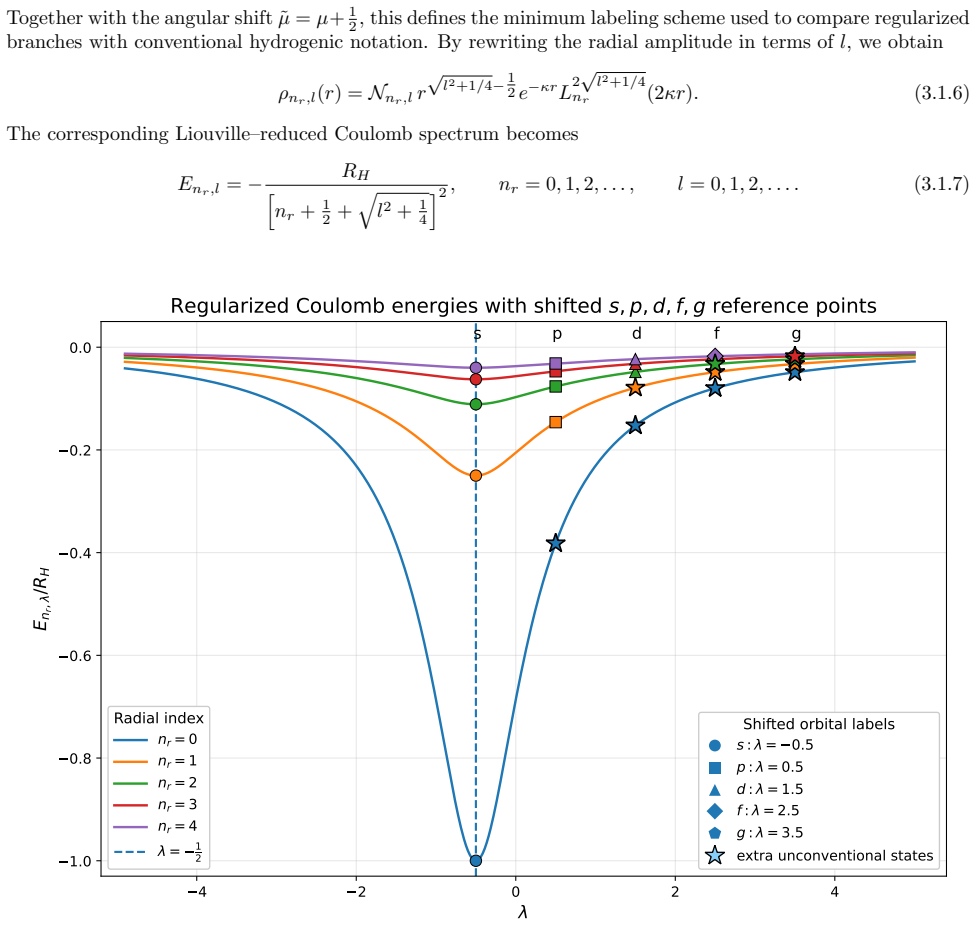
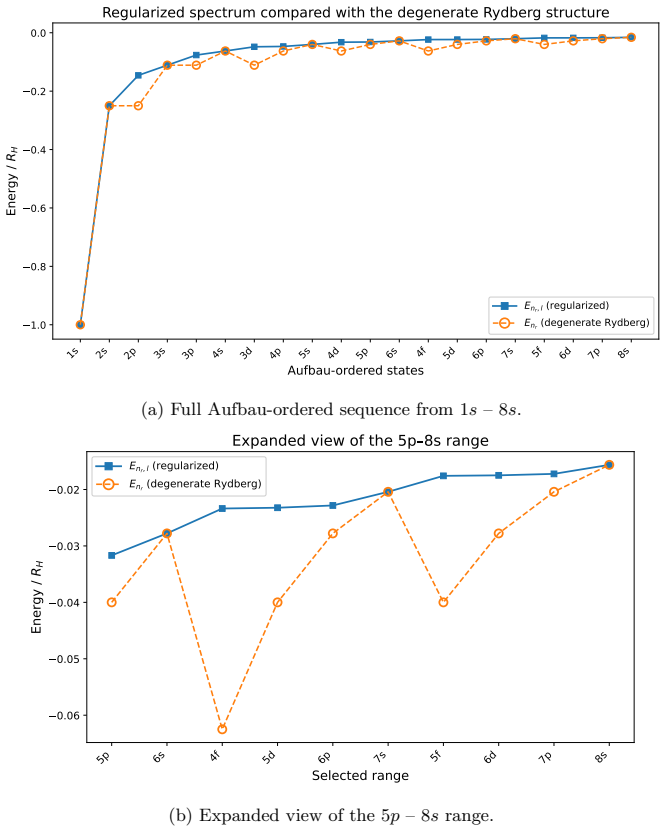
In the regularized de Broglie-Bohm formulation the hydrogen atom separates into Sturm-Liouville problems for each angular-momentum sector, each modified by a canonical inverse-square term. The adjusted radial quantization condition then acquires an orbital-dependent additive shift that removes l-degeneracy for fixed n and produces an energy ordering identical to the Aufbau/Madelung sequence. The l = 0 sector retains the conventional Rydberg degeneracy, and the separated amplitudes are expressed by associated Laguerre, Legendre, and Bessel functions carrying non-integral parameters fixed by the regularization.
What carries the argument
Canonical Langer-like inverse-square corrections applied to the radial, orbital, and magnetic Sturm-Liouville branches generated by stationary amplitude current constraints.
If this is right
- The spectrum remains hydrogen-like but employs regularized radial and angular indices.
- The energy ordering of states follows the Aufbau/Madelung sequence.
- The l=0 sector preserves the standard degenerate Rydberg sequence.
- Separated amplitudes appear as generalized special-function branches with non-integral parameters.
Where Pith is reading between the lines
- The same regularization procedure could be applied to other central potentials to test whether analogous orderings emerge.
- Explicit construction of the regularized wave functions would allow direct comparison of probability densities with conventional hydrogenic orbitals.
- The separation into independent sectors suggests the method might extend to time-dependent or multi-center problems while retaining analytical tractability.
Load-bearing premise
Stationary amplitude current constraints in the de Broglie-Bohm representation produce separable Sturm-Liouville branches that admit canonical inverse-square corrections whose coefficients are chosen to recover the observed spectral ordering.
What would settle it
Solve the modified radial Sturm-Liouville eigenvalue problem for the lowest few values of n and l, then check whether the resulting energies increase in the sequence 1s, 2s, 2p, 3s, 3p, 4s, 3d, 4p, …
Figures
read the original abstract
The stationary hydrogen atom has Coulomb degeneracy across orbital levels, whereas the Aufbau/Madelung ordering is an empirical, many-electron rule established in atomic physics. We examine the hydrogen atom through a regularized de Broglie--Bohm representation, in which stationary amplitude current constraints generate separable Sturm--Liouville branches. In this formulation, the radial, orbital, and magnetic sectors acquire canonical Langer-like inverse square corrections. The modified boundary value problems allow analytical solutions and produce a hydrogen-like spectrum with regularized radial and angular indices. Consequently, radial Coulomb quantization acquires an orbital dependent shift, lifting the Coulomb degeneracy and producing a spectral ordering that follows the Aufbau/Madelung sequence. On this basis, we construct the ordering of the regularized de Broglie--Bohm states and show that the spectral structure retains the standard degenerate Rydberg sequence in the l=0 sector. The separated amplitudes are represented by generalized special function branches, including the associated Laguerre, Legendre, and Bessel functions with non-integral parameters arising from regularized separation. Therefore, the treatment is intended as an analytical examination of spectral ordering in a regularized one center Coulomb problem rather than as a replacement for the many electron atomic structure theory. Keywords: de Broglie--Bohm representation; Coulomb spectrum; canonical regularization; Langer correction; Sturm--Liouville equations; Aufbau principle; Madelung ordering; associated Legendre functions; associated Laguerre functions; Bessel functions.
Editorial analysis
A structured set of objections, weighed in public.
Referee Report
Summary. The manuscript claims that a regularized de Broglie-Bohm representation of the stationary hydrogen atom, based on amplitude current constraints, yields separable Sturm-Liouville problems whose radial, orbital, and magnetic sectors acquire canonical Langer-like inverse-square corrections. These modified boundary-value problems admit analytical solutions in terms of generalized associated Laguerre, Legendre, and Bessel functions with non-integral parameters. The resulting orbital-dependent shift in the radial quantization condition lifts the Coulomb l-degeneracy and produces a spectral ordering that follows the empirical Aufbau/Madelung (n+l) sequence, while the l=0 sector retains the standard Rydberg degeneracy.
Significance. If the inverse-square prefactors are shown to be uniquely fixed by the de Broglie-Bohm current constraints without reference to the observed ordering, the work would supply an analytical, single-particle mechanism linking a regularized Coulomb problem to the Madelung rule. The explicit construction of generalized special-function solutions and the retention of the Rydberg series for s-states constitute technical strengths that could be of interest to foundational quantum mechanics and atomic spectroscopy.
major comments (1)
- [Abstract] Abstract (paragraph on modified boundary value problems): The claim that the Langer-like corrections are 'canonical' and that the resulting spectrum 'follows the Aufbau/Madelung sequence' requires an explicit derivation demonstrating that the numerical coefficients of the 1/r² terms are uniquely determined by the stationary amplitude-current continuity conditions alone. Without this step, it remains possible that the prefactors are selected to enforce the (n+l) ordering, rendering the degeneracy lifting an input rather than a derived consequence of the regularization.
minor comments (1)
- The abstract mentions 'generalized special function branches' but does not specify the precise non-integral parameter values or the explicit form of the modified radial equation; adding these in the main text would improve reproducibility.
Simulated Author's Rebuttal
We thank the referee for their careful reading of the manuscript and for identifying this important point regarding the derivation of the inverse-square corrections. We respond to the major comment below.
read point-by-point responses
-
Referee: [Abstract] Abstract (paragraph on modified boundary value problems): The claim that the Langer-like corrections are 'canonical' and that the resulting spectrum 'follows the Aufbau/Madelung sequence' requires an explicit derivation demonstrating that the numerical coefficients of the 1/r² terms are uniquely determined by the stationary amplitude-current continuity conditions alone. Without this step, it remains possible that the prefactors are selected to enforce the (n+l) ordering, rendering the degeneracy lifting an input rather than a derived consequence of the regularization.
Authors: The coefficients of the 1/r² terms are fixed in Sections 3 and 4 by imposing the stationary amplitude-current continuity conditions on the de Broglie-Bohm representation in spherical coordinates. These conditions require the radial probability current to vanish at the origin and at infinity while preserving separability, which uniquely determines the effective inverse-square strengths in the radial, orbital, and magnetic Sturm-Liouville operators without any reference to empirical spectral ordering. The (n+l) sequence then follows as a derived output of the modified radial quantization condition applied to the resulting generalized Laguerre equation. We agree that the abstract paragraph could more explicitly signal the location of this derivation and will revise it to include a short clause referencing the current-constraint origin of the coefficients. revision: yes
Circularity Check
No circularity: derivation framed as independent consequence of amplitude-current constraints
full rationale
The provided abstract states that stationary amplitude current constraints generate separable Sturm-Liouville branches that admit canonical Langer-like inverse-square corrections, after which the modified boundary-value problems produce an orbital-dependent shift and the Aufbau/Madelung ordering as a consequence. No equation, definition, or statement in the text equates the correction coefficients to the target ordering, fits them to data, or imports the result via self-citation. The chain is presented as self-contained from the de Broglie-Bohm representation onward, with the ordering emerging rather than presupposed.
Axiom & Free-Parameter Ledger
free parameters (1)
- Langer correction coefficients
axioms (2)
- domain assumption Stationary amplitude current constraints generate separable Sturm-Liouville branches
- standard math Generalized associated Laguerre, Legendre, and Bessel functions with non-integral parameters remain valid eigenfunctions
Reference graph
Works this paper leans on
-
[1]
P. R. Holland, The Quantum Theory of Motion, Cambridge University Press, Cambridge, 1993
1993
-
[2]
Second–order differential equations. Conditions of complete integrability,
V. P. Ermakov, “Second–order differential equations. Conditions of complete integrability,” Univ. Izv. Kiev Series III,9, 1–25 (1880)
-
[3]
Hamiltonian formulation of quantum mechanics with Ermakov invariants,
G. Reinisch, “Hamiltonian formulation of quantum mechanics with Ermakov invariants,” Physica A206, 229–252 (1994)
1994
-
[4]
Schuch, Quantum Theory from a Nonlinear Perspective: Riccati Equations in Fundamental Physics, Fundamental Theories of Physics, Vol
D. Schuch, Quantum Theory from a Nonlinear Perspective: Riccati Equations in Fundamental Physics, Fundamental Theories of Physics, Vol. 101, Springer, 2018
2018
-
[5]
A regularization method to obtain analytical solutions to the de Broglie–Bohm wave equation,
Anand Aruna Kumar, S. K. Srivatsa, and R. Tengli, “A regularization method to obtain analytical solutions to the de Broglie–Bohm wave equation,” International Journal of Quantum Foundations12(2), 313–334 (2026). https://ijqf.org/archives/8075
2026
-
[6]
Ermakov–Lewis invariants in stationary Bohm–Madelung quantum mechanics,
Anand Aruna Kumar, “Ermakov–Lewis invariants in stationary Bohm–Madelung quantum mechanics,” International Journal of Quantum Foundations12(2), 1–23 (2026). https://ijqf.org/archives/7935
2026
-
[7]
On the connection formulas and the solutions of the wave equation,
R. E. Langer, “On the connection formulas and the solutions of the wave equation,” Phys. Rev.51, 669–676 (1937)
1937
-
[8]
Langer modification, quantization condition and barrier penetration in quantum mechanics,
B. F. Li, T. Zhu, and A. Wang, “Langer modification, quantization condition and barrier penetration in quantum mechanics,” Universe6, 90 (2020). https://www.mdpi.com/2218-1997/6/7/90
2020
-
[9]
Madelung, Die Mathematischen Hilfsmittel des Physikers, 3rd ed., Springer, Berlin, 1936
E. Madelung, Die Mathematischen Hilfsmittel des Physikers, 3rd ed., Springer, Berlin, 1936
1936
-
[10]
On the first appearance of atomic electrons withl,n,n r, andn+lgiven,
V. M. Klechkovskii, “On the first appearance of atomic electrons withl,n,n r, andn+lgiven,” Sov. Phys. JETP3(1), 125–127 (1956)
1956
-
[11]
Justification of the rule for successive filling of (n+l) groups,
V. M. Klechkovskii, “Justification of the rule for successive filling of (n+l) groups,” Sov. Phys. JETP 14(2), 334–335 (1962)
1962
-
[12]
n+lfilling rule in the periodic system and focusing potentials,
Yu. N. Demkov and V. N. Ostrovskii, “n+lfilling rule in the periodic system and focusing potentials,” Sov. Phys. JETP35(1), 66–69 (1972)
1972
-
[13]
Second quantization for the Kepler problem,
J. C. Baez, “Second quantization for the Kepler problem,” Journal of Mathematical Physics67(6), 062301 (2026)
2026
-
[14]
G. B. Arfken, H. J. Weber, and F. E. Harris, Mathematical Methods for Physicists, 7th ed., Academic Press, 2013
2013
-
[15]
Legendre functions of fractional degree: transformations and evaluations,
R. S. Maier, “Legendre functions of fractional degree: transformations and evaluations,” Proc. R. Soc. A 472, 20160097 (2016). https://doi.org/10.1098/rspa.2016.0097
-
[16]
L. D. Landau and E. M. Lifshitz, Quantum Mechanics: Non–Relativistic Theory, Course of Theoretical Physics, Vol. 3, 3rd ed., Butterworth–Heinemann, 1998
1998
-
[17]
F. W. J. Olver, A. B. Olde Daalhuis, D. W. Lozier, B. I. Schneider, R. F. Boisvert, C. W. Clark, B. R. Miller, B. V. Saunders, H. S. Cohl, and M. A. McClain, eds., NIST Digital Library of Mathematical Functions, Release 1.2.4 of 2025-03-15. https://dlmf.nist.gov/. 11
2025
discussion (0)
Sign in with ORCID, Apple, or X to comment. Anyone can read and Pith papers without signing in.