Dispersive mode coupling in p-doped semiconductor nanomechanical resonators
Pith reviewed 2026-06-26 23:59 UTC · model grok-4.3
The pith
P-doping strongly enhances dispersive coupling between nanomechanical resonator modes and makes it grow with nonlinearity order.
A machine-rendered reading of the paper's core claim, the machinery that carries it, and where it could break.
Core claim
We show that in p-doped semiconductors such coupling is strongly enhanced. Moreover, the coupling parameters increase with the order of the nonlinearity. The doping-induced dispersive coupling becomes much stronger than the intrinsic one already for moderately strong doping. Its dependence on the hole density is nonmonotonic, and the temperature dependence becomes nonmonotonic for higher densities. Relevant mesoscopic frequency fluctuations are briefly discussed. The results are applied to Si resonators, where doping is used to compensate the temperature dependence of a clock mode, whereas another low-frequency mode is used as a thermometer to enable temperature stabilization.
What carries the argument
Doping-induced contribution to the nonlinear terms in the resonator Hamiltonian that produce dispersive coupling between modes of different frequencies.
If this is right
- Doping-induced coupling dominates intrinsic coupling already at moderate hole densities.
- Coupling strength increases with the order of the nonlinearity.
- Coupling versus hole density is nonmonotonic, allowing an optimal doping level.
- Temperature dependence of coupling becomes nonmonotonic at higher densities.
- The scheme enables simultaneous temperature compensation of a clock mode and thermometry via a second mode in silicon resonators.
Where Pith is reading between the lines
- The same doping mechanism could be used to engineer tunable nonlinear interactions in other semiconductor resonator materials.
- Nonmonotonic temperature dependence may require careful operating-point selection when scaling to arrays of coupled modes.
- Frequency fluctuations arising from mesoscopic hole distributions could set a practical limit on the achievable stability.
Load-bearing premise
The relation between hole density, temperature, and the nonlinear coupling coefficients is taken as given by the underlying model.
What would settle it
Plot measured dispersive coupling strength versus hole density in fabricated p-doped silicon resonators; a monotonic rise instead of a peak would contradict the central claim.
Figures
read the original abstract
Dispersive coupling between vibrational modes with different frequencies is a major nonlinear dynamical effect. We show that in $p$-doped semiconductors such coupling is strongly enhanced. Moreover, the coupling parameters increase with the order of the nonlinearity. The doping-induced dispersive coupling becomes much stronger than the intrinsic one already for moderately strong doping. Its dependence on the hole density is nonmonotonic, and the temperature dependence becomes nonmonotonic for higher densities. Relevant mesoscopic frequency fluctuations are briefly discussed. The results are applied to Si resonators, where doping is used to compensate the temperature dependence of a clock mode, whereas another low-frequency mode is used as a thermometer to enable temperature stabilization.
Editorial analysis
A structured set of objections, weighed in public.
Referee Report
Summary. The manuscript claims that p-doping in semiconductors strongly enhances dispersive coupling between vibrational modes of different frequencies in nanomechanical resonators, with the coupling strength increasing for higher-order nonlinearities. The doping-induced contribution exceeds the intrinsic one at moderate doping levels, exhibits nonmonotonic dependence on hole density, and develops nonmonotonic temperature dependence at higher densities. These effects are modeled for Si resonators and applied to temperature compensation of a clock mode using a low-frequency thermometer mode, with brief discussion of mesoscopic frequency fluctuations.
Significance. If the underlying carrier contributions to the nonlinear elastic coefficients are accurately captured, the work identifies a tunable mechanism for enhancing nonlinear mode coupling that is absent in undoped devices. This could enable new design strategies for resonators in precision timing and sensing, where doping is already used for temperature compensation. The nonmonotonic p- and T-dependences offer potential optimization points not available from intrinsic nonlinearity alone.
major comments (1)
- [model for doping-induced nonlinear coefficients (derivation of p- and T-dependent terms)] The central claims of strong enhancement, dominance over intrinsic coupling, and nonmonotonic p- and T-dependence all rest on the specific functional form of the doping corrections to the nonlinear coefficients in the resonator Hamiltonian. This form is obtained from an expansion of the strain-dependent band structure or carrier free-energy contribution for p-doped Si. The manuscript should explicitly state the approximations (effective-mass, deformation-potential, screening) and demonstrate that the reported nonmonotonic curves and crossover densities remain qualitatively unchanged when higher-order terms in hole density or impurity scattering are retained. Without this, the load-bearing predictions for clock applications cannot be assessed.
minor comments (1)
- [discussion of frequency fluctuations] The abstract states that 'relevant mesoscopic frequency fluctuations are briefly discussed,' but the connection between these fluctuations and the enhanced dispersive coupling should be made more explicit, including any quantitative estimates.
Simulated Author's Rebuttal
We thank the referee for the careful reading and constructive feedback on our manuscript. We respond to the single major comment below and will incorporate revisions to address the concerns raised.
read point-by-point responses
-
Referee: The central claims of strong enhancement, dominance over intrinsic coupling, and nonmonotonic p- and T-dependence all rest on the specific functional form of the doping corrections to the nonlinear coefficients in the resonator Hamiltonian. This form is obtained from an expansion of the strain-dependent band structure or carrier free-energy contribution for p-doped Si. The manuscript should explicitly state the approximations (effective-mass, deformation-potential, screening) and demonstrate that the reported nonmonotonic curves and crossover densities remain qualitatively unchanged when higher-order terms in hole density or impurity scattering are retained. Without this, the load-bearing predictions for clock applications cannot be assessed.
Authors: We agree that the central claims depend on the model details and that the approximations should be stated explicitly. In the revised manuscript we will add a dedicated subsection (or paragraph in the theory section) that lists the approximations employed: the effective-mass approximation for the valence band of Si, the deformation-potential description of strain-induced shifts, and the Thomas-Fermi (or RPA) treatment of screening. These are the standard framework used for carrier contributions to elastic coefficients in doped semiconductors. Regarding robustness, the nonmonotonic p- and T-dependences arise from the competition between the leading linear and quadratic terms in the hole free-energy expansion; higher-order density corrections and impurity scattering enter as perturbative corrections that shift the location of the extrema but do not remove the nonmonotonic character within the moderate-doping window relevant to our Si resonator examples. We will include a short supplementary analysis (or extended footnote) confirming that the qualitative features and crossover densities survive when the next-order terms are retained, thereby supporting the clock-mode compensation predictions. revision: yes
Circularity Check
No significant circularity in derivation chain.
full rationale
The paper derives the doping-induced corrections to nonlinear elastic coefficients from the strain dependence of the hole band structure and free-energy contributions in p-doped semiconductors, then computes the resulting dispersive coupling parameters between modes. These steps are presented as explicit expansions whose functional form for p- and T-dependence follows from the effective-mass and deformation-potential approximations stated in the text; the nonmonotonicity and crossover to dominance over intrinsic coupling are direct numerical consequences of that expansion rather than a fit or self-citation that re-labels an input as a prediction. No load-bearing premise reduces to a prior result by the same authors, no parameter is fitted to the target observables and then called a prediction, and the application to temperature-compensated Si clocks uses the computed coefficients without circular re-insertion. The derivation therefore remains self-contained against external benchmarks.
Axiom & Free-Parameter Ledger
Reference graph
Works this paper leans on
-
[1]
For our estimate we will use∥ˆC (2)∥ ∼ ∥ ˆC (3)∥ ∼ ∥ ˆC (4)∥
gives ˆC (n) with the components that increase with n, with∥ ˆC (4)∥/∥ ˆC (2)∥≳10for Si, in particular; the physical origin of this increase is not obvious). For our estimate we will use∥ˆC (2)∥ ∼ ∥ ˆC (3)∥ ∼ ∥ ˆC (4)∥. A major consequence of the nonlinear vibrational cou- pling is decay, which leads to a finite lifetime of vibra- tional modes. In this pa...
-
[2]
Estimate of the dispersive coupling and its renormalization for low-frequency modes Since the doping-induced nonlinear coupling between low-frequency modes is much stronger than the intrinsic coupling, to describe this coupling we can approximate the quartic nonlinearity parameters in Eq. (3) by keeping only the doping-induced term, γ(α1α2α3α4) = Z drΛ (4...
-
[3]
There- fore, if the square plate is cut out so that its edges are along the⟨100⟩directions, the strain tensor can be com- puted directly from the displacement fields in Eqs
Strain tensor in the⟨100⟩- coordinates The elastic tensors of single-crystal silicon are conven- tionally expressed in the coordinate system where the axes(x, y, z)are pointing along the⟨100⟩-axes. There- fore, if the square plate is cut out so that its edges are along the⟨100⟩directions, the strain tensor can be com- puted directly from the displacement ...
-
[4]
thermometer
The torsional-mode shift induced by the Lamé mode is ℵ⟨100⟩ TL = π2ΛLT 2C44 ,(25a) ℵ⟨110⟩ TL = π2ΛLT C11 −C 12 .(25b) In these equations,Cij =C (2) ij +Λ (2) ij are the components of the full linear elasticity tensor. Equations (24) and (25) show that the nonlinear fre- quency shifts of both modes are controlled by the same hole-induced mixed dispersive-c...
-
[5]
These results provide numerical substantiation of the qualitative arguments presented above
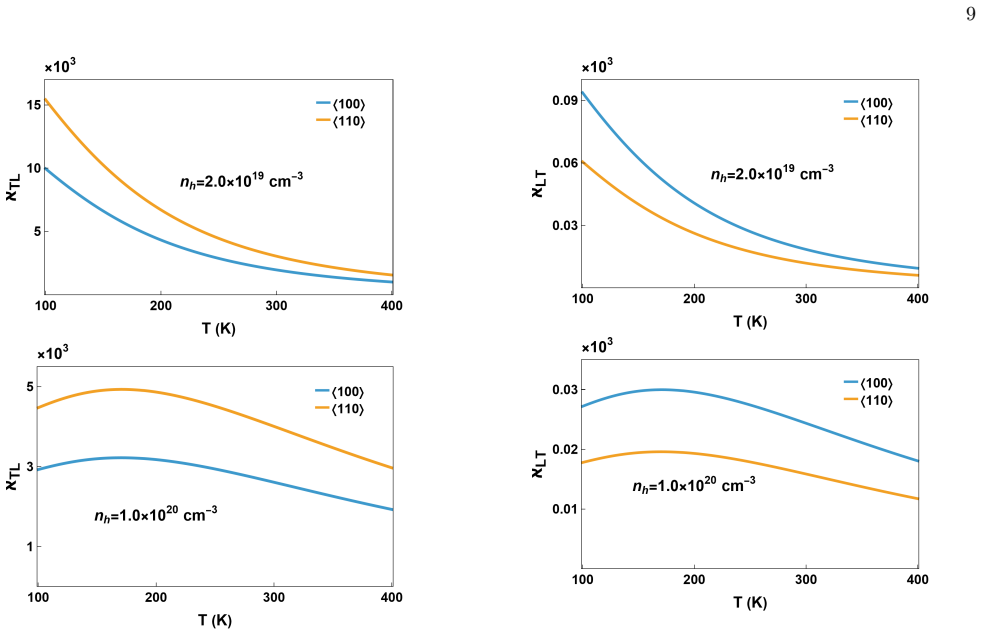
Temperature dependence of the dispersive frequency shifts Figure3showsthetemperaturedependenceoftheshift of the torsional mode frequency induced by the Lamé mode. These results provide numerical substantiation of the qualitative arguments presented above. At low hole density,n h = 2×10 19 cm−3, the scaled shift decreases monotonically with the increasing ...
-
[6]
Both modes exhibit a strongly nonmono- tonicdependenceonn h forbothcrystalorientations
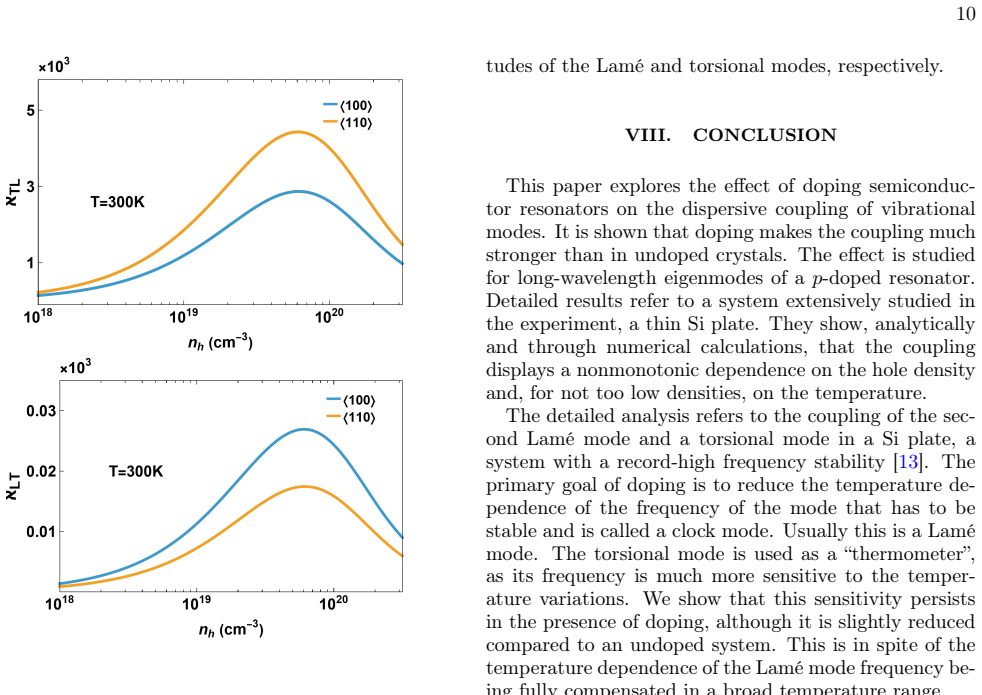
Density dependence at fixed temperature Figure 5 shows the density dependence of the cross- Kerr shifts atT= 300 Kfor the torsional and second Lamé modes. Both modes exhibit a strongly nonmono- tonicdependenceonn h forbothcrystalorientations. The overall behavior is in agreement with what is expected from the qualitative arguments presented above. At low ...
-
[7]
thermometer
Effect of the crystal orientation Figures 3 – 5 show the opposite effect of the nonlinear coupling on the studied two modes:ℵLT is larger for the crystal orientation⟨100⟩than for the orientation⟨110⟩, opposite to the dependence ofℵTL on the crystal orien- tation. This is a consequence of the difference between the elasticity componentsC11 −C 12 andC 44 in...
-
[8]
A. N. Cleland and M. L. Roukes, Fabrication of high frequency nanometer scale mechanical resonators from bulk Si crystals, Applied Physics Letters69, 2653 (1996)
1996
-
[9]
J. T. M. van Beek and R. Puers, A review of MEMS oscillators for frequency reference and timing applica- tions, Journal of Micromechanics and Microengineering 22, 013001 (2012)
2012
-
[10]
Brand, I
O. Brand, I. Dufour, S. M. Heinrich, and F. Josse, eds., Resonant MEMS: Fundamentals, Implementation, and Application(Wiley-VCH, Singapore, 2015)
2015
-
[11]
Yamaguchi, GaAs-Based Micro/Nanomechanical Res- onators, Semicond
H. Yamaguchi, GaAs-Based Micro/Nanomechanical Res- onators, Semicond. Sci. Techn.32, 103003 (2017)
2017
-
[12]
J. M. L. Miller, A. Ansari, D. B. Heinz, Y. Chen, I. B. Flader, D. D. Shin, L. G. Villanueva, and T. W. Kenny, Effective quality factor tuning mechanisms in microme- chanical resonators, Applied Physics Reviews5, 041307 (2018)
2018
-
[13]
Bachtold, J
A. Bachtold, J. Moser, and M. I. Dykman, Mesoscopic physics of nanomechanical systems, Reviews of Modern Physics94, 045005 (2022)
2022
-
[14]
E. J. Ng, H. K. Lee, C. H. Ahn, R. Melamud, and T. W. Kenny, Stability of silicon microelectromechanical sys- tems resonant thermometers, IEEE Sensors Journal13, 987 (2013)
2013
-
[15]
Comenencia Ortiz, H.-K
L. Comenencia Ortiz, H.-K. Kwon, J. Rodriguez, Y. Chen, G. D. Vukasin, D. B. Heinz, D. D. Shin, and T. W. Kenny, Low-power dual mode MEMS resonators with PPB stability over temperature, Journal of Micro- electromechanical Systems29, 190 (2020)
2020
-
[16]
H.-K. Kwon, G. D. Vukasin, N. E. Bousse, and T. W. Kenny, Crystal orientation dependent dual frequency ov- enized mems resonator with temperature stability and shockrobustness,JournalofMicroelectromechanicalSys- tems29, 1130 (2020)
2020
-
[17]
W. Jia, W. Chen, Y. Xiao, Z. Wu, and G. Wu, A micro- oven-controlleddual-modepiezoelectricMEMSresonator with±400 PPB stability over−40 to 80°C temperature range, IEEE Transactions on Electron Devices69, 2597 (2022)
2022
-
[18]
Y. Xiao, J. Han, K. Zhu, and G. Wu, A micro-oven con- trolled dual-mode piezoelectric MEMS resonator with± 190 ppb stability over−40 to 105°C temperature range, IEEE Electron Device Letters44, 1340 (2023)
2023
-
[19]
J. Yang, S. Verma, M. Gomi, J. Kim, J. Yan, J. Jing, G. Vukasin, R. Kwon, G. Bahl, and T. W. Kenny, Pre- cision MEMS timing: Microheater and machine learn- ing compensation for 21 PPT stability at 7.5 hours, in 2025 23rd International Conference on Solid-State Sen- sors, Actuators and Microsystems (Transducers)(2025) pp. 184–187
2025
-
[20]
J. Yan, J. Kim, R. Islam, J. Yang, K. Elmeligy, A. Bozkurt, T. W. Kenny, P. K. Hanumolu, and G. Bahl, A micromechanical frequency reference with parts-per- trillion holdover stability, arXiv:2605.08118 (2026)
Pith/arXiv arXiv 2026
-
[21]
Born, Thermodynamics of Crystals and Melting, J
M. Born, Thermodynamics of Crystals and Melting, J. Chem. Phys.7, 591 (1939)
1939
-
[22]
E. A. Stern, Theory of the Anharmonic Properties of Solids, Phys. Rev.111, 786 (1958)
1958
-
[23]
Asadi, J
K. Asadi, J. Yu, and H. Cho, Nonlinear couplings and en- ergy transfers in micro- and nano-mechanical resonators: intermodal coupling, internal resonance and synchroniza- tion, Philosophical Transactions of the Royal Society A: Mathematical, Physical and Engineering Sciences376, 20170141 (2018)
2018
-
[24]
A. A. Shevyrin, A. G. Pogosov, A. K. Bakarov, A. A. Shklyaev, and A. Naik, Intermode coupling in nanome- chanical resonators as a key for tuning the effective non- linearity, Phys. Rev. Appl.22, L061003 (2024)
2024
-
[25]
Allemeier, I
D. Allemeier, I. I. Kaya, M. S. Hanay, and K. L. Ekinci, Multistability and noise-induced transitions in disper- sively coupled nonlinear nanomechanical modes, Phys. Rev. A112, 023505 (2025)
2025
-
[26]
C. F. D. Wattjes, Z. Li, M. Xu, R. A. Norte, P. G. Steeneken, and F. Alijani, Experimental quantification of nonlinear mode coupling in nanomechanical resonators using multi-tone excitation, arXiv:2604.13920 (2026)
Pith/arXiv arXiv 2026
-
[27]
W. J. Venstra, R. van Leeuwen, and H. S. J. van der Zant, Strongly coupled modes in a weakly driven mi- cromechanical resonator, Applied Physics Letters101, 243111 (2012)
2012
-
[28]
M. H. Matheny, L. G. Villanueva, R. B. Karabalin, J. E. Sader, and M. L. Roukes, Nonlinear mode-coupling in nanomechanical systems, Nano Letters13, 1622 (2013)
2013
-
[29]
K. Gajo, G. Rastelli, and E. M. Weig, Tuning the non- linear dispersive coupling of nanomechanical string res- onators, Physical Review B101, 075420 (2020)
2020
-
[30]
R. W. Keyes, The electronic contribution to the elastic properties of germanium, IBM Journal of Research and Development5, 266 (1961)
1961
-
[31]
R. W. Keyes, Electronic effects in the elastic properties of semiconductors, inSolid State Physics, Vol. 20, edited by F. Seitz, D. Turnbull, and H. Ehrenreich (Academic Press) pp. 37–90
-
[32]
G. L. Bir and A. Tursunov, Effect of holes on the elastic constants of Germanium, Sov. Phys. Solid State4, 1925 (1963)
1925
-
[33]
J. J. Hall, Electronic effects in the elastic constants of n-type silicon, Phys. Rev.161, 756 (1967)
1967
-
[34]
Cerdeira and M
F. Cerdeira and M. Cardona, Effect of Carrier Concen- tration on the Raman Frequencies of Si and Ge, Phys. Rev. B5, 1440 (1972)
1972
-
[35]
C. K. Kim, M. Cardona, and S. Rodriguez, Effect of free carriers on the elastic constants ofp-type silicon and ger- manium, Phys. Rev. B13, 5429 (1976)
1976
-
[36]
N. S. Averkiev, Yu. V. Ilisavskiy, and V. M. Sternin, The free charge carrier effects on elastic properties of silicon, Solid State Communications52, 17 (1984)
1984
-
[37]
F. S. Khan and P. B. Allen, Temperature Dependence of the Elastic Constants of p+ Silicon, Phys. Status Solidi 12 B128, 31 (1985)
1985
-
[38]
N. S. Averkiev, Yu. V. Ilisavskiy, and V. M. Sternin, Elec- tron anharmonicity in semiconductors with a complex valence band structure, Sov. Phys. Solid State28, 829 (1987)
1987
-
[39]
Moskovtsev and M
K. Moskovtsev and M. I. Dykman, Strong vibration nonlinearityinsemiconductor-basednanomechanicalsys- tems, Physical Review B95, 085426 (2017)
2017
-
[40]
Liu and M
A. Liu and M. Dykman, Effect of hole-strain coupling on the eigenmodes of semiconductor-based nanomechanical systems, Physical Review B111, 235410 (2025)
2025
-
[41]
A. K. Samarao and F. Ayazi, Temperature compensation of silicon resonators via degenerate doping, IEEE Trans. Electron. Devices59, 87 (2012)
2012
-
[42]
Hajjam, A
A. Hajjam, A. Logan, and S. Pourkamali, Doping- Induced Temperature Compensation of Thermally Ac- tuated High-Frequency Silicon Micromechanical Res- onators, Journal of Microelectromechanical Systems21, 681 (2012)
2012
-
[43]
E. J. Ng, V. A. Hong, Y. Yang, C. H. Ahn, C. L. M. Everhart, and T. W. Kenny, Temperature dependence of the elastic constants of doped silicon, Journal of Micro- electromechanical Systems24, 730 (2015)
2015
-
[44]
Majjad, J.-R
H. Majjad, J.-R. Coudevylle, S. Basrour, and M. de Labachelerie, Modeling and characterization of Lamé-mode microresonators realized by UV-LIGA, in Transducers’ 01 Eurosensors XV: The 11th International Conference on Solid-State Sensors and Actuators June 10–14, 2001 Munich, Germany(Springer, 2001) pp. 300–303
2001
-
[45]
Khine and M
L. Khine and M. Palaniapan, High-Q bulk-mode SOI square resonators with straight-beam anchors, Journal of Micromechanics and Microengineering19, 015017 (2009)
2009
-
[46]
Holmgren, K
O. Holmgren, K. Kokkonen, T. Veijola, T. Mattila, V. Kaajakari, A. Oja, J. V. Knuuttila, and M. Kaivola, Analysis ofvibration modes in amicromechanical square- plate resonator, Journal of Micromechanics and Micro- engineering19, 015028 (2009)
2009
-
[47]
H. Zhu, C. Tu, G. Shan, and J. E.-Y. Lee, Dependence of temperature coefficient of frequency (TCf) on crystallog- raphy and eigenmode in N-doped silicon contour mode micromechanical resonators, Sensors and Actuators A: Physical215, 189 (2014)
2014
-
[48]
J. E.-Y. Lee, Lamé mode MEMS resonators, inEncyclo- pedia of Nanotechnology,editedbyB.Bhushan(Springer, Dordrecht, 2016) pp. 1–9
2016
-
[49]
Daruwalla, H
A. Daruwalla, H. Wen, C.-S. Liu, and F. Ayazi, Low mo- tional impedance distributed lamé mode resonators for high frequency timing applications, Microsystems & Na- noengineering6, 53 (2020)
2020
-
[50]
Landau and E
L. Landau and E. Lifshitz,Theory of Elasticity, 3rd ed. (Butterworth-Heinemann Ltd., Oxford, 1986)
1986
-
[51]
J. M. Luttinger and W. Kohn, Motion of electrons and holes in perturbed periodic fields, Physical Review97, 869 (1955)
1955
-
[52]
G. L. Bir and G. E. Pikus,Symmetry and Strain-Induced Effects in Semiconductors(Wiley, New York, 1974)
1974
-
[53]
Winkler,Spin-Orbit Coupling Effects in Two- Dimensional Electron and Hole Systems(Springer, Berlin, 2003)
R. Winkler,Spin-Orbit Coupling Effects in Two- Dimensional Electron and Hole Systems(Springer, Berlin, 2003)
2003
-
[54]
S. M. Girvin and K. Yang,Modern Condensed Matter Physics(Cambridge University Press, 2019)
2019
-
[55]
V. L. Gurevich,Transport in Phonon Systems(Elsevier Science Ltd, 1988)
1988
-
[56]
Pandit and A
A. Pandit and A. Bongiorno, A first-principles method to calculate fourth-order elastic constants of solid materials, Computer Physics Communications288, 108751 (2023)
2023
-
[57]
J. A. Garber and A. V. Granato, Theory of the tem- perature dependence of second-order elastic constants in cubic materials, Phys. Rev. B11, 3990 (1975)
1975
-
[58]
Malica and A
C. Malica and A. D. Corso, Quasi-harmonic temperature dependent elastic constants: applications to silicon, alu- minum, andsilver,JournalofPhysics: CondensedMatter 32, 315902 (2020)
2020
-
[59]
H. J. McSkimin, Measurement of elastic constants at low temperatures by means of ultrasonic waves–data for sil- icon and germanium single crystals, and for fused silica, Journal of Applied Physics24, 988 (1953)
1953
-
[60]
Y. P. Varshni, Temperature dependence of the elastic constants, Phys. Rev. B2, 3952 (1970)
1970
-
[61]
Y. A. Burenkov and S. P. Nikaronov, Temperature de- pendence of elastic constants of silicon, Sov. Phys. Solid State16, 963 (1974)
1974
-
[62]
M. I. Dykman and M. A. Krivoglaz, Classical theory of nonlinear oscillators interacting with a medium, Phys. Stat. Sol. B48, 497 (1971)
1971
-
[63]
R. E. Peierls,Quantum Theory of Solids(Clarendon Press, 1955)
1955
-
[64]
K. F. Graff,Wave Motion in Elastic Solids(Dover, New York, 1991)
1991
-
[65]
A. W. Leissa,Vibration of Plates(U.S. Government Printing Office, Washington, D.C., 1969)
1969
-
[66]
Liu and M
A. Liu and M. T. Elewa,https://github.com/ AA008WYR97/p-doped-silicon(2026)
2026
discussion (0)
Sign in with ORCID, Apple, or X to comment. Anyone can read and Pith papers without signing in.