Graph Neural Networks for Semi-Supervised Image Classification with Multi-Feature Aggregation
Pith reviewed 2026-06-27 02:13 UTC · model grok-4.3
The pith
Combining features from multiple extractors with manifold learning on graphs improves GNN accuracy for semi-supervised image classification.
A machine-rendered reading of the paper's core claim, the machinery that carries it, and where it could break.
Core claim
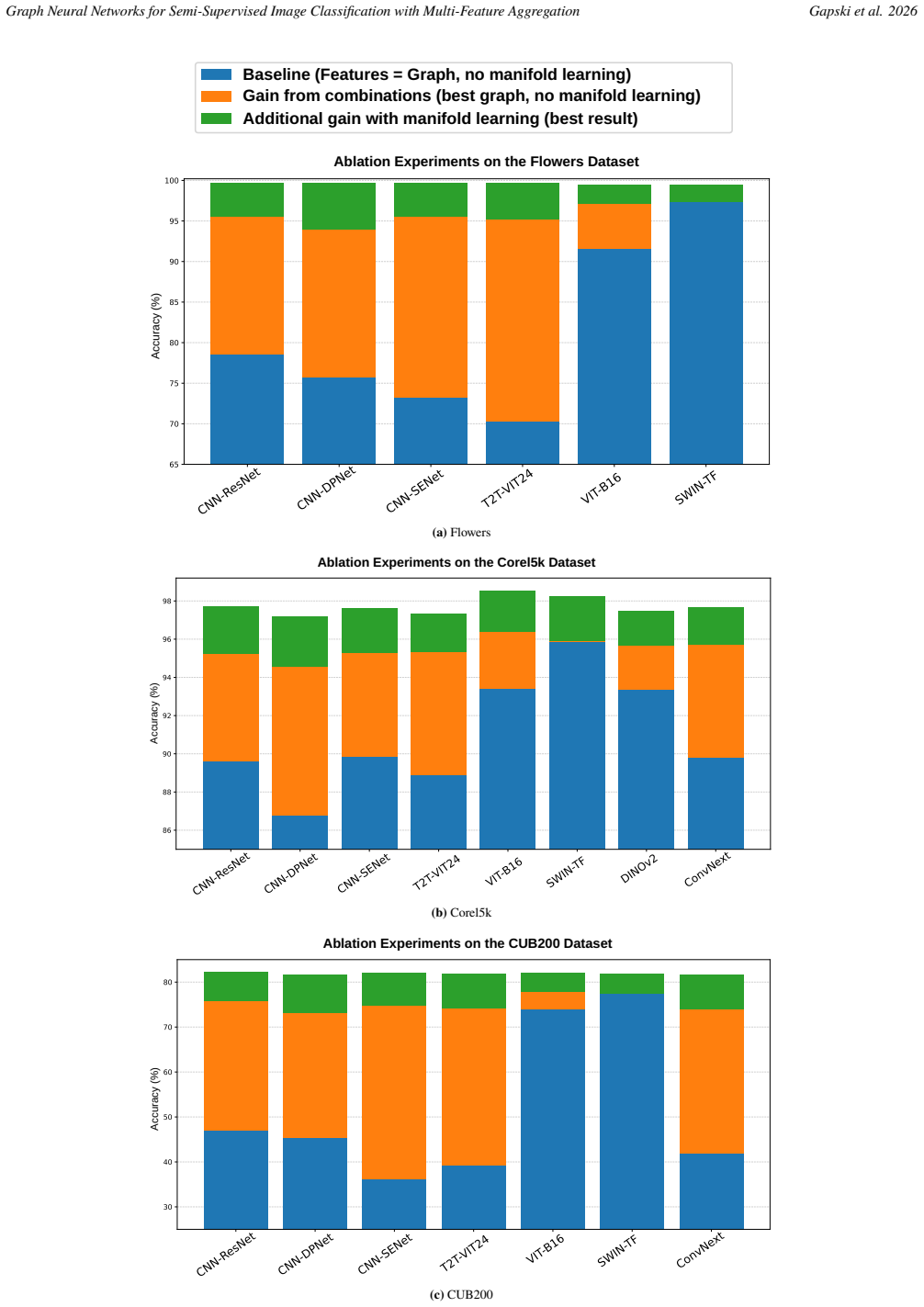
The strategic combination of feature and graph representations, coupled with the application of manifold learning for graph processing, leads to significant improvements in classification accuracy across the majority of experimental conditions. The utilization of rank aggregation techniques to integrate features from different extractors was shown to enhance classification accuracy.
What carries the argument
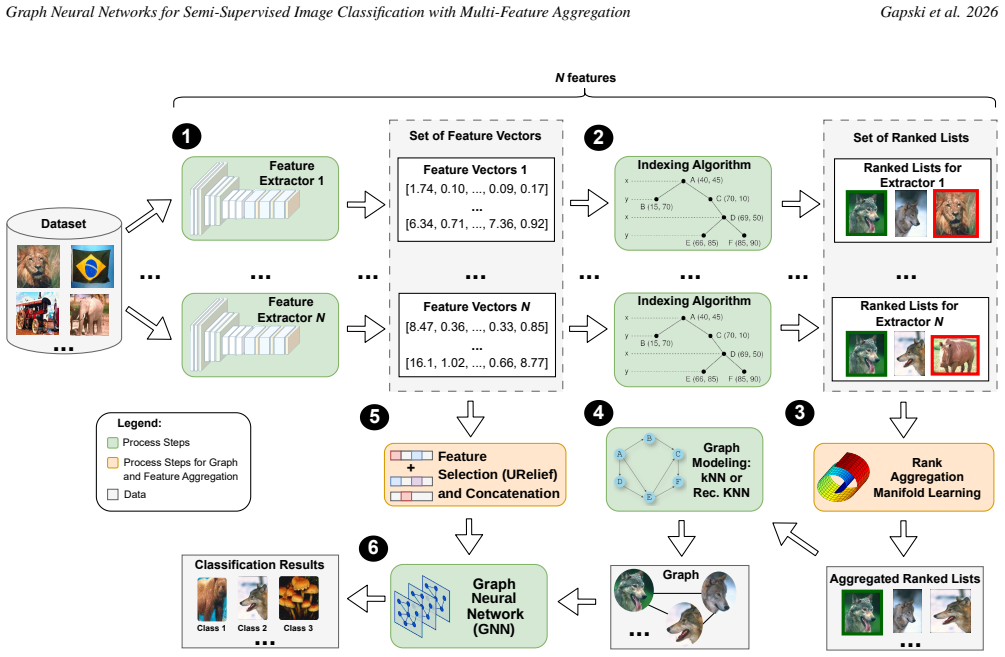
Multi-feature and multi-graph aggregation inside GNNs, where rank aggregation merges outputs from different CNN and ViT extractors and manifold learning refines the graphs used for label propagation.
If this is right
- Accuracy rises when rank aggregation fuses features from distinct extractors rather than using any one extractor alone.
- Manifold learning applied to the constructed graphs improves the quality of label propagation from the few labeled samples.
- The gains appear across the majority of tested extractor combinations and datasets.
- Rank aggregation provides a practical way to integrate complementary information without retraining the underlying extractors.
Where Pith is reading between the lines
- The same aggregation pattern could be tested on video or 3D data where multiple pretrained models also exist.
- If the complementarity assumption weakens on very large or very noisy collections, simpler single-graph GNNs might remain preferable.
- Measuring the degree of complementarity between extractors before aggregation could become a useful preprocessing step.
Load-bearing premise
Features from different extractors supply complementary information that can be aggregated without introducing noise that harms label propagation on the graph.
What would settle it
If controlled experiments show that the best single-extractor GNN consistently matches or exceeds the accuracy of the multi-extractor versions on the same datasets and splits, the claimed improvement does not hold.
Figures
read the original abstract
Feature extraction involves the identification and extraction of salient characteristics or patterns, including edges, textures, shapes, and color attributes. Contemporary feature extractors predominantly leverage deep learning architectures, such as Convolutional Neural Networks (CNNs) and Vision Transformers (VITs). The availability of diverse feature extractors in the literature provides a wide range of feature representations. Features extracted from an image depend on the specific application, the chosen extractor, and its configuration. Therefore, integrating complementary information by combining distinct extractors offers a promising way to enhance performance. Graph Neural Networks (GNNs), particularly Graph Convolutional Networks (GCNs), have emerged as powerful and widely adopted approaches for semi-supervised image classification, as they effectively leverage both labeled and unlabeled data while exploiting the underlying graph structures that capture relationships among samples. This study proposes a novel approach for GNNs in scenarios where labeled data is scarce, by integrating diverse sets of feature and graph representations derived from various extractors in classification scenarios. Experimental investigations were conducted, encompassing combinations of distinct feature and graph extractors, as well as rank aggregation strategies. The primary contributions of this work are underscored by the experimental findings, which demonstrate that the strategic combination of feature and graph representations, coupled with the application of manifold learning for graph processing, leads to significant improvements in classification accuracy across the majority of experimental conditions. Furthermore, the utilization of rank aggregation techniques to integrate features from different extractors was shown to enhance classification accuracy.
Editorial analysis
A structured set of objections, weighed in public.
Referee Report
Summary. The manuscript proposes integrating features from multiple CNN and ViT extractors via rank aggregation to construct graphs, applying manifold learning to these graphs, and feeding the resulting structures into GNNs (specifically GCNs) for semi-supervised image classification in low-label regimes; it claims that this multi-feature and multi-graph strategy, together with rank aggregation, yields significant accuracy gains across most tested conditions.
Significance. If the empirical claims are substantiated with proper controls, the approach could provide a practical way to leverage complementary information from off-the-shelf feature extractors within graph-based semi-supervised pipelines, potentially improving label propagation when labeled data is scarce.
major comments (2)
- [Abstract] Abstract: the assertion that the proposed combinations 'lead to significant improvements in classification accuracy across the majority of experimental conditions' and that rank aggregation 'was shown to enhance classification accuracy' supplies no numerical results, datasets, error bars, number of labeled samples, or statistical tests, so the central empirical claim cannot be evaluated.
- [Abstract] Abstract / implied experimental design: no ablation is described that holds the graph-construction and manifold-learning pipeline fixed while comparing the rank-aggregated multi-extractor representation against the single best extractor; without this control the claim that aggregation supplies non-redundant information (rather than noise) remains untested.
minor comments (1)
- [Abstract] Abstract: the phrase 'manifold learning for graph processing' is used without naming the concrete technique or its precise insertion point relative to graph construction and the subsequent GNN layers.
Simulated Author's Rebuttal
We thank the referee for the detailed and constructive comments. We address each major point below and indicate the revisions we will make to strengthen the manuscript.
read point-by-point responses
-
Referee: [Abstract] Abstract: the assertion that the proposed combinations 'lead to significant improvements in classification accuracy across the majority of experimental conditions' and that rank aggregation 'was shown to enhance classification accuracy' supplies no numerical results, datasets, error bars, number of labeled samples, or statistical tests, so the central empirical claim cannot be evaluated.
Authors: We agree that the abstract as currently written does not include the quantitative details needed to evaluate the central claims. In the revised version we will update the abstract to report representative numerical results drawn from the experiments section, including accuracy values, the datasets used, the fraction or number of labeled samples, and standard deviations across runs. revision: yes
-
Referee: [Abstract] Abstract / implied experimental design: no ablation is described that holds the graph-construction and manifold-learning pipeline fixed while comparing the rank-aggregated multi-extractor representation against the single best extractor; without this control the claim that aggregation supplies non-redundant information (rather than noise) remains untested.
Authors: The referee correctly identifies that the current manuscript does not present an ablation that isolates rank aggregation by holding the remainder of the pipeline fixed and comparing against the single best extractor. We will add this control experiment to the revised manuscript, reporting the corresponding accuracy figures so that readers can assess whether the aggregated representation supplies complementary information. revision: yes
Circularity Check
No circularity; purely empirical claims with no derivations or self-referential reductions.
full rationale
The paper describes an experimental pipeline combining feature extractors, rank aggregation, manifold learning, and GNNs for semi-supervised classification. No equations, uniqueness theorems, fitted parameters renamed as predictions, or derivation chains appear in the abstract or described contributions. All performance claims are presented as outcomes of experiments rather than algebraic identities or self-citations that reduce to inputs by construction. The central assumption (complementary information from extractors) is testable via the reported comparisons and does not collapse into a definitional tautology.
Axiom & Free-Parameter Ledger
Reference graph
Works this paper leans on
-
[1]
Proceedings of the IEEE Conference on Computer Vision and Pattern Recognition (CVPR) , month =
Hu, Jie and Shen, Li and Sun, Gang , title =. Proceedings of the IEEE Conference on Computer Vision and Pattern Recognition (CVPR) , month =
-
[3]
2009 IEEE Conference on Computer Vision and Pattern Recognition (CVPR) , year =
ImageNet: A Large-Scale Hierarchical Image Database , author =. 2009 IEEE Conference on Computer Vision and Pattern Recognition (CVPR) , year =
2009
-
[4]
ImageNet Classification with Deep Convolutional Neural Networks
Krizhevsky, Alex and Sutskever, Ilya and Hinton, Geoffrey E. ImageNet Classification with Deep Convolutional Neural Networks. Advances in Neural Information Processing Systems 25. 2012
2012
-
[7]
Content-Based Image Retrieval: Theory and Applications
Torres, Ricardo da Silva and Falcão, Alexandre Xavier. Content-Based Image Retrieval: Theory and Applications. Revista de Informática Teórica e Aplicada. 2006
2006
-
[8]
Information fusion in content based image retrieval: A comprehensive overview , journal =
Luca Piras and Giorgio Giacinto , keywords =. Information fusion in content based image retrieval: A comprehensive overview , journal =. 2017 , issn =
2017
-
[9]
Wang, Mengzhao and Xu, Xiaoliang and Yue, Qiang and Wang, Yuxiang , title =. 2021 , issue_date =. doi:10.14778/3476249.3476255 , journal =
-
[10]
Contrastive learning: Big Data Foundations and Applications
Tripathi, Sandhya and King, Christopher Ryan. Contrastive learning: Big Data Foundations and Applications. Proceedings of the 7th Joint International Conference on Data Science & Management of Data (11th ACM IKDD CODS and 29th COMAD). 2024
2024
-
[11]
Unsupervised metric learning by Self-Smoothing Operator , year=
Jiayan Jiang and Wang, Bo and Tu, Zhuowen , booktitle=. Unsupervised metric learning by Self-Smoothing Operator , year=
-
[12]
Omohundro , title =
Stephen M. Omohundro , title =
-
[13]
Júlia Rodrigues. and Joel Carbonera. , title=. Proceedings of the 26th International Conference on Enterprise Information Systems - Volume 1: ICEIS , year=. doi:10.5220/0012263200003690 , isbn=
-
[14]
Vasudevan, Varun and Bassenne, Maxime and Islam, Md Tauhidul and Xing, Lei , title =. 2023 , issue_date =. doi:10.1016/j.patrec.2023.01.003 , journal =
-
[15]
EAI Endorsed Transactions on AI and Robotics , volume=
Wenhao Tang , title=. EAI Endorsed Transactions on AI and Robotics , volume=. 2023 , month=
2023
-
[16]
Lucas Pascotti Valem , title =
-
[17]
PYG DOCUMENTATION , url =
-
[18]
TORCH\_GEOMETRIC , url =
-
[19]
He and X
K. He and X. Zhang and S. Ren and J. Sun , booktitle=. Deep Residual Learning for Image Recognition , year=
-
[20]
Unsupervised Distance Learning Framework for Multimedia Retrieval , url =
-
[21]
Pattern Recognition , volume =
Daniel Carlos Guimarães Pedronette and Lucas Pascotti Valem and Ricardo da Silva Torres , title =. Pattern Recognition , volume =. 2021 , note =
2021
-
[22]
International Conference on Multimedia Retrieval (ICMR) , year =
Lucas Pascotti Valem and Daniel Carlos Guimarães Pedronette , title =. International Conference on Multimedia Retrieval (ICMR) , year =
-
[23]
IEEE Transactiosn on Image Processing , volume =
Daniel Carlos Guimarães Pedronette, Lucas Pascotti Valem, Jurandy Almeida, and Ricardo da Silva Torres , title =. IEEE Transactiosn on Image Processing , volume =. 2019 , url =
2019
-
[24]
Relatório de Trabalho de Conclusão de Curso (Graduação em Ciência da Computação) , pages =
Lucas Pascotti Valem , title =. Relatório de Trabalho de Conclusão de Curso (Graduação em Ciência da Computação) , pages =. 2016 , note =
2016
-
[25]
PyUDLF: A Python Framework for Unsupervised Distance Learning Tasks , year =
Leticio, Gustavo and Valem, Lucas Pascotti and Lopes, Leonardo Tadeu and Pedronette, Daniel Carlos Guimar\. PyUDLF: A Python Framework for Unsupervised Distance Learning Tasks , year =. Proceedings of the 31st ACM International Conference on Multimedia , pages =. doi:10.1145/3581783.3613466 , abstract =
-
[26]
IEEE Conference on Computer Vision and Pattern Recognition , volume =
Maria-Elena Nilsback and Andrew Zisserman , title =. IEEE Conference on Computer Vision and Pattern Recognition , volume =
-
[27]
An Unsupervised Distance Learning Framework for Multimedia Retrieval , booktitle =
Valem, Lucas Pascotti and Pedronette, Daniel Carlos Guimar\. An Unsupervised Distance Learning Framework for Multimedia Retrieval , booktitle =. 2017 , isbn =. doi:10.1145/3078971.3079017 , acmid =
-
[28]
Image re-ranking and rank aggregation based on similarity of ranked lists , journal =. 2013 , issn =. doi:https://doi.org/10.1016/j.patcog.2013.01.004 , author =
-
[29]
Torres, Ricardo , booktitle=
Pedronette, Daniel Carlos Guimaraes and da S. Torres, Ricardo , booktitle=. Unsupervised manifold learning by correlation graph and strongly connected components for image retrieval , year=
-
[30]
A correlation graph approach for unsupervised manifold learning in image retrieval tasks , journal =. 2016 , note =. doi:https://doi.org/10.1016/j.neucom.2016.03.081 , author =
-
[31]
International Conference on Learning Representations , year=
Semi-Supervised Classification with Graph Convolutional Networks , author=. International Conference on Learning Representations , year=
-
[32]
Web Image Re-Ranking Using Query-Specific Semantic Signatures , year=
Wang, Xiaogang and Qiu, Shi and Liu, Ke and Tang, Xiaoou , journal=. Web Image Re-Ranking Using Query-Specific Semantic Signatures , year=
-
[33]
Tag-Based Image Search by Social Re-ranking , year=
Lu, Dan and Liu, Xiaoxiao and Qian, Xueming , journal=. Tag-Based Image Search by Social Re-ranking , year=
-
[34]
International Conference on Learning Representations , year=
Combining Neural Networks with Personalized PageRank for Classification on Graphs , author=. International Conference on Learning Representations , year=
-
[35]
A graph-based ranked-list model for unsupervised distance learning on shape retrieval , journal =. 2016 , note =. doi:https://doi.org/10.1016/j.patrec.2016.05.021 , author =
-
[39]
Why ResNet Works? Residuals Generalize , year=
He, Fengxiang and Liu, Tongliang and Tao, Dacheng , journal=. Why ResNet Works? Residuals Generalize , year=
-
[40]
PyTorch: An Imperative Style, High-Performance Deep Learning Library , volume =
Paszke, Adam and Gross, Sam and Massa, Francisco and Lerer, Adam and Bradbury, James and Chanan, Gregory and Killeen, Trevor and Lin, Zeming and Gimelshein, Natalia and Antiga, Luca and Desmaison, Alban and Kopf, Andreas and Yang, Edward and DeVito, Zachary and Raison, Martin and Tejani, Alykhan and Chilamkurthy, Sasank and Steiner, Benoit and Fang, Lu an...
-
[41]
An Image is Worth 16x16 Words: Transformers for Image Recognition at Scale , journal =
Alexey Dosovitskiy and Lucas Beyer and Alexander Kolesnikov and Dirk Weissenborn and Xiaohua Zhai and Thomas Unterthiner and Mostafa Dehghani and Matthias Minderer and Georg Heigold and Sylvain Gelly and Jakob Uszkoreit and Neil Houlsby , keywords =. An Image is Worth 16x16 Words: Transformers for Image Recognition at Scale , journal =. 2021 , doi =
2021
-
[42]
ICCV , year=
Swin Transformer: Hierarchical Vision Transformer using Shifted Windows , author=. ICCV , year=
-
[43]
Journal of Imaging , VOLUME =
Pedronette, Daniel Carlos Guimarães and Valem, Lucas Pascotti and Latecki, Longin Jan , TITLE =. Journal of Imaging , VOLUME =. 2021 , NUMBER =
2021
-
[45]
Texture Feature Extraction Methods: A Survey , year=
Humeau-Heurtier, Anne , journal=. Texture Feature Extraction Methods: A Survey , year=
-
[46]
A Deep Neural Network Combined CNN and GCN for Remote Sensing Scene Classification , year=
Liang, Jiali and Deng, Yufan and Zeng, Dan , journal=. A Deep Neural Network Combined CNN and GCN for Remote Sensing Scene Classification , year=
-
[47]
Multiscale Graph Sample and Aggregate Network With Context-Aware Learning for Hyperspectral Image Classification , year=
Ding, Yao and Zhao, Xiaofeng and Zhang, Zhili and Cai, Wei and Yang, Nengjun , journal=. Multiscale Graph Sample and Aggregate Network With Context-Aware Learning for Hyperspectral Image Classification , year=
-
[48]
International Journal of Electrical and Computer Engineering , volume=
Combination of texture feature extraction and forward selection for one-class support vector machine improvement in self-portrait classification , author=. International Journal of Electrical and Computer Engineering , volume=. 2023 , publisher=
2023
-
[51]
Attention Multihop Graph and Multiscale Convolutional Fusion Network for Hyperspectral Image Classification , year=
Zhou, Hao and Luo, Fulin and Zhuang, Huiping and Weng, Zhenyu and Gong, Xiuwen and Lin, Zhiping , journal=. Attention Multihop Graph and Multiscale Convolutional Fusion Network for Hyperspectral Image Classification , year=
-
[53]
Understanding of a convolutional neural network , year=
Albawi, Saad and Mohammed, Tareq Abed and Al-Zawi, Saad , booktitle=. Understanding of a convolutional neural network , year=
-
[54]
Novel Dataset for Fine-Grained Image Categorization , year =
Aditya Khosla and Nityananda Jayadevaprakash and Bangpeng Yao and Li Fei-Fei , booktitle =. Novel Dataset for Fine-Grained Image Categorization , year =
-
[56]
Semi-Supervised Learning , url =
-
[57]
The Caltech-UCSD Birds-200-2011 Dataset , publisher=
Wah, Catherine and Branson, Steve and Welinder, Peter and Perona, Pietro and Belongie, Serge , year=. The Caltech-UCSD Birds-200-2011 Dataset , publisher=
2011
-
[59]
Proceedings of the IEEE Conference on Computer Vision and Pattern Recognition (CVPR) , month =
He, Kaiming and Zhang, Xiangyu and Ren, Shaoqing and Sun, Jian , title =. Proceedings of the IEEE Conference on Computer Vision and Pattern Recognition (CVPR) , month =
-
[60]
Dual Path Networks , url =
Chen, Yunpeng and Li, Jianan and Xiao, Huaxin and Jin, Xiaojie and Yan, Shuicheng and Feng, Jiashi , booktitle =. Dual Path Networks , url =
-
[61]
Transactions on Machine Learning Research , issn=
Maxime Oquab and Timoth. Transactions on Machine Learning Research , issn=. 2024 , url=
2024
-
[62]
and Feng, Jiashi and Yan, Shuicheng , title =
Yuan, Li and Chen, Yunpeng and Wang, Tao and Yu, Weihao and Shi, Yujun and Jiang, Zi-Hang and Tay, Francis E.H. and Feng, Jiashi and Yan, Shuicheng , title =. Proceedings of the IEEE/CVF International Conference on Computer Vision (ICCV) , month =. 2021 , pages =
2021
-
[63]
Proceedings of the IEEE/CVF Conference on Computer Vision and Pattern Recognition (CVPR) , month =
Liu, Zhuang and Mao, Hanzi and Wu, Chao-Yuan and Feichtenhofer, Christoph and Darrell, Trevor and Xie, Saining , title =. Proceedings of the IEEE/CVF Conference on Computer Vision and Pattern Recognition (CVPR) , month =. 2022 , pages =
2022
-
[64]
Torres, Ricardo , journal=
Pedronette, Daniel Carlos Guimarães and Valem, Lucas Pascotti and Almeida, Jurandy and da S. Torres, Ricardo , journal=. Multimedia Retrieval Through Unsupervised Hypergraph-Based Manifold Ranking , year=
-
[65]
International Conference on Learning Representations , year=
Graph Attention Networks , author=. International Conference on Learning Representations , year=
-
[66]
Proceedings of the 36th International Conference on Machine Learning , pages =
Simplifying Graph Convolutional Networks , author =. Proceedings of the 36th International Conference on Machine Learning , pages =. 2019 , editor =
2019
-
[67]
Graph Neural Networks With Convolutional ARMA Filters , year=
Bianchi, Filippo Maria and Grattarola, Daniele and Livi, Lorenzo and Alippi, Cesare , journal=. Graph Neural Networks With Convolutional ARMA Filters , year=
-
[68]
Feature Fusion for Graph Convolutional Networks in Semi-Supervised Image Classification , year=
Gapski, Marina Chagas Bulach and Valem, Lucas Pascotti and Pedronette, Daniel Carlos Guimarães , booktitle=. Feature Fusion for Graph Convolutional Networks in Semi-Supervised Image Classification , year=
-
[69]
2002 , publisher=
Principal component analysis for special types of data , author=. 2002 , publisher=
2002
-
[70]
2002 , publisher=
Principal Component Analysis , author=. 2002 , publisher=
2002
-
[71]
Computer Vision and Image Understanding , volume=
Graph convolutional networks based on manifold learning for semi-supervised image classification , author=. Computer Vision and Image Understanding , volume=. 2023 , publisher=
2023
-
[74]
Understanding of a convolutional neural network
Saad Albawi, Tareq Abed Mohammed, and Saad Al-Zawi. Understanding of a convolutional neural network. In 2017 International Conference on Engineering and Technology (ICET), pages 1--6, 2017. doi:10.1109/ICEngTechnol.2017.8308186
-
[75]
Young Anna Argyris, Zuhui Wang, Yongsuk Kim, and Zhaozheng Yin. The effects of visual congruence on increasing consumers’ brand engagement: An empirical investigation of influencer marketing on instagram using deep-learning algorithms for automatic image classification. Computers in Human Behavior, 112: 0 106443, 2020. ISSN 0747-5632. doi:https://doi.org/...
-
[76]
Filippo Maria Bianchi, Daniele Grattarola, Lorenzo Livi, and Cesare Alippi. Graph neural networks with convolutional arma filters. IEEE Transactions on Pattern Analysis and Machine Intelligence, 44 0 (7): 0 3496--3507, 2022. doi:10.1109/TPAMI.2021.3054830
-
[77]
Semi-Supervised Learning
Olivier Chapelle, Bernhard Schölkopf, and Alexander Zien, editors. Semi-Supervised Learning. The MIT Press, 2006. ISBN 9780262033589. URL http://dblp.uni-trier.de/db/books/collections/CSZ2006.html
2006
-
[78]
Dual path networks
Yunpeng Chen, Jianan Li, Huaxin Xiao, Xiaojie Jin, Shuicheng Yan, and Jiashi Feng. Dual path networks. In I. Guyon, U. Von Luxburg, S. Bengio, H. Wallach, R. Fergus, S. Vishwanathan, and R. Garnett, editors, Advances in Neural Information Processing Systems, volume 30. Curran Associates, Inc., 2017. URL https://proceedings.neurips.cc/paper_files/paper/201...
2017
-
[79]
Afshin Dehghan, Syed Zain Masood, Guang Shu, and Enrique G. Ortiz. View independent vehicle make, model and color recognition using convolutional neural network. CoRR, abs/1702.01721, 2017. URL http://arxiv.org/abs/1702.01721
work page internal anchor Pith review Pith/arXiv arXiv 2017
-
[80]
Imagenet: A large-scale hierarchical image database
Jia Deng, Wei Dong, Richard Socher, Li-Jia Li, Kai Li, and Li Fei-Fei. Imagenet: A large-scale hierarchical image database. In 2009 IEEE Conference on Computer Vision and Pattern Recognition (CVPR), pages 248--255. IEEE, 2009
2009
-
[81]
Yao Ding, Xiaofeng Zhao, Zhili Zhang, Wei Cai, and Nengjun Yang. Multiscale graph sample and aggregate network with context-aware learning for hyperspectral image classification. IEEE Journal of Selected Topics in Applied Earth Observations and Remote Sensing, 14: 0 4561--4572, 2021. doi:10.1109/JSTARS.2021.3074469
-
[82]
An Image is Worth 16x16 Words: Transformers for Image Recognition at Scale
Alexey Dosovitskiy, Lucas Beyer, Alexander Kolesnikov, Dirk Weissenborn, Xiaohua Zhai, Thomas Unterthiner, Mostafa Dehghani, Matthias Minderer, Georg Heigold, Sylvain Gelly, Jakob Uszkoreit, and Neil Houlsby. An image is worth 16x16 words: Transformers for image recognition at scale. International Conference on Learning Representations, 2021. doi:https://...
work page internal anchor Pith review Pith/arXiv arXiv doi:10.48550/arxiv.2010.11929 2021
-
[83]
Fast Graph Representation Learning with PyTorch Geometric
Matthias Fey and Jan Eric Lenssen. Fast graph representation learning with pytorch geometric. CoRR, abs/1903.02428, 2019. URL http://arxiv.org/abs/1903.02428
work page internal anchor Pith review Pith/arXiv arXiv 1903
-
[84]
Feature fusion for graph convolutional networks in semi-supervised image classification
Marina Chagas Bulach Gapski, Lucas Pascotti Valem, and Daniel Carlos Guimarães Pedronette. Feature fusion for graph convolutional networks in semi-supervised image classification. In 2024 37th SIBGRAPI Conference on Graphics, Patterns and Images (SIBGRAPI), pages 1--6, 2024. doi:10.1109/SIBGRAPI62404.2024.10716341
-
[85]
Combining neural networks with personalized pagerank for classification on graphs
Johannes Gasteiger, Aleksandar Bojchevski, and Stephan Günnemann. Combining neural networks with personalized pagerank for classification on graphs. In International Conference on Learning Representations, 2019
2019
-
[86]
K. He, X. Zhang, S. Ren, and J. Sun. Deep residual learning for image recognition. In CVPR, pages 770--778, June 2016
2016
-
[87]
Squeeze-and-excitation networks
Jie Hu, Li Shen, and Gang Sun. Squeeze-and-excitation networks. In Proceedings of the IEEE Conference on Computer Vision and Pattern Recognition (CVPR), June 2018
2018
-
[88]
Texture feature extraction methods: A survey
Anne Humeau-Heurtier. Texture feature extraction methods: A survey. IEEE Access, 7: 0 8975--9000, 2019. doi:10.1109/ACCESS.2018.2890743
-
[89]
Unsupervised metric learning by self-smoothing operator
Jiayan Jiang, Bo Wang, and Zhuowen Tu. Unsupervised metric learning by self-smoothing operator. In 2011 International Conference on Computer Vision, pages 794--801, 2011
2011
-
[90]
Low-rank constraint based dual projections learning for dimensionality reduction
Lin Jiang, Xiaozhao Fang, Weijun Sun, Na Han, and Shaohua Teng. Low-rank constraint based dual projections learning for dimensionality reduction. Signal Processing, 204: 0 108817, 2023. ISSN 0165-1684. doi:https://doi.org/10.1016/j.sigpro.2022.108817
-
[91]
Novel dataset for fine-grained image categorization
Aditya Khosla, Nityananda Jayadevaprakash, Bangpeng Yao, and Li Fei-Fei. Novel dataset for fine-grained image categorization. In Workshop on Fine-Grained Visual Categorization, CVPR, June 2011
2011
-
[92]
Kipf and Max Welling
Thomas N. Kipf and Max Welling. Semi-supervised classification with graph convolutional networks. In International Conference on Learning Representations, 2017. URL https://openreview.net/forum?id=SJU4ayYgl
2017
-
[93]
Imagenet classification with deep convolutional neural networks
Alex Krizhevsky, Ilya Sutskever, and Geoffrey E Hinton. Imagenet classification with deep convolutional neural networks. In F. Pereira, C. J. C. Burges, L. Bottou, and K. Q. Weinberger, editors, Advances in Neural Information Processing Systems 25, pages 1097--1105. Curran Associates, Inc., 2012
2012
-
[94]
Neighbor embedding projection and graph convolutional networks for image classification
Gustavo Rosseto Leticio, Vinicius Atsushi Sato Kawai, Lucas Pascotti Valem, and Daniel Carlos Guimar \ a es Pedronette. Neighbor embedding projection and graph convolutional networks for image classification. In Proceedings of the 20th International Joint Conference on Computer Vision, Imaging and Computer Graphics Theory and Applications - Volume 2: VISA...
discussion (0)
Sign in with ORCID, Apple, or X to comment. Anyone can read and Pith papers without signing in.