An AI Security Agent for Banking: Multi-Vector Fraud and AML Detection Across Retail and Corporate Accounts
Pith reviewed 2026-06-27 00:34 UTC · model grok-4.3
The pith
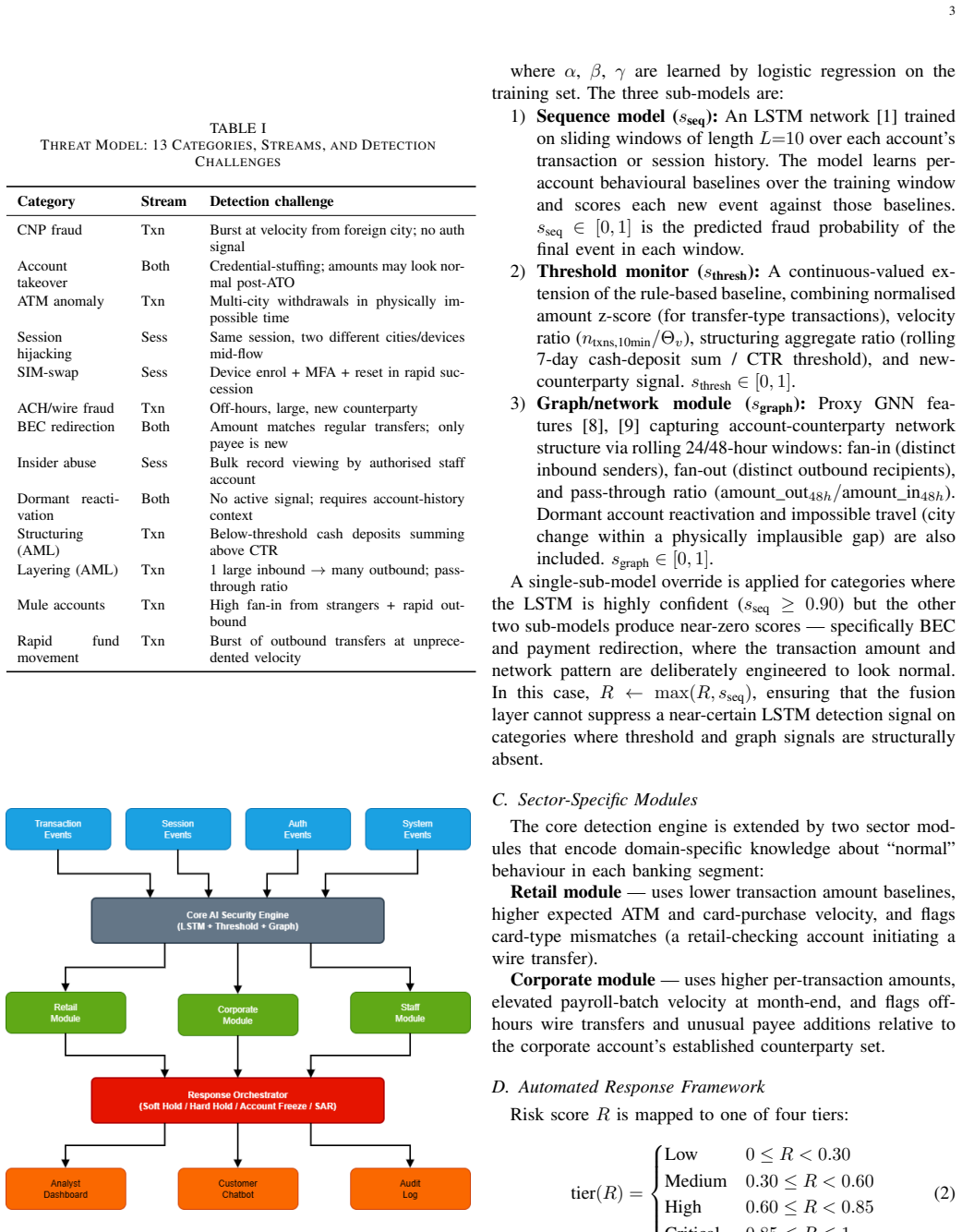
A fusion of LSTM sequence models, statistical monitors, and graph networks on transaction and session streams detects both signature-based fraud and behavioral financial crimes in banking.
A machine-rendered reading of the paper's core claim, the machinery that carries it, and where it could break.
Core claim
The central claim is that a three-component fusion architecture operating on transaction and session streams can detect both traditional signature-based fraud and behavioral financial crimes such as business email compromise and money laundering layering, which static rules cannot reliably identify because they appear indistinguishable from legitimate activity.
What carries the argument
The three-component fusion architecture that combines an LSTM sequence model for behavioral history, a statistical velocity and threshold monitor, and a graph or network module for relationship patterns like fan-in and fan-out.
If this is right
- The proposed model achieves an overall F1 of 0.787 on the transaction stream compared to 0.562 for rule-based and 0.655 for LSTM-only baselines.
- It achieves 0.867 F1 on the session stream versus 0.733 and 0.713 for the baselines.
- A customer-facing chatbot provides 96.6% identity verification accuracy and detects 86.8% of mass-reset attacks.
- An analyst case-summary assistant reaches 99.3% action-recommendation F1.
- Critical-tier automated responses have latency under 0.43 ms at the 95th percentile.
Where Pith is reading between the lines
- The architecture could be extended to incorporate additional data sources such as device fingerprints or external watchlists to further improve detection of mule networks.
- Deployment in live systems might reduce the volume of false positives that analysts must review by catching patterns across multiple accounts.
- Testing the same fusion approach on real rather than synthetic banking logs would clarify how well the performance holds when attack distributions differ from the simulation.
- The dual-stream design suggests a general pattern for security agents that must handle both point events and longer behavioral sequences.
Load-bearing premise
The synthetic event log accurately simulates the characteristics of real-world fraud, AML, and legitimate banking activity, including the indistinguishability of sophisticated attacks.
What would settle it
Evaluating the model on a real-world anonymized banking transaction dataset and checking whether the F1 scores remain higher than the rule-based and LSTM baselines.
Figures
read the original abstract
Banks simultaneously face signature-based fraud (card-not-present attacks, account takeover, ATM cloning) and behavioural financial crime (structuring, layering, mule networks, business email compromise) -- two threat families with fundamentally different detection requirements. Static rule engines that reliably catch brute-force and high-velocity events are structurally blind to business-email-compromise (BEC) payment redirection, session hijacking, and money-laundering layering, which are engineered to appear indistinguishable from legitimate activity at the individual transaction or session level. This paper presents an AI security agent for retail and corporate banking that addresses this gap through a three-component fusion architecture operating on two parallel event streams: a transaction stream (card fraud, ACH/wire fraud, AML categories) and a session stream (account takeover, session hijacking, SIM-swap, insider abuse). Each stream combines an LSTM sequence model capturing per-account behavioural history, a statistical velocity/threshold monitor, and a graph/network module capturing account-counterparty relationship patterns (fan-in, fan-out, pass-through ratio) for money-laundering detection. Experiments on a synthetic event log of 237,669 transactions and 113,508 sessions across 13 threat categories and 3,470 simulated accounts demonstrate overall F1 of 0.787 (transaction stream) and 0.867 (session stream) for the proposed model, versus 0.562/0.733 for a rule-based baseline and 0.655/0.713 for an LSTM-only baseline. The agent includes a customer-facing transaction-verification chatbot (96.6% identity verification accuracy, 86.8% mass-reset attack detection) and an analyst case-summary assistant (99.3% action-recommendation F1), with Critical-tier automated response latency under 0.43 ms at the 95th percentile.
Editorial analysis
A structured set of objections, weighed in public.
Referee Report
Summary. The manuscript presents a three-component AI security agent for banking that fuses LSTM sequence models, statistical velocity/threshold monitors, and graph/network modules (fan-in, fan-out, pass-through ratio) operating on parallel transaction and session streams to detect both signature-based fraud and behavioral crimes such as BEC and layering. Experiments on a synthetic log of 237,669 transactions and 113,508 sessions across 13 threat categories and 3,470 accounts report overall F1 scores of 0.787 (transaction) and 0.867 (session) for the proposed model versus 0.562/0.733 (rule-based) and 0.655/0.713 (LSTM-only), plus a customer chatbot (96.6% verification accuracy) and analyst assistant (99.3% action-recommendation F1) with sub-millisecond latency.
Significance. If the synthetic data faithfully reproduces the statistical indistinguishability of sophisticated attacks from legitimate activity, the multi-vector fusion approach could represent a practical step forward in addressing limitations of static rules for AML and session-based threats. The explicit numerical results, latency figures, and dual-stream design provide concrete, falsifiable claims that strengthen the contribution relative to purely conceptual work.
major comments (2)
- [Experiments section (synthetic event log)] Experiments section (synthetic event log): No description is supplied of the data-generation procedure, the parameter ranges used to enforce indistinguishability of BEC redirection and layering from legitimate flows, or any statistical comparison of the synthetic distributions against real banking logs. This is load-bearing for the central claim because the reported F1 deltas (0.225 and 0.154) rest entirely on the assumption that the simulation produces attacks that are separable only at the level the three-component model can exploit.
- [Results and evaluation] Results and evaluation: The manuscript reports point F1 values without error bars, confidence intervals, or statistical significance tests comparing the fusion model to the two baselines; the precise fusion rule (weighting, voting, or learned combination of LSTM, velocity, and graph outputs) is also omitted. These omissions directly affect assessment of whether the performance advantage is robust or an artifact of the particular synthetic realization.
minor comments (2)
- [Abstract] The abstract states that the agent 'combines' the three modules but does not indicate whether this occurs at the feature, score, or decision level; a short clarifying sentence would improve readability without altering the technical content.
- [Results tables/figures] Table or figure captions for the performance results should explicitly note that all metrics derive from the synthetic log rather than real transaction data.
Simulated Author's Rebuttal
We thank the referee for their thorough review and constructive comments. We address each major comment below and commit to revising the manuscript to improve clarity and completeness.
read point-by-point responses
-
Referee: Experiments section (synthetic event log): No description is supplied of the data-generation procedure, the parameter ranges used to enforce indistinguishability of BEC redirection and layering from legitimate flows, or any statistical comparison of the synthetic distributions against real banking logs. This is load-bearing for the central claim because the reported F1 deltas (0.225 and 0.154) rest entirely on the assumption that the simulation produces attacks that are separable only at the level the three-component model can exploit.
Authors: We agree that a detailed account of the synthetic data generation process is essential for validating the central claims. In the revised version, we will add a comprehensive description of the data-generation procedure in the Experiments section, including the specific parameter ranges employed to simulate BEC redirection and layering attacks such that they are statistically indistinguishable from legitimate flows at the transaction level. We will also include any statistical comparisons performed between the synthetic distributions and available real banking log characteristics, noting the limitations inherent to synthetic data. revision: yes
-
Referee: Results and evaluation: The manuscript reports point F1 values without error bars, confidence intervals, or statistical significance tests comparing the fusion model to the two baselines; the precise fusion rule (weighting, voting, or learned combination of LSTM, velocity, and graph outputs) is also omitted. These omissions directly affect assessment of whether the performance advantage is robust or an artifact of the particular synthetic realization.
Authors: We acknowledge these omissions in the original manuscript. We will revise the Results and evaluation section to include a detailed description of the precise fusion rule used to combine the LSTM, statistical, and graph module outputs. We will also add error bars, confidence intervals, and statistical significance tests comparing the models, using bootstrap methods or multiple runs as appropriate to demonstrate robustness. revision: yes
Circularity Check
No circularity: empirical F1 scores are direct measurements on synthetic data with no self-referential derivations
full rationale
The paper describes a three-component architecture (LSTM + statistical monitor + graph module) and reports F1 scores (0.787/0.867) obtained by running the model on a fixed synthetic event log of 237,669 transactions and 113,508 sessions. No equations, parameter-fitting steps, or self-citations are presented that would make the reported metrics equivalent to the inputs by construction. The results are computed outputs on externally generated data rather than renamed fits or self-defined quantities. The synthetic-data realism assumption is a modeling limitation but does not create circularity in the derivation chain.
Axiom & Free-Parameter Ledger
free parameters (3)
- LSTM model hyperparameters
- Statistical velocity and threshold values
- Graph pattern thresholds (fan-in, fan-out, pass-through ratio)
axioms (1)
- domain assumption The synthetic data generation process produces realistic distributions of legitimate and fraudulent events that match real banking environments.
Reference graph
Works this paper leans on
-
[1]
S. Hochreiter and J. Schmidhuber, “Long short-term memory,” Neural Computation, vol. 9, no. 8, pp. 1735–1780, 1997. doi: 10.1162/neco.1997.9.8.1735
-
[2]
F. T. Liu, K. M. Ting, and Z.-H. Zhou, “Isolation forest,” inProc. 8th IEEE Int. Conf. Data Mining (ICDM), Pisa, Italy, 2008, pp. 413–422. doi: 10.1109/ICDM.2008.17
-
[3]
A survey of network anomaly detection techniques,
M. Ahmed, A. N. Mahmood, and J. Hu, “A survey of network anomaly detection techniques,”J. Netw. Comput. Appl., vol. 60, pp. 19–31, 2016. doi: 10.1016/j.jnca.2015.11.016
-
[4]
Anomaly detection: A survey.ACM Computing Surveys, 41(3):1–58, 2009
V . Chandola, A. Banerjee, and V . Kumar, “Anomaly detection: a survey,”ACM Comput. Surv., vol. 41, no. 3, p. 15, 2009. doi: 10.1145/1541880.1541882
-
[5]
A finan- cial fraud detection model based on LSTM deep learning tech- nique,
Y . Alghofaili, A. Albattah, and M. A. Rassam, “A finan- cial fraud detection model based on LSTM deep learning tech- nique,”J. Appl. Secur. Res., vol. 15, no. 4, pp. 498–516, 2020. doi: 10.1080/19361610.2020.1815491
-
[6]
Feature engineering strategies for credit card fraud detection,
A. C. Bahnsen, D. Aouada, A. Stojanovic, and B. Ottersten, “Feature engineering strategies for credit card fraud detection,”Expert Syst. Appl., vol. 51, pp. 134–142, 2016. doi: 10.1016/j.eswa.2015.12.030
-
[7]
Anti-money laundering in Bitcoin: ex- perimenting with graph convolutional networks for financial forensics,
M. Weber, G. Domeniconi, J. Chen, D. K. I. Weidele, C. Bellei, T. Robinson, and C. E. Leiserson, “Anti-money laundering in Bitcoin: ex- perimenting with graph convolutional networks for financial forensics,” inProc. KDD 2019 Workshop FinancialCrime, 2019
2019
-
[8]
Semi-supervised classification with graph convolutional networks,
T. N. Kipf and M. Welling, “Semi-supervised classification with graph convolutional networks,” inProc. 5th Int. Conf. Learning Representa- tions (ICLR), Toulon, France, 2017
2017
-
[9]
Finding money launderers using heterogeneous graph neural networks,
W. W. Lo, G. Opedal, and T. Verdonck, “Finding money launderers using heterogeneous graph neural networks,”Intelligent Systems with Applications, vol. 25, 2025. doi: 10.1016/j.iswa.2025.200479
-
[10]
Financial fraud detection using graph neural networks: a systematic review,
S. Motie and B. Raahemi, “Financial fraud detection using graph neural networks: a systematic review,”Expert Syst. Appl., vol. 240, p. 122156,
-
[11]
doi: 10.1016/j.eswa.2023.122156
-
[12]
Internet Crime Report 2023,
FBI Internet Crime Complaint Center (IC3), “Internet Crime Report 2023,” Federal Bureau of Investigation, Washington, DC, 2024. [On- line]. Available: https://www.ic3.gov/Media/PDF/AnnualReport/2023 IC3Report.pdf
2023
-
[13]
What is business email compromise (BEC)?
Palo Alto Networks Unit 42, “What is business email compromise (BEC)?” 2024. [Online]. Avail- able: https://www.paloaltonetworks.com/cyberpedia/ what-is-business-email-compromise-bec-tactics-and-prevention
2024
-
[14]
Network intrusion datasets: a survey, limitations, and recommendations,
P. Goldschmidt and D. Chud ´a, “Network intrusion datasets: a survey, limitations, and recommendations,”Computers & Security, vol. 156, p. 104510, 2025. doi: 10.1016/j.cose.2025.104510
discussion (0)
Sign in with ORCID, Apple, or X to comment. Anyone can read and Pith papers without signing in.