ERQA-Plus: A Diagnostic Benchmark for Reasoning in Embodied AI
Pith reviewed 2026-06-27 00:38 UTC · model grok-4.3
The pith
ERQA-Plus supplies a taxonomy-driven benchmark that isolates distinct embodied reasoning skills in AI agents.
A machine-rendered reading of the paper's core claim, the machinery that carries it, and where it could break.
Core claim
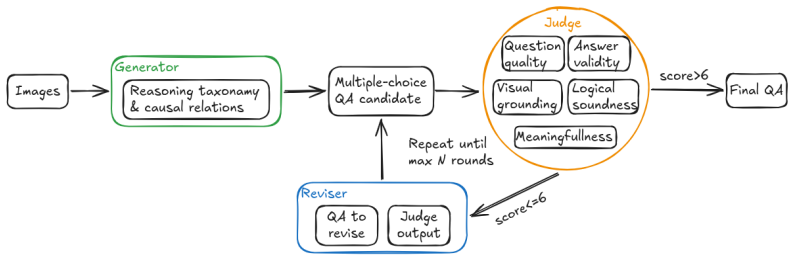
ERQA-Plus supplies 1,766 question-answer instances grounded in 711 images and organized by a structured taxonomy of embodied reasoning categories. The dataset is produced through taxonomy-guided question generation, automatic quality judging, iterative revision, and human assessment. Benchmarking of models such as Qwen3-VL-32B shows that high aggregate accuracy coexists with persistent category-level weaknesses in spatial reasoning, procedural reasoning, event prediction, and intention inference.
What carries the argument
The five-category taxonomy of reasoning types together with the multi-stage generation and validation pipeline that enforces visual grounding and prevents shortcut solutions.
If this is right
- Evaluation of embodied agents can shift from overall accuracy to per-category reliability scores.
- Models can be compared on their ability to handle spatial relations versus intention inference without conflating the two.
- Development efforts can target the specific categories where current models show the largest gaps.
- The same pipeline approach can generate additional diagnostic sets for other embodied tasks.
Where Pith is reading between the lines
- Category-level scores could be used to curate training data that strengthens weak reasoning types.
- The benchmark might be adapted to video sequences to test reasoning that unfolds over time.
- Taxonomies of this form could be applied to diagnose reasoning limits in non-embodied vision-language models.
Load-bearing premise
The pipeline produces questions that require the targeted reasoning category and cannot be solved by visual or linguistic patterns alone.
What would settle it
If replacing the images with unrelated visuals leaves model accuracy unchanged across categories, or if accuracy becomes uniform across all five reasoning types, the claim that the benchmark isolates specific reasoning forms would not hold.
Figures


read the original abstract
Generalist embodied agents require more than object recognition: they must reason about spatial relations, actions, procedures, human intentions, environmental constraints, and commonsense consequences from situated visual observations. Yet existing visual and embodied question answering benchmarks often provide limited control over the reasoning dependencies being tested, making it difficult to distinguish grounded embodied reasoning from shortcut-driven visual or linguistic pattern matching. We present ERQA-Plus, a diagnostic benchmark for reasoning in embodied AI. ERQA-Plus contains 1,766 question-answer instances grounded in 711 robot-centric images and organized according to a structured taxonomy spanning perceptual, action-centric, social-interaction, navigation-environmental, and contextual commonsense reasoning. The dataset is constructed using a multi-stage generation and validation pipeline that combines taxonomy-guided question generation, automatic quality judging, iterative revision, and human assessment to improve visual grounding, answer validity, and reasoning quality. We benchmark representative general-purpose vision-language models and embodied models, including LLaVA-NeXT-8B, Prismatic-7B, MiniCPM-V-4.5-8B, Qwen3-VL, RoboRefer-8B, and RoboBrain2.5-8B. Although the strongest model, Qwen3-VL-32B, achieves 83.4% overall accuracy and 61.4 SBERT score, category-level results reveal persistent weaknesses in spatial reasoning, procedural reasoning, event prediction, and intention inference. ERQA-Plus therefore provides a fine-grained evaluation framework for measuring not only whether embodied agents answer correctly, but also which forms of embodied reasoning they can and cannot perform reliably. The dataset is available https://huggingface.co/datasets/huggingdas/erqa-plus and the project page at https://github.com/LUNAProject22/erqa-plus.
Editorial analysis
A structured set of objections, weighed in public.
Referee Report
Summary. The manuscript presents ERQA-Plus, a diagnostic benchmark for embodied reasoning containing 1,766 QA instances grounded in 711 robot-centric images. Questions are organized by a taxonomy spanning perceptual, action-centric, social-interaction, navigation-environmental, and contextual commonsense reasoning. Construction uses a multi-stage pipeline of taxonomy-guided generation, automatic quality judging, iterative revision, and human assessment. The authors benchmark several VLMs and embodied models (LLaVA-NeXT-8B, Prismatic-7B, MiniCPM-V-4.5-8B, Qwen3-VL, RoboRefer-8B, RoboBrain2.5-8B), reporting that the strongest model reaches 83.4% accuracy and 61.4 SBERT score yet exhibits category-specific weaknesses in spatial reasoning, procedural reasoning, event prediction, and intention inference. The central claim is that ERQA-Plus enables fine-grained diagnosis of which embodied reasoning forms agents can and cannot perform reliably.
Significance. If the pipeline produces questions that isolate the intended reasoning categories without permitting visual or linguistic shortcuts, the benchmark would offer a useful diagnostic tool beyond aggregate accuracy metrics, directly addressing a gap in existing embodied QA datasets. The public release of the dataset on Hugging Face and the GitHub project page supports reproducibility and community use. Differential category performance in the reported results is consistent with the diagnostic goal and provides a concrete starting point for model improvement.
major comments (2)
- [§3] §3 (Pipeline): The multi-stage generation and validation pipeline is described at a high level without quantitative statistics such as inter-annotator agreement, rejection rates per stage, or revision success rates. These metrics are required to substantiate that generated questions test the targeted reasoning categories rather than permitting shortcut solutions based on visual or linguistic patterns.
- [§5] §5 (Evaluation): Category-level accuracy and SBERT scores are reported for multiple models, but no control experiments (e.g., text-only baselines, visual ablation, or pattern-matching probes) are included to demonstrate that performance differences reflect the intended reasoning distinctions rather than dataset artifacts.
minor comments (2)
- [Abstract] Abstract: The SBERT score is reported without stating the reference text or similarity computation details used for this metric.
- [§2] The taxonomy definitions and example questions per category would benefit from an explicit table or figure for clarity.
Simulated Author's Rebuttal
We thank the referee for the constructive feedback and the recommendation for major revision. We address each major comment below and will update the manuscript accordingly.
read point-by-point responses
-
Referee: [§3] §3 (Pipeline): The multi-stage generation and validation pipeline is described at a high level without quantitative statistics such as inter-annotator agreement, rejection rates per stage, or revision success rates. These metrics are required to substantiate that generated questions test the targeted reasoning categories rather than permitting shortcut solutions based on visual or linguistic patterns.
Authors: We agree that the current description in §3 is high-level and that quantitative pipeline statistics would strengthen the claims. In the revised manuscript we will add inter-annotator agreement from the human assessment stage, rejection rates at each pipeline stage, and revision success rates. These metrics will be computed from the existing generation logs and human review records. revision: yes
-
Referee: [§5] §5 (Evaluation): Category-level accuracy and SBERT scores are reported for multiple models, but no control experiments (e.g., text-only baselines, visual ablation, or pattern-matching probes) are included to demonstrate that performance differences reflect the intended reasoning distinctions rather than dataset artifacts.
Authors: We acknowledge that control experiments would provide additional evidence that performance differences arise from the targeted reasoning categories rather than artifacts. We will incorporate text-only baselines and visual-ablation results for the evaluated models in the revised §5. These experiments can be run on the existing dataset splits without new data collection. revision: yes
Circularity Check
No significant circularity; benchmark construction paper
full rationale
The paper describes construction of a diagnostic QA benchmark via a multi-stage pipeline (taxonomy-guided generation, automatic judging, revision, human assessment) and reports model accuracies on it. No equations, derivations, predictions, or first-principles results exist that could reduce to inputs by construction. Model evaluations are standard external benchmarks and do not rely on self-citation chains or fitted parameters renamed as predictions. The central claim (fine-grained evaluation of reasoning categories) is supported by the dataset design and observed differential performance, with no load-bearing step that collapses to self-definition or renaming.
Axiom & Free-Parameter Ledger
Reference graph
Works this paper leans on
-
[1]
M. Ahn, A. Brohan, N. Brown, Y . Chebotar, O. Cortes, B. David, C. Finn, C. Fu, K. Gopalakr- ishnan, K. Hausman, et al. Do as i can, not as i say: Grounding language in robotic affordances. arXiv preprint arXiv:2204.01691, 2022
work page internal anchor Pith review Pith/arXiv arXiv 2022
-
[2]
L. Chen, J. Li, X. Dong, P. Zhang, Y . Zang, Z. Chen, H. Duan, J. Wang, Y . Qiao, D. Lin, et al. Are we on the right way for evaluating large vision-language models? Advances in Neural Information Processing Systems, 37:27056–27087, 2024
2024
-
[3]
C. Chi, Z. Xu, S. Feng, E. Cousineau, Y . Du, B. Burchfiel, R. Tedrake, and S. Song. Diffusion policy: Visuomotor policy learning via action diffusion. The International Journal of Robotics Research, 44(10-11):1684–1704, 2025
2025
-
[4]
A. Dai, A. X. Chang, M. Savva, M. Halber, T. Funkhouser, and M. Nießner. Scannet: Richly-annotated 3d reconstructions of indoor scenes. In Proc. Computer Vision and Pattern Recognition (CVPR), IEEE, 2017
2017
-
[5]
A. Das, S. Datta, G. Gkioxari, S. Lee, D. Parikh, and D. Batra. Embodied question answering. In Proceedings of the IEEE conference on computer vision and pattern recognition, pages 1–10, 2018
2018
-
[6]
A. Das, G. Gkioxari, S. Lee, D. Parikh, and D. Batra. Neural modular control for embodied question answering. In Conference on robot learning, pages 53–62. PMLR, 2018
2018
-
[7]
X. Gao, Q. Gao, R. Gong, K. Lin, G. Thattai, and G. S. Sukhatme. Dialfred: Dialogue- enabled agents for embodied instruction following. IEEE Robotics and Automation Letters, 7(4):10049–10056, 2022
2022
-
[8]
Gemini 3 Pro model card
Google DeepMind. Gemini 3 Pro model card. Technical report, Google DeepMind, December
-
[9]
Model released November 2025
2025
-
[10]
Huang, S
J. Huang, S. Yong, X. Ma, X. Linghu, P. Li, Y . Wang, Q. Li, S.-C. Zhu, B. Jia, and S. Huang. An embodied generalist agent in 3d world. In Proceedings of the International Conference on Machine Learning (ICML), 2024
2024
-
[11]
M. M. Islam, A. Gladstone, R. Islam, and T. Iqbal. Eqa-mx: Embodied question answering using multimodal expression. In The Twelfth International Conference on Learning Representations, 2023
2023
-
[12]
Jiang, Y
K. Jiang, Y . Liu, W. Chen, J. Luo, Z. Chen, L. Pan, G. Li, and L. Lin. Beyond the destination: A novel benchmark for exploration-aware embodied question answering. In Proceedings of the IEEE/CVF International Conference on Computer Vision, pages 9091–9101, 2025
2025
-
[13]
Karamcheti, S
S. Karamcheti, S. Nair, A. Balakrishna, P. Liang, T. Kollar, and D. Sadigh. Prismatic vlms: Inves- tigating the design space of visually-conditioned language models. In International Conference on Machine Learning (ICML), 2024
2024
-
[14]
M. Kim, K. Pertsch, S. Karamcheti, T. Xiao, A. Balakrishna, S. Nair, R. Rafailov, E. Foster, G. Lam, P. Sanketi, Q. Vuong, T. Kollar, B. Burchfiel, R. Tedrake, D. Sadigh, S. Levine, P. Liang, and C. Finn. Openvla: An open-source vision-language-action model. arXiv preprint arXiv:2406.09246, 2024. 10
work page internal anchor Pith review Pith/arXiv arXiv 2024
-
[15]
M. J. Kim, C. Finn, and P. Liang. Fine-tuning vision-language-action models: Optimizing speed and success, 2025
2025
-
[16]
K. Li, Y . Wang, Y . He, Y . Li, Y . Wang, Y . Liu, Z. Wang, J. Xu, G. Chen, P. Luo, et al. Mvbench: A comprehensive multi-modal video understanding benchmark. In Proceedings of the IEEE/CVF Conference on Computer Vision and Pattern Recognition, pages 22195–22206, 2024
2024
-
[17]
H. Lin, S. Chen, J. Liew, D. Y . Chen, Z. Li, G. Shi, J. Feng, and B. Kang. Depth anything 3: Recovering the visual space from any views, 2025
2025
-
[18]
H. Liu, C. Li, Y . Li, B. Li, Y . Zhang, S. Shen, and Y . J. Lee. Llava-next: Improved reasoning, ocr, and world knowledge, January 2024
2024
-
[19]
S. Liu, Z. Zeng, T. Ren, F. Li, H. Zhang, J. Yang, C. Li, J. Yang, H. Su, J. Zhu, et al. Grounding dino: Marrying dino with grounded pre-training for open-set object detection. arXiv preprint arXiv:2303.05499, 2023
work page internal anchor Pith review Pith/arXiv arXiv 2023
-
[20]
Majumdar, A
A. Majumdar, A. Ajay, X. Zhang, P. Putta, S. Yenamandra, M. Henaff, S. Silwal, P. Mcvay, O. Maksymets, S. Arnaud, et al. Openeqa: Embodied question answering in the era of foundation models. In Proceedings of the IEEE/CVF conference on computer vision and pattern recognition, pages 16488–16498, 2024
2024
-
[21]
Hurst, A
OpenAI, :, A. Hurst, A. Lerer, A. P. Goucher, A. Perelman, A. Ramesh, A. Clark, A. Ostrow, A. Welihinda, A. Hayes, A. Radford, A. M ˛ adry, A. Baker-Whitcomb, A. Beutel, A. Borzunov, A. Carney, A. Chow, A. Kirillov, A. Nichol, A. Paino, A. Renzin, A. T. Passos, A. Kirillov, A. Christakis, A. Conneau, A. Kamali, A. Jabri, A. Moyer, A. Tam, A. Crookes, A. T...
2024
-
[22]
N. Ravi, V . Gabeur, Y .-T. Hu, R. Hu, C. Ryali, T. Ma, H. Khedr, R. Rädle, C. Rolland, L. Gustafson, E. Mintun, J. Pan, K. V . Alwala, N. Carion, C.-Y . Wu, R. Girshick, P. Dollár, and C. Feichtenhofer. Sam 2: Segment anything in images and videos, 2024
2024
-
[23]
Reimers and I
N. Reimers and I. Gurevych. Sentence-bert: Sentence embeddings using siamese bert-networks. In Proceedings of the 2019 Conference on Empirical Methods in Natural Language Processing. Association for Computational Linguistics, 11 2019
2019
- [24]
-
[25]
Sermanet, T
P. Sermanet, T. Ding, J. Zhao, F. Xia, D. Dwibedi, K. Gopalakrishnan, C. Chan, G. Dulac- Arnold, S. Maddineni, N. J. Joshi, et al. Robovqa: Multimodal long-horizon reasoning for robotics. In 2024 IEEE International Conference on Robotics and Automation (ICRA), pages 645–652. IEEE, 2024
2024
-
[26]
H. Tan, E. Zhou, Z. Li, Y . Xu, Y . Ji, X. Chen, C. Chi, P. Wang, H. Jia, Y . Ao, M. Cao, S. Chen, Z. Li, M. Liu, Z. Wang, S. Rong, Y . Lyu, Z. Zhao, P. Co, Y . Li, Y . Han, S. Xie, G. Yao, S. Wang, L. Zhang, X. Yang, Y . Jiao, D. Shi, K. Xie, S. Nie, C. Men, Y . Lin, Z. Wang, T. Huang, and S. Zhang. Robobrain 2.5: Depth in sight, time in mind. arXiv prep...
-
[27]
S. Tan, M. Ge, D. Guo, H. Liu, and F. Sun. Knowledge-based embodied question answering. IEEE Transactions on Pattern Analysis and Machine Intelligence, 45(10):11948–11960, 2023
2023
-
[28]
Y . Tang, D. Ding, Y . Rao, Y . Zheng, D. Zhang, L. Zhao, J. Lu, and J. Zhou. Coin: A large-scale dataset for comprehensive instructional video analysis, 2019
2019
-
[29]
G. R. Team, S. Abeyruwan, J. Ainslie, J.-B. Alayrac, M. G. Arenas, T. Armstrong, A. Balakr- ishna, R. Baruch, M. Bauza, M. Blokzijl, S. Bohez, K. Bousmalis, A. Brohan, T. Buschmann, A. Byravan, S. Cabi, K. Caluwaerts, F. Casarini, O. Chang, J. E. Chen, X. Chen, H.-T. L. Chiang, K. Choromanski, D. D’Ambrosio, S. Dasari, T. Davchev, C. Devin, N. D. Palo, T....
2025
-
[30]
O. M. Team, D. Ghosh, H. Walke, K. Pertsch, K. Black, O. Mees, S. Dasari, J. Hejna, T. Kreiman, C. Xu, et al. Octo: An open-source generalist robot policy. arXiv preprint arXiv:2405.12213, 2024. 12
work page internal anchor Pith review Pith/arXiv arXiv 2024
-
[31]
Q. Team. Qwen3 technical report, 2025
2025
- [32]
-
[33]
Y . Wu, Y . Wu, G. Gkioxari, and Y . Tian. Building generalizable agents with a realistic and rich 3d environment. arXiv preprint arXiv:1801.02209, 2018
work page internal anchor Pith review Pith/arXiv arXiv 2018
-
[34]
R. Xu, H. Gao, M. Yu, D. An, S. Chen, C. Wang, L. Guo, X. Liang, and S. Xu. 3d-more: Unified modal-contextual reasoning for embodied question answering. In 2025 IEEE/RSJ International Conference on Intelligent Robots and Systems (IROS), pages 5924–5929. IEEE, 2025
2025
-
[35]
T. Yu, Z. Wang, C. Wang, F. Huang, W. Ma, Z. He, T. Cai, W. Chen, Y . Huang, Y . Zhao, B. Xu, J. Cui, Y . Xu, L. Ruan, L. Zhang, H. Liu, J. Tang, H. Liu, Q. Guo, W. Hu, B. He, J. Zhou, J. Cai, J. Qi, Z. Guo, C. Chen, G. Zeng, Y . Li, G. Cui, N. Ding, X. Han, Y . Yao, Z. Liu, and M. Sun. Minicpm-v 4.5: Cooking efficient mllms via architecture, data, and tr...
2025
-
[36]
X. Yue, Y . Ni, K. Zhang, T. Zheng, R. Liu, G. Zhang, S. Stevens, D. Jiang, W. Ren, Y . Sun, et al. Mmmu: A massive multi-discipline multimodal understanding and reasoning benchmark for expert agi. In Proceedings of the IEEE/CVF conference on computer vision and pattern recognition, pages 9556–9567, 2024
2024
-
[37]
Zheng, R
Y . Zheng, R. Zhang, J. Zhang, Y . Ye, Z. Luo, Z. Feng, and Y . Ma. Llamafactory: Unified efficient fine-tuning of 100+ language models. In Proceedings of the 62nd Annual Meeting of the Association for Computational Linguistics (V olume3: System Demonstrations), Bangkok, Thailand, 2024. Association for Computational Linguistics
2024
-
[38]
A Survey on Vision-Language-Action Models: An Action Tokenization Perspective
Y . Zhong, F. Bai, S. Cai, X. Huang, Z. Chen, X. Zhang, Y . Wang, S. Guo, T. Guan, K. N. Lui, et al. A survey on vision-language-action models: An action tokenization perspective. arXiv preprint arXiv:2507.01925, 2025
work page internal anchor Pith review Pith/arXiv arXiv 2025
-
[39]
E. Zhou, J. An, C. Chi, Y . Han, S. Rong, C. Zhang, P. Wang, Z. Wang, T. Huang, L. Sheng, et al. Roborefer: Towards spatial referring with reasoning in vision-language models for robotics. arXiv preprint arXiv:2506.04308, 2025. 13 A Case studies: QA examples A.1 High-quality QAs generated by the Generator Example 1. Original Example (GPT) Question:What is...
-
[40]
Perceptual_Reasoning
shows the candies inside the clear cup with an empty table, likely representing the initial state before pouring. The ground-truth answer claims the candies are scattered on the table in the final frame, which directly contradicts the visual evidence of the provided sequence. Revised Example (GPT) Question:What is the initial state of the candies before a...
discussion (0)
Sign in with ORCID, Apple, or X to comment. Anyone can read and Pith papers without signing in.