REVIEW 3 major objections 1 minor 77 references
Stellar ages show mergers drove Milky Way evolution until 8 billion years ago, after which metallicity spread narrowed.
Reviewed by Pith at T0; open to challenge. T0 means a machine referee read the full paper against a public rubric. the ladder, T0–T4 →
T0 review · grok-4.3
2026-06-27 00:22 UTC pith:HX4G4RVT
load-bearing objection They add SPInS ages to the TOPoS low-res metallicity sample and report up to three metallicity peaks at fixed age that they tie to halo/thick/thin components and early mergers, but the peaks rest on qualitative patterns only. the 3 major comments →
TOPoS VII. Age-metallicity relation in the Galactic halo and assembly of the Milky Way
The pith
A machine-rendered reading of the paper's core claim, the machinery that carries it, and where it could break.
Core claim
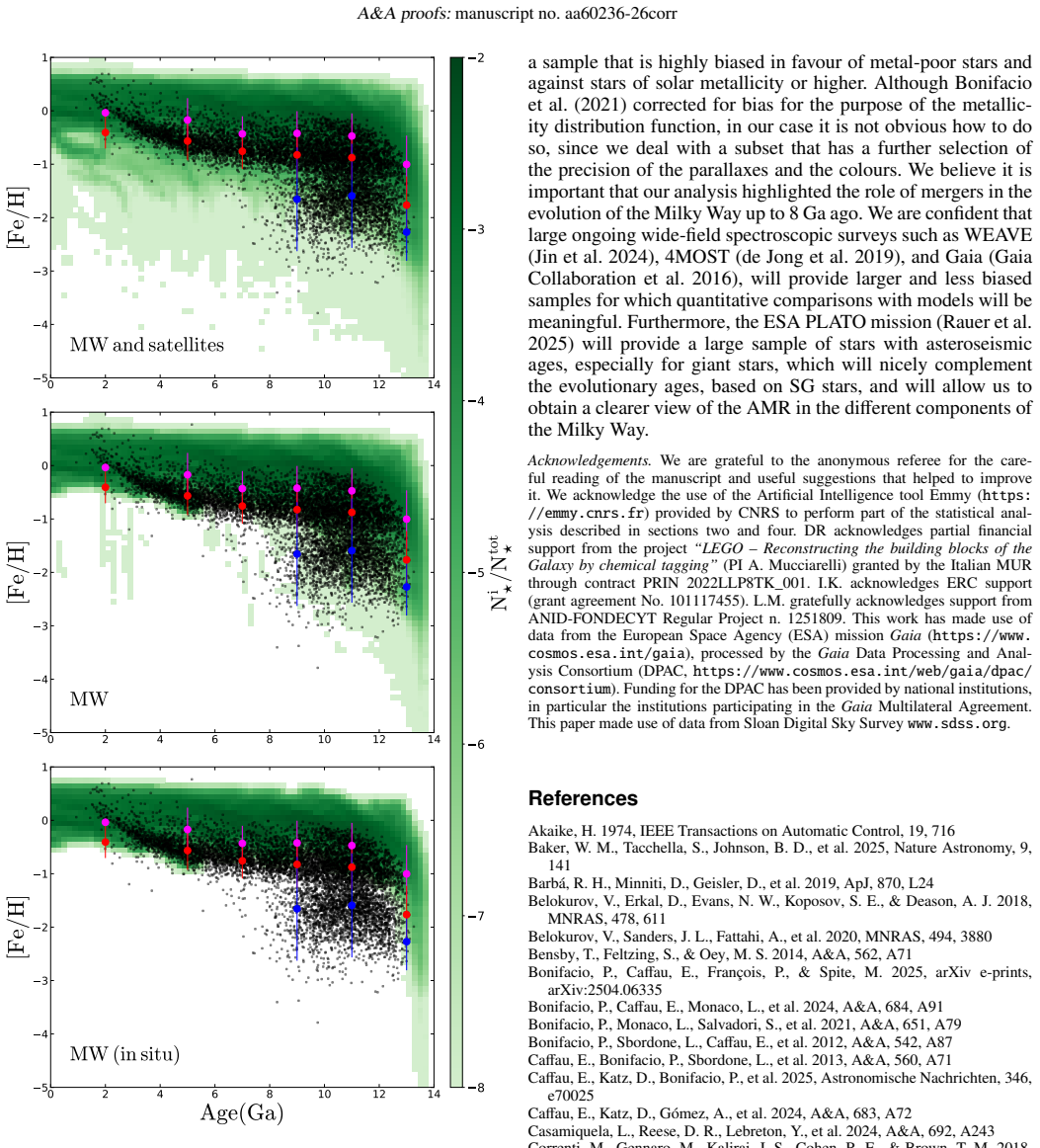
Using Bayesian inference with the SPInS code and BaSTI stellar evolutionary tracks on sub-giant stars that have precise Gaia parallaxes, we obtain ages that reveal a clear increase in metallicity with decreasing age but with considerable scatter. Above 8 Ga, age and metallicity appear uncorrelated. At any given age the metallicity distribution is multi-modal, with up to three distinct peaks that we tentatively identify with the halo, thick-disc and thin-disc populations. Our data demonstrate the important role of mergers in the evolution of the Galaxy up to 8 Ga ago; in more recent times the spread in metallicity drops, and one possibility is that the major merger Gaia-Sausage-Enceladus pert
What carries the argument
Bayesian age estimation via the SPInS code applied to BaSTI evolutionary tracks for sub-giant stars with Gaia parallaxes, which produces the multi-modal metallicity distributions at fixed age that trace distinct Galactic populations.
Load-bearing premise
The up-to-three distinct peaks in metallicity at fixed age can be identified with the halo, thick-disc and thin-disc populations, which rests on the accuracy of the SPInS Bayesian ages and the absence of strong selection biases that would create artificial peaks.
What would settle it
Re-deriving the ages of the same stars with an independent set of stellar tracks or a different age method that eliminates the three metallicity peaks at fixed age or removes the drop in scatter below 8 Ga.
If this is right
- Mergers were a dominant process in Milky Way evolution for the first several billion years.
- The metallicity dispersion narrowed after 8 Ga, consistent with a decline in merger activity following a major event.
- Both chemical evolution models and cosmological simulations of the Local Group align with the observed importance of early mergers.
- Larger samples with well-characterized selection biases are needed to enable quantitative comparison between the observed age-metallicity relations and model predictions.
Where Pith is reading between the lines
- The transition around 8 Ga could be tested by applying the same age-metallicity analysis to stars in other Local Group galaxies to check whether major mergers produce a comparable suppression of later accretion.
- If the multi-modal metallicity peaks at fixed age survive in larger, kinematically unbiased samples, the method could serve as an independent way to tag stellar populations without relying on velocity information.
- Future releases of Gaia data combined with higher-resolution spectroscopy could tighten the timing of the change in merger rate and distinguish between the proposed perturbation effect and other possible causes for the reduced scatter.
Editorial analysis
A structured set of objections, weighed in public.
Referee Report
Summary. The manuscript analyzes the age-metallicity relation in the Galactic halo using Bayesian ages derived with the SPInS code applied to BaSTI evolutionary tracks for sub-giant stars from the TOPoS sample (metallicities from low-resolution SDSS spectra, precise Gaia parallaxes). It reports a general increase of metallicity with decreasing age but with large scatter such that age and metallicity appear uncorrelated above ~8 Ga; at fixed age the metallicity distribution is multi-modal with up to three peaks, which are tentatively identified with the halo, thick-disc and thin-disc populations. The authors interpret the large early scatter as demonstrating the important role of mergers in Milky Way assembly up to 8 Ga ago, with a subsequent drop in metallicity spread possibly linked to the Gaia-Sausage-Enceladus merger.
Significance. If the reported multi-modality at fixed age is shown to trace distinct Galactic components rather than age uncertainties or selection effects, the work would supply qualitative observational support for merger-driven chemical evolution scenarios already present in both chemical-evolution and cosmological simulations of the Local Group. The underlying method (standard Bayesian isochrone fitting to an independent metallicity-plus-parallax dataset) is appropriate and reproducible in principle, but the current presentation remains qualitative and therefore of limited impact until the robustness of the peaks and the treatment of biases are quantified.
major comments (3)
- [Abstract] Abstract: the central interpretive claim that the data 'demonstrate the important role of mergers' up to 8 Ga rests on the multi-modal metallicity peaks at fixed age being real and population-specific; however, the manuscript provides no description of the peak-identification procedure, no statistical significance assessment, and no test of robustness against the reported age uncertainties from SPInS/BaSTI.
- [Abstract] Abstract: the assertion of uncorrelated age and metallicity above 8 Ga and the subsequent drop in spread is presented without reported age-error distributions, sample sizes per age bin, or any correction for possible age- or metallicity-dependent selection biases in the TOPoS sample; the abstract itself notes the need for 'larger, unbiased samples', indicating these issues remain unaddressed and directly affect the claimed trends.
- [Abstract] Abstract: the tentative assignment of the three metallicity peaks to halo/thick-disc/thin-disc populations is load-bearing for the interpretation of separate age-metallicity relations, yet no supporting evidence (e.g., kinematic membership probabilities, spatial distributions, or comparison with literature component definitions) is supplied to justify the identification over alternative explanations such as fitting artifacts.
minor comments (1)
- [Abstract] Abstract: the abbreviation 'Ga' is used for gigayears; adopting the conventional 'Gyr' would remove a minor source of potential confusion for readers.
Simulated Author's Rebuttal
We thank the referee for the constructive and detailed comments. We address each major comment below and indicate planned revisions to improve clarity and robustness.
read point-by-point responses
-
Referee: [Abstract] Abstract: the central interpretive claim that the data 'demonstrate the important role of mergers' up to 8 Ga rests on the multi-modal metallicity peaks at fixed age being real and population-specific; however, the manuscript provides no description of the peak-identification procedure, no statistical significance assessment, and no test of robustness against the reported age uncertainties from SPInS/BaSTI.
Authors: The peaks were identified through visual inspection of metallicity histograms constructed in successive age bins (as displayed in the figures). We agree a formal description is missing and will add an explicit paragraph describing the binning and peak identification process. We will also add a robustness check by resampling ages within the reported SPInS uncertainties and re-inspecting the histograms. A full statistical significance test (e.g., Gaussian mixture modeling) lies outside the qualitative scope of the present work but will be noted as a limitation; the merger interpretation is already qualified as tentative. revision: partial
-
Referee: [Abstract] Abstract: the assertion of uncorrelated age and metallicity above 8 Ga and the subsequent drop in spread is presented without reported age-error distributions, sample sizes per age bin, or any correction for possible age- or metallicity-dependent selection biases in the TOPoS sample; the abstract itself notes the need for 'larger, unbiased samples', indicating these issues remain unaddressed and directly affect the claimed trends.
Authors: We will include the age-error distribution, the number of stars per age bin, and an expanded discussion of possible selection biases inherent to the TOPoS sample in the revised manuscript. The abstract already flags the requirement for larger samples; we will make this limitation more prominent while retaining that the observed scatter and drop in spread are directly visible in the current data. revision: yes
-
Referee: [Abstract] Abstract: the tentative assignment of the three metallicity peaks to halo/thick-disc/thin-disc populations is load-bearing for the interpretation of separate age-metallicity relations, yet no supporting evidence (e.g., kinematic membership probabilities, spatial distributions, or comparison with literature component definitions) is supplied to justify the identification over alternative explanations such as fitting artifacts.
Authors: The assignment rests on the metallicities of the peaks matching the ranges commonly associated with halo, thick-disc and thin-disc stars in the literature. We will add an explicit comparison with those literature ranges and state that kinematic or spatial membership probabilities are not available for this sample. We will also emphasize that fitting artifacts cannot be excluded and that the population labels remain tentative. revision: partial
Circularity Check
No circularity: ages and metallicities derived from independent external models and observations
full rationale
The derivation applies the external SPInS Bayesian code and BaSTI stellar tracks to Gaia parallaxes and SDSS-derived metallicities to obtain ages; the reported age-metallicity scatter, multi-modality at fixed age, and tentative population identifications are direct outputs of this processing. No parameters are fitted to the target relations and then re-predicted, no self-citation chains underpin the central claims, and no definitions reduce the results to their inputs by construction. The paper explicitly notes the need for larger unbiased samples, confirming the analysis remains self-contained against external benchmarks.
Axiom & Free-Parameter Ledger
read the original abstract
One technique for determining stellar ages is to compare the position of a star in the Hertzsprung-Russell diagram to theoretical stellar evolutionary tracks. The sub-giant evolutionary stage is the one that is most sensitive to age and allows the most precise evolutionary age estimates. The TOPoS sample of stars with metallicities derived from low-resolution Sloan Digital Sky Survey spectra contains a large subset of sub-giant stars with precise parallaxes from the Gaia mission, for which evolutionary ages can be determined. Our aim is to use this stellar sample to investigate the age-metallicity relation in the Galactic halo. We use the Bayesian inference code SPInS and theoretical BaSTI stellar evolutionary tracks to determine the ages for TOPoS stars. There is a clear increase in metallicity with decreasing age, albeit with a considerable scatter at any given age. At ages larger than 8 Ga, the scatter is so large that in fact, over this range, age and metallicity appear to be uncorrelated. At any given age, the metallicity distribution is multi-modal, with up to three distinct peaks. These peaks trace three age-metallicity relations that we tentatively identify with the halo, thick-disc, and thin-disc. Our data demonstrate the important role of mergers in the evolution of the Galaxy, up to 8 Ga ago. In more recent times, the spread in metallicity drops. One possibility is that the major merger Gaia-Sausage-Enceladus may have perturbed the galaxies in the Milky Way vicinity in such a way as to decrease the merger rate. Chemical evolution models and cosmological models of the Local Group both support the importance of mergers in the early evolution of the Milky Way. Larger, unbiased samples, or at least with well-understood biases, of stars with accurate ages are required for a quantitative comparison between models and data.
Figures


Reference graph
Works this paper leans on
-
[1]
1974, IEEE Transactions on Automatic Control, 19, 716
Akaike , H. 1974, IEEE Transactions on Automatic Control, 19, 716
1974
-
[2]
M., Tacchella , S., Johnson , B
Baker , W. M., Tacchella , S., Johnson , B. D., et al. 2025, Nature Astronomy, 9, 141
2025
-
[3]
H., Minniti , D., Geisler , D., et al
Barb \'a , R. H., Minniti , D., Geisler , D., et al. 2019, , 870, L24
2019
-
[4]
W., Koposov , S
Belokurov , V., Erkal , D., Evans , N. W., Koposov , S. E., & Deason , A. J. 2018, , 478, 611
2018
-
[5]
L., Fattahi , A., et al
Belokurov , V., Sanders , J. L., Fattahi , A., et al. 2020, , 494, 3880
2020
-
[6]
Bensby , T., Feltzing , S., & Oey , M. S. 2014, , 562, A71
2014
-
[7]
2025, arXiv e-prints, arXiv:2504.06335
Bonifacio , P., Caffau , E., Fran c ois , P., & Spite , M. 2025, arXiv e-prints, arXiv:2504.06335
-
[8]
2024, , 684, A91
Bonifacio , P., Caffau , E., Monaco , L., et al. 2024, , 684, A91
2024
-
[9]
2021, , 651, A79
Bonifacio , P., Monaco , L., Salvadori , S., et al. 2021, , 651, A79
2021
-
[10]
2012, , 542, A87
Bonifacio , P., Sbordone , L., Caffau , E., et al. 2012, , 542, A87
2012
-
[11]
2013, , 560, A71
Caffau , E., Bonifacio , P., Sbordone , L., et al. 2013, , 560, A71
2013
-
[12]
2025, Astronomische Nachrichten, 346, e70025
Caffau , E., Katz , D., Bonifacio , P., et al. 2025, Astronomische Nachrichten, 346, e70025
2025
-
[13]
2024, , 683, A72
Caffau , E., Katz , D., G \'o mez , A., et al. 2024, , 683, A72
2024
-
[14]
R., Lebreton , Y., et al
Casamiquela , L., Reese , D. R., Lebreton , Y., et al. 2024, , 692, A243
2024
-
[15]
S., Cohen , R
Correnti , M., Gennaro , M., Kalirai , J. S., Cohen , R. E., & Brown , T. M. 2018, , 864, 147
2018
-
[16]
2012, Research in Astronomy and Astrophysics, 12, 1197
Cui , X.-Q., Zhao , Y.-H., Chu , Y.-Q., et al. 2012, Research in Astronomy and Astrophysics, 12, 1197
2012
-
[17]
S., Agertz , O., Berbel , A
de Jong , R. S., Agertz , O., Berbel , A. A., et al. 2019, The Messenger, 175, 3
2019
-
[18]
L., Patton , D
Ellison , S. L., Patton , D. R., Simard , L., & McConnachie , A. W. 2008, , 672, L107
2008
-
[19]
K., Sahlholdt , C
Feuillet , D. K., Sahlholdt , C. L., Feltzing , S., & Casagrande , L. 2021, , 508, 1489
2021
-
[20]
2020, , 888, 55
Franchini , M., Morossi , C., Di Marcantonio , P., et al. 2020, , 888, 55
2020
-
[21]
Gaia Collaboration , Prusti , T., de Bruijne , J. H. J., et al. 2016, , 595, A1
2016
-
[22]
J., Brook , C
Gallart , C., Bernard , E. J., Brook , C. B., et al. 2019, Nature Astronomy, 3, 932
2019
-
[23]
I., Bonifacio , P., Caffau , E., et al
Gonz \'a lez Hern \'a ndez , J. I., Bonifacio , P., Caffau , E., et al. 2009, , 505, L13
2009
-
[24]
G., Bragaglia , A., Carretta , E., et al
Gratton , R. G., Bragaglia , A., Carretta , E., et al. 2003, , 408, 529
2003
-
[25]
F., Ji , A
Griffen , B. F., Ji , A. P., Dooley , G. A., et al. 2016, , 818, 10
2016
-
[26]
A., et al
Hammer , F., Wang , J., Mamon , G. A., et al. 2024, , 527, 2718
2024
-
[27]
D., et al
Haywood , M., Di Matteo , P., Lehnert , M. D., et al. 2018, , 863, 113
2018
-
[28]
H., et al
Helmi , A., Babusiaux , C., Koppelman , H. H., et al. 2018, , 563, 85
2018
-
[29]
L., Pietrinferni , A., Cassisi , S., et al
Hidalgo , S. L., Pietrinferni , A., Cassisi , S., et al. 2018, , 856, 125
2018
-
[30]
2014, The Astrophysical Journal, 781, 60
Hirano, S., Hosokawa, T., Yoshida, N., et al. 2014, The Astrophysical Journal, 781, 60
2014
-
[31]
C., Dalton , G
Jin , S., Trager , S. C., Dalton , G. B., et al. 2024, , 530, 2688
2024
-
[32]
2025, , 704, A294
Katz , D., G \'o mez , A., Caffau , E., et al. 2025, , 704, A294
2025
-
[33]
H., Helmi , A., Massari , D., Price-Whelan , A
Koppelman , H. H., Helmi , A., Massari , D., Price-Whelan , A. M., & Starkenburg , T. K. 2019, , 631, L9
2019
-
[34]
2024, , 962, L26
Koutsouridou , I., Salvadori , S., & Sk \'u lad \'o ttir , \'A . 2024, , 962, L26
2024
-
[35]
NEFERTITI: Linking early galaxy formation to the assembly of the Milky Way
Koutsouridou , I., Salvadori , S., Sk \'u lad \'o ttir , \'A ., et al. 2026, arXiv e-prints, arXiv:2605.00990
work page internal anchor Pith review Pith/arXiv arXiv 2026
-
[36]
2023, , 525, 190
Koutsouridou , I., Salvadori , S., Sk \'u lad \'o ttir , \'A ., et al. 2023, , 525, 190
2023
-
[37]
2025, , 699, A32
Koutsouridou , I., Sk \'u lad \'o ttir , \'A ., & Salvadori , S. 2025, , 699, A32
2025
-
[38]
Larson , R. B. 1976, , 176, 31
1976
-
[39]
J., & Montalb \'a n , J
Lebreton , Y., Goupil , M. J., & Montalb \'a n , J. 2014, in EAS Publications Series, Vol. 65, EAS Publications Series, ed. Y. Lebreton , D. Valls-Gabaud , & C. Charbonnel (EDP), 99--176
2014
-
[40]
& Reese , D
Lebreton , Y. & Reese , D. R. 2020, , 642, A88
2020
-
[41]
J., Carollo , C
Lilly , S. J., Carollo , C. M., Pipino , A., Renzini , A., & Peng , Y. 2013, , 772, 119
2013
-
[42]
E., Torres, G., Prsa, A., et al
Mamajek, E. E., Torres, G., Prsa, A., et al. 2015, IAU 2015 Resolution B2 on Recommended Zero Points for the Absolute and Apparent Bolometric Magnitude Scales
2015
-
[43]
2010, , 408, 2115
Mannucci , F., Cresci , G., Maiolino , R., Marconi , A., & Gnerucci , A. 2010, , 408, 2115
2010
-
[44]
2026, arXiv e-prints, arXiv:2601.18896
Massari , D., Zerbinati , C., Fanelli , C., et al. 2026, arXiv e-prints, arXiv:2601.18896
-
[45]
G., Alonso , M
Michel-Dansac , L., Lambas , D. G., Alonso , M. S., & Tissera , P. 2008, , 386, L82
2008
-
[46]
Chemical decoding of kinematic substructures in the Galactic halo
Mori , A., Di Matteo , P., Salvadori , S., et al. 2025, arXiv e-prints, arXiv:2509.13408
work page internal anchor Pith review Pith/arXiv arXiv 2025
-
[47]
2017, , 605, A46
Mucciarelli , A., Bellazzini , M., Ibata , R., et al. 2017, , 605, A46
2017
-
[48]
2026, , 705, A134
Mucciarelli , A., Bonifacio , P., & Lardo , C. 2026, , 705, A134
2026
-
[49]
C., Vasiliev , E., Iorio , G., Evans , N
Myeong , G. C., Vasiliev , E., Iorio , G., Evans , N. W., & Belokurov , V. 2019, , 488, 1235
2019
-
[50]
2011, Journal of Machine Learning Research, 12, 2825
Pedregosa, F., Varoquaux, G., Gramfort, A., et al. 2011, Journal of Machine Learning Research, 12, 2825
2011
-
[51]
2021, , 908, 102
Pietrinferni , A., Hidalgo , S., Cassisi , S., et al. 2021, , 908, 102
2021
-
[52]
2020, , 641, A6
Planck Collaboration , Aghanim , N., Akrami , Y., et al. 2020, , 641, A6
2020
-
[53]
W., Beers , T
Preston , G. W., Beers , T. C., & Shectman , S. A. 1994, , 108, 538
1994
-
[54]
Preston , G. W. & Sneden , C. 2000, , 120, 1014
2000
-
[55]
2025, Experimental Astronomy, 59, 26
Rauer , H., Aerts , C., Cabrera , J., et al. 2025, Experimental Astronomy, 59, 26
2025
-
[56]
Reese , D. R. & Lebreton , Y. 2020, SPInS: Stellar Parameters INferred Systematically , Astrophysics Source Code Library, record ascl:2009.006
2020
-
[57]
2015, , 446, 4220
Romano , D., Bellazzini , M., Starkenburg , E., & Leaman , R. 2015, , 446, 4220
2015
-
[58]
& Starkenburg , E
Romano , D. & Starkenburg , E. 2013, , 434, 471
2013
-
[59]
2024, , 691, A284
Rossi , M., Romano , D., Mucciarelli , A., et al. 2024, , 691, A284
2024
-
[60]
2021, , 503, 6026
Rossi , M., Salvadori , S., & Sk \'u lad \'o ttir , \'A . 2021, , 503, 6026
2021
-
[61]
2024, , 974, L35
Rusta , E., Salvadori , S., Gelli , V., Koutsouridou , I., & Marconi , A. 2024, , 974, L35
2024
-
[62]
1993, , 414, 580
Salaris , M., Chieffi , A., & Straniero , O. 1993, , 414, 580
1993
-
[63]
2010, , 401, L5
Salvadori , S., Ferrara , A., Schneider , R., Scannapieco , E., & Kawata , D. 2010, , 401, L5
2010
-
[64]
2015, , 454, 1320
Salvadori , S., Sk \'u lad \'o ttir , \'A ., & Tolstoy , E. 2015, , 454, 1320
2015
-
[65]
2014, , 437, L26
Salvadori , S., Tolstoy , E., Ferrara , A., & Zaroubi , S. 2014, , 437, L26
2014
-
[66]
1978, Annals of Statistics, 6, 461
Schwarz , G. 1978, Annals of Statistics, 6, 461
1978
-
[67]
2019, , 623, A60
Spitoni , E., Silva Aguirre , V., Matteucci , F., Calura , F., & Grisoni , V. 2019, , 623, A60
2019
-
[68]
2021, , 647, A73
Spitoni , E., Verma , K., Silva Aguirre , V., et al. 2021, , 647, A73
2021
-
[69]
G., & Camisassa , M
Torres , S., Garc \' a-Berro , E., Althaus , L. G., & Camisassa , M. E. 2015, , 581, A90
2015
-
[70]
A., Brogaard , K., Leaman , R., & Casagrande , L
VandenBerg , D. A., Brogaard , K., Leaman , R., & Casagrande , L. 2013, , 775, 134
2013
-
[71]
2023, , 526, 2620
Vanni , I., Salvadori , S., Sk \'u lad \'o ttir , \'A ., Rossi , M., & Koutsouridou , I. 2023, , 526, 2620
2023
-
[72]
& Baumgardt , H
Vasiliev , E. & Baumgardt , H. 2021, , 505, 5978
2021
-
[73]
2019, , 882, 174
Villanova , S., Monaco , L., Geisler , D., et al. 2019, , 882, 174
2019
-
[74]
2024, , 527, 7144
Wang , J., Hammer , F., Yang , Y., et al. 2024, , 527, 7144
2024
-
[75]
2019, , 482, 4454
Wang , L., De Lucia , G., Fontanot , F., & Hirschmann , M. 2019, , 482, 4454
2019
-
[76]
2024, , 691, A363
Yang , Y., Caffau , E., Bonifacio , P., et al. 2024, , 691, A363
2024
-
[77]
G., Adelman , J., Anderson , Jr., J
York , D. G., Adelman , J., Anderson , Jr., J. E., et al. 2000, , 120, 1579
2000
discussion (0)
Sign in with ORCID, Apple, or X to comment. Anyone can read and Pith papers without signing in.