REVIEW 3 major objections 3 minor 49 references
GSPan models pansharpening residuals as continuous 2D Gaussian primitives to enable rendering at any scale from one trained model.
Reviewed by Pith at T0; open to challenge. T0 means a machine referee read the full paper against a public rubric. the ladder, T0–T4 →
GSPan introduces continuous 2D Gaussian primitives for band-wise residuals in pansharpening to support arbitrary-scale fusion without retraining.
T0 review reviewed 2026-06-27 challenge →
load-bearing objection GSPan swaps fixed-grid prediction for 2D Gaussian primitives on pansharpening residuals to support arbitrary scales, but the stress-test worry about missing high-frequency content looks like the load-bearing assumption. the 3 major comments →
GSPan: A Continuous Gaussian Primitive Representation for Arbitrary-Scale Pansharpening
The pith
A machine-rendered reading of the paper's core claim, the machinery that carries it, and where it could break.
The reading
Core claim
GSPan estimates a collection of 2D Gaussian primitives that encode band-wise residual details from PAN and MS inputs via a Dual-Stream Hierarchical Interaction architecture containing a Spatial-Spectral Interactive Attention module. The primitives are rendered by Gaussian splatting to produce a continuous residual detail field that is injected into the upsampled MS image. This continuous representation permits direct rendering of the fused multispectral image on arbitrary target grids and supports Scale-Decoupled Asymmetric Inference that reduces computation for large scenes while preserving fusion quality.
What carries the argument
2D Gaussian primitives that represent band-wise residual details, estimated by the DSHI network with SSIA module and rendered via Gaussian splatting to form the residual field.
Load-bearing premise
A finite collection of 2D Gaussian primitives estimated from the input observations can faithfully encode all necessary high-frequency residual information without introducing artifacts or losing detail when rendered at arbitrary scales.
What would settle it
Visible blurring, ringing, or loss of spatial detail when the same trained model renders outputs at scales differing substantially from the training resolution on the WorldView-3-4K dataset would falsify the arbitrary-scale claim.
If this is right
- A single trained model can produce fused images at any desired output resolution without retraining.
- Primitives can be estimated at reduced resolution and rendered at target resolution to accelerate inference on large scenes.
- The method reports state-of-the-art quantitative and qualitative results on QuickBird, GaoFen-2, WorldView-3, and WorldView-3-4K benchmarks.
- No separate scale-specific models or retraining steps are required for different output resolutions.
Where Pith is reading between the lines
- The continuous primitive representation could extend to other remote-sensing fusion tasks that require flexible output resolutions.
- Decoupling estimation from rendering may reduce memory demands when processing very large satellite scenes.
- The same primitives might support on-demand multi-resolution outputs in interactive analysis tools without additional computation.
Editorial analysis
A structured set of objections, weighed in public.
Referee Report
Summary. The paper proposes GSPan, which represents band-wise residual details for pansharpening as a set of continuous, learnable 2D Gaussian primitives (position, covariance, opacity, color per band) estimated from PAN and LRMS inputs by a Dual-Stream Hierarchical Interaction (DSHI) network containing a Spatial-Spectral Interactive Attention (SSIA) module. The primitives are rendered by splatting to produce a residual detail field that is added to the bicubically upsampled MS image; this continuous representation is claimed to support arbitrary-scale rendering without retraining and to enable Scale-Decoupled Asymmetric Inference (SDAI) that estimates primitives at reduced resolution before high-resolution rendering. Experiments on QuickBird, GaoFen-2, WorldView-3 and WorldView-3-4K report state-of-the-art quantitative results together with improved inference speed under SDAI.
Significance. A working continuous Gaussian-primitive representation would constitute a genuine departure from fixed-grid regression in pansharpening and could enable genuinely scale-agnostic fusion pipelines plus efficient large-scene processing. The SDAI decoupling of estimation and rendering resolution is a practical engineering contribution. Realization of these benefits, however, hinges on whether the finite set of learned Gaussians can faithfully encode high-frequency residuals across unseen target grids; the significance is therefore conditional on stronger empirical and analytical support for that claim.
major comments (3)
- [§3] §3 (Gaussian primitive estimation and rendering): the central claim that a finite collection of 2D Gaussians estimated at training resolution can encode all high-frequency residual content without loss or artifacts on arbitrary target grids is load-bearing yet unsupported by any frequency-domain analysis, anti-aliasing mechanism, or explicit covariance scaling rule; the rendering equation therefore risks introducing blurring or ringing precisely where the arbitrary-scale and SDAI claims are asserted.
- [Experiments] Experiments section (quantitative tables and ablations): no error bars, no explicit train/validation/test splits, and no ablation on the number of primitives or on scale factors outside the training distribution are reported; without these it is impossible to determine whether reported gains over baselines are attributable to the Gaussian representation or to other architectural choices.
- [§4] §4 (SDAI strategy): the claim that primitives estimated at reduced resolution can be rendered at full target resolution without quality degradation is asserted but not accompanied by a controlled study that isolates the effect of the resolution decoupling from the choice of primitive count or network capacity.
minor comments (3)
- [Abstract] Abstract: quantitative SOTA numbers and the exact baselines used are omitted, making the performance claim difficult to contextualize.
- [§3] Notation: the precise parameterization of each Gaussian primitive (mean, covariance matrix, opacity, per-band color) and the exact form of the splatting renderer should be stated with equations at the first appearance in §3.
- Figure captions: several figures lack scale bars or explicit indication of the target rendering resolution, complicating visual assessment of arbitrary-scale behavior.
Simulated Author's Rebuttal
We are grateful for the referee's insightful comments, which have helped us identify areas for improvement. We address each major comment below, indicating the revisions we plan to make to the manuscript.
read point-by-point responses
-
Referee: [§3] §3 (Gaussian primitive estimation and rendering): the central claim that a finite collection of 2D Gaussians estimated at training resolution can encode all high-frequency residual content without loss or artifacts on arbitrary target grids is load-bearing yet unsupported by any frequency-domain analysis, anti-aliasing mechanism, or explicit covariance scaling rule; the rendering equation therefore risks introducing blurring or ringing precisely where the arbitrary-scale and SDAI claims are asserted.
Authors: We thank the referee for highlighting this important aspect. While the paper emphasizes empirical results, we agree that additional analysis would strengthen the claims. In the revised version, we will add a section discussing the continuous nature of the Gaussian primitives and how the splatting process inherently supports arbitrary scales through the covariance parameters. We will also provide a brief analysis of potential artifacts and why they are mitigated in practice based on the learned opacities and positions. However, a full frequency-domain study may require further theoretical work beyond the scope of this revision. revision: partial
-
Referee: [Experiments] Experiments section (quantitative tables and ablations): no error bars, no explicit train/validation/test splits, and no ablation on the number of primitives or on scale factors outside the training distribution are reported; without these it is impossible to determine whether reported gains over baselines are attributable to the Gaussian representation or to other architectural choices.
Authors: We appreciate this feedback on experimental rigor. In the revised manuscript, we will include error bars computed over multiple training runs and explicitly state the train/validation/test splits for each dataset. We will also add an ablation study varying the number of Gaussian primitives to show its impact on performance. For scale factors outside the training distribution, this is a good point; our experiments include various scales but we will attempt to include additional results on unseen scales to demonstrate generalization. revision: partial
-
Referee: [§4] §4 (SDAI strategy): the claim that primitives estimated at reduced resolution can be rendered at full target resolution without quality degradation is asserted but not accompanied by a controlled study that isolates the effect of the resolution decoupling from the choice of primitive count or network capacity.
Authors: We agree that a more controlled study would better isolate the SDAI benefits. In the revision, we will add a controlled experiment where we fix the number of primitives and network capacity while varying the estimation resolution, comparing to full-resolution estimation, to demonstrate that the quality is maintained due to the continuous representation. revision: yes
Circularity Check
No significant circularity; derivation is self-contained
full rationale
The paper introduces a neural architecture (DSHI+SSIA) that learns parameters of 2D Gaussian primitives from PAN+MS inputs; these primitives are then rendered by standard splatting to produce a residual field added to an upsampled MS image. This is a standard learned representation whose parameters are optimized against reconstruction loss on training data, not defined in terms of the output metric or target scale. Arbitrary-scale rendering follows directly from the continuous splatting formulation rather than being presupposed. No self-citation chains, fitted-input-as-prediction, or ansatz smuggling appear in the provided description; empirical results on held-out datasets constitute independent evaluation.
Axiom & Free-Parameter Ledger
Cite this review
Pith. "Pith review of GSPan: A Continuous Gaussian Primitive Representation for Arbitrary-Scale Pansharpening." pith.science (2026). https://pith.science/paper/4YKOSV4U
@misc{pith2026260617722,
  author       = {Pith},
  title        = {Pith review of: GSPan: A Continuous Gaussian Primitive Representation for Arbitrary-Scale Pansharpening},
  year         = {2026},
  howpublished = {\url{https://pith.science/paper/4YKOSV4U}},
  note         = {Machine review of arXiv:2606.17722}
}
read the original abstract
Pansharpening aims to generate high-resolution multispectral (HRMS) images by fusing low-resolution multispectral (LRMS) and panchromatic (PAN) observations. Most existing deep learning methods treat pansharpening as fixed-grid prediction, which limits scale adaptation. To address this, we propose GSPan, a framework that introduces 2D Gaussian Splatting (GS) into pansharpening. Instead of directly predicting pixels, GSPan represents band-wise residual details as continuous and learnable 2D Gaussian primitives. We design a Dual-Stream Hierarchical Interaction (DSHI) architecture with a Spatial-Spectral Interactive Attention (SSIA) module to estimate these primitives from complementary PAN and MS observations. The predicted primitives are rendered as a residual detail field and injected into the upsampled MS image. This continuous representation allows GSPan to render fused images on arbitrary target sampling grids without scale-specific retraining. It further enables a Scale-Decoupled Asymmetric Inference (SDAI) strategy, which estimates primitives at a reduced resolution and renders the fused image at the target resolution for efficient large-scene pansharpening. Experiments on QuickBird, GaoFen-2, WorldView-3, and WorldView-3-4K datasets show that GSPan delivers state-of-the-art fusion performance. Moreover, SDAI markedly accelerates inference, achieving a favorable trade-off between computational efficiency and fusion quality. Our results demonstrate the potential of continuous Gaussian residual representations as a flexible and scale-decoupled alternative to fixed-grid prediction.
Figures


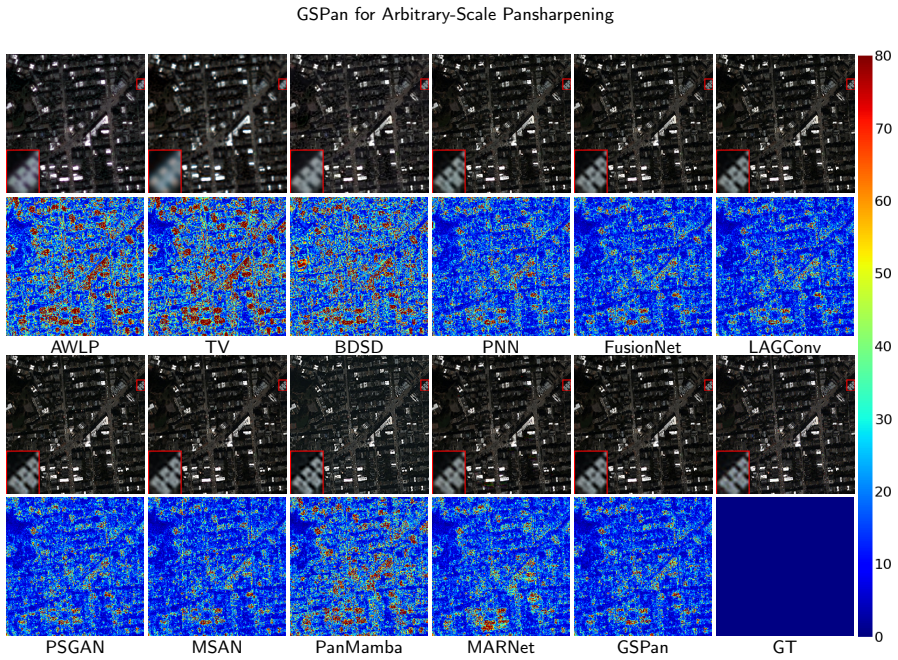


Reference graph
Works this paper leans on
-
[1]
Vivone, M
G. Vivone, M. Dalla Mura, A. Garzelli, R. Restaino, G. Scarpa, M. O. Ulfarsson, L. Alparone, J. Chanussot, A new benchmark based on recent advances in multispectral pansharpening: Revisiting pansharpening with classical and emerging pansharpening methods, IEEEGeoscienceandRemoteSensingMagazine9(1)(2020)53–81
2020
-
[2]
J. Li, D. Hong, L. Gao, J. Yao, K. Zheng, B. Zhang, J. Chanussot, Deep learning in multimodal remote sensing data fusion: A compre- hensive review, International Journal of Applied Earth Observation and Geoinformation 112 (2022) 102926
2022
-
[3]
Zhang, H
H. Zhang, H. Xu, X. Tian, J. Jiang, J. Ma, Image fusion meets deep learning: A survey and perspective, Information Fusion 76 (2021) 323–336
2021
-
[4]
Vivone, L
G. Vivone, L. Alparone, J. Chanussot, M. Dalla Mura, A. Garzelli, G. A. Licciardi, R. Restaino, L. Wald, A critical comparison among pansharpening algorithms, IEEE Transactions on Geoscience and Remote Sensing 53 (5) (2015) 2565–2586
2015
-
[5]
G. Masi, D. Cozzolino, L. Verdoliva, G. Scarpa, Pansharpening by convolutional neural networks, Remote Sensing 8 (7) (2016) 594
2016
-
[6]
J. Yang, X. Fu, Y. Hu, Y. Huang, X. Ding, J. Paisley, Pannet: A deep networkarchitectureforpan-sharpening,in:ProceedingsoftheIEEE international conference on computer vision, 2017, pp. 5449–5457
2017
-
[7]
L.-J. Deng, G. Vivone, C. Jin, J. Chanussot, Detail injection-based deep convolutional neural networks for pansharpening, IEEE Trans- actionsonGeoscienceandRemoteSensing59(8)(2020)6995–7010
2020
-
[8]
Q. Liu, H. Zhou, Q. Xu, X. Liu, Y. Wang, Psgan: A generative adversarial network for remote sensing image pan-sharpening, IEEE Transactions on Geoscience and Remote Sensing 59 (12) (2020) 10227–10242
2020
-
[9]
J. Ma, W. Yu, C. Chen, P. Liang, X. Guo, J. Jiang, Pan-gan: An un- supervised pan-sharpening method for remote sensing image fusion, Information Fusion 62 (2020) 110–120
2020
-
[10]
H.Zhou,Q.Liu,Y.Wang,Panformer:Atransformerbasedmodelfor pan-sharpening, in: 2022 IEEE international conference on multime- dia and expo (ICME), IEEE, 2022, pp. 1–6
2022
-
[11]
H. Lu, Y. Yang, S. Huang, R. Liu, H. Guo, Msan: Multiscale self- attentionnetworkforpansharpening,PatternRecognition162(2025) 111441
2025
-
[12]
Q. Meng, W. Shi, S. Li, L. Zhang, Pandiff: A novel pansharpen- ing method based on denoising diffusion probabilistic model, IEEE Transactions on Geoscience and Remote Sensing 61 (2023) 1–17
2023
-
[13]
X. He, K. Cao, J. Zhang, K. Yan, Y. Wang, R. Li, C. Xie, D. Hong, M. Zhou, Pan-mamba: Effective pan-sharpening with state space model, Information Fusion 115 (2025) 102779
2025
-
[14]
L. He, J. Zhu, J. Li, A. Plaza, J. Chanussot, Z. Yu, Cnn-based hyper- spectral pansharpening with arbitrary resolution, IEEE Transactions on Geoscience and Remote Sensing 60 (2022) 1–21
2022
-
[15]
L. He, Z. Fang, J. Li, H. Ye, A. Plaza, Arbitrary-resolution hy- perspectral pansharpening neural operators, IEEE Transactions on Geoscience and Remote Sensing 63 (2025) 1–19
2025
-
[16]
T. Wang, Z. Yan, J. Li, X. Zhao, C. Wang, M. Ng, Hyperspectral andmultispectralimagefusionwitharbitraryresolutionthroughself- supervisedrepresentations,InternationalJournalofComputerVision 133 (11) (2025) 7515–7535
2025
-
[17]
Wang,Learningcontinuous imagerepresentation with local implicit image function, in: Proceedings of the IEEE/CVF conference on computer vision and pattern recognition, 2021, pp
Y.Chen, S.Liu,X. Wang,Learningcontinuous imagerepresentation with local implicit image function, in: Proceedings of the IEEE/CVF conference on computer vision and pattern recognition, 2021, pp. 8628–8638
2021
-
[18]
J. Cao, Q. Wang, Y. Xian, Y. Li, B. Ni, Z. Pi, K. Zhang, Y. Zhang, R. Timofte, L. Van Gool, Ciaosr: Continuous implicit attention- in-attention network for arbitrary-scale image super-resolution, in: Proceedings of the IEEE/CVF Conference on Computer Vision and Pattern Recognition, 2023, pp. 1796–1807
2023
-
[19]
J. Lee, K. H. Jin, Local texture estimator for implicit representation function, in: Proceedings of the IEEE/CVF conference on computer vision and pattern recognition, 2022, pp. 1929–1938
2022
-
[20]
Liang, Z
Y.-J. Liang, Z. Cao, S. Deng, H.-X. Dou, L.-J. Deng, Fourier- enhanced implicit neural fusion network for multispectral and hyper- spectral image fusion, Advances in Neural Information Processing Systems 37 (2024) 63441–63465
2024
-
[21]
Kerbl, G
B. Kerbl, G. Kopanas, T. Leimkühler, G. Drettakis, 3d gaussian splattingforreal-timeradiancefieldrendering,ACMTransactionson Graphics 42 (4) (2023)
2023
-
[22]
G. Chen, W. Wang, A survey on 3d gaussian splatting, ACM Com- puting Surveys 58 (12) (2026)
2026
-
[23]
D. Chen, L. Chen, Z. Zhang, L. Zhang, Generalized and efficient 2d gaussiansplattingforarbitrary-scalesuper-resolution,in:Proceedings of the IEEE/CVF International Conference on Computer Vision, 2025, pp. 26435–26445
2025
-
[24]
Scarpa, S
G. Scarpa, S. Vitale, D. Cozzolino, Target-adaptive cnn-based pan- sharpening, IEEE Transactions on Geoscience and Remote Sensing 56 (9) (2018) 5443–5457
2018
-
[25]
X.Liu,Q.Liu,Y.Wang,Remotesensingimagefusionbasedontwo- stream fusion network, Information Fusion 55 (2020) 1–15
2020
-
[26]
Jin, L.-J
C. Jin, L.-J. Deng, T.-Z. Huang, G. Vivone, Laplacian pyramid net- works:Anewapproachformultispectralpansharpening,Information Fusion 78 (2022) 158–170. F. Li:Preprint submitted to Elsevier Page 15 of 16 GSPan for Arbitrary-Scale Pansharpening
2022
-
[27]
I.Pereira-Sánchez,E.Sans,J.Navarro,J.Duran,Multi-headattention residual unfolded network for model-based pansharpening, Interna- tional Journal of Computer Vision 134 (2) (2026) 55
2026
-
[28]
Y. Chen, Z. Wan, Z. Chen, M. Wei, Cslp: A novel pansharpening method based on compressed sensing and l-pnn, Information Fusion 118 (2025) 103002
2025
-
[29]
Zhang, Z
Y.Yan,Y.Wang,W.Tu,J.Wang,B.Cai,Q.Zhuang,X.Zuo,Y.Chen, H. Zhang, Z. Shao, S3mamba: Pan-sharpening via spatial–spectral synergistic state space model, IEEE Journal of Selected Topics in Applied Earth Observations and Remote Sensing 19 (2026) 12820– 12834
2026
-
[30]
X. Rui, X. Cao, L. Pang, Z. Zhu, Z. Yue, D. Meng, Unsupervised hy- perspectralpansharpeningvialow-rankdiffusionmodel,Information Fusion 107 (2024) 102325
2024
-
[31]
Cao, L.-J
Q. Cao, L.-J. Deng, W. Wang, J. Hou, G. Vivone, Zero-shot semi- supervised learning for pansharpening, Information Fusion 101 (2024) 102001
2024
-
[32]
H. Wang, H. Zhang, X. Tian, J. Ma, Zero-sharpen: A universal pansharpening method across satellites for reducing scale-variance gap via zero-shot variation, Information Fusion 101 (2024) 102003
2024
-
[33]
K. Shen, X. Yang, S. Lolli, G. Vivone, A continual learning-guided trainingframeworkforpansharpening,ISPRSJournalofPhotogram- metry and Remote Sensing 196 (2023) 45–57
2023
-
[34]
K. Shen, X. Yang, Z. Li, J. Jiang, F. Jiang, H. Ren, Y. Li, Docsnet: a dual-outputandcross-scalestrategyforpan-sharpening,International Journal of Remote Sensing 43 (5) (2022) 1609–1629
2022
-
[35]
Z. Yang, S. Yin, J. Liang, L.-J. Deng, G-zap: A generalizable zero- shot framework for arbitrary-scale pansharpening, arXiv preprint arXiv:2603.14412 (2026)
work page internal anchor Pith review arXiv 2026
-
[36]
Zhang, X
X. Zhang, X. Ge, T. Xu, D. He, Y. Wang, H. Qin, G. Lu, J. Geng, J. Zhang, Gaussianimage: 1000 fps image representation and com- pression by 2d gaussian splatting, in: European Conference on Com- puter Vision, Springer, 2024, pp. 327–345
2024
-
[37]
L. Peng, A. Wu, W. Li, P. Xia, X. Dai, X. Zhang, X. Di, H. Sun, R. Pei, Y. Wang, et al., Pixel to gaussian: Ultra-fast continu- ous super-resolution with 2d gaussian modeling, arXiv preprint arXiv:2503.06617 (2025)
work page Pith review arXiv 2025
-
[38]
J. Hu, B. Xia, B. Chen, W. Yang, L. Zhang, Gaussiansr: High fi- delity2dgaussiansplattingforarbitrary-scaleimagesuper-resolution, in: Proceedings of the AAAI Conference on Artificial Intelligence, Vol. 39, 2025, pp. 3554–3562
2025
-
[39]
10012–10022
Z.Liu,Y.Lin,Y.Cao,H.Hu,Y.Wei,Z.Zhang,S.Lin,B.Guo,Swin transformer: Hierarchical vision transformer using shifted windows, in: Proceedings of the IEEE/CVF international conference on com- puter vision, 2021, pp. 10012–10022
2021
-
[40]
L.-J. Deng, G. Vivone, M.E. Paoletti, G. Scarpa, J. He, Y. Zhang, J. Chanussot, A. Plaza, Machine learning in pansharpening: A bench- mark, from shallow to deep networks, IEEE Geoscience and Remote Sensing Magazine 10 (3) (2022) 279–315
2022
-
[41]
L. Wald, T. Ranchin, M. Mangolini, Fusion of satellite images of differentspatialresolutions:Assessingthequalityofresultingimages, Photogrammetricengineeringandremotesensing63(6)(1997)691– 699
1997
-
[42]
L.Alparone,S.Baronti,A.Garzelli,F.Nencini,Aglobalqualitymea- surement of pan-sharpened multispectral imagery, IEEE Geoscience and Remote Sensing Letters 1 (4) (2004) 313–317
2004
-
[43]
Alparone, L
L. Alparone, L. Wald, J. Chanussot, C. Thomas, P. Gamba, L. M. Bruce, Comparison of pansharpening algorithms: Outcome of the 2006grs-sdata-fusioncontest,IEEETransactionsonGeoscienceand Remote Sensing 45 (10) (2007) 3012–3021
2007
-
[44]
Garzelli, F
A. Garzelli, F. Nencini, Hypercomplex quality assessment of multi/hyperspectral images, IEEE Geoscience and Remote Sensing Letters 6 (4) (2009) 662–665
2009
-
[45]
Arienzo, G
A. Arienzo, G. Vivone, A. Garzelli, L. Alparone, J. Chanussot, Full-resolutionqualityassessmentofpansharpening:Theoreticaland hands-on approaches, IEEE Geoscience and Remote Sensing Maga- zine 10 (3) (2022) 168–201
2022
-
[46]
Garzelli, F
A. Garzelli, F. Nencini, L. Capobianco, Optimal mmse pan sharpen- ing of very high resolution multispectral images, IEEE Transactions on Geoscience and Remote Sensing 46 (1) (2007) 228–236
2007
-
[47]
Otazu, M
X. Otazu, M. González-Audícana, O. Fors, J. Núñez, Introduction of sensor spectral response into image fusion methods. application to wavelet-based methods, IEEE Transactions on Geoscience and Remote Sensing 43 (10) (2005) 2376–2385
2005
-
[48]
Palsson, J
F. Palsson, J. R. Sveinsson, M. O. Ulfarsson, A new pansharpening algorithm based on total variation, IEEE Geoscience and Remote Sensing Letters 11 (1) (2013) 318–322
2013
-
[49]
Jin, T.-J
Z.-R. Jin, T.-J. Zhang, T.-X. Jiang, G. Vivone, L.-J. Deng, Lagconv: Local-context adaptive convolution kernels with global harmonic bias for pansharpening, in: Proceedings of the AAAI conference on artificial intelligence, Vol. 36, 2022, pp. 1113–1121. F. Li:Preprint submitted to Elsevier Page 16 of 16
2022
This paper was first reviewed by grok-4.3 on June 27, 2026.
discussion (0)
Sign in with ORCID, Apple, or X to comment. Anyone can read and Pith papers without signing in.