Mass Probe of Tetrahedral Symmetry in Atomic Nuclei
Pith reviewed 2026-06-26 22:20 UTC · model grok-4.3
The pith
The peak in triple binding energy difference at N=40 for zirconium isotopes appears only when tetrahedral nuclear deformation is allowed in mean-field calculations.
A machine-rendered reading of the paper's core claim, the machinery that carries it, and where it could break.
Core claim
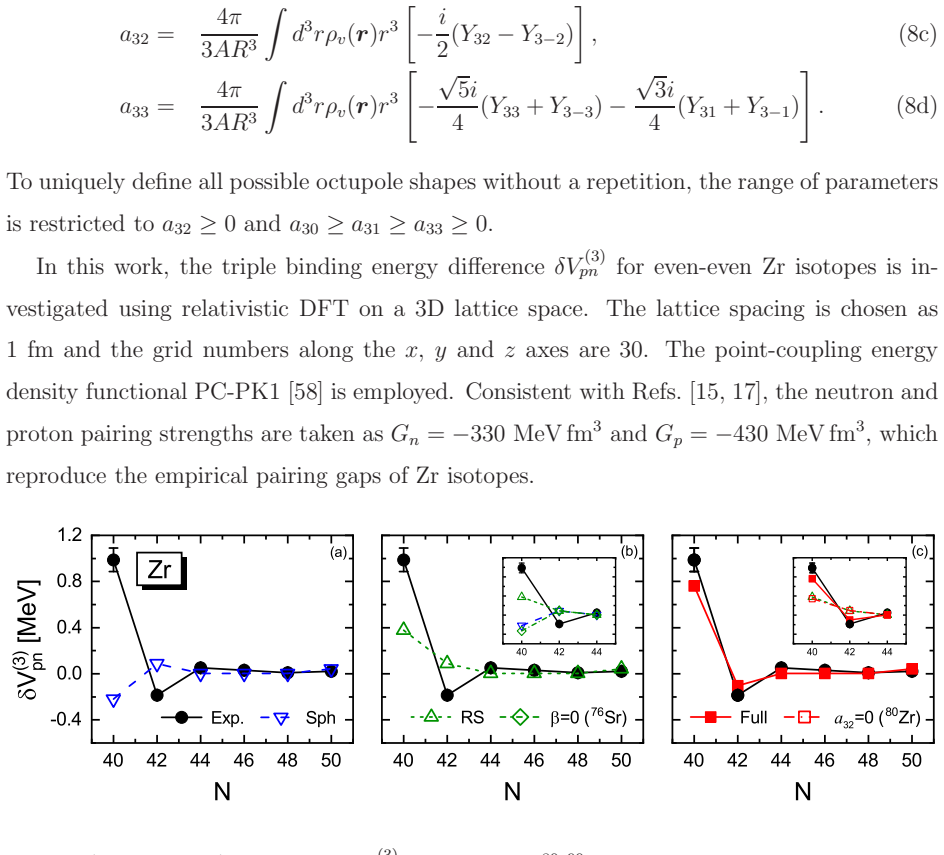
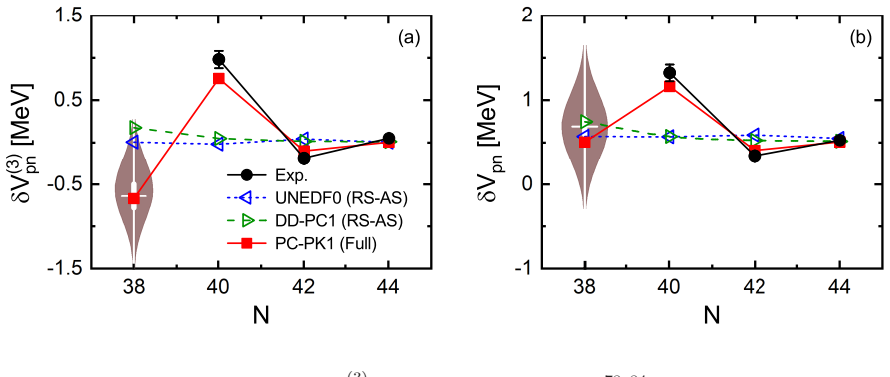
Relativistic density functional theory solved without symmetry restrictions reproduces the experimental triple binding energy differences δV_pn^(3) for 80-90Zr isotopes. The peak at N=40 arises at the mean-field level only with tetrahedral deformation; setting it to zero removes the peak. This is traced to a well-localized tetrahedral minimum in 80Zr, and quadrupole-triaxial restrictions fail to capture the localized enhancement, showing it is symmetry-selective rather than a generic correlation effect.
What carries the argument
the tetrahedral degree of freedom in the mean-field calculation, which produces a localized energy minimum in 80Zr and a symmetry-selective enhancement of proton-neutron binding
If this is right
- Nuclear masses serve as a sensitive probe for tetrahedral symmetry.
- The anomaly at N=40 is a structural mechanism separate from conventional Wigner-type enhancements near N=Z.
- Calculations restricted to quadrupole and triaxial shapes fail to reproduce the localized enhancement.
- The effect is a symmetry-selective increase of proton-neutron binding tied to tetrahedral geometry.
Where Pith is reading between the lines
- Similar mass-based probes could be applied to search for tetrahedral effects in other isotopic chains or mass regions.
- Confirmation via masses would motivate targeted experiments on excited-state properties in 80Zr to seek additional tetrahedral signatures.
- The method might reveal whether tetrahedral minima occur more broadly than current models predict.
Load-bearing premise
The chosen relativistic density functional solved on a 3D lattice without symmetry restrictions accurately locates a tetrahedral energy minimum in 80Zr that is not an artifact of the functional or numerical method.
What would settle it
An improved calculation or new measurement that reproduces the N=40 peak in δV_pn^(3) even after tetrahedral deformation is explicitly constrained to zero would falsify the requirement for tetrahedral symmetry.
Figures
read the original abstract
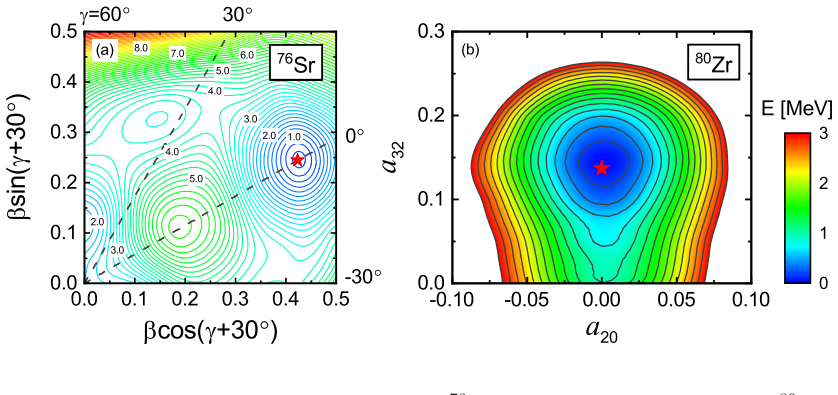
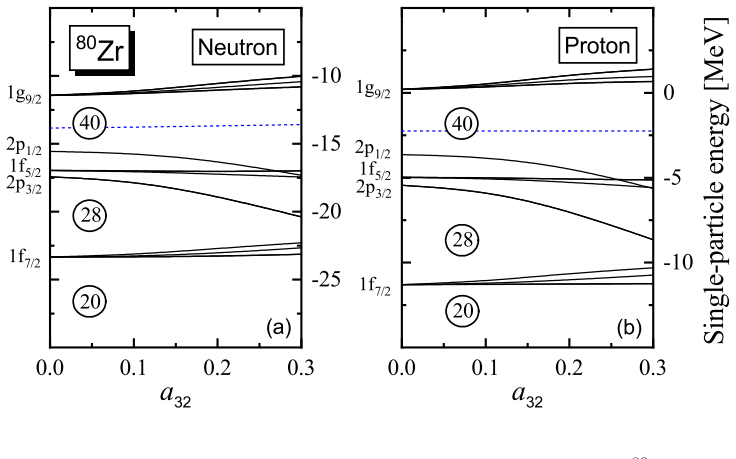
Tetrahedral symmetry has long been predicted as an exotic shape degree of freedom in atomic nuclei, yet clear experimental manifestations remain elusive. We show that the triple binding energy difference $\delta V_{pn}^{(3)}$ can isolate a structural effect of tetrahedral symmetry in $^{80}$Zr. Using relativistic density functional theory solved on a three-dimensional lattice without symmetry restrictions, the experimental $\delta V_{pn}^{(3)}$ values for even-even $^{80\text{-}90}$Zr isotopes are well reproduced without adjustable parameters. While an enhancement of $\delta V_{pn}^{(3)}$ near $N\simeq Z$ is commonly attributed to proton-neutron correlations beyond the mean field, the pronounced nonmonotonic peak at $N=40$ emerges at the mean-field level only when the tetrahedral degree of freedom is included. Constraining the tetrahedral deformation to zero removes the peak and leads to clear deviations from experiment. The anomaly is traced to a well-localized tetrahedral minimum in $^{80}$Zr, supported by potential energy surfaces and characteristic single-particle level splittings. Calculations restricted to quadrupole and triaxial shapes fail to reproduce the localized enhancement, indicating that the effect is not a generic proton-neutron correlation but a symmetry-selective increase of proton-neutron binding associated with tetrahedral geometry. We therefore identify the $\delta V_{pn}^{(3)}$ anomaly in $^{80}$Zr as a structural mechanism distinct from the conventional Wigner-type enhancement and show that nuclear masses constitute a sensitive probe of tetrahedral symmetry.
Editorial analysis
A structured set of objections, weighed in public.
Referee Report
Summary. The manuscript claims that the pronounced nonmonotonic peak in the triple binding energy difference δV_pn^(3) at N=40 for even-even Zr isotopes is a mean-field effect arising exclusively from a localized tetrahedral energy minimum in 80Zr. Using relativistic density functional theory solved without symmetry restrictions on a 3D lattice, the experimental δV_pn^(3) values are reproduced without adjustable parameters; constraining tetrahedral deformation to zero removes the peak and produces deviations from data, while quadrupole/triaxial restrictions also fail to capture the enhancement.
Significance. If the central result holds, the work identifies nuclear masses as a symmetry-selective probe capable of isolating tetrahedral effects from generic proton-neutron correlations. The parameter-free reproduction of data via unconstrained mean-field calculations and the explicit comparison of constrained versus unconstrained solutions constitute clear strengths.
major comments (3)
- [Abstract] Abstract and methods description: the specific relativistic density functional is never named, and no lattice spacing, basis parameters, or convergence tests are reported. This directly undermines the claim that the tetrahedral minimum in 80Zr is physical rather than a discretization or functional artifact, as the peak's appearance is tied to the unconstrained 3D solution.
- [Results on potential energy surfaces] Section discussing the potential energy surfaces and single-particle levels: the depth and stability of the tetrahedral minimum relative to other shapes are not quantified with respect to variations in numerical parameters or alternative functionals. Without such checks, the assertion that the δV_pn^(3) anomaly is produced only when tetrahedral freedom is allowed remains vulnerable to the possibility that the minimum is method-dependent.
- [Constrained calculations] Comparison of constrained calculations: while the text states that setting tetrahedral deformation to zero removes the peak, no quantitative measure is given for how the energy surface changes or whether residual triaxial or octupole effects could mimic the feature under different constraints.
minor comments (1)
- [Abstract] The symbol δV_pn^(3) should be defined explicitly on first appearance, including the precise combination of binding energies involved.
Simulated Author's Rebuttal
We thank the referee for the detailed and constructive report. We address each major comment below and will make the necessary revisions to improve the clarity and robustness of the manuscript.
read point-by-point responses
-
Referee: [Abstract] Abstract and methods description: the specific relativistic density functional is never named, and no lattice spacing, basis parameters, or convergence tests are reported. This directly undermines the claim that the tetrahedral minimum in 80Zr is physical rather than a discretization or functional artifact, as the peak's appearance is tied to the unconstrained 3D solution.
Authors: We agree that the manuscript should explicitly name the relativistic density functional employed and provide details on the lattice spacing, basis parameters, and convergence tests. These details are standard for reproducibility in lattice DFT calculations. In the revised version, we will include this information in the methods section and abstract if space permits, along with results from convergence checks to demonstrate that the tetrahedral minimum is robust and not an artifact of discretization or the choice of functional. revision: yes
-
Referee: [Results on potential energy surfaces] Section discussing the potential energy surfaces and single-particle levels: the depth and stability of the tetrahedral minimum relative to other shapes are not quantified with respect to variations in numerical parameters or alternative functionals. Without such checks, the assertion that the δV_pn^(3) anomaly is produced only when tetrahedral freedom is allowed remains vulnerable to the possibility that the minimum is method-dependent.
Authors: The referee correctly points out the need for quantification of the tetrahedral minimum's depth and stability. We will revise the section on potential energy surfaces to include quantitative measures of energy differences relative to other shapes and perform additional calculations varying numerical parameters and, if feasible, using an alternative functional to confirm the robustness of the result. revision: yes
-
Referee: [Constrained calculations] Comparison of constrained calculations: while the text states that setting tetrahedral deformation to zero removes the peak, no quantitative measure is given for how the energy surface changes or whether residual triaxial or octupole effects could mimic the feature under different constraints.
Authors: We will enhance the discussion of the constrained calculations by providing quantitative data on the changes in the energy surface when tetrahedral deformation is constrained to zero. Additionally, we will include comparisons with constraints on triaxial and octupole degrees of freedom to address the possibility of mimicking effects and strengthen the conclusion that the anomaly is specific to tetrahedral symmetry. revision: yes
Circularity Check
No significant circularity; derivation compares mean-field results to external data
full rationale
The paper computes δV_pn^(3) for even-even Zr isotopes using a relativistic density functional on a 3D lattice without symmetry restrictions and without adjustable parameters. It reproduces experimental values and isolates the N=40 peak by direct comparison of two classes of calculations (tetrahedral freedom allowed vs. constrained to zero) against the same external dataset. No self-definitional steps, fitted inputs renamed as predictions, or load-bearing self-citations appear in the derivation chain; the result remains falsifiable by other functionals or solvers.
Axiom & Free-Parameter Ledger
axioms (1)
- domain assumption Relativistic density functional theory solved on a 3D lattice without symmetry restrictions yields the correct ground-state shape for 80Zr
Reference graph
Works this paper leans on
-
[1]
Hamamoto, B
I. Hamamoto, B. Mottelson, H. Xie, and X. Z. Zhang, Z. Phys . D 21, 163 (1991)
1991
-
[2]
Dudek, A
J. Dudek, A. Go´ zd´ z, N. Schunck, and M. Mi´ skiewicz, Phys. Rev. Lett. 88, 252502 (2002)
2002
-
[3]
R. A. Bark, J. F. Sharpey-Schafer, S. M. Maliage, T. E. Mad iba, F. S. Komati, E. A. Lawrie, 10 J. J. Lawrie, R. Lindsay, P. Maine, S. M. Mullins, S. H. T. Murr ay, N. J. Ncapayi, T. M. Ramashidza, F. D. Smit, and P. Vymers, Phys. Rev. Lett. 104, 022501 (2010)
2010
-
[4]
Jentschel, W
M. Jentschel, W. Urban, J. Krempel, D. Tonev, J. Dudek, D. Curien, B. Lauss, G. de Angelis, and P. Petkov, Phys. Rev. Lett. 104, 222502 (2010)
2010
-
[5]
Li and J
X. Li and J. Dudek, Phys. Rev. C 49, R1250 (1994)
1994
-
[6]
W. D. Heiss, R. A. Lynch, and R. G. Nazmitdinov, Phys. Rev. C 60, 034303 (1999)
1999
-
[7]
Dudek, D
J. Dudek, D. Curien, N. Dubray, J. Dobaczewski, V. Pangon , P. Olbratowski, and N. Schunck, Phys. Rev. Lett. 97, 072501 (2006)
2006
-
[8]
Arita and Y
K.-i. Arita and Y. Mukumoto, Phys. Rev. C 89, 054308 (2014)
2014
-
[9]
Dudek, D
J. Dudek, D. Curien, I. Dedes, K. Mazurek, S. Tagami, Y. R. Shimizu, and T. Bhattacharjee, Phys. Rev. C 97, 021302(R) (2018)
2018
-
[10]
Schunck, J
N. Schunck, J. Dudek, A. G´ o´ zd´ z, and P. H. Regan, Phys.Rev. C 69, 061305(R) (2004)
2004
-
[11]
Zberecki, P.-H
K. Zberecki, P.-H. Heenen, and P. Magierski, Phys. Rev. C 79, 014319 (2009)
2009
-
[12]
Tagami, Y
S. Tagami, Y. R. Shimizu, and J. Dudek, Phys. Rev. C 87, 054306 (2013)
2013
-
[13]
Miyahara and H
S. Miyahara and H. Nakada, Phys. Rev. C 98, 064318 (2018)
2018
-
[14]
X. Wang, G. Dong, Z. Gao, Y. Chen, and C. Shen, Phys. Lett. B 790, 498 (2019)
2019
-
[15]
Zhao, B.-N
J. Zhao, B.-N. Lu, E.-G. Zhao, and S.-G. Zhou, Phys. Rev. C 95, 014320 (2017)
2017
-
[16]
Rong, X.-Y
Y.-T. Rong, X.-Y. Wu, B.-N. Lu, and J.-M. Yao, Phys. Lett . B 840, 137896 (2023)
2023
-
[17]
F. F. Xu, B. Li, Z. X. Ren, and P. W. Zhao, Phys. Rev. C 109, 014311 (2024)
2024
-
[18]
F. F. Xu, B. Li, P. Ring, and P. W. Zhao, Phys. Lett. B 856, 138893 (2024)
2024
-
[19]
Bijker and F
R. Bijker and F. Iachello, Phys. Rev. Lett. 112, 152501 (2014)
2014
-
[20]
Epelbaum, H
E. Epelbaum, H. Krebs, T. A. L¨ ahde, D. Lee, U.-G. Meißne r, and G. Rupak, Phys. Rev. Lett. 112, 102501 (2014)
2014
-
[21]
Ackermann, H
B. Ackermann, H. Baltzer, C. Ensel, K. Freitag, V. Grafe n, C. G¨ unther, P. Herzog, J. Manns, M. Marten-T¨ olle, U. M¨ uller, J. Prinz, I. Romanski, R. T¨ olle, J. deBoer, N. Gollwitzer, and H. Maier, Nucl. Phys. A 559, 61 (1993)
1993
-
[22]
S. S. Ntshangase, R. A. Bark, D. G. Aschman, S. Bvumbi, P. Datta, P. M. Davidson, T. S. Dinoko, M. E. A. Elbasher, K. Juh´ asz, E. M. A. Khaleel, A. Kra sznahorkay, E. A. Lawrie, J. J. Lawrie, R. M. Lieder, S. N. T. Majola, P. L. Masiteng, H. M ohammed, S. M. Mullins, P. Nieminen, B. M. Nyak´ o, P. Papka, D. G. Roux, J. F. Sharpey- Shafer, O. Shirinda, M....
2010
-
[23]
Sumikama, K
T. Sumikama, K. Yoshinaga, H. Watanabe, S. Nishimura, Y . Miyashita, K. Yam- aguchi, K. Sugimoto, J. Chiba, Z. Li, H. Baba, J. S. Berryman, N. Blasi, A. Bracco, F. Camera, P. Doornenbal, S. Go, T. Hashimoto, S. Hayakawa, C . Hinke, E. Ideguchi, T. Isobe, Y. Ito, D. G. Jenkins, Y. Kawada, N. Kobayashi, Y. Ko ndo, R. Kr¨ ucken, S. Kubono, G. Lorusso, T. Nak...
2011
-
[24]
D. J. Hartley, L. L. Riedinger, R. V. F. Janssens, S. N. T. Majola, M. A. Riley, J. M. Allmond, C. W. Beausang, M. P. Carpenter, C. J. Chiara, N. Cooper, D. Cu rien, B. J. P. Gall, P. E. Garrett, F. G. Kondev, W. D. Kulp, T. Lauritsen, E. A. McCutch an, D. Miller, S. Miller, J. Piot, N. Redon, J. F. Sharpey-Schafer, J. Simpson, I. Stef anescu, X. Wang, V....
2017
-
[25]
J. Y. Zhang, R. F. Casten, and D. S. Brenner, Phys. Lett. B 227, 1 (1989)
1989
-
[26]
D. S. Brenner, C. Wesselborg, R. F. Casten, D. D. Warner, and J. Y. Zhang, Phys. Lett. B 243, 1 (1990)
1990
-
[27]
R. F. Casten, Phys. Rev. Lett. 54, 1991 (1985)
1991
-
[28]
R. B. Cakirli and R. F. Casten, Phys. Rev. Lett. 96, 132501 (2006)
2006
-
[29]
Heyde, P
K. Heyde, P. Van Isacker, R. Casten, and J. Wood, Phys. Le tt. B 155, 303 (1985)
1985
-
[30]
R. B. Cakirli, D. S. Brenner, R. F. Casten, and E. A. Millm an, Phys. Rev. Lett. 94, 092501 (2005)
2005
-
[31]
Van Isacker, D
P. Van Isacker, D. D. Warner, and D. S. Brenner, Phys. Rev . Lett. 74, 4607 (1995)
1995
-
[32]
Satu/suppress la, D
W. Satu/suppress la, D. Dean, J. Gary, S. Mizutori, and W. Nazarewicz, Phys. Lett. B 407, 103 (1997)
1997
-
[33]
L. Chen, Y. A. Litvinov, W. R. Plaß, K. Beckert, P. Beller , F. Bosch, D. Boutin, L. Cac- eres, R. B. Cakirli, J. J. Carroll, R. F. Casten, R. S. Chakraw arthy, D. M. Cullen, I. J. Cullen, B. Franzke, H. Geissel, J. Gerl, M. G´ orska, G. A. Jon es, A. Kishada, R. Kn¨ obel, C. Kozhuharov, S. A. Litvinov, Z. Liu, S. Mandal, F. Montes, G . M¨ unzenberg, F. N...
2009
-
[34]
Neidherr, G
D. Neidherr, G. Audi, D. Beck, K. Blaum, C. B¨ ohm, M. Brei tenfeldt, R. B. Cakirli, R. F. Cas- 12 ten, S. George, F. Herfurth, A. Herlert, A. Kellerbauer, M. K owalska, D. Lunney, E. Minaya- Ramirez, S. Naimi, E. Noah, L. Penescu, M. Rosenbusch, S. Sch warz, L. Schweikhard, and T. Stora, Phys. Rev. Lett. 102, 112501 (2009)
2009
-
[35]
Ketelaer, G
J. Ketelaer, G. Audi, T. Beyer, K. Blaum, M. Block, R. B. C akirli, R. F. Casten, C. Droese, M. Dworschak, K. Eberhardt, M. Eibach, F. Herfurth, E. Minay a Ramirez, S. Nagy, D. Nei- dherr, W. N¨ ortersh¨ auser, C. Smorra, and M. Wang, Phys. Rev. C 84, 014311 (2011)
2011
-
[36]
Mardor, S
I. Mardor, S. A. S. Andr´ es, T. Dickel, D. Amanbayev, S. B eck, J. Bergmann, H. Geissel, L. Gr¨ of, E. Haettner, C. Hornung, N. Kalantar-Nayestanaki , G. Kripko-Koncz, I. Miskun, A. Mollaebrahimi, W. R. Plaß, C. Scheidenberger, H. Weick, S . Bagchi, D. L. Balabanski, A. A. Bezbakh, Z. Brencic, O. Charviakova, V. Chudoba, P. Con stantin, M. Dehghan, A. S....
2021
-
[37]
M. Wang, Y. H. Zhang, X. Zhou, X. H. Zhou, H. S. Xu, M. L. Liu , J. G. Li, Y. F. Niu, W. J. Huang, Q. Yuan, S. Zhang, F. R. Xu, Y. A. Litvinov, K. Blaum, Z. Meisel, R. F. Casten, R. B. Cakirli, R. J. Chen, H. Y. Deng, C. Y. Fu, W. W. Ge, H. F. Li, T. Liao, S. A. Litvinov, P. Shuai, J. Y. Shi, Y. N. Song, M. Z. Sun, Q. Wang, Y. M. Xing, X. Xu, X. L. Yan, J...
2023
-
[38]
D. S. Brenner, R. B. Cakirli, and R. F. Casten, Phys. Rev. C 73, 034315 (2006)
2006
-
[39]
G. J. Fu, H. Jiang, Y. M. Zhao, and A. Arima, Phys. Rev. C 82, 014307 (2010)
2010
-
[40]
Bender and P.-H
M. Bender and P.-H. Heenen, Phys. Rev. C 83, 064319 (2011)
2011
-
[41]
Z. Wu, S. A. Changizi, and C. Qi, Phys. Rev. C 93, 034334 (2016)
2016
-
[42]
Zhang and S
W. Zhang and S. Q. Zhang, Phys. Rev. C 100, 054303 (2019)
2019
-
[43]
Y. P. Wang, Y. K. Wang, F. F. Xu, P. W. Zhao, and J. Meng, Phys. Rev. Lett. 132, 232501 (2024)
2024
-
[44]
R. B. Cakirli, K. Blaum, and R. F. Casten, Front. Phys. 13, 1653635 (2025)
2025
-
[45]
Federman and S
P. Federman and S. Pittel, Phys. Lett. B 77, 29 (1978)
1978
-
[46]
Stoitsov, R
M. Stoitsov, R. B. Cakirli, R. F. Casten, W. Nazarewicz, and W. Satu/suppress la, Phys. Rev. Lett. 98, 132502 (2007). 13
2007
-
[47]
Ring, Prog
P. Ring, Prog. Part. Nucl. Phys. 37, 193 (1996)
1996
-
[48]
Z. X. Ren and P. W. Zhao, Phys. Rev. C 102, 021301(R) (2020)
2020
-
[49]
Z. X. Ren, S. Q. Zhang, P. W. Zhao, N. Itagaki, J. A. Maruhn , and J. Meng, Sci. China-Phys. Mech. Astron. 62, 112062 (2019)
2019
-
[50]
B. Li, Z. X. Ren, and P. W. Zhao, Phys. Rev. C 102, 044307 (2020)
2020
-
[51]
D. D. Zhang, Z. X. Ren, P. W. Zhao, D. Vretenar, T. Nikˇ si´ c, and J. Meng, Phys. Rev. C 105, 024322 (2022)
2022
-
[52]
Z. X. Ren, P. W. Zhao, S. Q. Zhang, and J. Meng, Nucl. Phys. A 996, 121696 (2020)
2020
-
[53]
Yamagami, K
M. Yamagami, K. Matsuyanagi, and M. Matsuo, Nucl. Phys. A 693, 579 (2001)
2001
-
[54]
Meng, ed., Relativistic Density Functional for Nuclear Structure, Int ernational Review of Nuclear Physics , Vol
J. Meng, ed., Relativistic Density Functional for Nuclear Structure, Int ernational Review of Nuclear Physics , Vol. 10 (World Scientific, Singapore, 2016)
2016
-
[55]
Vretenar, A
D. Vretenar, A. V. Afanasjev, G. A. Lalazissis, and P. Ri ng, Phys. Rep. 409, 101 (2005)
2005
-
[56]
Nikˇ si´ c, D
T. Nikˇ si´ c, D. Vretenar, and P. Ring, Prog. Part. Nucl. Phys. 66, 519 (2011)
2011
-
[57]
Ryssens, V
W. Ryssens, V. Hellemans, M. Bender, and P.-H. Heenen, Comput. Phys. Commun. 190, 231 (2015)
2015
-
[58]
P. W. Zhao, Z. P. Li, J. M. Yao, and J. Meng, Phys. Rev. C 82, 054319 (2010)
2010
-
[59]
M. Wang, W. J. Huang, F. G. Kondev, G. Audi, and S. Naimi, Chin. Phys. C 45, 030003 (2021)
2021
-
[60]
Hamaker, E
A. Hamaker, E. Leistenschneider, R. Jain, G. Bollen, S. A. Giuliani, K. Lund, W. Nazarewicz, L. Neufcourt, C. R. Nicoloff, D. Puentes, R. Ringle, C. S. Sumit hrarachchi, and I. T. Yandow, Nat. Phys. 17, 1408 (2021)
2021
-
[61]
Erler, N
J. Erler, N. Birge, M. Kortelainen, W. Nazarewicz, E. Ol sen, A. M. Perhac, and M. Stoitsov, Nature 486, 509 (2012)
2012
-
[62]
S. E. Agbemava, A. V. Afanasjev, D. Ray, and P. Ring, Phys . Rev. C 89, 054320 (2014)
2014
-
[63]
X. H. Wu and P. W. Zhao, Phys. Rev. C 101, 051301 (2020)
2020
-
[64]
M¨ oller, A
P. M¨ oller, A. Sierk, T. Ichikawa, and H. Sagawa, Atomic Data and Nuclear Data Tables 109-110, 1 (2016). 14
2016
discussion (0)
Sign in with ORCID, Apple, or X to comment. Anyone can read and Pith papers without signing in.