Hybrid Stars with Post-Merger Rotation Profiles
Pith reviewed 2026-06-26 23:47 UTC · model grok-4.3
The pith
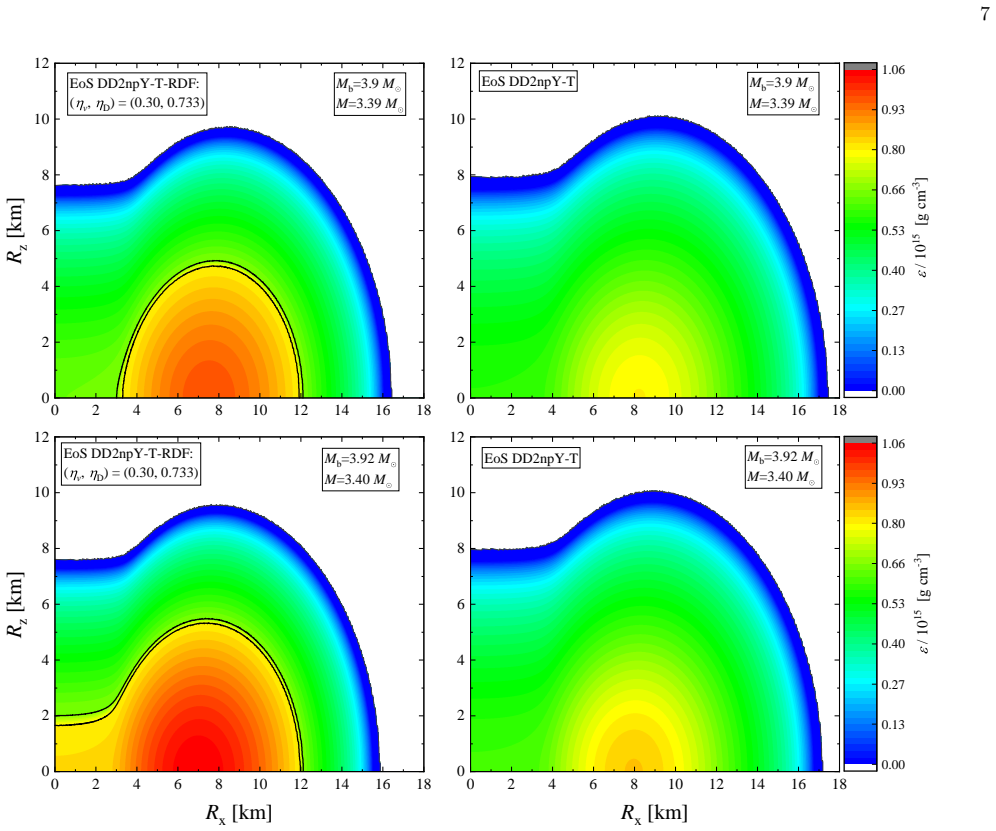
Differential rotation produces hybrid stars with deconfined quark matter in a ring around a hadronic center and outer layers.
A machine-rendered reading of the paper's core claim, the machinery that carries it, and where it could break.
Core claim
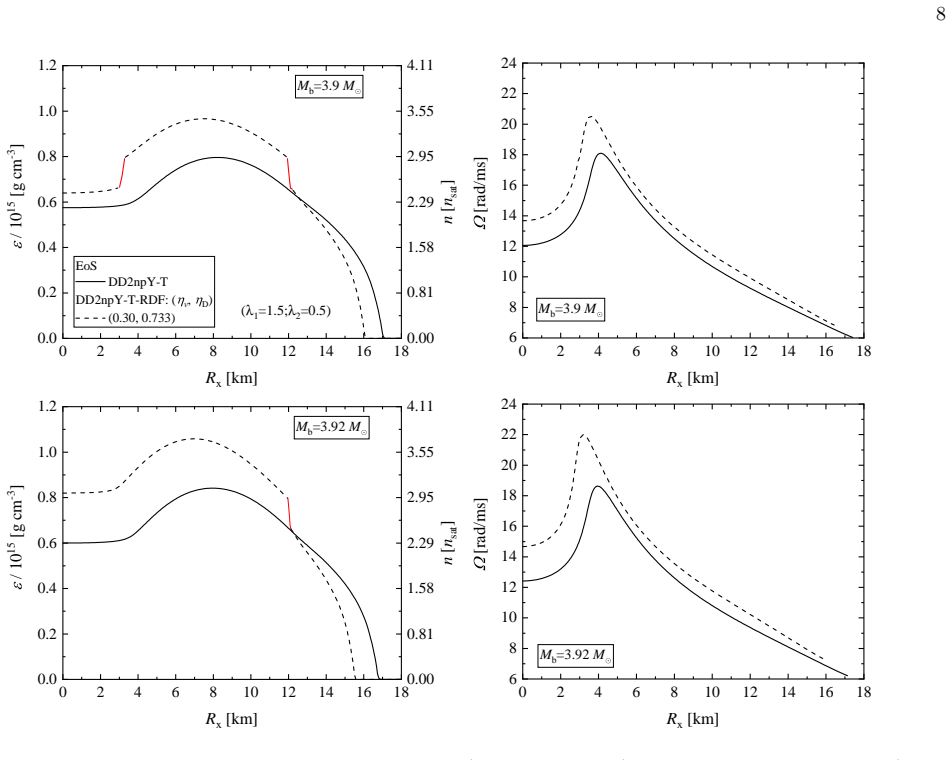
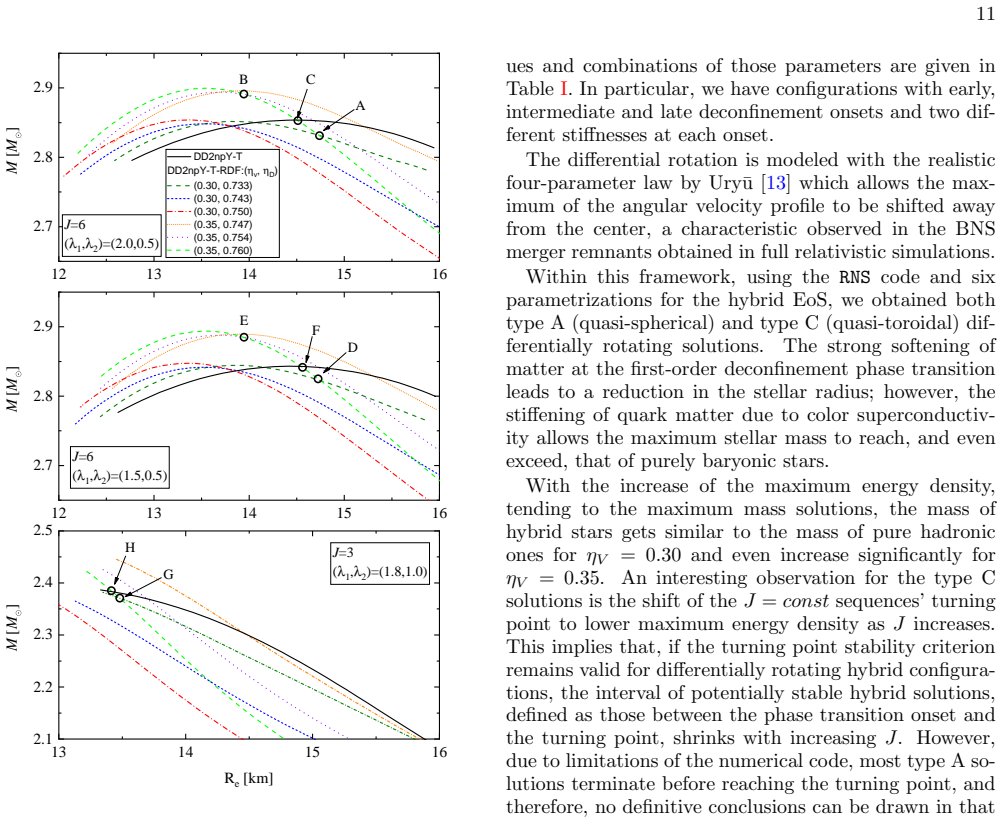
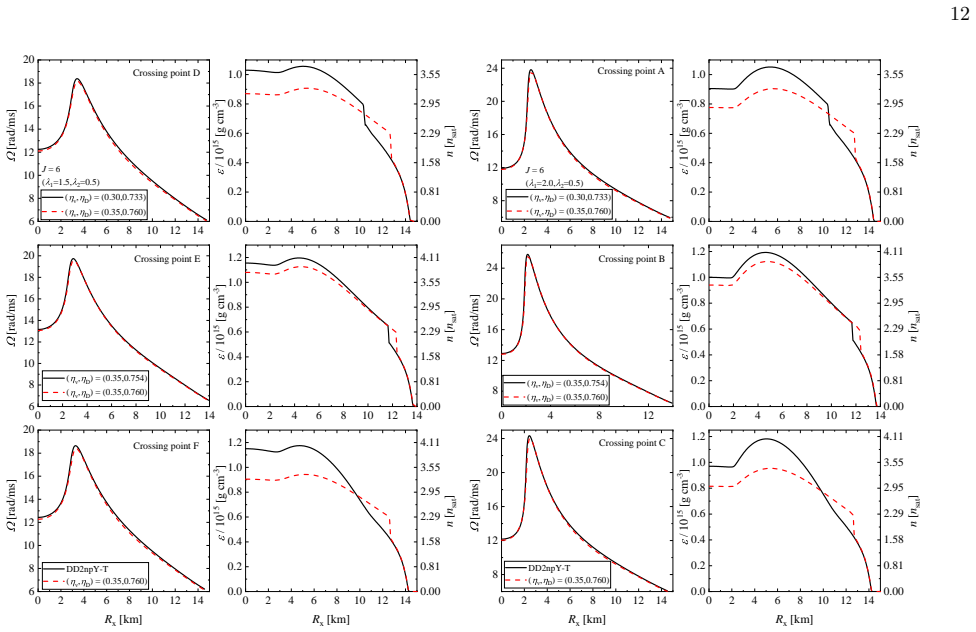
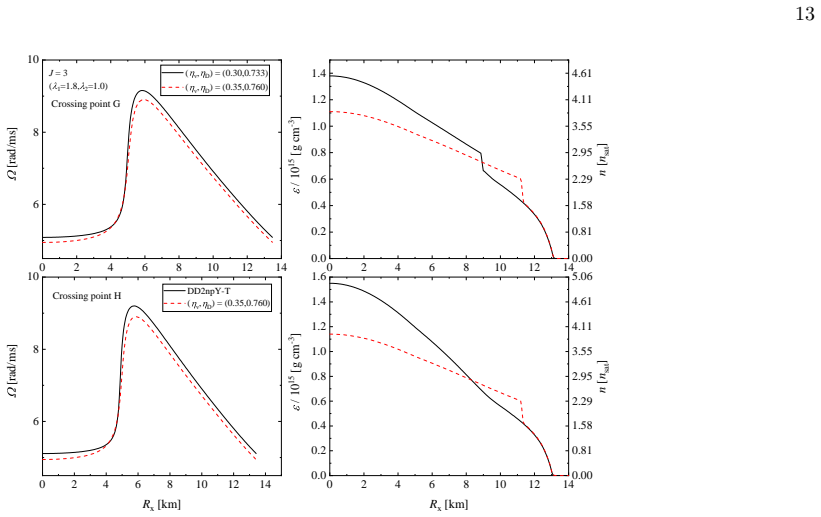
We demonstrate the existence of quasi-toroidal hybrid star configurations in which deconfined quark matter forms a ring around the center of mass, while hadronic matter remains at the center and outer layers. Moreover, at the crossing points where the mass-radius curves for different equations of state intersect, the rotational profiles of the solutions are very close despite large differences in the energy density profiles. The angular velocity profile is continuous throughout the star despite the discontinuity in the energy density.
What carries the argument
Four-parameter phenomenological differential rotation law that shifts the location of maximum angular velocity away from the center, applied to stars containing a first-order deconfinement phase transition.
If this is right
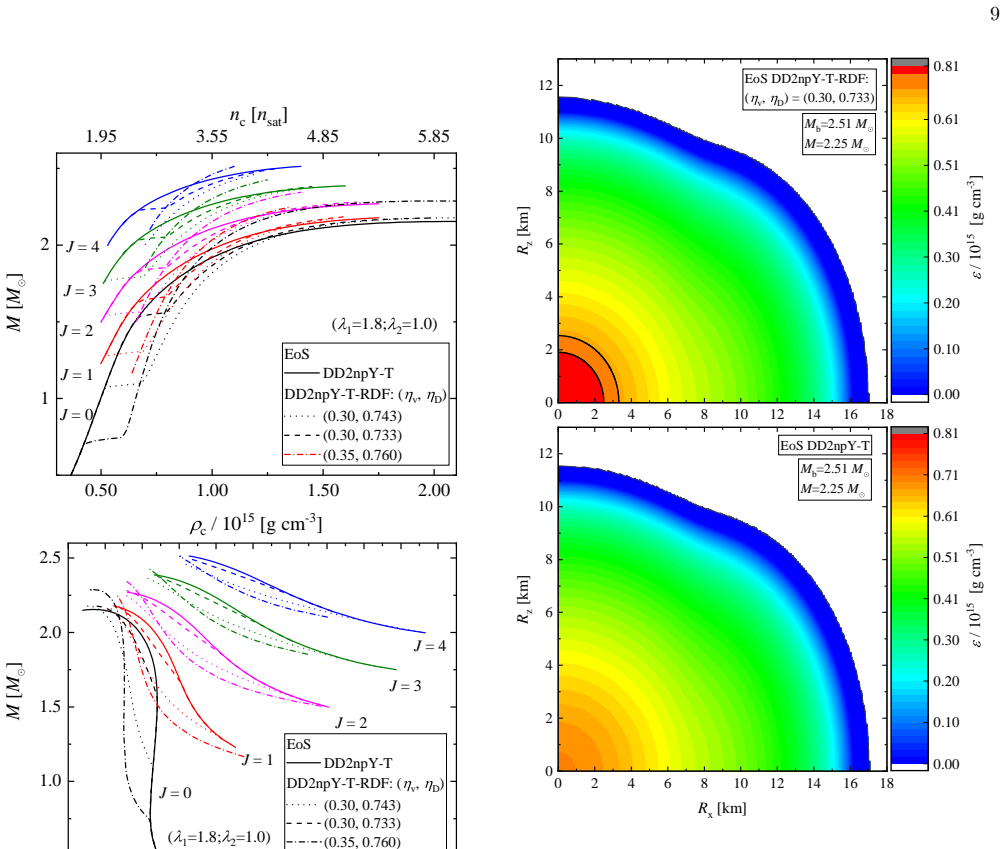
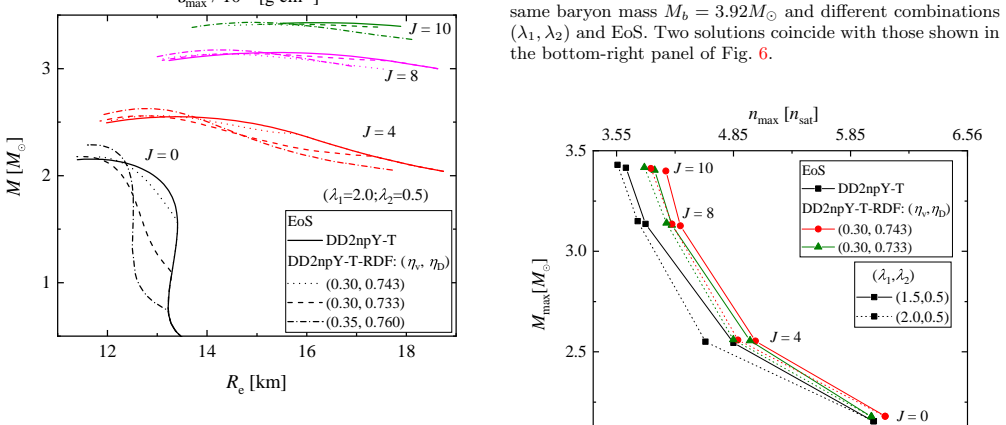
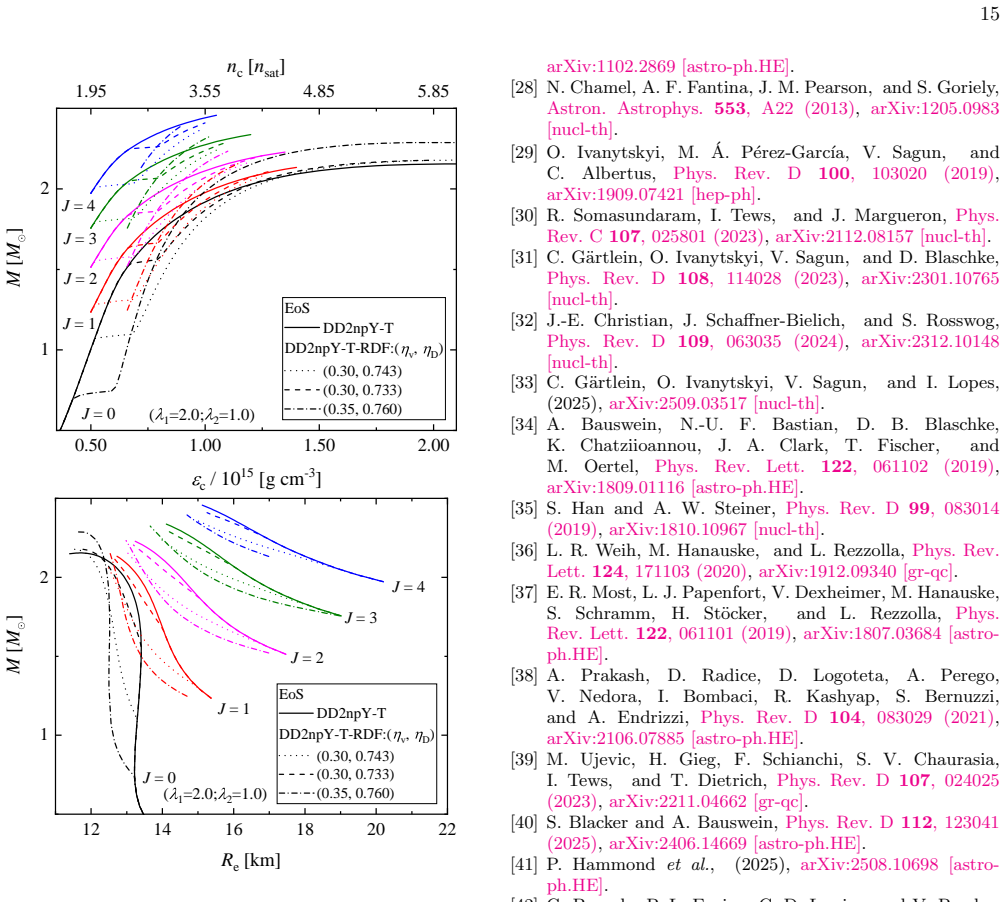
- Increasing total angular momentum moves the turning points of J=constant sequences toward lower central densities and reduces the parameter space occupied by stable differentially rotating stars with phase transitions.
- Angular velocity remains continuous for both quasi-spherical and quasi-toroidal solutions across the phase-transition interface.
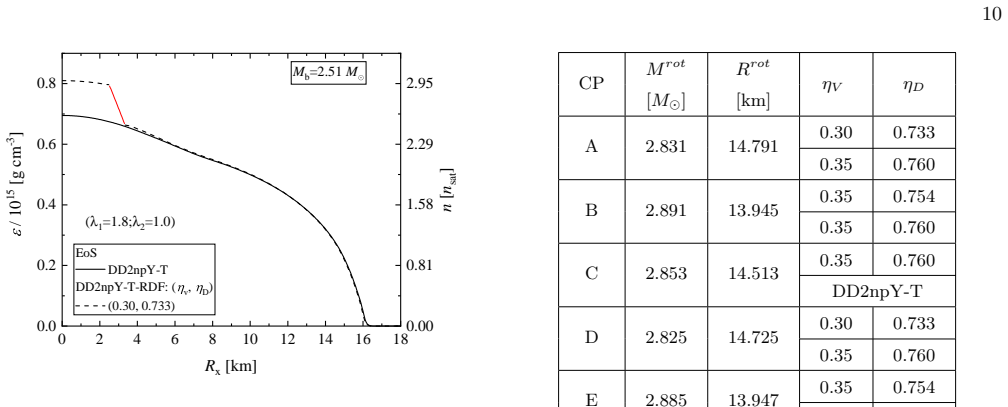
- Rotational profiles at mass-radius crossing points are nearly identical for equations of state that do and do not contain a phase transition.
Where Pith is reading between the lines
- Mass and radius measurements alone may be insufficient to detect a phase transition in post-merger remnants because rotation profiles can coincide at the same global parameters.
- Gravitational-wave or electromagnetic signals that probe internal velocity structure could be required to break the reported degeneracy between hadronic and hybrid models.
- The continuity of angular velocity across a sharp density jump suggests that rotation data may mask abrupt changes in composition unless combined with other observables.
Load-bearing premise
The four-parameter phenomenological rotation law accurately models the differential rotation present in post-merger neutron star remnants.
What would settle it
An observation or simulation showing a discontinuous angular velocity profile exactly at the density jump of a first-order phase transition in a quasi-toroidal configuration would falsify the reported continuity.
Figures
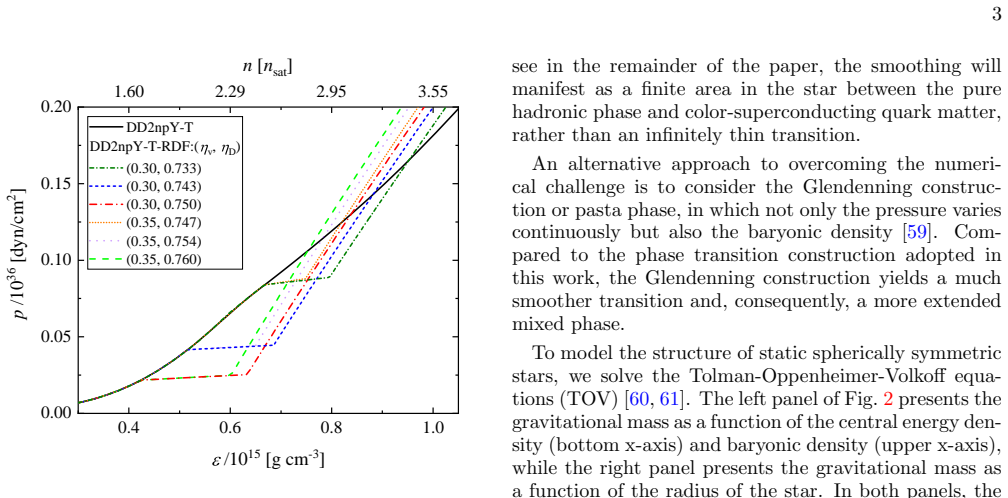
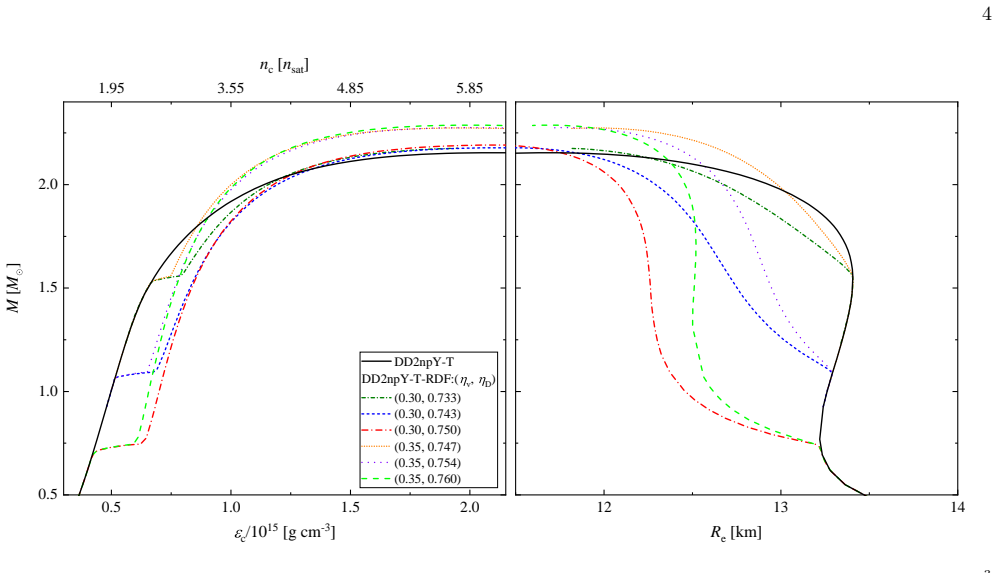
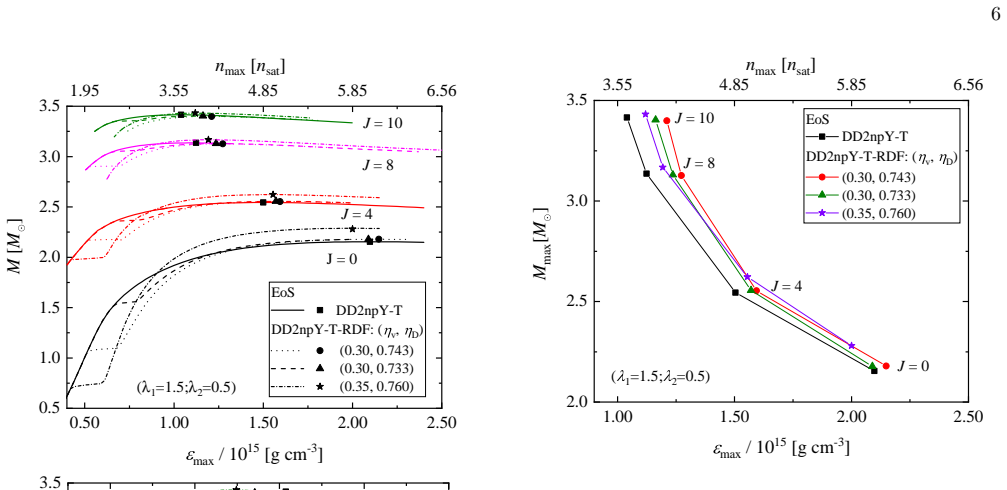
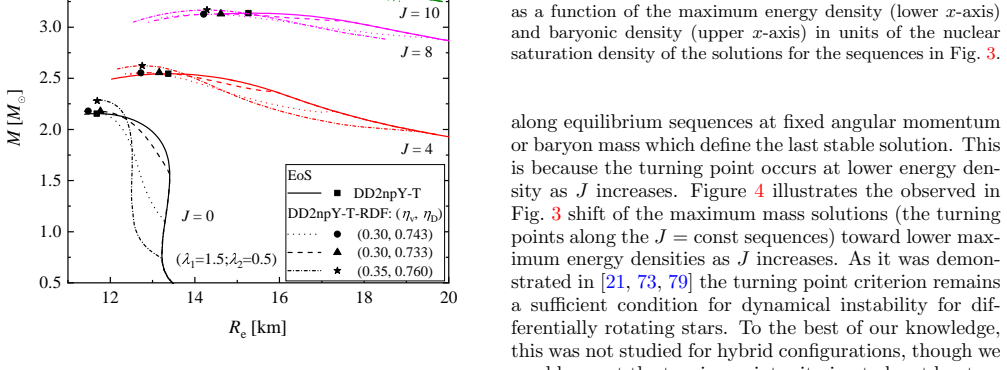
read the original abstract
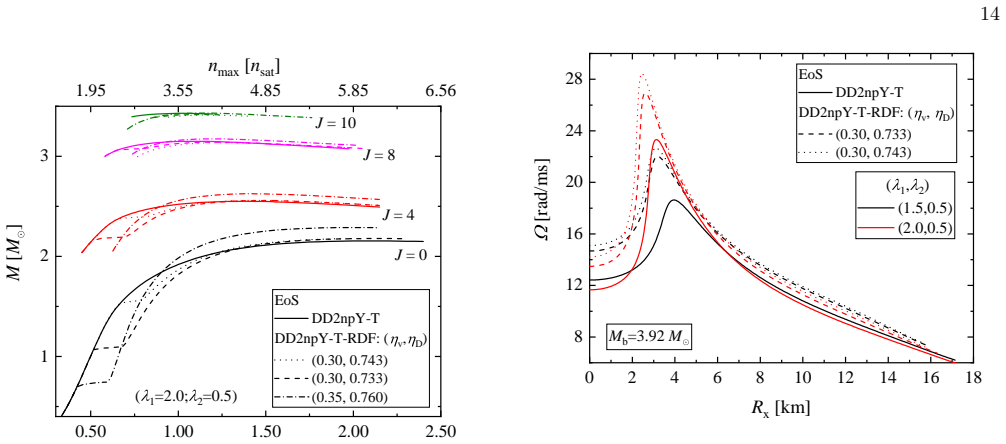
We study the effect of differential rotation on hybrid stars with the first-order deconfinement phase transition from hadronic to color superconducting quark matter. The differential rotation is introduced within a realistic, four-parameter phenomenological rotation law, in which the maximum angular velocity of the rotating configuration is shifted away from the center. We focus on two classes of differentially rotating solutions, namely quasi-toroidal (type C) and quasi-spherical (type A), and study the changes in the star global properties and angular velocity profiles due to the presence of a phase transition. Thus, we demonstrate the existence of quasi-toroidal hybrid star configurations in which deconfined quark matter forms a ring around the center of mass, while hadronic matter remains at the center and outer layers. Furthermore, we show that when increasing the angular momentum $J$ the turning points of the $J=const$ sequences shift towards lower energy densities, shrinking considerably the region where differentially rotating neutron stars with phase transitions exists. Interestingly, for both type A and type C solutions, the angular velocity profile is continuous throughout the star despite the discontinuity in the energy density. Moreover, we show that at the crossing points where the mass-radius curves for different equations of state intersect, the rotational profiles of the solutions are very close despite large differences in the energy density profiles. This reveals a possible degeneracy between the post-merger remnant properties for models with and without phase transitions, emphasizing the need for complementary multi-messenger observables to distinguish between them.
Editorial analysis
A structured set of objections, weighed in public.
Referee Report
Summary. The paper numerically solves the stellar structure equations for hybrid stars with a first-order hadronic-to-quark deconfinement transition under differential rotation. It employs a four-parameter phenomenological rotation law that shifts the angular-velocity maximum off-center to model post-merger conditions, focusing on quasi-toroidal (type C) and quasi-spherical (type A) solutions. Key findings include the existence of configurations with a deconfined quark ring surrounding a hadronic center and outer layers, continuity of the angular-velocity profile across the density discontinuity, shifts of J=const turning points to lower densities with increasing angular momentum, and near-identical rotational profiles at mass-radius curve intersections for different EOS despite differing energy-density profiles, implying possible degeneracies in post-merger observables.
Significance. If the adopted rotation law faithfully represents post-merger angular-velocity distributions, the work identifies novel quasi-toroidal hybrid configurations and highlights a potential degeneracy between models with and without phase transitions at mass-radius crossings. This would strengthen the case for multi-messenger constraints on dense-matter phase structure. The demonstration of continuous Ω profiles across a first-order transition under this law is a concrete, falsifiable numerical result.
major comments (3)
- [Introduction / Methods (rotation-law definition)] The central claims (quasi-toroidal hybrids with quark rings, continuity of Ω, and rotational-profile degeneracy at mass-radius crossings) are obtained by imposing a specific four-parameter phenomenological rotation law whose maximum is shifted off-center. No quantitative comparison is presented between the resulting Ω(r) profiles and angular-velocity fields extracted from numerical-relativity binary-merger simulations. This assumption is load-bearing for interpreting the configurations as post-merger models rather than mathematical solutions for an arbitrary law.
- [Results (angular-velocity profiles)] The abstract and results state that the angular-velocity profile remains continuous despite the energy-density jump at the phase transition. The manuscript should explicitly show (via a plot or table of Ω across the interface for at least one type-C sequence) that this continuity is enforced by the rotation law rather than emerging from the Einstein equations or EOS matching conditions.
- [Results (J=const sequences)] The paper reports that increasing J shifts the turning points of J=const sequences to lower central densities and shrinks the domain of stable hybrid configurations. The quantitative size of this shrinkage and the location of the new turning points should be given for the specific EOS pairs used, together with a statement of the numerical resolution and convergence criterion employed to locate the turning points.
minor comments (2)
- [Introduction] The abstract refers to 'realistic' four-parameter law without a reference or brief justification in the main text; a short paragraph citing the origin of the parametrization would improve clarity.
- [Results (mass-radius crossings)] Energy-density and angular-velocity profiles are described as 'very close' at mass-radius crossings; quantitative measures (e.g., L2 difference or maximum relative deviation) would make the degeneracy statement more precise.
Simulated Author's Rebuttal
We thank the referee for their constructive comments and suggestions. We respond to each major comment below and indicate the revisions made to the manuscript.
read point-by-point responses
-
Referee: [Introduction / Methods (rotation-law definition)] The central claims (quasi-toroidal hybrids with quark rings, continuity of Ω, and rotational-profile degeneracy at mass-radius crossings) are obtained by imposing a specific four-parameter phenomenological rotation law whose maximum is shifted off-center. No quantitative comparison is presented between the resulting Ω(r) profiles and angular-velocity fields extracted from numerical-relativity binary-merger simulations. This assumption is load-bearing for interpreting the configurations as post-merger models rather than mathematical solutions for an arbitrary law.
Authors: We acknowledge the importance of linking the phenomenological law to NR simulations. The law was selected because its form allows for an off-center maximum, a key feature of post-merger remnants. We will add citations and a brief discussion in the revised introduction explaining how the parameters are motivated by NR results in the literature. A full quantitative comparison would require specific data from simulations, which is beyond the scope of this work but could be pursued in future studies. revision: partial
-
Referee: [Results (angular-velocity profiles)] The abstract and results state that the angular-velocity profile remains continuous despite the energy-density jump at the phase transition. The manuscript should explicitly show (via a plot or table of Ω across the interface for at least one type-C sequence) that this continuity is enforced by the rotation law rather than emerging from the Einstein equations or EOS matching conditions.
Authors: We agree with this observation. The continuity is imposed by the choice of rotation law, which is a function of the cylindrical radius and thus continuous by construction across the density jump. We will include in the revised paper a dedicated plot or table demonstrating the Ω values across the interface for a type-C sequence, with accompanying text clarifying that this is due to the rotation law. revision: yes
-
Referee: [Results (J=const sequences)] The paper reports that increasing J shifts the turning points of the J=const sequences to lower central densities and shrinks the domain of stable hybrid configurations. The quantitative size of this shrinkage and the location of the new turning points should be given for the specific EOS pairs used, together with a statement of the numerical resolution and convergence criterion employed to locate the turning points.
Authors: We will provide the requested quantitative information in the revised manuscript. This includes the specific central densities at the turning points for the EOS pairs at various J values, as well as details on the numerical resolution and convergence criteria used in locating these points. revision: yes
Circularity Check
No significant circularity; results are numerical outputs from imposed phenomenological law
full rationale
The paper computes stellar models by solving the structure equations under an explicitly phenomenological four-parameter differential rotation law and chosen EOS families. The quasi-toroidal configurations, continuity of angular velocity across density jumps, and near-identical profiles at mass-radius crossings are direct numerical consequences of those inputs rather than any self-definitional reduction, fitted parameter renamed as prediction, or load-bearing self-citation chain. No equations or claims in the provided text reduce the reported results to the inputs by construction; the rotation law is stated as an external modeling choice, not derived from the solutions.
Axiom & Free-Parameter Ledger
free parameters (1)
- Four parameters of the phenomenological rotation law
axioms (1)
- standard math General relativistic hydrostatic equilibrium for differentially rotating stars with first-order phase transition
Reference graph
Works this paper leans on
-
[1]
G. Baym, T. Hatsuda, T. Kojo, P. D. Powell, Y. Song, and T. Takatsuka, Rept. Prog. Phys.81, 056902 (2018), arXiv:1707.04966 [astro-ph.HE]
Pith/arXiv arXiv 2018
-
[2]
F. ¨Ozel and P. Freire, Ann. Rev. Astron. Astrophys.54, 401 (2016), arXiv:1603.02698 [astro-ph.HE]
Pith/arXiv arXiv 2016
-
[3]
L. Baiotti and L. Rezzolla, Rept. Prog. Phys.80, 096901 (2017), arXiv:1607.03540 [gr-qc]
Pith/arXiv arXiv 2017
-
[4]
J. W. T. Hessels, S. M. Ransom, I. H. Stairs, P. C. C. Freire, V. M. Kaspi, and F. Camilo, Science311, 1901 (2006), arXiv:astro-ph/0601337
Pith/arXiv arXiv 1901
-
[5]
G. K. Jaisawalet al., Astrophys. J.975, 67 (2024), arXiv:2504.07328 [astro-ph.HE]
arXiv 2024
-
[6]
V. Paschalidis and N. Stergioulas, Living Rev. Rel.20, 7 (2017), arXiv:1612.03050 [astro-ph.HE]
Pith/arXiv arXiv 2017
-
[7]
N. Andersson and K. D. Kokkotas, Int. J. Mod. Phys. D 10, 381 (2001), arXiv:gr-qc/0010102. 14 0 .501 .001 .502 .002 .501 .953 .554 .855 .856 .561 2 3 n m ax [ns at]M [M/s8857 ] /s101 m ax / 101 5 [g cm- 3]E oS DD2npY-TDD2npY-T-RDF: (/s104v ,/s104D ) (0.30, 0.743) (0.30, 0.733) (0.35, 0.760)(/s1081 =2.0;/s1082 =0.5)J = 0J = 4J = 8J = 10 1 21 41 61 81 2 3 M...
Pith/arXiv arXiv 2001
-
[8]
B. Haskell, J. L. Zdunik, M. Fortin, M. Bejger, R. Wi- jnands, and A. Patruno, Astron. Astrophys.620, A69 (2018), arXiv:1805.11277 [astro-ph.HE]
Pith/arXiv arXiv 2018
-
[9]
D. Chakrabarty, E. H. Morgan, M. P. Muno, D. K. Gal- loway, R. Wijnands, M. van der Klis, and C. B. Mark- wardt, Nature424, 42 (2003), arXiv:astro-ph/0307029
Pith/arXiv arXiv 2003
-
[10]
M. D. Duez, Y. T. Liu, S. L. Shapiro, and B. C. Stephens, Phys. Rev. D69, 104030 (2004), arXiv:astro-ph/0402502
Pith/arXiv arXiv 2004
-
[11]
B. P. Abbottet al.(LIGO Scientific, Virgo), Phys. Rev. Lett.121, 161101 (2018), arXiv:1805.11581 [gr-qc]
Pith/arXiv arXiv 2018
-
[12]
R. Gill, A. Nathanail, and L. Rezzolla, Astrophys. J. 876, 139 (2019), arXiv:1901.04138 [astro-ph.HE]
Pith/arXiv arXiv 2019
-
[13]
K. Uryu, A. Tsokaros, L. Baiotti, F. Galeazzi, K. Taniguchi, and S. Yoshida, Phys. Rev. D96, 103011 (2017), arXiv:1709.02643 [astro-ph.HE]
Pith/arXiv arXiv 2017
-
[14]
M. Cassing and L. Rezzolla, Mon. Not. Roy. Astron. Soc. 532, 945 (2024), arXiv:2405.06609 [gr-qc]
arXiv 2024
-
[15]
A. Passamonti and N. Andersson, Mon. Not. Roy. Astron. Soc.498, 5904 (2020), arXiv:2003.10198 [astro-ph.SR]. 0 2 4 6 8 1 01 21 41 61 881216202428 (/s1081 ,/s1082 ) (1.5,0.5) (2.0,0.5)M b =3.92 M/s8857 /s87 [rad/ms]R x [km]E oS DD2npY-TDD2npY-T-RDF: (/s104v , /s104D ) (0.30, 0.733) (0.30, 0.743) FIG. 14. Angular velocity profiles for solutions with the sam...
arXiv 2020
-
[16]
G. Camelio, T. Dietrich, M. Marques, and S. Rosswog, Phys. Rev. D100, 123001 (2019), arXiv:1908.11258 [gr- qc]
arXiv 2019
-
[17]
G. Camelio, T. Dietrich, S. Rosswog, and B. Haskell, Phys. Rev. D103, 063014 (2021), arXiv:2011.10557 [astro-ph.HE]
arXiv 2021
-
[18]
P. Iosif and N. Stergioulas, Mon. Not. Roy. Astron. Soc. 503, 850 (2021), arXiv:2011.10612 [gr-qc]
arXiv 2021
-
[19]
P. Iosif and N. Stergioulas, Physical Sciences Forum2 (2021), 10.3390/ECU2021-09312. 15 0 .501 .001 .502 .001 .953 .554 .855 .851 2 J = 0( /s1081 =2.0;/s1082 =1.0)J = 4J = 3J = 2n c [ns at]M [M/s8857 ] /s101 c / 101 5 [g cm- 3]E oS DD2npY-TDD2npY-T-RDF:(/s104v , /s104D ) (0.30, 0.743) (0.30, 0.733) (0.35, 0.760)J = 1 1 21 41 61 82 02 21 2 J = 0(/s1081 =2....
-
[20]
G. Bozzola, N. Stergioulas, and A. Bauswein, Mon. Not. Roy. Astron. Soc.474, 3557 (2018), arXiv:1709.02787 [gr-qc]
Pith/arXiv arXiv 2018
-
[21]
L. R. Weih, E. R. Most, and L. Rezzolla, Mon. Not. Roy. Astron. Soc.473, L126 (2018), arXiv:1709.06058 [gr-qc]
Pith/arXiv arXiv 2018
-
[22]
Ciolfi, G
R. Ciolfi, G. Stratta, M. Branchesi, and B. Gendre, Ex- perimental Astronomy52, 245 (2021)
2021
-
[23]
Rosati, S
P. Rosati, S. Basa, A. W. Blain, E. Bozzo, and M. Branchesi, Experimental Astronomy52, 407 (2021)
2021
- [24]
- [25]
-
[26]
M. Alford, D. Blaschke, A. Drago, T. Klahn, G. Pagliara, and J. Schaffner-Bielich, Nature445, E7 (2007), arXiv:astro-ph/0606524
Pith/arXiv arXiv 2007
-
[27]
S. Weissenborn, I. Sagert, G. Pagliara, M. Hempel, and J. Schaffner-Bielich, Astrophys. J. Lett.740, L14 (2011), arXiv:1102.2869 [astro-ph.HE]
Pith/arXiv arXiv 2011
-
[28]
N. Chamel, A. F. Fantina, J. M. Pearson, and S. Goriely, Astron. Astrophys.553, A22 (2013), arXiv:1205.0983 [nucl-th]
Pith/arXiv arXiv 2013
-
[29]
O. Ivanytskyi, M. ´A. P´ erez-Garc´ ıa, V. Sagun, and C. Albertus, Phys. Rev. D100, 103020 (2019), arXiv:1909.07421 [hep-ph]
arXiv 2019
-
[30]
R. Somasundaram, I. Tews, and J. Margueron, Phys. Rev. C107, 025801 (2023), arXiv:2112.08157 [nucl-th]
arXiv 2023
-
[31]
C. G¨ artlein, O. Ivanytskyi, V. Sagun, and D. Blaschke, Phys. Rev. D108, 114028 (2023), arXiv:2301.10765 [nucl-th]
arXiv 2023
-
[32]
J.-E. Christian, J. Schaffner-Bielich, and S. Rosswog, Phys. Rev. D109, 063035 (2024), arXiv:2312.10148 [nucl-th]
arXiv 2024
-
[33]
C. G¨ artlein, O. Ivanytskyi, V. Sagun, and I. Lopes, (2025), arXiv:2509.03517 [nucl-th]
arXiv 2025
-
[34]
A. Bauswein, N.-U. F. Bastian, D. B. Blaschke, K. Chatziioannou, J. A. Clark, T. Fischer, and M. Oertel, Phys. Rev. Lett.122, 061102 (2019), arXiv:1809.01116 [astro-ph.HE]
Pith/arXiv arXiv 2019
-
[35]
S. Han and A. W. Steiner, Phys. Rev. D99, 083014 (2019), arXiv:1810.10967 [nucl-th]
Pith/arXiv arXiv 2019
-
[36]
L. R. Weih, M. Hanauske, and L. Rezzolla, Phys. Rev. Lett.124, 171103 (2020), arXiv:1912.09340 [gr-qc]
arXiv 2020
-
[37]
E. R. Most, L. J. Papenfort, V. Dexheimer, M. Hanauske, S. Schramm, H. St¨ ocker, and L. Rezzolla, Phys. Rev. Lett.122, 061101 (2019), arXiv:1807.03684 [astro- ph.HE]
Pith/arXiv arXiv 2019
-
[38]
A. Prakash, D. Radice, D. Logoteta, A. Perego, V. Nedora, I. Bombaci, R. Kashyap, S. Bernuzzi, and A. Endrizzi, Phys. Rev. D104, 083029 (2021), arXiv:2106.07885 [astro-ph.HE]
arXiv 2021
- [39]
-
[40]
S. Blacker and A. Bauswein, Phys. Rev. D112, 123041 (2025), arXiv:2406.14669 [astro-ph.HE]
arXiv 2025
-
[41]
Hammondet al., (2025), arXiv:2508.10698 [astro- ph.HE]
P. Hammondet al., (2025), arXiv:2508.10698 [astro- ph.HE]
arXiv 2025
-
[42]
G. Bozzola, P. L. Espino, C. D. Lewin, and V. Pascha- lidis, Eur. Phys. J. A55, 149 (2019), arXiv:1905.00028 [astro-ph.HE]
arXiv 2019
-
[43]
C. G¨ artlein, V. Sagun, O. Ivanytskyi, D. Blaschke, and I. Lopes, Phys. Rev. D111, 123021 (2025), arXiv:2412.07758 [nucl-th]
arXiv 2025
-
[44]
M. Cierniak and D. Blaschke, Eur. Phys. J. ST229, 3663 (2020), arXiv:2009.12353 [astro-ph.HE]
arXiv 2020
-
[45]
M. Shahrbaf, D. Blaschke, S. Typel, G. R. Farrar, and D. E. Alvarez-Castillo, Phys. Rev. D105, 103005 (2022), arXiv:2202.00652 [nucl-th]
arXiv 2022
-
[46]
E. Fonsecaet al., Astrophys. J. Lett.915, L12 (2021), arXiv:2104.00880 [astro-ph.HE]
arXiv 2021
-
[47]
R. W. Romani, D. Kandel, A. V. Filippenko, T. G. Brink, and W. Zheng, Astrophys. J. Lett.908, L46 (2021), arXiv:2101.09822 [astro-ph.HE]
arXiv 2021
-
[48]
M. C. Milleret al., Astrophys. J. Lett.887, L24 (2019), arXiv:1912.05705 [astro-ph.HE]
Pith/arXiv arXiv 2019
-
[49]
S. Vinciguerraet al., Astrophys. J.961, 62 (2024), arXiv:2308.09469 [astro-ph.HE]
arXiv 2024
-
[50]
T. Salmiet al., Astrophys. J.974, 294 (2024), arXiv:2406.14466 [astro-ph.HE]
arXiv 2024
-
[51]
A. J. Dittmannet al., Astrophys. J.974, 295 (2024), 16 arXiv:2406.14467 [astro-ph.HE]
arXiv 2024
-
[52]
D. Choudhuryet al., Astrophys. J. Lett.971, L20 (2024), arXiv:2407.06789 [astro-ph.HE]
arXiv 2024
-
[53]
T. Salmiet al., Astrophys. J.976, 58 (2024), arXiv:2409.14923 [astro-ph.HE]
arXiv 2024
-
[54]
L. Mauviardet al., Astrophys. J.995, 60 (2025), arXiv:2506.14883 [astro-ph.HE]
arXiv 2025
-
[55]
Typel, J
S. Typel, J. Phys. G45, 114001 (2018)
2018
-
[56]
O. Ivanytskyi and D. Blaschke, Phys. Rev. D105, 114042 (2022), arXiv:2204.03611 [nucl-th]
arXiv 2022
-
[57]
O. Ivanytskyi and D. B. Blaschke, Particles5, 514 (2022), arXiv:2209.02050 [nucl-th]
arXiv 2022
-
[58]
Rapidly Spinning Massive Pulsars as an Indicator of Quark Deconfinement
C. G¨ artlein, V. Sagun, O. Ivanytskyi, D. Blaschke, and I. Lopes, (2025), 10.48550/arXiv.2512.07977, arXiv:2512.07977 [nucl-th]
work page internal anchor Pith review Pith/arXiv arXiv doi:10.48550/arxiv.2512.07977 2025
-
[59]
N. K. Glendenning, Phys. Rev. D46, 1274 (1992)
1992
-
[60]
J. R. Oppenheimer and G. M. Volkoff, Phys. Rev.55, 374 (1939)
1939
-
[61]
R. C. Tolman, Phys. Rev.55, 364 (1939)
1939
-
[62]
M. Cierniak and D. Blaschke, Astron. Nachr.342, 819 (2021), arXiv:2106.06986 [nucl-th]
arXiv 2021
-
[63]
M. Cierniak and D. Blaschke, EPJ Web Conf.258, 07009 (2022), arXiv:2112.09166 [nucl-th]
arXiv 2022
-
[64]
N. Stergioulas and J. L. Friedman, Astrophys. J.444, 306 (1995), arXiv:astro-ph/9411032 [astro-ph]
Pith/arXiv arXiv 1995
-
[65]
G. B. Cook, S. L. Shapiro, and S. A. Teukolsky, Astro- phys. J.422, 227 (1994)
1994
-
[66]
Komatsu, Y
H. Komatsu, Y. Eriguchi, and I. Hachisu, Mon. Not. Roy. Astron. Soc.237, 355 (1989)
1989
-
[67]
Komatsu, Y
H. Komatsu, Y. Eriguchi, and I. Hachisu, Mon. Not. Roy. Astron. Soc.239, 153 (1989)
1989
-
[68]
A. G. Pili, N. Bucciantini, A. Drago, G. Pagliara, and L. Del Zanna, Mon. Not. Roy. Astron. Soc.462, L26 (2016), arXiv:1606.02075 [astro-ph.HE]
Pith/arXiv arXiv 2016
-
[69]
Franceschetti, L
K. Franceschetti, L. Del Zanna, J. Soldateschi, and N. Bucciantini, Universe8, 172 (2022)
2022
-
[70]
Lorene: Langage objet pour la relativit´ e num´ erique,
“Lorene: Langage objet pour la relativit´ e num´ erique,” http://www.lorene.obspm.fr, numerical relativity li- brary
-
[71]
S. D. Tootle, T. P. Jacques, and M. Cassing, (2026), arXiv:2601.05176 [gr-qc]
arXiv 2026
-
[72]
K. V. Staykov, D. D. Doneva, L. Heisenberg, N. Ster- gioulas, and S. S. Yazadjiev, Phys. Rev. D108, 024058 (2023), arXiv:2303.07769 [gr-qc]
arXiv 2023
-
[73]
A. T.-L. Lam, K. V. Staykov, H.-J. Kuan, D. D. Doneva, and S. S. Yazadjiev, Phys. Rev. D111, 104030 (2025), arXiv:2502.03973 [gr-qc]
arXiv 2025
-
[74]
L. Cipriani, V. Sagun, K. V. Staykov, D. D. Doneva, and S. S. Yazadjiev, (2025), arXiv:2512.05898 [astro-ph.HE]
arXiv 2025
-
[75]
E. Zhou, A. Tsokaros, K. Uryu, R. Xu, and M. Shi- bata, Phys. Rev. D100, 043015 (2019), arXiv:1902.09361 [astro-ph.HE]
arXiv 2019
-
[76]
M. Ansorg, D. Gondek-Rosinska, and L. Villain, Mon. Not. Roy. Astron. Soc.396, 2359 (2009), arXiv:0812.3347 [gr-qc]
Pith/arXiv arXiv 2009
-
[77]
V. Paschalidis, W. E. East, F. Pretorius, and S. L. Shapiro, Phys. Rev. D92, 121502 (2015), arXiv:1510.03432 [astro-ph.HE]
Pith/arXiv arXiv 2015
-
[78]
X. Zhang, Z. Cao, and H. Gao, Int. J. Mod. Phys. D28, 1950026 (2018), arXiv:1710.01881 [gr-qc]
Pith/arXiv arXiv 2018
-
[79]
P. Szewczyk, D. Gondek-Rosi´ nska, and P. Cerd´ a-Dur´ an, Astrophys. J.990, 199 (2025), arXiv:2507.05453 [astro- ph.HE]
arXiv 2025
-
[80]
M. Hanauske, K. Takami, L. Bovard, L. Rezzolla, J. A. Font, F. Galeazzi, and H. St¨ ocker, Phys. Rev. D96, 043004 (2017), arXiv:1611.07152 [gr-qc]
Pith/arXiv arXiv 2017
discussion (0)
Sign in with ORCID, Apple, or X to comment. Anyone can read and Pith papers without signing in.