AI Adoption Across a Multinational Workforce: Sociotechnical Conditions for GenAI Acceptance in Human Resources
Pith reviewed 2026-06-26 22:58 UTC · model grok-4.3
The pith
GenAI adoption in HR succeeds when the system's design assumptions align with employees' roles, spoken languages, and tenure.
A machine-rendered reading of the paper's core claim, the machinery that carries it, and where it could break.
Core claim
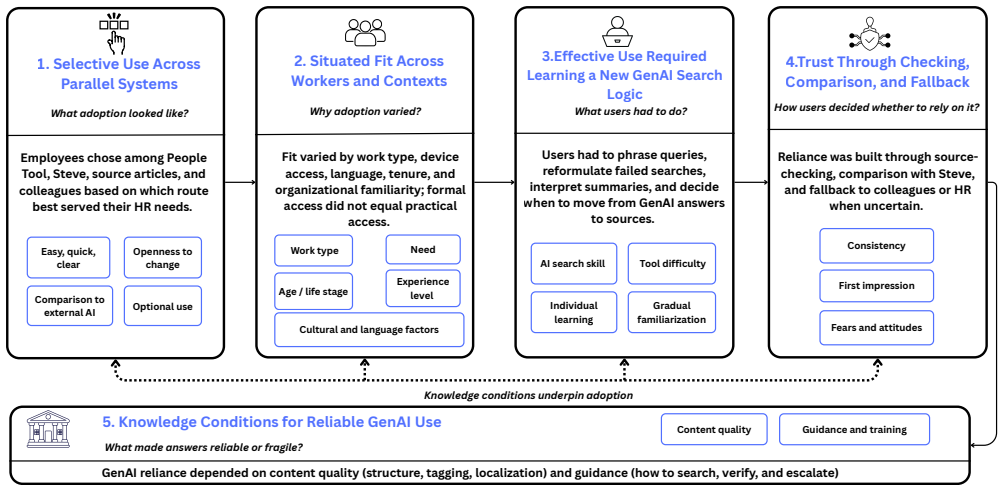
Adoption depended on the fit between the GenAI system's design assumptions and employees' work positionalities (role, spoken language, tenure). Employees built trust in GenAI answers through source-checking, comparison among systems, and seeking input from colleagues or HR when in doubt. The study supplies empirical evidence from a live organizational transition and converts the patterns into design considerations for inclusive deployment.
What carries the argument
The fit between GenAI design assumptions and employees' work positionalities (role, spoken language, tenure)
If this is right
- Organizations must design GenAI systems to account for role- and context-sensitive benefits across different employee groups.
- Treating organizational knowledge infrastructure as AI infrastructure improves accountability and usability of GenAI systems.
- Search literacy, trust calibration, content quality, training, and guidance shape adoption alongside positional fit.
- Inclusive deployment requires attention to situational fit rather than uniform rollout.
Where Pith is reading between the lines
- The same positional fit issues could appear in other knowledge-work settings where information quality affects decisions.
- Targeted design adjustments for language or tenure groups might raise overall adoption without changing the underlying model.
- Longitudinal tracking of the same employees after initial rollout could reveal whether trust-building habits persist or change.
Load-bearing premise
Observations from a single tech company's HR transition and a small sample of participants can inform broader GenAI deployment in other high-stakes environments.
What would settle it
A study in another organization or with a larger workforce where GenAI adoption rates show no link to differences in role, language, or tenure.
Figures
read the original abstract
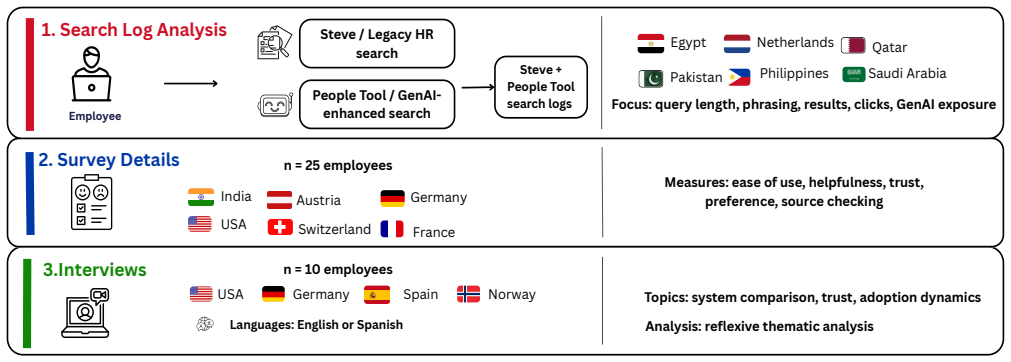
Generative AI (GenAI) deployment in the workplace is accelerating rapidly. Nevertheless, questions of who adopts, who benefits, and who is left behind and why are still understudied. In this paper, we investigate these dynamics in the context of a multinational tech company transitioning from a legacy Human Resources (HR) search system to a GenAI-supported system, analyzing search log data, survey data (n=25), and ten semi-structured interviews. Our findings show that adoption depended on the fit between the GenAI system's design assumptions and employees' work positionalities (role, spoken language, tenure). Further, we find that employees' trust in GenAI answers was built through source-checking, comparison among systems, and seeking input from colleagues or HR when in doubt. Our contribution is twofold. First, we provide empirical evidence of workplace GenAI adoption during a live organizational transition, showing that adoption is influenced by factors such as situational fit, search literacy, and trust calibration. It is also further shaped by knowledge conditions such as the system's content quality, employee training, and guidance. Second, we translate these findings into design considerations for inclusive deployment and adoption in high-stakes environments such as HR. We argue that organizations should design systems considering the role and context-sensitive benefits they yield to different social groups. They also need to treat the organizational knowledge infrastructure as AI infrastructure to improve the accountability and usability of GenAI systems
Editorial analysis
A structured set of objections, weighed in public.
Referee Report
Summary. The paper reports a mixed-methods case study of GenAI adoption during a live transition from a legacy HR search system to a GenAI-supported system at one multinational tech company. Drawing on search logs, a survey (n=25), and 10 semi-structured interviews, it claims that adoption is shaped by the fit between the system's design assumptions and employees' positionalities (role, spoken language, tenure), and that trust is constructed via source-checking, cross-system comparison, and consultation with colleagues or HR. The stated contributions are empirical evidence on sociotechnical adoption factors (situational fit, search literacy, trust calibration, knowledge infrastructure) plus design considerations for inclusive GenAI deployment in high-stakes HR settings.
Significance. If the patterns hold, the work supplies timely, real-world evidence on how positionalities and trust-calibration practices affect workplace GenAI uptake, which could usefully inform HCI and CSCW research on sociotechnical systems. The live-transition setting and mixed-methods design are strengths. However, the single-site, small-sample evidence base (explicitly noted as n=25 survey + 10 interviews) substantially constrains the strength of any broader claims about adoption dynamics or design recommendations.
major comments (2)
- [Methods / Findings] Methods and Findings sections: The abstract and introduction state that search log data were analyzed alongside the survey and interviews, yet no quantitative results, metrics, or triangulation from the logs are reported to corroborate the positionalities (role/language/tenure) claims; the central findings therefore rest entirely on the small qualitative sample.
- [Discussion] Discussion section: The leap from the single-company case to 'design considerations for inclusive deployment' in high-stakes HR environments (final paragraph of abstract and Discussion) is presented without an explicit limitations subsection addressing external validity, cross-site replication, or tests of whether the same positionalities predict adoption elsewhere.
minor comments (1)
- [Abstract / Introduction] The term 'work positionalities' is used repeatedly from the abstract onward but receives no explicit operational definition or citation to prior literature on the first use, which reduces clarity for readers outside the immediate subfield.
Simulated Author's Rebuttal
We thank the referee for the detailed and constructive feedback. We address the two major comments point by point below, indicating the revisions we will make to strengthen the manuscript.
read point-by-point responses
-
Referee: [Methods / Findings] Methods and Findings sections: The abstract and introduction state that search log data were analyzed alongside the survey and interviews, yet no quantitative results, metrics, or triangulation from the logs are reported to corroborate the positionalities (role/language/tenure) claims; the central findings therefore rest entirely on the small qualitative sample.
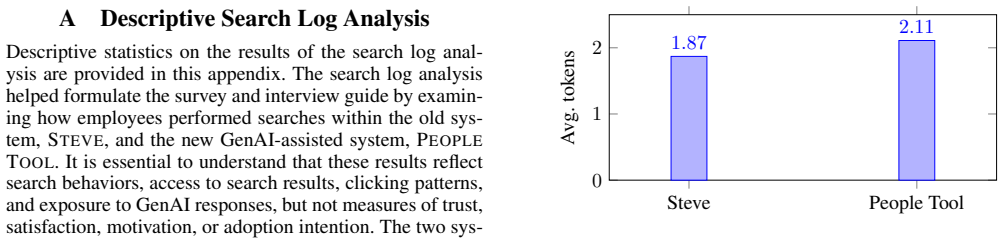
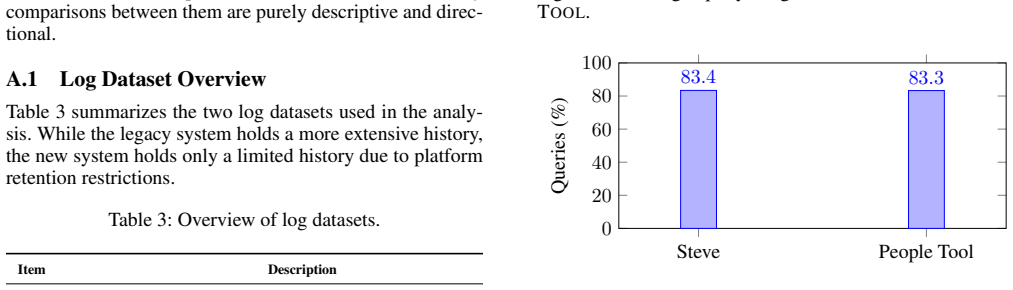
Authors: We acknowledge the referee's observation. The search log data were used to guide participant recruitment and to provide background context on overall usage patterns during the transition, but no quantitative metrics or direct triangulation from the logs were reported to support the positionalities findings. The core claims rest on the survey and interview data. We will revise the Methods section to clarify the specific role of the log data, adjust the abstract and introduction to avoid overstating its contribution to the reported findings, and add any non-sensitive descriptive statistics from the logs if they can be included without privacy issues. revision: yes
-
Referee: [Discussion] Discussion section: The leap from the single-company case to 'design considerations for inclusive deployment' in high-stakes HR environments (final paragraph of abstract and Discussion) is presented without an explicit limitations subsection addressing external validity, cross-site replication, or tests of whether the same positionalities predict adoption elsewhere.
Authors: We agree that an explicit limitations discussion is warranted. We will add a dedicated Limitations subsection that directly addresses the single-site case-study design, the modest sample (n=25 survey + 10 interviews), constraints on external validity, and the absence of cross-site replication or predictive testing. The design considerations will be reframed as case-derived insights intended to inform future work rather than as broadly generalizable prescriptions. revision: yes
Circularity Check
No circularity: purely empirical qualitative study with data-grounded observations
full rationale
The paper reports findings from search logs, a small survey (n=25), and 10 interviews in a single-organization case study. No equations, fitted parameters, predictions, or derivations appear. Central claims about adoption depending on fit with positionalities and trust-building behaviors are presented as direct observations from the collected data rather than reductions to prior self-citations or constructed quantities. The contribution section frames results as empirical evidence translated into design considerations without any load-bearing self-citation chains or ansatzes. This is a standard honest non-finding for an empirical HCI paper.
Axiom & Free-Parameter Ledger
axioms (1)
- domain assumption Qualitative interviews and surveys can reliably capture adoption factors and trust mechanisms in workplace technology use
Reference graph
Works this paper leans on
-
[2]
Journal of Technology in Behavioral Science , year=
Employees' Perceptions of the Implementation of Robotics, Artificial Intelligence, and Automation on Job Satisfaction, Job Security, and Employability , author=. Journal of Technology in Behavioral Science , year=
-
[3]
Generative
Brynjolfsson, Erik and Li, Danielle and Raymond, Lindsey , journal=. Generative. 2025 , doi=
2025
-
[4]
Technovation , volume=
When does AI pay off? AI-adoption intensity, complementary investments, and R&D strategy , author=. Technovation , volume=. 2022 , doi=
2022
-
[5]
2025 , institution=
The Cybernetic Teammate: A Field Experiment on Generative AI Reshaping Teamwork and Expertise , author=. 2025 , institution=
2025
-
[6]
Douglas, Michael R. and Verstyuk, Sergiy , title =. arXiv preprint arXiv:2501.17894 , year =. doi:10.48550/arXiv.2501.17894 , eprint =
-
[7]
arXiv preprint arXiv:2503.14499 , year=
Kwa, Thomas and West, Ben and Becker, Joel and Deng, Amy and Garcia, Katharyn and Hasin, Max and Jawhar, Sami and Kinniment, Megan and Rush, Nate and Von Arx, Sydney and Bloom, Ryan and Broadley, Thomas and Du, Haoxing and Goodrich, Brian and Jurkovic, Nikola and Miles, Luke Harold and Nix, Seraphina and Lin, Tao and Parikh, Neev and Rein, David and Sato,...
-
[8]
Information Systems Frontiers , year =
Enholm, Ida Merete and Papagiannidis, Emmanouil and Mikalef, Patrick and Krogstie, John , title =. Information Systems Frontiers , year =
-
[9]
Annals of Operations Research , year =
Venkatesh, Viswanath , title =. Annals of Operations Research , year =
-
[10]
Proceedings of the National Academy of Sciences , year =
Humlum, Anders and Vestergaard, Emilie , title =. Proceedings of the National Academy of Sciences , year =
-
[11]
2026 , month = jan, url =
Deloitte AI Institute , title =. 2026 , month = jan, url =
2026
-
[12]
2025 , month = jul, url =
The GenAI Divide: State of AI in Business 2025 , author =. 2025 , month = jul, url =
2025
-
[13]
2025 , month = dec, type =
The Dividend Age: How AI Is Turning Promise into Payoff , author =. 2025 , month = dec, type =
2025
-
[14]
MIS Quarterly , volume=
Perceived usefulness, perceived ease of use, and user acceptance of information technology , author=. MIS Quarterly , volume=. 1989 , doi=
1989
-
[15]
MIS Quarterly , volume=
User acceptance of information technology: Toward a unified view , author=. MIS Quarterly , volume=. 2003 , doi=
2003
-
[16]
Journal of Biomedical Informatics , volume =
Shachak, Aviv and Kuziemsky, Craig and Petersen, Carolyn , title =. Journal of Biomedical Informatics , volume =. 2019 , doi =
2019
-
[17]
, title =
Mogaji, Emmanuel and Viglia, Giampaolo and Srivastava, Pallavi and Dwivedi, Yogesh K. , title =. International Journal of Contemporary Hospitality Management , volume =. 2024 , doi =
2024
-
[18]
Kanesaraj and Subbarao, Anusuyah , title =
Lee, Ann Thong and Ramasamy, R. Kanesaraj and Subbarao, Anusuyah , title =. Healthcare , volume =. 2025 , doi =
2025
-
[19]
How to raise technology acceptance: user experience characteristics as technology-inherent determinants , journal =
Mlekus, Lisa and Bentler, Dominik and Paruzel, Agnieszka and Kato-Beiderwieden, Anna-Lena and Maier, G. How to raise technology acceptance: user experience characteristics as technology-inherent determinants , journal =. 2020 , volume =
2020
-
[20]
Proceedings of the CHI Conference on Human Factors in Computing Systems , series =
How Do Data Analysts Respond to AI Assistance? A Wizard-of-Oz Study , author =. Proceedings of the CHI Conference on Human Factors in Computing Systems , series =. 2024 , publisher =
2024
-
[21]
Proceedings of the CHI Conference on Human Factors in Computing Systems , series =
The Metacognitive Demands and Opportunities of Generative AI , author =. Proceedings of the CHI Conference on Human Factors in Computing Systems , series =. 2024 , publisher =
2024
-
[22]
Proceedings of the 2022 ACM conference on fairness, accountability, and transparency , year =
Designing for Responsible Trust in AI Systems: A Communication Perspective , author =. Proceedings of the 2022 ACM conference on fairness, accountability, and transparency , year =
2022
-
[24]
Human Resource Management Journal , year =
Human Resource Management in the Age of Generative Artificial Intelligence: Perspectives and Research Directions on ChatGPT , author =. Human Resource Management Journal , year =
-
[26]
1990 , publisher=
The Processes of Technological Innovation , author=. 1990 , publisher=
1990
-
[27]
Information Systems Theory: Explaining and Predicting Our Digital Society, Vol
The technology--organization--environment framework , author=. Information Systems Theory: Explaining and Predicting Our Digital Society, Vol. 1 , pages=. 2011 , publisher=
2011
-
[28]
Journal of Enterprise Information Management , volume=
Integrated technology-organization-environment (TOE) taxonomies for technology adoption , author=. Journal of Enterprise Information Management , volume=. 2017 , publisher=
2017
-
[29]
2011 , journal=
Literature review of information technology adoption models at firm level , author=. 2011 , journal=
2011
-
[30]
Revisiting
Wolfe, Diana and Price, Matt and Choe, Alice and Kidd, Fergus and Wagner, Hannah , journal=. Revisiting. 2025 , doi=
2025
-
[31]
Proceedings of the
Woodruff, Allison and Shelby, Renee and Kelley, Patrick Gage and Rousso-Schindler, Steven and Smith-Loud, Jamila and Wilcox, Lauren , title =. Proceedings of the. 2024 , doi =
2024
-
[32]
Proceedings of the
Kawakami, Anna and Taylor, Jordan and Fox, Sarah and Zhu, Haiyi and Holstein, Kenneth , title =. Proceedings of the. 2024 , doi =
2024
-
[33]
Proceedings of the Conference on Fairness, Accountability, and Transparency (FAccT) , pages =
Raghavan, Manish and Barocas, Solon and Kleinberg, Jon and Levy, Karen , title =. Proceedings of the Conference on Fairness, Accountability, and Transparency (FAccT) , pages =. 2020 , doi =
2020
-
[34]
Proceedings of the Conference on Fairness, Accountability, and Transparency (FAccT) , pages =
Sanchez-Monedero, Javier and Dencik, Lina and Edwards, Lilian , title =. Proceedings of the Conference on Fairness, Accountability, and Transparency (FAccT) , pages =. 2020 , doi =
2020
-
[35]
Proceedings of the
Ingber, Alexis Shore and Andalibi, Nazanin , title =. Proceedings of the. 2025 , doi =
2025
-
[36]
and Woo, Sang Eun , title =
Bankins, Sarah and Ocampo, Anna Carmella and Marrone, Mauricio and Restubog, Simon Lloyd D. and Woo, Sang Eun , title =. Journal of Organizational Behavior , volume =. 2024 , doi =
2024
-
[37]
Journal of the Association for Information Systems , year =
A Knowledge Management Perspective of Generative Artificial Intelligence , author =. Journal of the Association for Information Systems , year =
-
[38]
MIS Quarterly , year =
Review: Knowledge Management and Knowledge Management Systems: Conceptual Foundations and Research Issues , author =. MIS Quarterly , year =
-
[39]
Proceedings of the
Bansal, Gagan and Wu, Tongshuang and Zhou, Joyce and Fok, Raymond and Nushi, Besmira and Kamar, Ece and Ribeiro, Marco Tulio and Weld, Daniel , title =. Proceedings of the. 2021 , doi =
2021
-
[40]
Proceedings of the 2023 CHI conference on human factors in computing systems , pages=
Why Johnny can't prompt: how non-AI experts try (and fail) to design LLM prompts , author=. Proceedings of the 2023 CHI conference on human factors in computing systems , pages=. 2023 , doi=
2023
-
[41]
and Cox, Anna L
Xia, Qing Nancy and Constantinides, Marios and Sarkar, Advait and Brumby, Duncan P. and Cox, Anna L. , journal=. ``. 2026 , doi=
2026
-
[43]
and boyd, danah and Friedler, Sorelle A
Selbst, Andrew D. and boyd, danah and Friedler, Sorelle A. and Venkatasubramanian, Suresh and Vertesi, Janet , title =. Proceedings of the Conference on Fairness, Accountability, and Transparency (FAccT) , pages =. 2019 , doi =
2019
-
[44]
2020 , publisher =
Design Justice: Community-Led Practices to Build the Worlds We Need , author =. 2020 , publisher =
2020
-
[45]
Proceedings of the ACM on Human-Computer Interaction , volume =
Cheon, EunJeong and Erickson, Ingrid , title =. Proceedings of the ACM on Human-Computer Interaction , volume =. 2025 , doi =
2025
-
[46]
2003 , publisher =
Technology and Social Inclusion: Rethinking the Digital Divide , author =. 2003 , publisher =
2003
-
[47]
2005 , publisher =
The Deepening Divide: Inequality in the Information Society , author =. 2005 , publisher =
2005
-
[48]
2021 , publisher =
The Digital Disconnect: The Social Causes and Consequences of Digital Inequalities , author =. 2021 , publisher =
2021
-
[49]
and See, Katrina A
Lee, John D. and See, Katrina A. , title =. Human Factors , volume =. 2004 , doi =
2004
-
[50]
, title =
Knowles, Bran and Richards, John T. , title =. Proceedings of the 2021 ACM Conference on Fairness, Accountability, and Transparency , pages =. 2021 , doi =
2021
-
[51]
2025 , month = jul, note =
Large Language Models in Human Resource Management: A Systematic Literature Review of Applications, Open Issues and Future Research Directions , author =. 2025 , month = jul, note =
2025
-
[52]
Qualitative Research in Psychology , volume =
Braun, Virginia and Clarke, Victoria , title =. Qualitative Research in Psychology , volume =. 2006 , doi =
2006
-
[53]
Alavi, M.; and Leidner, D. E. 2001. Review: Knowledge Management and Knowledge Management Systems: Conceptual Foundations and Research Issues. MIS Quarterly, 25(1): 107--136
2001
-
[54]
E.; and Mousavi, R
Alavi, M.; Leidner, D. E.; and Mousavi, R. 2024. A Knowledge Management Perspective of Generative Artificial Intelligence. Journal of the Association for Information Systems, 25(1): 1--12
2024
- [55]
-
[56]
O.; Ojiabo, O
Awa, H. O.; Ojiabo, O. U.; and Orokor, L. E. 2017. Integrated technology-organization-environment (TOE) taxonomies for technology adoption. Journal of Enterprise Information Management, 30(6): 893--921
2017
-
[57]
Baker, J. 2011. The technology--organization--environment framework, 231--245. Springer
2011
-
[58]
C.; Marrone, M.; Restubog, S
Bankins, S.; Ocampo, A. C.; Marrone, M.; Restubog, S. L. D.; and Woo, S. E. 2024. A multilevel review of artificial intelligence in organizations: Implications for organizational behavior research and practice. Journal of Organizational Behavior, 45(2): 159--182
2024
-
[59]
T.; and Weld, D
Bansal, G.; Wu, T.; Zhou, J.; Fok, R.; Nushi, B.; Kamar, E.; Ribeiro, M. T.; and Weld, D. 2021. Does the Whole Exceed Its Parts? T he Effect of AI Explanations on Complementary Team Performance. In Proceedings of the CHI Conference on Human Factors in Computing Systems
2021
-
[60]
Bhargava, A.; Bester, M.; and Bolton, L. 2021. Employees' Perceptions of the Implementation of Robotics, Artificial Intelligence, and Automation on Job Satisfaction, Job Security, and Employability. Journal of Technology in Behavioral Science, 6: 106--113
2021
-
[61]
Braun, V.; and Clarke, V. 2006. Using Thematic Analysis in Psychology. Qualitative Research in Psychology, 3(2): 77--101
2006
-
[62]
Brynjolfsson, E.; Li, D.; and Raymond, L. 2025. Generative AI at Work. The Quarterly Journal of Economics, 140(2): 889--942
2025
-
[63]
J.; Beltran, J
Budhwar, P.; Chowdhury, S.; Wood, G.; Aguinis, H.; Bamber, G. J.; Beltran, J. R.; Boselie, P.; Cooke, F. L.; Decker, S.; DeNisi, A.; Dey, P. K.; Guest, D.; Knoblich, A. J.; Malik, A.; Paauwe, J.; Papagiannidis, S.; Patel, C.; Pereira, V.; Ren, S.; Rogelberg, S.; Saunders, M. N. K.; Tung, R. L.; and Varma, A. 2023. Human Resource Management in the Age of G...
2023
-
[64]
Cheon, E.; and Erickson, I. 2025. Fulfillment of the Work Games: Warehouse Workers' Experiences with Algorithmic Management. Proceedings of the ACM on Human-Computer Interaction, 9
2025
-
[65]
Costanza-Chock, S. 2020. Design Justice: Community-Led Practices to Build the Worlds We Need. Cambridge, MA: The MIT Press
2020
-
[66]
K.; Giannopoulos, P
Dasaklis, T. K.; Giannopoulos, P. G.; Koutras, D.; Malamas, V.; and Chountalas, P. T. 2025. Large Language Models in Human Resource Management: A Systematic Literature Review of Applications, Open Issues and Future Research Directions. Preprint submitted to Elsevier
2025
-
[67]
Davis, F. D. 1989. Perceived usefulness, perceived ease of use, and user acceptance of information technology. MIS Quarterly, 13(3): 319--340
1989
-
[68]
Dell'Acqua, F.; Ayoubi, C.; Lifshitz, H.; Sadun, R.; Mollick, E.; Mollick, L.; Han, Y.; Goldman, J.; Nair, H.; Taub, S.; and Lakhani, K. R. 2025. The Cybernetic Teammate: A Field Experiment on Generative AI Reshaping Teamwork and Expertise. Technical Report w33641, NBER
2025
-
[69]
Douglas, M. R.; and Verstyuk, S. 2025. Progress in Artificial Intelligence and its Determinants. arXiv preprint arXiv:2501.17894
-
[70]
M.; Papagiannidis, E.; Mikalef, P.; and Krogstie, J
Enholm, I. M.; Papagiannidis, E.; Mikalef, P.; and Krogstie, J. 2022. Artificial Intelligence and Business Value: a Literature Review. Information Systems Frontiers, 24: 1709--1734
2022
-
[71]
Ernst & Young LLP . 2025. The Dividend Age: How AI Is Turning Promise into Payoff. Us ai pulse survey: Wave 4, EY. Survey of 500 US senior business leaders
2025
-
[72]
Gu, K.; Grunde-McLaughlin, M.; McNutt, A.; Heer, J.; and Althoff, T. 2024. How Do Data Analysts Respond to AI Assistance? A Wizard-of-Oz Study. In Proceedings of the CHI Conference on Human Factors in Computing Systems, CHI '24. ACM
2024
-
[73]
Helsper, E. J. 2021. The Digital Disconnect: The Social Causes and Consequences of Digital Inequalities. London: SAGE Publications
2021
-
[74]
Humlum, A.; and Vestergaard, E. 2025. The unequal adoption of ChatGPT exacerbates existing inequalities among workers. Proceedings of the National Academy of Sciences, 122(1): e2414972121
2025
-
[75]
S.; and Andalibi, N
Ingber, A. S.; and Andalibi, N. 2025. Emotion AI in Job Interviews: Injustice, Emotional Labor, Identity, and Privacy. In Proceedings of the ACM Conference on Fairness, Accountability, and Transparency (FAccT)
2025
-
[76]
Institute, D. A. 2026. State of AI in the Enterprise: The Untapped Edge. Technical report, Deloitte AI Institute
2026
-
[77]
Kawakami, A.; Taylor, J.; Fox, S.; Zhu, H.; and Holstein, K. 2024. AI Failure Loops in Feminized Labor: Understanding the Interplay of Workplace AI and Occupational Devaluation. In Proceedings of the AAAI/ACM Conference on AI , Ethics, and Society (AIES)
2024
-
[78]
Knowles, B.; and Richards, J. T. 2021. The Sanction of Authority: Promoting Public Trust in AI. In Proceedings of the 2021 ACM Conference on Fairness, Accountability, and Transparency, 262--271
2021
-
[79]
arXiv preprint arXiv:2503.14499 , year=
Kwa, T.; West, B.; Becker, J.; Deng, A.; Garcia, K.; Hasin, M.; Jawhar, S.; Kinniment, M.; Rush, N.; Von Arx, S.; Bloom, R.; Broadley, T.; Du, H.; Goodrich, B.; Jurkovic, N.; Miles, L. H.; Nix, S.; Lin, T.; Parikh, N.; Rein, D.; Sato, L. J. K.; Wijk, H.; Ziegler, D. M.; Barnes, E.; and Chan, L. 2025. Measuring AI Ability to Complete Long Tasks. arXiv prep...
-
[80]
T.; Ramasamy, R
Lee, A. T.; Ramasamy, R. K.; and Subbarao, A. 2025. Understanding Psychosocial Barriers to Healthcare Technology Adoption: A Review of TAM and UTAUT Frameworks. Healthcare, 13(3): 250
2025
-
[81]
D.; and See, K
Lee, J. D.; and See, K. A. 2004. Trust in Automation: Designing for Appropriate Reliance. Human Factors, 46(1): 50--80
2004
-
[82]
S.; Kim, T.; Choi, S.; and Kim, W
Lee, Y. S.; Kim, T.; Choi, S.; and Kim, W. 2022. When does AI pay off? AI-adoption intensity, complementary investments, and R&D strategy. Technovation, 118: 102590
2022
-
[83]
V.; and Sundar, S
Liao, Q. V.; and Sundar, S. S. 2022. Designing for Responsible Trust in AI Systems: A Communication Perspective. In Proceedings of the 2022 ACM conference on fairness, accountability, and transparency. ACM
2022
-
[84]
MIT Project NANDA . 2025. The GenAI Divide: State of AI in Business 2025. Technical report, Massachusetts Institute of Technology. Preliminary findings
2025
discussion (0)
Sign in with ORCID, Apple, or X to comment. Anyone can read and Pith papers without signing in.