PhaseWin: An Efficient Search Algorithm for Faithful Visual Attribution
Pith reviewed 2026-06-27 00:55 UTC · model grok-4.3
The pith
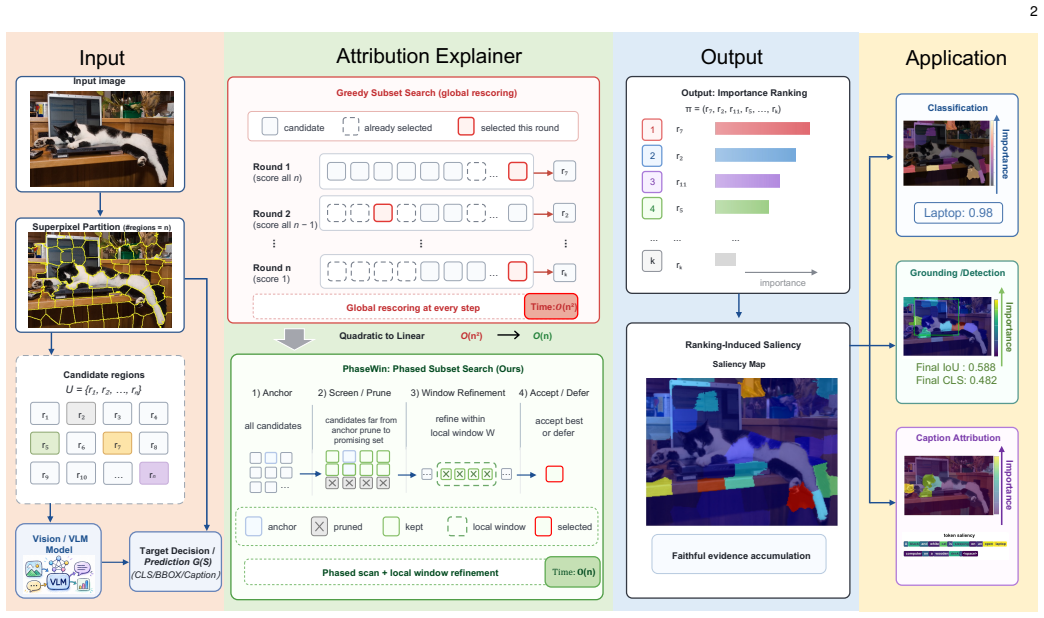
PhaseWin reorganizes greedy region selection for visual attribution into a phased window procedure that drops model evaluations from quadratic to linear while keeping near-greedy faithfulness.
A machine-rendered reading of the paper's core claim, the machinery that carries it, and where it could break.
Core claim
PhaseWin attains controllable linear evaluation complexity together with near-greedy faithfulness guarantees by reorganizing greedy region selection into a phased window-search procedure that alternates global candidate screening, adaptive pruning, and localized window refinement.
What carries the argument
Phased window-search procedure that preserves the essential region-ranking behavior of greedy search without re-evaluating the full candidate set at every step.
If this is right
- Attribution for high-resolution images or dense region partitions becomes practical at scale.
- The same phased procedure can be applied to any ordered subset-search task whose scoring function satisfies the monotone accumulation property.
- Model auditing pipelines can now afford exhaustive faithfulness checks on many more inputs without increasing compute budget.
- Downstream tasks that rely on attribution heatmaps, such as debugging or regulatory reporting, inherit the reduced cost.
Where Pith is reading between the lines
- If the structural assumptions hold for transformer-based vision models, PhaseWin could be inserted into existing explanation libraries with minimal code change.
- The linear-complexity regime may allow attribution to be recomputed on-the-fly during interactive model inspection sessions.
- Extensions to video or 3-D data would follow by treating spatio-temporal patches as the region set.
Load-bearing premise
The analysis assumes monotone evidence-accumulation conditions together with feature-level structural assumptions on the model responses.
What would settle it
An experiment that measures the number of forward passes required on images with n regions and checks whether faithfulness metrics fall below the greedy baseline once n exceeds a few hundred.
Figures




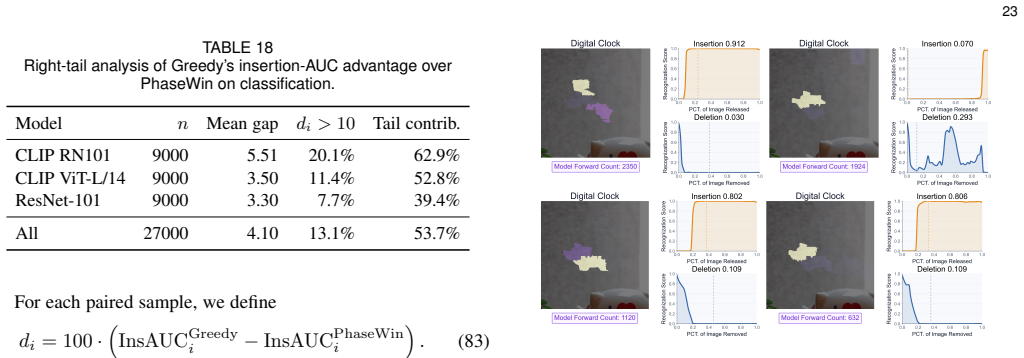
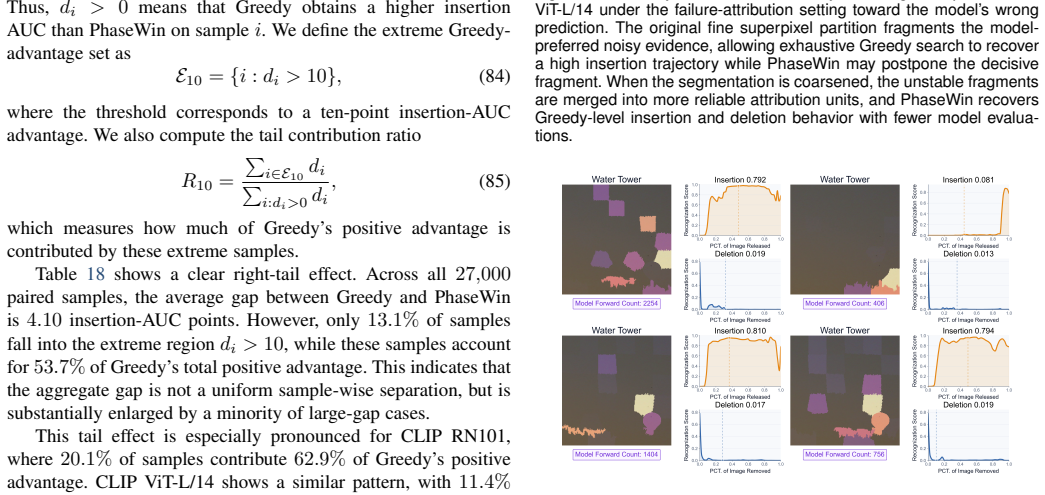











read the original abstract
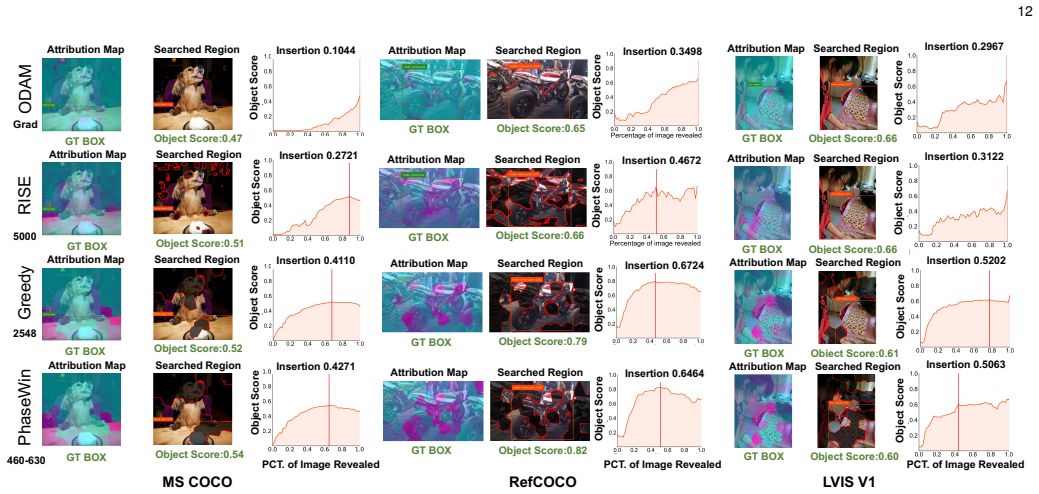
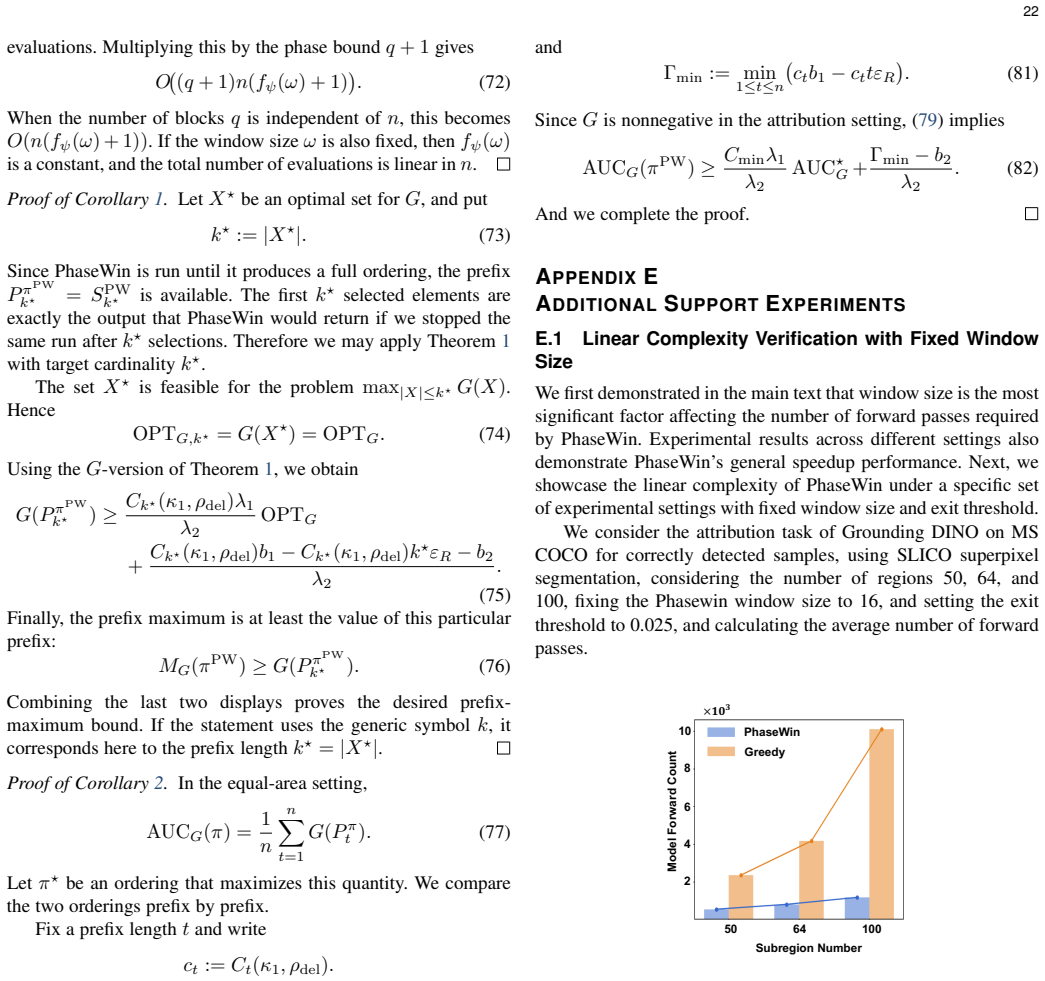
Visual attribution is a fundamental tool for interpreting modern vision and vision-language models, particularly when their decisions must be inspected, diagnosed, or audited. Its goal is to explain how a model's decision depends on local regions of the visual input, typically by assigning an importance ordering over candidate image regions. Given an image partitioned into $n$ regions, faithful attribution can be cast as an ordered subset-search problem, in which progressively inserting the selected regions should recover the target model response as early as possible. Exhaustive search over region subsets incurs exponential cost, while the widely used greedy search still requires a quadratic number of model evaluations, because every selection step rescores all remaining candidates. We propose PhaseWin, an efficient subset-search algorithm for faithful visual attribution. PhaseWin reorganizes greedy region selection into a phased window-search procedure: rather than re-evaluating the full candidate set at every step, it alternates between global candidate screening, adaptive pruning, and localized window refinement, while preserving the essential region-ranking behavior of greedy search. We analyze PhaseWin under monotone evidence-accumulation conditions and show that, under feature-level structural assumptions, it attains controllable linear evaluation complexity together with near-greedy faithfulness guarantees. Extensive experiments on image classification, object detection, visual grounding, and image captioning show that, among all compared attribution methods, PhaseWin reaches high faithfulness with the fewest forward passes, empirically realizing the predicted reduction from $O(n^2)$ to $O(n)$. The code is available at https://github.com/Qihuai27/phasewin-va.
Editorial analysis
A structured set of objections, weighed in public.
Referee Report
Summary. The paper introduces PhaseWin, a phased window-search algorithm that reorganizes greedy region selection for faithful visual attribution. Under monotone evidence-accumulation conditions and feature-level structural assumptions, the analysis claims controllable linear evaluation complexity together with near-greedy faithfulness guarantees. Experiments across image classification, object detection, visual grounding, and image captioning report that PhaseWin achieves high faithfulness with the fewest forward passes, empirically realizing an O(n) reduction from the quadratic cost of standard greedy search. Code is released.
Significance. If the stated assumptions hold for the evaluated models, the work supplies a theoretically grounded, scalable alternative to quadratic-cost greedy attribution while preserving ranking behavior. The combination of complexity analysis, near-greedy guarantees, and broad empirical coverage on four vision tasks would constitute a useful contribution to model-interpretation tooling.
major comments (1)
- [Analysis section] Analysis section: the linear-complexity and near-greedy faithfulness claims are derived under the monotone evidence-accumulation conditions and feature-level structural assumptions. The manuscript provides no verification (e.g., monotonicity plots or counter-example checks) that these conditions are satisfied by the ResNet, detection, grounding, or captioning models used in the experiments. Because the theoretical guarantees are invoked to explain the observed O(n) scaling, this verification step is load-bearing for the central claim that the empirical results realize the predicted theoretical behavior.
Simulated Author's Rebuttal
We thank the referee for the constructive comment on the analysis section. We address the point directly below.
read point-by-point responses
-
Referee: Analysis section: the linear-complexity and near-greedy faithfulness claims are derived under the monotone evidence-accumulation conditions and feature-level structural assumptions. The manuscript provides no verification (e.g., monotonicity plots or counter-example checks) that these conditions are satisfied by the ResNet, detection, grounding, or captioning models used in the experiments. Because the theoretical guarantees are invoked to explain the observed O(n) scaling, this verification step is load-bearing for the central claim that the empirical results realize the predicted theoretical behavior.
Authors: We agree that the manuscript does not contain explicit verification (such as monotonicity plots or counter-example checks) that the monotone evidence-accumulation conditions and feature-level structural assumptions hold for the ResNet, detection, grounding, and captioning models used in the experiments. The theoretical claims are stated conditionally on these assumptions, while the reported O(n) scaling is an empirical observation. To strengthen the link between the analysis and the experimental results, the revised manuscript will include an appendix with monotonicity verification and any relevant counter-example analysis for the evaluated models. revision: yes
Circularity Check
No circularity: derivation self-contained under explicit assumptions
full rationale
The paper presents PhaseWin as a reorganization of greedy subset search into phased window screening and refinement. It states theoretical guarantees explicitly under the monotone evidence-accumulation conditions and feature-level structural assumptions, without deriving those assumptions from the target faithfulness metric or from any fitted parameter. No equations reduce a claimed prediction to a fitted input by construction, and no load-bearing step relies on a self-citation chain whose content is itself unverified within the paper. Empirical results on ResNet, detection, grounding, and captioning tasks are reported separately as validation of the O(n) complexity, independent of the analytic bounds. The derivation chain therefore remains non-circular.
Axiom & Free-Parameter Ledger
axioms (2)
- domain assumption monotone evidence-accumulation conditions
- domain assumption feature-level structural assumptions
Reference graph
Works this paper leans on
-
[1]
Attribution explanations for deep neural networks: A theoretical perspective,
H. Deng, H. Pei, Q. Zhang, and M. Du, “Attribution explanations for deep neural networks: A theoretical perspective,”IEEE Transactions on Pattern Analysis and Machine Intelligence, 2026
2026
-
[2]
Explainable AI (XAI): Core ideas, techniques, and solutions,
R. Dwivedi, D. Dave, H. Naik, S. Singhal, R. Omer, P. Patel, B. Qian, Z. Wen, T. Shah, G. Morganet al., “Explainable AI (XAI): Core ideas, techniques, and solutions,”ACM Comput. Surv., vol. 55, no. 9, pp. 1–33, 2023
2023
-
[3]
A survey of feature attribution techniques in explainable ai: Taxonomy, analysis and comparison,
M. A. Nazir, E. Evangelista, S. M. S. Bukhari, and R. Sharma, “A survey of feature attribution techniques in explainable ai: Taxonomy, analysis and comparison,”Annals of Mathematics and Computer Science, vol. 28, pp. 115–126, 2025
2025
-
[4]
A review and comparative study on probabilistic object detection in autonomous driv- ing,
D. Feng, A. Harakeh, S. L. Waslander, and K. Dietmayer, “A review and comparative study on probabilistic object detection in autonomous driv- ing,”IEEE Transactions on Intelligent Transportation Systems, vol. 23, no. 8, pp. 9961–9980, 2021
2021
-
[5]
Going beyond xai: A systematic survey for explanation-guided learning,
Y . Gao, S. Gu, J. Jiang, S. R. Hong, D. Yu, and L. Zhao, “Going beyond xai: A systematic survey for explanation-guided learning,”ACM Computing Surveys, vol. 56, no. 7, pp. 1–39, 2024
2024
-
[6]
L. Yang, R. Chen, H. Liu, J. Liang, S. Sun, and X. Cao, “Can attribution predict risk? from multi-view attribution to planning risk signals in end- to-end autonomous driving,”arXiv preprint arXiv:2605.06264, 2026
work page internal anchor Pith review Pith/arXiv arXiv 2026
-
[7]
R. Chen, S. Sun, X. Guo, S. Zhang, K. Liu, S. Liu, Z. Wang, Q. Zhang, H. Zhang, and X. Cao, “Where not to learn: Prior-aligned training with subset-based attribution constraints for reliable decision-making,”arXiv preprint arXiv:2602.07008, 2026
work page internal anchor Pith review Pith/arXiv arXiv 2026
-
[8]
Safe: Sensitivity-aware features for out-of-distribution object detection,
S. Wilson, T. Fischer, F. Dayoub, D. Miller, and N. Sünderhauf, “Safe: Sensitivity-aware features for out-of-distribution object detection,” in ICCV, 2023, pp. 23 565–23 576
2023
-
[9]
Safemobile: Chain-level jailbreak detection and automated evaluation for multimodal mobile agents,
S. Liang, T. Fang, Z. Liu, A. Liu, Y . Xiao, J. He, E.-C. Chang, and X. Cao, “Safemobile: Chain-level jailbreak detection and automated evaluation for multimodal mobile agents,”arXiv preprint arXiv:2507.00841, 2025
-
[10]
RISE: Randomized input sampling for explanation of black-box models,
V . Petsiuk, A. Das, and K. Saenko, “RISE: Randomized input sampling for explanation of black-box models,” inBMVC, 2018, p. 151
2018
-
[11]
Black-box explanation of object detectors via saliency maps,
V . Petsiuk, R. Jain, V . Manjunatha, V . I. Morariu, A. Mehra, V . Ordonez, and K. Saenko, “Black-box explanation of object detectors via saliency maps,” inCVPR, 2021, pp. 11 443–11 452
2021
-
[12]
Less is More: Efficient Black-box Attribution via Minimal Interpretable Subset Selection
R. Chen, S. Liang, J. Li, S. Liu, L. Liu, H. Zhang, and X. Cao, “Less is more: Efficient black-box attribution via minimal interpretable subset selection,”arXiv preprint arXiv:2504.00470, 2025
work page internal anchor Pith review Pith/arXiv arXiv 2025
-
[13]
Spatial sensitive grad-cam: Visual explanations for object detection by incorporating spatial sensitivity,
T. Yamauchi and M. Ishikawa, “Spatial sensitive grad-cam: Visual explanations for object detection by incorporating spatial sensitivity,” in ICIP, 2022, pp. 256–260
2022
-
[14]
Spatial Sensitive Grad-CAM++: Improved visual expla- nation for object detectors via weighted combination of gradient map,
T. Yamauchi, “Spatial Sensitive Grad-CAM++: Improved visual expla- nation for object detectors via weighted combination of gradient map,” inCVPR Workshop, 2024, pp. 8164–8168
2024
-
[15]
Less is more: Fewer interpretable region via submodular subset selection,
R. Chen, H. Zhang, S. Liang, J. Li, and X. Cao, “Less is more: Fewer interpretable region via submodular subset selection,” inICLR, 2024
2024
-
[16]
Interpreting Object-level Foundation Models via Visual Pre- cision Search,
R. Chen, S. Liang, J. Li, S. Liu, M. Li, Z. Huang, H. Zhang, and X. Cao, “Interpreting Object-level Foundation Models via Visual Pre- cision Search,” inCVPR, 2025
2025
-
[17]
Explain any concept: Seg- ment anything meets concept-based explanation,
A. Sun, P. Ma, Y . Yuan, and S. Wang, “Explain any concept: Seg- ment anything meets concept-based explanation,” inNeurIPS, 2023, pp. 21 826–21 840
2023
-
[18]
Imagenet: A large-scale hierarchical image database,
J. Deng, W. Dong, R. Socher, L.-J. Li, K. Li, and L. Fei-Fei, “Imagenet: A large-scale hierarchical image database,” inCVPR, 2009, pp. 248–255
2009
-
[19]
Learning transferable visual models from natural language supervision,
A. Radford, J. W. Kim, C. Hallacy, A. Ramesh, G. Goh, S. Agarwal, G. Sastry, A. Askell, P. Mishkin, J. Clarket al., “Learning transferable visual models from natural language supervision,” inICML, 2021, pp. 8748–8763
2021
-
[20]
Deep residual learning for image recognition,
K. He, X. Zhang, S. Ren, and J. Sun, “Deep residual learning for image recognition,” inProceedings of the IEEE Conference on Computer Vision and Pattern Recognition, 2016, pp. 770–778
2016
-
[21]
Microsoft COCO: Common objects in context,
T.-Y . Lin, M. Maire, S. Belongie, J. Hays, P. Perona, D. Ramanan, P. Dollár, and C. L. Zitnick, “Microsoft COCO: Common objects in context,” inECCV, 2014, pp. 740–755
2014
-
[22]
LVIS: A dataset for large vocabulary instance segmentation,
A. Gupta, P. Dollar, and R. Girshick, “LVIS: A dataset for large vocabulary instance segmentation,” inCVPR, 2019, pp. 5356–5364
2019
-
[23]
ReferItGame: Referring to objects in photographs of natural scenes,
S. Kazemzadeh, V . Ordonez, M. Matten, and T. Berg, “ReferItGame: Referring to objects in photographs of natural scenes,” inEMNLP, 2014, pp. 787–798
2014
-
[24]
Grounding DINO: Marrying dino with grounded pre- training for open-set object detection,
S. Liu, Z. Zeng, T. Ren, F. Li, H. Zhang, J. Yang, C. Li, J. Yang, H. Su, J. Zhuet al., “Grounding DINO: Marrying dino with grounded pre- training for open-set object detection,” inECCV, 2024
2024
-
[25]
Florence-2: Advancing a unified representation for a variety of vision tasks,
B. Xiao, H. Wu, W. Xu, X. Dai, H. Hu, Y . Lu, M. Zeng, C. Liu, and L. Yuan, “Florence-2: Advancing a unified representation for a variety of vision tasks,” inCVPR, 2024, pp. 4818–4829
2024
-
[26]
S. Bai, K. Chen, X. Liu, J. Wang, W. Ge, S. Song, K. Dang, P. Wang, S. Wang, J. Tanget al., “Qwen2.5-vl technical report,”arXiv preprint arXiv:2502.13923, 2025
work page internal anchor Pith review Pith/arXiv arXiv 2025
-
[27]
Phasewin search framework enable efficient object-level interpretation,
Z. Gu, R. Chen, J. Zhang, Y . Hu, H. Zhang, and X. Cao, “Phasewin search framework enable efficient object-level interpretation,” inCVPR, 2026
2026
-
[28]
On pixel-wise explanations for non-linear classifier decisions 16 by layer-wise relevance propagation,
S. Bach, A. Binder, G. Montavon, F. Klauschen, K.-R. Müller, and W. Samek, “On pixel-wise explanations for non-linear classifier decisions 16 by layer-wise relevance propagation,”PloS one, vol. 10, no. 7, p. e0130140, 2015
2015
-
[29]
Gradient methods for submodular maximization,
H. Hassani, M. Soltanolkotabi, and A. Karbasi, “Gradient methods for submodular maximization,”Advances in Neural Information Processing Systems, vol. 30, 2017
2017
-
[30]
Grad-CAM: visual explanations from deep networks via gradient-based localization,
R. R. Selvaraju, M. Cogswell, A. Das, R. Vedantam, D. Parikh, and D. Batra, “Grad-CAM: visual explanations from deep networks via gradient-based localization,”International Journal of Computer Vision, vol. 128, pp. 336–359, 2020
2020
-
[31]
Grad-CAM++: Generalized gradient-based visual explanations for deep convolutional networks,
A. Chattopadhay, A. Sarkar, P. Howlader, and V . N. Balasubramanian, “Grad-CAM++: Generalized gradient-based visual explanations for deep convolutional networks,” inWACV, 2018, pp. 839–847
2018
-
[32]
Score-cam: Score-weighted visual explanations for convolu- tional neural networks,
H. Wang, Z. Wang, M. Du, F. Yang, Z. Zhang, S. Ding, P. Mardziel, and X. Hu, “Score-cam: Score-weighted visual explanations for convolu- tional neural networks,” inProceedings of the IEEE/CVF conference on computer vision and pattern recognition workshops, 2020, pp. 24–25
2020
-
[33]
Vit-cx: Causal explanation of vision transformers,
W. Xie, X. Li, C. C. Cao, and N. L. Zhang, “Vit-cx: Causal explanation of vision transformers,” inIJCAI, 2023
2023
-
[34]
Gradient- based visual explanation for transformer-based clip,
C. Zhao, K. Wang, X. Zeng, R. Zhao, and A. B. Chan, “Gradient- based visual explanation for transformer-based clip,” inICML, 2024, pp. 61 072–61 091
2024
-
[35]
Axiomatic attribution for deep networks,
M. Sundararajan, A. Taly, and Q. Yan, “Axiomatic attribution for deep networks,” inICML, 2017, pp. 3319–3328
2017
-
[36]
iGOS++: integrated gradient optimized saliency by bilateral perturbations,
S. Khorram, T. Lawson, and L. Fuxin, “iGOS++: integrated gradient optimized saliency by bilateral perturbations,” inProceedings of the Conference on Health, Inference, and Learning, 2021, pp. 174–182
2021
-
[37]
Making sense of dependence: Ef- ficient black-box explanations using dependence measure,
P. Novello, T. Fel, and D. Vigouroux, “Making sense of dependence: Ef- ficient black-box explanations using dependence measure,” inNeurIPS, 2022, pp. 4344–4357
2022
-
[38]
"why should I trust you?
M. T. Ribeiro, S. Singh, and C. Guestrin, “"why should I trust you?": Ex- plaining the predictions of any classifier,” inACM SIGKDD International Conference on Knowledge Discovery and Data Mining, 2016
2016
-
[39]
A value for n-person games,
L. S. Shapley, “A value for n-person games,”Contribution to the Theory of Games, vol. 2, 1953
1953
-
[40]
A unified approach to interpreting model predictions,
S. M. Lundberg and S.-I. Lee, “A unified approach to interpreting model predictions,” inNeurIPS, 2017, pp. 4765–4774
2017
-
[41]
Harsanyinet: Computing accurate shapley values in a single forward propagation,
L. Chen, S. Lou, K. Zhang, J. Huang, and Q. Zhang, “Harsanyinet: Computing accurate shapley values in a single forward propagation,” inICML, 2023
2023
-
[42]
Problems with shapley-value-based explanations as feature importance measures,
I. E. Kumar, S. Venkatasubramanian, C. Scheidegger, and S. A. Friedler, “Problems with shapley-value-based explanations as feature importance measures,” inICML, 2020
2020
-
[43]
One explanation is not enough: structured attention graphs for image classification,
V . Shitole, F. Li, M. Kahng, P. Tadepalli, and A. Fern, “One explanation is not enough: structured attention graphs for image classification,” in NeurIPS, 2021, pp. 11 352–11 363
2021
-
[44]
Explain to Fix: A Framework to Interpret and Correct DNN Object Detector Predictions
D. Gudovskiy, A. Hodgkinson, T. Yamaguchi, Y . Ishii, and S. Tsukizawa, “Explain to fix: A framework to interpret and correct dnn object detector predictions,”arXiv preprint arXiv:1811.08011, 2018
work page internal anchor Pith review Pith/arXiv arXiv 2018
-
[45]
Gradient-based instance-specific visual explanations for object specification and object discrimination,
C. Zhao, J. H. Hsiao, and A. B. Chan, “Gradient-based instance-specific visual explanations for object specification and object discrimination,” IEEE Transactions on Pattern Analysis and Machine Intelligence, 2024
2024
-
[46]
Diverse explanations for object detectors with nesterov-accelerated igos++
M. Jiang, S. Khorram, and F. Li, “Diverse explanations for object detectors with nesterov-accelerated igos++.” inBMVC, 2023, pp. 188– 189
2023
-
[47]
Comparing the decision-making mechanisms by transformers and cnns via explanation methods,
M. Jiang, S. Khorram, and L. Fuxin, “Comparing the decision-making mechanisms by transformers and cnns via explanation methods,” in CVPR, 2024, pp. 9546–9555
2024
-
[48]
Interpreting clip’s image representation via text-based decomposition,
Y . Gandelsman, A. A. Efros, and J. Steinhardt, “Interpreting clip’s image representation via text-based decomposition,” inICLR, 2024
2024
-
[49]
Explaining Object Detectors via Collective Contribution of Pixels
T. Yamauchi, H. Kera, and K. Kawamoto, “Explaining object detectors via collective contribution of pixels,”arXiv preprint arXiv:2412.00666, 2024
work page internal anchor Pith review Pith/arXiv arXiv 2024
-
[50]
Lvlm- intrepret: An interpretability tool for large vision-language models,
G. Ben Melech Stan, E. Aflalo, R. Y . Rohekar, A. Bhiwandiwalla, S.-Y . Tseng, M. L. Olson, Y . Gurwicz, C. Wu, N. Duan, and V . Lal, “Lvlm- intrepret: An interpretability tool for large vision-language models,” in IEEE Conf. Comput. Vis. Pattern Recog. (CVPR) Workshops, 2024, pp. 8182–8187
2024
-
[51]
D. Omeiza, S. Speakman, C. Cintas, and K. Weldermariam, “Smooth Grad-CAM++: An enhanced inference level visualization technique for deep convolutional neural network models,”arXiv preprint arXiv:1908.01224, 2019
-
[52]
From redundancy to relevance: Enhancing explainability in multimodal large language models,
X. Zhang, Y . Quan, C. Shen, X. Yuan, S. Yan, L. Xie, W. Wang, C. Gu, H. Tang, and J. Ye, “From redundancy to relevance: Enhancing explainability in multimodal large language models,” inNAACL, 2025
2025
-
[53]
Where do large vision-language models look at when answering questions?
X. Xing, C.-W. Kuo, L. Fuxin, Y . Niu, F. Chen, M. Li, Y . Wu, L. Wen, and S. Zhu, “Where do large vision-language models look at when answering questions?”arXiv preprint arXiv:2503.13891, 2025
-
[54]
Token activation map to visually explain multimodal llms,
Y . Li, H. Wang, X. Ding, H. Wang, and X. Li, “Token activation map to visually explain multimodal llms,” inICCV, 2025
2025
-
[55]
Mllms know where to look: Training-free perception of small visual details with multimodal llms,
J. Zhang, M. Khayatkhoei, P. Chhikara, and F. Ilievski, “Mllms know where to look: Training-free perception of small visual details with multimodal llms,” inICLR, 2025
2025
-
[56]
Where mllms attend and what they rely on: Explaining autoregressive token generation,
R. Chen, X. Guo, K. Liu, S. Liang, S. Liu, Q. Zhang, L. Wang, H. Zhang, and X. Cao, “Where mllms attend and what they rely on: Explaining autoregressive token generation,” inProceedings of the IEEE/CVF Con- ference on Computer Vision and Pattern Recognition, 2026
2026
-
[57]
Accelerated greedy algorithms for maximizing submodular set functions,
M. Minoux, “Accelerated greedy algorithms for maximizing submodular set functions,”INFOR: Information Systems and Operational Research, vol. 14, no. 3, pp. 247–255, 1978
1978
-
[58]
Cost-effective outbreak detection in networks,
J. Leskovec, A. Krause, C. Guestrin, C. Faloutsos, J. VanBriesen, and N. Glance, “Cost-effective outbreak detection in networks,” inProceed- ings of the 13th ACM SIGKDD international conference on Knowledge discovery and data mining. ACM, 2007, pp. 420–429
2007
-
[59]
Lazier than lazy greedy,
B. Mirzasoleiman, A. Badanidiyuru, A. Karbasi, J. V ondrák, and A. Krause, “Lazier than lazy greedy,” inProceedings of the AAAI Conference on Artificial Intelligence, vol. 29, no. 1, 2015
2015
-
[60]
Fast multi-stage submodular maximiza- tion,
K. Wei, R. Iyer, and J. Bilmes, “Fast multi-stage submodular maximiza- tion,” inInternational conference on machine learning. PMLR, 2014, pp. 1494–1502
2014
-
[61]
The fast algorithm for submod- ular maximization,
A. Breuer, E. Balkanski, and Y . Singer, “The fast algorithm for submod- ular maximization,” inInternational Conference on Machine Learning. PMLR, 2020, pp. 1134–1143
2020
-
[62]
Deep inside convolutional networks: Visualising image classification models and saliency maps,
K. Simonyan, A. Vedaldi, and A. Zisserman, “Deep inside convolutional networks: Visualising image classification models and saliency maps,” in ICLR Workshop, 2014
2014
-
[63]
SLIC superpixels compared to state-of-the-art superpixel methods,
R. Achanta, A. Shaji, K. Smith, A. Lucchi, P. Fua, and S. Süsstrunk, “SLIC superpixels compared to state-of-the-art superpixel methods,” IEEE Transactions on Pattern Analysis and Machine Intelligence, vol. 34, no. 11, pp. 2274–2282, 2012
2012
-
[64]
Look at the variance! efficient black-box explanations with sobol- based sensitivity analysis,
T. Fel, R. Cadene, M. Chalvidal, M. Cord, D. Vigouroux, and T. Serre, “Look at the variance! efficient black-box explanations with sobol- based sensitivity analysis,” inAdvances in Neural Information Processing Systems, vol. 34, 2021, pp. 26 005–26 014
2021
-
[65]
Top- down neural attention by excitation backprop,
J. Zhang, S. A. Bargal, Z. Lin, J. Brandt, X. Shen, and S. Sclaroff, “Top- down neural attention by excitation backprop,”International Journal of Computer Vision, vol. 126, no. 10, pp. 1084–1102, 2018. APPENDIXA SUBMODULARITY ANDSUPERMODULARITY This appendix clarifies why the score optimized by greedy-based visual attribution should not be regarded as a g...
2018
-
[66]
Therefore λ2G(S) +b 2 ≥F(S)≥c F(T)−η≥c λ1G(T) +b 1 −η
IfS, T⊆Uandc, η≥0satisfy F(S)≥c F(T)−η,(50) then G(S)≥ cλ1 λ2 G(T) + cb1 −η−b 2 λ2 .(51) Proof.The upper side of Assumption 3 givesF(S)≤λ 2G(S)+ b2, while the lower side givesF(T)≥λ 1G(T) +b 1. Therefore λ2G(S) +b 2 ≥F(S)≥c F(T)−η≥c λ1G(T) +b 1 −η. (52) Movingb 2 to the right-hand side and dividing byλ 2 proves the claim. Proof of Theorem 1.Let the firstk...
discussion (0)
Sign in with ORCID, Apple, or X to comment. Anyone can read and Pith papers without signing in.